청정에너지기술
Feasibility Study of Employing a Catalytic Membrane Reactor for a Pressurized CO
2and Purified H
2Production in a Water Gas Shift Reaction
Hankwon Lim*
Department of Chemical Systematic Engineering Catholic University of Daegu 13-13 Hayang-ro, Hayang-yep, Gyeongsan-si, Gyeongbuk 712-702, Korea
(Received for review November 3, 2014; Revision received December 9, 2014; Accepted December 9, 2014)
요 약
이 논문은 촉매막반응기(catalytic membrane reactor)에서의 중요한 두 요소인 수소선택도와 수소투과량 및 Ar sweep 유량
과 압력이 수성가스전이반응의 성능에 미치는 영향에 대하여 1차원 반응기모델과 반응속도식에 근거한 연구결과를 나타
내고 있다. 연소전 이산화탄소 포집의 한 방법으로서, 촉매막반응기를 사용하여 원통부분에서는 고압/고농도의 이산화탄 소를 관부분에서는 고순도의 수소를 동시에 얻을 수 있는지에 대한 가능성을 검토하였다. 또한, 고농도의 이산화탄소와 고 순도의 수소를 동시에 얻기 위해 필요한 수소투과량, 수소선택도, Ar sweep 유량 및 압력에 대한 지침을 나타내었다. 그 결 과 1 × 10
-8molm
-2s
-1Pa
-1의 수소투과량과 10000의 수소선택도를 가진 막을 장착한 촉매막반응기에서는 8 atm의 압력과 6.7 × 10
-4mols
-1의 Ar sweep 유량의 조건하에서 약 90%의 농도를 가진 이산화탄소와 100%의 순도를 가진 수소가 동시에 얻어짐이 밝혀졌다.
주제어 : 촉매막반응기, 수성가스전이반응, 연소전 이산화탄소 포집, 수소선택도, 수소투과량
Abstract : The effect of two important parameters of a catalytic membrane reactor (CMR), hydrogen selectivity and hydrogen permeance, coupled with an Ar sweep flow and an operating pressure on the performance of a water gas shift reaction in a CMR has been extensively studied using a one-dimensional reactor model and reaction kinetics. As an alternative pre-combustion CO
2capture method, the feasibility of capturing a pressurized and concentrated CO
2in a retentate (a shell side of a CMR) and separating a purified H
2in a permeate (a tube side of a CMR) simultaneously in a CMR was examined and a guideline for a hydrogen permeance, a hydrogen selectivity, an Ar sweep flow rate, and an operating pressure to achieve a simultaneous capture of a concentrate CO
2in a retentate and production of a purified H
2in a permeate is presented. For example, with an operating pressure of 8 atm and Ar sweep gas for rate of 6.7 × 10
-4mols
-1, a concentrated CO
2in a retentate (~90%) and a purified H
2in a permeate (~100%) was simultaneously obtained in a CMR fitted with a membrane with hydrogen permeance of 1 × 10
-8mol m
-2s
-1Pa
-1and a hydrogen selectivity of 10000.
Keywords : Catalytic membrane reactor, Water gas shift reaction, Pre-combustion CO
2capture, Hydrogen selectivity, Hydrogen permeance
* To whom correspondence should be addressed.
E-mail: [email protected] http://cleantech.or.kr/ct/
doi: 10.7464/ksct.2014.20.4.425 pISSN 1598-9721 eISSN 2288-0690
This is an Open-Access article distributed under the terms of the Creative Commons Attribution Non-Commercial License (http://creativecommons.org/licences/
by-nc/3.0) which permits unrestricted non-commercial use, distribution, and reproduction in any medium, provided the original work is properly cited.
1. Introduction
Recent issues like environmental pollutions and CO
2emissions have led to a strong demand for a clean energy such as solar energy, hydrogen, and fuel cells. However, it is very unlikely for these technologies to realize in a near future from an econo- mical point of view and it will be inevitable to depend on current fossil fuel based energy. Therefore, many efforts have been made to reduce or capture CO
2, which is considered as a green house gas causing a global warming, released from the use of current fossil fuels and three different types of CO
2capture methods,
post-combustion, oxy-fuel, and pre-combustion have been exten- sively studied so far[1-5]. A post-combustion CO
2capture is to capture CO
2from a flue gas released from burning fossil fuels and a commercially available amine absorption technology can be used for this method, but it is very expensive and energy- intensive process. In addition, an additional compression step is required for a subsequent CO
2sequestration because the pre- ssure of a captured CO
2is relatively low. Oxy-fuel is a new concept of using pure O
2instead of air so that a flue gas after gasification contains only CO
2and steam. In oxy-fuel, a concen- trated CO
2can be obtained in a flue gas by removing steam in
425
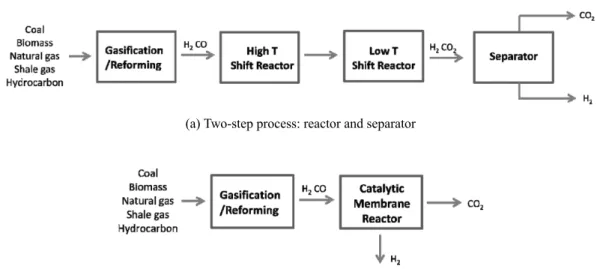
(a) Two-step process: reactor and separator
(b) One-step process: catalytic membrane reactor
Figure 1. A pre-combustion CO
2capture for a gasification/reforming process (a) two-step process: reactor and separator (b) one-step process:
catalytic membrane reactor.
a cooler, but this process requires an additional air separation unit (ASU) to separate O
2from air to provide a pure O
2to a gasification/reforming process. A pre-combustion CO
2capture is to separate CO
2from a stream containing mainly H
2and CO
2in order to only combust H
2, a clean fuel, and the captured CO
2can be further sequestered. Figure 1(a) shows a gasification/
reforming process to produce a synthesis gas coupled with a pre-combustion CO
2capture process. Initially, different feed st- reams such as coal, biomass, natural gas (NG), shale gas, and hydrocarbon are fed to a gasifier or reformer to produce a syn- thesis gas, a H
2-CO rich stream, and then undergo high tempera- ture and low temperature shift reactors to produce H
2-CO
2rich stream by a water-gas shift reaction described in reaction 1.
CO + H
2O ↔ CO
2+ H
2ΔH
°298K= -41 KJmol
-1This stream is then separated into H
2and CO
2by a separator and H
2-rich stream is combusted and CO
2-rich stream is tran- sported and further sequestered. This process is called a two-step process because a shift reactor and a separator are needed inde- pendently and separators using solvents, physical/chemical adsor- bents, or membranes can be used [1]. Figure 1(b) presents a new concept of a one-step process employing a catalytic membrane reactor (CMR) combining a reactor for a water gas shift reac- tion and a separator for H
2-CO
2separation and this process is very simple and cost-efficient because two independent units are merged onto a single unit. Moreover, a simultaneous production of a pressurized and concentrated CO
2in a retentate (a shell side of a CMR) and purified H
2in a permeate (a tube side of a CMR) can be achieved in a CMR with the use of a hydrogen separation membrane and an enhanced H
2production is expected from an equilibrium shift by continuously removing H
2during reaction (Le Chatelier’s principle) [6].
A CMR consists of a reactor with a catalyst for reaction and a separator with a membrane for separation and has been exten- sively used for H
2producing processes like various reforming reactions [7-12]. For a membrane separation, there are two key factors to determine the quality of a membrane of interest, hy- drogen permeance and hydrogen selectivity [13]. A hydrogen permeance(Q
H2) is defined as a hydrogen molar flux divided by pressure and can be obtained by the formula,
∆
,
where Q
H2is a hydrogen permeance (mol m
-2s
-1Pa
-1), F
H2is
the molar flow rate of hydrogen (mol s
-1), A is the membrane
area (m
2), and ∆ p is the pressure difference between a retentate
and a permeate in a CMR (Pa). A hydrogen selectivity is defined
as the ratio of a hydrogen permeance and other gas molecule’s
permeance with a higher hydrogen selectivity meaning a higher
hydrogen permeance than other gas molecule. Many researchers
have shown the benefit of a CMR both theoretically and experi-
mentally and have reported an enhanced reactant conversion and
H
2production because of an equilibrium shift driven by conti-
nuously removing H
2during reaction in various reforming reac-
tions. Similarly, there are some research results reporting the ap-
plication of a CMR for a water gas shift reaction close to a con-
cept of a one-step process introduced in Figure 1(b). Tosti et
al.[14] reported a CO conversion close to 100% far exceeding
the equilibrium conversion of about 80% for a water gas shift
reaction in a CMR equipped with a low temperature shift catalyst
and a Pd-Ag membrane with infinite hydrogen selectivity. Basile
et al. [15] studied a water gas shift reaction in a CMR with
a low temperature shift catalyst and Pd or Pd-Ag membranes
with infinite hydrogen selectivity by varying a feed molar flow
and N
2sweep molar flow. They found that a Co conversion of
close to 100% was obtained and simulation data fitted very well
with experimental data. Although previous results showed the benefits of employing a CMR for a water gas shift reaction, little work has been done in their studies to investigate the effect of a wider range of hydrogen permeance and hydrogen selec- tivity, two important factors of a membrane, on the performance of a CMR. Therefore, the effect of hydrogen selectivity and hy- drogen permeance coupled with an operating pressure and Ar flow rate on the performance of a CMR is extensively examined and the feasibility studies of a simultaneous production of a con- centrated CO
2in a retentate and a purified H
2in a permeate are performed in this paper.
2. Materials and Methods
A one-dimensional reactor model with reaction kinetics was used to model a CMR[16] using equations 1-7 with F
irepresenting a molar flow rate of species i in a retentate and F
ituberepresen- ting a molar flow rate of species i in a permeate. It is assumed that r
itubeis proportional to pressure difference of species i between a retentate and a permeate.
tube i i
i
r r
dW
dF = − − (1)
tube i tube
i
r
dW
dF = (2)
total i i
i
P
F P F
= Σ
(3)
tube total tube i tube tube i
i
P
F P F
= Σ
(4)
)
(
2 22 2
tube H H tube H tube
H
K P P
r = − (5)
W A
K
tubeH2= Q
H2 c(6)
) (
2 tube
i i i tube tube H
i
K P P
r = −
α (7)
From previously reported reaction kinetics for a water gas shift reaction[17], an empirical rate equation (Equation 8 and 9) ob- tained from kinetic data at 473 K by Phatak et al.[18] was chosen for this study because the kinetic data were obtained using a Pt/CeO
2catalyst showing high stability in air and at high tem- peratures as well as sulfur tolerance. The composition of a flue gas obtained from different gasifiers such as GE Energy Radiant,
Table 1. Reaction conditions and membrane properties used in a catalytic membrane reactor
Reactant CO
in(mol s
-1) 10
-6CO : H
2O : H
2: CO
21 : 0.9 : 0.8 : 0.3
Reactor
T (K) 473
P (atm) 1-8
Catalyst used (g) 2
Tubular membrane
Length (cm) 4
Tube diameter (cm) 1
H
2permeance (mol m
-2s
-1Pa
-1) 1×10
-8- 1×10
-7H
2selectivity 10 - 10000 Ar sweep flow (mol s
-1) 6.7×10
-10- 6.7×10
-4Conoco-Phillips E-Gas, KBR, and Shell was used for a feed stream to a CMR and reaction conditions and membrane properties are shown in Table 1.
) ( ) ( 10 9 . 5 )
(
244 . 0 33 . 0 7
O H CO
co
P P
s
r mol = ×
− −) 1
( ) ( ) (
2 2 2 2
2
38 . 0 09 . 0
O H CO eq
H CO H
CO
K P P
P P P
P
− −− (8)
) 33 . 4 / 8 . 4577 (
exp −
= T
K
eq(9)
3. Results and Discussion
3.1. Effect of an operating pressure and a hydrogen se- lectivity on the performance of a CMR
CMR studies were carried out at an operating pressure of 1-8
atm and a reaction temperature of 473 K using various membranes
with a hydrogen selectivity ranging from 10 to 10000. The broad
range of a hydrogen selectivity was chosen to extensively in-
vestigate the effect of a hydrogen selectivity on the performance
of a CMR and the hydrogen selectivity of 10 represents a micro-
porous membrane with a Knudsen diffusion mechanism, in which
a permeance of a gas molecule is inversely proportional to the
square root of its molecular weight while the hydrogen selec-
tivity of 10000 represents a hydrogen perm-selective membrane
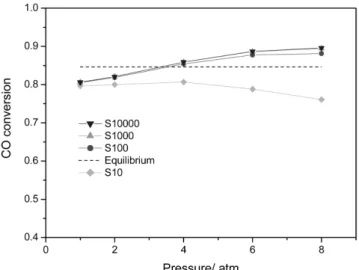
like a palladium membrane[19,20]. Figure 2 shows the effect
of an operating pressure and a hydrogen selectivity on a CO
conversion at 473 K in a CMR fitted with a membrane with a
hydrogen permeance of 1 × 10
-8mol m
-2s
-1Pa
-1. An equilibrium
CO conversion of 0.846 at the reaction condition (dashed line)
was obtained from UniSim
®Design Suite using a Gibbs reactor
model and Peng-Robinson equation of state. For a membrane with
a hydrogen selectivity of 10, a CO conversion slightly increased
with pressure initially because of an increased driving force
between a retentate and a permeate caused by increased pressure,
(a) CO
2concentration in a retentate (b) H
2concentration in a permeate
Figure 3. Effect of an operating pressure and a hydrogen selectivity on the performance of a catalytic membrane reactor (S: hydrogen selectivity, H
2permeance = 1 × 10
-8mol m
-2s
-1Pa
-1, T = 473 K).
Figure 2. Effect of an operating pressure and a hydrogen selectivity on a CO conversion in a catalytic membrane reactor (S:
hydrogen selectivity, dashed line: equilibrium conversion, H
2permeance = 1 × 10
-8mol m
-2s
-1Pa
-1, T = 473 K).
but then declined with pressure. In addition, for all pressures studied a CO conversion was less than an equilibrium conver- sion of 84.6 indicating no benefit of using a CMR and it is sur- mised that a low hydrogen selectivity of 10 led to a permeation of a reactant, CO, through a membrane and less CO to react remained in a shell side of a CMR (retentate) resulting in a low CO conversion. However, as a hydrogen selectivity increased, a CO conversion higher than the equilibrium was obtained at a certain pressure range. For example, for a hydrogen selectivity of 100 a CO conversion increased with pressure considerably because of an increased driving for between a retentate and a permeate and then exceeded an equilibrium at a pressure of about 3.5 atm confirming the benefit of a CMR that an enhanced reac- tant conversion can be obtained by a shift of equilibrium by con- tinuously removing hydrogen during reaction. Moreover, for a hydrogen selectivity of 1000 and 10000 a similar trend of in-
creasing CO conversion with pressure was observed and a CO conversion surpassed an equilibrium one at a pressure of about 3.25 atm also confirming the benefit of a membrane reactor. One interesting thing to note is that a CO conversion increased noti- ceably at low pressure and then increased only slightly at high pressure and it is conjectured that an additional pressure effect of driving more hydrogen through a membrane decreased under a current hydrogen permeance of 1 × 10
-8mol m
-2s
-1Pa
-1. In other words, it can be said that a membrane with a higher hydrogen permeance is required to fully utilize the benefit of a CMR at high pressure.
Figure 3 presents the effect of an operating pressure and a hy- drogen selectivity on a CO
2concentration in a retentate (a shell side of a CMR) and H
2concentration (H
2purity) in a permeate (a tube side of a CMR) with a fixed hydrogen permeance of 1 × 10
-8mol m
-2s
-1Pa
-1and this is to test the feasibility of em- ploying a CMR, a simple and less expensive process, for a water gas shift reaction after a gasification/reforming process as a pre- combustion CO
2capture method as described in Figure 1(b). For a CO
2concentration in a retentate, it is apparent that pressure had a positive effect for all CMRs studied and a CO
2concen- tration close to 90% was obtained at 8 atm in a retentate side for all membranes while a CO
2concentration of about 40% was attained at 1 atm for all membranes as shown in Figure 3(a).
It is believed that pressure was a strong driving force for a H
2penetration through a membrane resulting in less H
2and more
CO
2in a retentate. Interestingly, the highest CO
2concentration
in a retentate was achieved in a membrane with a hydrogen se-
lectivity of 10 and it is conjectured that reactants such as CO
and H
2O as well as H
2could easily pass through a membrane
with pressure due to a low hydrogen selectivity and this resulted
in a relatively increased CO
2concentration in a retentate. On the
other hand, the effect of an operating pressure and a hydrogen
selectivity on a H
2concentration in a permeate is shown in Figure
3(b). For a membrane with a hydrogen selectivity of 10 a H
2concentration obviously decreased dramatically with pressure from 87% at 1 atm to 64% at 8 atm because pressure made other species such as CO, H
2O, CO
2pass through a membrane leading to a less H
2concentration in a permeate. There was a slight decrease of a H
2concentration in a permeate with pressure for a mem- brane with a hydrogen selectivity of 100 (98% at 1atm and 95%
at 8 atm) and little decrease for a hydrogen selectivity of 1000 and 10000 with pressure (close to 100%). From combined results presented in Figure 3(a) and 3(b), it can be concluded that a membrane with a hydrogen selectivity close to 100 is required to obtain a pressurized and concentrated CO
2close to 90% in a retentate and a purified H
2close to 95% in a permeate at the same time. In addition, these results suggest that a membrane should be very carefully chosen depending on its application and there can be no big advantages of using expensive Pd-based mem- branes with infinite selectivity compared to other inexpensive membranes with a hydrogen selectivity of about 100 for a pre- combustion CO
2capture in a CMR.
3.2. Effect of a hydrogen permeance and an operating pressure on the performance of a CMR
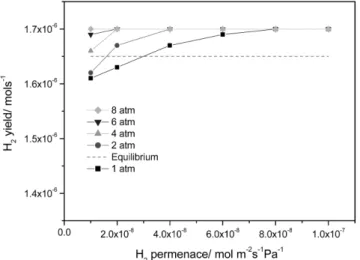
Figure 4 presents the effect of a hydrogen permeance and pressure on a H
2yield at 473 K in a CMR with a fixed hydro- gen selectivity of 10000 representing Pd-based membranes. The range of a hydrogen permeance studied was 1 × 10
-8mol m
-2s
-1Pa
-1to 1 × 10
-7mol m
-2s
-1Pa
-1and an equilibrium H
2yield of 1.65
× 10
-6mol s
-1at the reaction condition (dashed line) was ob- tained from UniSim
®Design Suite using a Gibbs reactor model and Peng-Robinson equation of state. For an operating pressure of 1 atm, a H
2yield increased with an increasing H
2permeance
Figure 4. Effect of a H
2permeance and an operating pressure on a H
2yield in a catalytic membrane reactor (H
2selectivity = 10000, dashed line: equilibrium yield, T = 473 K).
Figure 5. Effect of a hydrogen permeance and an operating pressure on the ratio of a hydrogen permeated and hydrogen pro- duced (H
2selectivity = 10000, T = 473 K).
and a H
2yield higher than an equilibrium one was attained at a hydrogen permeance higher than 3 × 10
-8mol m
-2s
-1Pa
-1due to a continuous removal of hydrogen through a membrane confirming the benefit of a CMR. A similar trend was obtained for an ope- rating pressure of 2 atm and a H
2yield higher than an equilibrium one was attained at a hydrogen permeance higher than 1.5 × 10
-8mol m
-2s
-1Pa
-1, which is less than the one obtained for 1 atm.
In addition, a H
2yield higher than an equilibrium one was ob- tained for an operating pressure of 4, 6, and 8 atm irrespective of a hydrogen permeance. Apparently, a hydrogen permeance was favorable for a H
2yield and an increased pressure lowered minimum hydrogen permeance required to achieve a H
2yield higher than an equilibrium one. It is also noteworthy that a H
2yield reached a saturated yield of 1.7 ×10
-6mol s
-1for all hydro- gen permeance studied in this paper possibly because most of hydrogen produced was removed from a retentate during reaction resulting in no further driving force for H
2transport through a membrane at a high hydrogen permeance. A ratio of a hydrogen permeated through a membrane and a hydrogen produced during reaction is shown in Figure 5 and obviously there was a signifi- cant difference in the ratio for 1 atm leading to a big change in a H
2yield with a hydrogen permeance while there was less di- fference in the ratio with higher pressure resulting in a slight change in a H
2yield. In addition, the ratio was close to 1.0 for all pressure at a hydrogen permeance of 1 × 10
-7mol m
-2s
-1Pa
-1and these results can explain why a saturated H
2yield was ob- tained at a hydrogen permeance of 1 × 10
-7mol m
-2s
-1Pa
-1.
The effect of a hydrogen permeance and an operating pressure
on a CO
2concentration in a retentate and a H
2concentration
(H
2purity) in a permeate is shown in Figure 6(a) and 6(b),
respectively. A H
2concentration in a permeate close to 100% was
(a) CO
2concentration in a retentate (b) H
2concentration in a permeate
Figure 6. Effect of a hydrogen permeance and an operating pressure on the performance of a catalytic membrane reactor (H
2selectivity = 10000, T = 473 K).
obtained for all hydrogen permeance studied because a membrane with a hydrogen selectivity of 10000 was used. For a CO
2con- centration in a retentate, a general trend of a higher CO
2concen- tration with pressure was attained mainly because pressure was favorable for hydrogen permeation through a membrane. For a hydrogen permeance of 1 × 10
-8to 1 × 10
-7mol m
-2s
-1Pa
-1, a significant increase of a CO
2concentration from 44 to 89% was observed for a pressure of 1atm with a slight increase of a CO
2concentration from 88 to 92 for a pressure of 8 atm. In other words, for a high operating pressure a CO
2concentration close to 90% was attained even at a hydrogen permeance of 1 × 10
-8mol m
-2s
-1Pa
-1because higher pressure led to a higher driving force for a H
2transport through a membrane.
3.3. Effect of an Ar sweep flow and an operating pressure on the performance of a CMR
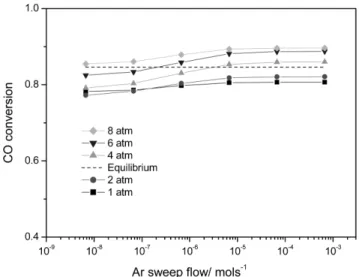
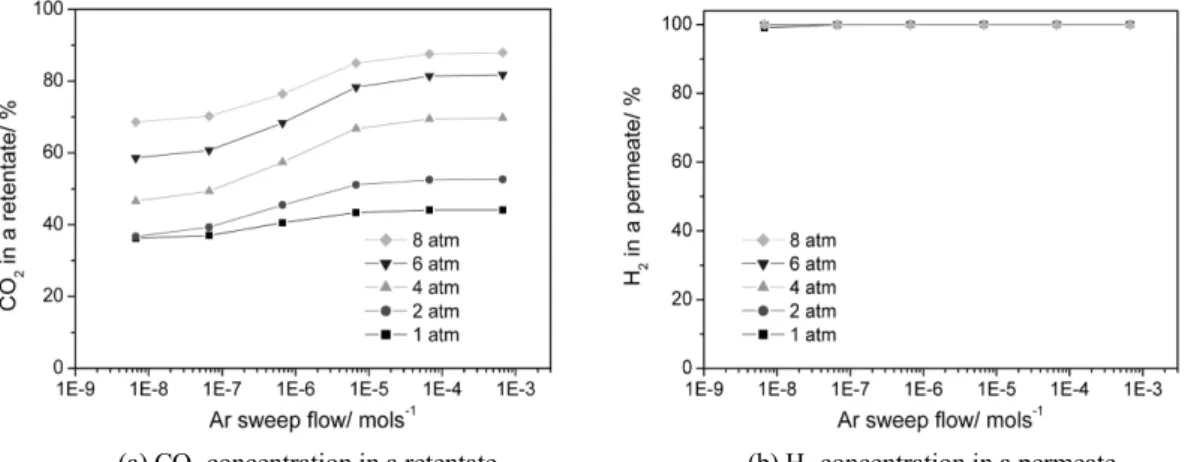
There are two methods to increase a hydrogen permeation through a membrane in order to fully utilize the benefits of a CMR. One is to pressurize a retentate so that more hydrogen can pass through a membrane and the other is to use an inert sweep gas in a permeate so that a hydrogen concentration difference between a retentate and a permeate increases by continuously sweeping a permeated hydrogen. Figure 7 shows the effect of two factors, an Ar sweep flow rate and an operating pressure, on a CO conversion at 473 K in a CMR with a fixed hydrogen per- meance of 1 × 10
-8mol m
-2s
-1Pa
-1and hydrogen selectivity of 10000. The general trend of higher CO conversion with an Ar sweep flow rate was obtained reflecting the benefit of using a sweep flow in a CMR for an improved driving force for a hydrogen permeation. For an operating pressure of 1 and 2 atm, a CO conversion never exceeded an equilibrium one irrespective of an Ar sweep flow rate, but a CO conversion surpassing an equilibrium one appeared for a pressure of 4,6, and 8 atm. Res-
Figure 7. Effect of an Ar sweep flow and an operating pressure on a CO conversion in a catalytic membrane reactor (H
2per- meance = 1 ×10
-8mol m
-2s
-1Pa
-1, H
2selectivity = 10000, dashed line: equilibrium conversion, T = 473 K).
pective Ar sweep flow rates of 3.5 × 10
-6and 2.0 × 10
-7mol s
-1were required to achieve a CO conversion higher than an equi-
librium one for respective operating pressures of 4 and 6 atm
while a CO conversion higher than an equilibrium was attained
at 8 atm irrespective of an Ar sweep flow rate. The effect of an
Ar sweep flow and an operating pressure on a CO
2concentration
in a retentate and a H
2concentration in a permeate is shown
in Figure 8(a) and 8(b). A clear trend of an increasing CO
2con-
centration with both an Ar sweep flow and an operating pressure
was obtained, but a CO
2concentration close to 90% was obtained
only with an Ar sweep flow rate of 6.7 × 10
-4mols
-1and an ope-
rating pressure of 8 atm because a membrane with a low hydrogen
permeance of 1 × 10
-8mol m
-2s
-1Pa
-1was used in a CMR and
these results confirm the need to develop a hydrogen separation
membrane with a high hydrogen permeance.
(a) CO
2concentration in a retentate (b) H
2concentration in a permeate
Figure 8. Effect of an Ar sweep flow and an operating pressure on the performance of a catalytic membrane reactor (H
2permeance = 1 × 10
-8mol m
-2s
-1Pa
-1, H
2selectivity = 10000, T = 473 K).
4. Conclusions
A numerical simulation using a one-dimensional reactor model and reaction kinetics has been carried out for a water gas shift reaction in a catalytic membrane reactor (CMR) with a feed stream obtained from real coal gasifiers and feasibility studies of a simultaneous production of a pressurized and concentrated CO
2and a purified H
2in a CMR have been performed.
It was found that a CO conversion never surpassed the equi- librium one for all pressure studied for a membrane with a hy- drogen selectivity of 10 and a CO conversion higher than the equilibrium one was obtained only for a membrane with a hy- drogen selectivity of 100, 1000, 10000, reflecting the benefit of employing a CMR.
A hydrogen permeance of a membrane had a positive effect on a H
2yield in a CMR and a H
2yield higher than an equili- brium one was obtained for all pressure studied. A further analysis using a ratio of hydrogen permeated and hydrogen produced revealed that a significant H
2yield increase was observed at a low pressure because of a dramatic change of the ratio while a slight H
2yield was obtained at a high pressure due to a little change of the ratio.
A CO conversion never exceeded an equilibrium one for an operating pressure of 1 and 2 atm irrespective of Ar sweep flow rate while a minimum Ar sweep flow rate to obtain a CO con- version higher than an equilibrium one existed for an operating pressure of 4 and 6 atm. Interestingly, a CO conversion sur- passing an equilibrium one was observed for all Ar sweep flow rates studied at an operating pressure of 8 atm. For a hydrogen permeance of 1 × 10
-8mol m
-2s
-1Pa
-1and a hydrogen selectivity of 10000, a concentrated CO
2in a retentate (~90%) and a puri- fied H
2in a permeate (~100%) was attained simultaneously only at an Ar flow rate of 6.7 × 10
-4mols
-1and an operating pressure of 8 atm.
In conclusion, these studies provide a very useful guideline for a hydrogen permeance and a hydrogen selectivity coupled with an operating pressure and an Ar sweep flow to achieve a simultaneous production of a concentrated CO
2in a retentate and a purified H
2in a permeate and show the feasibility of em- ploying a CMR as a pre-combustion CO
2capture method.
Acknowledgements
This work was supported by a research grant (#20141141) from the Catholic University of Daegu in 2014.
Nomenclature
F
iMolar flow rate of species i on a shell side of a CMR (retentate) (mol s
-1)
F
itubeMolar flow rate of species i on a tube side of a CMR (permeate) (mol s
-1)
W Catalyst weight (g)
r
iReaction rate equation of reaction i (mol s
-1g
-1) r
itubePermeation rate equation of species i through a mem-
brane (mol s
-1g
-1)
P
iPartial pressure of species i on a shell side of a CMR (retentate) (atm)
P
itubePartial pressure of species i on a tube side of a CMR (permeate) (atm)
P
totalTotal pressure on a shell side of a CMR (retentate)
(atm)
tube total
P Total pressure on a tube side of a CMR (permeate) (atm)
tube
K
H2
Proportional constant of r
Htube2
(mol s
-1g
-1atm
-1)
H2