Gun-Yeob Kim, Sun-Il Lee, Jong-Sik Lee, Hyun-Cheol Jeong and Eun-Jung Choi
680Korean J. Environ. Biol. 36(4) : 680~686(2018) https://doi.org/10.11626/KJEB.2018.36.4.680
서 론
농경지에서 배출되는 온실가스 배출가스인 N2O는 지구 온난화잠재력(GWP; Global Warming Potential)이 CO2 대비 310배로 가장 크다(IPCC 1996). 대기 중 N2O 농도는 산업혁 명 이전 270ppb에서 2006년에 320ppb로 약 1.2배 증가하였 다(IPCC 2007). 농업활동에서 N2O의 주 배출원은 질소비료 및 가축분뇨이며, N2O의 지구온난화 기여율은 5% 이상인 것으로 알려져 있다(IPCC 2007). 농업활동에 의한 온실가스 배출감축을 위해서는 먼저 농업부문의 온실가스 발생원과 토 양에 양분공급원별로 온실가스 배출에 미치는 영향을 구체 적으로 평가할 필요가 있다.
비료 종류 중 효과지연성 피복비료는 수용성의 속효성 입 상비료를 안정한 피막으로 피복하여 비료성분의 용출속도를 조절한 것으로서 일명 Coating비료로 불려 지기도 한다. 피 복비료에서 양분의 용출은 피복의 미세한 공극을 통해서 확 산·용출하며, 수지로 피복한 비료는 피막두께의 변화나 용 출조정제의 사용에 따라 용출속도를 임의로 조절 할 수 있다. LCU(Latex Coating Urea)효과지연성 복합비료를 토양에 시 용하면 질소성분이 천천히 용출될 뿐 아니라 오랫동안 지속 되기 때문에 질소성분의 유실과 휘산을 경감할 수 있는 장점 이 있다(Azeem et al. 2014; LeMonte et al. 2016). 따라서 작 물이 필요로 하는 시기에 양분이 공급되어 비료효과를 증가 시키기 때문에 수량을 증가시키고 분시횟수의 단축 등 시비 노력이 절감되는 이점이 있어 최근에 LCU효과지연성 복합 비료를 기비로만 시용하고 추비를 생략하는 농가가 늘어나 고 있는 추세이다. 이와 같이 LCU효과지연성 복합비료 시용
* Corresponding author: Gun-Yeob Kim, Tel. 063-238-2493, Fax. 063-238-3823, E-mail. [email protected]
ⓒ2018. Korean Society of Environmental Biology.
콩과 고추재배지에서 양분 공급원별 N
2O 배출량 평가
김건엽*· 이선일 · 이종식 · 정현철 · 최은정
농촌진흥청 국립농업과학원 기후변화생태과
Evaluation of N
2O Emissions by Nutrient Source in Soybean and Pepper Fields
Gun-Yeob Kim*, Sun-Il Lee, Jong-Sik Lee, Hyun-Cheol Jeong and Eun-Jung Choi National Institute of Agricultural Sciences, RDA, Wanju 55365, Republic of Korea
Abstract - Nitrogen fertilizers, hairy vetch, and slow-release complex fertilizers were applied to the soil during the cultivation of crops. The impact of these factors on N2O emission was quantitatively assessed and the GHGs reduction effect comprehensively evaluated. Among the three factors, the significant factors affecting N2O emission were mineral nitrogen>soil moisture>temperature. Yield and fertilizer utilization efficiency were highest in the slow-release complex fertilizer treatment. There was no significant difference in N2O emissions between the slow-release complex fertilizer treatments and the NPK+hairy vetch treatments. Comprehensive results showed that slow-release complex fertilizers treatment has high yield and fertilizer utilization efficiency but low N2O emission.
Keywords : N2O emission, low-release complex fertilizer, soybean and red pepper fields
<Original article>
으로 수량 증대와 더불어 토양에 무기태질소 공급의 조절을 통하여 N2O 배출을 줄일 수 있을 것으로 기대하고 있다. 그 리고 헤어리베치는 공중질소를 고정하는 두과 작물로서 다 른 녹비작물 보다 C/N율이 비교적 낮고(탈질율 10) 분해속 도가 빠른 유기물이다(Cho et al. 2012). 경작지에서 유기물 투입은 논토양에서는 CH4 생성 박테리아에 의해 혐기조건 상태로 유기물이 분해되어 CH4이발생하지만 유기물이 밭 토양에서 질소 비료에 의해서만 발생되는 N2O와는 크게 영 향을 받지 않으므로 N2O 배출 감축에 기여하고 있다. 따라서 LCU효과지연성 복합비료 시용으로 인한 N2O 배출과 녹비작 물 시용으로 인한 N2O 배출 감축효과 등 질소공급원인 비료 한 종류와 N2O 배출 연구(Kim et al. 2002, 2010; Seo et al.
2012; Azeem et al. 2014; Sakatar et al. 2015; LeMonte et al.
2016)는 있으나, 질소공급원별로 N2O 배출 감축효과를 종합 적으로 파악한 연구는 미미하였다.
본 연구에서는 작물 재배시 질소비료와 유기물인 헤어리 베치 그리고 LCU효과지연성 복합비료 등 질소공급원별로 토양에 시용하여 작물의 수량, N2O 배출 특성 및 N2O 배출 량 감축 효과 등 종합적으로 파악하고 질소공급원별로 N2O 배출에 얼마나 영향을 주는지를 정량적으로 밝혀서 온실가 스 배출관리에 필요한 기초자료를 제공하고자 하였다.
재료 및 방법
1. 처리 및 시료 분석방법
본시험은 전라북도 완주군 이서면에 위치한 국립농업과학 원의 시험포장(위도: 35°82ʹL41.5ʺN, 경도: 127°04ʹL36.0ʺE) 에서 2016∼2017년(2년) 동안 수행하였다. 시험 토양은 pH 는 6.2∼7.1, 유기물함량은 7.8∼13.8g kg-1로서 특성은 Table 1과 같고 농촌진흥청 토양화학분석법(NIAS 2010)에 준하였다. 대상작물은 우리나라에서 주요 밭작물인 콩(대풍) 그리고 고추(시알)를 공시작물로 하였다. 콩의 파종일은 6월 12일경, 고추의 정식일은 5월 10일경으로 검정 피복 비닐로 멀칭하여 재배하였다. 비료 시용량은 농촌진흥청 작물별 시 비처방기준(RDA 2006)의 표준시비량을 기준으로 하였으며, 콩 재배에서 NPK 처리는 N-P2O5-K2O를 32-33-37kg ha-1으
로 질소, 인산, 칼리 등을 전량 기비하였고 고추는 질소는 요 소로 3회 분시, 인산은 용성인비로 전량 기비, 칼리는 염화 칼리를 2회 분시하였다. 비료 및 유기물처리는 NPK, NPK (질소 성분량 50%)+헤어리베치 생초(질소 성분량 50%), LCU(Latex Coating Urea)효과지연성 복합비료(질소 성분량 100%) 등 3처리 3반복으로 각 처리 당 질소성분량 100%에 맞추었다. 헤어리베치의 질소함량은 헤어리베치가 32g kg-1 으로 헤어리베치 투입량(수분함량 75.7%)은 8,800kg ha-1 이었다.
토양화학성은 토양시료를 채취하여 풍건 후 2mm체를 통 과시켜 농촌진흥청 토양화학분석법(NIAS 2010)에 준하여 분석하였다. pH는 토양을 증류수와 1:5(W/V)로 혼합한 후 30분간 교반하여 pH meter(Orion 4 star, Thermo, Singapore) 로 측정하였고, EC는 pH 측정 후 토양용액을 #42 여과지로 여과 후 EC meter(Orion 4 star, Thermo, Singapore)를 이용 하여 측정하였다. 유효인산은 Lancaster법(NIAS 2010)으로 720nm 파장에서 비색계(AU/CARY 300, Varian, Australia) 로 분석하였으며, 치환성 양이온은 1 M NH4OAC(pH 7.0) 용액으로 침출하여 유도결합플라즈마 방출분광기(Optima 7300DV, Perkin Elmer, USA)로 분석하였다. 총질소는 CN analyzer(Vario Max CN, Elementar, Germany)로 분석하였 다.
2. 시료채취 및 온실가스 분석방법
시험포장에서 N2O는 비정체형 밀폐형태(Closed Chamber Method)인 순환형 상자법(Denmead et al. 1979)을 이용하여 외부로의 공기 유출이 없도록 포집하였다. 설치된 chamber 는 지름이 0.25m, 높이가 0.5m인 PVC 소재로 제작하였으 며, 가스포집 챔버는 콩과 고추 재배기간 동안 밭 토양 위 작 물과 작물 사이에 고정하여 설치하였고 포집하지 않을 때는 챔버 덮개는 열어두었다. 챔버 재원과 가스포집 형태는 기 존에 검증받았던 방법(Matthias et al. 1978; Denmead et al.
1979)에 의해 제작하였으며, N2O 발생원인 토양 위에 챔버 를 설치한 후 챔버 내부와 외부를 단절시켜 챔버 내부에서 단위 시간당 온실가스의 농도 증가율을 측정하였다. N2O 가 스 포집 방법(Sebacher et al. 1980; Yagi et al. 1990; Shin et al. 1995)은 가스 채취 시작시점에 가스 포집 즉시 챔버 위쪽 Table 1. Chemical properties of soil in soybean and red pepper fields before the experiment
Crop pH(1:5) EC(dS m-1) OM(g kg-1) Av. P2O5(mg kg-1) T-N(g kg-1) Exch. Cation(cmolc kg-1)
K Ca Mg
Soybean
Red pepper 6.6
7.0 0.45
0.66 19.7
25.7 392.0
324.3 1.2
1.8 0.52
0.51 5.93
7.78 2.91
3.15
덮개를 덮고, 그리고 30분 후 가스를 포집하여 30분 전 포집 한 농도와 30분 후 포집한 농도차를 이용하여 배출량을 측 정하였다. 가스시료 채취는 Yagi et al.(1991)의 방법에 의하 여 24시간 배출되는 온실가스 농도를 평균한 값의 시간 범 위가 하루에 두 번인 10:00∼13:00시와 오후 16:00∼19:00 시로 나타나 오전과 오후 시간 중에 하나의 시간범위를 선 택하여 가스를 채취하므로 본 시험에서는 10:00∼13:00시 사이에 60mL 주사기로 1주일에 2회 채취하여 분석하였다.
채취한 공기 시료의 N2O 기체농도는 10 port와 4 port valve 를 장착한 GC-ECD(7890A, Agilent, USA)를 사용하였고 column은 Porapack Q(80/100 mesh)를 충전한 1/8ʺ×2m의 stainless steel tubing column, 그리고 Detector의 온도는 320
℃로 하였다. N2O 분석 조건은 Table 2와 같다.
N2O 플럭스(Minami 1987)는 다음 식(1)에 따라서 계산하 였다.
F(mg m-2 hr-1)=ρ·V A-1·ΔcΔt-1·273T-1 (1) ρ는 가스밀도(mg m-3)이며, A는 챔버 바닥면적(m2), V 는 챔버내 공기체적(m3), ΔcΔt-1는 챔버내 가스농도의 평 균 증가속도(10-6 m3 m-3 hr-1) 그리고 T는 챔버내의 평균기 온이다. N2O의 ρ값(T=273 K)은 다음과 같다; ρN2O=1.96, ρN2O-N=1.25.
콩과 고추밭에서 N2O 배출에 관여하는 요인들 중 N2O 배 출에 어느 정도 영향이 미치는가를 정량적으로 파악하기 위 해 N2O 배출에 대한 기여도를 평가하였다. N2O 배출에 대한 기여도를 평가하기 위한 통계분석은 SPSS를 이용하여 다중 회귀분석(multiple regression analysis)을 하였다. N2O 배출 에 대한 요인별 기여율은 관여하는 N2O 배출 요인인 독립변 수(무기태질소, 토양수분함량, 토양온도)들의 상관계수 값에 이들 각 각의 표준편회귀계수로 곱하여 백분율로 환산하였 고, 결정계수는 기여율을 합하여 중상관계수의 제곱을 하였 다.
결과 및 고찰
콩과 고추 재배기간 동안 토양수분과 토양온도와 N2O 배출량의 경시적 변화는 Fig. 1과 같다. 콩과 고추 토양의 N2O 배출량 변화는 전 생육기간 동안 토양수분과 토양온 도의 변화와 유사한 양상을 보였다. N2O 배출량은 토양수 Table 2. Gas chromatographic analysis conditions for N2O mea-
surement
Detector ECD
Column Packing material Porapack Q (80/100) Materials Stainless steel O.D.×length 1/8ʺ×2m
Carrgier gas N2
Flow rate 30mL min-1(Carrier+make up) Temperature Column 70°C
Injector 80°C
Detector 320°C
Retention time 3.2min
Concentration of calibration gas 0.5 and 1.0 ppmvN2O in N2
Loop 2mL
Fig. 1. Daily changes of soil water contents, soil temperature and soil N2O in soybean and red pepper fields (all flux measurements included).
Values are the mean of three replicates measured between 10:00 a.m. and 12:00 at sampling dates.
분(Stevens et al. 1997; Arnone and Bohlen 1998; Hou et al.
2000; Kim et al. 2008)과 토양온도(Gödde and Conrad 1999;
Kim et al. 2008)와 정의 상관관계가 있어, 토양수분 함량이 많을수록 그리고 토양온도가 높을수록 N2O 배출량이 많다 고 하였다.
콩 재배 토양의 N2O 배출량 변화는 생육 초기인 6월 중순 (6월 21일)부터 7월 중순(7월 11일)까지 약한달 간은 NPK 처리에서 헤어리베치+N 비료와 LCU효과지연성 복합비 료 처리보다 배출량이 높게 나타났으며, 그 이후 생육중기부 터 수확기까지 배출량은 다른 처리와 비슷한 배출량을 보였 다. NPK 비료 시용 후 초기 생육기간에 질소 비료는 분해속 도가 빨라서 N2O 배출량이 높은 것으로 나타났다. 헤어리베 치+N 비료와 LCU효과지연성 복합비료 처리는 생육초기부 터 수확기까지 전 생육기간 동안 NPK 비료처리에 비해 낮 은 배출을 유지하였다. 고추 재배 토양의 N2O 배출량 변화 는 여름철인 6월 중순(6월 27일)부터 8월 초순(8월 1일)까 지 높은 배출량을 보였고 NPK 화학비료 처리가 전 생육기 간 동안 배출이 높게 나타났다.
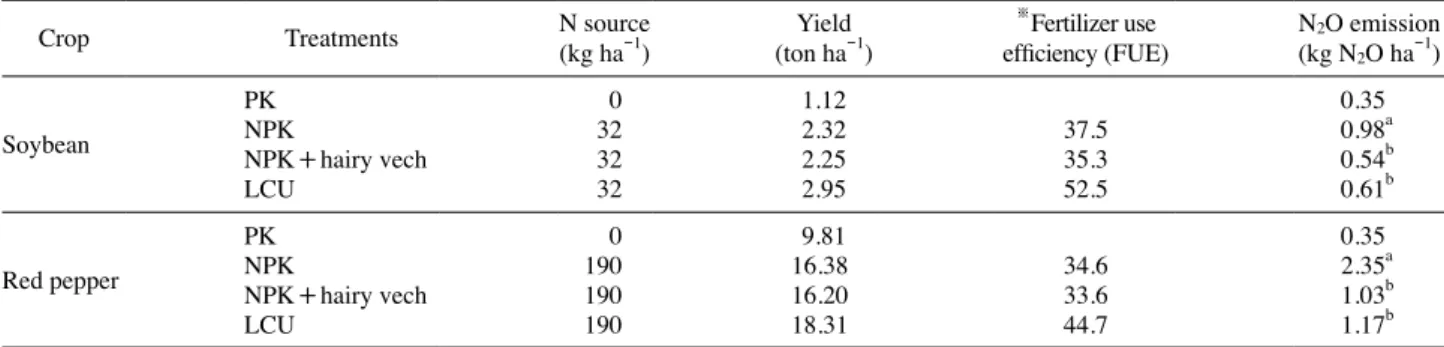
콩과 고추 재배 토양에서 질소공급원 처리별로 N2O 총 배출량은 Fig. 2에서 보는 바와 같이 NPK 비료처리에서 가 장 많은 배출량(콩 0.98kg ha-1, 고추 2.35kg ha-1)을 보였고 LCU효과지연성 복합비료 처리(콩 0.61kg ha-1, 고추 1.17 kg ha-1) 다음으로 헤어리베치+N 비료 처리(콩 0.54kg ha-1, 고추 1.03kg ha-1)로 배출량이 적었다. LCU효과지연성 복 합비료가 같은 화학비료인 NPK 처리보다 N2O 배출량이 낮은 원인은 일시적 고농도 질소의 분해를 피하고 일정하 게 질소성분이 용출되는 LCU효과지연성 질소비료의 특성 (LeMonte et al. 2016) 때문으로 생각된다. 또한 유기물 종류 들 중에서 비교적 C/N율이 낮은 헤어리베치는 토양에서 유 기물의 분해속도가 빨라 양분의 유효도와 비료이용효율이 높아서 온실가스 배출을 높이지만(Cho et al. 2012; Alam et al. 2015) 유기물보다 NPK 화학비료가 분해속도가 더 빨라 서 N2O 배출량이 높게 나타난 것(Alam et al. 2015)으로 판 단된다.
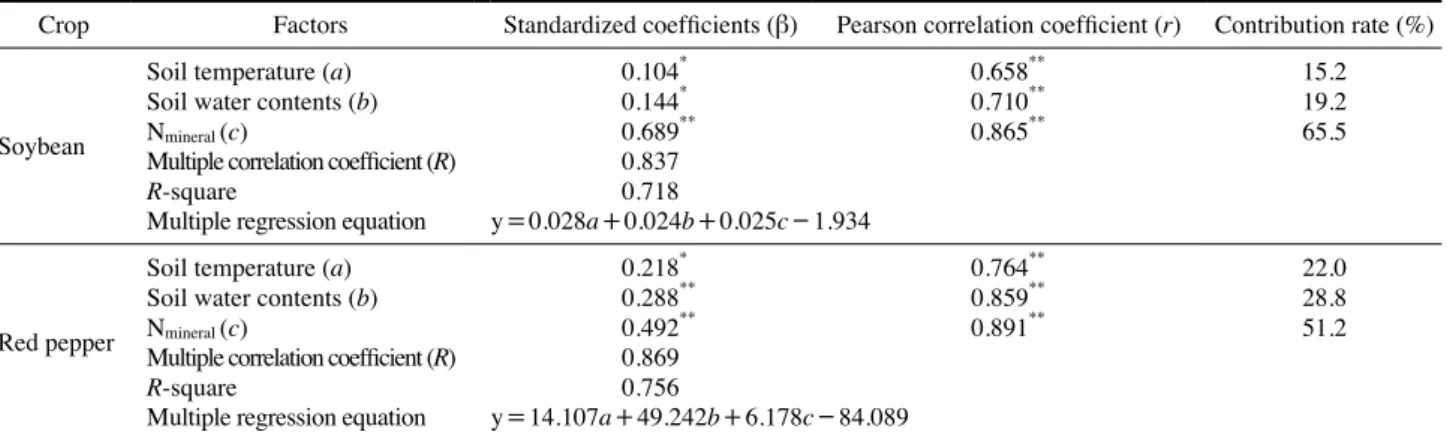
N2O 배출에 대한 기여도를 Table 3에 나타냈다. 결정계수 는 콩 0.729, 고추 0.760의 결과를 얻었다. 따라서 N2O 배출
Fig. 2. Accumulated N2O emission from soybean and red pepper fields by different fertilizers.
Table 3. Multiple regression analysis for contribution factors to N2O in soybean and red pepper fields (*p<.05, **p<.01; statistically signif- icant at 0.5% and 1%)
Crop Factors Standardized coefficients (β) Pearson correlation coefficient (r) Contribution rate (%)
Soybean
Soil temperature (a) Soil water contents (b) Nmineral (c)
0.104* 0.144* 0.689**
0.658**
0.710**
0.865**
15.219.2 Multiple correlation coefficient (R) 65.5
R-square 0.837
0.718
Multiple regression equation y=0.028a+0.024b+0.025c-1.934
Red pepper
Soil temperature (a) Soil water contents (b) Nmineral (c)
0.218* 0.288**
0.492**
0.764**
0.859**
0.891**
22.028.8 Multiple correlation coefficient (R) 51.2
R-square 0.869
0.756
Multiple regression equation y=14.107a+49.242b+6.178c-84.089
에 대한 3개의 독립변수(무기태질소, 토양수분함량과 토양 온도)에 의해 콩에서 71.8%, 고추 75.6%를 설명할 수 있었 다. N2O 배출량과 토양온도, 토양수분함량 그리고 무기태질 소의 상관 분석한 결과, 콩에서 각 0.658**, 0710** 그리고 0.865**, 고추는 0.764**, 0.859** 그리고 0.891**으로 고 도로 유의하여 N2O 배출량에 큰 영향을 주는 것으로 나타 났다. N2O 배출에 영향을 미치는 요인은 콩에서 무기태질 소(65.5%), 토양수분함량(19.2%), 토양온도(15.2%), 그리고 고추에서는 무기태질소(51.2%), 토양수분함량(28.8%), 토 양온도(22.0%) 순으로 나타났으며, 두 작물 모두 무기태질 소의 기여도가 가장 큰 것으로 나타나 N2O 배출에 가장 큰 영향이 미치는 것으로 나타났다. Arone and Bohlen(1998) 은 N2O 배출량과 토양 수분함량과는 정의 상관관계가 있다 고 하였으며, Dobbie et al.(1999)은 남부 스코틀랜드의 N2O 배출량이 조사지역과 기후 차이에 관계없이 토양수분과 밀 접한 관계가 있다고 하였다. 무기태질소, 토양수분, 토양온 도는 밭 토양에서 N2O 배출에 가장 영향을 미치는 요인들이 다(Davidson et al. 1993; Parton et al. 1996; Wagner-Riddle et al. 1997; Lemke et al. 1998; Frolking et al. 1998; Jones 2007). Hellebrand et al.(2008)은 유채와 호밀 등 일년생작물 에서 N2O 배출량과 토양 중 무기태질소인 NO3--N은 정의 상 관관계가 있으며, NO3--N이 높으면 N2O 배출량도 많다고 하 였다. 이와 같이 인위적으로 조절이 불가능한 토양온도를 제 외하고 밭 토양에서 온실가스를 감축하기 위해서는 N2O 배 출에 큰 영향을 주는 토양수분과 무기태질소와 관계가 있는 질소시비량을 조절함으로써 가능하다고 생각된다. 세 가지 요 인 중 N2O 배출에 가장 크게 영향을 미치는 요인은 무기태질 소(콩 65.5%, 51.2%), 토양수분함량(콩 19.2%, 고추 28.8%), 토양온도(콩 15.2%, 고추 22.0%) 순으로 나타났다. 즉, 무 기태질소가 N2O 배출에 가장 영향을 미치는 요인으로 분석 되었으며, N2O 배출에 기여하는 세 가지 요소 중 토양온도 가 N2O 배출에 대한 미치는 영향은 낮았다. 이는 고추와 콩
재배에서 N2O 배출에 큰 영향을 주는 요인은 무기태질소이 며 다음으로 토양수분이었다는 선행 연구결과와 일치하였다 (Kim et al. 2010). Iserman(1994)은 농경지 토양에서 대기 로 배출되는 아산화질소의 양 가운데 81%가 질소비료에 의 해 배출된다고 하였다. 농경지 토양에서 아산화질소 배출은 질산화작용이나 탈질작용 등 생물학적인 과정이 가장 중요 하며, 토양에 요소를 시용할 때 요소의 가수분해로 방출되는 NH4는 화학적 자급영양생물인 질화균에 의해 N2O-와 NO3-
로 산화되고 이러한 질산화작용의 여러 과정을 통한 생화 학적 경로를 통해 N2O와 NO를 배출한다(Firestone et al.
1989). 탈질균은 호흡내에 전자 수용체가 질산화 과정을 통 해 질소산화물을 이용하고 N2O와 N2를 배출한다(Davidson et al. 1993). 그러므로 토양 내 무기태질소 공급을 조절하기 위해 LCU효과지연성 복합비료를 시용하여 아산화질소 배 출량을 줄일 수 있는 효과를 기대할 수 있다.
Table 4는 콩과 고추 재배에서 비료공급원별 질소비료 이용효율을 나타낸 것이다. 수량은 질소 무처리구에서 콩 이 1.12 톤 ha-1 그리고 고추 9.81 톤 ha-1, NPK 처리에서 콩 2.32 톤 ha-1 그리고 고추 16.38 톤 ha-1, NPK+헤어리베치 처리에서 콩이 2.25 톤 ha-1 그리고 고추 16.20 톤 ha-1, LCU 효과지연성 복합비료 처리에서 콩 2.95 톤 ha-1 그리고 고 추 18.31 톤 ha-1으로 가장 높았다. 질소비료 이용효율에서 도 LCU효과지연성 복합비료 처리에서 콩 52.5와 고추 44.7 로 가장 높았다. N2O 배출량에서도 LCU효과지연성 복합비 료와 NPK+헤어리베치 처리에서 차이를 보이지 않았으며 수량과 질소비료이용효율 그리고 N2O 배출량 등을 종합적 으로 살펴보면, LCU효과지연성 복합비료 처리가 생산성 및 환경적인 면에서 가장 우수한 것으로 나타났다. 그러므로 토 양내 무기태질소 공급을 조절하기 위해 LCU효과지연성 복 합비료를 시용하여 아산화질소 배출을 줄일 수 있는 효과를 기대할 수 있다.
Table 4. Yield, fertilizer utilization efficiency and N2O emission of soybean and red pepper fields from treatments
Crop Treatments N source
(kg ha-1) Yield (ton ha-1)
※Fertilizer use
efficiency (FUE) N2O emission (kg N2O ha-1) Soybean
PK 0 1.12 0.35
NPK 32 2.32 37.5 0.98a
NPK+hairy vech 32 2.25 35.3 0.54b
LCU 32 2.95 52.5 0.61b
Red pepper
PK 0 9.81 0.35
NPK 190 16.38 34.6 2.35a
NPK+hairy vech 190 16.20 33.6 1.03b
LCU 190 18.31 44.7 1.17b
※Fertilizer use efficiency (kg unhulled rice yield/kg of applied N): (Yield in respective treatment-Yield in PK)/(N fertilization rate)
적 요
작물 재배시에 질소비료와 유기물인 헤어리베치 그리고 LCU효과지연성 복합비료 등 질소공급원별로 토양에 시용 하여 N2O 배출에 영향을 주는 요인들의 특성을 조사하였다.
그리고 그 요인들이 N2O 배출에 얼마나 영향을 주는지를 정 량적으로 밝히고 온실가스 배출의 영향 인자들에 대해 온실 가스 감축 효과를 종합적으로 평가하였다.
N2O 배출에 영향을 미치는 요인은 토양온도, 토양수분과 무기태질소 등이다. 이 세 가지 요인 중 N2O 배출에 가장 크 게 영향을 미치는 요인은 무기태질소(콩 65.5%, 51.2%)>
토양수분함량(콩 19.2%, 고추 28.8%)>토양온도(콩 15.2%, 고추 22.0%) 순으로 나타났다. 수량과 비료이용효율은 LCU 효과지연성 복합비료 처리에서 가장 높았다. N2O 배출량은 LCU효과지연성 복합비료와 NPK+헤어리베치 처리에서 차 이를 보이지 않아 종합적인 결과는 수량과 비료이용효율 그 리고 낮은 N2O 배출량을 보인 LCU효과지연성 복합비료 처 리가 가장 양호한 것으로 나타났다. 따라서 앞으로 N2O 배 출을 저감할 수 있는 토양 양분관리 기술 개발 연구가 확대 되면 온실가스 배출저감 대책에 도움이 될 것으로 기대할 수 있다.
사 사
본 연구는 농촌진흥청 국립농업과학원 농업과학기술 연 구개발사업(과제번호: PJ012614)의 지원에 의해 이루어진 것임
REFERENCES
Alam F, TY Kim, SY Kim, SS Alam, P Pramanik, PJ Kim and YB Lee. 2015. Effect of molybdenum on nodulation, plant yield and nitrogen uptake in hairy vetch (Vicia villosa Roth). Soil Sci. Plant Nutr. 61:664-675.
Arone JA and PJ Bohlen. 1998. Stimulated N2O flux from in- tact grassland monoliths after two growing seasons under elevated atmospheric CO2. Oecologia 116:331-335.
Azeem B, KZ KuShaari, ZB Man, A Basit and TH Thanh.
2014. Review on materials & methods to produce con- trolled release coated urea fertilizer. J. Control. Release 181:11-21.
Cho JL, HS Choi, Y Lee, SM Lee and SK Jung. 2012. Effect of organic materials on growth and nitrogen use efficiency of
rice in paddy. Korean J. Org. Agric. 20:211-220.
Davidson EA, PA Matson, PM Vitousek, R Riley, K Dunklin, G García-Méndez and JM Maass. 1993. Processes of reg- ulating soil emissions of NO and N2O in a seasonally dry tropical forest. Ecology 74:130-139.
Denmead OT. 1979. Chamber systems for measuring nitrous oxide emission from soils in the field. Soil Sci. Soc. Am. J.
43:89-95.
Dobbie KE, IP Mctagart and KA Smith. 1999. Nitrous oxide emissions from intensive agricultural systems: variations between crop and seasons, key driving variables, and mean emission factors. J. Geophys. Res.-Atmos. 104:26891- 26899.
Firestone MK and EA Davidson. 1989. Microbiological basis of NO and N2O production and consumption in soil. In Ex- change of Trace Gases between Terrestrial Ecosystems and the Atmosphere (Andreae and Schimel, eds.). Wiley, New York.
Frolking SE, AR Mosier and DS Ojima. 1998. Comparison of N2Oemissions from soils at three temperate agricultural sites: simulations of year-round measurements by four models. Nutr. Cycl. Agroecosyst. 52:77-105.
Gödde M and R Conrad. 1999. Immediate and adaptational temperature effects on nitric oxide production and nitrous oxide release from nitrification and denitrification in two soils. Biol. Fertil. Soils 30:33-40.
Hellebrand HJ, V Scholz and J Kern. 2008. Fertilizer induced nitrous oxide emissions during energy crop cultivation on loamy sand soils. Atmos. Environ. 42:8403-8411.
Hou A, H Akiyama, Y Nakajima, S Sudo and H Tsuruta. 2000.
Effects of urea form and soil moisture on N2O and NO emissions from Japanese Andosols. Chemosphere-Glob.
Change Sci. 2:321-327.
IPCC. 1996. Revised IPCC guideline for national greenhouse gas inventories: Reference manual, revised in 1996. Inter- governmental Panel on Climate Change. Geneva, Switzer- land.
IPCC. 2007. Climate change 2007: The physical science basis:
Summary for policymakers. Intergovernmental Panel on Climate Change. Geneva, Switzerland.
Iserman K. 1994. Agriculture’s share in the emissions of trace gases affecting the climate and some cause oriented pro- posals for reducing this share. Environ. Pollut. 83:95-111.
Jones SK, RM Rees, UM Skiba and BC Ball. 2007. Influence of organic and mineral N fertiliser on N2O fluxes from a temperate grassland. Agric. Ecosyst. Environ. 121:74-83.
Kim GY, SI Park and BH Song. 2002. Effects of water and nu- trient management on methane and nitrous oxide emission from a rice paddy field. Korean J. Environ. Agric. 21:136-
143.
Kim GY, BH Song, KA Roh, SY Hong, BG Ko, KM Shim and KH So. 2008. Evaluation of green house gases emissions according to changes of soil water content, soil temperature and mineral N with different soil texture in pepper cultiva- tion. Korean J. Soil Sci. Fert. 41:399-407.
Kim GY, KH So, HC Jeong, KM Shim, SB Lee and DB Lee.
2010. Evaluation of N2O emissions with changes of soil temperature, soil water content and mineral N in red pepper and soybean field. Korean J. Soil Sci. Fert. 43:880-885.
Lemke RL, RC Izaurralde, SS Malhi, MA Arshad and M Ny- borg. 1998. Nitrous oxide emissions from agricultural soils of the Boreal and Parkland regions of Alberta. Soil Sci.
Soc. Am. J. 62:1096-1102.
LeMonte JJ, VD Jolley, JS Summerhays, RE Terry and BG Hopkins. 2016. Polymer coated urea in turfgrass maintains vigor and mitigates nitrogen's environmental impacts. PloS One 11:e0146761.
Matthias AD, DN Yarger and RS Weinbeck. 1978. A numerical evaluation of chamber methods for determining gas fluxes.
Geophys. Res. Lett. 5:765-768.
Minami K. 1987. Emission of nitrous oxide (N2O) from agro-ecosystems. Jpn. Agric. Res. Q. 21:22-27.
NIAS. 2010. Methods of Soil Chemical Analysis. National In- stitute of Agricultural Sciences, Sam-Mi press. pp. 13-290.
Parton WJ, AR Mosier, DS Ojima, DW Valentine, DS Schimel, K Weier and AE Kulmala. 1996. Generalized model for N2
and N2O production from nitrification and denitrification.
Glob. Biogeochem. Cycle 10:401-412.
RDA. 2006. Fertilizer Recommendation Standards for Various Crops. Rural Development Administration, Sanglok-sa. pp.
16-17.
Sakatar R, S Shimada, H Arai, N Yoshioka, R Yoshioka, H Aoki, N Kimoto, A Sakamoto, L Melling and K Inubushi.
2015. Effect of soil types and nitrogen fertilizer on nitrous oxide and carbon dioxide emissions in oil palm plantations.
Soil Sci. Plant Nutr. 61:48-60.
Sebacher DI and RC Harris. 1980. A continuous sampling and analysis system for monitoring methane fluxes from soil and water surfaces to the atmosphere. pp. 22-27. In Pro- ceedings of 73rd Annual Meeting of Air Pollution Control Assn in Montreal. Montreal, Quebec.
Seo YH, SW Kim, SC Choi, IJ Kim, KH Kim and GY Kim.
2012. Effect of green manure crop and biochar on nitrous oxide emission from red pepper field. Korean J. Soil Sci.
Fert. 45:540-543.
Shin YK, YS Lee, SH Yun and ME Park. 1995. A simplified closed static chamber method for measuring methane flux in paddy soils. Korean Soc. Soil Sci. Fert. 28:183-190.
Stevens RJ, RJ Laughlin, LC Burns, JRM Arah and RC Hood.
1997. Measuring the contributions of nitrification and de- nitrification to the flux of nitrousoxide from soil. Soil Biol.
Biochem. 29:139-151.
Wagner-Riddle C, GW Thurtell, GE Kidd, EG Beauchamp and R Sweetman. 1997. Estimates of nitrous oxide emissions from agricultural fields over 28months. Can. J. Soil Sci.
77:135-144.
Yagi K, K Minami and Y Ogawa. 1990. Effects of water perco- lation on methane emission from paddy fields. NIAES Res.
Rep. Div. Environ. Planning 6:105-122.
Yagi K. 1991. Emission of biogenic gas compounds from soil ecosystem and effect of global environment: 2. Methane emission from paddy fields. Soil Fert. Japan 62:556-562.
Received: 20 November 2018 Revised: 18 December 2018 Revision accepted: 18 December 2018