Print ISSN: 2288-4637 / Online ISSN 2288-4645 doi:10.13106/jafeb.2021.vol8.no5.0167
Paradoxical Leadership and Proactive Work Behavior:
The Role of Psychological Safety in the Hotel Industry*
Ji Eun KIM 1
Received: January 15, 2021 Revised: March 21, 2021 Accepted: April 01, 2021
Abstract
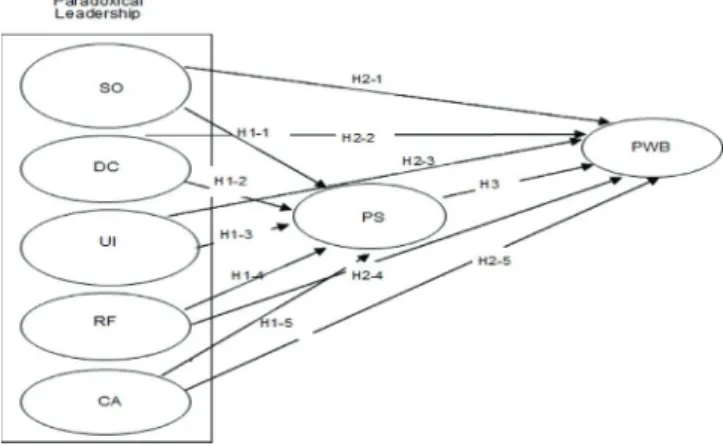
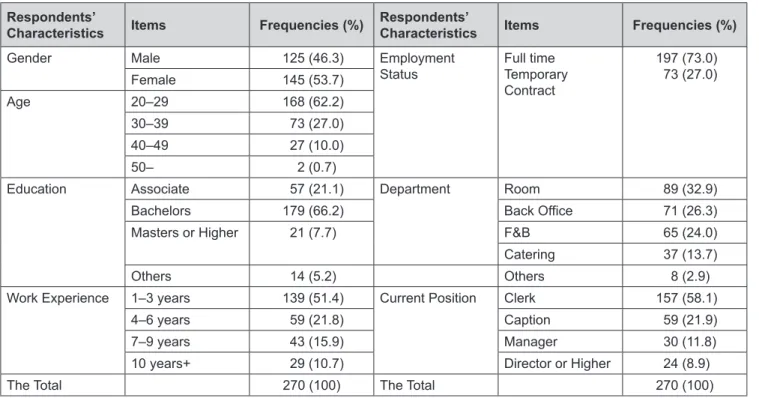
This study aims to identify the influence of paradoxical leadership on proactive work behavior mediated through psychological safety in the hotel industry. This study employs survey data of five-star deluxe hotels in South Korea using convenience sampling. The number of 270 cases was used for analysis and the hypotheses were analyzed with structural equation modeling and AMOS 20. Paradoxical leadership includes five sub-variables of self-centeredness with other-centeredness (SO) distance and closeness (DC), uniformly and individualization (UI), work requirements and flexibility (RF), and decision control and autonomy (CA). The results indicate that DC, UI, and CA positively influence psychological safety. Further, RF and CA make a positive impact on proactive work. Psychological safety fully mediates the effect of DC and UI on proactive work behavior and partially mediates the effect of CA on it. The findings of this study suggest that the impact of paradoxical leadership on proactive work behavior can be strengthened when this relationship is accompanied with psychological safety and other mediation variables for the relationship need to be further investigated. This study suggests how hotel managers enhance the level of proactive work behavior by training themselves to be paradoxical leaders and making psychologically safe environment.
Keywords: Paradox, Paradoxical Leadership, Psychological Safety, Proactive Work Behavior JEL Classification Code: J2, J24, L8, M1, M12
outputs while the employees like to have more autonomy for their job (Brewer & Gardner, 1996). The hotel organizations particularly control their employees’ work process because standard operation process (SOP) and mistake reduction have been believed to be sustained through control. On the other hand, organizational performance beyond work manual cannot be expected if hotel organizations merely depend on control itself. For example, hotel employees’discretionary efforts based on autonomy can resolve exceptional customer needs and control may block their discretion to make better service performances. On the other hand, autonomy without control is not ideal to manage primary service consistency.
Therefore, the hotel leaders need to allow the subordinates to have autonomy while control from leaders always exist. The leader behavior embracing paradox which should coexist is paradoxical leadership.
Likewise, each department in the hotel business is interdependent and the leaders in the hotel industry need to make their subordinates have ownership to make synergy effect with other departments. Employees need to be psychologically safe about their ownership behaviors and this can be possible when leaders comprehend and embrace all possible issues regarding organizational behaviors (Xue, Li, Liang, & Lee, 2020).
*Acknowledgements:
1
This work was supported by research grants from Daegu Catholic University in 2020.
1