• 검색 결과가 없습니다.

First Report of Three Didymella Species Isolated from Freshwater Ecosystem in Korea

N/A
N/A
Protected

Academic year: 2021

Share "First Report of Three Didymella Species Isolated from Freshwater Ecosystem in Korea"

Copied!
8
0
0

로드 중.... (전체 텍스트 보기)

전체 글

(1)

Received: December 13, 2017 Revised: January 17, 2018 Accepted: January 20, 2018

Ⓒ The Korean Society of Mycology

This is an Open Access article distributed under the terms of the Creative Commons Attrib- ution Non-Commercial License (http://creative- commons.org/licenses/by-nc/4.0/) which permits unrestricted non-commercial use, distribution, and reproduction in any medium, provided the original work is properly cited.

Kor. J. Mycol. 2018 March, 46(1): 1-8 https://doi.org/10.4489/KJM.20180001

pISSN : 0253-651X eISSN : 2383-5249

OPEN ACCESS

RESEARCH ARTICLE

담수환경에서 발굴된 Didymella 속 3종의 국내 최초 보고

문혜연*, 고재덕, 오유선, 정애란, 정남일
국립낙동강생물자원관 담수생물조사연구실 균류자원조사부

First Report of Three Didymella Species Isolated from Freshwater Ecosystem in Korea

Hye Yeon Mun

*

, Jaeduk Goh, Yoosun Oh, Ae-Ran Jeong, Namil Chung

Fungal Resources Research Division, Freshwater Bioresources Research Bureau, Nakdonggang National Institute of Biological Resources, Sangju 37242, Korea

*Corresponding author: [email protected]

ABSTRACT

Three fungal isolates, NNIBRFG108, 1139, and 1480, were isolated from freshwater environments;

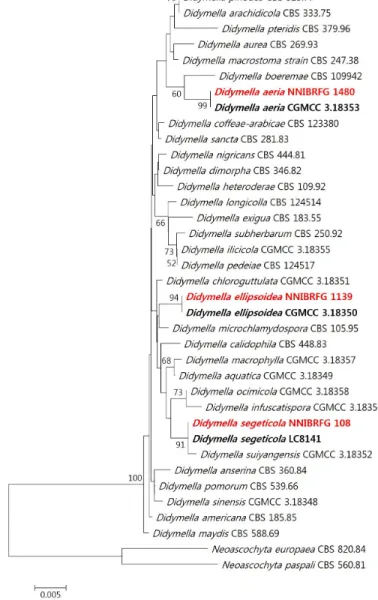
NNIBRFG108 from plant litter in Samcheok, Gangwon and NNIBRFG1139 and 1480 from the soil in Jeju & Gimcheon, Gyeongbuk, Korea. Based on the morphological characteristics and phylogenetic analysis of internal tanscribed spacer (ITS), 28S rDNA region, and β-tubulin gene, NNIBRFG108, NNIBRFG1139, and NNIBRFG1480 isolates were confirmed as Didymella segeticola, D. ellipsoidea, and D. aeria, respectively. Neither species has previously been described in Korea.

Keywords: Didymella, Freshwater ecosystem, Fungi

서 론

Didymella 는 Phoma의 유성세대에 속하는 분류군으로, 이들은 다계통분류체계(polyphyletic group) 를 가진 속이다. Didymella는 처음에는 Mycosphaerellaceae, 그 다음은 Pleosporaceae, Phaeosphaeriaceae, Venturiaceae 에서 Pleosporales의 incertae sedis로 분류됐다가 de Gruyter 등[1]에 의해 재분류되는 과정에서 새롭게 생긴 Didymellaceae과에 포함되었다.

Didymellaceae 는 “Didymella clade”를 위한 분류군으로서 Pleosporales 중 가장 많은 종을

가지고 있는 과이며, 다양한 서식지에 넓게 분포하고 있다. 그 중 Ascochyta속, Didymella속,

Phoma 속이 많은 비중을 차지하고 있으며, 광범위한 감염 범위를 가진 식물병원균으로서 식

물체의 잎과 줄기에 병반을 형성한다[2]. 현재까지 국내에 보고된 Didymella속은 멜론에 덩

굴마름병을 일으키는 것으로 알려진 D. bryoniae만이 알려져 있다[3]. Phoma속에 속하는 종

(2)

들을 재동정 할 경우 국내에도 많은 종이 존재하고 있을 것으로 판단된다.

본 연구에서는 Chen 등[2]에 의해서 보고된 Didymella속의 3종, D. segeticola, D. ellip- soidea, D. aeria 균류를 국내의 담수환경에서 발굴하였으며, 이를 국내 최초로 보고하였다.

재료 및 방법

강원도 삼척시 및 경상북도 김천, 제주의 담수지역에서 침전식물체 및 토양을 채집하였다. 강 원 삼척지역에서 담수 침전 식물체를 부식된 식물 잎을 폴리에틸렌 봉투에 채집하였다. 경북 김천 및 제주 지역에서는 하천의 물 아래에 분포하는 토양을 conical tube 담아 채집하였다.

시료는 수분이 있는 상태에서 냉장 보관하면서 실험에 사용하였다. 채집한 담수 침전 식물체 및 담수토양에서 균을 분리하였다. 채집한 담수 침전 식물체를 멸균수에 2번 세척한 후 멸균 수에 넣고 20°C에서 하루 정도 배양한 후, 배양된 물 100 µL를 water agar (WA, 20 g/L, agar) 에 도말하고 2일 동안 15°C에서 배양하였다. 채집한 토양시료는 10 1 , 10 2 , 10 3 으로 희석하여 200 µL 를 potato dextrose agar (PDA; Difco, Detroit, MI, USA)에 도말한 후 3~4일 동안 15°C 에서 배양하였다. 배양된 배지에서 단포자 분리를 통해 곰팡이를 순수분리하였다. 순수 분리된 균류는 PDA에 접종하고 20°C 또는 25°C에 배양하며 실험에 사용하고, 일부는 15%

글리세롤에 담은 후 ‒80°C에 저장하였다.

낙동강 유역의 담수침전식물체 및 담수토양에서 분리된 균류는 PDA에 배양하여 균사체 를 수확하였다. 수확한 균사를 glass bead가 담긴 tube에 넣어 균질화시킨 후 Macherey- Nagel NucleoSpin Plant II DNA extraction Kit (Macherey-Nagel, Bethlehem, PA, USA) 를 사용하여 DNA를 추출하였다. 추출된 DNA의 internal transcribed spacers (ITS) rDNA, 28S rDNA, β-tubulin 유전자 부분을 증폭시키기 위해 ITS1 (5'-TCCGTAGGTGAACCTGC GG-3')/ ITS4 (5'-TCCTCCGCTTATTGATATGC-3'), LR0R (5'-ACCCGCTGAACTTA AGC)/LR7 (5'-GCAGATCTTGGTGGTAG-3') 및 Bt2a (5'-GGTAACCAAATCGGTGC TGCTTTC-3')/Bt2b (5'-ACCCTCAGTGTAGTGACCCTTGGC-3') primer 를 사용하여 PCR 하였다[4]. DNA 염기서열 정렬 및 편집을 위해 Clustal X2.1 [5]와 Bioedit 7.2.5 [6]를 사용 하였고, 계통수 작성을 위해 MEGA 6.07 [7]을 사용하였다.

환경조건에 따른 생장률을 조사하기 위해 5°C, 15°C, 20°C, 25°C, 30°C, 35°C, 45°C의 7

개 온도 범위와 PDA, malt extract agar (MEA), oatmeal agar (OA; Difco) 등 8가지 배지 종

류를 실험에 사용하였다. 각각의 배지를 90 mm 페트리 플레이트에 조제하여 5일 동안 배양

한 후 균사생장을 측정하였다. 3반복으로 실시하였다. 실험에 사용한 배지는 PDA, MEA

(malt extract 2%; agar 2%/1 L), OA, Czapeck-dox solution agar (CDA; Difco), corn meal

agar (CMA; Difco), yeast extract peptone dextrose agar (YPDA; Duchefa Biochemie,

Haarlem, Netherlands), Dichloran glycerol chloramphenicol (DG18; Merck Millipore,

Billerica, MA, USA), potato carrot agar (PCA; HiMedia, Mumbai, India) 이다.

(3)

결과 및 고찰

Didymella segeticola Q. Chen, Crous & L. Cai. Figs. 1 and 2

Didymella segeticola 는 Chen 등[8]에 의해 발견된 Phoma segeticola를 Chen 등[2]에 의해 재명명된 종이다. 종 이름은 기주식물인 Cirsium segetum Bunge에서 기인하여 명명되었다.

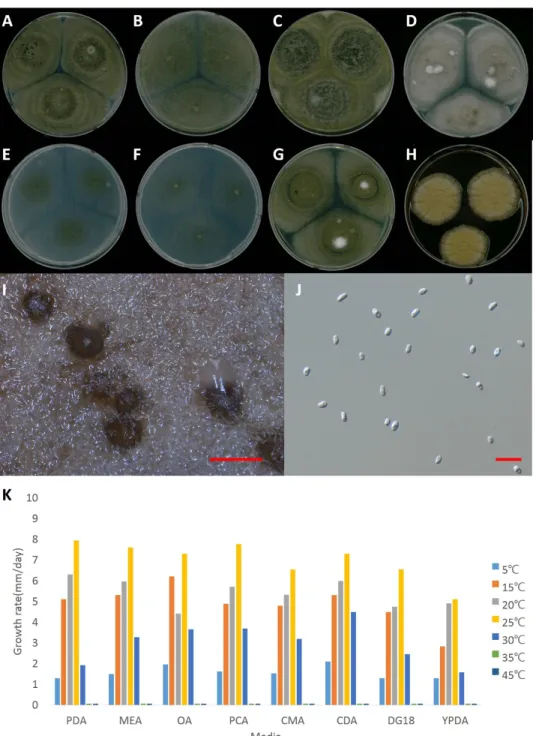
Conidiomata: 병자각(pycnidium)은 25°C 이상의 배지 상에서 잘 형성되고, 독립되어 있거나 여러 개가 결합한 형태이며, 원형 또는 약간 타원형의 모양이지만 대부분 모양이 일정하지 않 고, 어두운 갈색에서 검은색이며, 균사체에 덮여 있지 않다. 크기는 127~189(~573) µm × 129~197(~491) µm 이다.

Fig. 1. Neighbor-joining tree of a concatenated alignment of internal transcribed spacer (ITS), 18S, 28S rDNA region and β-tubulin of three Didymella species including D. segeticola, D.

ellipsoidea and D. aeria from deposited plant litter and soil. Neoascochyta europaea and N.

paspali were used as an outgroup. Bootstrap values higher than 50% from 1,000 replications

were shown above/below branches.

(4)

Conidia: 원형 또는 타원형이고, 부드럽고 얇은 외벽을 가지고 있으며, 투명하고 격벽을 가지 고 있지 않다. 크기는 3~5 µm × 2~3 µm이다.

Culture characteristics: PDA 상에서는 25°C에서 10일 동안 97 mm로 생장하고, 가장자리가 일정하며, 균사체가 수북하게 밀집된 형태로 덮여 있다. 가장자리는 녹색을 띠며 가운데는 흰 색을 띤다. MEA 상에서는 25°C에서 10일 동안 81 mm로 생장하며, 가장자리가 일정하다.

Fig. 2. Colony shape and conidia and growth rate of Didymella segeticola NNIBRFG108. A,

colony shape on potato dextrose agar (PDA); B, colony shape on malt extract agar (MEA); C,

colony shape on oatmeal agar (OA); D, colony shape on potato carrot agar (PCA); E, colony

shape on corn meal agar (CMA); F, colony shape on Czapeck-dox solution agar (CDA); G,

colony shape on Dichloran glycerol chloramphenicol (DG18) agar; H, colony shape on yeast

extract peptone dextrose agar (YPDA); I, pycnidia on PDA plate, ×50; J, pycnidium focused

under light microscope, ×400; K, conidia on PDA at 25°C, ×400; L, growth rate (scale bars: I =

500 µm, J = 10 µm, K = 10 µm).

(5)

균사체가 수북하게 덮여 있으며, 연한 녹색을 띤다. OA 상에서는 25°C에서 10일 동안 86 mm 로 생장하고, 가장자리가 일정하다. 균사체가 수북하게 밀집된 형태로 덮여 있고, 가장자 리는 흰색을 띠며 가운데로 갈수록 녹색에서 연한 카키색을 띤다. 온도 및 배지별 생장을 조

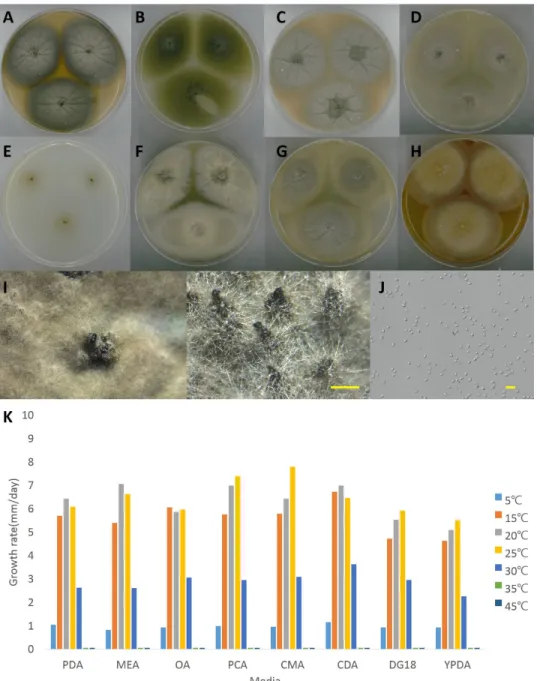
Fig. 3. Colony shape and conidia and growth rate of Didymella ellipsoidea NNIBRFG1139. A,

colony shape on potato dextrose agar (PDA); B, colony shape on malt extract agar (MEA); C,

colony shape on oatmeal agar (OA); D, colony shape on potato carrot agar (PCA); E, colony

shape on corn meal agar (CMA); F, colony shape on Czapeck-dox solution agar (CDA); G,

colony shape on Dichloran glycerol chloramphenicol (DG18) agar; H, colony shape on yeast

extract peptone dextrose agar (YPDA); I, pycnidia on PDA plate, ×80; J, conidia on PDA at

25°C, ×400; K, growth rate (scale bars: I = 500 µm, J = 10 µm).

(6)

사한 결과, 25°C의 PDA 배지에서 생장률이 가장 높았다.

Specimen examined: 대한민국 강원도 삼척시, 담수침전식물체, 2015년 10월 13일 채집, NNIBRFG108, 국립낙동강생물자원관

Synonym: Phoma segeticola Q. Chen

Didymella ellipsoidea Q. Chen, Crous & L. Cai. Figs. 1 and 3

D. ellipsoidea 은 포자모양이 타원형(ellipsoidal)인데서 기인하여 명명되었으며, Chen 등[2]

에 의해 보고되었다.

Conidiomata: 병자각은 25°C 이상의 배지 상에서 잘 형성되고, 하나의 독립된 병자각으로 존 재한다. 원형 또는 약간 타원형으로 일정한 형태를 가지며, 갈색 또는 어두운 갈색을 띠고, 균 사에 덮여 있지 않다. 크기는 149~256 µm × 176~287 µm이다.

Conidia: 타원형이고, 부드럽고 얇은 외벽을 가지고 있으며, 투명하고 격벽을 가지고 있지 않 다. 크기는 3~4.5 µm × 2~3 µm이다.

Culture characterisitics: PDA 상에서는 25°C에서 10일 동안 79 mm로 생장하고, 가장자리 가 일정하며, 균사체가 수북하게 밀집된 형태로 덮여있다. 콜로니 색은 올리브색에서 어두운 올리브색이다. MEA 상에서는 25°C에서 10일 동안 76 mm로 생장하고, 가장자리가 일정하 다. 균사체가 수북하게 밀집된 형태로 덮여있고, 밝은 녹색이다. OA 상에서는 25°C에서 10 일 동안 73 mm로 생장하고, 가장자리가 일정하다. 균사체가 수북하게 밀집된 형태로 덮여 있으며, 밝은 올리브색에서 어두운 올리브색을 띤다. 생장률은 25°C, PDA 배지에서 가장 높았다.

Specimen examined: 대한민국 제주도 제주시, 토양, 2016년 3월 22일 채집, NNIBRFG1139, 국 립낙동강생물자원관

Didymella aeria Q. Chen, Crous & L. Cai. Figs. 1 and 4

D. aeria 는 공기 중에서 분리된 종으로 Chen 등[2]에 의해 보고되었다.

Conidiomata: 병자각은 독립되어 있거나 여러 개가 결합된 형태이며, 원형 또는 약간 타원형 의 모양이지만 형태가 일정하지 않고, 어두운 갈색이며, 균사체에 덮여 있다. 크기는 100~134 µm × 104~145 µm 이다.

Conidia: 타원형이고, 부드럽고 얇은 외벽을 가지며, 포자색은 투명하고, 격벽이 없다. 크기 는 3~5 µm × 2~3 µm이다.

Culture characteristics: PDA 상에서는 25°C에서 10일 동안 61 mm로 생장하고, 가장자리가

일정하다. 콜로니는 중심에서부터 방사형으로 갈라지고, 균사체가 수북하게 밀집된 형태로

덮여 있으며 콜로니색은 녹색에서 회녹색을 띤다. MEA 상에서는 25°C에서 10일 동안 66

mm 로 생장하고, 가장자리는 일정하다. 균사체가 수북하게 밀집된 형태이며, 콜로니는 녹색

에서 어두운 녹색을 띤다. OA 상에서는 25°C에서 10일 동안 60 mm로 생장하고, 가장자리는

일정하다. 콜로니 중심에서부터 방사형으로 갈라지고, 균사체는 수북하게 밀집된 형태로 덮

여 있으며, 백녹색에서 밝은 녹색을 띤다. 온도 및 배지별 생장을 조사한 결과, 20°C 또는

25°C 에서 생장이 좋았으며, PCA 배지에서 생장률이 가장 높았다.

(7)

Specimen examined: 대한민국 경상북도 김천시, 토양, 2016년 3월 23일 채집, NNIBRFG- 1480, 국립낙동강생물자원관

Fig. 4. Colony shape and conidia and growth rate of Didymella aeria NNIBRFG1480. A,

colony shape on potato dextrose agar (PDA); B, colony shape on malt extract agar (MEA); C,

colony shape on oatmeal agar (OA); D, colony shape on potato carrot agar (PCA); E, colony

shape on corn meal agar (CMA); F, colony shape on Czapeck-dox solution agar (CDA); G,

colony shape on Dichloran glycerol chloramphenicol (DG18) agar; H, colony shape on yeast

extract peptone dextrose agar (YPDA); I, pycnidia on PDA plate, ×80 & ×25; J, conidia on

PDA at 25°C, ×400; K, growth rate (scale bars: I = 500 µm, J = 10 µm).

(8)

적 요

국내에 보고되지 않은 3종의 균류가 담수환경으로 부터 분리되었다. NNIBRFG108은 강원 도 삼척의 담수침전식물체에서 분리되었고, NNIBRFG1139와 NNIBRFG1480은 경북 김천 과 제주지역의 토양으로부터 분리되었다. 형태적 특징 및 internal transcribed spacers (ITS), 18S rDNA, 28S rDNA 및 β-tubulin 유전자를 이용한 분자계통학적 분류를 통해 동정한 결 과, NNIBRFG108, NNIBRFG1139, NNIBRFG1480 균주는 각각 Didymella segeticola, D.

ellipsoidea 및 D. aeria으로 확인되었다. 이는 국내에서는 발견되지 않은 미기록종으로 본 보 고가 국내 최초이다.

ACKNOWLEDGEMENTS

This results was supported by a grant from the Nakdonggang National Institute of Biological Resources (NNIBR) of the Republic of Korea for projects on survey and discovery of freshwater bioresources (NNIBR, 2017).

REFERENCES

1. de Gruyter J, Aveskamp MM, Woudenberg JH, Verkley GJ, Groenewald JZ, Crous PW.

Molecular phylogeny of Phoma and allied anamorph genera: towards a reclassification of the Phoma complex. Mycol Res 2009;113:508-19.

2. Chen Q, Hou LW, Duan WJ, Crous PW, Cai L. Didymellaceae revisited. Stud Mycol 2017;87:105-59.

3. Choi IY, Choi JN, Choi DC, Sharma PK, Lee WH. Identification and characterization of the causal organism of Gummy stem blight in the muskmelon (Cucumis melo L.).

Mycobiology 2010;38:166-70.

4. Glass NL, Donaldson GC. Development of primer sets designed for use with the PCR to amplify conserved genes from filamentous ascomycetes. Appl Environ Microbiol 1995;

61:1323-30.

5. Larkin MA, Blackshields G, Brown NP, Chenna R, McGettigan PA, McWilliam H, Valentin F, Wallace IM, Wilm A, Lopez R, et al. Clustal W and Clustal X version 2.0.

Bioinformatics 2007;23:2947-8.

6. Hall TA. BioEdit: a user-friendly biological sequence alignment editor and analysis program for Windows 95/98/NT. Nucleic Acids Symp Ser (Oxf) 1999;41:95-8.

7. Tamura K, Stecher G, Peterson D, Filipski A, Kumar S. MEGA6: Molecular Evolutionary Genetics Analysis version 6.0. Mol Biol Evol 2013;30:2725-9.

8. Chen Q, Zhang K, Zhang G, Cai L. A polyphasic approach to characterise two novel

species of Phoma (Didymellaceae) from China. Phytotaxa 2015;197:267-81.

수치

Fig. 1. Neighbor-joining tree of a concatenated alignment of internal transcribed spacer (ITS),  18S, 28S rDNA region and  β-tubulin of three Didymella species including D
Fig. 2. Colony shape and conidia and growth rate of Didymella segeticola NNIBRFG108. A,  colony shape on potato dextrose agar (PDA); B, colony shape on malt extract agar (MEA); C,  colony shape on oatmeal agar (OA); D, colony shape on potato carrot agar (P
Fig. 3. Colony shape and conidia and growth rate of Didymella ellipsoidea NNIBRFG1139
Fig. 4. Colony shape and conidia and growth rate of Didymella aeria NNIBRFG1480. A,  colony shape on potato dextrose agar (PDA); B, colony shape on malt extract agar (MEA); C,  colony shape on oatmeal agar (OA); D, colony shape on potato carrot agar (PCA);

참조

관련 문서

[r]

17 에너지는 한 형태에서 다른 형태로 전환될 수 있으며, 이 과정에서 에너지가 새로 생기거나 소멸되지 않고 전체 에 너지의 양은 일정하게 보존된다..

First, ICT convergence innovation ecosystem creation; Second, expansion of climate smart agriculture and precision agriculture; third, strengthening the on-off linking platform

- 우선, 외부 전원이 없는 회로, 즉 초기조건에 의해서 전류, 전압이 결정되 는 회로의 응답 : natural response.. - 다음, 직류 전압이나 전류가

Protecting the aquatic ecosystem in the water body Recover water and resources from wastewater and. produce renewable energy using wastewater constituents.. • So, the goal

In this study, the mercury in exhaust gas was measured from three large coal-fired power plants in Korea using the continuous emission monitoring system

Comparison of genotypes using REP-PCR and Integron-IS26 PCR results among 78 IRAB strains isolated from 2 university hospitals.. The result of REP-PCR genotypes and

급속한 산업화와 도시화로 인하여 수질오염이 심해지고 있으며 악취 및 휘발성 유기화합물(VOCs)에 의한 오염이 대두되고 있다.이러한 오염원들은 대기 중에서