항암제 유발 신경독성을 관리하는 한의학 및 보완대체요법들과 임상시험 현황
박선주1․고호연2․한유진3․고성규4․김성훈1* 1)
1: 경희대학교 한의과대학 암예방소재개발연구센터 2: 세명대학교 한의과대학 내과학교실 3: 숙명여자대학교 글로벌서비스학부 3: 경희대학교 한의과대학 예방의학교실
The Present Clinical Studies of Oriental Medicine and CAM Therapies in Chemotherapy-induced Peripheral Neurotoxicity
Sunju Park1, Ho-Yeon Go2, Yoo-Jin Han3, Seong-Gyu Ko4, Sung-Hoon Kim1*
1: Department of Cancer Preventive Material Development Research Center, College of Oriental Medicine, Kyung Hee University
2: Department of Oriental Internal Medicine, College of Oriental Medicine, Semyung University 3: School of Global Service, Sookmyung Women’s University
4: Department of Preventive Medicine, College of Oriental Medicine, Kyung Hee University
ABSTRACT
Objectives : Cancer incidence is increasing in all countries and chemotherapy-induced peripheral
neuropathy (CIPN) in patients undergoing chemotherapeutic agents have been a clinically serious problems. So far therapeutic options for CIPN patients are limited and no confirmed methods have yet been established for dealing with peripheral neuropathy. Therefore this review is to provide an evidence-based summary of oriental medicine and CAM (complementary and alternative medicine) neuroprotective and treatment therapies which have gone through clinical trials.
Methods : An overview of the domestic and international papers of adult clinical trials relating management of only CIPN symptoms through 1990 to present were searched by electronic databases.
Search key words were chemotherapy-induced neurotoxicity, chemotherapy-induced peripheral neuropathy, chemotherapy toxicity & herb, chemotherapy toxicity & acupuncture, chemotherapy toxicity & CAM.
Only English and Korean written papers were reviewed. Total 25 papers were reviewed in this study, 18 papers were retrieved by electronic search.
Results : Clinical studies of managing CIPN were rare, two acupuncture clinical studies and four herb medicinal studies were found. Rest of 19 papers were about other CAM clinical studies. Total 25 papers were analyzed, and all interventions were focused on their pain control efficacy. Other 24 trials of potential therapies except one proved to be effective for CIPN, however some described to be inadequate positive or sufficient negative.
Conclusions : As most of the studies were pilot studies, interventions for the prevention and treatment of CIPN have to go through prospective confirmatory studies, such as larger scale randomized, double-blinded, placebo controlled clinical trials must be done for the safe and effective use of proposed therapies. Also standard measurement scales have to be developed for the better clinical study of CIPN.
Key words : Chemotherapy, Neurotoxicity, CIPN, Clinical trial, Oriental medicine, CAM
* 교신저자 : 김성훈, 서울시 동대문구 회기동 1번지 경희대학교 한의과대학 암예방소재개발연구센터
․ Tel : 02-961-9233 ․ E-mail : [email protected]
․ 접수:2009년 11월 25일 ․ 수정:2009년 12월 21일 ․ 채택:2009년 12월 21일
서 론
세계보건기구(World Health Organization, WHO)의 세 계암보고서(world cancer report)에 의하면 해마다 590만 명의 암 환자들이 발생하고 있으며, 2020년경에는 지금보 다 암 발생률이 50% 증가하며 1,500만 명의 환자가 생길 것으로 전망하고 있다. 암은 발병하면 치료하기 어려울뿐 더러, 치료과정 중에도 높은 진료비, 부작용, 삶의 질 저 하 등 다양한 문제들을 가지고 있다.
암을 치료하기 위하여 다양한 여러 항암요법 중 화학 요법(항암제)은 대표적인 암 치료 방법 중의 하나로 많 은 암 환자들이 받고 있지만, 위장관계 장애, 심혈관계 장애, 호흡기계 장애, 신경계 장애 등 다양한 부작용을 나타낸다. 여러 부작용(독성) 중 ‘항암제 유발 신경독성 (chemotherapy-induced neurotoxicity)’은 혈액학적 독성 에 이어 두 번째로 빈도가 높다1). 항암제 유발 신경독성이 란 항암제 투여후 신경독소 노출로 인해 신경세포가 파괴 되어 뇌 또는 신경계 다른 부분에 신호전달을 하지 못하 거나, 신경계의 정상 기능을 변화시켜 여러 증상들이 발생 하는 것을 말한다. 항암제로 유발된 신경독성에는 부위에 따라, 뇌독성, 소뇌독성, 뇌신경독성, 자율신경독성, 말초신 경독성 등 다양한 종류가 있다. 그 중 항암제 투여 후 말 초신경에 염증, 손상, 퇴화 등을 유발하여 말초신경병증을 나타내는 경우를 CIPN (chemotherapy-induced peripheral neuropathy)라고 한다2). 일반적으로 암으로 유발된 신경 병증은 신경계에 종양이 퍼지거나, 종양이 신경을 압박하 는 경우에 발생하는데, 암에 의한 말초신경병증은 5% 정 도로 적은 비율이지만, CIPN은 최대 72%정도 발생할 정 도로 화학요법을 받는 환자들에게 흔한 부작용이다3).
CIPN은 화학요법을 받는 환자에게 고빈도로 나타나지 만 외형적으로는 차이가 없고 환자 본인만이 느끼는 자 각증상이 대부분이기 때문에, 환자가 일상생활을 하기 어 려워도 주변의 도움을 구하기가 쉽지 않고, 삶의 질을 떨 어뜨리게 된다. CIPN은 화학요법을 끝냈을 때 증상이 사 라지기도 하지만, 다수의 경우 후유증을 남겨 고통을 유 발한다. 지금까지 CIPN을 개선하고 치료하기 위한 방법 은 화학요법 약물을 감량 또는 중단하거나, 새로운 약물 이나 치료법을 적용하는 경우의 2가지로 나누어 볼 수 있다4). 그렇지만, 용량을 줄이거나 중단하는 경우, 종양의 성장을 억제하지 못하거나, 증상을 악화시켜 치료율에 좋 지 않는 영향을 주기 때문에 현실적으로 어려운 점이 있 다. 따라서 신경독성 효과를 최소화하면서, 항암효과를 높이는 화학요법제를 개발하는 것이 최선이라고 하겠으 나, 이는 현실적으로 많은 기간과 고비용을 초래하기 때 문에 어려운 상황이다. 또한 CIPN을 개선하기 위해 사용 한 양방적 치료방법들은 CIPN에 효과적이지 못하다고 알려져 있다. CIPN 환자들 중 한의학을 포함한 대체의학 을 받는 비율은 정확히 보고된 바는 없으나, CIPN 환자 77명을 대상으로 설문조사 결과에 의하면 절반 정도가 한 종류 이상의 대체의학치료를 받고 있으며, 그 중 절반
정도는 효과 있다고 답했다5). 따라서 본 연구에서는 CIPN을 유발하는 항암제와 CIPN을 개선하기 위한 한약 재를 포함한 현행치료법들은 무엇인지 알아보고, 이들의 유효성과 안전성을 검증하는 임상시험 연구들을 조사 분 석하여, 문제점과 한계를 살펴보고 앞으로 연구방향에 대 해 논의해보고자 한다.
내용 및 방법
1. 검색 대상
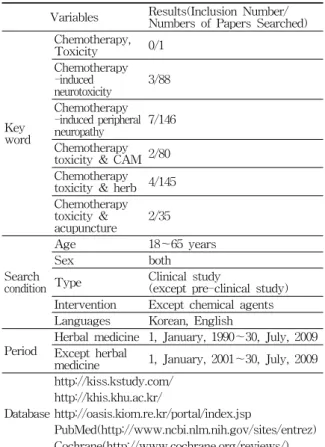
항암 화학요법의 여러 부작용 중 CIPN에 대해 조사하 였다. 조사방법은 전임상시험은 제외하고 사람을 대상으로 실시한 임상논문에 대해 조사하였다. 임상논문은 임상시험 단계, 성별은 구분하지 않았으며, 연령은 성인(18~65세)만 을 대상으로 하였다. 사용된 중재(intervention)로는 화학제 제를 제외한 한약제제, 천연추출물, 항산화제, 식품 및 영 양소, 침구치료, 기타 비약물요법 등 한의학 및 현행 보 완대체의학을 대상으로 하였다(Table 1).
Table 1. Search Conditions and Results
Variables Results(Inclusion Number/
Numbers of Papers Searched)
Key word
Chemotherapy,
Toxicity 0/1
Chemotherapy -induced
neurotoxicity 3/88 Chemotherapy -induced peripheral
neuropathy 7/146
Chemotherapy toxicity & CAM 2/80 Chemotherapy toxicity & herb 4/145 Chemotherapy toxicity &
acupuncture 2/35
Search condition
Age 18~65 years
Sex both
Type Clinical study
(except pre-clinical study) Intervention Except chemical agents
Languages Korean, English
Period
Herbal medicine 1, January, 1990~30, July, 2009 Except herbal
medicine 1, January, 2001~30, July, 2009
Database
http://kiss.kstudy.com/
http://khis.khu.ac.kr/
http://oasis.kiom.re.kr/portal/index.jsp
PubMed(http://www.ncbi.nlm.nih.gov/sites/entrez) Cochrane(http://www.cochrane.org/reviews/)
2. 자료수집 및 분석방법
국내자료수집은 학술 데이터베이스 검색사이트(http://
kiss.kstudy.com/), 경희대학교 중앙도서관(http://khis.khu.ac.kr/),
전통의학정보포털(http://oasis.kiom.re.kr/portal/index.jsp) 웹사이트에서 ‘항암제’와 ‘독성’이라는 주제어로 검색하였 다. 수집 결과 국내에서는 1편의 논문이 검색되었으나, 사람을 대상으로 실시한 논문이 아니어서 제외하였다.
국외자료수집은 Pubmed(www.pubmed.com)와 Cochrane (www.cochrane.org/reviews/) 등을 주로 이용하였다. 주 제어는 ‘hemotherapy-induced neurotoxicity’, ‘chemotherapy- induced peripheral neuropathy’, ‘chemotherapy toxicity’
& ‘herb’, ‘chemotherapy toxicity’ & ‘acupuncture’, ‘chemotherapy toxicity’ & ‘CAM’이었다. 한국어로 영어로 한정하여 수 집하였다. 한약제제의 경우 검색기간은 1990년 1월 1일부 터 2009년 7월 30일로, 비타민과 영양제제 등은 2001년부 터 1월 1일부터 2009년 7월 30일까지로 한정하였다.
3. 검색결과
Pubmed에서는 ‘chemotherapy-induced neurotoxicity’
로 88건이, ‘chemotherapy-induced peripheral neuropathy’
로 검색하여 146건의 논문이 검색되었다. 이 중 조건에 해당하는 논문(임상시험, 18~65세 대상 등)은 각 3편과 7편 이 해당하여 10건을 선정하였다. ‘Chemotherapy toxicity’와
‘CAM’(complementary and alternative medicine)로 검색하니 80편이 검색되었으며, 이 중 조건에 해당하는 논문은 2편 이 있었다. ‘Chemotherapy toxicity’와 ‘herb’로 검색하니 총 145건이 검색되었으며, 이 중 조건에 해당하는 논문 은 4편이었다. ‘Chemotherapy toxicity’와 ‘acupuncture’로 검색한 결과 35편이 검색되었으며 이 중 조건에 해당하는 논문은 2편이었다. 이 중에서 중복되는 논문은 한 건도 없 었다. 국내에서도 한 건의 논문이 검색되었으나, 임상시험 논문이 아니기에 제외하였다. 이렇게 검색된 18편의 논문 (Table 1) 중 참고문헌을 살펴보아 해당되는 논문 7편을 추가하여 총 25편의 논문을 바탕으로 분석하였다.
결 과
1. CIPN 원인 및 발병기전
항암제가 CIPN을 유발하는 기전에 대해 여러 연구가 있었다. 기존 연구 결과를 요약하면 Fig. 1과 같다6,7).
Fig. 1. CIPN agents' mechanism of action
2. 신경독성을 일으키는 항암제 목록 (in common use), 발생빈도 및 증상
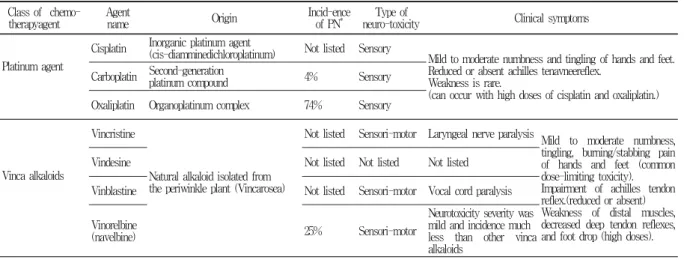
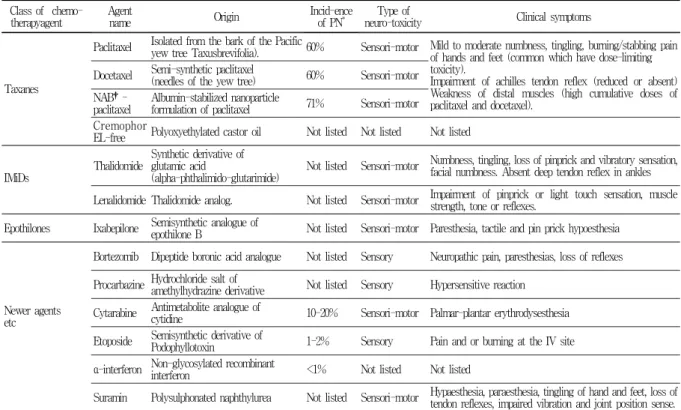
신경독성이 보고된 항암제의 명칭, 기원, 빈도, 신경독 성 종류, 증상은 Table 2와 같다6,8,9).
3. Current approaches for managing CIPN and summary of clinical trials
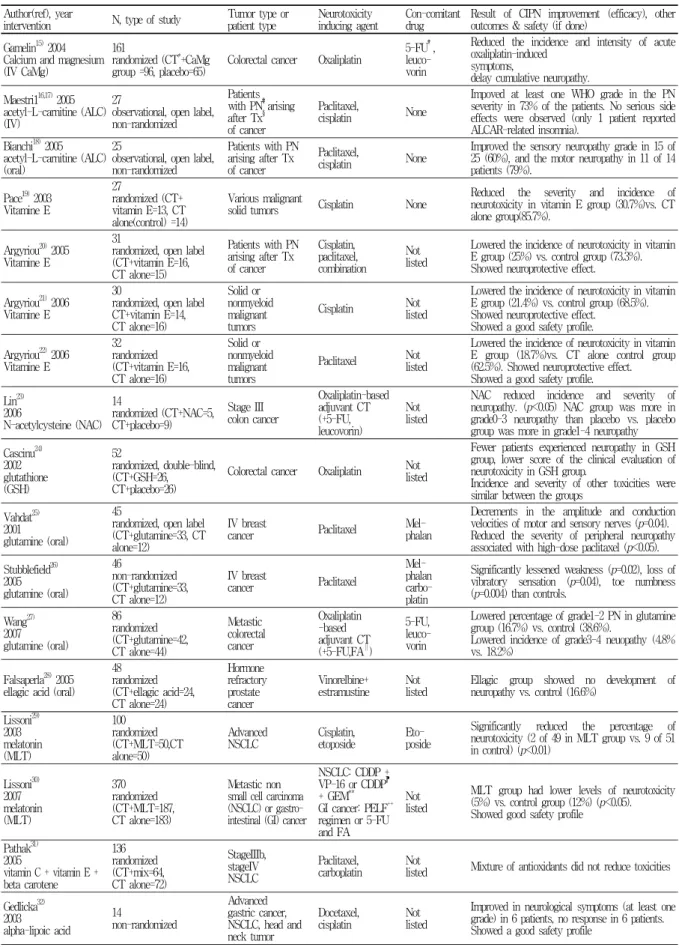
항암제를 제외하고, 항암제 유발 신경독성증상을 예방 또는 치료하기 위해 임상시험을 진행한 현행 한의학 치료 법 목록은 Table 3과 같다10-14). 한약제제로 인한 임상시험 은 4건이 있었으며, 침으로 인한 임상시험은 2건이 있었다.
임상시험을 시행한 보완대체의학 요법들로는 19건이 검색되었다(Table 4)15-34).
Table 2. Lists of Chemotherapy Induced Neuropathy Agents Class of chemo-
therapyagent Agent
name Origin Incid-ence
of PN* Type of
neuro-toxicity Clinical symptoms
Platinum agent
Cisplatin Inorganic platinum agent
(cis-diamminedichloroplatinum) Not listed Sensory
Mild to moderate numbness and tingling of hands and feet.
Reduced or absent achilles tenavneereflex.
Weakness is rare.
(can occur with high doses of cisplatin and oxaliplatin.) Carboplatin Second-generation platinum compound 4% Sensory
Oxaliplatin Organoplatinum complex 74% Sensory
Vinca alkaloids
Vincristine
Natural alkaloid isolated from the periwinkle plant (Vincarosea)
Not listed Sensori-motor Laryngeal nerve paralysis
Mild to moderate numbness, tingling, burning/stabbing pain of hands and feet (common dose-limiting toxicity).
Impairment of achilles tendon reflex.(reduced or absent) Weakness of distal muscles, decreased deep tendon reflexes, and foot drop (high doses).
Vindesine Not listed Not listed Not listed
Vinblastine Not listed Sensori-motor Vocal cord paralysis
Vinorelbine
(navelbine) 25% Sensori-motor
Neurotoxicity severity was mild and incidence much less than other vinca alkaloids
Author(ref), year
intervention N, type of study Tumor type or
patient type Neuro-toxicity
inducing agent Con-comitant
drug Result of CIPN improvement (efficacy), other outcomes & safety (if done)
Wang10)1990 pu tuo ointment +herbmix
70 randomized
Primary liver
cancer No details None Less incidence and severity of pain in treatment group. (96.7%
proved to be effective in alleviating the pain, 83.5% remarkable).
Jiang11) 1996 Fei Ai-Chong Ji62
non-randomized
TNM scale stage II, III,
IV patients No details No
details No details given. Improvements in pain 40%, improvement rated for grade II 89%, for grade III 66%.
Yamamoto12) 2001 Shakuyaku- kanzo-to
10 non- randomized
Patients with muscle pain arising
after treatment of paclitaxel, carboplatin Carbo-platin
Extremely effective(improvement by at least two ranks) in 5 cases, effective(improvement by one rank) in 2 cases, not effective in 3 cases in the prevention of muscle pain, induced by paclitaxel and carboplatin.
No notable adverse reactions developed from TJ-68.
Mok13) 2007 CHM
120 randomized, double-blind, placebo controlled (CT*+CHM†=60, CT+placebo=60)
Breast or colorectal cancer
Adjuvant chemo-
therapy No details Fewer patients experienced severe grade pain in CHM group, and grade 0 pain was 90.9% in CHM group vs. placebo (80.4%).
Alimi14) 2003 auricular acupuncture
90 randomized (ATx‡=29, 2 placebo groups acupuncture at placebo points=28, seeds fixed at placebo points=30)
Patients with chronic peripheral or central neuropathic pain arising after treatment of cancer
Analgesic drugs, coanalgesic drugs
Pain intensity decreased by 36% at 2 months from baseline in the group receiving acupuncture.
Wong3) 2006
acupuncture 5,case series
(prospective) Gynae-cological
cancer Carboplatin,
paclitaxel
Narcotic analgesicdrugs, tricyclic- antidepressant
Improvement of pain, numbness, tingling.
Reduction in analgesic dose.
Gait significantly improved.
No adverse events.
* : chemotherapy. † : Chinese herb medicine. ‡: acupuncture treatment.
Class of chemo- therapyagent Agent
name Origin Incid-ence
of PN* Type of
neuro-toxicity Clinical symptoms
Taxanes
Paclitaxel Isolated from the bark of the Pacific
yew tree Taxusbrevifolia). 60% Sensori-motor Mild to moderate numbness, tingling, burning/stabbing pain of hands and feet (common which have dose-limiting toxicity).
Impairment of achilles tendon reflex (reduced or absent) Weakness of distal muscles (high cumulative doses of paclitaxel and docetaxel).
Docetaxel Semi-synthetic paclitaxel
(needles of the yew tree) 60% Sensori-motor NAB†-
paclitaxel Albumin-stabilized nanoparticle
formulation of paclitaxel 71% Sensori-motor Cremophor
EL-free Polyoxyethylated castor oil Not listed Not listed Not listed
IMiDs Thalidomide Synthetic derivative of glutamic acid
(alpha-phthalimido-glutarimide) Not listed Sensori-motor Numbness, tingling, loss of pinprick and vibratory sensation, facial numbness. Absent deep tendon reflex in ankles Lenalidomide Thalidomide analog. Not listed Sensori-motor Impairment of pinprick or light touch sensation, muscle strength, tone or reflexes.
Epothilones Ixabepilone Semisynthetic analogue of
epothilone B Not listed Sensori-motor Paresthesia, tactile and pin prick hypoesthesia
Newer agents etc
Bortezomib Dipeptide boronic acid analogue Not listed Sensory Neuropathic pain, paresthesias, loss of reflexes Procarbazine Hydrochloride salt of amethylhydrazine derivative Not listed Sensory Hypersensitive reaction
Cytarabine Antimetabolite analogue of
cytidine 10-20% Sensori-motor Palmar-plantar erythrodysesthesia Etoposide Semisynthetic derivative of
Podophyllotoxin 1-2% Sensory Pain and or burning at the IV site α-interferon Non-glycosylated recombinant interferon <1% Not listed Not listed
Suramin Polysulphonated naphthylurea Not listed Sensori-motor Hypaesthesia, paraesthesia, tingling of hand and feet, loss of tendon reflexes, impaired vibration and joint position sense.
* : peripheral neuropathy. †: nanoparticle albumin-bound-paclitaxel.
Table 3. Current CAM Approaches for Managing CIPN and Clinical Trials
Table 4. Acupuncture and Herb for Managing CIPN and Clinical Trials Author(ref), year
intervention N, type of study Tumor type or
patient type Neurotoxicity
inducing agent Con-comitant
drug Result of CIPN improvement (efficacy), other outcomes & safety (if done)
Gamelin15) 2004 Calcium and magnesium (IV CaMg)
161
randomized (CT*+CaMg
group =96, placebo=65) Colorectal cancer Oxaliplatin 5-FU†, leuco- vorin
Reduced the incidence and intensity of acute oxaliplatin-induced
symptoms,
delay cumulative neuropathy.
Maestri116,17) 2005 acetyl-L-carnitine (ALC) (IV)
27
observational, open label, non-randomized
Patients with PN‡arising after Tx§ of cancer
Paclitaxel,
cisplatin None
Impoved at least one WHO grade in the PN severity in 73% of the patients. No serious side effects were observed (only 1 patient reported ALCAR-related insomnia).
Bianchi18) 2005 acetyl-L-carnitine (ALC) (oral)
25
observational, open label, non-randomized
Patients with PN arising after Tx of cancer
Paclitaxel,
cisplatin None Improved the sensory neuropathy grade in 15 of 25 (60%), and the motor neuropathy in 11 of 14 patients (79%).
Pace19) 2003 Vitamine E
27
randomized (CT+
vitamin E=13, CT alone(control) =14)
Various malignant
solid tumors Cisplatin None Reduced the severity and incidence of neurotoxicity in vitamin E group (30.7%)vs. CT alone group(85.7%).
Argyriou20) 2005 Vitamine E
31
randomized, open label (CT+vitamin E=16, CT alone=15)
Patients with PN arising after Tx of cancer
Cisplatin, paclitaxel, combination
Not listed
Lowered the incidence of neurotoxicity in vitamin E group (25%) vs. control group (73.3%).
Showed neuroprotective effect.
Argyriou21) 2006 Vitamine E
30
randomized, open label CT+vitamin E=14, CT alone=16)
Solid or nonmyeloid malignant tumors
Cisplatin Not
listed
Lowered the incidence of neurotoxicity in vitamin E group (21.4%) vs. control group (68.5%).
Showed neuroprotective effect.
Showed a good safety profile.
Argyriou22) 2006 Vitamine E
32 randomized (CT+vitamin E=16, CT alone=16)
Solid or nonmyeloid malignant tumors
Paclitaxel Not
listed
Lowered the incidence of neurotoxicity in vitamin E group (18.7%)vs. CT alone control group (62.5%). Showed neuroprotective effect.
Showed a good safety profile.
Lin23) 2006
N-acetylcysteine (NAC) 14
randomized (CT+NAC=5, CT+placebo=9)
Stage III colon cancer
Oxaliplatin-based adjuvant CT (+5-FU, leucovorin)
Not listed
NAC reduced incidence and severity of neuropathy. (p<0.05) NAC group was more in grade0-3 neuropathy than placebo vs. placebo group was more in grade1-4 neuropathy Cascinu24)
2002 glutathione (GSH)
52
randomized, double-blind, (CT+GSH=26, CT+placebo=26)
Colorectal cancer Oxaliplatin Not listed
Fewer patients experienced neuropathy in GSH group, lower score of the clinical evaluation of neurotoxicity in GSH group.
Incidence and severity of other toxicities were similar between the groups
Vahdat25) 2001 glutamine (oral)
45
randomized, open label (CT+glutamine=33, CT alone=12)
IV breast
cancer Paclitaxel Mel-
phalan
Decrements in the amplitude and conduction velocities of motor and sensory nerves (p=0.04).
Reduced the severity of peripheral neuropathy associated with high-dose paclitaxel (p<0.05).
Stubblefield26) 2005 glutamine (oral)
46
non-randomized (CT+glutamine=33, CT alone=12)
IV breast
cancer Paclitaxel
Mel- phalan carbo- platin
Significantly lessened weakness (p=0.02), loss of vibratory sensation (p=0.04), toe numbness (p=0.004) than controls.
Wang27) 2007 glutamine (oral)
86 randomized (CT+glutamine=42, CT alone=44)
Metastic colorectal cancer
Oxaliplatin -based adjuvant CT (+5-FU,FA‖)
5-FU, leuco- vorin
Lowered percentage of grade1-2 PN in glutamine group (16.7%) vs. control (38.6%).
Lowered incidence of grade3-4 neuopathy (4.8%
vs. 18.2%) Falsaperla28) 2005
ellagic acid (oral) 48 randomized (CT+ellagic acid=24, CT alone=24)
Hormone refractory prostate cancer
Vinorelbine+
estramustine Not
listed Ellagic group showed no development of neuropathy vs. control (16.6%)
Lissoni29) 2003 melatonin (MLT)
100 randomized (CT+MLT=50,CT alone=50)
Advanced
NSCLC Cisplatin,
etoposide Eto-
poside
Significantly reduced the percentage of neurotoxicity (2 of 49 in MLT group vs. 9 of 51 in control) (p<0.01)
Lissoni30) 2007 melatonin (MLT)
370 randomized (CT+MLT=187, CT alone=183)
Metastic non small cell carcinoma (NSCLC) or gastro- intestinal (GI) cancer
NSCLC: CDDP + VP-16 or CDDP⁋ + GEM**
GI cancer: PELF++
regimen or 5-FU and FA
Not listed
MLT group had lower levels of neurotoxicity (5%) vs. control group (12%) (p<0.05).
Showed good safety profile
Pathak31) 2005
vitamin C + vitamin E + beta carotene
136 randomized (CT+mix=64, CT alone=72)
StageIIIb, stageIV NSCLC
Paclitaxel,
carboplatin Not
listed Mixture of antioxidants did not reduce toxicities Gedlicka32)
2003 alpha-lipoic acid
14
non-randomized
Advanced gastric cancer, NSCLC, head and neck tumor
Docetaxel,
cisplatin Not
listed
Improved in neurological symptoms (at least one grade) in 6 patients, no response in 6 patients.
Showed a good safety profile
Author(ref), year
intervention N, type of study Tumor type or
patient type Neurotoxicity
inducing agent Con-comitant
drug Result of CIPN improvement (efficacy), other outcomes & safety (if done)
Love33) 2009 Neurosol hydrotherapy, warming socks and gloves, Epsom salt baths
Case report IV colon cancer Oxaliplatin Not
listed Resolved PN completely
Cata34) 2004 Neurosol Spinal cord stimulation (SCS)
2
case reports Patients with peripheral neuropathic after pain arising Tx of cancer
Anal- gesic medi- cation
Improved pain scores and facilitated a reduction of medications. Both patients reported improved gait and one of them also reported an increase in leg flexibility
* : chemotherapy. †: fluorouracil. ‡: peripheral neuropathy. § : treatment. ‖: folinic acid. ⁋ : cisplatin. ** : gemcitabine.
++ : regimen (CDDP, epirubicin,leucovorin,5-FU).
고 찰
암의 종류에 따라 사용하는 항암제 종류, 양, 치료 횟 수가 다르므로 독성 및 부작용 발생률이 다르지만, 일단 누적 총 투여량이 늘어날수록 독성 발병률이 높아진다고 알려져 있다. 그렇기 때문에 화학요법을 실시하면서 항상 이러한 독성 및 부작용에 대해 주의해야만 한다. 여러 독 성 작용 중에서, CIPN은 외형적으로 잘 나타나지 않고, 환자의 자각증상이 주된 증상이기 때문에, 환자는 남이 알아주지 않다는 괴로움을 호소하고, 삶의 질과 치료율이 나빠지는 경향이 있다. 기존에는 CIPN을 줄여주기 위하 여 진통제, 이뇨제, 수액 등을 활용하여 혈중 농도를 조 절하는 방법을 이용하였으나, 현실적으로 어려움이 있다.
따라서 항암효과를 그대로 유지하면서, 신경독성 유발을 줄이는 새로운 치료법이 중요하고 시급하다고 할 수 있 다. 그렇지만 현재 항암 치료의 문제점을 극복하는 새로 운 치료법을 개발하고 임상시험을 통해 검증한 뒤 사용 하려면 막대한 자본과 시간이 필요하다. 따라서 기존에 효과를 보이는 항암제들의 부작용 감소, 누적 투여 용량 감소 등 효율적인 항암치료를 계속하게 하는 치료법 연 구도 반드시 필요하다. 현재까지 CIPN을 완화하고 치료 하기 위한 다양한 방법들이 연구되고 있지만, 확실한 치 료방법은 없는 실정이며, 때때로 CIPN 증상을 치료하거 나 예방하는 치료법 자체에서의 부작용도 보고 되고 있 는 실정이다.
한의학적 치료법 및 보완대체요법들이 ‘자연’기원이라 는 이유 때문에 안전성면에서 우위에 있다는 인식이 예 전부터 있으며35), 오랜 역사가 증명하듯 안전성 면에서 유리한 면은 사실이다. 그렇지만 한약이나 생약들도 약제 이므로 일반 환자보다 취약한 암 환자에게 더욱 독성이 있을 수 있기 때문에36) 효용성 연구뿐만이 아니라 안전 성 연구도 매우 필요하다고 할 수 있다. 따라서 본 연구 에서는 CIPN을 예방 완화 치료하기 위한 한의학 및 보 완대체 치료법을 살펴보고 이들을 바탕으로 한 임상시험 연구에 대해 조사 분석하고자 하였다.
CIPN을 일으키는 화학요법제는 종류가 다양하였으며, 빈도가 기록되지 않은 경우부터 최대 74%까지 보고되었다.
심각한 CIPN은 단일항암화학요법제제일 경우에는 3~7%, 복합항암화학요법제일 경우에는 무려 38%까지 생긴다는 보 고도 있다37). 이 외에도 5-Fluorouracil, 5-Azacytedine,
Gemcitabine, Hexamethylmelamine, Ifosphamide, Misonidazole, VM-26(Teniposide)4) 등이 있는데, 이들 약제에 대해서는 아직 구체적으로 밝혀진 바가 없어 Table에는 정리하지 않았다. 항암제 유형별로 신경독성 증상을 보이는 사례가 적지 않았고, CIPN 발생 빈도는 약물마다 서로 달랐으며, 사용 빈도가 낮은 약물의 경우는 발생 빈도조차 알 수 없었다. 또한 보고된 발생 빈도 자체도 확신할 수 없다는 문제점도 있는데, 이는 표준화된 진단법, 잠재 환자를 모 니터링하는 표준화된 방법이 없기 때문이라고 추측할 수 있다. 특히 심각도에서는 환자에 비해 의사가 낮게 신고 하는 경우, 환자가 과대하게 의사에게 설명하는 등의 문 제점이 있다.
발생한 증상들을 살펴보면, CIPN agents들은 주로 감 각 이상을 야기하며, 사지말단의 통증을 큰 특징으로 한 다. CIPN의 증상을 요약하면, 감각신경, 감각운동 신경병 증이 대부분이며, 자율신경 기능 장애는 흔하지 않은 증 상으로 특수한 경우에 보였다38). CIPN은 주관적 증상이 대부분이기 때문에 객관화 하는데 어려움이 있지만, 해결 을 위해 전문가 집단이 모여서, CIPN의 정확한 진단기준, 보고방법, 측정도구에 대한 개발과 협의가 필요할 것으로 보인다.
CIPN을 치료하는 본초로는 성요한 풀, 은행 등이 거 론되기는 하였으나 이 본초들은 임상시험을 거치지 않았 고, CIPN을 위한 임상시험으로는 한약제제 4종류, 침 2 종류의 연구가 있었으며, 기타 비타민제, 영양제 등을 포 함하는 보완대체요법으로는 19건이 검색되었다. 기존의 임상시험을 분석한 결과 진단기준 및 측정도구 등이 다 양하게 사용되었으며, 투여방법, 임상시험 디자인, 종양 종류 등이 서로 달라 일괄적으로 비교하기에는 어려웠다 (Table 2, Table 3).
한약제제 임상시험의 경우 피험자 수는 10명에서 120 까지 다양하였으며, 총 4건의 임상연구 중 무작위 배정의 임상시험은 2건이 있었다. 한약제제 연구가 4건으로 매우 적기 때문에 한의학적 접근이 어렵다고 생각되지만, 그만 큼 미개척분야라고 생각된다.
25건의 임상연구에 대해 사용된 중재(intervention)는 다양하였다. 한약제제에 대한 최신 연구는 매우 부족하였 으며, 1990년대의 논문은 연구 설계나 중재에 대해 자세 하게 기술되어 있지 않아, 유효하다는 결론을 내리기 어 려운 상황이다. 25건의 임상연구 중 1건의 임상연구
(Pathak31) 등)를 제외하고는 비교적 효과가 있다고 결론 을 내리기 어려웠다.
대부분의 임상연구 논문에서 안전성을 함께 본 연구는 25편 중에 6편 밖에 해당하지 않았으며, 나머지 논문은 유효성만을 살펴보았다. 시간이 흐름에 따라 악화되는 암 의 특성 때문에 안전성을 보기 어려운 점도 있지만, 반드 시 유효성 외에도 안전성 연구가 필요하다고 생각된다.
위에서 분석한 25편의 임상시험 논문들이 사용한 측정 도구로는 신경보호효과, 증상완화지속(symptomatic relief persistancy), 2-or 5-year survival, CIPN 발생일, 반응 평균 시간(median time to response), 화학요법내성(chemotherapy toleration), 항암 활동감소 여부, 기존 항암제와의 상호작 용 여부, 삶의 질 개선, 일상생화능력(activities of daily living, ADL) 등으로 다양했으나, 발생률과, CIPN 증상의 중증도 감소(incidence, reduction of CIPN symptom severity)가 가장 흔하고 많았다. 이들 25건의 임상연구는 복용량, 복용방법, 급성, 만성 구분, 증상의 분류 등이 체 계적이고 구체적이지 않았다.
항암제로 유발된 신경독성을 치료하기 위해 한의학 및 보완대체요법 약물학적 치료법을 병행하는 경우 기존 항 암제와의 상호작용도 결과지표로 함께 보고 임상시험을 수행한 연구는 단 한 건으로(Cascinu24) 등, Wang27) 등), 향후 이에 대한 연구가 같이 실시되어야 할 것으로 사료 된다.
연구 디자인이 워낙 다양하기에 여기서 각각 임상연구 에 대한 질 평가는 하지 않았다. 보다 나은 임상시험 연구를 위하여 위에서 언급한 단점을 개선해, 개발한 후보물질의 유효 성과 안전성을 정확히 입증할 만한 임상시험 디자인 고안도 향후 체계적으로 개발해 가야 할 문제이다.
결 론
CIPN을 관리하기 위하여 기존에 실시된 임상연구들을 분석한 결과 다음과 같은 결론을 얻었다.
1. 아직 한약제제 및 보완대체 요법도 수가 적으며 이 들에 관한 임상연구는 부족한 실정하며, 중재, 설계, 시술방법, 시술 종류 등이 매우 다양하였다.
2. 효과적인 임상연구를 위해 진단기준, 척도 개발, 보 고방법 등에 대해 개발 연구를 통하여 표준화를 이 루어야 할 것으로 사료된다.
3. CIPN 임상연구시에 안전성 및 약물들 간 상호작용 에 대한 연구를 동시에 실시해야 할 것이다.
향후 암의 유병률이 증가하면서, CIPN 증상의 환자들 은 더욱 많아질 것이다. 이를 개선하기 위해서는 상대적 으로 안전하고 효과 있는 한의학 및 CAM제제 후보물질 들의 개발과 함께 이들을 검증하는 임상시험의 방법을 표준화하여, 잘 설계된, 적절한 피험자를 모집하여, 임상
시험을 실시해야 할 것으로 판단되며, 미개척분야로서 한 의학이 해야 할 역할이 많을 것으로 생각한다.
감사의 글
이 논문은 2009년도 정부(교육과학기술부)의 재원으로 한국과학재단의 지원을 받아 수행된 연구임(No. 2009- 0063466)
참고문헌
1. Windebank AJ, Grisold W. Chemotherapy-induced neuropathy. J Peripher Nerv Syst. 2008 ; 13(1) : 27-46.
2. Hilkens PH, ven den Bent MJ. Chemotherapy- induced peripheral neuropathy. J Peripher Nerv Syst. 1997 ; 2(4) : 350-61.
3. Wong R, Sagar S. Acupuncture treatment for chemotherapy- induced peripheral neuropathy-a case series. Acupunct Med. 2006 ; 24(2) : 87-91.
4. Head KA. Peripheral neuropathy: pathogenic mechanisms and alternative therapies. Altern Med Rev. 2006 ; 11(4) : 294-329.
5. Brunelli B, Gorson KC. The use of complementary and alternative medicines by patients with peripheral neuropathy. J Neurol Sci. 2004 ; 15 ; 218(1-2) : 59-66.
6. Airley R. Cancer chemotherapy. Chichester West Sussex Hoboken NJ : John & Wiley. 2009 : 95-104.
7. Park SB, Krishnan AV, Lin CS-Y, Goldstein D, Friedlander M, Kiernan MC. Mechanisms Underlying Chemotherapy-Induced Neurotoxicity and the Potential for Neuroprotective Strategies. Current Medicinal Chemistry. 2008 ; 15(29) : 3081-3094.
8. Perry MC, Yarbropp JW. Toxicity of chemotherapy.
Orlando : Grune & Stratton. 1984 : 365-477.
9. Wilkes G. Peripheral neuropathy related to chemotherapy.
Semin Oncol Nurs. 2007 ; 23(3) : 162-73.
10. Wang DL. Analysis of 70 cases of primary liver carcinoma treated by pu tuo ointment and herbs.
Zhong Xi Yi Jie He Za Zhi. 1990 ; 10(12) : 723-5.
11. Jiang L, Han Y. Relieving cancerous pain and improving the survival quality with fei ai chong ji.
J Tradit Chin Med. 1996 ; 16(2) : 98-100.
12. Yamamoto K, Hoshiai H, Noda K. Effects of shakuyaku-kanzo-to on muscle pain from combination chemotherapy with paclitaxel and carboplatin.
Gynecol Oncol. 2001 ; 81(2) : 333-4.
13. Mok TS, Yeo W, Johnson PJ, Hui P, Ho WM, Lam KC, Xu M, Chak K, Chan A, Wong H, Mo F, Zee B. A double-blind placebo-controlled randomized study of Chinese herbal medicine as complementary therapy for reduction of chemotherapy-induced toxicity. Annals of Oncology. 2007 ; 18(4) : 768-74.
14. Alimi D, Rubino C, Pichard-Léandri E, Fermand- Brulé S, Dubreuil-Lemaire ML, Hill C. Analgesic effect of auricular acupuncture for cancer pain: a randomized, blinded, controlled trial. J Clin Oncol.
2003 ; 15 ; 21(22) : 4120-6.
15. Gamelin L, Boisdron-Celle M, Delva R, Guérin- Meyer V, Ifrah N, Morel A, Gamelin E. Prevention of oxaliplatin-related neurotoxicity by calcium and magnesium infusions: a retrospective study of 161 patients receiving oxaliplatin combined with 5-Fluorouracil and leucovorin for advanced colorectal cancer. Clin Cancer Res. 2004 ; 10 : 4055-61.
16. Maestri A, De Pasquale CA, Cundari S, Zanna C, Cortesi E, Crinò L. A pilot study on the effect of acetyl-L-carnitine in paclitaxel- and cisplatin- induced peripheral neuropathy. Tumori. 2005 ; 91(2) : 135-8.
17. Cavaletti G, Zanna C. Current status and future prospects for the treatment of chemotherapy- induced peripheral neurotoxicity. European Journal of Cancer. 2002 ; 38 : 1832-1837.
18. Bianchi G, Vitali G, Caraceni A, Ravaglia S, Capri G, Cundari S, Zanna C, Gianni L. Symptomatic and neurophysiological responses of paclitaxel- or cisplatin-induced neuropathy to oral acetyl-L- carnitine. Eur J Cancer. 2005 ; 41(12) : 1746-50.
19. Pace A, Savarese A, Picardo M, Maresca V, Pacetti U, Del Monte G, Biroccio A, Leonetti C, Jandolo B, Cognetti F, Bove L. Neuroprotective effect of vitamin E supplements in patients treated with cisplatin chemotherapy. J Clin Oncol. 2003 ; 21(5) : 927-31.
20. Argyriou AA, Chroni E, Koutras A, Ellul J, Papapetropoulos S, Katsoulas G, Iconomou G, Kalofonos HP. Vitamin E for prophylaxis against chemotherapy-induced neuropathy: a randomized controlled trial. Neurology. 2005 ; 64(1) : 26-31.
21. Argyriou AA, Chroni E, Koutras A, Iconomou G, Papapetropoulos S, Polychronopoulos P, Kalofonos HP. A randomized controlled trial evaluating the efficacy and safety of vitamin E supplementation for protection against cisplatin-induced peripheral neuropathy: final results. Support Care Cancer.
2006 ; 14(11) : 1134-40.
22. Argyriou AA, Chroni E, Koutras A, Iconomou G, Papapetropoulos S, Polychronopoulos P, Kalofonos HP. Preventing paclitaxel-induced peripheral neuropathy: a phase II trial of vitamin E supplementation. J Pain Symptom Manage. 2006 ; 32(3) : 237-44.
23. Lin PC, Lee MY, Wang WS, Yen CC, Chao TC, Hsiao LT, Yang MH, Chen PM, Lin KP, Chiou TJ. N-acetylcysteine has neuroprotective effects against oxaliplatin-based adjuvant chemotherapy in colon cancer patients: preliminary data. Support Care Cancer. 2006 ; 14(5) : 484-7.
24. Cascinu S, Catalano V, Cordella L, Labianca R, Giordani P, Baldelli AM, Beretta GD, Ubiali E, Catalano G. Neuroprotective effect of reduced glutathione on oxaliplatin-based chemotherapy in advanced colorectal cancer: a randomized, double- blind, placebo-controlled trial. J Clin Oncol. 2002 ; 20(16) : 3478-83.
25. Vahdat L, Papadopoulos K, Lange D, Leuin S, Kaufman E, Donovan D, Frederick D, Bagiella E, Tiersten A, Nichols G, Garrett T, Savage D, Antman K, Hesdorffer CS, Balmaceda C. Reduction of paclitaxel-induced peripheral neuropathy with glutamine. Clin Cancer Res. 2001 ; 7(5) : 1192-7.
26. Stubblefield MD, Vahdat LT, Balmaceda CM, Troxel AB, Hesdorffer CS, Gooch CL. Glutamine as a neuroprotective agent in high-dose paclitaxel- induced peripheral neuropathy: a clinical and electrophysi Troic study. Clin Oncol (R Coll Radi T). 2005 ; 17(4) : 271-6.
27. Wang WS, Lin JK, Lin TC, Chen WS, Jiang JK, Wang HS, Chiou TJ, Liu JH, Yen CC, Chen PM.
Oral glutamine is effective for preventing oxaliplatin-induced neuropathy in colorectal cancer patients. Oncologist. 2007 ; 12(3) : 312-9.
28. Falsaperla M, Morgia G, Tartarone A, Ardito R, Romano G. Support ellagic acid therapy in patients with hormone refractory prostate cancer (HRPC) on standard chemotherapy using vinorelbine and estramustine phosphate. Eur Urol. 2005 ; 47(4) : 449-54.
29. Lissoni P, Chilelli M, Villa S, Cerizza L, Tancini G. Five years survival in metastatic non-small cell lung cancer patients treated with chemotherapy alone or chemotherapy and melatonin: a randomized trial. J Pineal Res. 2003 ; 35(1) : 12-5.
30. Lissoni P. Biochemotherapy with standard chemotherapies plus the pineal hormone melatonin in the treatment of advanced solid neoplasms. Paris : Pathol Biol.
2007 ; 55(3-4) : 201-4.
31. Pathak AK, Bhutani M, Guleria R, Bal S, Mohan A, Mohanti BK, Sharma A, Pathak R, Bhardwaj NK, Prasad KN, Kochupillai V. Chemotherapy alone vs. chemotherapy plus high dose multiple antioxidants in patients with advanced non small cell lung cancer. J Am Coll Nutr. 2005 ; 24(1) : 16-21.
32. Gedlicka C, Kornek GV, Schmid K, Scheithauer W. Amelioration of docetaxel/cisplatin induced polyneuropathy by alpha-lipoic acid. Ann Oncol.
2003 ; 14(2) : 339-40.
33. Love SS, Weizer K. Successful Treatment of Oxaliplatin-Induced Peripheral Neuropathy with Naturopathy. International Journal of Naturopathic Medicine. 2009 ; 4(1) : 39-41.
34. Cata JP, Cordella JV, Burton AW, Hassenbusch SJ, Weng HR, Dougherty PM. Spinal cord
stimulation relieves chemotherapy-induced pain: a clinical case report. J Pain Symptom Manage. 2004 ; 27(1) : 72-8.
35. Tascilar M, de Jong FA, Verweij J, Mathijssen RH. Complementary and alternative medicine during cancer treatment: beyond innocence. Oncologist.
2006 ; 11(7) : 732-41.
36. Niggemann B, Grüber C. Side-effects of complementary and alternative medicine. Allergy. 2003 ; 58(8) : 707-16.
37. Visovsky C, Collins M, Abbott L, Aschenbrenner J, Hart C. Putting evidence into practice: evidence- based interventions for chemotherapy-induced peripheral neuropathy. Clin J Oncol Nurs. 2007 ; 11(6) : 901-13.
38. Kaley TJ, Deangelis LM. Therapy of chemotherapy- induced peripheral neuropathy. Br J Haematol.
2009 ; 145(1) : 3-14.