반응표면분석법 이용한 더덕 추출조건의 최적화
김이슬․김성호 대구대학교 식품공학과
Optimization of Deodeok (Codonopsis lanceolata) Extraction Condition Using Response Surface Methodology
Yi-Seul Kim and Seong-Ho Kim Department of Food Engineering, Daegu University
ABSTRACT The deodeok extraction conditions were optimized by a response surface methodology (RSM). The physicochemical properties and major components of the deodeok extracts were analyzed. A central composite design was applied to examine the effects of three independent variables: solvent to sample ratio (10∼30 mL/g; X1), extraction temperature (70∼90°C; X2), and extraction time (1∼5 hour; X3). The extraction conditions were optimized with the characteristics of the extracts as a dependent variable. As a result, the extraction yields were 35.01∼71.53% and the coefficient (R2) of the derived equation from the response surface regression for extraction yield was 0.9574.
The total sugar and reducing sugar contents in all extracts were 3.19∼6.04 mg/mL and 1.58∼3.11 mg/mL, respectively, which were within the 1% significance level. The crude saponin contents in all extraction samples were 0.09∼0.17%
with a R2 value of 0.9373 and were within the 1% significance level. The lobetyolin content as a major component in all extraction samples was 16.72∼32.82 μg/mL with a R2 value of 0.9791 that was within the 1% significance level. The optimal conditions based on the superimposing of the four-dimensional RSM on the crude saponin and lobetyolin contents under various conditions were established as follows: solvent to sample ratio, 12 mL/g; extraction temperature, 75°C; and extraction time, 3 hours.
Key words: deodeok, Codonopsis lanceolata, extraction condition, response surface methodology
Received 22 January 2019; Accepted 20 February 2019 Corresponding author: Seong-Ho Kim, Department of Food Engin- eering, Daegu University, Gyeongsan, Gyeongbuk 38453, Korea E-mail: [email protected], Phone: +82-53-850-6536
Author information: Yi-Seul Kim (Graduate student), Seong-Ho Kim (Professor)
서 론
더덕(Codonopsis lanceolata)은 한국을 비롯한 중국 및 일본의 산간지방에서 야생하는 꽃초롱과의 근채류이다(Lee 등, 2013a). 더덕은 한방에서 폐를 보호하고 강장, 해열, 거 담, 천식, 진해 등에 효과적인 약용식물로 알려져 있다(Jung 등, 2012). 더덕은 비타민 B1, B2가 풍부하며(Lee 등, 2013b), saponin, polyphenol, polyacetylene 등과 같은 기능성분 들로 인하여 고지방식이로 인한 혈청 및 간의 중성지질과 총 콜레스테롤의 축적을 효과적으로 억제하였다고 보고되었고 (Han 등, 1998; Kim 등, 1993, Won과 Oh, 2007; Han 등, 2004), 항산화(Jeong 등, 1996), 항돌연변이 및 항종양(Kim 등, 2009), 세포독성(Kim 등, 1998) 및 더덕과 일부 한약재 열수 추출물의 혼합비율에 따른 생리활성에 관한 연구(Oh 와 Kim, 2006; Oh와 Kim, 2007) 등의 생리활성이 보고되었다.
예로부터 더덕은 독특한 맛과 향으로 인해 구이, 무침, 누름적, 장아찌 등으로 이용되어 왔으며(Kim 등, 2010;
Ahn 등, 2016), 대부분 조리 및 단순가공 식품에 치우쳐있 다. 더덕을 가공식품에 이용한 연구로는 더덕 껍질 농축액을 첨가한 양갱의 품질특성(Chae와 Jung, 2013), 더덕을 첨가 한 된장의 품질 변화(Hong 등, 2010), 더덕을 첨가한 약주 개발(Jin 등, 2008), 더덕 분말을 첨가한 고추장(Kim 등, 2012) 등이 있으며, 최근 더덕의 재배에 성공하여 대량생산 이 가능하게 됨으로써 더욱더 다양한 더덕의 활용증대와 부 가가치를 높일 수 있는 연구가 필요한 실정이다.
반응표면분석법은 최소의 실험횟수로부터 최대의 정보를 얻을 수 있는 실험계획 및 결과 정리 기법이며(Myers, 1971), 변수에 대한 실험데이터를 분석하여 반응변수에 영향을 주 는 유의한 요인 효과들을 최적화하는 데 사용되어 물리적인 시간 절감이 가능하고, 요인별 상호작용도 관찰할 수 있기 때문에 1회 1인자(one factor at a time, OFAT) 실험법으 로 찾아내기 어려운 실제적 최적조건을 구하는 데 사용되고 있다(Zhu 등, 2010).
이에 본 연구에서는 더덕의 식품에 이용과 다양한 활용을 위하여 열수에서 더덕의 유용성분을 다량 함유하도록 추출 할 수 있는 최적조건으로 세 가지 독립변수(추출시간, 추출
Table 1. Levels of extraction conditions in experimental design
Variables Symbols Coded variables
−2 −1 0 1 2
Solvent to sample ratio (mL/g) Temperature (°C)
Time (h)
X1
X2
X3
10 70 1
15 75 2
20 80 3
25 85 4
30 90 5
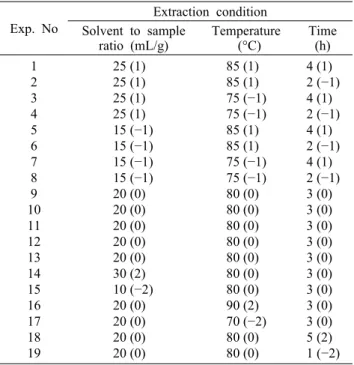
Table 2. Central composite design for the optimization of ex- traction condition
Exp. No
Extraction condition Solvent to sample
ratio (mL/g) Temperature
(°C) Time (h) 1
2 3 4 5 6 7 8 9 10 11 12 13 14 15 16 17 18 19
25 (1) 25 (1) 25 (1) 25 (1) 15 (−1) 15 (−1) 15 (−1) 15 (−1) 20 (0) 20 (0) 20 (0) 20 (0) 20 (0) 30 (2) 10 (−2) 20 (0) 20 (0) 20 (0) 20 (0)
85 (1) 85 (1) 75 (−1) 75 (−1) 85 (1) 85 (1) 75 (−1) 75 (−1) 80 (0) 80 (0) 80 (0) 80 (0) 80 (0) 80 (0) 80 (0) 90 (2) 70 (−2) 80 (0) 80 (0)
4 (1) 2 (−1) 4 (1) 2 (−1) 4 (1) 2 (−1) 4 (1) 2 (−1) 3 (0) 3 (0) 3 (0) 3 (0) 3 (0) 3 (0) 3 (0) 3 (0) 3 (0) 5 (2) 1 (−2) 온도, 용매비)를 반응표면분석법을 통하여 검토하였다.
재료 및 방법
재료
본 연구에서 사용된 더덕은 경북 영양에서 2년간 재배하 여 2017년 11월에 채취한 것을 농업회사법인 (주)들산초 (Gyeongsan, Korea)로부터 제공받았다. 이를 일정 규격 (10±2 cm, 45±3 g)으로 선별하여 세척한 후 50°C에서 18 시간 건조한 다음 분쇄하여 사용하였다.
반응표면분석법을 이용한 더덕 추출조건 최적화
본 실험에서는 추출특성의 모니터링과 추출조건의 최적 화를 위하여 반응표면분석법(response surface method- ology, RSM)(Myers, 1971)을 이용하였고, 추출조건에 대 한 실험계획은 중심합성 계획법(Wanasundara와 Shahidi, 1996)으로 실시하였다. Table 1과 같이 용매비(X1), 추출온 도(X2) 및 추출시간(X3)을 독립변수로 설정하고 각각을 5단 계로 부호화하였으며, 19가지의 추출조건으로 더덕을 추출 하였다(Table 2). 또한 이들 독립변수에 영향을 받은 종속변 수로는 추출수율, 총당, 환원당, 조사포닌, lobetyolin 함량
등을 측정하여 그 값을 회귀분석에 사용하였다. 반응표면 회귀분석을 위해서는 Statistical Analysis System(SAS) program(SAS Institute, 2005)을 사용하였으며 변수들의 특성과 그에 상응하는 최적 추출조건은 예측된 모델식을 바 탕으로 Mathematica program(Abell과 Braselton, 1992) 을 이용하여 4차원 반응표면으로 나타내었다.
총 수용성 당 및 환원당 함량 분석
더덕 추출물의 총당 함량은 phenol-sulfuric acid법(Du- Bois 등, 1956)으로 측정하였다. 즉 시료용액 1 mL에 5%
(v/v) 페놀용액 1 mL와 95% 황산 5 mL를 가하여 발열시킨 후 30분 동안 상온에서 방치하였으며, 분광광도계(UVmini- 1240, Shimadzu, Kyoto, Japan)를 이용하여 470 nm에서 흡광도를 측정하였다. 더덕 추출물의 환원당은 dinitrosali- cylic acid(DNS)법(Miller, 1959)에 따라 측정하였다. 즉 시 료용액 0.5 mL에 DNS액 0.5 mL를 혼합한 후 끓는 물에서 5분 동안 반응시킨 다음 방랭한 것을 분광광도계를 이용하 여 570 nm에서 흡광도를 측정하였다. 총 수용성 당 및 환원 당 함량은 D-(-)-fructose를 표준물질로 사용하여 환산하 였다.
추출수율
추출수율은 추출물 20 mL를 미리 항량을 구한 수기에 취 하여 105°C에 건조시킨 후 그 무게를 측정하여 추출물 조제 에 사용된 건물량에 대한 백분율로써 추출수율을 나타내었 다(Kwon 등, 2003).
조사포닌 함량 측정
더덕 추출물의 조사포닌 함량은 n-butanol 추출법(Lee 등, 2013b)에 따라 정량하였다. 추출시료 30 mL를 diethyl- ether 30 mL로 2회 반복 추출하여 지용성 성분을 제거하였 다. 이후 수포화부탄올 30 mL를 가하여 3회 반복 추출한 후 미리 항량을 구한 농축 플라스크에 회수하여 감압 농축하였 으며, 105°C에서 건조, 항량하여 조사포닌 함량을 구하였다.
Lobetyolin 함량 분석
더덕 추출물의 lobetyolin 함량 분석을 위해 시료를 0.45 µm membrane filter로 여과하여 HPLC(2695 Alliance HPLC, Waters, Milford, MA, USA)로 분석하였다. 분석용 컬럼은 Jupiter Proteo 90 Å column(250×4.6 mm, 4 μm Phenomenex, Torrance, CA, USA)을 사용하였으며, 이동
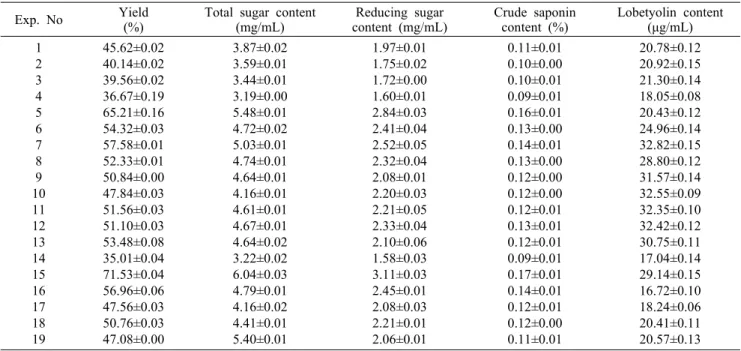
Table 3. Experimental data on yield, total sugar, reducing sugar, crude saponin, and lobetyolin content of deodeok extracts under different extraction condition based on central composite design by response surface analysis
Exp. No Yield
(%) Total sugar content
(mg/mL) Reducing sugar
content (mg/mL) Crude saponin
content (%) Lobetyolin content (μg/mL) 1
2 3 4 5 6 7 8 9 10 11 12 13 14 15 16 17 18 19
45.62±0.02 40.14±0.02 39.56±0.02 36.67±0.19 65.21±0.16 54.32±0.03 57.58±0.01 52.33±0.01 50.84±0.00 47.84±0.03 51.56±0.03 51.10±0.03 53.48±0.08 35.01±0.04 71.53±0.04 56.96±0.06 47.56±0.03 50.76±0.03 47.08±0.00
3.87±0.02 3.59±0.01 3.44±0.01 3.19±0.00 5.48±0.01 4.72±0.02 5.03±0.01 4.74±0.01 4.64±0.01 4.16±0.01 4.61±0.01 4.67±0.01 4.64±0.02 3.22±0.02 6.04±0.03 4.79±0.01 4.16±0.02 4.41±0.01 5.40±0.01
1.97±0.01 1.75±0.02 1.72±0.00 1.60±0.01 2.84±0.03 2.41±0.04 2.52±0.05 2.32±0.04 2.08±0.01 2.20±0.03 2.21±0.05 2.33±0.04 2.10±0.06 1.58±0.03 3.11±0.03 2.45±0.01 2.08±0.03 2.21±0.01 2.06±0.01
0.11±0.01 0.10±0.00 0.10±0.01 0.09±0.01 0.16±0.01 0.13±0.00 0.14±0.01 0.13±0.00 0.12±0.00 0.12±0.00 0.12±0.01 0.13±0.01 0.12±0.01 0.09±0.01 0.17±0.01 0.14±0.01 0.12±0.01 0.12±0.00 0.11±0.01
20.78±0.12 20.92±0.15 21.30±0.14 18.05±0.08 20.43±0.12 24.96±0.14 32.82±0.15 28.80±0.12 31.57±0.14 32.55±0.09 32.35±0.10 32.42±0.12 30.75±0.11 17.04±0.14 29.14±0.15 16.72±0.10 18.24±0.06 20.41±0.11 20.57±0.13
Table 4. Regression coefficient of the predicted quadratic polynomial models on yield, total sugar, reducing sugar, crude saponin, and lobetyolin content of deodeok extracts
Response Quadratic polynomials R2 Significance
Yield Y=101.982956-1.749713X1-0.847307X2-4.280017X3+0.015196X12-
0.000450X1X2+0.005096X22-0.194250X1X3+0.205750X2X3-0.707601X32 0.9574 <0.0001 Total sugar
content
Y=0.804764-0.229973X1+0.223595X2-0.996149X3-0.000376X12+0.002000X1X2
-0.001926X22-0.013000X1X3+0.012500X2X3+0.059358X32 0.8460 0.0091 Reducing sugar
content
Y=7.013125-0.103220X1-0.086753X2-0.317855X3+0.001315X12-0.000050000X1X2
+0.000515X22-0.007250X1X3+0.008250X2X3-0.019628X32 0.9615 <0.0001 Crude saponin
content
Y=0.612382-0.007611X1-0.011078X2-0.018699X3+0.000062162X12+0.000050000X1X2
+0.000062162X22-0.000750X1X3+0.000750X2X3-0.002196X32 0.9373 <0.0001 Lobetyolin
content
Y=-632.782365-3.899230X1+18.937946X2+36.261014X3-0.087557X12+0.092900X1X2
-0.143657X22+0.090500X1X3-0.298500X2X3-2.838919X32 0.9791 <0.0001 상으로는 0.1% acetic acid/acetonitrile(A)과 deionized
water(B)를 사용하였다. 이동상의 비율(A:B)은 15:85(0 min)에서 35:65(25 min), 95:5(40 min), 95:5(50 min), 15:85(55 min), 15:85(60 min)로 순차적으로 변화시켜 측 정하였고, 유속은 0.5 mL/min으로 60분 동안 PDA 267 nm 에서 측정하였다. 표준시료는 한약진흥재단 천연물 물질은 행(National Development Institute of Korean Medicine, Gyeongsan, Korea)으로부터 분양받은 lobetyolin(CAS 136085-37-5, 98%) 1 mg을 HPLC용 증류수 10 mL에 녹여 HPLC 분석용 표준용액으로 사용하였다.
최적 추출조건의 예측 및 실증 시험
모든 반응 변수는 회귀분석(regression analysis)과 분산 분석(ANOVA)을 수행하였고, 이로부터 얻은 이차 회귀식을 통하여 반응모델의 적합성을 검증하였다. 추출조건별 더덕
의 최적 추출조건 예측은 조사포닌 함량과 lobetyolin 함량 에 대한 반응표면을 superimposing 했을 때 중복되는 부분 의 범위에서 최적 추출처리조건을 설정하였다. 또한 예측된 범위에서 임의의 점을 설정하여 회귀식에 대입한 후 그 예측 된 값들에 대하여 동일조건에서 실제 실험을 통하여 얻은 실험치를 비교하고 SAS program의 Student’s t-test로 P<0.05 수준에서 유의성을 검증하였다.
결과 및 고찰
반응표면분석법을 이용한 더덕 추출조건 최적화
반응표면분석법의 반응조건에 따라 더덕 추출조건에 따 른 반응변수 값을 조사한 결과는 Table 3과 같다. 추출수율 은 35.01~71.53%의 범위로 나타났으며, 이를 바탕으로 한 회귀식은 Table 4와 같다. 추출수율에 대한 회귀식의 R2값
Table 5. ANOVA values of the factors for the response surface model on yield, total sugar, reducing sugar, crude saponin, and lobetyolin content of deodeok extracts
Response F-Ratio
Solvent ratio (mL/g) Temperature (°C) Time (h) Yield
Total sugar content Reducing sugar content Crude saponin content Lobetyolin content
44.16***
11.50***
50.10***
28.30***
50.74***
3.51* 0.69 3.55* 2.23 61.80***
3.24* 0.22 2.83* 3.87 33.87***
*Significant at 10% level; **significant at 5% level; ***significant at 1% level.
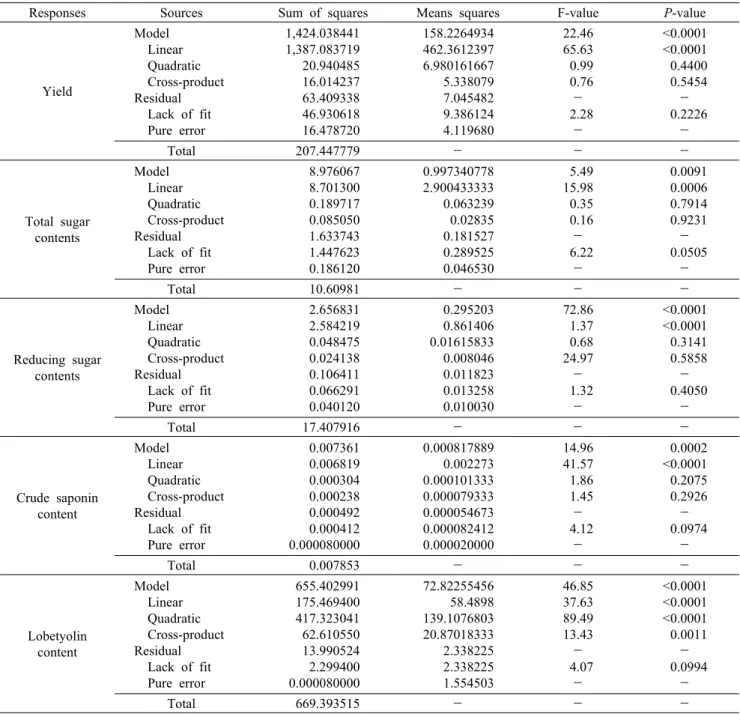
Table 6. Analysis of variance for response of dependent variables on yield, total sugar, reducing sugar, crude saponin, and lobetyolin content of deodeok extracts
Responses Sources Sum of squares Means squares F-value P-value
Yield
Model Linear Quadratic Cross-product Residual Lack of fit Pure error
1,424.038441 1,387.083719 20.940485 16.014237 63.409338 46.930618 16.478720
158.2264934 462.3612397 6.980161667 5.338079 7.045482 9.386124 4.119680
22.46 65.63 0.99 0.76
- 2.28
-
<0.0001
<0.0001 0.4400 0.5454
- 0.2226
-
Total 207.447779 - - -
Total sugar contents
Model Linear Quadratic Cross-product Residual Lack of fit Pure error
8.976067 8.701300 0.189717 0.085050 1.633743 1.447623 0.186120
0.997340778 2.900433333 0.063239 0.02835 0.181527 0.289525 0.046530
5.49 15.98 0.35 0.16
- 6.22
-
0.0091 0.0006 0.7914 0.9231
- 0.0505
-
Total 10.60981 - - -
Reducing sugar contents
Model Linear Quadratic Cross-product Residual Lack of fit Pure error
2.656831 2.584219 0.048475 0.024138 0.106411 0.066291 0.040120
0.295203 0.861406 0.01615833 0.008046 0.011823 0.013258 0.010030
72.86 1.37 0.68 24.97
- 1.32
-
<0.0001
<0.0001 0.3141 0.5858
- 0.4050
-
Total 17.407916 - - -
Crude saponin content
Model Linear Quadratic Cross-product Residual Lack of fit Pure error
0.007361 0.006819 0.000304 0.000238 0.000492 0.000412 0.000080000
0.000817889 0.002273 0.000101333 0.000079333 0.000054673 0.000082412 0.000020000
14.96 41.57 1.86 1.45
- 4.12
-
0.0002
<0.0001 0.2075 0.2926
- 0.0974
-
Total 0.007853 - - -
Lobetyolin content
Model Linear Quadratic Cross-product Residual Lack of fit Pure error
655.402991 175.469400 417.323041 62.610550 13.990524 2.299400 0.000080000
72.82255456 58.4898 139.1076803 20.87018333 2.338225 2.338225 1.554503
46.85 37.63 89.49 13.43
- 4.07
-
<0.0001
<0.0001
<0.0001 0.0011
- 0.0994
-
Total 669.393515 - - -
은 0.9574로 높은 신뢰도를 보였으며, P-value는 1% 이내 유의수준을 보였다(Table 4). 추출수율의 추출조건에 대한
영향에서 용매비는 1% 이내의 유의수준을 보이는 것으로 확인되며, 추출온도와 시간은 10% 이내 유의수준을 보였다
Fig. 1. Response surface for yield in deodeok extracts at con- stant values (yield: 40-45-50%) according to temperature, time, and solvent ratio.
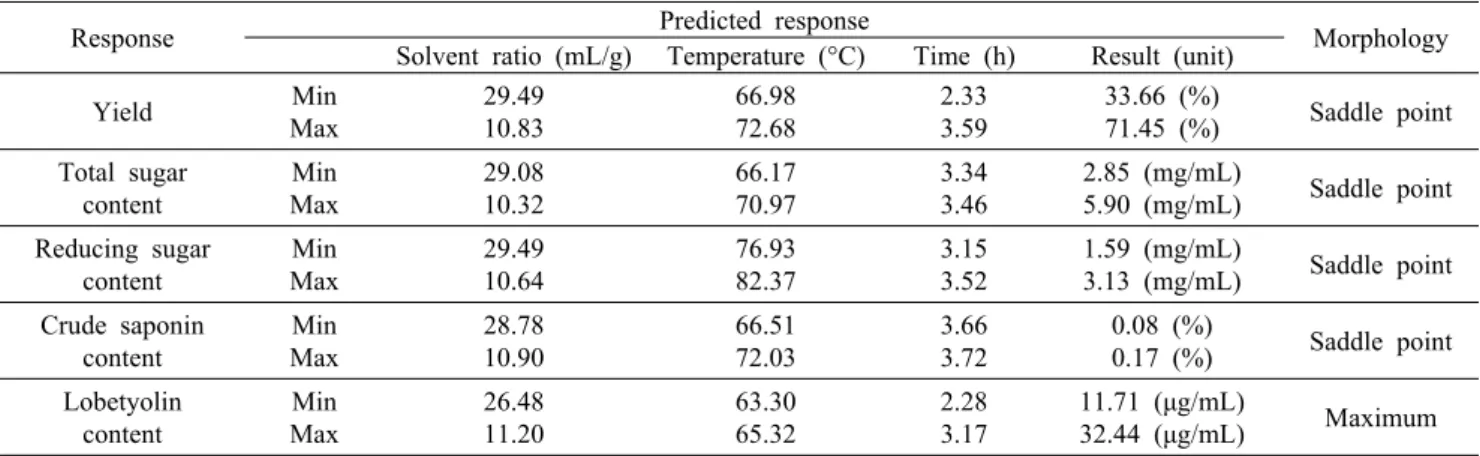
Table 7. Predicted levels of extraction conditions for the maximum responses by the ridge analysis on yield, total sugar, reducing sugar, crude saponin, and lobetyolin content of deodeok extracts
Response Predicted response Morphology
Solvent ratio (mL/g) Temperature (°C) Time (h) Result (unit)
Yield Min
Max
29.49 10.83
66.98 72.68
2.33 3.59
33.66 (%)
71.45 (%) Saddle point Total sugar
content
Min Max
29.08 10.32
66.17 70.97
3.34 3.46
2.85 (mg/mL)
5.90 (mg/mL) Saddle point Reducing sugar
content
Min Max
29.49 10.64
76.93 82.37
3.15 3.52
1.59 (mg/mL)
3.13 (mg/mL) Saddle point Crude saponin
content
Min Max
28.78 10.90
66.51 72.03
3.66 3.72
0.08 (%)
0.17 (%) Saddle point Lobetyolin
content
Min Max
26.48 11.20
63.30 65.32
2.28 3.17
11.71 (μg/mL)
32.44 (μg/mL) Maximum
Fig. 2. Response surface for total sugar content in deodeok ex- tracts at constant values (total sugar content: 3.0-4.5-6.0 mg/
mL) according to temperature, time, and solvent ratio (Table 5). 한편 lack of fit 값은 model의 적합도를 검정하
는 통계량으로 P-value가 0.05보다 작을 때 model의 적합 성에 문제가 있으며, 이보다 클 때 model이 적합하다고 판 단하는 통계값이다(SAS Institute, 2005). 추출수율에서 lack of fit의 P-value는 0.2226으로 나타나 model이 적합 한 것으로 나타났다(Table 6). 추출조건에 따라 반응표면모 델로 예측된 회귀분석 결과 정상점이 안장점으로 나타났으 며, 최적점을 산출한 결과 추출수율의 최대값은 71.45%이 고 이때의 추출조건은 용매비가 10.83 mL/g, 추출온도가 72.68°C, 추출시간이 3.59시간으로 나타났다(Table 7). 이 들 추출수율 값에 대한 반응표면은 Fig. 1과 같으며, 추출온 도와 용매비가 증가할수록 추출수율이 증가하는 것으로 나 타났다. 일반적으로 열수 추출액의 품질은 용매비, 가열시간 그리고 가열 온도에 따라 좌우된다. 용매비가 지나치게 적으 면 고농도의 추출액을 만들 수 있으나 수율이 낮은 단점이 있으며, 용매비가 높으면 수율은 높으나 묽은 추출액이 되어
품질이 떨어지는 문제점이 있다(Kim 등, 2001). Ahn 등 (2016)의 가열 처리한 더덕 열수 추출물의 이화학 및 관능특 성 연구에서 열풍 건조한 더덕 육질 추출액의 추출수율이 53.4%로 본 연구의 평균값과 유사하였다.
더덕 추출물의 총당은 3.19~6.04 mg/mL의 범위로 나타 났으며(Table 3), 이를 바탕으로 한 회귀식은 Table 4와 같다. 총당에 대한 R2값은 0.8460의 신뢰도를 보였으며, P- value는 1% 이내 유의수준을 보였다(Table 4). 추출조건에 대한 영향에서 총당의 경우 추출온도와 추출시간보다 용매 비가 큰 영향을 미치는 것으로 확인되었다(Table 5). 총당에 서 lack of fit의 P-value는 0.0505로 나타나 model이 적합 한 것으로 나타났다(Table 6). 추출조건에 따라 반응표면모 델로 예측된 회귀분석 결과 정상점이 안장점으로 나타났다.
최적점을 산출한 결과 총당의 최대값은 5.90 mg/mL이고 이 때의 추출조건은 용매비가 10.32 mL/g, 추출온도가 70.97
°C, 추출시간이 3.46시간으로 나타났다(Table 7). 이들 총
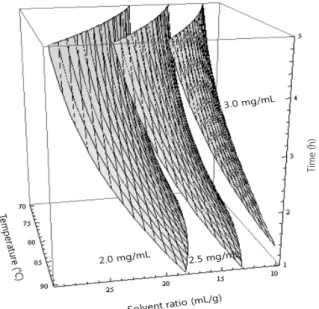
Fig. 3. Response surface for reducing sugar content in deodeok extracts at constant values (reducing sugar content: 2.0-2.5-3.0 mg/mL) according to temperature, time, and solvent ratio.
Fig. 4. Response surface for crude saponin contents in deodeok extracts at constant values (crude saponin content: 0.17-0.14- 0.11%) according to temperature, time, and solvent ratio.
당 값에 대한 반응표면은 Fig. 2와 같으며, 용매비와 추출시 간이 증가할수록 총당 함량이 증가하는 것으로 나타났다.
더덕 추출물의 환원당 함량은 1.58~3.11 mg/mL의 범위 로 나타났으며(Table 3), 이를 바탕으로 한 회귀식은 Table 4와 같다. 환원당에 대한 R2값은 0.9615로 높은 신뢰도를 보였으며, P-value는 1% 이내 유의수준을 보였다(Table 4). 환원당의 추출조건에 대한 영향에서 용매비는 1% 이내 의 유의수준을 보이는 것으로 확인되며, 추출온도와 시간은 10% 이내 유의수준을 보였다(Table 5). 환원당에서 lack of fit의 P-value는 0.4050으로 나타나 model이 적합한 것 으로 나타났다(Table 6). 추출조건에 따라 반응표면모델로 예측된 회귀분석 결과 정상점이 안장점으로 나타났다. 최적 점을 산출한 결과 환원당의 최대값은 3.13 mg/mL이고 이때 의 추출조건은 용매비가 10.64 mL/g, 추출온도가 82.37°C, 추출시간이 3.52시간으로 나타났다(Table 7). 이들 환원당 값에 대한 반응표면은 Fig. 3에 나타냈으며, 용매비가 감소 할수록 환원당 함량이 증가하는 것으로 나타났다.
더덕의 사포닌은 triterpene계 사포닌으로 lancemaside A, lancemaside B, lancemaside E, foetidissimoside A, aster saponin Hb 등이 존재한다(Kim 등, 2014b). 이러한 사포닌은 급성대장염(Joh 등, 2010)과 항염증(Xu 등, 2008) 을 완화시킨다고 보고되었다. 본 연구에서 더덕 추출물의 조사포닌 함량은 0.09~0.17%의 범위로 나타났으며(Table 3), 이를 바탕으로 한 회귀식은 Table 4와 같다. 조사포닌 함량에 대한 R2값은 0.9373으로 높은 신뢰도를 보였으며, P-value는 1% 이내 유의수준을 보였다(Table 4). 추출조 건에 대한 영향에서 조사포닌의 경우 추출온도와 추출시간 보다 용매비가 큰 영향을 미치는 것으로 확인된다(Table 5).
조사포닌에서 lack of fit의 P-value는 0.0974로 나타나
model이 적합한 것으로 나타났다(Table 6). 추출조건에 따 라 반응표면모델로 예측된 회귀분석 결과 정상점이 안장점 으로 나타났다. 최적점을 산출한 결과 조사포닌의 최대값은 0.17%이고 이때의 추출조건은 용매비가 10.90 mL/g, 추출 온도가 72.03°C, 추출시간이 3.72시간으로 나타났다(Table 7). 이들 조사포닌 값에 대한 반응표면은 Fig. 4와 같으며, 추출시간이 증가하고 용매비가 감소할수록 조사포닌 함량 이 증가하는 것을 알 수 있다. Ahn 등(2016)의 가열 처리한 더덕 열수 추출물의 이화학 및 관능특성 연구에서 열풍건조 더덕 추출물의 조사포닌 함량이 76.67 mg/g dry basis로 보고한 결과값보다 본 연구의 조사포닌 함량이 높게 측정되 었다. 이는 실험에 사용한 원료 더덕과 추출조건의 차이라 생각된다.
Lobetyolin은 더덕의 지표성분으로 알려져 있으며(He 등, 2015), 위장관 운동 촉진 효능(Hong 등, 2014)과 항산 화 활성(Yoon 등, 2014)이 보고되었다. 본 연구에서 lobe- tyolin 표준품과 더덕 추출액의 chromatogram은 Fig. 5와 같다. 더덕 추출물의 lobetyolin 함량은 16.72~32.82 μg/
mL의 범위로 나타났으며(Table 3), lobetyolin 함량에 대한 회귀식 R2값은 0.9791로 높은 신뢰도를 나타내었고, P- value는 1% 이내의 유의수준을 보였다(Table 4). Lobe- tyolin의 추출조건에 대한 영향에서 모든 추출조건이 영향 을 미치는 것으로 나타났다(Table 5). Lobetyolin 함량에 대한 lack of fit의 P-value는 0.0994로 나타나 model이 적합한 것으로 나타났다(Table 6). 추출조건에 따라 반응표 면모델로 예측된 회귀분석 결과 정상점이 최대점으로 나타 났고 최적점을 산출한 결과 lobetyolin의 최대값은 32.44 μg/mL인데 이때의 추출조건은 용매비가 11.20 mL/g, 추출 온도가 65.32°C, 추출시간이 3.17시간으로 나타났다(Table
Fig. 5. High performance liquid chro- matography ultraviolet detection (HPLC/
UV) chromatogram of lobetyolin stand- ard (100 ppm) and representative deo- deok extracts.
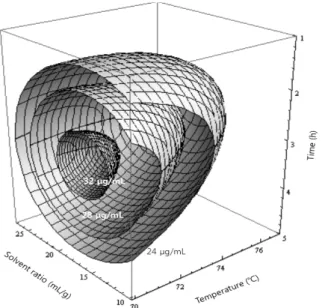
Fig. 6. Response surface for lobetyolin content in deodeok ex- tracts at constant values (lobetyolin content: 24-28-32 μg/mL) according to temperature, time, and solvent ratio.
Table 8. Superimposed response surface for optimization of lo- betyolin and crude saponin content as a function of solvent ratio, extraction temperature, and time
Extraction condition Range of predicted condition Solvent ratio (mL/g)
Temperature (°C) Time (h)
12 (10∼13) 75 (70∼80) 3 (2∼4)
Fig. 7. Superimposed response surface for optimization of crude saponin and lobetyolin content for deodeok extracts.
7). 이들 lobetyolin 값에 대한 반응표면은 Fig. 6에 나타내 었다. 추출시간이 짧을수록 lobetyolin 함량이 증가하는 것 으로 나타났으며, 특히 시료에 대한 용매비가 15~25 mL/g 의 범위에서 lobetyolin 함량이 높은 값을 나타내는 것을 알 수 있었다. Kim 등(2014a)의 연구에서 더덕의 lobetyo- lin 함량이 21.94 μg/g으로 보고하여 본 연구의 추출물과 비교하면 평균값과 유사한 결과값을 보였다.
최적 추출조건의 예측 및 실증시험
더덕의 추출조건을 설정하기 위하여 더덕의 lobetyolin
Table 9. Comparison between predicted and observed values of response variables within the range of the optimum extraction condition
Deodeok extracts
Predict value (A) Experimental value (B) B/A×100 (%) Yield
Total sugar content (mg/mL) Reducing sugar content (mg/mL) Crude saponin content (%) Lobetyolin contents (μg/mL)
67.98 5.67 2.77 0.23 23.03
68.05±1.23* 5.11±0.31 2.70±0.22* 0.21±0.08* 34.54±3.68
100.10 90.97 97.32 91.30 149.96
*Student’s t-test P<0.05.
함량과 조사포닌 함량을 만족시켜주는 최적 추출조건을 얻 고자 각 반응표면을 superimposing 한 결과를 Table 8과 Fig. 7에 나타내었다. 더덕 열수 추출의 최적조건 범위는 용매비 10~13 mL/g, 추출시간 2~4시간, 추출온도 70~80
°C로 나타났다. 또한 각 성분의 반응표면을 superimposing 하여 예측된 최적 추출조건(용매비 12 mL/g, 추출시간 3시 간, 추출온도 75°C)에서 실제 추출 및 실험을 수행하여 예측 치와 실제 실험치의 비교를 통해 모델의 정확도를 검증하였 다(Table 9). 그 결과 최적 추출조건에서의 lobetyolin 함량 이 예측치보다 높게 측정되었고, 그 외의 측정된 함량값은 예측값과 실제 실험치를 비교하였을 때 대부분 유사한 수준 으로 나타나 본 실험의 최적 발효조건 모델의 적합도가 적절 하였으나, 수율, 환원당 및 조사포닌 함량은 예측치와 실험 치 간에 유의적 오차가 적었지만(P<0.05), 총당과 lobetyo- lin 함량은 예측치와 실험치 간에 유의적 오차가 큰 것으로 나타났다.
요 약
본 연구에서는 더덕 열수 추출물의 이화학적 특성과 더덕의 주요성분의 함량 등을 측정하여 반응표면분석법으로 더덕 의 최적 추출조건을 설정하였다. 실험계획은 중심합성 계획 법으로 실시하여 3가지 독립변수로서 용매비(10~30 mL/g;
X1), 추출온도(70~90°C; X2) 및 추출시간(1~5시간; X3)을 설정하고, 종속변수로는 추출물의 추출수율, 총당, 환원당, 조사포닌 및 lobetyolin 함량 등을 측정하여 추출조건을 최 적화하였다. 그 결과 추출수율은 35.01~71.53%였고 R2값 은 0.9574로 높은 신뢰도를 보였다. 추출물의 총당과 환원 당 함량은 각각 3.19~6.04 mg/mL와 1.58~3.11 mg/mL의 범위였고 1% 이내의 유의성을 보였다. 더덕 추출물의 사포 닌 함량은 0.09~0.17%였으며 R2값은 0.9373으로 1% 이내 의 유의성을 보였다. 추출물의 lobetyolin 함량은 16.72~
32.82 μg/mL였고 R2값은 0.9791로 1% 이내의 유의성을 보였다. 조사포닌 함량과 lobetyolin 함량의 반응표면을 superimposing 하여 최적조건을 설정한 결과 용매비 12 mL/g, 추출온도 75°C 및 추출시간 3시간으로 나타났다.
감사의 글
이 논문은 2015학년도 대구대학교 학술연구비(과제번호 20150446) 지원에 의한 논문임.
REFERENCES
Abell ML, Braselton JP. The Mathematica handbook. 2nd ed.
[Compatible with Mathematica version 2.0]. Academic Press Inc., Boston, London, UK. 1992. p 15-511.
Ahn S, Kim J, Cho H, Park SY, Hwang KT. Physicochemical and sensory characteristics of hot water extracts of Codonop- sis lanceolata root skin and flesh with different heat treat- ments. Korean J Food Sci Technol. 2016. 48:104-110.
Chae HS, Jung SS. A study on the quality characteristics of Yanggaeng with Codonopsis lanceolata skin extracts. Korean J Food Nutr. 2013. 26:990-995.
DuBois M, Gilles KA, Hamilton JK, Rebers PA, Smith F.
Colorimetric method for determination of sugars and related substances. Anal Chem. 1956. 28:350-356.
Han EG, Lee YG, Cho HG. Extracts of Codonopsis lanceolata decrease CCl4-induced hepatotoxicity on high fat diet in rats.
J Exp Biomed Sci. 2004. 10:447-452.
Han EG, Sung IS, Moon HG, Cho SY. Effect of Codonopsis lanceolata water extract on the levels of lipid in rats fed high fat diet. J Korean Soc Food Sci Nutr. 1998. 27:940-944.
He JY, Ma N, Zhu S, Komatsu K, Li ZY, Fu WM. The genus Codonopsis (Campanulaceae): a review of phytochemistry, bioactivity and quality control. J Nat Med. 2015. 69:1-21.
Hong JY, Chung HJ, Choi TJ, Pyee Y, Lee JH, Lee DU, et al.
Evaluation of gastric motility enhancement of the extracts and isolates from traditional medicinal herbs. Korean J Pharma- cogn. 2014. 45:187-193.
Hong SC, Choi KS, Lee HJ, Kwon DJ. Effects of Deodeok con- tents on the qualities of quick fermented Doenjang type prod- uct. J Korean Soc Food Sci Nutr. 2010. 39:757-763.
Jeong HJ, Yoo JM, Kwak SS, Woo YM, Oh SM, Kim KW, et al. The effect of cultivated environments on the antioxidant enzyme activities of Codonopsis lanceolata. Korean J Plant Res. 1996. 9:203-210.
Jin TY, Lee WG, Lee IS, Wang MH. Changes of physicochem- ical, sensory and antioxidant activity characteristics in rice wine, yakju added with different ratios of Codonopsis lanceo- lata. Korean J Food Sci Technol. 2008. 40:201-206.
Joh EH, Lee IA, Han SJ, Chae SJ, Kim DH. Lancemaside A ameliorates colitis by inhibiting NF-κB activation in TNBS-in- duced colitis mice. Int J Colorectal Dis. 2010. 25:545-551.
Jung LS, Yoon WB, Park SJ, Park DS, Ahn J. Evaluation of physicochemical properties and biological activities of steamed
and fermented deodeok (Codonopsis lanceolata). Korean J Food Sci Technol. 2012. 44:135-139.
Kim EY, Kim JA, Jeon HJ, Kim S, Kim YH, Kim HY, et al.
Chemical fingerprinting of Codonopsis pilosula and simulta- neous analysis of its major components by HPLC-UV. Arch Pharm Res. 2014a. 37:1148-1158.
Kim HH, Yukio O, Lee SR, Heu H. Morphological character- istics and cytotoxic screening test of Codonopsis lanceolata in Korea. Korean J Plant Res. 1998. 11:168-172.
Kim JA, Moon HK, Choi YE. Triterpenoid saponin contents of the leaf, stem and root of Codonopsis lanceolata. Korean J Med Crop Sci. 2014b. 22:1-7.
Kim OS, Sung JM, Ryu HS. Antioxidative activity and quality characteristics of Kochujang amended with different ratios of deodeok (Condonopsis lanceolata) root powder. J East Asian Soc Diet Life. 2012. 22:667-676.
Kim SD, Ku YS, Lee IZ, Park IK, Youn KS. Optimization for hot water extraction condition of Liriope spicata tuber using response surface methodology. Korean J Postharvest Sci Technol. 2001. 8:157-163.
Kim SH, Choi HJ, Chung MJ, Cui CB, Ham SS. Antimutagenic and antitumor effects of Codonopsis lanceolata extracts. J Korean Soc Food Sci Nutr. 2009. 38:1295-1301.
Kim SH, Chung MJ, Jang HD, Ham SS. Antioxidative activities of the Codonopsis lanceolata extract in vitro and in vivo.
J Korean Soc Food Sci Nutr. 2010. 39:193-202.
Kim SY, Kim HS, Kim SH, Kim HS, Su IS, Chung SY. Effects of the feeding Platycodon grandiflorum and Codonopsis lan- ceolata on the fatty acid composition of serum and liver in rats. J Korean Soc Food Nutr. 1993. 22:524-530.
Kwon JH, Bélanger JMR, Paré JRJ. Optimization of microwave- assisted extraction (MAP) for ginseng components by response surface methodology. J Agric Food Chem. 2003. 51:1807- 1810.
Lee JY, Kim BK, Park HJ. Antioxidant activities and quality
characteristics of fermented Codonopsis lanceolata tea ac- cording to heating process. Korean J Food Nutr. 2013a. 26:
693-699.
Lee SJ, Shin SR, Yoon KY. Physicochemical properties of black doragi (Platycodon grandiflorum). Korean J Food Sci Tech- nol. 2013b. 45:422-427.
Miller GL. Use of dinitrosalicylic acid reagent for determination of reducing sugar. Anal Chem. 1959. 31:426-428.
Myers RH. Response surface methodology. Allyn and Bacon, Inc., Boston, MA, USA. 1971. p 126-256.
Oh HS, Kim JH. Characterization of physiological functionalities of Codonopsis lanceolata, Cornus officinalis S. et Z, and their mixtures. J Exp Biomed Sci. 2006. 12:393-398.
Oh HS, Kim JH. Physiological functionalities of hot water ex- tract of Codonopsis lanceolata and some medicinal materials, and their mixtures. Korean J Community Living Sci. 2007.
18:407-415.
SAS Institute. SAS/STAT User’s Guide (version 9.1.3). SAS Institute, Inc., Cary, NC, USA. 2005.
Wanasundara PKJPD, Shahidi F. Optimization of hexametaphos- phate-assisted extraction of flaxseed proteins using response surface methodology. J Food Sci. 1996. 61:604-607.
Won HR, Oh HS. Antioxidative activity and lipid composition from different part and supplement of Codonopsis lanceolata in rat. J Korean Soc Food Sci Nutr. 2007. 36:1128-1133.
Xu LP, Wang H, Yuan Z. Triterpenoid saponins with anti-in- flammatory activity from Codonopsis lanceolata. Planta Med.
2008. 74:1412-1415.
Yoon YP, Ryu J, Park SH, Lee HJ, Lee S, Lee SK, et al. Effects of lobetyolin, lobetyol and methyl linoleate on secretion, pro- duction and gene expression of MUC5AC mucin from airway epithelial cells. Tuberc Respir Dis. 2014. 77:203-208.
Zhu T, Heo HJ, Row, KH. Optimization of crude polysaccharides extraction from Hizikia fusiformis using response surface methodology. Carbohydr Polym. 2010. 82:106-110.