Article
https://doi.org/10.14478/ace.2018.10651)
1. Introduction
Reactive oxygen species (ROS), such as singlet oxygen (
1O
2), super- oxide anion radical (O
2⋅-), hydrogen peroxide (H
2O
2), hydroxyl radical (⋅OH), alkoxyl radical (⋅OR), and peroxyl radical (⋅OOR)[1], are
† Corresponding Author: Seoul National University of Science and Technology, Department of Fine Chemistry, Cosmetic R&D Center, Cosmetic Industry Coupled Collaboration Center, Seoul 01811, Republic of Korea
Tel: +82-2-970-6451 e-mail: [email protected]
pISSN: 1225-0112 eISSN: 2288-4505 @ 2018 The Korean Society of Industrial and Engineering Chemistry. All rights reserved.
produced as natural byproducts of the normal metabolism of oxygen and have important roles in cellular signaling and homeostasis[2-4].
There is a dynamic balance between the amount of free radicals gen- erated in the body and the antioxidants that function to quench and/or scavenge them and protect the body against their deleterious effects [5]. However, severe environmental stresses (e.g., UV exposure) in- crease cellular ROS levels and disrupt the balance of antioxidants and prooxidants. This may result in significant damage to cell structure and cause aging, atherosclerosis, cancer, and chronic inflammation[2]. The antioxidants from natural plants are abundant and possess multifaceted functions that provide enormous scope for correcting this imbalance[5].
클러스터 분석을 이용한 황련 추출물 항산화 활성 최적화 추출공정
부민민⋅현송화⋅박수남†
서울과학기술대학교 정밀화학과, 나노바이오화장품연구실, 화장품종합기술연구소 (2018년 6월 26일 접수, 2018년 7월 12일 심사, 2018년 7월 27일 채택)
Optimization of the Extraction Process and Antioxidant Capacity of Coptis chinensis Franch Extract through Cluster Analysis
Minmin Fu, Song Hua Xuan, and Soo Nam Park
†Department of Fine Chemistry, Cosmetic R&D Center, Cosmetic Industry Coupled Collaboration Center, Seoul National University of Science and Technology, Seoul 01811, Republic of Korea
(Received June 26, 2018; Revised July 12, 2018; Accepted July 27, 2018)
초 록
황련은 여러 가지 질병 치료에 사용되는 효과적인 전통약용식물이다. 하지만 황련 추출물의 생리활성성분 함량에 영 향을 미치는 주요 인자 및 생리활성성분과 항산화 효능의 상관관계는 아직 알려지지 않았다. 따라서 본 논문에서는 용매, 온도 및 추출 시간이 황련 추출물의 생리 활성성분의 함량과 항산화 활성에 미치는 영향을 조사하였다. 클라스 터를 이용하여 분석한 결과, 35 ℃에서 추출시간 30 min인 에탄올(50% 에탄올 : 50% 물) 조건으로 추출 시, 생리활성 성분 함량 및 항산화 활성이 제일 높으므로 공장에서 사용하기에 가장 적합한 추출조건임을 확인하였다. 다중선형회 귀분석 결과, 총 페놀화합물 함량은 DPPH소거 활성에 기여하였으며 총 알칼로이드 함량과 총 플라보노이드 함량은 FRAP활성에 기여하였다. 이상의 결과들로부터 황련의 추출 조건이 생리 활성 화합물의 수율 및 항산화 활성을 조절 가능하며, 이는 공업적인 응용에 중요한 정보를 제공할 수 있을 것으로 사료된다.
Abstract
Coptis chinensis Franch is a valuable traditional oriental medicinal plant used for the treatment of various diseases. The major factors affecting the content of bioactive compounds and the relationship between bioactive compounds and antioxidant capaci- ties of Coptis chinensis Franch were poorly understood. Thus, effects of the solvent, temperature, and extraction time on the extraction yields of bioactive compounds and the antioxidant activity of C. chinensis Franch extracts were investigated in this work. Our cluster analysis indicated that the hydroalcoholic solvent (50% ethanol : 50% water) at 35 ℃ for 30 min (extract time) was the best extraction condition for a factory use because the highest level of bioactive compounds and antioxidant activities was achieved. Multiple linear regression analysis revealed that total phenolic content (TPC) contributed to the 1,1-di- phenyl-2-picrylhydrazyl radical (DPPH) scavenging activity, while both total alkaloid content (TAC) and total flavonoid con- tent (TFC) were responsible for ferric reducing antioxidant power (FRAP) activity. These results indicated that extraction con- ditions controlled the yield of bioactive compounds and the antioxidant activity of C. chinensis Franch, which can provide important information for the industrial extraction.
Keywords: Coptis chinensis Franch, Antioxidant capacity, Bioactive compounds, Optimal extraction
The rhizomes of Coptis chinensis Franch (called Ji Zhua Huang Lian in Chinese) has been used in traditional Chinese medicine[6] for heat-clearing, damp-drying, relieving fidgetiness and detoxification; it is officially listed in the Chinese Pharmacopoeia[7]. In recent years, many researchers have demonstrated its pharmacological activities such as anti-inflammatory[8], broad-spectrum antimicrobial, and antioxidant activities, that have been considered the bases for its other biological activities[9]. C. chinensis Franch has been used clinically in treating dysentery, cholera, leukemia, diabetes, and lung cancer[10]; and non-clinically for cosmetics and food[11]. The bioactive compounds of C. chinensis Franch include alkaloids, flavonoids, and phenolics[12].
Furthermore, C. chinensis Franch methanol extract exhibits high anti- oxidant activities[13].
To date, the major factors affecting the content of bioactive com- pounds, the relationship between bioactive compounds and antioxidant capacity, and the extraction yields of C. chinensis Franch extracts re- main poorly understood. Thus, in this study the antioxidant activities of bioactive compounds of C. chinensis Franch extracts were charac- terized by DPPH⋅ scavenging activity and ferric reducing antioxidant power (FRAP) assay. Pearson’s correlation was administered to test for correlation between bioactive compounds and antioxidant capacity.
To establish the best extraction condition in obtaining the highest bi- oactive compound yield and antioxidative effects, we applied cluster analysis; the task of grouping a set of objects. Clustering is formulated as a multi-objective optimization problem, which is suitable in our study with several factors should be taken into consideration.
2. Materials and Methods
2.1. Chemicals
Berberine chloride form, quercetin, gallic acid, α-tocopherol, Folin-Ciocalteu reagent, DPPH⋅ (2,2-Diphenyl-1-picrylhydrazyl), so- dium carbonate monohydrate, iron(III) chloride hexahydrate, ferric chloride, TPTZ (2,4,6-tripyridyl-s-triazine), and sodium acetate trihy- drate were all obtained from Sigma-Aldrich (St. Louis, MO, USA).
Aluminum chloride hexahydrate, sodium nitrite, hydrochloric acid and ethanol were obtained from Dae Jung (Gyeonggi, Korea). Sodium hy- droxide and acetic acid were obtained from OCI, Ltd (Seoul, Korea).
2.2. Plant material and extraction procedure
The dried rhizome of Coptis chinensis Franch were isolated from Enshi, Hubei, China. The dried raw material resembles a chicken claw and the size is approximately 0.4-0.6 cm in diameter and 4-6 cm in length. The rhizome was powdered and filtered through a 0.5 mm × 0.5 mm sieve three times to obtain a uniform powder. One gram of plant powder was added to 10 mL of a gradient concentration of etha- nol (0, 25, 50, 75, and 100% ethanol) and then incubated at 25, 35, 45, and 55 ℃ for 30, 60, 90, and 120 min, respectively (Figure 1).
Ethanol was chosen in this study as it is safer than methanol or ace- tone, and with nonpolar property in comparison to water. After the treatment, the extracts were filtered and dried using an Integrated SpeedVac System (Thermo Fisher Scientific, USA), and then weighed to measure the yield. Each sample was processed in triplicate.
2.3. Determination of total alkaloid content (TAC)
The total alkaloid content in each C. chinensis Franch extract was
determined according to the method described by Xu et al.[14]. After
Figure 1. Scheme of C. chinensis Franch extract preparation. Each extract was prepared in triplicate and each replicate was analyzed in triplicate.
scanning at a maximal wavelength with a NanoDrop spectrophotometer (Thermo Fisher Scientific), 345 nm was selected as the optimum wave- length producing less peak noise. Thus, the total alkaloid content con- tained in C. chinensis Franch was determined by using 300 µL of ad- equately diluted samples in a 96-well plate, and then reading the ab- sorbance values at 345 nm. Berberine chloride form was used as a ref- erence for the calibration curve (R
2= 0.9973, 0-62.5 µg/mL), and the results were calculated and expressed as mg of berberine chloride equivalent (BCE)/g dry plant or/g extract powder of C. chinensis Franch.
2.4. Determination of total flavonoid content (TFC)
We determined the total flavonoid content according to the method described by Barroso[15], with slight modifications. One hundred and fifty microliters of the appropriate concentration of sample solution was added to a 96-well plate and then 9 µL 5% NaNO
2was added and mixed well to react for 5 min. Then 9 µL of 10% AlCl
3solution was added and mixed well. After 6 min, 60 µL of 1 mol/L NaOH and 72 µL water were added. The solution was mixed well and the absorb- ance was read at 510 nm. Quercetin was used to plot the standard curve ranging from 0 to 100 ppm (R
2= 0.9725), and the results were calculated and expressed as mg of quercetin equivalent (QE) per g dry plant or per g extract powder of C. chinensis.
2.5. Determination of total phenolic content (TPC)
Phenolic contents were determined using a protocol similar to Chandler and Dodds[16] described by Shetty et al.[17]. Eighty micro- liters of the samples was added to 20 µL of Folin-Ciocalteu reagent (50% v/v in water), mixed thoroughly, and incubated at room temper- ature for 5 min. Then, 200 µL of sodium carbonate solution (2% w/v in water) was added, and the mixture was incubated at room temper- ature for 30 min. The absorbance was measured at 762 nm by using a VersaMax microplate reader (Molecular Devices Corporation, USA).
The total phenolic contents of the samples were determined by prepar- ing a standard curve using different concentrations (0-62.5 µg/mL) of gallic acid as a reference material (R
2= 0.9977) and the results were calculated and expressed as mg of gallic acid equivalent (GAE) per g dry plant or per g extract powder of C. chinensis.
2.6. DPPH⋅ scavenging activity
The extracts’ radical scavenging ability was analyzed according to the method described in a previous study[15], with some modifications.
Diluted extracts (14 µL) were mixed well with freshly prepared 186 µL DPPH⋅ solution (9.3 × 10
-5mol/L in ethanol). The decrease of DPPH⋅ every 10 min was measured by monitoring the absorption at 525 nm. The endpoint of the reaction was set in 40 min. The total DPPH⋅ scavenging ability was based on a standard curve of different concentrations (0-100 µg/mL) of α-tocopherol as a reference material (R
2= 0.9802) and the results were calculated and expressed as mg of α-tocopherol equivalent (α-TE) per g dry plant or per g extract pow- der of C. chinensis.
2.7. Ferric reducing antioxidant power (FRAP) assay
The FRAP assay was performed in accordance to Costa et al.[18]
with some modifications. Briefly, 30 µL of diluted extracts were mixed with 270 µL of the FRAP solution. The FRAP solution was prepared according to Benzie[19], and consisted of 0.3 M acetate buffer at pH 3.6 (3.1 g C
2H
3NaO
2⋅3H
2O and 16 mL C
2H
4O
2per liter of buffer sol- ution), 10 mM TPTZ (2,4,6-tripyridyl-s-triazine) in 40 mM HCl and 20 mM FeCl
3⋅6H
2O. The working solution was prepared as required by mixing 25 mL acetate buffer, 2.5 mL TPTZ solution and 2.5 mL FeCl
3⋅6H
2O solution. A blank sample and solvents only were used for col- or correction. The mixture was kept for 30 min at 37 ℃ and the 96-well plates were incubated in the dark. Thereafter, the absorbance was measured at 595 nm. A standard curve was prepared with ferrous sulfate (50-450 µg/mL, R
2= 0.9998) and ferric reducing antioxidant power was calculated and expressed as mg of ferrous sulfate equiv- alents (FSE) per g of dry plant or per g extract powder of C. chinensis.
2.8. Statistics analysis
To evaluate the influence of the solvent, temperature and extraction time on the extraction yields of bioactive components as well as their anti-oxidative activity, a factorial experiment (5 × 4 × 4) was designed.
The solvent, temperature and time of extraction are set as the variables, while the dependent variables are yield, TAC, TFC, TPC, DPPH and FRAP. We measured each set of extraction in operating conditions (solvent, temperature, time) for three times. Then the set of vectors (solvent, temperature, time) were classified into homogeneous groups through a hierarchical clustering by average linkage (between groups) using the squared Euclidean distance as the measure of dissimilarity.
All analyses were performed using IBM SPSS Statistics 22 (SPSS Inc., Chicago, IL, USA), which is a platform that offers advanced stat- istical analysis. The differences between the means were analyzed by Duncan’s test of One-Way Analysis of variance (ANOVA). Pearson’s correlation was used to test for correlation between variables, and cor- relations were considered significant at p < 0.05. Linear regression analysis between the antioxidant activities and bioactive compounds was conducted by IBM SPSS Statistics 22 and relationships were con- sidered significant at p < 0.05.
3. Results and Discussion
3.1. Determination of yields
The extraction yields of bioactive compounds from natural plants de- pends highly on several factors. The type of solvent, solvent-to-solid ratio, time and temperature could all be managed to improve the ex- traction yields of bioactive components[20]. In the present study, five different solvents, four different temperatures and four different ex- traction times were tested (Figure 1).
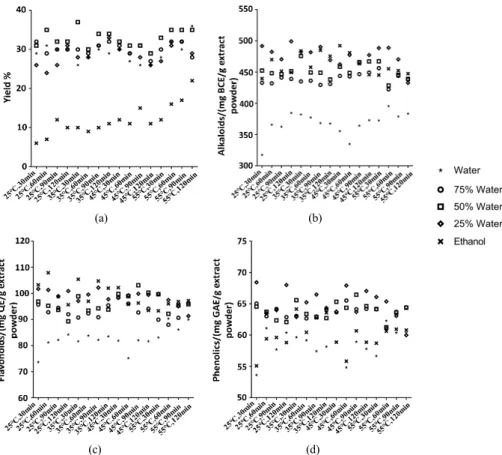
Our results show that the extraction yields ranged from 6% to 37%
(Figure 2a). The highest amount of total extractable compounds was isolated at 50% water/35 ℃/30 min extraction conditions (Figure 2a).
ANOVA (Table 1) shows that water content in the solvent and the ex-
traction temperature affected the yield significantly (p < 0.05) and con-
tributed to 94.5% of the yields (R
2= 0.945). Our findings are in agree- ment with previous investigation of Do et al., where they reported that maximum extract yield from Limnophila aromatica was obtained with 50% ethanol[21], as well as Sultana et al.[22]. The combined use of water and ethanol may facilitate the extraction of chemicals that are soluble in water and/or organic solvent.
3.2. Determination of bioactive compounds 3.2.1. Determination of TAC
Previous work has focused on the extraction of alkaloids. Choi et al., who optimized the microwave-assisted and ultrasonic-assisted ex- traction of alkaloids, identified the optimal conditions as: 50% ethanol : 50% water, 5 min and microwave power of 180 W[20] and ethanol
Variable Yield (%) (R2 = 0.945) TAC (R2 = 0.892) TPC (R2 = 0.563)
Source Sum of
square d.f. F-ratio P value Sum of
square d.f. F-ratio P value Sum of
square d.f. F-ratio P value Main effect
Water% 4457.825 4 319.621 0.000 115515.639 4 160.189 0.000 492.212 4 28.542 0.000
Temperature 118.238 3 11.303 0.000 575.391 3 1.064 0.377 5.306 3 0.410 0.747
Time 21.338 3 2.040 0.126 164.162 3 0.304 0.823 1.495 3 0.116 0.950
Variable TFC (R2 = 0.809) DPPH⋅ scavenging ability (R2 = 0.748) FRAP (R2 = 0.766) Source Sum of
square d.f. F-ratio P value Sum of
square d.f. F-ratio P value Sum of
square d.f. F-ratio P value Main effect
Water% 2930.691 4 77.115 0.000 13877.076 4 29.038 0.000 60170.150 4 64.731 0.000
Temperature 18.008 3 0.632 0.599 7962.974 3 22.217 0.000 1687.570 3 2.421 0.082
Time 9.998 3 0.351 0.789 687.252 3 1.917 0.144 368.661 3 0.529 0.665
Independent variables: water% in extraction solvent, temperature and extract time.
Dependent variables: Total alkaloid, total phenolic, total flavonoid content, DPPH⋅ scavenging ability and FRAP.
Table 1. Analysis of Variance (ANOVA) Statistics
(a)
(b)
(c)
(d)
Figure 2. Effect of solvent, temperature and extraction time on extraction yield, total alkaloid content, total flavonoid content and total phenolic
content per gram extraction powder of C. chinensis Franch.
concentration of 59%, 46.57 min and 66.22 ℃[9], respectively. In the present study, the best extraction of alkaloids was obtained from 25%
water/25 ℃/120 min (499.11 ± 1.53 mg BCE/g extract powder) and the worst was obtained from 100% water/25 ℃/30 min (317.43 ± 2.44 mg BCE/g extract powder). Based on ANOVA (Table 1), the water content in the solvent affected the alkaloids content significantly (R
2= 0.892, p < 0.05). The highest average value of alkaloids extracted was obtained with 25% water content (476.88 ± 3.81 mg BCE/g ex- tract powder), followed by 0% water (462.08 ± 3.81 mg BCE/g extract powder), 50% water (451.91 ± 3.81 mg BCE/g extract powder), 75%
water (438.69 ± 3.81 mg BCE/g extract powder) and 100% water (367.68 ± 3.81 mg BCE/g extract powder). Pure water was the least efficient extracting solvent for alkaloid extraction (Figure 2b), which could be attributed to the hydrophobic nature of berberine, jatror- rhizine, palmatine and coptisine, which are the main alkaloids present in C. chinensis[23].
3.2.2. Determination of TFC
The highest TFC was obtained from 0% water/25 ℃/60 min (107.91
± 0.87 mg QE/g extract powder) while the lowest was obtained from 100% water/25 ℃/30 min (73.65 ± 0.56 mg QE/g extract powder).
Based on ANOVA (Table 1), the water content in the solvent affected the TFC significantly (p < 0.05). The highest average value of fla- vonoids extracted was obtained with 0% water (99.12 ± 0.77 mg QE/g extract powder), followed by 25% water (98.78 ± 0.77 mg QE/g ex- tract powder), 50% water (96.29 ± 0.77 mg QE/g extract powder), 75% water (93.16 ± 0.77 mg QE/g extract powder) and the worst ex- traction condition was with 100% water (82.66 ± 0.77 mg QE/g extract powder). The mean value of TFC decreased as the water content in the solvent increased. In the study of Do et al.[21], the highest and lowest TFC value were obtained from 100% ethanol and 100% water, re- spectively, which is agreed with our study.
3.2.3. Determination of TPC
The highest TPC was extracted under conditions of 25% water/25 ℃ /30 min (68.44 ± 0.51 mg GAE/g extract powder), while the lowest was extracted under conditions of 100% water/25 ℃/30 min (53.62 ± 0.54 mg GAE/g extract powder). Based on ANOVA(Table 1), the wa- ter content in the solvent affected the TPC significantly (p < 0.05). The highest average value of TPC was obtained with 25% water (64.99 ± 0.52 mg GAE/g extract powder), followed by 50% water (63.84 ± 0.52 mg GAE/g extract powder), 75% water (63.67 ± 0.52 mg GAE/g ex- tract powder), 0% water (59.95 ± 0.52 mg GAE/g extract powder) and the least efficient extraction condition was with 100% water (58.58 ± 0.52 mg GAE/g extract powder). The average yield of TPC was lower with 100% water and 0% water compared to other solvents. This may due to the intermediate polarity of ferulic acid, chlorogenic acid and 3,4-dihydroxyphenethyl glucoside which are main phenolics present in C. chinensis[24,25].
3.3. Determination of antioxidant activity
As shown in Table 1, solvent and temperature affected the extracts’
DPPH⋅ scavenging ability significantly (p < 0.001, R
2= 0.748). The highest average DPPH⋅ scavenging ability was obtained with 25%
solvent water content (131.29 ± 2.73 mg α-TE/g extract powder), fol- lowed by 50% water (112.23 ± 2.73 mg α-TE/g extract powder), 100% water (103.81 ± 2.73 mg α-TE/g extract powder), 75% water (101.32 ± 2.73 mg α-TE/g extract powder) and 0% water (92.34 ± 2.73 mg α-TE/g extract powder).
The average value of DPPH⋅ scavenging ability changed depending on temperature. that the best value was obtained at 35 ℃ (120.66 ± 2.44 mg α-TE/g extract powder) followed by 25 ℃ (115.33 ± 2.44 mg α-TE/g extract powder), 45 ℃ (98.85 ± 2.44 mg α-TE/g extract powder) and 55 ℃ (97.96 ± 2.44 mg α-TE/g extract powder). The results indicate that high temperature maybe not be appropriate to maintain the DPPH⋅ scavenging activity of extracts.
In the FRAP assay, the solvent affected the antioxidant activity sig- nificantly (p < 0.0001, R
2= 0.766, Table 1). Taking solvent water con- tent as the independent variable, the highest antioxidant power was ob- tained using 25% water in the solvent (414.26 ± 2.44 mg FSE/g extract powder), followed by 0% water (405.75 ± 244 mg FSE/g extract pow- der), 50% water (402.83 ± 2.44 mg FSE/g extract powder), 75% water (387.90 ± 2.44 mg FSE/g extract powder) and 100% water (337.51 ± 2.44 mg FSE/g extract powder), indicating that 25% water content in the solvent was good for the extracts’ ferric reducing antioxidant power.
The relationships between bioactive compounds and antioxidant ac- tivity and the optimal extraction conditions that can yield the highest levels of bioactive compounds and antioxidant activity have rarely been found in C. chinensis Franch. In the present study, we first checked the TAC, TFC, TPC contributions to the complex antioxidant activity by measuring the DPPH⋅ scavenging ability and conducting FRAP as- says to evaluate the different and complementary mechanisms of anti- oxidant action in C. chinensis Franch.
The relationship between bioactive compounds and antioxidant ca- pacity has been studied in many other plants. Since the composition of each plant is very different, then this basic study could help us un- derstand each type of bioactive compounds’ contribution to antioxidant capacity. Deighton et al.[26] found that the antioxidant capacity (TEAC, FRAP) in Rubes fruit is associated with the phenolics (0.6713, 0.9646 respectively) while ascorbic acid contributes only minimally (<
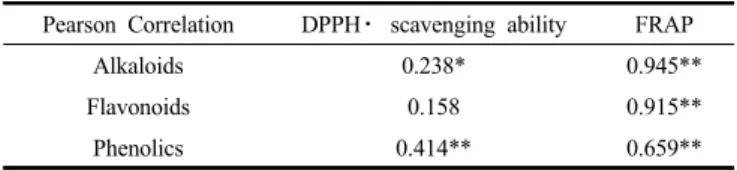
10%, TEAC). There has been no similar study in C. chinensis Franch, thus, we applied Pearson’s correlation coefficient to evaluate the rela- tionship between the antioxidant activity (DPPH⋅ and FRAP assay) and bioactive compound content (TAC, TFC, TPC) (Table 2). Both
Pearson Correlation DPPH⋅ scavenging ability FRAP
Alkaloids 0.238* 0.945**
Flavonoids 0.158 0.915**
Phenolics 0.414** 0.659**
*Correlation is significant at p < 0.05, **Correlation is significant at p < 0.01.
Table 2. Pearson’s Correlation Coefficients of DPPH⋅ Scavenging
Ability and FRAP Versus TAC, TPC and TFC
TAC and TPC showed significant positive correlations to DPPH⋅ with Pearson’s correlation coefficients of 0.238 (p < 0.05) and 0.414 (p <
0.01), respectively. TAC, TFC and TPC also showed significant pos- itive correlation to FRAP with Pearson’s correlation coefficients of 0.945, 0.915 and 0.659, respectively (p < 0.01). Our data shows that the antioxidant effect was not only dependent on TFC and TPC, but also alkaloids which agrees with a previous study on alkaloids isolated from C. chinensis Franch: these exhibited ⋅OH scavenging activity [27] and are closely related to the ferrous ion chelating activities of al- kaloids[28].
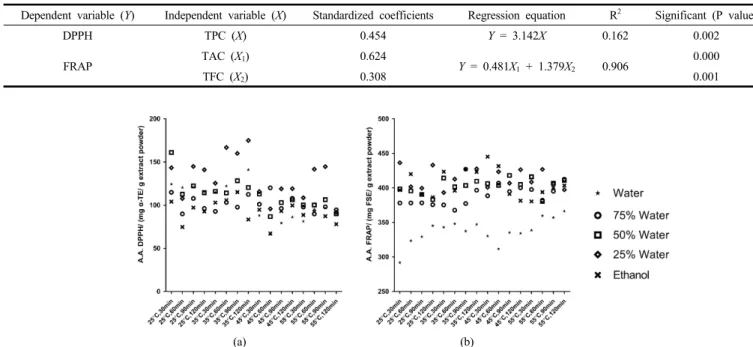
To understand the contribution of each compound to the antioxidant activity, multiple linear regression analysis was applied to construct multiple linear models with TAC, TFC, TPC as independent variables (X) and antioxidant activity (DPPH⋅ and FRAP) as dependent variable (Y) (Table 3). To establish the best model that could represent the in- fluence of TAC, TFC and TPC on the antioxidant activity of C. chi- nensis, the stepwise elimination of variables (if p > 0.05) and stepwise insertion of variables (if p < 0.10) were performed. As shown in Table 3, DPPH⋅ was significantly linearly correlated with TPC (R
2= 0.162, p < 0.002). In addition, the FRAP was significantly linearly correlated with TAC and TFC (R
2= 0.906, p < 0.001), which indicates that 90.6% of FRAP variation was dependent on TAC and TFC.
Furthermore, the effect of TAC was higher than TFC based on stand- ardized coefficients 0.624 and 0.308, respectively. Our findings in- dicate that TAC, TFC, and TPC all contribute to the antioxidant activ- ity, driven by different mechanisms.
The results show that the highest values of TAC, TPC, and DPPH⋅
scavenging activity were obtained under conditions of 25% water/25 ℃/
120 min, 25% water/25 ℃/30 min and 25% water/35 ℃/120 min, respectively. The highest average values of TAC, TPC, and DPPH⋅
scavenging activity were obtained with 25% water. We could ignore the extraction time since this did not significantly affect the yield of TAC, TPC and DPPH⋅ scavenging activity based on statistical analysis. However, the extraction temperature did affect the DPPH⋅
scavenging activity significantly and highest average value was ob- tained at 35 ℃. The highest values of TFC and FRAP were obtained under conditions of 0% water/25 ℃/60 min and 0% water/45 ℃/30 min, respectively. When only taking solvent into consideration, we found that the highest average value of TFC and FRAP were obtained with 0% water (99.12 ± 0.77 mg QE/g extract powder), followed by 25% water (98.78 ± 0.77 mg QE/g extract powder), respectively. In a conclusion, about the best extract powder was obtained using 25% wa- ter at 35 ℃; these conditions yielded powdered extracts with more bio- active compounds with good antioxidant activity and less impurities.
However, if we take into consideration energy savings, labor, waste reduction and high extraction yields, then expressing the results in terms of extraction efficiency is more meaningful. These results are presented as the yields of bioactive compounds and the antioxidant ac- tivity per gram of extract powder. This may be suitable to study the extracted compounds by different extraction methods as well as the composition of the extract powder; however, it is not suitable for fac- tory application, since it does not consider the yield of extract powder.
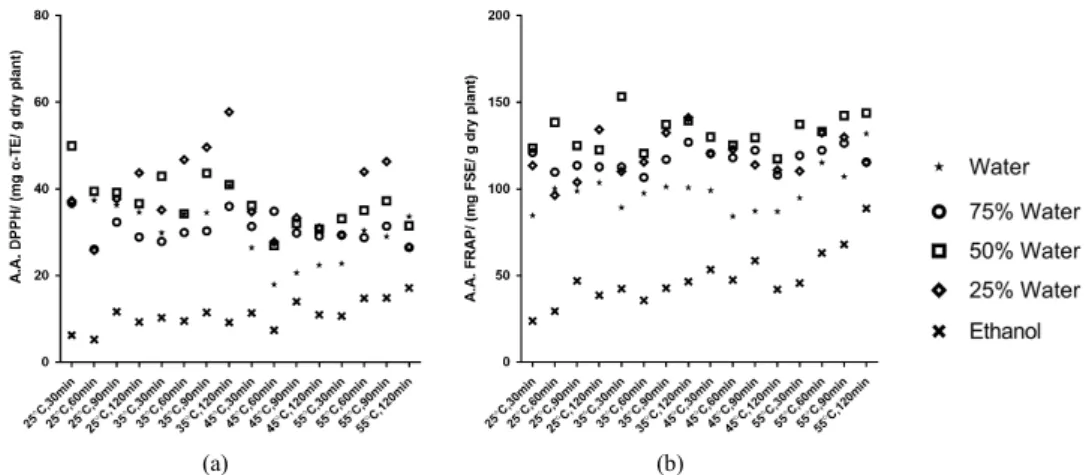
To address this, expressing the data in terms of active compounds and antioxidant capacity per gram dry plant is more appropriate for eco- nomic considerations. Thus, Figures S1, S2 express the yield value of bioactive compounds and antioxidant activity as per gram dry plant.
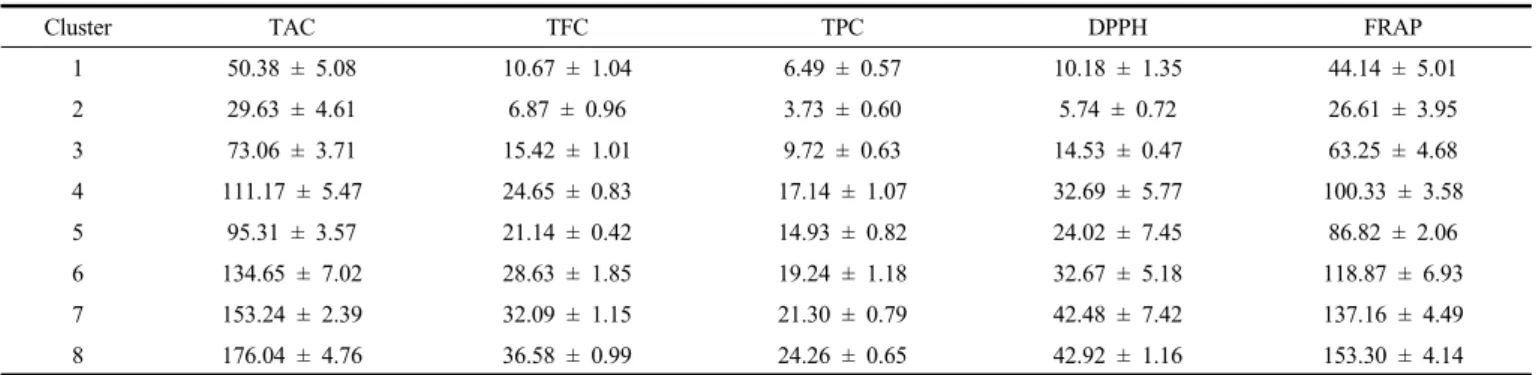
Thus, this provides better analysis of the extraction methods with high- er efficiency and less wastage. On the basis of these data, we per- formed a cluster analysis (Figure 4) to obtain the optimized extraction conditions considering the TAC, TFC, TPC, and antioxidant activity
Dependent variable (Y) Independent variable (X) Standardized coefficients Regression equation R2 Significant (P value)DPPH TPC (X) 0.454 Y = 3.142X 0.162 0.002
FRAP TAC (X1) 0.624
Y = 0.481X1 + 1.379X2 0.906 0.000
TFC (X2) 0.308 0.001
Table 3. Multiple Linear Regression Models of DPPH⋅ Scavenging Ability and FRAP with TAC, TPC and TFC
(a)
(b)
Figure 3. Effect of solvent, temperature and extraction time on antioxidant activity (A. A.) per gram extract powder of the C. chinensis Franch.
per gram dry plant. We obtained 8 clusters and counted the mean val- ue of each cluster of bioactive compounds and antioxidant activity (Table 4) and found that cluster 8 had the highest values of TAC, TFC, TPC, DPPH⋅ scavenging activity and FRAP assay. Therefore, the conditions of cluster 8 (50% water/35 ℃/30 min) are the optimum conditions for industrial use (Table 4).
4. Conclusion
In conclusion, multiple linear regression analysis on the relationship between bioactive compounds and antioxidant capacity in C. chinensis Franch shows that TPC contributes the DPPH⋅ scavenging activity, while both TAC and TFC contribute to FRAP. These results indicate that different compounds contribute to the antioxidant activity by dif- ferent mechanisms, which may provide guidance for choosing expected bioactivities in the future. Analysis of the bioactive compounds and an- tioxidant activity in each extract powder showed that the optimum ex- traction condition is 25% water content in the solvent at 35 ℃.
Economically, however, considering the total yield of the extract, clus- ter analysis (Figure 4) shows that 50% water, 35 ℃, and 30 min are the best conditions for efficient extraction of bioactive compounds per dry weight of plant.
References
1. M. Hayyan, M. A. Hashim, and I. M. AlNashef, Superoxide ion:
generation and chemical implications, Chem. Rev., 116, 3029-3085 (2016).
2. T. Devasagayam, J. Tilak, K. Boloor, K. S. Sane, S. S. Ghaskadbi, and R. Lele, Free radicals and antioxidants in human health:
Current status and future prospects, J. Assoc. Physicians India, 52, 794-804 (2004).
3. J. Nordberg and E. S. Arner, Reactive oxygen species, anti- oxidants, and the mammalian thioredoxin system1, Free Radical Biol. Med., 31, 1287-1312 (2001).
4. S. H. Xuan, Y. M. Park, J. H. Ha, Y. J. Jeong, and S. N. Park, The effect of dehydroglyasperin C on UVB-mediated MMPs ex- pression in human HaCaT cells, Pharmacol. Rep., 69, 1224-1231 (2017).
5. A. Shirwaikar, A. Shirwaikar, K. Rajendran, and I. S. R. Punitha, In vitro antioxidant studies on the benzyl tetra isoquinoline alka-
Cluster TAC TFC TPC DPPH FRAP
1 50.38 ± 5.08 10.67 ± 1.04 6.49 ± 0.57 10.18 ± 1.35 44.14 ± 5.01
2 29.63 ± 4.61 6.87 ± 0.96 3.73 ± 0.60 5.74 ± 0.72 26.61 ± 3.95
3 73.06 ± 3.71 15.42 ± 1.01 9.72 ± 0.63 14.53 ± 0.47 63.25 ± 4.68
4 111.17 ± 5.47 24.65 ± 0.83 17.14 ± 1.07 32.69 ± 5.77 100.33 ± 3.58
5 95.31 ± 3.57 21.14 ± 0.42 14.93 ± 0.82 24.02 ± 7.45 86.82 ± 2.06
6 134.65 ± 7.02 28.63 ± 1.85 19.24 ± 1.18 32.67 ± 5.18 118.87 ± 6.93
7 153.24 ± 2.39 32.09 ± 1.15 21.30 ± 0.79 42.48 ± 7.42 137.16 ± 4.49
8 176.04 ± 4.76 36.58 ± 0.99 24.26 ± 0.65 42.92 ± 1.16 153.30 ± 4.14
Table 4. Mean Values of the Bioactive Compounds and Antioxidant Activity of Several Clusters
Figure 4. Dendrogram from a cluster analysis of the extraction
operating conditions considering the total alkaloid, flavonoid, phenolic
content, and their antioxidant capacity per gram dry weight of plant
as variables.
loid berberine, Biol. Pharm. Bull., 29, 1906-1910 (2006).
6. B. Liu, W. Li, Y. Chang, W. Dong, and L. Ni, Extraction of ber- berine from rhizome of Coptis chinensis Franch using supercritical fluid extraction, J. Pharm. Biomed. Anal., 41, 1056-1060 (2006).
7. D. Yan, C. Jin, X.-H. Xiao, and X.-P. Dong, Antimicrobial proper- ties of berberines alkaloids in Coptis chinensis Franch by micro- calorimetry, J. Biochem. Biophys. Methods., 70, 845-849 (2008).
8. D. U. Lee, Y. J. Kang, M. K. Park, Y. S. Lee, H. G. Seo, T. S.
Kim, C. H. Kim, and K. C. Chang, Effects of 13-alkyl-substituted berberine alkaloids on the expression of COX-II, TNF-α, iNOS, and IL-12 production in LPS-stimulated macrophages, Life Sci., 73, 1401-1412 (2003).
9. W. Kong, J. Wang, X. Xiao, S. Chen, and M. Yang, Evaluation of antibacterial effect and mode of Coptidis rhizoma by micro- calorimetry coupled with chemometric techniques, Analyst, 137, 216-222 (2012).
10. D. Ding, Pharmacodynamic Action an Clinic of Chinese Medicinal Materials, 54-56, China Medicine Technology Press, Beijing, China (1999).
11. H. Teng and Y. H. Choi, Optimization of ultrasonic-assisted ex- traction of bioactive alkaloid compounds from rhizoma coptidis (Coptis chinensis Franch.) using response surface methodology, Food Chem., 142, 299-305 (2014).
12. S. B. Lotito and B. Frei, Consumption of flavonoid-rich foods and
increased plasma antioxidant capacity in humans: Cause, con- sequence, or epiphenomenon?, Free Radical Biol. Med., 41, 1727-1746 (2006).
13. G. R. Schinella, H. A. Tournier, J. M. Prieto, P. Mordujovich de Buschiazzo, and J. L. Rios, Antioxidant activity of anti-in- flammatory plant extracts, Life Sci., 70, 1023-1033 (2002).
14. P. Xu, Y. Gao, X. Zhang, L. Zhang, and K. Xu, Purification tech- nology of total alkaloids from rhizoma coptidis, Lishizhen Med.
Mater. Med. Res., 18, 3079-3080 (2007).
15. M. F. Barroso, J. Noronha, C. Delerue-Matos, and M. Oliveira, Flavored waters: Influence of ingredients on antioxidant capacity and terpenoid profile by HS-SPME/GC-MS, J. Agric. Food Chem., 59, 5062-5072 (2011).
16. S. Chandler and J. Dodds, The effect of phosphate, nitrogen and sucrose on the production of phenolics and solasodine in callus cultures of Solanum laciniatum, Plant Cell Rep., 2, 205-208 (1983).
17. K. Shetty, O. F. Curtis, R. E. Levin, R. Witkowsky, and W. Ang, Prevention of vitrification aßociated with in vitro shoot culture of oregano. (Origanum vulgare) by Pseudomonas spp, J. Plant Physiol., 147, 447-451 (1995).
18. A. S. Costa, R. C. Alves, A. F. Vinha, S. V. Barreira, M. A.
Nunes, L. M. Cunha, and M. B. P. Oliveira, Optimization of anti- oxidants extraction from coffee silverskin, a roasting by-product,
(a)(b)
(c)
Figure S1. Effect of solvent, temperature and extraction time on extraction yield, total alkaloid content, total flavonoid content, and total phenolic content per gram dry weight of C. chinensis Franch.
(a)
(b)