Nearest Neighbor Query Processing in the Mobile Environment
Hyun Mi Choi*
Proton Engineering Frontier Project, Korea Atomic Energy Research Institute Dukjin-dong 150, Yusong-gu, Daejeon, 305-353, Korea
*{hmchoi}@kaeri.re.kr
Young Jin Jung**, Eung Jae Lee**, Keun Ho Ryu**
Database Laboratory, ChungBuk National University Cheongju Chungbuk, 361-763, Korea
**{yjjeong, eungjae, khryu}@dblab.chungbuk.ac.kr Abstract: In the mobile environment, according to the
movement of the object, the query finds the nearest special object or place from object position. However, because query object moves continuously in the mobile environment, query demand changes according to the direction attribute of query object. Also, in the case of moving of query object and simply the minimum distance value of query result, sometimes we find the result against the query object direction. Especially, in most road condition, as user has to return after reaching U-turn area, user rather spends time and cost.
Therefore, in order to solve those problems, in this paper we propose the nearest neighbor method considering moving object position and direction for mobile recommendation system.
Keywords: Nearest Neighbor Query, Location-Based Service
1. Introduction
Recent development in a wireless computing and Global Positioning System(GPS) technology causes the active development in the application using location management system in real-time environment such as transportation vehicle management, air traffic control and location based system. With this, we got more the present location information exactly by real time and developed various location information system using the location information.
The Location based Service(LBS) provides an various information related the position to grasp user's position:
transportation vehicle management, aviation traffic control, location based service, etc, especially, vehicle location tracking system. To support the LBS effec- tively, it is essential to manage user's position provided in real time and to provide the information.
As nearest neighbor query retrieves the nearest located target objects to the requester, it is one of the queries used in the mobile environment very frequently. Be- cause of in the mobile environment, the location of the query requester or data objects are continuously moving over time, it is necessary to require a new type of query processing such as the continuous query processing and the variation of the query processing towards moving direction. However, in existing spatial database, be- cause the NN query calculates simply the distance of query/data objects, which returns the nearest located target objects, it is difficult to process such require-
ments in the mobile environment.
In the mobile environment, because the query/data ob- jects are moving continuously, the query occurs over time. But the existing methods have some limitations for continuous nearest neighbor search. For example, the loading problem makes the query process system hard to process in a real time. Also, this query returns the ineffective result, because user position in the query request time does not correspond with that of the query result acquisition time. Therefore, the query result from previous work spends a lot of money and time.
In this paper, we propose a novel nearest neighbor query processing technique that is able to retrieve near- est located target object from the user who is continu- ously moving with a direction. The proposed method retrieves objects using the direction property of moving object as well as Euclidean distance to target object.
The rest of this paper is structured as follows: Section 2 outlines existing methods for processing NN, and Section 3 describes a characteristic and data model.
Section 4 describes our proposed techniques. Section 5 experimentally evaluates our techniques and then con- cludes this paper and future work presents in Section 6.
2. Related Work
Roussopoulos et al[1] proposed the method using R- tree index for nearest neighbor search quickly. The method presents an efficient branch-and-bound R-tree traversal algorithm to find the nearest object to a point, and then generalize it to finding the k nearest neighbors.
The previous nearest neighbor query processing re- quired much money using previous query processing in the spatial database, because query objects change their position continuously over time. Recently Kollios[2], Benetis[3] and Tao at al[4] proposed the query process- ing method of new type using moving object property in the mobile environment.
This paper proposed the Direction-based Nearest
Neighbor(DNN) query processing using moving prop-
erty of query object and proposed the Quantized direc-
tion-based Nearest Neighbor(QDNN) using the direc-
tion property of moving object to correct a detailed
direction error.
3. Mobile Object Modeling
1) Characteristic of Mobile Object
Mobile objects are spatio-temporal objects which change their position continuously over time. Moving type of the mobile object can divide into two types; the free trajectory and the constrained trajectory. Based on the following assumptions, we are modeling the posi- tion information of mobile object in this paper.
1. The mobile object is a target of moving point object from two dimension spaces.
2. The query object is continuously moving at present and we regard the position change process as the free trajectory.
3. The position information management method of mobile object is based on the observation driven system using GPS, Beacon etc.
4. The query object performs the query process to search fixed target object from moving object in a par- ticular time in the mobile environment.
2) Data Model
The proposed method is about two kinds of objects;
one is point objects that change only their position con- tinuously over time (e.g., car, people, ship etc.). And the other is fixed objects that have specific position (e.g., gas station, hospital, banks etc.). The data struc- ture to save into the database and the operation process method changes according to modeling method of mov- ing position information. Therefore, the mobile object is defined as follows:
Definition 1. The mobile object is the point object and defines as MV =< T
A, S
A, G
A> .
Definition 2. The time attribute of mobile object is composed of valid time interval and defined by
>
=<
s eA
vt vt
T , .
Definition 3. The spatial attribute presents a position coordinate value in specific time of moving vehicle and defines as S
A=< x , y > .
Definition 4. The general attribute, G
Ais defined as an attribute by user.
4. Nearest Neighbor Query using Direction
1) Direction-based Nearest Neighbor Query The DNN Query is the method to process the nearest neighbor query processing using the direction of mobile
object. This query processing converts the direction of mobile object into the weight, and then the query de- cides the ranking of final target object using multiply- ing Euclidean distance by weight.
è
diff, the angle difference between the mobile object
and the search target object is calculated by following a formula 1, case (è
diff> 180°) is adjusted to get value of (0 è
diff180°) by formula 2.
θ
diff= | θ
target− θ
mo| (1) θ
diff= 360 ° − θ
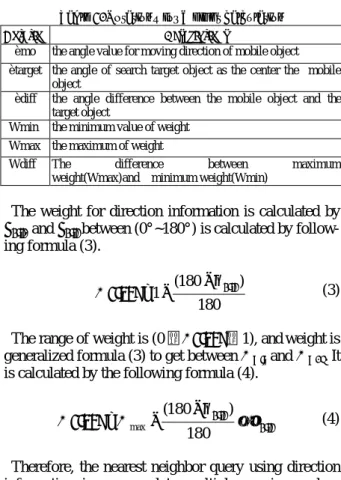
diff(2) Following Table 1 shows notations defined for weight calculation.
Table 1. Notations for Weight calculation
Notation Descriptions
èmo the angle value for moving direction of mobile object ètarget the angle of search target object as the center the mobile
object
èdiff the angle difference between the mobile object and the target object
Wmin the minimum value of weight Wmax the maximum of weight
Wdiff The difference between maximum
weight(Wmax)and minimum weight(Wmin)
The weight for direction information is calculated by è
diff, and è
diffbetween (0°~180°) is calculated by follow- ing formula (3).
180 ) 180
1 (
diffWeight − θ
−
= (3)
The range of weight is (0 Weight 1), and weight is generalized formula (3) to get between W
minand W
max. It is calculated by the following formula (4).
Weight W −
diff× W
diff−
= 180
) 180 (
max
θ (4)
Therefore, the nearest neighbor query using direction information is processed to multiply previous calcu- lated weight by Euclidean distance .
The nearest neighbor query processing using direction information algorithm is below:
Table 2. Algorithm of DNN Query Processing. (continue) Algorithm findNearest(moID, ts)
input moID : any mobile object, ts : qeury time output List NL : nearest neighbor query list
Begin
Step 1. Search the position of moID position and target from query time ts
1.1 moID position : (moID, ts, moX, moY, moDirection, moSpeed)
1.2 target position : (targetID, targetX, targetY) Step 2. Calculate the distance between moID position and target
position
Step 3. Search the direction information of moID information and target information
3.1 Search moving direction angle about moID position 3.2 Calculate an angle about target position using trigono-
metric function
Step 4. Calculate the weight with direction information of step 2 4.1 if (èmo > ètarget) then // if mobile object' processing direction angle is bigger
than target object angle
èdiff = èmo - ètarget
else then // Otherwise, the target is bigger than mobile object's moving direction angle
èdiff = ètarget - èmo
if (èdiff > 180) then // The angle is bigger than 180°
èdiff = 360 - èdiff // angle difference(èdiff) 4.2 Weight = Wmax - ((180 - èdiff) / 180) * Wdiff Step 5. Make nearest neighbor query list based distance and weight
5.1 Estimation = Distance * Weight 5.2 Add Estimation to NL 5.3 Sort NL with Estimation value Step 6. Return NL
End
2) Quantized Direction-based Nearest Neighbor Query
QDNN query processing method is the extended DNN query processing to overcome an error according to process direction of mobile object. For example, in case of quantization as 30° interval, an angle difference be- tween (0°~30°) have the same weight.
In this case, the quantized angle is QD, and divided number of quantized angle is defined as QN. They are calculated by formula (5) and (6) respectively.
QD QN 180
= (5)
QN = QD 180 (6)
The weight calculation by the quantized angle using formula (6) is calculated by following formula.
QN
Weight 180 (
diffQD )
1 − −
−
= θ (7)
Here, the range of the weight value is (0 Weight 1), and if the weight is generalized to get between W
minand W
max, we can lead a formula (8).
diff
diff
W
QN QD W QN
Weight − ×
−
= /
max
θ (8)
The nearest neighbor query processing using quan- tized direction information algorithm is following:
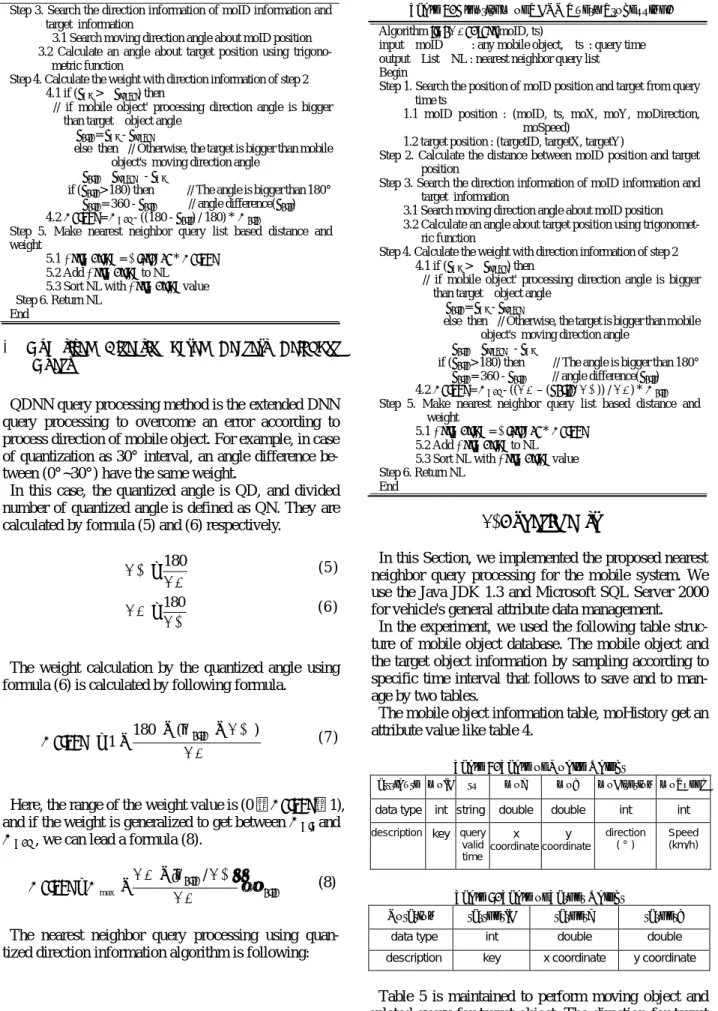
Table 3. Algorithm of QDNN Query Processing.
Algorithm findQNearest(moID, ts)
input moID : any mobile object, ts : query time output List NL : nearest neighbor query list Begin
Step 1. Search the position of moID position and target from query time ts
1.1 moID position : (moID, ts, moX, moY, moDirection, moSpeed)
1.2 target position : (targetID, targetX, targetY)
Step 2. Calculate the distance between moID position and target position
Step 3. Search the direction information of moID information and target information
3.1 Search moving direction angle about moID position 3.2 Calculate an angle about target position using trigonomet-
ric function
Step 4. Calculate the weight with direction information of step 2 4.1 if (èmo > ètarget) then // if mobile object' processing direction angle is bigger
than target object angle
èdiff = èmo - ètarget
else then // Otherwise, the target is bigger than mobile object's moving direction angle
èdiff = ètarget - èmo
if (èdiff > 180) then // The angle is bigger than 180°
èdiff = 360 - èdiff // angle difference(èdiff) 4.2 Weight = Wmax - ((QN – (èdiff / QD)) / QN) * Wdiff Step 5. Make nearest neighbor query list based distance and
weight
5.1 Estimation = Distance * Weight 5.2 Add Estimation to NL 5.3 Sort NL with Estimation value Step 6. Return NL
End
5. Experiments
In this Section, we implemented the proposed nearest neighbor query processing for the mobile system. We use the Java JDK 1.3 and Microsoft SQL Server 2000 for vehicle's general attribute data management.
In the experiment, we used the following table struc- ture of mobile object database. The mobile object and the target object information by sampling according to specific time interval that follows to save and to man- age by two tables.
The mobile object information table, moHistory get an attribute value like table 4.
Table 4. Table of Mobile Object
attribute moID ts moX moY moDiretion moSpeed
data type int string double double int int description key query
valid time
x coordinate
y coordinate
direction ( ° )
Speed (km/h)
Table 5. Table of Target Object
Notation tartgetID targetX targetY
data type int double double
description key x coordinate y coordinate
Table 5 is maintained to perform moving object and
related query for target object. The direction for target
object can be calculated an angle information us- ing trigonometric function about target object's position information.
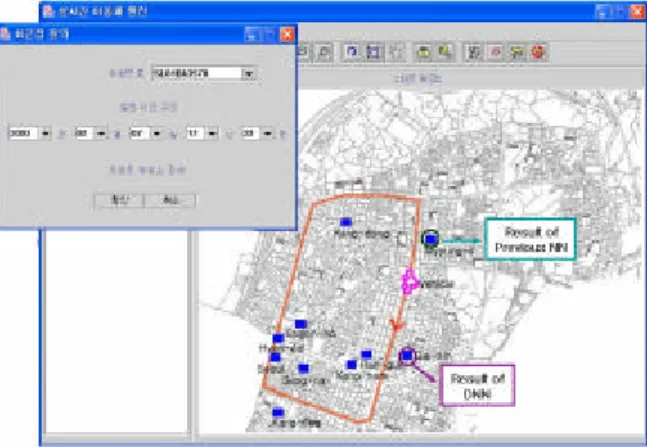
We showed the query result by proposed DNN query processing method in the fig. 1.
Fig. 1. Result of DNN Query Processing
The nearest oil station from vehicle is “Myoung-il” at query time in the fig. 1. However, we can select “Gai- sin” from DNN query processing.
Fig. 2. Moving of Other Type’s Mobile Object
The fig. 2 have showed moving trajectory of other type's mobile object.
In the case fig. 2, the result generated by proposed query processing method is like Table 6.
Table 6. Result of Query Processing Oil station
name
Real
distance èdiff WDNN DNNdistance WQDNN QDNditance
Sung-nai 76.8981 53 0.65 49.9837 0.63 48.4458 Kang-nam 112.2309 177 0.99 111.1086 0.96 107.746 Cheon-ho 121.2312 30 0.59 71.5264 0.59 71.5264 Hyun-dai 156.7305 2 0.51 79.9325 0.50 78.3652 Seoul 157.3261 23 0.57 89.6758 0.55 86.5293 Han-guk 160.2743 160 0.95 152.0000 0.92 147.4523 Kang-seo 235.8452 73 0.71 167.4501 0.67 158.0163
Gai-sin 286.7212 161 0.95 272.3851 0.92 263.7835 Kang-dong 440.5295 83 0.73 321.5865 0.71 312.7759 Myoung-il 525.2683 117 0.83 435.9727 0.80 420.2146