• 검색 결과가 없습니다.

Heavy Metals in Surface Sediments from Doam Bay, Southwestern Coast of Korea

N/A
N/A
Protected

Academic year: 2021

Share "Heavy Metals in Surface Sediments from Doam Bay, Southwestern Coast of Korea"

Copied!
10
0
0

로드 중.... (전체 텍스트 보기)

전체 글

(1)

159 http://dx.doi.org/10.7850/jkso.2015.20.4.159

Free Access

한국 남서해안 도암만 표층퇴적물의 중금속 함량 및 분포 특성

조형찬 · 조영길*

목포대학교 해양자원학과

Heavy Metals in Surface Sediments from Doam Bay, Southwestern Coast of Korea

H YEONG -C HAN C HO AND Y EONG -G IL C HO *

Department of Marine Resources, Mokpo National University, Chonnam 534-729, Korea

한국 남서해 연안의 도암만에서 44개 표층퇴적물을 채취하여 총유기탄소(TOC), 총질소(TN) 및 중금속(Al, Fe, Mn, Cr, Cu, Ni, Pb, Zn)을 분석하였으며, 11개 시료에 대해서는 화학적 존재형태별 분석을 병행하였다. TOC(0.32~3.10%), TN(0.03~0.26%)은 주변 해역의 평균 수준이었고, C/N 비(7.9~11.9)에 근거할 때 육상기원 유기물의 영향이 반영된 일부 지역이 구분되었다. 중금속 함량은 대부분의 정점에서 해양퇴적물 주의기준(TEL) 이하였고, 화학적 존재형태 별 함량은 광물격자부분에서 Cr, Cu, Ni 등이, 비광물격자부분에서 Mn, Pb가 총량의 절반을 상회하였다. 연구지역의 중금 속 배경농도를 누적빈도곡선과 선형회귀분석에 의해 추정한 결과 Cu=11.8, Ni=23.1, Pb=26.8, Zn=76.6, Cr=56.7, Mn=585 mg/kg으로 계산되었으며, 이를 바탕으로 한 농축지수(I

geo

)에 근거해 국지적인 Mn 농축의 징후를 확인하였 다. 그러나 농축지수와 존재형태비를 고려할 때 Zn, Pb도 환경변화에 따른 용출 가능성이 추정되었다.

Forty-four surface sediments from Doam Bay were analyzed for total organic carbon (TOC), total nitrogen (TN), total metal (Al, Fe, Mn, Cr, Cu, Ni, Pb, Zn) and further chemical partitioning of metals were carried out in some samples. The TOC (0.32~3.10%) and TN (0.03~0.26%) values of the samples were similar to those of other coastal area. The C/N ratios ranged from 7.9 to 11.9 with an average 9.3 which revealed that contribution of terrestrial organic matters was relatively rare. Contents of analysed metals showed a level lower than thresh- old effects level (TEL) in sediment quality guidelines. Based on the chemical speciation of metals, the lattice fractions were found in the order Cr > Cu > Ni > Zn > Pb > Mn, while Mn and Pb are the ratio of the non-lat- tice fractions accounted for more than 50%. The average baseline values were obtained relative cumulative fre- quency curves and linear regression analysis. The respective baseline concentrations for Cu, Ni, Pb, Zn, Cr and Mn were 11.8, 23.1, 26.8, 76.6, 56.7, 585 mg/kg, respectively. Based on geoaccumulation index (I

geo

) with a baseline values of Mn showed that face the contamination phase from estuarine stations. However, in case of Zn and Pb, although there is no sign of contamination, it could be release from sediment when there is a change in the environment, which is caused from the high ratio of non-lattice fractions.

Key words: Doam bay, sediments, TOC, TN, heavy metals, speciation, baseline concentration

서 론

우리나라 갯벌은 국토면적의 약 2%에 해당되는 총 2,489 km

2

로 세계 5대 갯벌에 자리매김 되는 규모의 우월성뿐만 아니라 수산물 의 생산 및 서식지, 정화, 심미 등 기능적 측면을 포함한 다양한 부 가가치가 여러 연구를 통해 확인되고 강조되었다(Park, 1999; Kim

et al., 2001; Choi, 2004). 그러나 근래 급속한 산업화와 도시화, 수산양식 및 어장확보에 따른 각종 난개발과 경제활동으로 갯벌의 축소 및 황폐화가 현실화되고 사회문제로 대두되었다. 이에 정부는 1999 년에 갯벌을 연안습지로 지정하는 습지보존법을 발효시켜 갯 벌의 보전 및 관리를 체계적이고 종합적으로 수립하기 위해 갯벌 현황 조사를 5년마다 시행하도록 법으로 명시하였다. 습지보존법 에 따라 1999년부터 2003년까지 전국 갯벌을 대상으로 본격적인 조사가 추진되었으며, 이후 습지보호구역 지정을 목표로 2008년부

Received September 24, 2015; Revised October 16, 2015; Accepted November 10, 2015

*Corresponding author: [email protected]

(2)

터 2012년까지 선정된 지역에 대한 정밀조사가 이루어졌다.

2009 년에 정밀조사가 이루어진 강진 도암만은 평균조차가 약 2.2 m 인 중조차 퇴적환경으로 내륙 깊숙이 만입된 깔때기 모양의 내만 상부와 해안선 쪽으로 발달한 갯골을 중심으로 과거 45.5 km

2

의 갯벌이 존재하였다(MOLIT, 1994). 그러나 지금까지 진행된 각 종 방조제 축조와 간척사업으로 갯벌의 규모는 100년 사이에 절반 수준인 23.9 km

2

로 감소하였으며, 1918년 76.5 km의 초기 해안선 도 54.9 km로 줄었다(MOF, 2000). 바다와 하천의 에너지 균형에 의해 유지돼온 내만의 유수체계는 2006년 탐진강 댐 건설에 따른 하천배수량 변화로 도암만이 갖는 반폐쇄 하구형 만갯벌의 다양한 장점과 가치를 간섭하기에 이르렀다(Kim et al., 2001; Kim et al., 2005). 현저한 하천에너지 약세는 창조 우세의 조류비대칭을 심화 시켜 내만 갯벌의 성장을 촉진하고 있으며(MLTM, 2010), 유입된 해수 또한 변형된 조류에 의해 조각된 해저지형을 따라 재배치가 이루어지고 있음이 해면동물의 골침 및 규조각의 산출빈도로부터 확인되었다(Koh et al., 2008).

유수 흐름이 변화된 만내 퇴적작용은 퇴적물이 재분포되는 과정 을 통해 저서생태는 물론 퇴적물의 지화학적 특성에도 큰 영향을 미친다. 도암만의 지난 생태학적 연구는 생물상 및 생물군집을 퇴 적환경 변화와 밀접한 의존적 관계로 제시하고 있으며, 저서생태 에 미칠 퇴적상 변화의 영향을 단적으로 보여준다(Ju et al., 2002;

Kim, 2005; Koh et al., 2008; Nam et al., 2009). 이곳의 지화학적 연구 또한 퇴적물의 화학성분 함량과 분포가 유수의 유동에 따른 물질의 혼합과 수평 및 수직 이동에 의해 조절되는 현상으로 이해 하고 있다(Na, 2002; Hong et al., 2007). 그 과정에서 이질적인 외 지물질의 유입과 혼합은 때로 환경오염을 수반하며, Hong(2007) 은 퇴적물의 중금속 분석을 통해 그러한 가능성을 제시하였다. 일 반적으로 중금속에 의한 환경문제는 비교된 기준값에 대한 상대적 평가방식이기 때문에 무엇보다 배경농도의 객관적 설정이 중요하 다. 따라서 중금속의 농축 혹은 오염 가능성에 대한 판단은 해당 지역 퇴적물의 배경농도를 설정하는 시도가 전제되어야 한다. 본 연구는 중금속의 총량과 아울러 탄산염, 산화물, 유기물, 광물격자 등 다양한 지화학성분과 결합된 중금속을 선별추출하여 그것의 존 재형태를 파악하고, 이에 기초한 배경농도를 객관적 기법을 통해 제안함으로써 도암만 퇴적물의 중금속 농축을 검토하였다.

재료 및 방법

강진 도암만과 탐진강 하구의 44개 정점에서 2009년부터 2년 동안 van Veen 채니기를 이용하여 표층퇴적물을 채취하였다(Fig.

1). 퇴적물은 현장에서 분석항목별로 분리하여 실험실로 운반하였 고, 화학분석을 위한 시료는 냉동건조한 후 마노유발을 사용하여 연마하였다. 확보된 시료는 항목별로 제안된 방법에 따라 입도와 총유기탄소(TOC, total organic carbon), 총질소(TN, total nitrogen) 및 중금속 분석이 이루어졌다.

퇴적물의 입도는 원시료를 Ingram(1971)의 표준입도분석법에 따 라 4Ø 보다 조립한 성분은 체질을 통해 선별하여 1Ø 간격으로 무 게를 구하는 방법으로, 4Ø 보다 세립한 성분은 Stokes’ Law를 적 용한 피펫방법으로 분석하였다. 입도변수는 Folk and Ward(1957) 의 도식법에 따라 계산하였고, Folk(1968)의 방법으로 퇴적상을 파

악하였다. TOC는 분말시료에 1 M 염산을 첨가하여 무기탄소를 제

거한 후 SHIMADZU 모델 SSM-5000 유기탄소분석기로 정량하

였고, TN은 퇴적물의 질소화합물을 분해하여 질산이온으로 산화

시킨 후 분광광도법을 따라 측정하였다(MLTM, 2010). TN, TOC

모두 반복 분석하였으며, 측정의 표준편차는 ±5% 이내였다. 중금

속은 9개 항목(Li, Al, Fe, Mn, Cr, Cu, Ni, Pb, Zn)의 총량과 일부 항

목의 존재형태별 분석을 병행하였다. 총량은 테프론 비이커(teflon

bomb) 에 분말시료와 혼합산(HNO

3

+HF+HCIO

4

) 을 넣어 고온에서

시료를 완전히 용해시켜 건조한 뒤 1N 질산으로 중금속을 용출한

용액을 ICP-AES로 측정하였다. 존재형태별 분석은 시료에 추출시

약을 단계적으로 반응시켜 특정 지화학성분과 결합된 중금속을 분리,

용출하는 방법으로(Kitano, 1980) 네 가지 반응물질을 대상으로 하

Fig. 1. Map showing the sampling stations of Doam Bay and Tamjin

river mouth.

(3)

였으며, 추출된 존재형태는 탄산염부분(carbonate fraction), 산화물 부분(oxide fraction), 유기물부분(organic fraction) 및 광물격자부 분(mineral lattice fraction)이다. 각 추출부분의 합은 측정된 금속 모두 총량에 대해 ±10% 이내의 오차를 보였다. 중금속의 총량은 NRC 표준물질 MESS-1을 함께 분석하여 측정값의 신뢰도를 검증 하였으며, 측정에 의한 각 금속의 회수율은 Al 88.1%, Fe 96.9%, Mn 87.5%, Cr 91.4%, Cu 81.7%, Ni 86.7%, Pb 94.3%, Zn 80.0% 였다.

결과 및 고찰 퇴적물의 입도 및 유기물 함량

퇴적물의 평균입도는 3.3~7.6Ø 범위였으며, 전반적으로 실트와 점토가 우세하나 시료의 27%는 50% 이상의 모래 또는 약간의 자 갈(<5%)을 포함하였다. 따라서 도암만은 니질(M) 및 실트질(Z) 퇴 적상을 기반으로 모래가 10% 이상 포함된 사니질(sM) 및 사실트 질(sZ) 퇴적상이 주를 이루며, 하구 및 해안에 인접한 지역에 역니

질((g)M) 및 역니사질((g)mS) 퇴적상이 분포한다(Fig. 2).

TOC 및 TN 함량은 각각 0.32~3.10%(평균 0.90%), 0.03~0.26%

( 평균 0.09%) 범위로 도암만 주변의 해역과 비슷하며(Woo et al., 2014), 오염해역인 마산만, 진해만에 비하면 절반 수준이다(Choi et al., 2005; Hwang et al., 2006). 공간적으로는 TOC, TN 모두 탐진강 하구와 만의 상부에서 함량이 높은 가운데 전반적으로 퇴 적물의 입도성분 변화와 밀접한 관련성을 보인다(Fig. 3). 차이가 뚜렷한 하구시료 3개를 제외한 만 퇴적물에서 점토와 TOC의 양 호한 상관관계(R

2

=0.81, p<0.01)는 퇴적물의 세립성분, 특히 점토 입자와 연관된 유기물의 함량 및 분포를 지시하며, 점토와 TN의 상관관계(R

2

=0.83, p<0.01) 역시 그러한 사실을 뒷받침한다(Fig.

4). 이와 같은 결과는 여러 연구에서 보고된 현상으로(Ganeshram et al., 1999; Volkman et al., 2000), 세립질의 표면적 증가에 의한 유기물 흡착성 향상, 유기물과 점토입자의 유사 수경성 및 친화성에 의한 것으로 설명된다(Mayer, 1994; Ashagrie et al., 2005).

하천의 영향을 받는 만 퇴적환경에서 C/N 비는 흔히 유기물의 기원을 구분하는 지표로 사용된다. 해양의 기초생산에 의한 유기

Fig. 2. Distribution of surface sedimentary facies.

Fig. 3. Variations of TOC(●), TN(▲) and grain-size compositions in surface sediments from the study area.

(4)

물은 풍부한 단백질로 인해 5~10의 C/N 비를, 육지기원 유기물은 다량의 섬유소에 의해 보통 10 이상의 높은 C/N 비를 갖기 때문 이다(Bordovskiy, 1965; Lee and Fuhrman, 1987; Meyer, 1994).

연구지역의 C/N 비는 7.9~11.9(평균 9.3) 범위로 대부분 해양기원 영역에 해당되며, 탐진강 및 소규모 유입하천에 인접한 정점들에 서 10 이상의 비교적 높은 비를 나타낸다(Fig. 5). 따라서 하천을 통한 육지기원 유기물은 하구역에 제한적인 영향을 미치며, 도암 만 퇴적물의 유기물은 주로 해양의 기초생산에 의한 것으로 판단 된다.

중금속의 함량 및 분포

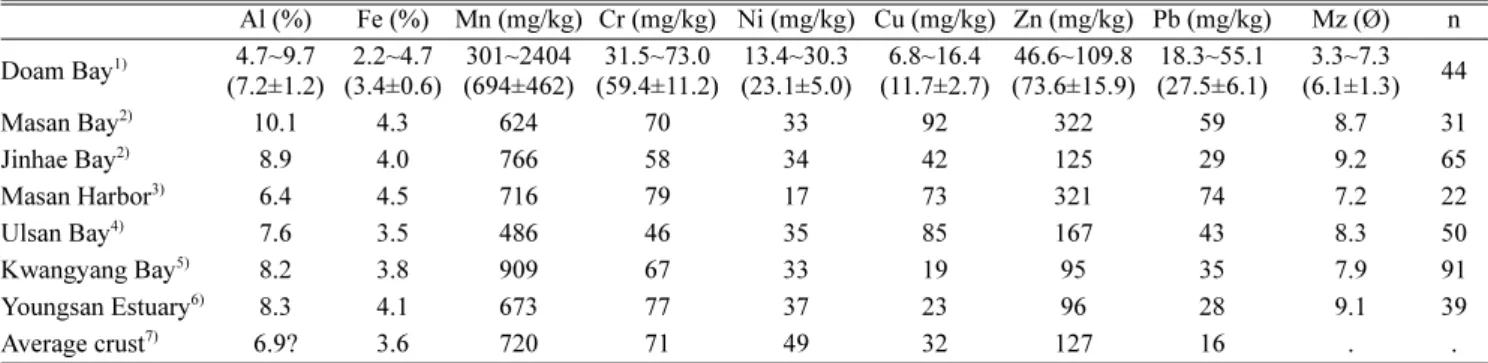
퇴적물의 중금속 함량은 우리나라 연안의 만이나 하구 환경에서 보고된 값의 범위에 포함되었고 비오염해역의 평균과 유사한 값을 보였다(Table 1). 공간적으로는 금속의 대부분이 입도 변화에 의존 적인 분포를 보이며, 만의 상부에서 함량이 높은 Mn과 정점 33을 중심으로 함량이 높은 Pb의 국지적 분포가 타 금속과 구분되었다.

시료간 함량의 변화(σ

x

/ ) 는 Mn이 67%로 가장 컸고 Al, Fe, Cr, Ni, Zn, Pb, Cu 순으로 17~23% 범위에서 변동하였다.

퇴적물에서 중금속 함량의 입도 의존적 변화는 일반적인 현상으로 인식된다(Salomons and Förstner, 1984; Klamer et al., 1990;

Horowitz, 1991; Cho et al., 1999; Crompton, 2015). 그렇기 때문 에 함량의 상대적 크기가 갖는 의미를 이해하기 위해서는 입도의 영향을 보정하는 일련의 표준화 과정이 필요하다. 우리나라 해저 퇴적물의 중금속 오염관리를 위한 주의기준(TEL, Threshold Effects Level) 및 관리기준(PEL, Probable Effects Level) 농도설정에 근거 하여 제안된 방법으로(국토해양부고시 제2013-186호) Li(59.1±11.0 mg/kg, n=44) 을 이용하여 입도 보정한 후 기준농도와 비교하면 Fig. 6 과 같다. 그림의 중금속은 단지 Pb 함량이 한 정점에서 TEL 을 초과하는 것을 제외하면 나머지 금속 모두 생태계에 부정적 영

x

Table 1. Contents of heavy metals in surface sediments from Doam Bay. Related values for some of the other coastal areas were also shown for comparison

Al (%) Fe (%) Mn (mg/kg) Cr (mg/kg) Ni (mg/kg) Cu (mg/kg) Zn (mg/kg) Pb (mg/kg) Mz (Ø) n Doam Bay

1)

4.7~9.7

(7.2±1.2)

2.2~4.7 (3.4±0.6)

301~2404 (694±462)

31.5~73.0 (59.4±11.2)

13.4~30.3 (23.1±5.0)

6.8~16.4 (11.7±2.7)

46.6~109.8 (73.6±15.9)

18.3~55.1 (27.5±6.1)

3.3~7.3 (6.1±1.3) 44

Masan Bay

2)

10.1 4.3 624 70 33 92 322 59 8.7 31

Jinhae Bay

2)

8.9 4.0 766 58 34 42 125 29 9.2 65

Masan Harbor

3)

6.4 4.5 716 79 17 73 321 74 7.2 22

Ulsan Bay

4)

7.6 3.5 486 46 35 85 167 43 8.3 50

Kwangyang Bay

5)

8.2 3.8 909 67 33 19 95 35 7.9 91

Youngsan Estuary

6)

8.3 4.1 673 77 37 23 96 28 9.1 39

Average crust

7)

6.9? 3.6 720 71 49 32 127 16 . .

1)
This study, Figures in parenthesis are average±1SD;

2)

Cho and Lee(2012);

3)

Hwang et al.(2006);

4)

ME(1999);

5)

Cho et al.(2000);

6)

Cho and Park(1998);

7)

Martin and Whitfield(1983).

Fig. 4. Correlation between the clay percentage, TOC and TN of the 41 bay sediments, excluding river mouth sections (n=3).

Fig. 5. TOC versus TN contents for surface sediments from the study

area. The solid and dotted lines represent the boundary of terrige-

nous and oceanic origins for organic matter in sediments. Note that

samples from river mouth sections (▲) showed higher TOC/TN

ratios than the others.

(5)

향이 없을 것으로 예측되는 주의기준(TEL) 이하의 수준을 보여준다.

중금속의 화학적 존재형태

퇴적물에서 중금속은 퇴적환경 변화에 수반된 제반 물리·화학적 과정을 통해 다양한 형태로 존재하며, 존재형태의 이러한 종속적 변화는 수·저질 환경을 위협하는 잠재된 요소로 작용한다(Gibbs, 1977; Li and Thornton, 2001). 따라서 중금속의 존재형태별 분석 은 환경변화에 따라 전이 가능한 부분을 구분함으로써 함량에 내 재된 정보와 저서환경의 위해성을 추정할 수 있는 단초를 제공한

다. 본 연구에서는 만의 수직방향으로 11개 퇴적물을 선정하여 유 기물, 산화물, 탄산염, 광물격자 등의 존재형태별 중금속(Mn, Cr, Cu, Ni, Zn, Pb) 함량을 분석하였으며, 그 결과를 Fig. 7에 제시하 였다.

환경변화에 독립적인 광물격자부분(mineral lattice fraction)의 존 재비는 Cr이 총량의 91.4~93.6%로 가장 높았으며, Cu(74.3~92.8%), Ni(64.7~83.8%), Zn(53.8~65.3%), Pb(36.8~47.4%), Mn(7.1~42.9%) 순으로 감소하였다. 존재형태가 불안정한 부분(탄산염+유기물+산 화물)의 함량이 가장 높은 금속은 Mn, Pb가 대표적이며, 그 비는 각각 평균 80.0%와 57.4%로 총량의 절반을 넘는다(Fig. 7). 산화 물부분(oxide fraction)의 존재비는 Pb(31.2~54.0%), Mn(16.5~66.7%), Zn(20.1~31.0%), Ni(11.0~14.6%) 등이 높았으며, 일반적으로 혐기 성 조건에서 열역학적으로 불안정한 산화물과 친화도가 큰 금속의 특징에 부합하였다(Dong et al., 2000; Cuong and Obbard, 2006;

Yang et al., 2012; Liu et al., 2013). Pb의 경우 광물격자부분(평 균 42.6%)과 비슷한 산화물부분의 존재비(평균 38.3%)는 연구지 역에서 산화물성분이 중요한 조절자 역할을 하고 있음을 보여준다.

유기물부분(organic fraction)의 존재형태는 Cu를 제외하면 대부 분의 금속에서 미미하였다. 유기물에 의한 중금속 농축은 보통 1~10% 정도로 보고되나 금속에 따라 친화도의 차이가 존재하며 (Horowitz, 1985), Cu 는 비교적 유기물과 친화도가 큰 금속에 해 당된다(Montoura et al., 1978), 광물격자부분에 이어 유기물부분 에서 두 번째로 높은 Cu의 존재비(2.7~19.6%)는 그러한 특성을 어느 정도 반영한 것으로 이해된다. 탄산염부분(carbonate fraction)의 존 재비는 특히 Mn에서 평균 50.4%(22.0~71.5%)로 현저히 높다. 이 값은 산화물부분(평균 26.7%)의 1.8배, 광물격자부분(평균 20.0%)의 2.5 배에 달하며, 여러 퇴적물에서 드러난 것처럼(Cho et al., 1994;

Wang et al., 2010; Davutluoglu et al., 2011) 탄산염이 Mn의 대표 적 존재형태임을 지시한다. 탄산염의 이온결합에서 칼슘이온과 치 환에 의한 일부 중금속(Cd, Mn, Pb, Zn 등) 함량이 탄산칼슘에서 높은 현상은(Cho et al., 994; Rath et al., 2009; Wang et al., 2010) 탄산염추출부분에서 유의한 비를 나타낸 Pb(2.3~26.7%, 평균 16.7%) 및 Zn(7.2~14.0%, 평균 9.6%)의 존재형태를 뒷받침한다.

Fig. 6. Grain size corrected concentrations of heavy metals (Cr, Cu, Ni, Pb, Zn) in surface sediments from the study area. The dotted lines are threshold effects level (TEL) of Korean coastal sediments.

Fig. 7. Contents of heavy metals (lines in figures) and their chemical speciation in surface sediments from the study area.

(6)

도암만 퇴적물의 중금속 배경농도 설정 및 평가

지금까지 셰일 및 지각의 포괄적 기준치(Turekian and Wedepohl, 1961; Martin and Whitfield, 1983), 지역 또는 권역별 퇴적물의 산 업화 이전 농도(국토해양부고시 제2013-186호)와 같은 지화학적 방법에 의한 배경농도를 기준으로 값의 비교를 통한 여러 오염평 가가 시도되었다. 그러나 퇴적환경으로 유입되는 물질의 운반과 이 동경로, 퇴적과정이 다른 조건에서 그와 같은 포괄적 기준을 적용 하는 경우 환경 고유의 특성이 간과되는 오류가 생길 수 있다. 해 당 지역의 자료에 근거한 통계적인 방법은 그러한 문제를 보완할 수 있는 하나의 대안이 될 수 있으며(Siegel 1995; Matschullat et al., 2000; Newman and Watling 2007; Teng et al., 2009), 연구지 역 중금속 함량이 우리나라 중금속 오염관리를 위한 주의기준 이 하로 판정된 결과는(Fig. 6) 비오염퇴적물 배경농도에 대한 통계적 접근의 합리적 기준을 충족한다. 이에 본 연구에서는 두 가지 통 계적 방법, 즉 선형회귀분석(linear regression analysis)과 누적빈도 곡선(cumulative frequency curve)에 의해 배경농도를 추정하였다.

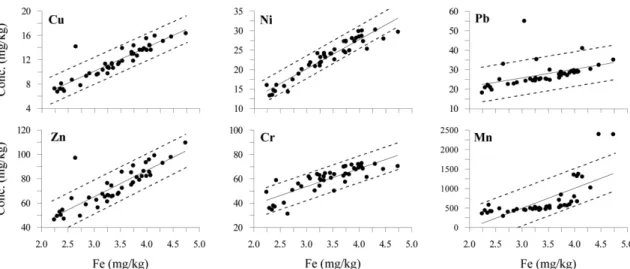
선형회귀분석은 독립변수로서 무엇보다 보존성 원소의 선정이 중요하다. 보존성 원소는 환경에서 자연적 기원으로 안정된 존재 형태, 타 원소와 양호한 관련성이 유지되는 요건을 만족해야 하며, 여러 연구에서 그러한 금속으로 Al, Fe, Li, Sc, Cs 등이 제시되었다 (Klamer et al., 1990; Luoma 1990; Schropp et al., 1990; Summers et al., 1996; Lim et al., 2007). 연구지역에서 보존성 원소는 평균 입도 및 금속간의 상관관계를 통해 Fe를 선정하였으며(Table 2), 특히 광물격자 존재형태비가 높은 금속들과(Fig. 7) Fe의 양호한 관계는 Fe의 보존적 거동을 뒷받침한다. 각 금속의 배경농도(C

M

) 는 보존성 원소(C

N

) 와 관계식(C

M

=aC

N

+b) 으로부터 계산하였으며(Table

3), 이때 95% 신뢰구간을 벗어난 이상치는 제외하였다(Fig. 8).

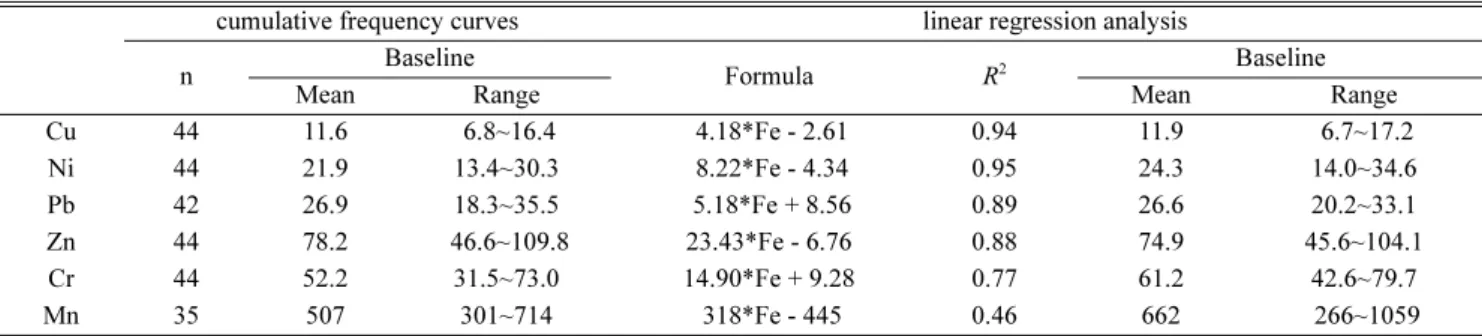
누적빈도곡선에 의한 배경농도는 곡선에 나타난 변곡점이 산정의 기준이 된다(Matschullat et al., 2000; Teng et al., 2009). 즉, 곡선 의 변곡점은 자연농도와 변칙농도의 경계를 의미하기 때문에 변곡 점 이하의 구간으로부터 배경농도를 추산할 수 있다. 본 연구에서 변곡점은 누적도수의 선형회귀분석을 통해 결정하였고, 누적빈도 곡선이 직선에 가까워 변곡점이 없는 경우에는(Cu, Ni, Zn, Cr) 자 료 전체가 배경농도 범위에 포함된 것으로 간주하였다(Fig. 9). 이 과정에서 Kolmogorov-Smirnov 검정을 통해 값의 정규분포를 확 인하였으며(2-tailed P>0.05), 누적빈도곡선에 의거한 배경농도는 Table 3 에 요약하였다. 이로써 선형회귀분석과 누적빈도곡선에 의 한 배경농도의 평균은 Cu 11.8 mg/kg, Ni 23.1 mg/kg, Pb 26.8 mg/kg, Zn 76.6 mg/kg, Cr 56.7 mg/kg, Mn 585 mg/kg 으로 계산되었다.

산출된 배경농도의 상호비교는 중금속 오염을 진단할 수 있는 중요한 근거를 제공한다. 위 배경농도를 기반으로 도암만 퇴적물의 오염화 단계를 존재형태별 분석을 수행한(상대적으로 중금속 함량 이 높은) 시료를 선정해 농축지수(geoaccumulation index; I

geo

) 에 근거하여(Müller, 1979; Förstner and Salomons, 1980) 평가하였다.

농축지수를 구하기 위해 본 연구에서는 제안된 입도표준화 방법에 따라 직경 63 μm 이하의 입자를 분리하여 추가 분석하였으며, 그 값(C

n

) 을 다음과 같은 식을 따라 배경농도(B

n

) 와 비교하였다.

I

geo

= log

2

C

n

/ B

n

× 1.5

중금속 Ni, Cr의 농축지수는 분석시료 모두 I

geo

0 이하의 값을 보였다. Cu, Zn, Pb 또한 1개 시료를 제외하면 모두 I

geo

0 이하로 오염 징후가 없는 단계의 수준이 유지되었다. 반면에 Mn은 하구에 위치한 일부 시료에서 I

geo

1 이상으로 낮은 단계의 국지적인 농축 이 진행된 것으로 나타났다(Fig. 10). 이러한 결과는 농축지수를 검 토한 시료의 상대적 함량을 고려할 때(Fig. 7) 전반적으로 양호한 환경을 뒷받침한다.

한편, 중금속의 존재형태와 농축지수의 관계는 퇴적환경 변화에 따른 수질의 변화를 예측할 수 있으며, Fig, 10은 그러한 가능성을 보여준다. 그림에서 Ni(R

2

=0.76), Cr( R

2

=0.92) 의 농축지수는 광물 격자부분과 양호한 관계를 나타낸 반면 Mn(R

2

=0.77), Zn( R

2

=0.83), Pb( R

2

=0.71) 의 농축지수는 존재형태가 불안정한 비광물격자부분과 관련성이 크다. 퇴적물의 초기속성과정에서 존재형태가 불안정한 부분의 용출을 고려한다면 비록 비오염 단계인 Zn, Pb 또한 Mn과 아울러 저서환경 변화에 따라 용존형태로 전환될 수 있는 가능성 이 잠재된 것으로 판단된다.

Table 2. Comparison of reference element normalizers (All correlations are significant at p<0.01)

Correlation coefficient

Mz Al Fe

Mz - 0.76 0.90

Al 0.76 - 0.87

Fe 0.90 0.87 -

Cu 0.88 0.78 0.96

Ni 0.94 0.83 0.97

Pb 0.42 0.44 0.42

Zn 0.81 0.67 0.92

Cr 0.90 0.78 0.86

Mn 0.49 0.44 0.66

Table 3. Calculated baseline concentrations (mg/kg) based on cumulative frequency curve and linear regression equations in the sediments of Doam Bay

cumulative frequency curves linear regression analysis

n Baseline

Formula R

2

Baseline

Mean Range Mean Range

Cu 44 11.6 6.8~16.4 4.18*Fe - 2.61 0.94 11.9 6.7~17.2

Ni 44 21.9 13.4~30.3 8.22*Fe - 4.34 0.95 24.3 14.0~34.6

Pb 42 26.9 18.3~35.5 5.18*Fe + 8.56 0.89 26.6 20.2~33.1

Zn 44 78.2 46.6~109.8 23.43*Fe - 6.76 0.88 74.9 45.6~104.1

Cr 44 52.2 31.5~73.0 14.90*Fe + 9.28 0.77 61.2 42.6~79.7

Mn 35 507 301~714 318*Fe - 445 0.46 662 266~1059

(7)

Fig. 8. Linear regression showing background values for Cu, Ni, Pb, Zn, Cr and Mn based on their correlation with Fe (Dotted lines rep- resent the upper and lower of 95% confidential intervals).

Fig. 9. The frequency (bar) and cumulative frequency (circle) curve of Cu, Ni, Pb, Zn, Cr and Mn. Arrows in plots are inflection point indicating the natural and anomalous boundary. Linear regressions were performed on cumulative frequency with P<0.05 and R

2

>0.9, except for Cr (R

2

=0.88).

Fig. 10. Relationships between the heavy metals in lattice (●)/non-lattice (○) fractions and their corresponding Igeo. The dash and solid

lines are non-lattice and lattice, respectively. The shading area indicates that the accumulation.

(8)

결 론

강진 도암만의 44개 정점에서 표층퇴적물을 채취하여 입도와 TOC, TN 및 중금속(Al, Fe, Mn, Cr, Cu, Ni, Pb, Zn)을 분석하였 으며, 11개 정점에 대해서는 중금속의 존재형태별 분석을 병행하 였다.

퇴적물의 입도는 3.3Ø~7.6Ø 범위로 변화하였으며, 실트와 점토를 기반으로 모래 또는 약간의 자갈을 포함하는 퇴적상이 혼재하였다.

TOC 및 TN 함량은 각각 평균 0.90%, 0.09%로 해역의 평균 수준 이었고 특히 점토성분과 양호한 관련성을 보였다. TOC와 TN에 근거한 C/N 비는 7.9~11.9(평균 9.3) 범위로 대부분 해양기원의 특 성을 반영하는 비의 분포가 일반적이었고, 일부 하구 정점에서 육 지기원의 영향으로 추정되는 10 이상의 비교적 높은 비를 나타냈다.

중금속 함량은 비오염 퇴적물에서 보고되는 값의 범위로서 오염 관리를 위한 주의기준을 하회하였다. 공간적으로는 Mn의 변화가 67%( σ

x

/ ) 로 가장 컸고, 그 밖의 금속은 17~23% 범위에서 주로 입도 의존적인 분포를 보였다. 안정된 형태인 광물격자부분의 존 재비는 Cr(총량의 91.4~93.6%), Cu(74.3~92.8%), Ni(64.7~83.8%) 등이 높았으며, 존재형태가 불안정한 부분에서 함량이 가장 높은 금속은 Mn(평균 80.0%), Pb(57.4%)로 그 비가 총량의 절반을 훨 씬 넘었다. 특히 산화물부분에서 Pb, 유기물부분에서 Cu, 탄산염 부분에서 Mn의 높은 존재비는 지화학성분에 의한 조절능력이 금 속에 따라 달리 작동되는 결과로 인식하였다.

도암만 저서환경 평가를 위한 중금속 배경농도를 선형회귀분석과 누적빈도곡선에 의거하여 추정한 결과 Cu 11.8 mg/kg, Ni 23.1 mg/kg, Pb 26.8 mg/kg, Zn 76.6 mg/kg, Cr 56.7 mg/kg, Mn 585 mg/kg 으로 계산되었다. 시도된 두 통계적 방법은 다른 조건의 포괄적 기준을 적용하는 지화학적 방법에 의한 오류를 보완할 수 있는 하나의 대 안으로 비오염퇴적물 배경농도에 대한 합리적 기준을 충족한다. 배 경농도에 근거한 중금속 농축지수(I

geo

) 는 하구의 일부 시료에서 낮 은 단계의 국지적인 Mn 농축을 제외하면 그 밖의 금속 모두 오염 징후가 없는 I

geo

0 이하의 수준을 유지하였다. 그러나 상당부분 비 광물격자 형태인 Mn, Zn 및 Pb는 농축지수와 존재형태비의 관계 로부터 저서환경 변화에 따른 용출 가능성이 잠재된 금속으로 추 정되었다.

사 사

본 논문은 2009년 국토해양부「연안습지 기초조사」 ‘정밀조사’

과제의 결과에 근거한 것입니다. 연구의 지원에 감사드립니다. 아 울러 심사를 통해 건설적인 제안과 논평을 해주신 두 분의 심사위 원께 감사의 마음을 전합니다.

참고문헌

Ashagrie, Y., W. Zech and G. Guggenberger, 2005. Transformation of a Podocarpus falcatus dominated natural forest into a monocul- ture Eucalyptus globules plantationat Munesa, Ethiopia: soil organic C, N and S dynamics in primary particle and aggregate- size fractions. Agriculture, Ecosystems and Environ., 106: 89–98.

Bordovskiy, O.K., 1965. Accumulation and transformation of organic

substances in marine sediments. Mar. Geol., 3: 3–114.

Cho, Y.G. and C.B. Lee, 2012. Heavy Metal contamination in surface sediments from Masan and Jinhae bay, southeast coast of Korea.

J. KOSMEE, 15: 302−313.

Cho, Y.G. and K.Y. Park, 1998. Heavy metals in surface sediments of the Youngsan estuary, west coast of Korea. J. Environ. Sci., 7:

549 −557.

Cho, Y.G., C.B. Lee and C.H. Koh, 2000. Heavy metals in surface sediments from Kwangyang bay, south coast of Korea. J. Korean Soc. Oceanogr., 5: 131−140.

Cho, Y.G., C.B. Lee and M.S. Choi, 1999. Geochemistry of surface sediments off the southern and western coasts of Korea. Mar.

Geol., 159: 111−129.

Cho, Y.G., C.B. Lee, and M.S. Choi, 1994. Characteristics of heavy metal distribution in surface sediments from the South Sea of Korea. J. Korean Soc. Oceanogr., 29: 338−356.

Choi, M.C., H.B. Moon, S.S. Kim and J.S. Park, 2005. Evaluation of sewage pollution by Coprostanol in the sediments from Jinhae bay, Korea. J. Kor. Fish. Soc., 38: 118−128.

Choi, M.H., 2004. Economic value of the Korean mudflat wetland.

J. Wetlands Res., 6: 89−104.

Crompton, T.R., 2015. Determination of Metals in Natural Waters, Sediments, and Soils. Elsevier, 318 pp.

Cuong, D.T., and J.P. Obbard, 2006. Metal speciation in coastal marine sediments from Singapore using a modified BCR-sequential extraction procedure. Appl. Geochem. 21: 1335−1346.

Davutluoglu, O.I., G. Seckin, C.B. Ersu, T. Yilmaz and B. Sari, 2011.

heavy metal content and distribution in surface sediments of the Seyhan river, Turkey. J. Environ. Management, 92: 2250−2259.

Dong, D., Y.M. Nelson, L.W. Lion, M.L. Shuler and W.C. Ghiorse, 2000. Adsorption of Pb and Cd onto metal oxides and organic material in natural surface coatings as determined by selective extraction: new evidence for the importance of Mn and Fe oxides.

Water Res., 34: 427−436.

Folk, R.L. and W.C. Ward, 1957. Brazos river bar; A study in the sig- nificance of grain size parameter, J. Sed. Petrol., 27: 3−26.

Folk, R.L., 1974. Petrology of Sedimentary Rocks. Hemphill Pub- lishing Company, Austin, Texas, 182 pp.

Förstner, U. and W. Salomons, 1980. Trace metal analysis on polluted sediments. I. Assessment of sources and intensities. Environ.

Technol. Lett., 1: 494−505.

Ganeshram, R.S., S.E. Calvert, T.F. Pedersen and G.L. Cowie. 1999.

Factors controlling the burial of organic carbon in laminated and bioturbated sediments off NW Mexico: implications for hydro- carbon preservation. Geochim. Cosmochim. Acta, 63: 1723–1734.

Gibbs, R.J. 1977. Transport phase of transition metals in the Amazon and Yukon rivers. Geol. Soc. Am. Bull., 88: 829−843.

Hong, J.T., B.S. Na, J.Y. Kim, Y.K. Koh, S.T. Youn, S.E. Shin, H.G.

Kim, B.C. Moon and K.H. Oh, 2007. Sedimentary geochemical characteristics and environmental impact of sediments in Tamjin river and Doam bay. J. Environ. Impact Assess. 16: 393−405.

Horowitz, A.J., 1985. A Primer on Trace Metal Sediment Chemistry.

U.S. Geological Survey, Denver, pp. 36 −46.

Horowitz, A.J., 1991. A Primer on Sediment-Trace Element Chem- istry. Lewis Publishers, INC., 136 pp.

x

(9)

Hwang, D.W., H.G. Jin, S.S. Kim, J.D. Kim, J.S. Park and S.G. Kim, 2006. Distribution of organic matters and metallic elements in the surface sediments of Masan harbor, Korea. J. Kor. Fish. Soc., 39:

106 −117.

Ingram, R.L., 1971. Sieve Analysis. In: Procedures in Sedimentary Petrology, edited by Carver, R.E., Wiley-Inter Science, New York, 49 −67.

Ju, J.M., C.E. Chung and H.B. Yoo, 2002. Dynamics of zooplankton community in upper Tamjin river system, Korea. J. Sci. Edu.

Chonnam Nat’l Univ., 26: 201−224.

Kim, D.H., G.S. Kim and H.S. Cho, 2001. Estimate to the capacity of self purification in tidal flats of Kangjin bay, Korea. Collection of Dissertations of Mokpo National Maritime University, pp.

173 −184.

Kim, J.B., 2005. Role of Intertidal flats for the supply of food of fish- eries organisms in Doam-Bay and near naro-do of the South Sea of Korea: Community Composition and Food Sources. Ph.D. Thesis, Pukyong National University, 166 pp.

Kitano, Y. and R. Hujiyoshi, 1980. Selective chemical leaching of cadmium, copper, manganese and iron in marine sediments. Geo- chem J., 14: 133−122.

Klamer, J.C., W.J.M. Hegeman and F. Smedes, 1990. Comparison of grain size correction procedures for organic micropollutants and heavy metals in marine sediments. Hydrobiologia, 208: 213−220.

Koh, Y.K., S.T. Toun and K.H. Oh, 2008. Sponge spicules and sil- icoflagellates in surface sediments of Doam bay, Jeonnam Prov- ince. J. Sci. Edu. Chonnam Nat’l Univ., 32: 83−91.

Lee, S. and J.A. Fuhrman, 1987. Relationships between biovolume and biomass of naturally derived marine bacterioplankton. Appl.

Environ. Microbiol., 53: 1298−1303.

Lee, S.H. and J.A. Fuhrman, 1987. Relationship between biovolume and biomass of naturally derived marine bacterioplankton. Appl.

Environ. Microbiology, 53: 1298−1303.

Li, X. and I. Thornton, 2001. Chemical partitioning of trace and major elements in soils contaminated by mining and smelting activities.

Appl. Geochem., 16: 1693−1706.

Lim, D.I., J.Y. Choi, H.S. Jung, H.W. Choi and Y.O. Kim, 2007. Nat- ural background level analysis of heavy metal concentration in Korean coastal sediments. Ocean & Polar Res., 29: 379−389.

Liu, H.C., C.F. You, B.J. Huang and C.A. Huh, 2013. Distribution and accumulation of heavy metals in carbonate and reducible fraction of marine sediment from offshore mid-western Taiwan.

Mar. Pollut. Bull., 73: 37−46.

Luoma, S., 1990. Processes affecting metal concentrations in estua- rine and coastal marine sediments. In: Heavy Metals in the Marine Environment, edited by Furness R.W. and P.S., Rainbow, CRC Press Inc., pp. 51–66.

Martin, J.M. and M. Whitfield, 1983. The significance of the river input of chemical elements to the ocean. In: Trace Metals in Sea Water, edited by Wong, C.S., E.A. Boyle, K.W. Bruland, J.D.

Burton and E.D. Goldberg, New York: Plenum, pp. 265 −296.

Matschullat, J., R. Ottenstein and C. Reimann, 2000. Geochemical background-can we calculate it?, Environ. Geol., 39: 990−1000.

Mayer, L.M., 1994. Relationships between mineral surfaces and organic carbon concentrations in soils and sediments. Chem. Geol.,

114: 347–363.

Meyers, P.A., 1994. Preservation of elemental and isotopic source identification of sedimentary organic matter. Chem. Geol., 114:

289–302.

Ministry of Environment, 1999. Methodologies for the Quality Assess- ment of Benthic Environment of Korean Coastal Waters. 786 pp.

MLTM(Ministry of Land, Transport and Maritime Affairs), 2010.

Maritime Environment Pollutant' Testing Method, pp. 363 −365.

MLTM(Ministry of Land, Transport and Maritime Affairs), 2010.

National Survey of Coastal Wetland: Precision Investigation, pp.

29 −52.

MOF(Ministry of Oceans and Fisheries), 2000. Studies for Sustain- able Use of Tidal Flats in Korea(II), pp. 97 −99.

MOLIT(Ministry of Land, Infrastructure and Transport), 1994. Tech- nical Reports, 1101: 132−149.

Montoura, R.F., C.A. Dickson and J.P. Riley, 1978. The complexation of metals with humic materials in natural waters. Estuar. Coast. &

Mar. Sci., 6: 387−408.

Müller, G., 1979. Schwermetalle in den sedimenten des Rheins Vernderun- gen seit 1971. Umschau, 79: 778−783.

Na, B.S., 2002. Distribution and Geochemical Characteristics of Sur- face Sediments in Doam Bay. Graduate School, Chonnam Nat,l Univ., Gwangju, 88 pp.

Nam, D.W., S.S. Cha, C.G. Choi, J.B. Lee and H.Y. Lee, 2009. Ich- thyofauna and habitat type of the fish in Tamjin river system, Korea. J. Environ. Sci., 18: 1001−1010.

Newman, B.K. and R.J. Watling, 2007. Definition of baseline metal concentration for assessing metal enrichment of sediment from the south-eastern Cape coastline of South Africa. Water SA, 33:

675 −691.

Park, T.Y., 1999. A Study on the management planning for the con- servation and environmentally friendly use of Korean coastal wet- lands. J. Kor. Environ. Res. Tech., 2: 64−73.

Rath, P., U.C. Panda, D. Bhatta and D.C. Sahu, 2009. Use of sequen- tial leaching, mineralogy, morphology and multivariate statistical technique for quantifying metal pollution in highly polluted aquatic sediments-A case study: Brahmani and Nandira rivers, India. J.

Hazard. Mater., 163: 632−644.

Salomons, W. and U. Förstner, 1984. Metals in the Hydrocycle. Springer- Verlag, Berlin, 349 pp.

Schropp, S., G. Lewis, H. Windom, J. Ryann, F. Caldner and L. Bur- ney, 1990. Interpretation of metal concentrations in estuarine sed- iments of Florida using aluminum as a reference element. Estuaries, 13: 227−235.

Siegel, F.R., 1995. Environmental geochemistry in development planning:

An example from the Nile delta, Egypt. Geochem. Exploration, 55: 265−273.

Summer, J.K., T.L. Wade, V.D. Engle and Z.A. Malaeb, 1996. Nor- malization of metal concentration in estuarine sediments from the Gulf of Mexico. Estuaries, 19: 581−594.

Teng, Y.G. and Y.P. Huang, 2009. Geochemical baseline of trace ele- ments in the sediment in Dexing area, South China. Environ.

Geol., 57: 1649−1660.

Turekian K.K. and K.H. Wedepohl, 1961. Distribution of the elements in

some major units of the earth's crust, Geol. Soc. Am. Bull., 72:

(10)

175 −192.

Volkman, J.K., D. Rohjans, J. Rullkötter, B.M. Scholz-Böttcher and G. Liebezeit, 2000. Sources and diagenesis of organic matter in tidal flat sediments from the German Wadden Sea. Cont. Shelf Res., 20: 1139–1158.

Wang, S., Y, Jia, S. Wang, X. Wang, H. Wang, Z. Zhao and B. Liu, 2010. Fractionation of heavy metals in shallow marine sediments from Jinzhou bay, China. J. Environ. Sci., 22: 23−31.

Woo, J.S., H.S. Choi, H.J. Lee and T.H. Kim, 2014. Organic matter in the sediments of Youngsan river estuary: Distribution and

sources. J. Environ. Sci. Int., 23: 1375−1383.

Yang, Y., F. Chen, L. Zhang, J. Liu, S. Wu and M. Kang, 2012. Com- prehensive assessment of heavy metal contamination in sediment of the Pearl river estuary and adjacent shelf. Mar. Pollut. Bull., 64: 1947−1955.

2015년 9월 24일 원고접수

2015년 10월 16일 수정본 접수

2015년 11월 10일 수정본 채택

담당편집위원: 최만식

수치

Fig. 2. Distribution of surface sedimentary facies.
Fig. 5. TOC versus TN contents for surface sediments from the study area. The solid and dotted lines represent the boundary of  terrige-nous and oceanic origins for organic matter in sediments
Fig. 7. Contents of heavy metals (lines in figures) and their chemical speciation in surface sediments from the study area
Table 3. Calculated baseline concentrations (mg/kg) based on cumulative frequency curve and linear regression equations in the sediments of Doam Bay
+2

참조

관련 문서

A Systematics and Ecological Notes on Marine Polychaetes (Annelida, Polychaeta) from Korea, with the Secondary Production of Hediste japonica Population in Suncheon

They suggested that vaporization of a thin layer of liquid between the growing bubble and the heating surface caused removal of heat from the surface, thus lowing

 Heat sink, provides large surface area to dissipate heat from

This study reconstructed variations in the SST during the Holocene by using the alkenone unsaturation index of marine sediments of two deep-drilled cores (HMB-102 and

이 방법은 토양 내에 존재하 는 중금속 이온들을 시멘트 혼합물에 의해 수산화물(hydroxide)이나 탄 산염(carbonates), 실리케이트(silicates)형태로 전환하여

Therefore, gravity concentration treatment followed by citric acid leaching could remove successfully heavy metals contaminants from the contaminated soil.. KEY

- The strains in a beam in pure bending vary linearly with distance from the neutral surface regardless of the shape of the stress-strain curve of the material.. Normal

In such a condition, the density of charged surface groups reaches its maximum, the interfacial tension its minimum and further adsorption forces the surface area to