DOI http://dx.doi.org/10.9725/kstle.2015.31.4.157
UNSM 기술을 이용한 초경의 기계적 특성변화
이승철1·김준형1·김학두1·최갑수1·아마노프 아웨즈한2·편영식2†
1선문대학교 대학원 기계공학과, 2선문대학교 기계공학과
Changes in Mechanical Properties of WC-Co by Ultrasonic Nanocrystal Surface Modification Technique
Seung-Chul Lee1, Jun-Hyong Kim1, Hak-Doo Kim1, Gab-Su Choi1, Auezhan Amanov2 and Young-Sik Pyun2†
1Graduate School, Dept. of Mechanical Engineering, Sun Moon University, Asan 336-708, Korea
2Dept. of Mechanical Engineering, Sun Moon University, Asan 336-708, Korea (Received January 28, 2015; Revised June 20, 2015; Accepted June 25, 2015)
Abstract − In this study, an ultrasonic nanocrystalline surface modification (UNSM) technique is applied to tung- sten carbide-cobalt (WC-Co) to extend the service life of carbide parts used in press mold. The UNSM technique modifies the structure, reduces the surface roughness, increases the surface hardness, induces the compressive residual stress, and increases the wear resistance of materials by introducing severe plastic deformation. The sur- face roughness, hardness, and compressive residual stress of WC after UNSM treatment improve by about 42, 10, and 71%, respectively. A wear test under dry conditions is used to assess the effectiveness of the UNSM tech- nique on the friction and wear behavior of WC. The UNSM technique is found to reduce the WC friction coef- ficient by approximately 21% and enhance the wear resistance by approximately 85%. The improved friction and wear behavior of WC may be mainly attributed to the increased hardness and compressive residual stress. More- over, the WC specimen is treated by UNSM technique using three different WC, silicon nitride (Si3N4) and stain- less steel (STS304) balls. The surface treated by WC balls shows the highest hardness when compared with treatment by stainless steel and silicon nitride balls. According to the obtained results, the UNSM technique is believed to increase the durability of the carbide component by improving the friction and wear behavior.
Keywords − dimple(딤플), press die(프레스 금형), tungsten carbide-cobalt (초경), surface hardness(표면경도), ultrasonic nanocrystal surface modification(초음파나노표면개질)
1. 서 론
주로 금속판을 반복적으로 소성변형시켜 제품을 만 드는 프레스금형은 제품 정밀도를 유지하기 위해 부품 의 내구성이 중요하며, 이와 관련하여 내마모성과 고온 강도가 확보되어야 한다[1]. 이에 산업계에서는 고가의 초경부품을 주로 사용하므로 효율적인 사용을 위해 인 서트 타입의 공구개발[2] 및 부품설계 최적화를 통해
원가절감을 위해 노력하고 있다. 초경 수명을 연장하는 기술은 소결시 성분 밀도를 높게하는 방법[3]과 physical vapor deposition(PVD)[4] 및 chemical vapor deposition (CVD)[5] 등이 개발되어 공구 등 다양한 부품의 적용 되고 있지만, 제품 정밀도와 생산성 향상을 위한 내마 모성과 피로한계는 점점 높아지고 있는 산업계의 요구 에는 한계가 있을 것으로 보고 있으며, 원재료의 표면 개질 처리를 통한 수명연장은 아직 적용되고 있지 않 다. 주로 판금을 가공하는 프레스금형은 가공시 높은 면압부하가 발생하므로 PVD와 CVD는 표면 박리현상 에 의해 적용하는데 한계가 있었다. 이와 관련하여 본
†Corresponding author : [email protected] Tel: 82-41-530-2333, Fax: +82-41-530-8018
논문에서는 국내에서 개발된 UNSM(초음파나노표면개 질) 기술을 적용하여 내구성 확보를 통한 프레스금형 수명연장 가능성을 확인하였다. 시험 전 예비 시험을 진행하여 적정한 UNSM 처리 조건을 선정하였으며, 마찰·마모시험을 통한 초경부품의 내구성 향상 여부 를 확인하였고, 표면거칠기, 표면경도, 압축잔류응력 등 기계적 특성 변화를 확인하여 UNSM 기술이 마찰·
마모에 미치는 영향을 분석하였다. 정확한 분석을 위 해서는 현장시험이 중요하나 우선적으로 시험편을 이 용하여 마찰·마모 변화를 통한 프레스 금형 수명연 장 가능성을 확인하기 위해 본 시험을 진행하였다.
UNSM 기술은 초음파 진동에너지를 응용하여 아주 큰 정적 및 동적 하중이 부가된 볼로써 1초에 20,000 번 이상의 타격(1,000~100,000회/mm2 정도)을 금속 표면에 주어, SPD(severe plastic deformation) 및 탄 성변형을 발생시켜 이로 인해 표층부의 조직을 나노결 정 조직으로 개질함과 동시에 아주 크고 깊은 압축잔 류응력 등을 부가하는 한국의 특허기술이다[6]. Fig. 1 는 UNSM 기술의 기본 원리를 나타낸다. Fig. 2(a)은 UNSM 처리모습을 나타냈으며, UNSM 장치의 구성은 Fig. 2(b)와 같이 진동자(20 kHz 또는 40 kHz), 부스 터(booster), 혼(horn)으로 되어있고, 추가로 혼의 선단 에는 볼(Ball)과 볼을 고정시켜주는 볼팁(Tip)이 위치
해 있다.
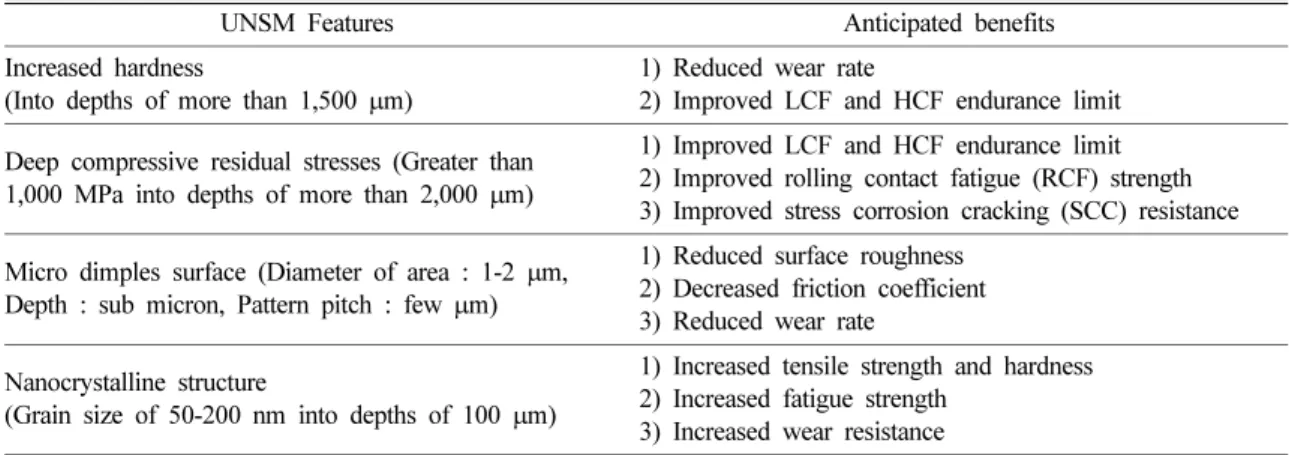
UNSM(초음파나노표면개질)처리 전과 후의 베어링 강 표면 상태는 Fig. 3과 같다. 연마(grinding)한 금속 에 UNSM 처리를 하면 예로 들은 Fig. 4(a)와 같이 외관상 구분이 되며, Fig. 4(b)와 같이 마이크로 딤플 (dimple)이 생성되면서 딤플 패턴을 형성하게 되고, 이 표면은 연마한 표면보다 거칠기(surface roughness)가 낮아진다. 또한 금속 표면에 1초당 20,000번 이상의 타격을 통해 나노 구조화(nano structure), 표면경도 (surface hardness) 향상, 압축잔류응력(compressive residual stress)이 부가된다. Table 1은 UNSM 처리 Fig. 1. Basic mechanism of UNSM treatment.
Fig. 2. Schematic view of a UNSM treatment process (a) and its anatomy (b).
Fig. 3. Modified structure of a material before and after UNSM treatment [6].
Fig. 4. UNSM-treated specimen (a) and optical micrograph of UNSM-treated specimen showing the produced dimples on the surface (b).
후 얻게 되는 기계적 특성 및 기대 효과를 나타내었다.
2. 시험절차
2-1. 시험편
본 시험에서 기계적 특성을 확인하기 위해 사용한 시험편은 Fig. 5와 같이 사각형태의 초경을 사용했으 며, 시험편의 물성값은 Table 2와 같다. 타격볼의 형상 은 둥근 형태의 WC, Si3N4, STS304 세 가지 볼을 사용하였으며, φ2.38 볼을 사용하였다.
마찰 및 마모의 변화를 확인하기 위해 사용한 시험
편은 Fig. 6과 같이 초경소재의 원형링을 2개씩 준비 하였으며, 물성값은 Table 2와 같으며 마찰 및 마모시 험에 사용된 WC ball의 형상은 둥근 형태의 φ7볼을 사용하였다.
2-2. 시험 방법
2-2-1. 기계적 특성 시험편 및 마찰마모 시험편 UNSM 처리조건
기계적 특성과 마찰·마모 변화를 확인하기 위하여 Table 3과 같이 동일한 조건으로 시험편에 UNSM처리 하였다.
2.2.2. 표면거칠기, 경도, 압축잔류응력 측정장비 표면거칠기를 확인하기 위해 사용된 측정 장비는 Mitutoyo SJ-210, Japan을 사용하였으며, 표면경도를 Table 1. The effects and benefits of UNSM treatment [6, 7]
UNSM Features Anticipated benefits
Increased hardness
(Into depths of more than 1,500 µm)
1) Reduced wear rate
2) Improved LCF and HCF endurance limit Deep compressive residual stresses (Greater than
1,000 MPa into depths of more than 2,000 µm)
1) Improved LCF and HCF endurance limit 2) Improved rolling contact fatigue (RCF) strength 3) Improved stress corrosion cracking (SCC) resistance Micro dimples surface (Diameter of area : 1-2 µm,
Depth : sub micron, Pattern pitch : few µm)
1) Reduced surface roughness 2) Decreased friction coefficient 3) Reduced wear rate
Nanocrystalline structure
(Grain size of 50-200 nm into depths of 100 µm)
1) Increased tensile strength and hardness 2) Increased fatigue strength
3) Increased wear resistance
Fig. 5. Dimensions of the plate specimen to be treated by three different balls (tips).
Table 2. Some properties of disk specimen WC+E.T.C
(%)
Co (%)
Density (g/cm2)
Hardness (HRA) 88.5 11.5 14.28±0.1 90.5±0.5
Fig. 6. Dimensions of friction test specimens.
Table 3. UNSM treatment parameters UNSM Unit Speed
(mm/min)
Pitch (mm)
Ball Size (mm)
Load (N)
Amplitude (µm)
Frequency (kHz)
2000 0.07 2.38 130 30 20
확인하기 위한 측정 장비는 Buehler Micromet-3, USA, 압축잔류응력을 확인하기 위한 측정 장비 Rigaku DIMAX2299HR, Japan을 사용하였다. 또한 깊이별 경도를 확인하기 위한 측정장비는 Mitutoyo HM-112, Japan을 사용했으며, Micro dimples를 확인 하기 위해 사용한 장비는 atomic force microscope, SPA400, Japan을 사용하였다. 그리고 Fig. 10의 표면 사진 촬영은 FE-SEM, SUPRA 40, ZEISS, Germany 장비를 사용했으며, 표면거칠기는 Accretech, Surfcom 1500 sd3, Japan 측정장비를 각각 사용하였다.
2-3-3. 마찰마모시험 조건 및 측정장비
마찰·마모 시험은 Fig. 7과 같이 진행하였으며, 마 찰·마모에 사용된 장비 사양은 Table 4와 같고, 마 찰·마모 시험조건은 Table 5와 같이 진행하였다.
3. 시험 결과
3-1. UNSM처리 후 외관 및 딤플 생성 여부
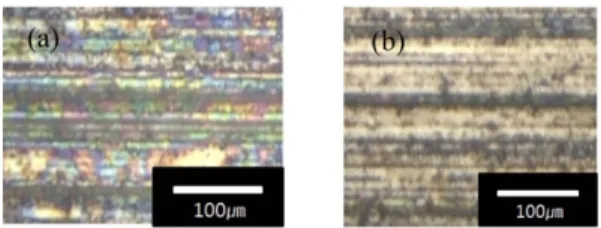
WC ball로 UNSM 처리한 시험편이 Si3N4, STS304 ball로 처리했을 때 보다 외관상 구분은 되었으나, 예
로 들은 Fig. 4(a)와 같이 선명하게 나타나지는 않았다.
Fig. 4(b)와 같이 UNSM 처리 후 기대했던 딤플은 Fig. 8(b)와 같이 생성되지 않았다.
3-2. UNSM 처리후 기계적 특성 변화
UNSM 처리 후 표면거칠기는 Fig. 9와 같이WC Ball로 처리했을 때 0.081 µm 감소되어 UNSM 처리 전보다 42% 향상되었다. 이러한 결과는 Fig. 10과 같 Fig. 7. Schematic of a friction and wear tests.
Table 4. Specifications of a multi-purpose friction and wear tester
Max.
Load Capacity
(N)
Min.
Load Capacity
(N)
Load Cell Measureme nt error
(N)
Rotation Speed
(rpm) Temp Sensor (oC)
Vibration Sensor (OGpeak) 2,000 2 ±0.3 1~3000 RT~150 0.5~5
Table 5. Friction and wear tests conditions Sliding time
(min)
Rotation speed (mm/min)
Ball Size (mm)
Load (N)
60 100 7 (WC) 49.03
Fig. 8. Comparison of micrographs before (a) and after (b) UNSM treatment.
Fig. 9. Comparison of average surface roughness before and after UNSM treatment.
Fig. 10. FE-SEM image of the untreated (a) and UNSM- treated (b) specimens.
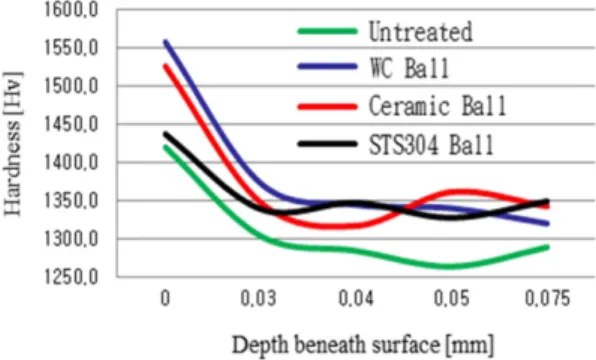
Fig. 11. Comparison of surface hardness before and after UNSM treatment.
이 UNSM 처리 후 표면이 정형화되면서 기공 및 WC입자의 미세화에 따른 영향으로 사료된다.
표면경도는 Fig. 11과 같이 WC Ball로 UNSM 처 리했을때 137.2 Hv 증가되어 UNSM 처리 전 보다 10% 향상되었으며, 깊이별 경도 변화는 Fig. 12와 같 이 0.03 mm 이내에 경도가 가장 높게 나오는 것을 확인할 수 있었다. 이러한 결과는 UNSM 처리시 표면 이 다져지면서 표면조직이 미세하게 변화된 영향으로 사료된다.
압축잔류응력은 Fig. 13과 같이 WC Ball로 UNSM 처리 후 918 Pa 증가되어 UNSM 처리 전 대비 71%
향상되었다. 이러한 결과는 UNSM 처리 시 재료표면 에 압축력을 받으면서 표면층에 미세한 소성변형이 생 긴 영향으로 사료된다.
3.3. UNSM 처리 후 마찰 마모 변화
초경 부품의 성능 향상 가능성을 확인하기 위해 Dry상태에서 진행한 마찰·마모 시험 결과 Fig. 14와 같이 UNSM 처리 후 마찰계수는 약 0.14 감소되어 UNSM 처리 전 보다 약 21% 향상되었다. Fig. 15와 같이 시험편 마모량도 0.0028 g 감소되어 UNSM 처
리전 보다 85% 향상되었다. 향상 원인으로 UNSM 처리 시 표면이 나노결정 조직으로 개질되면서 초경의 WC입자 크기와 Co층 두께가 감소하여 표면거칠기, 표 면경도, 압축잔류응력 등 기계적 특성이 향상되었기 때 문으로 사료된다.
4. 결 론
UNSM 처리 전, 후 시험편을 이용하여 마찰·마모 시험을 통한 프레스금형의 수명연장 가능성을 확인한 결과 UNSM 처리 후 마찰계수가 21%, 시험편 마모 량이 85% 향상되어 초경부품 수명연장에 UNSM 기 술이 도움이 되는 것을 확인하였다. 초경 시험편에 WC, Si3N4, STS304 세가지의 타격볼을 사용하여 동 일 조건으로 UNSM 처리하였을 때 WC ball로 타격 한 시험편의 기계적 특성이 가장 많이 변해 초경 UNSM 처리시 타격볼 경도도 중요한 요소임을 알 수 있었다. 기대했던 마이크로딤플은 생성되지 않았지만, 표면거칠기, 표면경도, 압축잔류응력 등 기계적특성이 Fig. 12. Comparison of surface hardness as a function
of depth from the top surface.
Fig. 13. Comparison of compressive residual stress before and after UNSM.
Fig. 14. Comparison of friction coefficient before and after UNSM treatment.
Fig. 15. Comparison of wear loss before and after UNSM treatment.
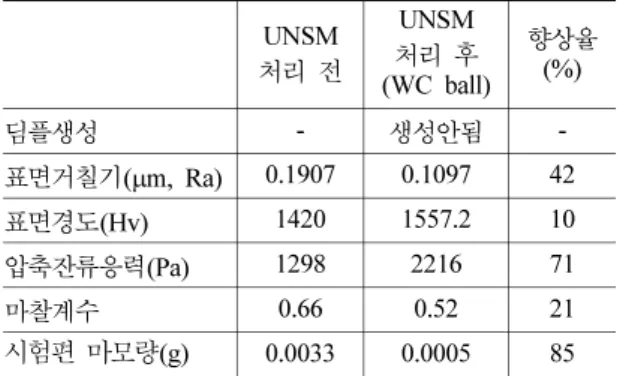
향상되어 마찰·마모 감소에 따른 초경부품 내구성이 향상되는 것을 확인하였다. 본 논문의 시험결과 요약은 Table 6 과 같으며, 피로특성 확인을 위하여 RCF(구름접 촉피로)시험과 Scratch test 등 추가 시험을 진행할 계획 이며, 실제 프레스금형에 적용하여 어떠한 영향이 있 는지 현장시험도 진행할 계획이다.
References
[1] Jeon, Y. J., Kim, S. H., Yoon, K. T., Heo, Y. M., Lee, T.
G., “Indirect Prediction of Surface Damage for a
Press Die with Wear Characteristics and Finite Ele- ment Stamping Analysis”, Transactions of Materials Processing, Vol. 23, No. 1, pp. 29-34, 2014.
[2] Kang, J. H., “The technology trends of new concept of cutting tools of eco convergence”, Journal of the KSME, Vol. 52, No. 2, pp. 48-52, 2012.
[3] Kim, J. H., Park, Y. H., Haa, G. H., “Synthesis of Nano-sized Tungsten Carbide - Cobalt Powder by Liq- uid Phase Method of Tungstate”, Journal of Korean Powder Metallurgy Institute, Vol. 18, No. 4, pp.
332-339, 2011.
[4] Gim, J. S., Jeong, Y. T., “Introduction to PVD/PACVD Coating”, Journal of the Korean Society for Preci- sion Engineering, Vol. 24, No. 5, pp. 7-13, 2007.
[5] Oh, S. M., “A Study on the Tribological Character- istics of Surface Modification by TiC,N of the Ther- mal CVD Method use to the Automotive Poppet Valve”, J. Korean Soc. Of Mechanical Technology, Vol. 15, No. 2, pp. 273-278, 2011.
[6] Amanov, A., Cho, I. S., Pyoun, Y. S., Lee, C. S., Park, I. G., “Micro-dimpled Surface by Ultrasonic Nanocrystal Surface Modification and its Tribological Effects”, Wear, Vols. 286-287, pp. 136-144, 2012.
[7] Pyun, Y. S., Suh, C. M., Yamaguchi, T., Im, J. S., Kim, J. H., Amanov, A., Park, J. H., “Fatigue Characteris- tics of SAE52100 Steel via Ultrasonic Nanocrystal Surface Modification Technology”, Journal of Nano- science and Nanotechnology, Vol. 12, pp. 6089-6095, 2012.
Table 6. Comparison of some mechanical properties before and after UNSM treatment
UNSM 처리 전
UNSM 처리 후 (WC ball)
향상율 (%)
딤플생성 - 생성안됨 -
표면거칠기(µm, Ra) 0.1907 0.1097 42
표면경도(Hv) 1420 1557.2 10
압축잔류응력(Pa) 1298 2216 71
마찰계수 0.66 0.52 21
시험편 마모량(g) 0.0033 0.0005 85
![Fig. 3. Modified structure of a material before and after UNSM treatment [6].](https://thumb-ap.123doks.com/thumbv2/123dokinfo/5123334.334495/2.892.530.699.509.768/fig-modified-structure-material-unsm-treatment.webp)