• 검색 결과가 없습니다.

Does Plantar-Flexor Muscle Fatigue Degrade Proprioceptive Sense at the Ankle Joint?

N/A
N/A
Protected

Academic year: 2021

Share "Does Plantar-Flexor Muscle Fatigue Degrade Proprioceptive Sense at the Ankle Joint?"

Copied!
7
0
0

로드 중.... (전체 텍스트 보기)

전체 글

(1)

| Abstract |

Purpose: This study investigated the effect of plantar-flexor muscle fatigue on the force sense and joint reposition sense of ankle joints in the healthy adults.

Methods: Fifteen healthy subjects (male: 9, female: 6) participated in this study. A digital dynamometer was used to measure the force sense error while a wireless motion capture device was used to measure the joint reposition sense error. To induce plantar-flexor muscle fatigue for a dominant lower extremity, the subjects were asked to perform plantar flexion until exhaustion while barefoot. The differences in force sense error and joint reposition sense error for the ankle joint were measured immediately.

The Wilcoxon test was used to compare these values before and after inducing plantar-flexor muscle fatigue.

Results: The force sense error and joint reposition sense error of ankle joints after inducing plantar-flexor muscle fatigue increased significantly compared to the values before inducing muscle fatigue.

Conclusion: This study suggests that plantar-flexor muscle fatigue could degrade the force sense and joint reposition sense in ankle joints. In addition, it could deteriorate ankle proprioception.

Key Words: Muscle fatigue, Proprioception, Force sense, Reposition sense, Ankle joint

†Corresponding Author : Jin-Tae Han ([email protected])

Original Article Open Access

발바닥굽힘근 근피로가 발목관절 고유수용성 감각을 감소시키는가?
한진태

1)

경성대학교 물리치료학과

Does Plantar-Flexor Muscle Fatigue Degrade Proprioceptive Sense at the Ankle Joint?

Jin-Tae Han, P.T., Ph.D

Department of Physical Therapy, Kyungsung University

Received: October 14, 2019 / Revised: October 31, 2019 / Accepted: November 7, 2019

ⓒ 2019 Journal of Korea Proprioceptive Neuromuscular Facilitation Association

This is an Open Access article distributed under the terms of the Creative Commons Attribution Non-Commercial License

(http://creativecommons.org/licenses/by-nc/3.0) which permits unrestricted non-commercial use, distribution, and reproduction

in any medium, provided the original work is properly cited.

(2)

Ⅰ. 서 론

일반적으로 고유수용기 시스템(proprioceptive system)은 다양한 말초영역에서 얻는 정보에 통해 지 각과 움직임 조절에 도움을 준다(Park et al., 1999).

고유수용성 감각은 운동감각(kinesthesia), 관절 재위 치 감각(joint reposition sense), 그리고 힘 감각(force sense) 등을 이용하여 측정할 수 있다(Riemann &

Lephart, 2002).

발목관절의 고유수용성 감각은 서기 , 걷기 그리고 달리기와 같은 기능적 활동 동안 신체의 균형을 유지 하는 데 매우 중요하다 (Lee & Lin, 2008). 발목 삠(ankle sprain)과 같은 기능적 발목 불안정은 스포츠 활동이나 작업장에서 가장 많이 일어나는 손상 중에 하나이며 근육이나 고유수용성 감각의 손상을 포함한 다양한 문제를 초래한다(Hertel, 2008; Verhagen et al., 1995).

예를 들면, 발목 삠이나 발목 관절의 기능적 불안정성 이 있는 사람은 손상이 없는 사람보다 운동감각 손상 이 크며(Konradsen, 2002), 또한 발목 불안정성은 안쪽 번짐(inversion) 재위치감각 혹은 목표각의 능동적 재 현 능력을 손상시킨다 (Konradsen & Magnusson, 2000).

일반적으로, 발목 관절의 고유수용성 감각은 거의 대부분 관절 재위치 감각과 힘감각 측정을 통하여 평 가된다(Hertel, 2008; Riemann & Lephart, 2002). 관절의 안정성에 영향을 주는 요인은 관절 위치 혹은 운동을 감지하는 것과 함께 근 긴장 혹은 힘을 감지하는 것이 중요하다 (Docherty et al., 2006). 이런 힘의 감지는 체중 부하 (weight bearing) 동안 관절을 적절하게 지지할 수 있도록 알맞게 근육의 긴장 정도를 조절한다 (Docherty

& Arnold, 2008).

고유수용성 감각을 방해하는 요인으로는 근피로, 진동, 운동, 외상, 수술 등이 있다(Allen & Proke, 2006).

이중 근피로는 운동하는 동안 요구되는 근력을 유지 하기 어려운 상태를 말하며 장기간 혹은 반복적인 활 동으로 야기되는 불편한 느낌 및 능률저하, 그리고 자극에 대한 반응능력의 상실을 초래한다(Enoka &

Stuart, 1992; Vollestad, 1997). 근피로는 고유수용성 감

각 중에 위치 감각과 힘 감각의 오류를 유발할 수 있으 며 (Allen & Proke, 2006; Vuillerme & Boisgontier, 2008), 고유수용성 감각이 근피로 이후 자세동요를 설명하는 일차적인 기전이 될 수 있다고 보고하였다(Caron, 2003; Gribble & Hertel, 2004). 특히, 발목 발바닥 굽힘 근(plantar flexor)의 근피로는 자세 조절을 방해하는 원인이며 발바닥굽힘근의 근피로는 안전성을 방해하 며 자세 흔들림 (postural sway)을 증가시킨다고 하였다 (Gimmon et al., 2011).

최근 많은 연구들이 근피로가 조용히 서있는 동안 자세조절을 방해하고 위치 감각과 힘 감각을 감소시 킨다고 보고하고 있다(Han & Lee, 2014; Papa et al., 2015; Vuillerme & Boisgontier, 2008). 몇몇 선행연구는 근피로 때문에 공간 속에서 팔다리의 위치 감각에 오 류가 발생될 수 있고 (Allen & Proske, 2006) 발목관절의 힘 감각을 감소시킬 수 있다고 보고하였다(Vuillerme

& Boisgontier, 2008). 하지만 몇몇 다른 연구에서 넙다 리근의 근피로가 무릎관절의 힘 감각에는 영향을 미 치지 않는다고 보고하였고 (Allison et al., 2015) 발목관 절에서 관절 재위치 감각과 힘 감각은 서로 관련성이 없다고 보고하였다(Kim et al., 2014).

선행연구들은 대부분 근피로 유발에 따른 힘 감각

오류와 관절 재위치 감각 오류의 변화를 알아보고 이

를 통해 자세조절에 미치는 영향을 주로 알아보았다 .

하지만 근피로 유발이 관절의 힘 감각과 재위치 감각

을 감소시킨다는 가설은 아직까지도 논란 중에 있다 .

특히 자세조절에 밀접한 관련이 있는 다리 근육의 피

로가 발목관절의 굽힘 시 힘 감각과 관절 재위치 감각

에 어떤 영향이 있는 지 동시에 알아보는 연구는 부족

한 실정이다 . 따라서 본 연구는 발바닥굽힘근 근피로

가 발목관절 굽힘 시 힘 감각 오류와 관절 재위치 감각

오류를 유발하는지 알아보고 발다닥굽힘근 근피로가

발목관절의 고유수용성감각에 미치는 영향을 간접적

으로 알아보고자 한다.

(3)

Ⅱ. 연구 방법

1. 연구 대상

20대 건강한 성인 15명이 본 실험에 참여했으며 정상적인 관절운동범위와 근력, 정상보행을 할 수 있 고 신체질량지수(body mass index)가 정상 범위(18.5–

22.9kg/m2)인 대상자를 선정하였고(Kim et al., 2014), 다리 통증이 있는 자 , 기형이 있는 자, 최근 3개월 이내 자세 및 보행에 문제를 발생시키는 질환이 있었던 자 는 대상자에서 제외하였다(Ledoux & Hillstrom, 2002).

본 연구는 헬싱키선언에 따른 실험절차로 진행하였으 며 실험 전, 대상자들에게 실험에 대한 내용에 대해 설명을 충분히 설명한 후 연구에 참여에 자발적인 동 의를 받았다.

2. 측정방법 및 도구

1) 힘 감각 오류(force sense error) 측정

힘 감각 오류를 측정하기 위해 디지털 근력측정기 (Power Tract Ⅱ Commander, JTECH Medical, USA)를 사용하였다 (Fig. 1A). 제조사에 의하면, 이 근력측정기 는 최대 556.3N의 부하량(load)까지 측정할 수 있으며 99%의 정확도를 가진다고 하였다(Bolgla et al., 2007).

또한 이러한 디지털 근력측정기는 측정자내 신뢰도 0.88-0.95, 측정자간 신뢰도 0.89-0.94였다(Click Fenter et al., 2003). 대상자는 반바지를 착용하고 발이 닿지 않는 테이블에 앉은 자세에서 힘 감각 오류를 측정하 였다 . 먼저 엉덩관절과 무릎관절 90°굽힘자세로 고정 하고 발목관절 발바닥 굽힘의 최대 근력을 측정하였 으며 최대 근력의 30%를 목표 발목관절 발바닥굽힘 힘으로 정하였다(Smith et al., 2012). 발목관절 발바닥 굽힘 힘 오류는 대상자가 눈을 감은 상태에서 목표 힘을 3초간 먼저 인지시킨 후에 다시 목표 힘을 재현하 도록 하였으며 대상자 스스로가 목표 힘과 같은 힘에 도달하였다고 판단한 순간 “예”라고 말하고 3초간 유

지하도록 지시하였다(Docherty & Arnold, 2008). 이때 발목관절 발바닥굽힘 힘 값을 측정하여 목표 힘 값과 의 차이를 기록하였으며, 3회 측정 후 평균 오류 값을 사용하였다.

2) 관절 재위치 감각 오류(joint reposition sense error) 측정

관절 재위치 감각 오류를 측정하기 위해 무선 동작 캡쳐 장비(Myomotion Research PRO, Noraxon Inc, USA)를 사용하였다. Yoon (2017)은 관성측정장비를 이용한 관절의 움직임에 대한 측정은 신뢰도와 타당 도가 있다고 보고하였다 . 발목관절 발바닥 굽힘의 관 절 재위치 오류를 측정하기 위해 동작감지 센서는 2번 째와 3번째 발허리뼈 중간에 위치하였다(Fig. 1B). 대 상자는 반바지를 착용하고 발이 닿지 않는 테이블에 앉은 자세에서 발목관절 발바닥굽힘의 최대 범위를 먼저 측정하였다. 발목관절의 관절 재위치 목표 각도 는 최대 발바닥굽힘 각도의 30%로 각각 정하였고(Kim et al., 2014). 모든 검사 동안 대상자는 눈을 감고 실시 하였다. 발바닥굽힘 목표 각도를 인지하도록 검사자 가 수동적으로 대상자의 발을 목표 각도에 3초간 위치 한 후 시작자세로 위치시켰다. 이어 대상자에게 발목 관절 발바닥굽힘을 목표 각도로 재현하도록 지시하였 으며 대상자가 스스로 목표 위치를 도달하였다고 판 단한 순간 “예”라고 말하고 3초간 유지하도록 지시하 였다(Kim et al., 2014). 이때의 발목관절 발바닥굽힘 각도를 측정하여 목표 각도와 차이를 기록하였고 , 3번 실시하여 평균 오류 값을 사용하였다.

3. 실험 절차

본 연구에서 발바닥굽힘근의 피로는 서 있는 자세

에서 우세 다리의 최대 발바닥굽힘을 1초에 1회 반복

해서 운동하도록 하여 유발하였다. 운동은 10회 반복

을 1 세트로 하여 총 15세트를 실시하도록 하였고 세트

사이에 30초간 휴식시간을 제공하였다(Miyamoto et

(4)

al., 2011). 운동하는 동안 엉덩관절과 무릎관절은 폄 상태를 유지하고 맨발로 실시하였으며 최대한 노력 하라고 구두로 격려하였다(Gimmon et al., 2011). 발 바닥굽힘근의 피로는 대상자가 더 이상 운동을 수행 하지 못하거나 운동을 15세트 모두 수행한 후에 발바 닥굽힘근의 근피로가 발생된 것으로 판정하였다 (Vuillerme et al., 2006). 발바닥굽힘근의 근피로 발생 직후 즉각 발목관절 발바닥굽힘근의 힘 감각 오류와 관절 재위치 감각 오류를 측정하였다.

4. 자료 분석

발바닥굽힘근의 근피로 전-후 발목관절 발바닥 굽 힘의 힘 감각 오류와 관절 재위치 감각 오류를 비교하 기 위하여 윌콕슨 검정(Wilcoxon test)을 사용하였고 자료는 평균과 표준편차로 제시하였다 . 통계자료분석 은 SPSS Version 25.0(SPSS Inc., USA)을 사용하였으 며, 유의수준은 α는 0.05로 하였다.

Ⅲ. 연구 결과

1. 연구 대상자의 일반적인 특성

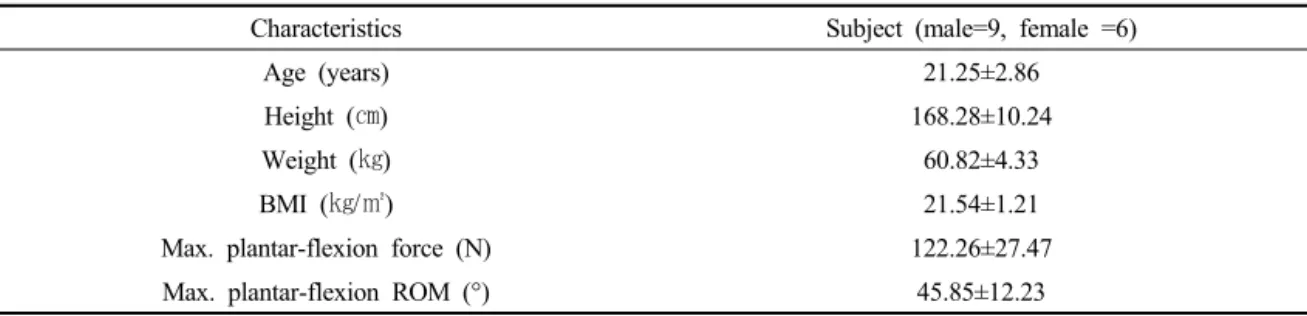
본 연구에 참여한 대상자는 성인 15명으로 대상자 들의 신체적 특성은 Table 1과 같다.

2. 발바닥굽힘근의 근피로 전-후 발목관절 발바닥 굽힘근의 힘 감각 오류 비교

발바닥굽힘근의 근피로 후의 발목관절 발바닥 굽 힘근 힘 감각 오류가 피로 전보다 증가하였고 통계적 으로 유의한 차이가 있었다(p<0.05)(Table 2).

Characteristics Subject (male=9, female =6)

Age (years) 21.25±2.86

Height (㎝) 168.28±10.24

Weight (㎏) 60.82±4.33

BMI (㎏/㎡) 21.54±1.21

Max. plantar-flexion force (N) 122.26±27.47

Max. plantar-flexion ROM (°) 45.85±12.23

Table 1. General characteristics of subjects (mean±SD) Fig. 1. Experimental equipment of measurement. A:

Digital muscle tester B: Myomotion system.

Variable Pre-fatigue Post-fatigue z p

Force sense error (N) 5.49±1.24 7.74±1.93 -3.12

b

0.00*

*p<0.05, b: based on negative ranks

Table 2. Comparison of force sense error of ankle plantar flexor between pre and post plantar flexor muscle fatigue

(mean ±SD)

(5)

3. 발바닥굽힘근의 근피로 전-후 발목관절 발바닥 굽힘 재위치 오류 비교

발바닥굽힘근의 근피로 후의 발목관절 발바닥굽힘 재위치 감각 오류가 피로 전 보다 증가하였으며 통계 적으로 유의한 차이가 있었다(p<0.05)(Table 3).

Ⅳ. 고 찰

신체의 움직임으로 조절하기 위한 감각 중 고유 수용성 감각(proprioception)은 관절의 위치, 움직임, 힘, 무게, 압력, 진동, 그리고 신체의 크기 및 모양을 인식하는 감각을 뜻한다(Dover & Powers, 2003;

Kavounoudias et al., 2001). 발목의 고유수용감각을 정 확하게 측정하기 위해 효과적인 평가방법을 설정하는 것은 자세 유지와 안정적 보행을 위해 임상적으로 중 요한 사항이다(Kim et al., 2014). 본 연구는 근피로가 고유수용성감각을 방해한다는 것을 연구가설로 정하 여 발바닥굽힘 근피로가 발목관절 재위치 감각 오류 와 힘 감각 오류에 어떠한 영향을 미치는지 알아보고 자 하였다.

힘 감각 오류의 경우 , 본 연구의 결과는 발바닥굽힘 근의 근피로 후 발목관절 발바닥굽힘의 힘 감각 오류 는 근피로 전 보다 유의하게 증가하였다. Vuillerme과 Boisgontier (2008)는 발목관절 발바닥 굽힘근 근피로 유발 후 힘 감각 오류가 유의하게 증가하였다고 보고 하였고, Lee 등(2007) 역시 팔꿉관절 굽힘근 근피로 후 힘 재현 감각 오류가 근피로 전 보다 유의하게 증가 하였다고 보고하였다.

관절 재위치 감감 오류의 경우, 본 연구의 결과는 발바닥굽힘근의 근피로 후 발목관절의 발바닥굽힘 재

위치 감각 오류 역시 근피로 전 보다 유의하게 증가하 였다. Allen과 Proske (2006)는 팔꿉관절 굽힘근 근피로 유발이 위치 감각(position sense)을 방해한다고 보고하 였고 , Han과 Lee (2014)는 넙다리네갈래근(quadriceps) 근피로 유발 후 관절 재위치 오류가 유의하게 증가하 였다고 보고하였다.

이러한 연구들은 고유수용성 감각 결손이 근육의 근원인 힘 감각에서 기인한다는 근거로 제시되고 있 다 (Docherty & Arnold, 2008). 특히, 발목관절의 힘 감각 퇴화는 발바닥 굽힘근 피로에 의한 부작용이라고 보고되고 있으며(Vuillerme & Boisgontier, 2008), 그 외의 유사 선행연구에서도 발목관절 근피로가 한발 서기 동안 자세 동요를 유발하여 집중도(attentional demands)를 높이지 못하였으며(Bisson et al., 2011), 또 한 Gimmon 등(2011)은 발바닥 굽힘근 피로가 자세 조절을 어렵게 하는 원인이 된다고 보고하였다. 즉, 발목관절 주위 근피로는 자세 균형에 필요한 관절 재 위치 감각과 힘 감각과 같은 고유수용성 감각 조절을 방해할 수 있다고 사료된다.

이들 선행연구와 본 연구의 결과는 근피로가 힘의 인식과 운동 감각을 방해하는 원인이 될 수 있다고 근거라고 생각된다. 따라서, 본 연구 결과는 근피로가 고유수용감각인 힘 감각과 관절 재위치 감각을 방해 하여 발생한 것으로 생각되며, 이는 근피로가 고유수 용성 감각에 영향을 미친다는 가설을 뒷받침하는 것 으로 사료된다.

본 연구의 제한점으로는 대상자 수가 부족하여 연 구의 결과를 일반화하는데 어려움이 있고 성별에 따 른 측정 자료의 차이가 연구결과에 다소 영향을 미쳤 을 것으로 생각하다 . 또한 발목관절에서 힘 감각 오류 와 관절 재위치 오류와의 상관관계를 제시한다면 근 피로가 고유수용감감에 미치는 영향을 보다 정확하게

Variable Pre-fatigue Post-fatigue z p

Joint reposition sense error (°) 5.49±1.24 7.74±1.93 -3.12

b

0.00*

*p<0.05, b: based on negative ranks

Table 3. Comparison of joint reposition sense error of ankle plantar flexion between pre and post plantar flexor muscle

fatigue (mean ±SD)

(6)

제시할 수 있을 것으로 생각한다. 향후 대상자수를 충분히 모집하고 성별에 따른 차이를 보완한다면 결 과에 대한 신뢰성을 높일 수 있을 것으로 생각한다 . 그리고 발목 관절의 안정성을 제공하는 발목 관절 주위 의 모든 근육에 대해 조사하지 못한 점 역시 제한점이 라고 사료되며 추후 연구에서 보완하도록 할 것이다 .

Ⅴ. 결 론

본 연구는 발목관절 발바닥굽힘근의 근피로 유발 전-후 발목관절의 발바닥굽힘 힘 감각과 재위치 감각 오류에 미치는 영향을 알아보고 발바닥굽힘근의 피로 가 고유수용성 감각을 방해하는 지 간접적으로 증명 하고자 하였다. 발목관절의 발바닥굽힘근 근피로 유 발 후 발목관절의 발바닥굽힘 힘 감각 오류와 관절 재위치 감각오류는 유의하게 증가하였다. 따라서 발 목관절 발바닥굽힘근의 근피로는 발목관절의 고유수 용성 감각을 방해하여 발목의 불안정성을 유발할 수 도 있다는 것을 확인하였다. 이는 향후 발목관절 불안 정성을 예방하기 위한 근거자료로 사용될 수 있을 것 으로 생각한다.

Acknowledgments

이 논문은 2019학년도 경성대학교 학술연구지원에 의하여 연구되었음.

References

Allen TJ, Proske U. Effect of muscle fatigue on the sense of limb position and movement. Experimental Brain Research. 2006;170(1):30-38.

Allison KF, Sell TC, Benjaminse A, et al. Force sense of the knee not affected by fatiguing the knee extensor

and flexors. Journal of Sport Rehabilitation. 2015;

25(2):155-163.

Bisson EJ, McEwen D, Lajoie Y, et al. Effects of ankle and hip muscle fatigue on postural sway and attentional demands during unipedal stance. Gait & Posture.

2011;33(1):83-87.

Bolgla LA, Malone TR, Umberger BR, et al. Hip strength and hip and knee kinematics during stair descent in females with and without patellofemoral pain syndrome. The Journal of Orthopaedic and Sports Physical Therapy. 2008;38(1):12-18

Caron O. Effects of local fatigue of the lower limbs on postural control and postural stability in standing posture.

Neuroscience Letter. 2003;340(2):83-86.

Click Fender P, Bellew JW, Pitts TA, et al. Reliability of stabilised commercial dynamometers for measuring hip abduction strength: a pilot study. British Journal of Sports Medicine, 2003;37(4):331-334.

Docherty CL, Arnold BL. Force sense deficits in functionally unstable ankles. Journal of Orthopedic Research.

2008;26(11):1489-1493.

Docherty CL, Arnold BL, Hurwitz S. Contralateral force sense deficits are related to the presence of functional ankle instability. Journal of Orthopedic Research. 2006;

24(7):1412-1419.

Dover G, Powers ME. Reliability of joint position sense and force-reproduction measures during internal and external rotation of the shoulder. Journal of Athletic Training. 2003;38(4):304-310.

Enoka RM, Stuart DG. Neurobiology of muscle fatigue. Journal of Applied Physiology. 1992;72(5):1631-1648.

Gimmon Y, Riemer R, Oddsson L, et al. The effect of plantar flexor muscle fatigue on postural control. Journal of Electromyography and Kinesiology. 2001;21(6):

922-928.

Gribble PA, Hertel J. Effect of lower-extremity muscle fatigue

on postural control. Archives of Physical Medicine

and Rehabilitation. 2004;85(4):589-592.

(7)

Han JT, Lee JH. Effects of kinesiology taping on repositioning error of the knee joint after quadriceps muscle fatigue.

Journal of Physical Therapy Science. 2014;26(6):

921-923.

Hertel J. Sensorimotor deficits with ankle sprains and chronic ankle instability. Clinical in Sports Medicine. 2008;

27(3):353-370.

Kavounoudias A, Roll R, Roll JP. Foot sole and ankle muscle inputs contribute jointly to human erect posture regulation. The Journal of Physiology. 2001;532(3):

869-878.

Kim CY, Choi JD, Kim HD. No correlation between joint position sense and force sense for measuring ankle proprioception in subjects with healthy and functional ankle instability. Clinical Biomechanics. 2014;29(9):

977-983.

Kim MK, Han KD, Kwon HS, et al. Normal weight obesity in Korean adults. Clinical Endocrinology. 2014;

80(2):214-220.

Konradsen L. Factors contributing to chronic ankle instability:

kinesthesia and joint position sense. Journal of Athletic Training. 2002;37(4):381-385.

Konradsen L, Magnusson P. Increased inversion angle replication error in functional ankle instability. Knee Surgery, Sports Traumatology, Arthroscopy. 2000;

8(4):246-251.

Ledoux WR, Hillstrom HJ. The distributed plantar vertical forced of neutrally aligned and pes planus feet. Gait

& Posture. 2002;15(1):1-9.

Lee AJ, Lin W. Twelve-week biomechanical ankle platform system training on postural stability and ankle proprioception in subjects with unilateral functional ankle instability. Clinical Biomechanics. 2008;

23(8):1065-1072.

Lee WH, Ha SM, Kim YW, et al. Influence of muscle fatigue on the sensing of force reproduction in elbow flexors.

Physical Therapy Korea. 2007;14(3):16-22.

Miyamoto N, Hirata K, Mitsukawa N, et al. Effect of pressure

intensity of graduated elastic compression stocking on muscle fatigue calf-raise exercise. Journal of Electromyography and Kinesiology. 2001;21(2):

249-254.

Papa EV, Garg H, Dibble LE. Acute effects of muscle fatigue on anticipatory and reactive postural control in older individuals: a systematic review of the evidence.

Journal of Geriatric Physical Therapy. 2015;38(1):

40-48.

Park S, Toole T, Lee S. Functional roles of the proprioceptive system in the control of goal-directed movement.

Perceptual and Motor Skills. 1999;88(2):631-647.

Riemann BL, Lephart SM. The sensorimotor system, part 1:

the physiologic basis of functional joint stability.

Journal of Athletic Training. 2002;37(1):71-79.

Smith BI, Docherty CL, Simon J, et al. Ankle strength and force sense after a progressive, 6-week strength- training program in people with functional ankle instability. Journal of Athletic Training. 2012;

47(3):282-288.

Verhagen RA, de Keizer G, van Dijk CN. Long-term follow-up of inversion trauma of the ankle. Archives of Orthopaedic and Trauma Surgery. 1995;114(2):

92-96.

Vuillerme N, Boisgontier M. Muscle fatigue degrades force sense at the joint. Gait & Posture. 2008;28(3):521-524.

Vuillerme N, Burdet C, Isableu B, et al. The magnitude of the effect of calf muscles fatigue on postural control during bipedal quiet standing with vision depends on the eye-visual target distance. Gait & Posture.

2006;24(2):169-172.

Vollestad NK. Measurement of human muscle fatigue. Journal of Neuroscience Methods. 1997;74(2):219-227.

Yoon TL. Validity and reliability of an inertial measurement unit–based 3D angular measurement of shoulder joint motion. The Journal of Korean Physical Therapy.

2017;29(3):145-151.

수치

Table 2. Comparison of force sense error of ankle plantar flexor between pre and post plantar flexor muscle fatigue (mean ±SD)
Table 3. Comparison of joint reposition sense error of ankle plantar flexion between pre and post plantar flexor muscle fatigue (mean ±SD)

참조

관련 문서

The proprioceptive sense was measured through the joint reposition sense error and neural positon error in the head-neck during smartphone usage for 0, 5, and 20 minutes..

Chronic instability of the ankle joint is progressed by injury such as an ankle sprain, and is caused by weak muscle strength of the tib- ialis anterior and peroneus longus, as

Conclusions: The results showed that smartphones provide high validity and reliability as measurement equipment for JPS of dorsi-plantar flexion of the ankle.. Finally, the study

Isokinetic dynamometer was used to measure the sense of active joint position of the ankle at mid-range and end-range of an inversion motion and invertor as well as the

After inducing fatigue in the quadriceps muscle, the subjects were required to match 50% of the MVIC torque without visual feedback.. The perceived magnitude of the

PURPOSE: This study was conducted to investigate the effects of combined Joint Mobilization and Functional Electrical Stimulation on Muscle Activation and Mobility of ankle joints

The purpose of this study was to investigate the effects of knee joint muscle fatigue and overweight on the angular displacement and moments of the lower limb joints

Conclusion : S quat exercises on the balance pad and togu were affects knee joint proprioception and muscle strength improvement... Knee joint
