• 검색 결과가 없습니다.

Characteristics of the Radio-Frequency/Vacuum Drying of Heavy Timbers for Post and Beam of Korean Style Housings Part II : For Korean red pine heavy timbers with 250 × 250 mm, 300 × 300 mm in cross section and 300 mm in diameter, and 3,600 mm in length

N/A
N/A
Protected

Academic year: 2021

Share "Characteristics of the Radio-Frequency/Vacuum Drying of Heavy Timbers for Post and Beam of Korean Style Housings Part II : For Korean red pine heavy timbers with 250 × 250 mm, 300 × 300 mm in cross section and 300 mm in diameter, and 3,600 mm in length"

Copied!
8
0
0

로드 중.... (전체 텍스트 보기)

전체 글

(1)

*1 Received on October 14, 2010; accepted on March 2, 2011

*2 Department of Wood Science and Technology, Chonbuk National University, Jeonju, Chonbuk 561-756, Korea

*3 Department of Wood Engineering, Beihua University, Third Teaching Building, No.3999, Huashan Road, Jilin City, Jilin Province, 132000, P. R. China

*4 Department of Wood Science and Technology, Chonbuk National University, Jeonju, Chonbuk 561-756, Korea

*5 Division of Wood Engineering, Korea Forest Reseach Insititute, Seoul 730-012, Korea

Corresponding author : Nam-ho Lee (e-mail: [email protected])

Characteristics of the Radio-Frequency/Vacuum Drying of Heavy Timbers for Post and Beam of Korean Style

Housings Part II* 1 :

For Korean red pine heavy timbers with 250 × 250 mm, 300 × 300 mm in cross section and 300 mm in diameter, and 3,600 mm in length

Nam-Ho Lee*

2†

, Xue-Feng Zhao*

3

, Ik-Hyun Shin*

4

, Moon-Jae Park*

5

, Jung-Hwan Park*

5

, and Joo-Saeng Park*

5

ABSTRACT

This study examined the characteristics of radio-frequency/vacuum dried Korean red pine (Pinus denso- flora) heavy timbers with 250 × 250 mm (S), 300 × 300 mm (L) in cross section and 300 mm in diameter, and 3,600 mm in length, which were subjected to compressive loading after a kerf pretreatment. The fol- lowing results were obtained : The drying time was short and the drying rate was high in spite of the large cross section of specimens. The moisture gradient inall specimens was gentle in both longitudinal and transverse directions owing to dielectric heating. The shrinkage of the width in the direction perpendic- ular to was 21 percent ∼ 76 percent of that of the thickness of square timbers in the direction parallel to the mechanical pressure. The casehardening for all specimens was very slight because of significantly reduced ratio of the tangential to radial shrinkage of specimens and kerfing. The surface checks somewhat severely occurred although the occurrence extent of the surface checks on the kerfed specimens was slight compared withthat on the control specimen.

Keywords : radio-frequency/vacuum drying, kerf treatment, compressive loading, surface check

1. INTRODUCTION

The Korean red pine boxed heart timbers with large cross section were extensively used

in ancient buildings and traditional Korean-style houses in Korea.

Two methods, traditional air drying and con-

ventional kiln drying, have been applied to dry-

(2)

Boxed heart square timbers

(Thickness × width × length)

Kerfed 2 49.8

L Control 300 × 300 × 3600

(Thickness × width × length)

2 77.8

Kerfed 1 89.9

Boxed heart round timbers Control ∅ 300 × 3600 (Diameter × length)

2 68.7

Kerfed 1 64.0

Table 2. Drying schedule

Drying time (hour) 0∼24 24∼48 48∼72 72∼96 96∼120 120∼192

Wood temperature (°C) 40 42 44 46 48 52

ing the timbers in Korea. However, severe sur- face checks often occurred on the timber during drying and a long drying period was needed.

Therefore, to develop a new technique to quickly dry the timber without surface check is urgent.

This study was to aim at investigation into the characteristics of radio-frequency/vacuum (RF/V) drying of Korean red pine boxed heart timbers with 250 × 250 mm, 300 × 300 mm in cross section and 300 mm in diameter, and with the fixed length of 3,600 mm, that were sub- jected to a compressive load after a kerf pretreatment.

2. MATERIALS and PROCEDURES

2.1. Preparation of Specimens

Korean red pine (Pinus densoflora) boxed heart timbers with 250 × 250 mm (S), 300 × 300 mm (L) in cross section and 300 mm in di- ameter, and with the fixed length of 3,600 mm were prepared in this experiment. The speci- mens were divided into control and kerfing treatment specimen, respectively. The longi-

tudinal kerfs with a width of 3 mm and the depth of 80 mm were sawn with a circular saw.

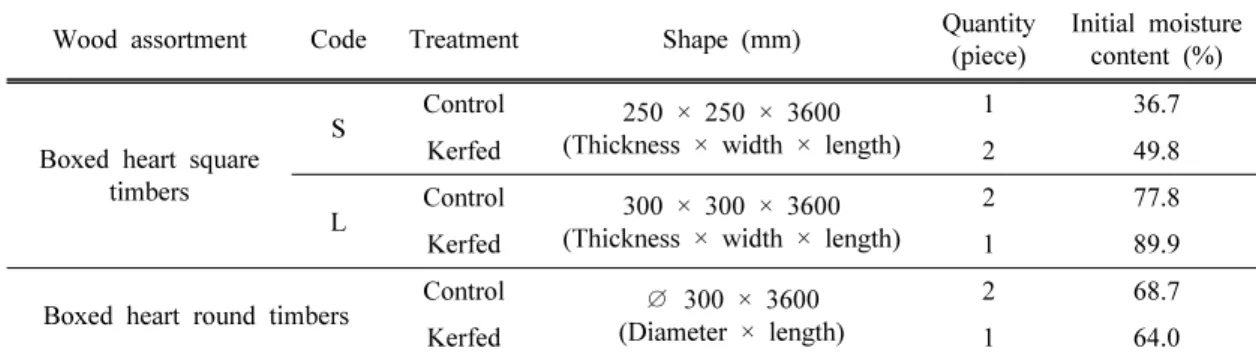
The dimension, quantity and initial moisture content of specimens are shown in Table 1.

2.2. Radio-Frequency/Vacuum Dryer

The internal dimension of the rectangular chamber of a RF/V dryer used in this study were 600 cm in length, 120 cm in width, and 67 cm in depth. The maximum output of its ra- dio-frequency (RF) generator at a fixed fre- quency of about 13 MHz, which was turned on for 8 minutes and then off for 2 minutes, was 25 kW. The specimens stacked in the chamber, covering with a flexible rubber sheet, were compressively loaded by the pressure of 10,000 kgf/m

2

during drying.

2.3. Stacking of Specimens

An experiment was carried out on the boxed

heart square and round timbers in the RF/V dri-

er, respectively. For the boxed heart square tim-

bers, a positive electrode plate was placed in

(3)

Fig. 1. Stacking diagram of the boxed heart square (left) and round timbers (right) in the RF/V dryer (unite: mm).

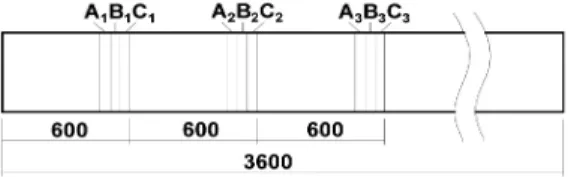
Fig. 2. Sawing diagram of the specimens to evaluate a distribution of moisture content and the casehardening after the end of drying (unite:

mm).

Fig. 3. Sawing diagram of the boxed heart square (left) and round timber (right) to survey a distribution of final moisture content after the end of drying.

the centric position inside the chamber while the negative plates were placed on the top and bottom of a stack which was consisted of two layers of specimens. The L-specimens were stacked in the upper part while the S-specimens were stacked in the lower part of the chamber.

For the boxed heart round timbers, all speci- mens were stacked in the upper part of the chamber. The remainder of the space inside the chamber was filled with dummy boards (Fig. 1).

Especially, for the kerfed specimens, the di- rection in the depth of kerf was paralleled to the direction of the compressive pressure in or- der to restrain the widening of kerf during dry- ing as much as possible, and to reduce the ratio of the tangential to the radial shrinkage of specimen.

2.4. Drying Condition

The drying condition used in this experiment

is shown in Table 2. The ambient vapor pressure was kept at an absolute value of 50 mmHg ∼ 70 mmHg. The wood temperature was controlled by a teflon-sheathed platinum 100 Ω sensor with a diameter of 3.5 mm, inserting into a specimen stacking in the upper part of the cham- ber, at the distance of 45 cm from an end surface of the specimen and 8 cm from the top plate.

2.5. Drying Curve and Drying Rate

One piece of specimen was selected from the control and kerfed timber, respectively, to in- vestigate the moisture content (MC)s of the tim- ber during drying. The moisture content and drying rate during drying were obtained from the weight measured at 24 hours intervals after the dryer was stopped and the oven-dry weight calculated from the final moisture contents of specimens.

2.6. Distribution of Moisture Content and Residal Stress

The distribution of moisture content and the residue stress of the specimens were evaluated- from the specimens, used to investigate drying curve and drying rate, at the positions described in Fig. 2 after after finishing drying.

All distribution of final moisture content was

(4)

Fig. 4. Reducing process of the moisture content of the boxed heart square (above) and round timber (below) during RF/V drying and dry- ing schedule.

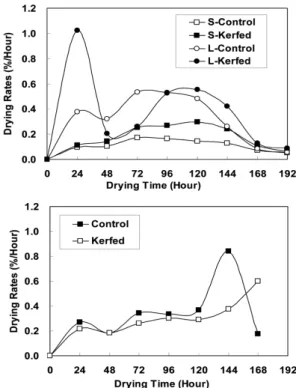
Fig. 5. Process of the drying rate of the boxed heart square (above) and round timber (below) dur- ing RF/V drying.

investigated from the 9, 11 slices for the S-specimen and L-specimen and the 13 slices for the boxed heart round timber, sawn at 10 mm intervals from the shell to core on the cross section of specimen (Fig. 3).

The casehardening of the boxed heart square timber was surveyed in the directions both par- allel to and perpendicular to the pressure in the chamber.

2.7. Shrinkage of Cross Section

The transverse shrinkages of specimens for square timbers were calculated based on the di- mensional changes of the thickness and the width of specimen before and after drying. The shrinkages of the circumferences of specimens

for round timbers were calculated based on the dimensional changes, measued with π tape, of the circumferences of specimens before and af- ter drying.

2.8. Surface Check

The total length and numbers of the surface checks occurred on the surfaces of all speci- mens were surveyed after drying.

3. RESULTS and DISCUSSIONS

3.1. Drying Curve and Drying Rate

The variation of the moisture content and

drying rate of specimens during RF/V drying as

a function of drying time is presented in Figs.

(5)

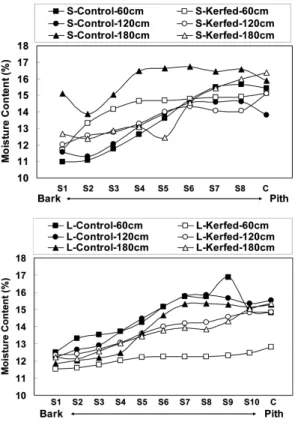
Fig. 6. Distribution of the final moisture content of the S-specimen (above) and L-specimen (below) for boxed heart square timber after the end of drying.

Fig. 7. Distribution of the final moisture content of the boxed heart round timber after the end of drying.

Fig. 8. Straight rongs show the state of no stress.

4 and 5, respectively.

The changes of the moisture content (MC) and drying rate of specimens during RF/V dry- ing are presented in Figs. 4 and 5, respectively 168 and 144 hours were needed to dry from ini- tial MC to 19% MC for square timber while 192 and 168 hours were needed to dry from initial MC to 15% MC for round timber.

The average drying rate of the boxed heart square timbers for the S-control, S-kerfed, L-control and L-kerfed specimens was 0.117%/h, 0.187%/h, 0.331%/h and 0.400 %/h, respectively.

The difference in drying rates between the con- trol and kerfed specimens can be attributed to the difference in initial MC rather than the ef-

fect of kerfing. The fact that the drying rate of the control round timbers with a lower initial moisture content was slower than that of the kerfed round timbers confirms the explanation above.

3.2. Distribution of Final Moisture Content

The distribution of the final moisture contents in the transverse and longitudinal directions in- side specimens after the end of drying is shown in Figs. 6 and 7, respectively.

Irrespective of kerf treatment and the size of

cross section, the lowest and highest MC of the

(6)

Perpendicular to 1.03 1.00 1.05

S-kerfed Parallel to 1.00 1.02 1.01

Perpendicular to 1.02 1.03 1.02

L-control Parallel to 1.00 0.99 1.02

Perpendicular to 0.98 0.97 0.99

L-kerfed Parallel to 1.03 1.04 1.00

Perpendicular to 1.00 1.01 1.01

Note)

a

; Distance from one end surface.

boxed heart square timbers was 11.0 percent and 16.6 percent. Even if the RF/V drying was applied to such a heavy structure timber with the cross section of 300 mm and the length of 3,600 mm, the drying time to be needed was only within 8 days from green to below 17 per- cent of MC. The lowest and highest MC of the boxed heart round timbers was 4.0 percent and 13.5 percent. These were much lower than those of square timbers because more dried dummy boards used in drying round timbers re- sulted in concentration of more energy on dry- ing round timbers.

The MC inside the both square and round timbers showed a distribution of higher value from surface nearer to a centry of specimen while that inside the control specimen showed a distribution of higher value of central layer than that of intermediate layer at same distance from the end surface of specimens. This is due to the type effect of dielectric heating specimen in the range of the high MC above the fiber sat- uration point (Kanagawa, 1989; Lee et al., 1998).

It was shown that the MC inside specimen showed a distribution of higher value farther from the end surface at same distance from the

shell of specimen.

3.3. Casehardening

The casehardening after the end of RF/V dry- ing is presented in Table 3. The shape of prongs to be investigated and the caseharding of specimen can be seen in Fig. 8.

The casehardening showed a very slight val- ue irrespective of wood assortment, the direc- tion against the pressure, and the distance from the end surface of specimen. This results from the effect of the gentle moisture gradient due to dielectric heating. It means that there is a possi- bility not only to greatly improve the further workability because the effect of dimensional stabilization can be achieved, but also to engraft on precut engineering even though the cross section of structural timber is very large if RF/V drying is applied.

3.4. Shrinkage of Cross Section

The shrinkages of cross section of specimens from green to the end of drying are given in Table 4.

The total shrinkages of cross section for the

(7)

Table 5. Occurrence extent of surface check of RF/V dried specimen

Wood assortment

Average number (number/piece)

Average total length (cm/piece)

Boxed heart square timbers

S-control 31 794

S-kerfed 23 374

L-control 28 871

L-kerfed 34 506

Boxed heart round timbers

Control 28 838

Kerfed 16 504

Table 4. Linear shrinkage of specimen after RF/V dried

Wood assortment

Shrinkage of cross section Parallel

to

a

(%)

Perpen- dicular to

b

(%)

b/a Sum

Boxed heart square timbers

S-control 2.84 1.86 0.65 4.70 S-kerfed 3.38 0.72 0.21 4.10 L-control 3.11 2.35 0.76 5.46 L-kerfed 3.94 2.97 0.75 6.91 Boxed heart

round timbers

3.31

c

2.78

c

Note)

a

,

b

; Direction against the external pressure applied to the surface of specimen during drying, respectively.

c

; Shrinkage of the circumference of round timber.

boxed heart square timbers from green to the end of drying were 4.10 percent ∼ 6.91 per- cent, no significant differences in wood assortment.

However, the shrinkage of the width in the di- rection perpendicular to was 21 percent ∼ 76 percent of that of the thickness of square tim- bers in the direction parallel to the mechanical pressure. This is because the shrinkage in the direction parallel to the pressure is accelerated while the shrinkage in the direction perpendicu- lar to the pressure is restrained by applying the mechanical compressive pressure to the surface of specimens during drying (Li and Lee, 2004).

3.5. Surface Check

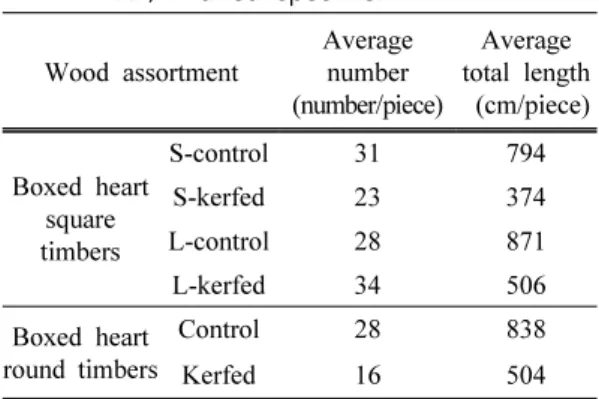
The average total length and numbers of the surface checks occurred on all specimens after the end of drying are presented in Table 5.

The surface checks somewhat severely oc- curred irrespective of wood assortment, how- ever, the width of surface check of most speci- mens was not wide. The occurrence extent of the surface checks on the kerfed specimens was

slight compared with that on the control specimen.

It is judged that dying sound timber is impos- sible with this technique. Therefore, a special research is necessary to develop a new drying technique.

4. CONCLUSIONS

The characteristics of RF/V drying Korean red pine (Pinus densoflora) boxed heart timbers with 250 × 250 mm (S), 300 × 300 mm (L) in cross section and 300 mm in diameter, and with the fixed length of 3,600 mm, that were sub- jected to a compressive load after a kerf pre- treatment can be described as the follows:

The drying time was short and the drying rate was fast in spite of the cross section of heavy timber being large.

The moisture gradient for all specimens was gentle in both longitudinal and transverse direc- tions owing to dielectric heating.

The shrinkage of the width in the direction perpendicular to was 21 percent ∼ 76 percent of that of the thickness of square timbers in the direction parallel to the mechanical pressure.

The casehardening for all specimens was very

slight because of significantly reduced ratio of

the tangential to radial shrinkage of specimens

and kerfing.

(8)

ACKNOWLEDGEMENT

This work was supported by the Korea Research Foundation Grant funded by the Korea Government.

Science 36: 9∼16.

2. Kanagawa, Y. 1989. Resin distribution in lumber dried by vacuum drying combined with ra- dio-frequency. Proc. of the IUFRO International Wood Drying Symposium. Seatle, Washington, USA: 158∼163.

3. Lee, N. H., K. Hayashi, and H. S. Jung. 1998.

Effect of radio-frequency/vacuum drying and me-

chanical press-drying on shrinkage and checking

of walnut log cross sections. Forest Products

Journal 48(5): 73∼79.

수치

Table 2. Drying schedule
Fig. 3. Sawing diagram of the boxed heart square  (left) and round timber (right) to survey a  distribution of final moisture content after  the end of drying.
Fig. 4. Reducing process of the moisture content of  the boxed heart square (above) and round  timber (below) during RF/V drying and  dry-ing schedule.
Fig. 7. Distribution of the final moisture content of  the boxed heart round timber after the end of  drying.
+2

참조

관련 문서

The liquid has a specific gravity of 1.60 and negligible vapor pressure. Calculate the flowrate for incipient cavitation in the 75 mm section, assuming that the tube flows

Mean thickness of palate including bone and soft tissue according to Level at 2 and 4 mm laterally from antero-posterior reference line in

rotating speed of 3000 rpm in nozzle diameter of 2.5 mm ··· 42 Table 20 Turbulence kinetic energy data according to nozzle angle with the engine rotating speed of 3000 rpm

The Dynamic Mechanical Analysis is a high precision technique for measuring the viscoelastic properties of materials. It consists in applying a sinusoidal deformation to a

UI/UX 평가 평가 UX Evaluation : UX Evaluation : 사용자경험 리서치 매뉴얼 사용자경험 리서치

 extent to which a system, product or service can be used by specified users to achieve specified goals with effectiveness, efficiency and satisfaction in a specified context

강좌 소개 강좌 소개 멀티미디어의 이해 멀티미디어의

 캐릭터 애니메이션은 벡터 포맷 (vector format) 이나 해상도 독립적 인 포맷 (resolution-independent format) 으로 작성.  애니메이션은 캐릭터에 독립적으로