DOI: http://dx.doi.org/10.7316/KHNES.2013.24.5.367
대량용해 Ti0.85Zr0.13(Fex-V)0.56Mn1.47Ni0.05 수소저장합금의 용융방사공정을 통한 수소저장특성
김진호ㆍ한규성
한국세라믹기술원 이천분원
Effect of Melt-Spinning Process on Hydrogen Storage Properties of Mass-Produced Ti
0.85Zr
0.13(Fe
x-V)
0.56Mn
1.47Ni
0.05Alloy
JINHO KIM, KYUSUNG HAN
Korea Institute of Ceramic Engineering & Technology, Icheon 467-843, Korea
Abstract >> Hydrogen storage as a metal hydride is the most promising alternative because of its relatively large hydrogen storage capacities near room temperature. TiMn2-based C14 Laves phases alloys are one of the promising hydrogen storage materials with easy activation, good hydriding-dehydriding kinetics, high hydrogen storage capacity and relatively low cost. In this work, multi-component, hyper-stoichiometric Ti0.85Zr0.13(Fex-V)0.56Mn1.47
Ni0.05 C14 Laves phase alloys were prepared by a vacuum induction melting for a hydrogen storage tank. Since pure vanadium (V) is quite expensive, the substitution of the V element in these alloys has been tried and some interesting results were achieved by replacing V by commercial ferrovanadium (FeV) raw material. In addition, the melt-spinning process, which was applied to the manufacturing of some of these alloys, could make the plateau slopes much flatter, which resulted in the increase of reversible hydrogen storage capacity. The improvement of sloping properties of melt-spun Ti0.85Zr0.13(Fex-V)0.56Mn1.47Ni0.05 alloys was mainly attributed to the homogeneity of chemical composition.
Key words : Hydrogen storage(수소저장), Metal hydride(금속수소화물), C14 Laves phase(C14 라베스상), Melt spinning(용융방사공정), Vacuum induction melting(진공유도용해)
†Corresponding author : [email protected]
[ 접수일 : 2013.9.30 수정일 : 2013.10.17 게재확정일 : 2013.10.31 ] Copyright ⓒ 2013 KHNES
1. 서 론
다양한 수소저장물질 중에서, 금속간수소화물 (metal hydride)은 상온에서 수소저장 및 방출이 가능 한 고체저장법으로 안전하고 높은 부피저장밀도 (volumetric storage density) 특성을 보인다1). 특히,
라베스 상(Laves phase)을 갖는 TiMn2계 AB2 수소저 장합금은 우수한 활성화 특성, 빠른 수소흡방출 속 도, 높은 수소저장밀도 및 가격경쟁력을 갖추고 있는 것으로 알려져 있다2-4). 그러나 TiMn2계 수소저장합 금은 높은 수소화압력(H2 plateau pressure)과 수소 흡방출시 큰 히스테리시스(hysteresis)를 보이기 때문 에, 이를 해결하기 위하여 원소 치환을 통한 합금설 계가 이루어지고 있다. Gamo 등은 Ti0.9Zr0.1Mn1.4Cr0.4
V0.2 합금 설계를 통하여 향상된 sloping 특성을 보여 주었고5), Park 등은 TiMn2계 합금에 V, Zr 치환을 통
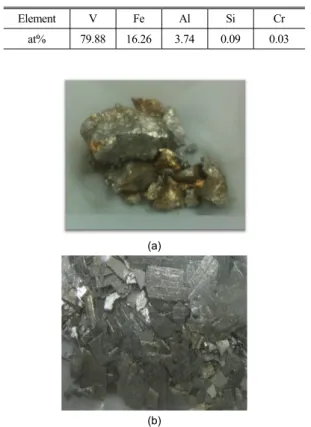
Table 1 Chemical composition of ferrovanadium(FexV) used in this study
Element V Fe Al Si Cr
at% 79.88 16.26 3.74 0.09 0.03
(a)
(b)
Fig. 1 Photograph of (a) VIM and (b) Melt-spun Ti0.85Zr0.13
(Fex-V)0.56Mn1.47Ni0.05 alloys
한 우수한 수소저장특성을 보고하였다6). 수소저장합 금의 수소화압력과 히스테리시스 특성을 제어하는 또 다른 방법으로 용융방사공정(Melt spinning process) 이 사용된다7-10). Shudo 등은 Ti-Zr-Mn-V 계 합금에 대하여 용융방사공정을 통한 수소화압력 특성을 제 어하여 수소저장특성에 미치는 영향에 대하여 보고 하였다7). Suwarno 등은 용용방사공정 조건에 따른 Ti0.8V0.2 합금의 미세구조 제어 및 수소저장특성에 미치는 영향에 대하여 보고하였다8).
TiMn2계 합금설계에서 V은 친수소화 특성을 갖는 원소로서 sloping 특성을 제어하고 수소저장용량을 증가시키는 역할을 하게 된다. 그러나 V은 고가의 물질로서 TiMn2계 합금의 상용화시 가격경쟁력 저 하를 가져오기 때문에, 최근에는 저가의 페로바나듐 (ferrovanadium, FeV)을 이용하는 연구가 진행되고 있다11-13). Taizhong 등은 TiCr1.8-x(FeV)x 합금에서 3.0 wt%의 최대용량과 1.8 wt%의 가역용량 (30℃, 10-4 to 3 MPaH2)을 보고하였으며, Kim 등은 TiMn2계 합 금에 저가의 페로바나듐(FexV)을 V 대신 사용하여 수소저장특성에 미치는 영향에 대하여 보고하였다2). 본 연구에서는 진공유도용해(Vacuum Induction Melting, VIM) 공정으로 Ti0.85Zr0.13(Fex-V)0.56Mn1.47Ni0.05
합금을 제작하였다. VIM 공정은 진공하에서 electro- magnetic induction을 통하여 금속을 용해하여 합금 을 제조하는 방식으로 (a)Oxygen-free 용해, (b)대량 생산, (c)높은 생산수율, (d)균일한 합금조성 확보, (e) 슬래그 방지를 용이하게 할 수 있다고 보고되고 있
다2,14). 또한 pure V 대신에 Fex-V를 사용한 VIM-Ti0.85
Zr0.13(Fex-V)0.56Mn1.47Ni0.05 합금에 용융방사공정을 통한 미세구조 제어 및 수소저장특성에 미치는 영향에 대 하여 고찰하였다.
2. 실험방법
본 연구의 TiMn2계 합금의 조성은 비화학양론조 성(hyper-stoichimetric) 설계된 Ti0.85Zr0.13(Fex-V)0.56Mn1.47
Ni0.05 이며, 사용된 페로바나듐(FexV) 화학조성은 다 음과 같다.
Ti0.85Zr0.13(Fex-V)0.56Mn1.47Ni0.05 합금은 (주)한국에 너지재료에서 제작되었으며, 진공유도용해(VIM, 25 kW) 공정으로 1 batch에서 약 15kg의 합금을 제조하 였다 (Fig. 1(a)). 제작된 ingot을 파쇄하여 용융방사 (Melt-spinning, MS)공정을 통하여 리본타입의 합금 을 제조하였다 (Fig. 1(b)). 용용방사공정은 반응관 내에서 합금 ingot을 용융 후 고속(1000, 1500rpm)으 로 회전하는 Cu roll에 분사하여 급속냉각 방식으로 진행된다. 용융방사공정시 합금의 냉각속도는 약 4x10⁻⁵ K·S-1 이다.
제조된 VIM and MS 합금은 기계적분쇄 후 100 mesh 체거름을 통하여 합금분말을 제조한다. 합금분
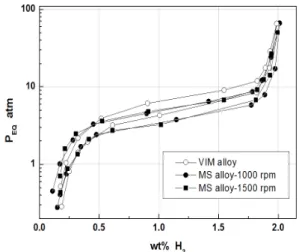
Fig. 2 PCT curves of (a) VIM and (b) MS Ti0.85Zr0.13(Fex-V)
0.56Mn1.47Ni0.05 alloys
Fig. 3 XRD patterns of VIM- and MS-Ti0.85Zr0.13(Fex-V)
0.56Mn1.47Ni0.05 alloys: (a) VIM, (b) 1000rpm, (c) 1500rpm (●: C14 Laves phase, ○: FeO, ◇: α-ZrO2)
말의 상분석 및 결정구조분석을 위하여 XRD(Rigaku D/Max 2500) 분석을 수행하였으며, 미세구조 분석 을 위하여 접속이온빔(Focused ion beam, FIB) 처리 를 통한 HRTEM(High Resolution Transmission Electron Microscopy, Tecnai G2 F30 S-Twin)과 EDS(Energy dispersive spectrometer) 측정을 수행하였다. Ti0.85Zr0.13
(Fex-V)0.56Mn1.47Ni0.05 합금의 수소저장특성은 Sievert's type automatic PCT (Pressure-Composition-Temperature) 장치를 이용하여 측정되었다. 수소측정 압력범위는 0.01-50bar H2 이며, 가스채널과 반응관의 온도는 각 각 298K와 203K 이다. 측정에 사용되는 시료분말의 무게는 0.35-0.5g이다. 수소측정 이전에 합금의 활성 화를 위하여 각각 5회의 수소흡방출 및 Ar purging 과정이 수행되었다.
3. 결과 및 토의
Fig. 2는 PCT 측정을 통한 VIM- and MS-Ti0.85
Zr0.13(Fex-V)0.56Mn1.47Ni0.05 합금(1000 & 1500rpm)의 수소화반응 특성을 보여주고 있다. VIM 합금은 약 2.0 wt%의 최대수소저장용량에 6-8MPa 수소화압력 거동을 보이고 있다. 그러나 PCT 곡선의 평탄도 (sloping plateau)가 크기 때문에 가역수소저장용량은 1.6 wt%로 측정된다. 반면에 MS 합금의 경우 최대 수소저장용량(2.0 wt%)과 수소화압력(6MPa)은 VIM 합금과 거동의 동일하지만, 상대적으로 우수한 평탄 도 특성을 보이고 있다. 또한 MS 합금에서 Cu roll 회전속도(1000 & 1500rpm)에 따른 수소저장특성의 변화는 관찰되지 않았다. 수소저장합금의 평탄도 특 성은 sloping factor(Hs)로 표현할 수 있으며, Hs는 다 음과 같은 수식으로 계산된다15).
Hs = d(ln Pα+β) / d(mass% H)
수식에서 Pα+β 는 수소평형압(hydrogen equilibrium
pressure), d (mass% H)는 α+β 영역에서 흡장된 수소 량을 의미한다. Fig. 2의 결과에서, VIM 합금의 Hs는 1.16 인데 반하여, MS 합금의 Hs는 1.06으로 감소하 였다. Ms 합금의 Hs 값은 pure V을 사용하는 결과와 후열처리를 진행한 결과와 비슷한 값을 보이고 있다2). 따라서 Melt spinning 공정은 TiMn2계 합금의 평탄 도 특성을 향상시켰으며, MS 합금의 가역수소저장 용량이 1.75wt%로 증가하는 효과를 가져오게 되었다.
Fig. 3은 VIM 합금과 MS 합금에 대한 XRD 분석
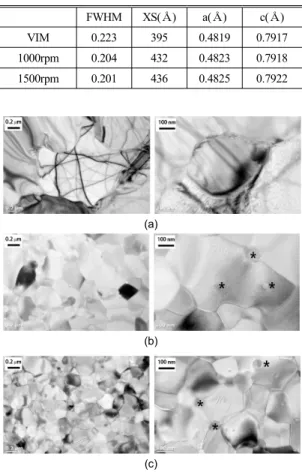
Table 2 Lattice parameter of VIM- and MS-Ti0.85Zr0.13
(Fex-V)0.56Mn1.47Ni0.05 alloys
FWHM XS(Å) a(Å) c(Å)
VIM 0.223 395 0.4819 0.7917
1000rpm 0.204 432 0.4823 0.7918 1500rpm 0.201 436 0.4825 0.7922
(a)
(b)
(c)
Fig. 4 TEM micrographs of VIM- and MS-Ti0.85Zr0.13(Fex-V)
0.56Mn1.47Ni0.05 alloys: (a) VIM, (b) 1000rpm, (c) 1500rpm
결과를 보여주고 있다. VIM 합금은 주상(mapin phase) C14 라베스 상(space group P63/mmc;#194)이 확인되 었으며, 일부 제2상(second phase)이 관찰되었다.
Ti-Mn 상태도에 따르면, C14 라베스 상은 TiMn1.6에 서 TiMn2.1 조성 사이에서 나타나며, 높은 수소저장 용량과 우수한 수소흡방출 특성을 보이는 것으로 알 려져 있다2-4). 반면에 제2상으로 관찰된 wustite 상 (FeO)은 수소저장 특성은 없으며, pure V 대신 사용 된 FexV에서 기인한 것으로 판단된다. VIM 합금의 C14 라베스 상과 Wustite 상의 분율은 각각 91.7 과 8.3at%로 관찰되었으며, 이러한 결과는 JADE 7.0 프 로그램의 Simulated pattern으로 측정되었다. 반면에 Fig. 3(b)의 MS 합금(1000rpm)의 XRD 측정 결과에 서는 주상인 C14 라베스 상의 회절피크(diffraction peak)가 더욱 sharp해지고 강도가 증가하는 것을 확 인할 수 있다. 그러나 VIM 합금에서 관찰되었던 wustite 상은 더 이상 나타나지 않고, α-ZrO2 상을 의미하는 회절피크가 매우 약하게 관찰되고 있다. Wustite 상 이 사라지는 결과는 FexV 합금 치환으로 발생한 합 금내 불균질성이 용융방사공정으로 해결되었음을 의 미한다. Fig. 3(c)의 MS 합금(1500rpm)의 경우에도 wustite 상은 사라지고 미약한 α-ZrO2 상이 관찰되고 있다. 또한 1000rpm의 합금에 비교하여 C14 라베스 상의 회절피크가 더욱 sharp 해지고 결정사이즈가 감 소하는 것을 알 수 있다. VIM 합금과 MS 합금(1000
& 1500rpm)의 격자변수(lattice parameter)를 Table 2 에 정리하였다.
Fig. 4는 FIB 처리된 VIM 합금과 MS 합금(1000
& 1500rpm)의 TEM 과 EDS 분석결과를 보여주고 있다. TEM 이미지에서 MS 합금은 벌크 내 입경 (grain) 크기가 1000rpm의 경우 200-600nm 이며, 1500rpm의 경우는 200nm 이하의 입경이 잘 정렬되 어 있는 것을 알 수 있다. 반면에 VIM 합금은 입경 의 구분이 명확하지 못하고, 크기가 1μm급에 이르는 것을 알 수 있다. EDS 분석결과 VIM 합금의 경우
대부분 Ti-rich 상이 관찰되었지만, 일부에서 Fe-rich 상이 관찰되는 것을 알 수 있다. 반면에 MS 합금의 경우 EDS 분석에서 Ti-rich 상의 조성분포가 VIM 합 금에 비하여 더욱 균일하게 측정되었고, Fe-rich 상은 관찰되지 않았다. 그러나 MS 합금(1000 & 1500rpm) 에서 입경 내 관찰되는 편석물(* 표시)은 Zr-rich 상 으로 확인되었으며, XRD 결과의 α-ZrO2 상의 결과 와 일치한다. 앞서 PCT 측정결과(Fig. 2)에서 용융방 사공정은 합금의 평탄도 특성을 향상시켰는데, 일반 적으로 평탄도 특성은 합금조성의 균일도 영향을 받 는 것으로 알려져 있다2,3). 이상의 결과에서 MS 합금 의 평탄도 특성 향상은 합금 조성의 균일도 향상에 기인한 것으로 판단된다.
4. 결 론
본 연구에서는 VIM 공정으로 대량제조된 hyper- stoichiometric TiMn2계 합금의 수소저장특성을 분석 하였다. 또한 용융방사공정이 Ti0.85Zr0.13(Fex-V)0.56Mn1.47
Ni0.05 합금의 수소저장특성에 미치는 영향에 대하여 고찰하였다. VIM Ti0.85Zr0.13(Fex-V)0.56Mn1.47Ni0.05 합 금의 경우 고용량 수소저장특성을 갖는 C14 라베스 상을 주상을 갖으며, wustite(FeO) 제 2상이 관찰되 었다. Wustite 상은 고가의 V 대신에 사용하는 페로 바나듐(FexV) 합금에 기인하며, wustite 상은 수소저 장특성이 없으며 VIM 합금의 PCT 거동에서 높은 평 탄도와 그에 따른 가역수소저장용량의 감소를 가져 오는 것으로 판단된다. 반면에 MS 합금은 주상으로 C14 라베스 상이 유지되지만, wustite 상은 더 이상 관찰되지 않으며, PCT 거동에서의 우수한 평탄도 특 성으로 1.75wt%의 높은 가역수소저장용량을 보이고 있다. 따라서 Ti0.85Zr0.13(Fex-V)0.56Mn1.47Ni0.05 합금에 대한 용융방사공정은 급속냉각 공정을 통하여 합금 내 작고 균일한 입경 분포와 균일한 조성분포 효과 를 가져오기 때문에 수소저장특성을 향상시키는 것 으로 확인되었다.
후 기
이 연구(논문)은 지식경제부 중소기업청의 지원으 로 수행되는 제조현장기술개발사업의 일환으로 수행 되었습니다.
References
1. S.Shi, J.Y.Hwang, “Research frontier on new materials and concepts for hydrogen storage”, Int. J. Hydrogen Energy, Vol. 32, 2007, p. 224.
2. J.H.Kim, K.S.Han, K.T.Hwang, B.G.Kim, Y.M.
Kang, “Effect of heat treatment on microstructure
and hydrogen storage properties of mass-produced Ti0.85Zr0.13(Fex-V)0.56Mn1.47Ni0.05 alloy”, Int. J.
Hydrogen Energy, Vol. 38, 2013, p. 6215.
3. J.Huot, E.Akiba, Y.Ishido, “Crystal structure of multiphase alloys (Zr,Ti)(Mn,V)2”, J. Alloys Compd., Vol. 231, 1995, p. 85.
4. H.H.Lee, J.Y.Lee, “A study on the alloy desigin of high capacity Ti-based metal hydride for for Ni/MH rechargeable battery”, J. of the Korean Hydrogen Energy Society, Vol. 7, No. 1, 1996, p. 19.
5. T.Gamo, Y.Moriwaki, N.Yanagihara, T.Iwaki, “Life properties of Ti-Mn alloy hydrides and their hydrogen purification effect”, J. Less-Common Met., Vol.
89, 1983, p. 495.
6. J.G.Park, H.Y.Jang, S.C.Han, P.S.Lee, J.Y.Lee,
“Hydrogen storage properties of TiMn2-based alloys for metal hydride heat pump”, Mater. Sci.
Eng. B, Vol. A329-331, 2002, p. 351.
7. Y.Shudo, T.Ebisawa, H.Itoh, “Characterization of Ti-Zr-Mn-V-based phase alloys for MH refriger- ation system”, J. Alloys Compd., Vol. 356-357, 2003, p. 497.
8. S.Suwarno, J.K.Solberg, V.A.Yartys, B.Krogh,
“Hydrogenation and microstructural study of melt- spun Ti0.8V0.2”, J. Alloys Compd., Vol. 509S, 2011, p. S775.
9. H.H.Cheng, H.G.Yang, S.L.Li, X.X.Deng, D.M.
Chen, K.Yang, “Hydrogen storage properties of melt-spun LaNi4.25Al0.75”, J. Alloys Compd., Vol.
458, 2008, p. 330.
10. F.S.Wei, Y.Q.Lei, L.X.Chen, G.L.Lu, Q.D.Wang,
“Influence of rapid quenching on the microstruc- ture and electrochemical properties of Co-free LaNi4.92Sn0.33 hydrogen stroage electrode alloy”, Int. J. Hydrogen Energy, Vol. 32, 2007, p. 2935.
11. H.Taizhong, Z.Wu, B.Xia, J.Chen, X.Yu, N.Xu,
“Effect of stoichiometry on hydrogen storage performance of Ti-Cr-V-Fe based alloys”, Interme- tallics, Vol. 13, 2005, p. 1075.
12. S.F.Santos, J.Huot, “Hydrogen storage in TiCr1.2
(FeV)x BCC solid solutions”, J. Alloys Compd.,
Vol. 472, 2009, p. 247.
13. J.Mi, X.Guo, X.Liu, L.Jiang, Z.Li, L.Hao, “Effect of Al on microstructures and hydrogen storage properties of Ti26.5Cr20(V0.45Fe0.085)100-XAlxCe0.5
alloy”, J. Alloys Compd., Vol. 485, 2009, p. 234.
14. R.Li, J.Wu, S.Zhou, J.Qian, “Effects of cobalt content and preparation on electrochemical capacity
of AB5-type hydrogen storage alloys at different temperature”, J. Rare Earths, Vol. 24, 2006, p. 341.
15. J.K.Park, H.W.Jang, S.C.Han, P.S.Lee, J.Y.Lee,
“The thermodynamic properties of Ti-Zr-Cr-Mn Laves phase alloys”, J. Alloys Compd., Vol. 325, 2001, p. 293.