The Study about the Bluetooth Communication
Zhenghua Song* · Hyun-sik Shin* · Chun-suk Kim*
ABSTRACT
Bluetooth is a standard for short range, low power, low cost wireless communication that uses radio technology. This paper presents an overview of Bluetooth communication the following article will focus on the formation of Bluetooth scatter nets and some proposed scatter net models.
Keywords
Bluetooth Communication, Bluetooth Scatter, Bluetooth Core Protocol, Radio Technology
* 전남대학교 전자통신공학과 접수일자 : 2007. 07. 20 심사완료일자 : 2007. 08. 27
Ⅰ. Introduction
With the aim of establishing wireless connection system worldwide and developing a new type of technology to be characterized by beinguser-friendly and applicable to and compatible with various kinds of equipment and establishing an actual wireless interface and associated softwarestandard and promoting more equipment manufactures to support this protocol, Bluetooth SIG was established to research a new generation of wireless transmission technology by Eriksson, Nokia, IBM, Toshiba and Intel in February, 1998. Up to mow, the number of enterprise members of SIG has reached 2500, of which can be classified into many groups by grade and function The sponsor group is responsible for leading Bluetooth SIG whose members include 3Com, Ericsson, Intel, Microsoft and Motorola etc.
Bluetooth is a standard for short range, low power, low cost wireless communication that uses radio tec- hnology. Although originally envisioned as arable- replacement technology by Ericsson (a major cell
phone manufacturer) in 1994, embedded Bluetooth capability is becoming widespread innumerous types of devices. They include intelligent devices (PDA cell phones, PCs), data peripherals (mice, key boards etc.), audio peripherals (headsets, speakers, etc.), and embedded applications (automobile power locks, industrial systems).
Ⅱ. The Bluetooth protocol stack
The Bluetooth specification divides the Bluetooth protocol stack into three logical groups. They are the Transport Protocol group, the Middleware Protocol group and the Application Group, as shown in Fig. 1.
The Transport group protocols allow Bluetooth devices to locate each other, and to manage physical and logical links with higher layer protocols and applications. Please note that the use of the word
"transport" in the Transport protocol group does not indicate that it coincides with the Transport layer of the Open Systems Interconnection Reference Model (OSI) model. Rather, these protocols correspond to
the Data-Link and Physical layers of the OSImodel.
Fig. 1 Bluetooth Core Protocol Groups
The Radio, Baseband, Link Manager, Logical Link Control and Adaptation (L2CAP) layers and the Host Controller Interface (HCI) are included in the Transport Protocol group. These protocols support both asynchronous and synchronous transmission. All the protocols in this group are required to support communications between Bluetooth devices.
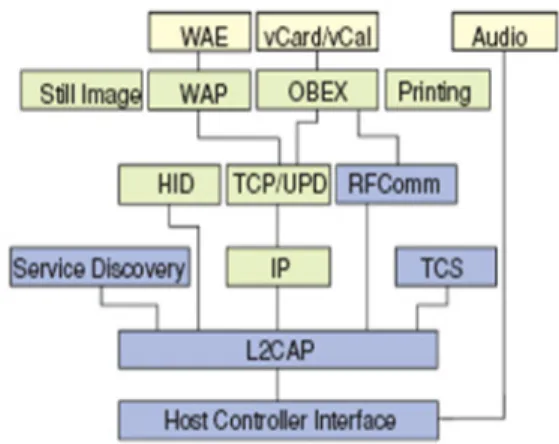
The Middleware Protocol group includes third- party and industry-standard protocols, as well as Bluetooth SIG developed protocols. These protocols allow existing and new applications to operate over Bluetooth links. Industry standard protocols include Point-to-Point Protocol (PPP), Internet Protocol (IP), Transmission Control Protocol (TCP), wireless app- lication protocols (WAP), and object exchange (OBEX) protocols, adopted from Infrared Data Asso- ciation (IrDA). Bluetooth SIG-developed protocols include
1) a serial port emulator (RFCOMM) that enables legacy applications to operate seamlessly over Bluetooth transport protocols,
2) a packet based telephony control signaling protocol (TCS) for managing telephony ope- rations,
3) a service discovery protocol (SDP) that allows devices to obtain information about each other's available services. Reuse of existing protocols
and seamless interfacing to existing applications was a high priority in the development of the Bluetooth specifications, as shown in Fig. 2.
Fig. 2 Interoperability with existing protocols & applications
The Application group consists of actual applications that use Bluetooth links. They can include legacy applications as well as Bluetooth-aware applications. A brief discussion of the layers in the Transport group follows. Radio layer. The specification of the Radio layer is primarily concerned with the design of the Bluetooth transceivers, discussed in detail later Baseband layer. This layer defines how Bluetooth devices search for and connect to other devices. The master and slave roles that a device may assume are defined here, as are the frequency-hopping sequences used by devices. The devices usea time division duplexing (TDD), packet-based polling scheme to share the air-interface. The master and slave each communicateonly in their pre-assigned time slots. Also, defined here are the types of packets, packet processing procedures and the strategies for error detection and correction, signal scrambling (whitening), encryption, packet transmission and retransmissions.
The Baseband layer supports two types of links:
Synchronous Connection- Oriented (SCO) and Asynchronous Connection-Less (ACL). SCO links are characterized by a periodic, single-slot packet
assignment, and are primarily used for voice transmissions that require fast, consistent data transfer. A device that has established a SCO link has, in essence, reserved certain time slots for its use. Its data packets are treated as priority packets, and will be serviced before any ACL packets. A device with an ACL link can send variable length packets of 1, 3 or 5 time-slot lengths.
But it has no time slots reserved for it. Link Manager layer. This layer implements the Link Manager Protocol (LMP), which manages the properties of the air interface link between devices.
LMP manages bandwidth allocation for general data, bandwidth reservation for audio traffic, authentication using challenger esponse methods, trust relationships between devices, encryption of data and control of power usage. Power usage control includes the negotiation of low-power activity modes and the determination of transmission power levels. L2CAP layer. The Logical Link Control andAdaptation Protocol (L2CAP) layer provides the interface between the higher-layer protocols and the lower-layer transport protocols. L2CAP supports multiplexing of several higher layer protocols, such as RF Comm. and SDP. This allows multiple protocols and applications to share the air-interface.
L2CAP is also responsible for packet segmentation and reassembly, and for maintaining the negotiated service level between devices.
HCI layer. The Host Controller Interface (HCI) layer defines a standard interfacefor upper level applications to access the lower layers of the stack.
This layer is not a required part of the specification.
Its purpose is to enable interoperability among devices and the use of existing higher level protocols and applications.
Ⅲ. Communication
A Bluetooth transceiver is a frequency hopping
spread-spectrum (FHSS) device that uses the unlicensed (worldwide) 2.4 GHz ISM (Industrial, Scientific, Medical) frequency band. In most countries, there are 79 channels available; however, some countries allow the use of only 23 channels.
The nominal bandwidth for each channel is 1MHz.
FCC part 15.247 regulations restrict the maximum allowed peak power output to 1 watt and require that at least 75 of the 79 channels be used in a pseudorandom manner. A device cannot operate on a given channel for longer than0.4 seconds within any 30-second period. These limits (or restrictions) were put into place to minimize the amount of interference in the ISM band, which is also used by 802.11 b/g devices,Home RF devices, portable phones and microwave ovens. When connected to other Bluetoothdevices, a Bluetooth device hops (changes frequencies) at the rate of 1600 times per second for typical use, with a residence time of 625 ?sec . When in inquiry or page mode, it hops at 3200hops per second with a residence time of 312.5sec .
A Bluetooth transceiver uses all 79 channels, and hops pseudo-randomly across all channels at a rate of 1600 hops per second for standard transmissions.
It has a range of approximately 10 meters, although ranges up to 100 meters can be achieved with amplifiers. Because the transceiver has an extremely small footprint, it is easily embedded into physical devices, making it a truly ubiquitous radio link.
The Bluetooth specification uses time division duplexing (TDD) and time division multiple access (TDMA) for device communication. A single time slot is 625 ?sec in length, representing the length of a single-slot packet. At the Baseband layer, a packet consists of an access code, a header, and the payload, as shown in Fig. 3.
Fig. 3 The packet Format
Bluetooth uses polling-based packet transmission.
All communication between devices takes place between a master and a slave, using time-division duplex (TDD), with no direct slave-to slave communication. The master will poll each active slave to determine if it has data to transmit. The slave may only transmit data when it has been polled. Also, it must send its data in the time slot immediately following the one in which it was polled.
The master transmits only in even numbered time slots, while the slaves transmit only in odd- numbered time slots. In each time slot, a different frequency channel f is used (a hop in the hopping sequence).
Ⅳ. Conclusions
Bluetooth wireless technology encompasses several key points that facilitate its widespread adoption:
1) it is an open specification that is publicly available and royalty free;
2) its short-range wireless capability allows per- ipheral devices to communicate over a single air-interface, replacing cables that use con- nectors with a multitude of shapes, sizes and numbers of pins;
3) Bluetooth supports both voice and data, making it an ideal technology to enable many types of devices to communicate; and
4) Bluetooth uses an unregulated frequency band available anywhere in the world. To fully realize the Bluetooth vision, full networking of multiple Bluetooth devices is required. This leads to the investigation of Bluetooth scatter nets, which must address scatter netformation and reconf- iguration, scheduling, and routing issues.
References
[1] M. Albrecht, M. Frank, P. Martini, M.
Schetelig, A. Vilavaara and A. Wenzel, "IP Services over Bluetooth: Leading the Way to a New Mobility", Proceeding of the 24th Con- ference on Local Computer Networks, Lo- well, MA, pp.2-11, Oct. 1999.
[2] Simon Baatz, et. al, "Handoff Support for Mobility with IP over Bluetooth", Proceeding of the 25th Conference on Local Computer Networks, pp.143-154, Nov. 2000.
[3] Chatschik Bisdikian, "An Overview of the Bluetooth Wireless Technology", IEEE Comm- unications Magazine, Dec. 2001.
[4] Bluetooth SIG, Specification of the Bluetooth System Core, 2001.
[5] Bluetooth SIG, Specification of the Bluetooth System Profiles, 2001.
[6] K. Brown and S. Singh, "M-TCP: TCP for Mobile Cellular Networks", ACM Computer Com- munications Review, Vol. 27, No. 5, pp.19-43, 1997.
[7] R. Caceres and L. Iftode, "Improving the Performance of Reliable Transport Protocols in Mobile Computing Environments", IEEE Jo- urnal on Selected Area in Communications, Vol. 13, No. 5, pp.850-857, June 1995.
[8] Jaap C. Haartsen, "The Bluetooth Radio Sy- stem", IEEE Personal Communications, Vol. 7, No. 1, pp.28-36, Feb. 2000.
[9] J. Hartsen et al., "Bluetooth: Visions, Goals, and Architecture", ACM Computer Communications Review, Vol. 4, No. 2, pp.38-45, 1998.
[10] Hewlett-Packard Company, "Netperf: A Network Performance Benchmark", Feb. 1995.
[11] http://www.bluetooth.org/
[12] A. G. Valko, "Cellular IP: A New Approach to InternetHost Mobility", Computer Comm- unication Review, Vol. 29.
Authors
Zhenghua Song Was born in JiangSu Province P.R.China, on November 03, 1982. He received the B.E degree from the Beijing Institute Of Petro and Chemical in 2005, Beijing China, in 2005, Beijing China, the M.S degree in the Electric Communication Engineering at Chonnam National University from March 2006 to now .
Email : [email protected]
Hyun-sik Shin He received the B.E degree in Radio communication engineering from the University of Kwangwoon in 1969. The M.S degree in communication police from the University of Gunkook in 1980, and the Ph.D. degree in communication police from the University of Keongnam in 1995. He joined the Department of radio communication engineering and police, Yosu National University, in 1982 and became and Assistant Professor, Associate Professor in 1983 and 1987. And became and Professor in 1988 and 1992. 1995-1997 Dean of Academic Affairs, Yosu National Univ. 1997-present Director, Korean Society for Fisheries & Marine Science Education, 1999-2000 Director, Central Library. 2001-2002 Chairman, Korea Institute of Marine Communication. 2004-2005 Graduate School of Industry. 2005-2006 Graduate School Education. 2006 Graduate School of Industrial Cooperation.
Since 2006, he has been a professor in the Division of Electronic Communication Engineering at Chonnam National University. He is a member of KICS of Korea, KINPR of Korea and KIMICS of Korea.
Email:[email protected]
Chun-suk Kim Was born in Yeosu, South Korea, on October 03,1954. He received B.E degree in electrical engineering from the University of Kwangwoon in 1980, the M.E degree in electrical engineering from the University of Gunkook in 1982, and the Ph.D. degree in electrical engineering from the University of Keongnam in 1998. He joined the Department of Computer Engineering, Yosu National University, in 1980 and became an Assistant Professor, Associate Professor in 1982 and 1989, respectively. Since 1993, he has been a professor in the Division of Electronic Communication Engineering at Yosu National University.
Since 2006, he has been a professor in the Division of Electric Communication Engineering at Chonnam National University. His research interests lie in the area of digital signal processing, radio communication, information theory and various kinds of communication systems. He is a member of ISS of Korea, ICS of Korea, ITE of Korea and IMICS of Korea.
Email:[email protected]