• 검색 결과가 없습니다.

The Effect of Acoustic Correlates of Domain-initial Strengthening in Lexical Segmentation of English by Native Korean Listeners

N/A
N/A
Protected

Academic year: 2021

Share "The Effect of Acoustic Correlates of Domain-initial Strengthening in Lexical Segmentation of English by Native Korean Listeners"

Copied!
10
0
0

로드 중.... (전체 텍스트 보기)

전체 글

(1)

말소리와 음성과학 제2권 제3호 (2010) pp. 115~124

The Effect of Acoustic Correlates of Domain-initial Strengthening in Lexical Segmentation of English by Native Korean Listeners

Kim, Sahyang

1)

․Cho, Taehong

2)

ABSTRACT

The current study investigated the role of acoustic correlates of domain-initial strengthening in lexical segmentation of a non-native language. In a series of cross-modal identity-priming experiments, native Korean listeners heard English auditory stimuli and made lexical decision to visual targets (i.e., written words). The auditory stimuli contained critical two word sequences which created temporal lexical ambiguity (e.g., 'mill#company', with the competitor 'milk'). There was either an IP boundary or a word boundary between the two words in the critical sequences. The initial CV of the second word (e.g., [kʌ]

in 'company') was spliced from another token of the sequence in IP- or Wd-initial positions. The prime words were postboundary words (e.g., company) in Experiment 1, and preboundary words (e.g., mill) in Experiment 2. In both experiments, Korean listeners showed priming effects only in IP contexts, indicating that they can make use of IP boundary cues of English in lexical segmentation of English. The acoustic correlates of domain-initial strengthening were also exploited by Korean listeners, but significant effects were found only for the segmentation of postboundary words. The results therefore indicate that L2 listeners can make use of prosodically driven phonetic detail in lexical segmentation of L2, as long as the direction of those cues are similar in their L1 and L2. The exact use of the cues by Korean listeners was, however, different from that found with native English listeners in Cho, McQueen, and Cox (2007). The differential use of the prosodically driven phonetic cues by the native and non-native listeners are thus discussed.

Keywords: domain-initial strengthening, spoken word recognition, non-native perception

1. Introduction

A prerequisite to a complete understanding of a spoken utterance is lexical segmentation. Adult native listeners normally do not have much difficulty in segmenting words from their native language. When it comes to processing a non-native language, however, this effortless work becomes a serious challenge. Most L2 learners find it difficult to figure out word boundaries from running L2 speech. There are many reasons for

1) Hongik University [email protected]

2) Hanyang University [email protected], corresponding author

This work was supported by the Hongik University new faculty research support fund.

Received: August 7, 2010 Revision: September 14, 2010 Accepted: September 21, 2010

such difficulty, including L2 learners' incomplete lexical knowledge and their poor perception of individual segments of L2. Another reason for the segmentation difficulty comes from the learners' tendency to use their L1 segmentation strategies in L2 processing. For example, Japanese listeners use mora, the rhythmic pattern of their L1, when segmenting English, of which the rhythmic pattern is trochaic stress (Cutler & Otake, 1994);

German listeners also use the phonotactic patterns of their L1 in segmenting words from English (Weber, 2001). This tendency is in line with general findings of L2 perception studies, showing that listeners' experience with the phonetic and phonological system of their L1 modulates their perception of non-native languages (e.g., Best, 1995; Broersma, 2010; Cho & McQueen, 2006; Flege, 1995).

L1 influence on L2 speech perception, however, has a positive

side as well. For example, if the same phoneme category exists

in L1 and L2, listeners would not have difficulty in learning the

(2)

category in L2 (e.g., Best, 1995; Flege, 1995). A similar idea can also be applied to strategies for L2 lexical segmentation. If L1 and L2 share a feature that can be used as a cue for segmentation, listeners would be able to use the cue for word segmentation of both L1 and L2, which would alleviate the processing load for L2 to some extent.

One such L1 segmentation cue which can be potentially used for the lexical segmentation of a non-native language is a prosodic cue, because the number of prosodic cues used in human languages is quite limited, and because they perform similar functions across languages. For example, in many languages, prosodic structure of utterances is acoustically manifested by phrase final lengthening (Klatt, 1975; Wightman et al., 1991) and phrase final boundary tones (Jun, 2004) at the right edge (viz., end) of a prosodic phrase, and by domain-initial strengthening (Cho & Keating, 2001; Fougeron & Keating, 1997;

Keating et al., 2003) at the left edge (viz., beginning) of a prosodic boundary. All of these edge cues are known to serve a function of marking prosodic boundaries. These prosodically- driven phonetic cues can be efficient tools for lexical segmentation, since listeners usually do not attempt lexical search spanning a prosodic boundary (Christophe et al., 2004).

Studies have indeed shown that the right edge cues such as final lengthening and phrase-final boundary tone facilitate lexical segmentation of native language (Kim & Cho, 2009), and more importantly, lexical segmentation of artificial languages (Bagou et al., 2002; Kim, 2006; Kim et al., in revision; Tyler & Cutler, 2009). The final lengthening cue, which is known to be a universal cue for the end of a prosodic phrase (Vaissière, 1983), helped native listeners of many languages (e.g., French, Bagou et al., 2002; Korean, Kim, 2006; Dutch and Korean, Kim et al., in revision; Dutch, English, French, Tyler & Cutler, 2009) to segment words from artificial languages. F0 cues at prosodic boundaries are also found to be helpful in lexical segmentation of artificial languages, but they facilitated segmentation only when listeners were exposed to the F0 cues that match with the prosodic pattern of their native language (Kim, 2006; Kim et al., in revision). These findings strongly suggest that listeners can make use of prosodic cues of their native language in L2 lexical segmentation, as long as both languages have the same prosodic cues.

Compared with the right edge cues, the role of a left edge prosodic cue (viz., acoustic correlates of domain-initial strengthening), in lexical segmentation has been less studied thus far. It has been investigated only with native listeners of English

(Cho, McQueen, and Cox, 2007), and its role in segmentation of non-native language has not been examined before. The current study aims to examine the role of domain initial strengthening effect in lexical segmentation of L2, and to provide a fair comparison between native and non-native listeners on their use of fine phonetic details in lexical segmentation. To this end, we adopted Cho et al (2007)'s experimental paradigm and stimuli.

(See 1.1 for detail.)

Note that the domain initial strengthening effect is manifested in a similar way in both English and Korean. Domain initial strengthening effect of stops, for instance, is revealed by larger linguo-palatal contact area, longer VOT and stronger burst energy in both languages (Cho & Keating, 2001; Keating et al., 2003).

The acoustic correlates of domain initial strengthening may not be

as perceptually salient as final lengthening and phrase boundary

tones. However, Cho, et al. (2007) showed that English listeners

used the cue in lexical segmentation when other prosodic cues are

not available. Korean listeners have not been tested with regard

to the use of domain-initial cues in lexical segmentation of their

native language, but there are reasons to believe that they would

be able to use the cue in their L1 segmentation. A

cross-linguistic study of domain-initial strengthening revealed that

Korean shows the strongest initial strengthening effect among

English, French, and Taiwanese (Keating et al., 2003), which

means that Korean listeners are exposed to spoken utterances with

strong acoustic cues at phrase-initial positions. Further, a study on

Korean listeners' lexical segmentation showed that they are

sensitive to the acoustic mismatch at prosodic boundaries (e.g.,

listening to IP-medial (viz. Wd-initial) acoustic cue at the

IP-initial position, Kim & Cho, 2009). Therefore, we assume that

Koreans would be sensitive to the acoustic correlates of domain

initial strengthening. Furthermore, given that Koreans are familiar

with the acoustic correlates of domain-initial strengthening, which

both English and Korean seem to share, we expect that Korean

listeners would be able to use the domain initial cue of English

in lexical segmentation. However, since Koreans would be

listening to an L2, the way they use the acoustic correlates of

domain initial strengthening in word segmentation may be further

constrained by other factors such as lexical knowledge, which

may contribute to yielding different results from those found with

native English listeners. In the following section, we will briefly

summarize the experimental methods of Cho et al.(2007) and

findings with native listeners of English, and we will present our

hypotheses with non-native listeners in section 1.2.

(3)

1.1 Domain-initial strengthening in L1 lexical

segmentation by native English listeners (Cho et al., 2007)

Cho, et al., (2007) tested the effect of domain-initial strengthening, using a cross-modal identity priming paradigm. In this paradigm, listeners see a visual target word (i.e., a written word form) as they hear an auditory stimulus, and make a lexical decision on the target word. Normally, listeners' responses are faster and/or more accurate when they hear an auditory stimulus (e.g., mill) and see an identical visual target (e.g., mill) than when the hear an auditory stimulus (e.g., bus) and see an unrelated visual target (e.g., mill). This effect is called an identity-priming effect.

In order to test the role of acoustic correlates of domain-initial strengthening in different prosodic contexts, Cho et al. (2007) made speech materials which contained critical two word sequences (marked in bold in (1a and 1b)) in two boundary conditions, IP (Intonational Phrase)-boundary (as in (1a)) and Wd (Word)-boundary (as in (1b)). The words at the IP boundary (in this case, 'mill') showed final lengthening and carried a boundary tone, but there was no pause between the two IPs.

(1a) When I was thinking about buying a coffee mill, company names were the most important things I considered.

(an IP boundary between 'mill' and 'company')

(1b) To learn about wood products, they visited a mill company in Alabama last summer.

(a word boundary between 'mill' and 'company')

The effect of domain-initial strengthening itself was tested by splicing. The initial CV of the second word in two critical word sequences (e.g., /kʌ/ from 'company') was spliced from either a different token of the same sentence (i.e., same-spliced) or from a token of a paired sentence with different prosodic context (i.e., cross-spliced). If priming effects varied across splicing conditions, it would mean that there was a strengthening effect.

In order to obtain a more concrete strengthening effect, each sequence was designed in such a way that the critical two word sequences created temporal lexical ambiguity. That is, the preboundary word (e.g., 'mill' in (1a,b)) and the initial segment of the next word (e.g., [k] in company in (1a,b)) consisted of another word (e.g., milk) or the beginning of another word (e.g., partner in part names). Thus, for instance, as listeners hear the critical sequences (mill company), they will face lexical ambiguity

(i.e., both 'mill' and 'milk' will be activated). If the domain initial cue (i.e., [k] in company) played a role in segmentation, the recognition of the intended word 'mill' and the rejection of the competitor 'milk' would be faster when listeners heard IP-initial CV than when they heard IP-medial (viz., Wd-initial) CV. Note also that the competition would all else being equal be stronger between the preboundary word and the competitor (e.g., mill versus milk) than between the competitor and the postboundary word (e.g., milk versus company) because the preboundary word and the competitor are more overlapped (mill and milk) than the competitor and the postboundary word are (milk and [k]ompany) in this design.

They performed two experiments: Experiment 1 was conducted to examine whether the acoustic correlates of domain-initial strengthening assist the recognition of the domain-initial words themselves (i.e., postboundary words in the domain-initial position, 'company' in (1a and b)). Experiment 2 was conducted to investigate whether the acoustic correlates of domain-initial strengthening influence the recognition of the preceding words (i.e., preboundary words in the domain-final position, 'mill' in (1a and b)). Further, each experiment had 2 sub-experiments, where the boundary context differed. In ‘a’ experiments (Experiments 1a and 2a), the critical two word sequences straddled a word boundary, whereas in ‘b’ experiments (Experiments 1b and 2b), the critical sequences straddled an IP boundary.

Cho et al. (2007) found the strengthening effect only with recognition of preboundary words in Wd-boundary context (viz., Experiment 2a). This indicates that a strong domain-initial CV cue can help native English listeners to correctly segment words from the spoken utterances of English, but only in an adverse condition.

1.2 Domain-initial strengthening in L2 lexical segmentation

The current study expands Cho et al' (2007)'s study into non-native perception by examining how Korean listeners make use of fine-grained phonetic cue in L2 speech for lexical segmentation. Since non-native listeners tend to pay more attention to acoustic detail than lexical knowledge, compared to native listeners (Mattys et al., in press), we expect that Korean listeners would show more reliance on acoustic information than native English listeners would.

1) Identity priming effect

In Cho et al., (2007), general priming effects were found in all

(4)

experimental conditions. Since cross-modal priming effect has been observed in many studies, the priming effect is expected to be observed in the current study as well. Given that the subjects are listening to non-native speech material, however, there is a possibility that the priming effect may not be observed in all experimental conditions, but only in conditions where listeners hear stimuli in less adverse acoustic conditions. If this is the case, it is expected that the priming effect will be observed only in IP-contexts where there are more prosodic cues (e.g., final lengthening and domain initial strengthening) than Wd-contexts.

2) Splicing effect

Since Korean and English showed comparable domain-initial strengthening effect (Keating et al., 2003), it is expected that the acoustic correlates of domain-initial strengthening used in this study will facilitate Korean listeners' segmentation of L2 words. If so, the interaction between splicing effect and priming effect will be observed. Since the domain initial acoustic cues from IP-boundary context is stronger than the cues from Wd-boundary context, it is expected that priming effect would be stronger in same-spliced condition than in cross-spliced condition in IP boundary context, and that it would be stronger in cross-spliced condition than in same-spliced condition in Wd boundary context.

3) Competitor effect

In Cho et al. (2007)'s study, they found the domain initial strengthening effect only in Wd-context and only for preboundary words. The reason that they were not able to observe the same effect for postboundary words, according to their explanation, is that the strong CV-initial became not only a perceptual cue for the target word (e.g., company), but also its cohort competitors.

(e.g., compact, comrade, compensate). That is, the strong initial CV cue helps activating both the target words and their competitor words, resulting in null priming effect on the target words due to ongoing competition at the time when the cue was available. The competitor mechanism has been observed in previous studies and integrated in all psycholinguistic models of word recognition (Marselen-Wilson, 1987; McClelland & Elman, 1986; Norris, 1994). We therefore expect the similar processing mechanism in non-native spoken word recognition. However, given that lexical competition comes from listeners' lexical knowledge and given that non-native listeners have limited lexical knowledge, the competitor effect with non-native listeners (viz., Koreans) may not be as strong as the one observed with the native listeners.

2. Experiment

The materials used for the current study and the experimental paradigm and design employed here were identical with those of Cho et al. (2007)'s study. See Cho et al. (2007) for the complete list of prime sentences, visual target words and representative competitors.

2.1 Participants

There were 56 subjects for each of the four experiments, and hence the total number of subjects was 224. They were undergraduate or graduate students and were paid for the participation. Their native language is Korean, and all of them have learned English as their second language. None had an experience of living abroad for more than a year. The subjects were selected based on their official English standardized test scores (TOEIC, TOEFL or TEPS). The TOEFL or TEPS scores were converted into TOEIC scores, following a comparison table from the Internet. Participants’ TOEIC scores (or converted scores) ranged from 850-975, and the average score of each group ranged from 900-903.6. The selection process was done to ensure that the participants’ English proficiency level was high enough to perform the experimental task, and that they were more or less evenly distributed in each group in terms of their English proficiency level.

2.2 Stimuli

There were 48 pairs of English sentences and each pair contained the same critical two-word sequences. An example pair is given in (1a) and (1b). As aforementioned, one of the pair has an IP boundary (1a) and the other has a word boundary (1b) between the two critical words.

Since the original sentences constructed to test native English listeners could give heavy processing load to non-native English listeners and hence could potentially cause an unwanted confounding effect, the auditory stimuli were trimmed such that only the critical sequences and the two syllables before and after the sequences were presented to the listeners Thus, for example, from (1a), only the “coffee mill, company names were” part was excised and played to the subjects. When the first or the last syllable of a sequence was part of a multisyllabic word, the whole word was included in the stimuli. For example, from (1b),

“visited a mill company in Alabama” was excised, instead of “ted a mill company in Al.”

Among the 48 pairs, 18 pairs had a voiceless stop ([p], [t], or

(5)

[k]), 18 pairs had the voiceless fricative [s] and 12 pairs had the nasal stop [n], as the initial consonant of postboundary words (e.g., 'company' in (1a) and (1b)). The acoustic analyses performed on the postboundary initial consonants by Cho et al.

(2007) revealed that the initial oral stops showed a strong domain initial strengthening effect with respect to peak amplitude (i.e., significantly larger peak amplitude during the stop burst for Cs from IP boundaries than those from word boundaries) and the initial fricative showed a significant initial lengthening (i.e., [s]

was longer in IP initial than in word initial position). The acoustic analyses on nasal [n], however, did not reveal such domain initial strengthening effect

3)

; therefore, twelve [n]

sequences were not included for the statistical analysis.

In addition to the target pairs, there were 112 fillers. Sixty-four filler sentences and practice sentences were unspliced. Among the remaining 48 fillers which had word boundary between two-word sequences, half of them were cross-spliced and the other half were same-spliced. For 24 spliced fillers, non-word targets were made in such a way that they were phonologically related to the second word in the critical two-word sequence. For the other 24 spliced fillers and 32 unspliced fillers, non-word targets were phonologically unrelated to the auditory prime. For the other 32 unspliced fillers, real words that were phonologically and semantically unrelated to the auditory prime were presented as visual targets. There were also 10 practice items; half of them were presented with real word targets and the other half with non-word targets. All the fillers and practice items were excised following the same criteria used for the targets.

2.3 Procedure

In each trial, listeners heard an auditory stimulus and performed a lexical decision task on a visual target. In Experiments 1a and 1b, the second word (i.e., postboundary word) in the critical two-word sequence served as a target. In Experiments 2a and 2b, the first word (i.e., preboundary word) in the critical two-word sequence served as a target. For all four experiments, the visual target appeared on the monitor at the onset of the postboundary word. This means that for the experiments targeting postboundary words (i.e., Experiments 1a and 1b), the display of the visual target was aligned with the onset of the critical word (i.e., postboundary word), while for the

3) See Cho & Keating, (2001) and Fougeron (2001) for a detailed discussion on why the weaker nasality (e.g., less nasal energy, less nasal flow) are associated with higher prosodic domains.

experiments targeting preboundary words (i.e., Experiments 2a and 2b), the visual target was displayed after the listener heard the critical word (i.e., preboundary word) in the auditory prime. If the visual target was aligned with the preboundary target word in Experiments 2a and 2b, it means that the visual target would appear even before the critical part (i.e., the onset of the second word) where phonetic detail was manipulated, which would defeat the purpose of the experiment.

Listeners were tested individually, wearing a headphone, in a sound-proof room at Hanyang Phonetics and Psycholinguistcs Lab.

In each trial, they listened to an auditory prime sentence fragment and performed a lexical decision task on a visual target word (i.e., whether the visual target word was a real word or not) by pressing a button (either 'YES' or 'No') on a button box. The visual target words were presented on a computer screen in synchrony with the onset of postboundary words. Reaction times (RTs) were measured from the onset of the visual target word to listeners' response (i.e., button press) and recorded on a PC. The experimental flow was controlled by NESU (Nijmegen Experiment Set-Up).

3. Results

3.1 Statistical Analysis

A series of repeated measures Analyses of Variance (RM

ANOVAs) was conducted to examine whether there is a priming

effect and whether the priming effect is modulated by fine

phonetic details conveying prosodic boundary information. For the

current study, only by-subject analyses were conducted. When

evaluating individual experiments, the within-subject factors

considered were Relatedness (Identical vs. Unrelated visual

targets) and Splicing (Same-spliced vs. Cross-spliced auditory

stimuli). If there is a significant Relatedness effect, it means that

the auditory stimuli primed listeners' lexical decision on the visual

target words. If there is a significant interaction between

Relatedness and Splicing, it indicates that listeners' decisions were

affected by fine phonetic information in the auditory stimuli one

way or another. When comparing two experiments with the same

target word position but different boundary contexts (i.e.,

Experiments 1a and 1b; Experiments 2a and 2b), Boundary (IP

vs. Word) was included as a between-subject factor. When there

were interaction effects between factors, posthoc pairwise

comparisons were conducted. Dependent variables were RTs

(reaction time) and error rates. In all ANOVAS, p-values 0.05

and less were considered significant, and p-values above 0.051

(6)

and below 0.1 were considered as trend.

Note that items with error rates greater than 20% were excluded for the statistical analyses. This process left 32 items out of the original 36 items for Experiments 2a and 2b. For Experiments 1a and 1b, three additional items were excluded by the same standard and additional 4 items were excluded due to technical errors, which eventually yielded 29 items available for the statistical analyses. In addition, for each subject, RTs above or below 2.5 standard deviations from the average RT of the subject were treated as errors. Error rates calculated as such were 5.7% for Experiment 1a, 4.6% for Experiment 1b, 8.3% for Experiment 2a, and 8% for Experiment 2b.

3.2 Experiment 1a (postboundary word; word context) There was no main effect of Relatedness nor Splicing on both RTs and on error rates. There was no significant interaction, yet Splicing x Relatedness interaction showed a trend (F(1,55)=2.913, p=.094) on error rates. As shown in Figure 1, the trend was due to a significant priming effect in cross-spliced trials (t(55)=-2.123, p=.038), which was not found in same-spliced trials. That is, listeners made less errors with identical than with unrelated trials in their lexical decision on the postboundary words when they heard IP-initial CVs in word boundary context.

Figure 1. Mean error rates for Experiment 1a (Postboundary targets in word context; '*' indicates a significant difference.)

3.3 Experiment 1b (postboundary word; IP context) A significant priming effect was found on RTs (F(1,55)=4.245, p=.044). Listeners were faster in responding to identical visual targets (e.g., to 'company', as they hear 'mill # company') than to unrelated visual targets (e.g., to 'ticket' as they hear 'mill # company'), when they heard IP-initial CVs in IP boundary context and when the visual targets (e.g., company) appeared at the onset of the postboundary words (e.g., mill # company). No other effects or interactions were found.

3.4 Combined analysis - Experiments 1a and 1b

Combined analyses of the RTs and error rates from Experiment 1a and 1b (both have postboundary target words, with different prosodic boundaries) were performed. A significant priming effects was found for the RT analyses (F(1,110)=5.356, p=.023), and a trend was found for the error rates analyses (F(1,110)=3.799, p=.054). Listeners responded faster and made fewer errors on the visual targets that were identical to the postboundary prime words than those that were unrelated to the prime words.

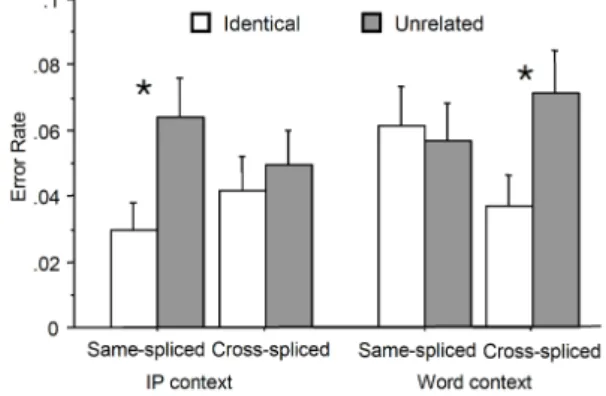
The error rate analyses showed a significant three-way interaction between Boundary, Splicing, and Relatedness (F(1,110)=4.663, p=.033). As shown in Figure 2, the interaction is due to the fact that listeners’ behaviors were similar with same-spliced targets in IP context and with cross-spliced targets in Word context: listeners showed significantly lower error rates for the identical than unrelated targets when the same-spliced targets (i.e., IP-initial CVs) were presented in IP context (t(55)=-2.021, p=.048; the leftmost pair in the figure) and when the cross-spliced targets (i.e., IP-initial CVs) were presented in word boundary context (t(55)=-2.123, p=.038; the rightmost pair in the figure). The priming effect was not significant when listeners heard the cross-spliced word (i.e., word-initial CVs) in the IP boundary context (the second pair in Figure 2) and when they heard same-spliced word (i.e., word-initial CVs) in the word boundary context (the third pair in Figure 2). No other significant main effects or interactions were found.

Figure 2. Mean error rates for the combined analyses of Experiments 1a and 1b. (Postboundary targets; '*' indicates a

significant difference.)

3.5 Experiment 2a (preboundary word; word context)

There was no main effect of Relatedness and Splicing on RT

and on error rates. No significant interaction was found between

the two factors.

(7)

3.6 Experiment 2b (preboundary word; IP context) As shown in Figure 3, there was a significant priming effect on RTs (F(1,55)= 18.413, p=.000). Listeners' responses were faster when they responded to an identical visual target (i.e., to 'mill' as they heard 'mill # company', where # was an IP boundary) than to an unrelated visual target (i.e., to 'mill' as they heard 'bus # ticket').

Figure 3. Mean RT for Experiment 2b (Preboundary targets in IP boundary context; '*' indicates a significant difference.)

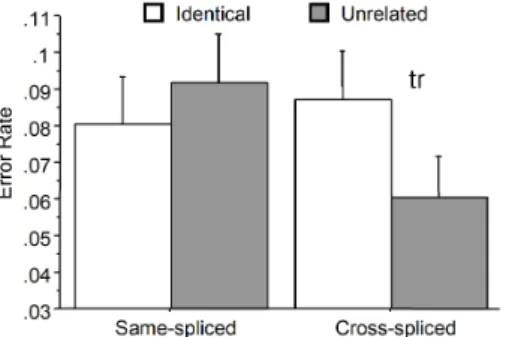
Further, there was a trend in Splicing x Relatedness interaction in the analysis for error rates (F(1,55)=3.130, p=.082). The interaction was mainly due to a different directionality, as shown in Figure 4.

Figure 4. Mean error rates for Experiment 2b (Preboundary targets in IP boundary context; 'tr' indicates a trend.)

When CVs with word-initial acoustic characteristics were presented in IP context (i.e., cross-spliced in Figure 4), listeners' error rates were higher with identical preboundary words than with unrelated preboundary words. Posthoc comparisons showed a trend toward significance (t(55)= 1.951, p=.055) on cross-spliced trials. No other significant effect was found on RTs and error rates.

3.7 Combined analysis - Experiments 2a and 2b

Combined analyses of the RTs and error rates from Experiment 2a and 2b (both have preboundary target words, with different

prosodic boundaries) were performed, in order to test whether priming effect would interact with boundary type. The RT analysis showed a significant priming effect (F(1,110)=18.525, p=.000). There was also a significant interaction between Relatedness and Boundary (F(1,110)= 7.254, p=.008). This, obviously, is due to the fact that the priming effect was significant in IP boundary context (see the results of Experiment 2b), while the effect was not significant in word boundary context (see the results of Experiment 2a). No other effects or interactions were found.

4. Discussion

One of the main findings of the current study was that the priming effect was found only when the auditory primes were in IP boundary context (Experiments 1b and 2b), but not in Wd-boundary context, regardless of whether the primes appeared at the preboundary position (mill # company) or the postboundary position (mill # company). This suggests that the IP context itself assisted Korean listeners' lexical segmentation of English. As Cho et al. (2007) reported, the speech materials used in IP contexts contained final lengthening and boundary tones as prosodic boundary cues. Both final lengthening and phrase-final boundary tone are known to help Korean listeners with lexical segmentation in their native language (Kim & Cho, 2009) and in an artificial language (Kim, Broersma and Cho, in revision). The results of the current study suggest that Koreans, as non-native listeners, can also make use of the prosodic boundary cues of IP.

Recall that this prosodic context dependent priming was not observed with native listeners in Cho et al. (2007). Native listeners of English showed the priming effect in all experimental conditions (both in IP-context with more segmentation cues and in Wd-context with less cues), unlike Korean listeners who showed the effect only in the IP-context with more segmentation cues. The fact that Korean listeners were able to segment words only in IP context suggests that they actually 'knew' the words, but they could not segment them successfully (in the Wd context) without the help of acoustic cues coming from IP boundary. This has important implications for L2 lexical processing: successful L2 lexical segmentation would require more acoustic-phonetic cues than L1 lexical segmentation, and an important source of the cues in L2 processing is prosodic structure.

Another important finding of the current study is the

interaction between priming effect and splicing effect, which

indicates listeners' use of acoustic correlates of domain initial

(8)

strengthening. In IP context, Korean listeners showed a significant priming effect with same-spliced CVs (with IP-initial cue), but not with cross-spliced CVs (with Wd-initial cue). On the other hand, in Wd-context, they showed a significant priming effect only with cross-spliced CVs (with IP-initial cue). This suggests that Korean listeners can take advantage of the acoustic consequences of domain-initial strengthening of English, such that they can efficiently segment the postboundary words which contain the acoustic correlates of domain-initial strengthening. The same effect, however, was not observed in preboundary condition, indicating that the domain-initial cue does not play a significant role in recognizing a preboundary word.

Note that the domain-initial effect found in the current study is quite different from what has been found with native English listeners. In Cho et al. (2007), the domain-intial strengthening effect was found only with preboundary words in word context.

They explained that the strong initial CV cue gave the information of the end of a preboundary word, which helped the segmentation of preboundary words. However, they could not find the same effect with postboundary words because, according to them, the strong initial CV activates not only the postboundary prime word itself, but also its cohort competitors. Unlike Cho et al. (2007)'s native English listeners, Korean listeners found the domain-initial strengthening cue helpful in segmenting domain-initial words (viz, postboundary words) themselves. One possible explanation for this difference is related to lexical knowledge itself. That is, non-native listeners simply cannot activate many competitors as native listeners can, because they do not have enough lexical knowledge. Therefore, they are less influenced by the competitors than native listeners during lexical segmentation. Another possible explanation has to do with the speed of lexical access. Even if non-native listeners had substantial lexical knowledge, their activation of both competitors and targets could be slower than that of native listeners, such that by the time when they activate cohorts, they have already heard enough acoustic information to reject many candidates. In either case, the results seem to suggest that domain-initial cues were more informational to Korean listeners than lexical knowledge during their online lexical segmentation. In that sense, the results are in parallel with Mattys et al. (in press) who showed that non-native listeners pay more attention to acoustic cues than to lexical information.

5. Conclusion

The current study investigated native Korean listeners' use of acoustic correlates of domain-initial strengthening in lexical segmentation of English. A series of cross-modal identity priming experiments revealed that Korean listeners showed identity priming effect only when prime words (both preboundary words and postboundary words) appeared in IP contexts. This suggests that IP-final boundary cues such as final lengthening and boundary tones can be useful cues for Korean listeners when they segment words from English. More importantly, the results also showed that Korean listeners make use of domain-initial cues in lexical segmentation of English. The results, therefore, suggest that phonetic cues driven by prosodic structure can help listeners to segment words from their L2, when the patterns of the cues that exist in L2 are similar to those in L1.

The comparison between the current results and the results with native English listeners, however, indicates differential use of fine acoustic-phonetic cues in lexical segmentation of L1 and L2.

Korean listeners' showed priming effects only in IP contexts, while English listeners showed the effects in all contexts. There was also a difference between non-native listeners and native listeners in terms of the use of domain initial strengthening cue.

For Korean listeners, domain-initial cues facilitated the segmentation of domain-initial words (viz., postboundary words);

but for English listeners, they facilitated the segmentation of pre-boundary words, and only when they were in Wd-context.

This seems to be due to differential degree of lexical competition between native and non-native processing. The results, therefore, suggest that non-native listeners rely heavily on prosodically driven acoustic-phonetic cues in segmenting words from L2, and that lexical knowledge and prosodically-driven phonetic detail interact in a different way in native versus non-native lexical segmentation.

The current study successfully showed that non-native listeners can use prosodically-driven fine phonetic detail of their L2 in lexical processing of L2. For a better understanding of L2 lexical processing in general, however, we should take into account other factors which would influence L2 lexical processing, such as the size of L2 lexicon, frequency of L2 lexical items, the size of their neighboring words, and the listeners' L1 lexical knowledge.

Thus, our future endeavor should be directed to further

investigation of how various levels of lexical information of L1

and L2 affect L2 segmentation and how they interact with fine

phonetic detail in online processing.

(9)

Acknowledgement

We thank Yuna Hur, Bobae Lee, and Jiyeon Lee for their assistance with data acquisition, and the authors of Cho et al.

(2007) for allowing us to use and to modify their original stimuli.

Appendix 1

List of pre- and post-boundary target words (# = IP or Wd boundary)

tan # tiles limb # pain new # socks sue # poor bay # tourists pen # samples

bow # tie ham # salad pea # soup

day # time neck # sizes fee # service pine # table ten # scientists pay # notice high # tide ray # signals low # net chess # tournament win # summer stay # nervous

bus # tickets whole # sales shy # nuns loyal # team den # search kid # near tree # top pier # side part # names bee # competition fan # sites play # new

mill # company knee # surgery spy # novels pie # cooking lock # systems key # notions dim # parking buy # salmon law # notes dumb # people sea # serpents say # negative

lamb # pork pick # some lay # numerous

References

Bagou, O., Fougeron, C. & Frauenfelder, U. H. (2002).

“Contribution of prosody to the segmentation and storage of

“words" in the acquisition of a new mini-language”, Paper presented at the Speech Prosody, Aix-en-Provence.

Best, C. T. (1995). “A direct realist perspective on cross-language speech perception”, in W. Strange (Ed.), Speech perception and linguistic experience: Theoretical and methodological issues in cross-language speech research (pp. 167-200). Baltimore, MD:

York.

Broersma, M. (2010). “Perception of final fricative voicing: Native and nonnative listeners' use of vowel duration”, Journal of the Acoustical Society of America, Vol. 127, pp. 1636-1644.

Cho, T. & Keating, P. A. (2001). “Articulatory and acoustic studies on domain-initial strengthening in Korean”, Journal of Phonetics, 29, pp. 155-190.

Cho, T. & McQueen, J. M. (2006). “Phonological versus phonetic cues in native and non-native listening: Korean and Dutch

listeners' perception of Dutch and English consonants”, Journal of the Acoustical Society of America, Vol. 119, pp. 3085-3096.

Cho, T., McQueen, J. M. & Cox, E. (2007). “Prosodically driven phonetic detail in speech processing: The case of domain-initial strengthening in English”, Journal of Phonetics, Vol. 35, pp.

210-243.

Christophe, A., Peperkamp, S., Pallier, C., Block, E., & Mehler, J.

(2004). “Phonological phrase boundaries constrain lexical access I. Adult data,” Journal of Memory and Language, 51, pp.523-547.

Cutler, A. & Otake, T. (1994). “Mora or phoneme--Further evidence for language-specific listening,” Journal of Memory and Language, Vol. 33, pp. 824-844.

Flege, J. (1995). “Second-language speech learning: Theory, findings, and problems”, in W. Strange (Ed.), Speech perception and linguistic experience: Theoretical and methodological issues (pp. 233-272). Baltimore, MD: York.

Fougeron, C. & Keating, P. A. (1997). “Articulatory strengthening at edges of prosodic domains”, Journal of the Acoustical Society of America, Vol. 101, pp. 3728-3740.

Fougeron, C. (2001). “Articulatory properties of initial segments in several prosodic constituents in French”, Journal of Phonetics, Vol. 29, pp. 109-135.

Jun, S.-A. (Ed.). (2004). Prosodic typology: The phonology of intonation and phrasing. Oxford, UK: Oxford University Press.

Keating, P. A., Cho, T., Fougeron, C. & Hsu, C. (2003).

“Domain-initial strengthening in four languages”, in J. Local, R.

Ogden, & R. Temple (Eds.), Laboratory phonology, Vol. IV:

Phonetic interpretation (pp. 145-163). Cambridge, U.K.:

Cambridge University Press.

Kim, S. (2006). “The role of prosodic boundary cues in word segmentation in Korean”, Speech Sciences, Vol. 13, pp. 29-42.

Kim, S., Broersma, M. & Cho, T. (in revision). “The use of prosodic cues in processing an unfamiliar language”, Studies in Second Language Acquisition.

Kim, S. & Cho, T. (2009). “The use of phrase-level prosodic information in lexical segmentation: Evidence from word-spotting experiments in Korean”, Journal of the Acoustical Society of America, Vol. 125, pp. 3373-3386.

Klatt, D. H. (1975). “Vowel lengthening is syntactically determined in connected discourse”, Journal of Phonetics, Vol. 3, pp.

129-140.

Mattys, S. L., Carroll, L. M., Li, C. K. W. & Chan, S. L. Y. (in

press). “Effects of energetic and informational masking on

speech segmentation by native and non-native speakers”, Speech

(10)

Communication.

Marslen-Wilson, W. D. (1987). “Functional parallelism in spoken word-recognition”, Cognition, Vol. 25, pp. 71-102.

McClelland, J. L. & Elman, J. L. (1986). “The TRACE model of speech perception”, Cognitive Psychology, Vol. 18, pp. 1-86.

Norris, D. (1994). “Shortlist: A connectionist model of continuous speech recognition”, Cognition, Vol. 52, pp. 189-234.

Tyler, M. D. & Cutler, A. (2009). “Cross-language differences in cue use for speech segmentation”, Journal of the Acoustical Society of America, Vol. 126, pp. 367-376.

Vaissière, J. 1983. “Language-independent prosodic features”, in A.

Cutler & D. R. Ladd (Eds.), Prosody: Models and measurements (pp. 53-66). Springer-Verlag, Hamburg.

Weber, A. (2001). “Language-specific listening: The case of phonetic sequences.” Unpublished Ph.D. dissertation, Max Planck Institute for Psycholinguistics, Nijmegen, the Netherlands.

Wightman, C. W., Shattuck-Hufnagel, S., Ostendorf, M. & Price, P.

J. (1992). “Segmental durations in the vicinity of prosodic phrase boundaries”, Journal of the Acoustical Society of America, Vol.

91, pp. 1707-1717.

∙Sahyang Kim

Department of English Education Hongik University,

Sangsu-dong 72-1, Mapo-gu, Seoul (121-791), Korea Email: [email protected]

∙Taehong Cho

Department of English Language and Literature Hanyang University,

Haengdang-dong 17, Seongdong-gu, Seoul (133-791), Korea

Email: [email protected]

수치

Figure 2. Mean error rates for the combined analyses of  Experiments 1a and 1b. (Postboundary targets; '*' indicates a
Figure 4. Mean error rates for Experiment 2b (Preboundary  targets in IP boundary context; 'tr' indicates a trend.)

참조

관련 문서

Therefore, A lot of native English-speaking teachers have come to Korea to teach English.. The purpose of this study is to assess the job satisfaction of

The purpose of this study is to investigate the effect of peer-mentoring on the achievement and learning attitudes of middle school students toward

In the study of English lexical learning strategies by majors and non-majors, the strategies commonly used by the two groups was indicated the orderly

• Apply the principle of impulse and momentum. Since the initial momenta is zero, the system of impulses must be equivalent to the final system of momenta. • Assume

The aim of this study is to explain difficulties of Korean high school students' use of English relative pronouns by the error analysis and then provide English teachers

His initial knowledge of the tradition was fragmentary because it was based on the literature that comprises this tradition and its descendants.. His initial

In the design of reactors that are to be operated at conditions (e.g., temperature and initial concentration) identical to those at which temperature and

This study looks at the types of learning activities preferred by native English teachers for English speaking classes, criteria that are considered important