Short-term Evaluation of a Comprehensive Education Program Including Inhaler
Training and Disease Management on Chronic Obstructive Pulmonary Disease
Kwang Ha Yoo, M.D.
1,*, Wou Young Chung, M.D.
2,*, Joo Hun Park, M.D.
2, Sung Chul Hwang, M.D.
2, Tae-Eun Kim, M.D.
3, Min Jung Oh, B.Sc.
4, Dae Ryong Kang, Ph.D.
4, Chin Kook Rhee, M.D.
5,
Hyoung Kyu Yoon, M.D.
5, Tae-Hyung Kim, M.D.
6, Deog Kyeom Kim, M.D.
7, Yong Bum Park, M.D.
8, Sang-Ha Kim, M.D.
9and Ho-Kee Yum, M.D.
101
Department of Internal Medicine, Konkuk University School of Medicine, Seoul,
2Department of Pulmonary and Critical Care Medicine, Ajou University School of Medicine, Suwon,
3Department of Clinical Pharmacology, Konkuk University School of Medicine, Seoul,
4Office of Biostatistics, Department of Humanities and Social Medicine, Ajou University School of Medicine, Suwon,
5Division of Pulmonary, Allergy and Critical Care Medicine, Department of Internal Medicine, Seoul St. Mary’s Hospital, College of Medicine, The Catholic University of Korea, Seoul,
6Division of Pulmonology, Department of Internal Medicine, Hanyang University Guri Hospital, Hanyang University College of Medicine, Guri,
7Division of Pulmonary and Critical Care Medicine, Department of Internal Medicine, Seoul Metropolitan Government-Seoul National University Boramae Medical Center, Seoul National University College of Medicine, Seoul,
8Department of Pulmonary and Critical Care Medicine, Hallym University Kangdong Sacred Heart Hospital, Seoul,
9Department of Internal Medicine, Wonju Severance Christian Hospital, Wonju,
10Department of Internal Medicine, Inje University Seoul Paik Hospital, Seoul, Korea
Background: Proper education regarding inhaler usage and optimal management of chronic obstructive pulmonary disease (COPD) is essential for effectively treating patients with COPD. This study was conducted to evaluate the effects of a comprehensive education program including inhaler training and COPD management.
Methods: We enlisted 127 patients with COPD on an outpatient basis at 43 private clinics in Korea. The patients were educated on inhaler usage and disease management for three visits across 2 weeks. Physicians and patients were administered a COPD assessment test (CAT) and questionnaires about the correct usage of inhalers and management of COPD before commencement of this program and after their third visit.
Results: The outcomes of 127 COPD patients were analyzed. CAT scores (19.6±12.5 vs. 15.1±12.3) improved significantly after this program (p<0.05). Patients with improved CAT scores of 4 points or more had a better understanding of COPD management and the correct technique for using inhalers than those who did not have improved CAT scores (p<0.05).
Conclusion: A comprehensive education program including inhaler training and COPD management at a primary care setting improved CAT scores and led to patients’ better understanding of COPD management.
Keywords: Pulmonary Disease, Chronic Obstructive; Education; Metered Dose Inhalers; Dry Powder Inhalers
Address for correspondence: Joo Hun Park, M.D.
Department of Pulmonary and Critical Care Medicine, Ajou University School of Medicine, 206 World cup-ro, Yeongtong-gu, Suwon 16499, Korea
Phone: 82-31-219-5116, Fax: 82-31-219-5124, E-mail: [email protected]*Kwang Ha Yoo and Wou Young Chung contributed equally to this work as a first author.
Received: Feb. 21, 2017, Revised: May. 15, 2017, Accepted: Jun. 2, 2017, Published online: Sep. 1, 2017
cc
It is identical to the Creative Commons Attribution Non-Commercial License (http://creativecommons.org/licenses/by-nc/4.0/).
Copyright © 2017
The Korean Academy of Tuberculosis and Respiratory Diseases.
All rights reserved.
Introduction
Morbidity and mortality by chronic obstructive pulmonary disease (COPD) is increasing worldwide and Korean survey in 2008 detected 13.4% of COPD among subjects older than 40 years
1,2. Comprehensive care including inhalation therapy and disease education for self management is a cornerstone in the management of COPD
1,3,4. However, previous studies showed that COPD patients were not using inhalers as prescribed or correctly
5-7. Correct usage of inhalers is reported to be related to patients’ knowledge about disease process, educational sta- tus, age, gender, formal training, etc.
5,6,8,9. It has been reported that inadequate inhalation technique and poor adherence to inhaled medication in COPD are associated with poor clinical outcomes such as increased hospitalization and high mortal- ity
10,11. Even self-management interventions in patients with COPD are associated with improved health-related quality of life, a reduction in hospital admissions, and improvement in dyspnea
4.
Recently, comprehensive educational program of COPD management including smoking cessation, nutritional sup- port, exercise, vaccination, co-morbidity evaluation, acute exacerbation, and inhaler training was developed by Korean Academy of Tuberculosis and Respiratory Disease
12. We implemented this program for COPD patients in a primary care setting and evaluated the efficacy of this comprehensive education program comparing clinical markers before and after this program.
Materials and Methods
1. Inclusion and exclusion criteria
From August 2014 to April 2016, we enlisted 285 patients with asthma or COPD on an outpatient basis who volun- teered to be enrolled, and primary physicians of 43 private clinics from seven provinces (Seoul, Chungcheongbuk-do, Chungcheongnam-do, Gyeonggi-do, Gangwon-do, Jeollabuk- do, Jeollanam-do, Jeju-do) throughout Korea participated in this study. We selected four to five primary clinics from each province to make our data representative of general asthma or COPD population of Korea. Among the total group, 127 pa- tients with COPD were selected for the analysis.
Patients were diagnosed as COPD based on the primary physician’s clinical judgment according to the following crite- ria: (1) 40 years or older, (2) forced expiratory volume in 1 sec- ond (FEV
1) to forced expiratory volume in 6 seconds (FEV
6)
<0.73, (3) no evidence of malignant cancer, severe kidney or heart disease, transplanted organ for any lesion, bronchiecta- sis, sequelae of tuberculosis, or pregnancy
13,14.
The comprehensive educational program developed by Korean Academy of Tuberculosis and Respiratory Disease consisted of inhaler training, an action plan for emergency situation focusing on acute exacerbation of COPD, and man- agement of COPD concerning smoking cessation, nutritional support, exercise, vaccination, and comorbidities
12.
2. Study design
This prospective study was performed to evaluate a 1-month comprehensive educational program. This study en- rolled subjects who had been visiting each primary clinic over 1 year or more onto the education program. Considering the
Visit 1 (day 1) (n=285)
Education and survey by questionnaires Visit 2 (day 15) (n=285)
Education
Visit 3 (day 30) (n=285)
Education and survey by questionnaires
COPD (n=127) Asthma (n=158)
Not follow-up (n=143) Not meeting inclusion criteria Subject consent withdrawal Collecting failure of data Assessed for eligibility (n=428)
Follow-up (n=285)
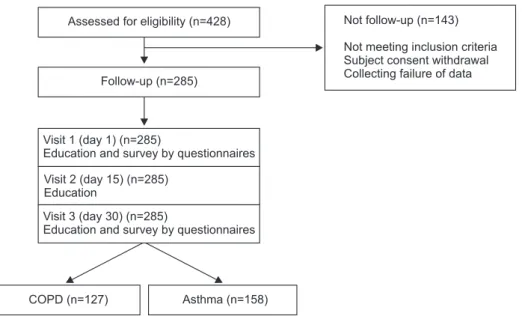
Figure 1. Study design and enrollment.
COPD: chronic obstructive pulmonary
disease.
reality of primary care setting, we designed this study consist- ing of three consecutive educational visits with every 2-week follow-up and analyzed the outcomes of a 1-month education program (Figure 1). This comprehensive educational program was performed with educating patients with pamphlet by physicians and educational video by nurses.
At first visit, we obtained the informed consent from each patient and conducted a knowledge assessment about their chronic airway disease, and tested the inhaler technique before the patients received the educational program. At the second and third visits, this education program were repeated.
Questionnaires were completed by patients and physicians at the first visit and third visit to evaluate the following items; the knowledge about COPD, COPD assessment test (CAT), inhal- er use technique, and measurement items of each topic were composed of six (knowledge), eight (CAT), seven (inhaler use), three (satisfaction of the patients), and five items (satis- faction of the physicians). Each item had 4 grade scales such as “strongly disagree, somewhat disagree, somewhat agree, strongly agree.” Minimum Clinically Important Difference (MCID) for objective evaluation of quality of life improvement was defined as the improvement of 4 points or more in CAT score
15.
3. Ethics statement
The study protocol was reviewed and approved by the Inje University Institutional Review Board (IIT-2014-283). Written informed consent, describing the purpose of the study was obtained from all the participating patients.
4. Statistical methods
All data were expressed as mean±SD or percentage. We determined the 95% confidence interval of each variable from the mean and standard deviation. Paired t test was used for the comparison of continuous variables before and after edu- cation. We used chi-square test was used for categorical vari- ables. The chi-square test was used for categorical data before and after education. A p-value of <0.05 was deemed statisti- cally significant. All data were analyzed with SPSS version 21.0 (IBM Corp., Armonk, NY, USA).
Results
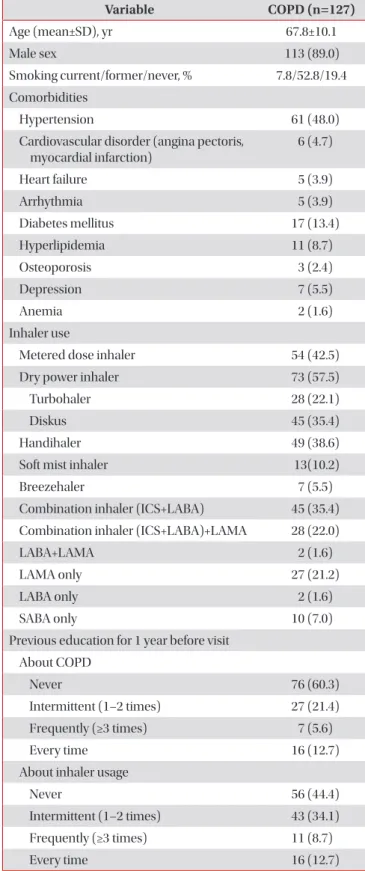
1. Baseline characteristics of the study population Out of 147 COPD patients initially enrolled, 127 patients patients (male, 89%; mean age, 67.8±14.2 years) with COPD completed this study. The baseline characteristics are shown in Table 1. Hypertension was the most frequent comorbidity (n=61, 48.0%). For 1 year prior to this study, previous educa-
Table 1. Baseline characteristics of enrolled COPD patients
Variable COPD (n=127)
Age (mean±SD), yr 67.8±10.1
Male sex 113 (89.0)
Smoking current/former/never, % 7.8/52.8/19.4 Comorbidities
Hypertension 61 (48.0)
Cardiovascular disorder (angina pectoris, myocardial infarction)
6 (4.7)
Heart failure 5 (3.9)
Arrhythmia 5 (3.9)
Diabetes mellitus 17 (13.4)
Hyperlipidemia 11 (8.7)
Osteoporosis 3 (2.4)
Depression 7 (5.5)
Anemia 2 (1.6)
Inhaler use
Metered dose inhaler 54 (42.5)
Dry power inhaler 73 (57.5)
Turbohaler 28 (22.1)
Diskus 45 (35.4)
Handihaler 49 (38.6)
Soft mist inhaler 13(10.2)
Breezehaler 7 (5.5)
Combination inhaler (ICS+LABA) 45 (35.4) Combination inhaler (ICS+LABA)+LAMA 28 (22.0)
LABA+LAMA 2 (1.6)
LAMA only 27 (21.2)
LABA only 2 (1.6)
SABA only 10 (7.0)
Previous education for 1 year before visit About COPD
Never 76 (60.3)
Intermittent (1–2 times) 27 (21.4)
Frequently (≥3 times) 7 (5.6)
Every time 16 (12.7)
About inhaler usage
Never 56 (44.4)
Intermittent (1–2 times) 43 (34.1) Frequently (≥3 times) 11 (8.7)
Every time 16 (12.7)
Values are presented as number (%) unless otherwise indicated.
COPD: chronic obstructive pulmonary disease; ICS: inhaled cor-
ticosteroid; LABA: inhaled long acting β 2 agonist; LAMA: long-
acting muscarinic agent; SABA: inhaled short acting β 2 agonist.
tion about COPD was not performed in 60.3% and inhaler training was not done in 44.4% (Table 1).
2. Inhaler usage assessed by physicians before and after a comprehensive education program
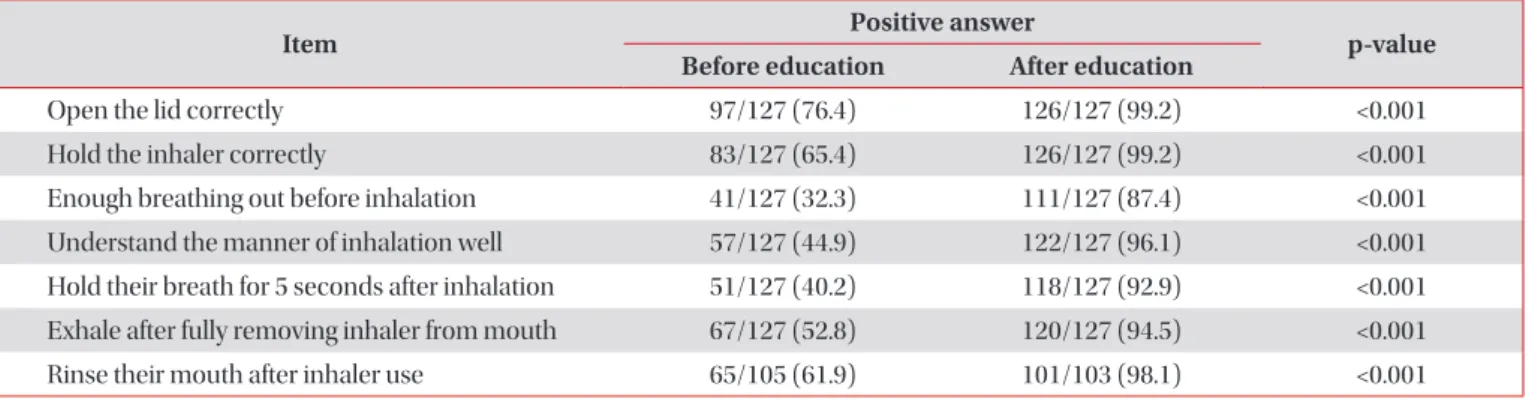
Inhaler use technique was assessed stage by stage from opening the lid to rinsing the mouth after inhalation. Before this program, positive answer for enough breathing out before inhalation and holding their breath for 5 seconds after inhala- tion was only 32.3% and 40.2%, respectively. However, after the completion of this education program, every item regard- ing inhaler usage was improved significantly as assessed by physicians (p<0.05) (Table 2).
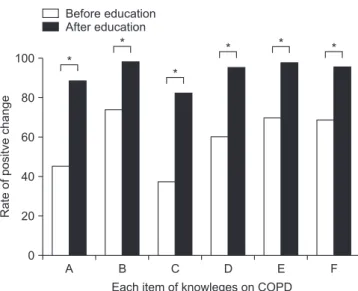
3. Change of CAT score and of knowledge about COPD before and after a comprehensive education program Total CAT score and all items in the CAT score except ‘have lots of energy’ were significantly improved after this compre- hensive program (p<0.05) (Figure 2). All items concerning patients’ knowledge about COPD per se and management of problems arising from COPD showed significant positive changes as well (p<0.01) (Figure 3).
4. Evaluation of CAT by the improvement with MCID (CAT score improvement ≥4) or more after a comprehensive education program
In 44.9% of enrolled patients, the improvement of MCID or
Table 2. Inhaler usage assessed by physicians before and after inhaler training
Item Positive answer
p-value Before education After education
Open the lid correctly 97/127 (76.4) 126/127 (99.2) <0.001
Hold the inhaler correctly 83/127 (65.4) 126/127 (99.2) <0.001
Enough breathing out before inhalation 41/127 (32.3) 111/127 (87.4) <0.001
Understand the manner of inhalation well 57/127 (44.9) 122/127 (96.1) <0.001 Hold their breath for 5 seconds after inhalation 51/127 (40.2) 118/127 (92.9) <0.001 Exhale after fully removing inhaler from mouth 67/127 (52.8) 120/127 (94.5) <0.001
Rinse their mouth after inhaler use 65/105 (61.9) 101/103 (98.1) <0.001
Values are presented as number (%).
30
20
10
0
TotalCATscore
6
4
2
0
Symptomscore
A
Before education After education
Before education After education Cough Sputum Chest
tightness
Dyspnea Activity Leaning home
Sleep Energy
* B
Each item in CAT score
* *
*
*
* * *
Figure 2. Chronic obstructive pulmonary disease assessment test (CAT) score before and after comprehensive education program (n=125).
(A) Total CAT score (20.1±9.6 vs. 15.7±9.0, p<0.001). (B) 1: I never cough (2.67±1.48 vs. 1.91±1.43, p<0.001); 2: sputum (2.84±1.43 vs. 2.30±1.36,
p<0.001); 3: chest tightness (2.34±1.69 vs. 1.75±1.46, p<0.001); 4: dyspnea (3.36±1.42 vs. 2.69±1.54, p<0.001); 5: limitation on home activity
(2.08±1.67 vs. 1.39±1.37, p<0.001); 6: confidently leaving my home (2.05±1.60 vs. 1.66±1.48, p=0.008); 7: sleep soundly (2.15±1.68 vs. 1.66±1.53,
p=0.001); 8: have lots of energy (2.57±1.47 vs. 2.28±2.30, p=0.189). Values are presented as mean±SD. *p<0.05.
more in CAT were achieved through this program.
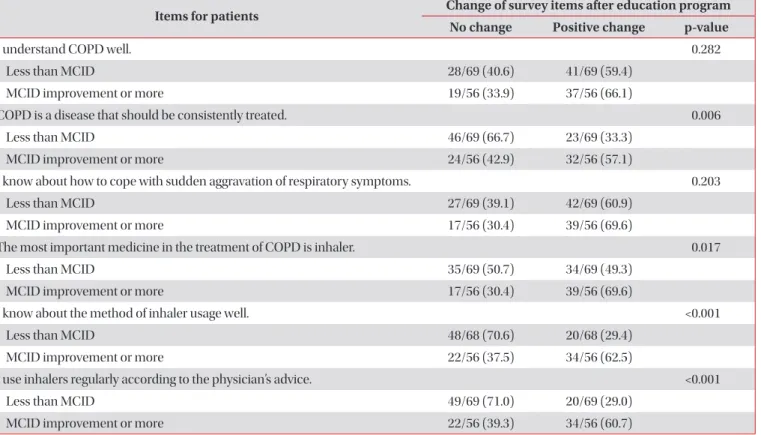
After the inhaler usage education, the following four of all seven items regarding inhaler usage achieved the improvement of MCID or more (p<0.05): (1) open the lid correctly; (2) hold the inhaler correctly; (3) hold the breath for 5 seconds after in- halation; and (4) rinse their mouth after inhaler use (Table 3).
After the education of the understanding on COPD, the fol- lowing four items were associated with the improvement of MCID or more (p<0.05): (1) COPD is a disease that should be consistently treated; (2) the most important medicine in the treatment of COPD is inhaler; (3) I know about the method of inhaler usage, well; and (4) I use inhalers on a regular basis ac- cording to the physician’s advice (Table 4).
Discussion
Our study demonstrated that a comprehensive education program including inhaler training and COPD management performed at primary care setting resulted in positive outcomes including correct inhaler usage, improvement of CAT score, and patients’ better understanding of COPD management.
Therefore, authors are of the opinion that education pro- gram about the clinical course of COPD should be combined
with inhaler training to overcome poor adherence and im- prove the outcomes of COPD.
Our study has some noteworthy findings.
First, inhaler training and organized education program on COPD management with pamphlet and educational video (specially designed by The Korean Academy of Tuberculosis and Respiratory Diseases) made significant improvements on many outcomes including inhaler usage, CAT score, and knowledge about COPD, in COPD patients treated by primary care physicians. Few studies have addressed the clinical out- comes of COPD assessed by clinicians and patients through comprehensive program with a visual education by video and pamphlet, including the education of patients on the manage- ment of COPD and inhaler training.
In inhaler items of our study, positive answers for enough breathing out before inhalation, holding their breath for 5 sec- onds after inhalation, and understanding the manner of inha- lation were only 32.3%, 40.2%, and 44.9% respectively, before inhaler training. However, positive answers for all the items regarding inhaler usage increased after inhaler training.
Previous studies showed that correct usage of inhalers was 58.9% for dry powder inhaler (DPI) and 31.1% for pressurized metered dose inhaler (pMDI), and that proper training led to an improvement in correct usage of inhalers to 92.6% for DPI and to 45.2% for pMDI
5.
Misuse of inhaler devices due to inadequate training can lead to poor disease control and an increase in health care cost in COPD and asthma
16.
Analysis of Torch study over 3-year period showed that increased adherence independent of study treatment was as- sociated with improved mortality and reduction in hospital admission in COPD, although direct comparison between Torch study and our findings is not possible because of differ- ent study design
10.
Another randomized controlled trial in COPD over 3-month period demonstrated that the intervention focusing on inhala- tion technique and adherence to maintenance therapy could reduce hospitalization rate
17.
Second, all the items of our study concerning the knowl- edge on COPD care showed a remarkable improvement after comprehensive disease education program. The effect of comprehensive disease education was further proven in find- ings that most items regarding the understanding of COPD being associated with improvement of MCID or more.
One limitation is that our study cannot prove whether the comprehensive education per se may have been a placebo effect due to the single arm design. Another limitation is that this study did not demonstrate how long the effect of com- prehensive education will last and how often the education should be performed on a long-term basis. Further studies are required to instruct such points.
The improvement of MCID or more were achieved in 44.9%
of enrolled patients, through this program. We defined MCID
100
80
60
40
20
0
Rateofpositvechange
Before education After education
A B C D E
Each item of knowleges on COPD
*
*
*
* * *
F