• 검색 결과가 없습니다.

Factors Associated with Indeterminate and False Negative Results of QuantiFERON-TB Gold In-Tube Test in Active Tuberculosis

N/A
N/A
Protected

Academic year: 2021

Share "Factors Associated with Indeterminate and False Negative Results of QuantiFERON-TB Gold In-Tube Test in Active Tuberculosis"

Copied!
10
0
0

로드 중.... (전체 텍스트 보기)

전체 글

(1)

Tuberc Respir Dis 2012;72:416-425

CopyrightⒸ2012. The Korean Academy of Tuberculosis and Respiratory Diseases. All rights reserved.

Factors Associated with Indeterminate and False Negative Results of QuantiFERON-TB Gold In-Tube Test in Active Tuberculosis

Kiwon Cho, M.D., Eunha Cho, M.D., Soohoon Kwon, M.D., Sanghyuk Im, M.D., In Sohn, M.D., Sookhee Song, M.D., Hyeok Kim, Ph.D., Suhyun Kim, M.D.

Department of Internal Medicine, Seoul Medical Center, Seoul, Korea

Background: The sensitivities and specificities of interferon-gamma release assays (IGRAs) vary among different population studies, and the data on the routine use of IGRAs are limited. The aim of this study was to evaluate the role of QuantiFERON-TB Gold In-Tube (QFT-GIT) test in the diagnosis of active tuberculosis.

Methods: We conducted a prospective study, enrolling 77 patients with suspected pulmonary tuberculosis (TB), at a secondary care teaching hospital in Seoul.

Results: In total, 12 (15.6%) patients showed indeterminate results due to positive control failure on the QFT-GIT test. Indeterminate results were significantly associated with the elderly, history of the intensive care unit stay, lymphocytopenia, especially low CD4 count, increased C-reactive protein and decreased protein levels. Of the 77 patients, 44 (57.1%) were diagnosed with active pulmonary tuberculosis, and the percentage of false negative results of the QFT-GIT was 36.4% (vs. 31.8% with TST). In the TB group with >65 years old (n=12), the proportions of the indeterminate (33.3% vs. 3.1%) and the false negative results (58.3% vs. 25.0%) of the QFT-GIT were significantly higher than in the younger TB group (n=32).

Conclusion: Indeterminate and false negative results of QFT-GIT test were not infrequent in tuberculosis, especially in the elderly. Care should be considered for the interpretation with the elderly, immunocompromised, chronic and severely diseased patients.

Key Words: Interferon-gamma Release Tests; Tuberculin Test; Aged

Address for correspondence: Suhyun Kim, M.D.

Department of Internal Medicine, Seoul Medical Center, 156, Sinnae-ro, Jungnang-gu, Seoul 135-740, Korea

Phone: 82-2-2276-7808, Fax: 82-2-2276-7820 E-mail: [email protected]

Received: Jan. 11, 2012 Revised: Jan. 27, 2012 Accepted: Mar. 16, 2012

Introduction

Acid-fast bacilli (AFB) staining of sputum has a sensi- tivity of only 50∼60%, and cultures for tuberculosis (TB) diagnosis usually require several weeks for results.

Moreover, diagnosis and treatment decisions may be difficult in case with clinical suspicion of TB and neg- ative AFB sputum smears. In this case, the rapid diag- nosis of TB classically relies on the results of different methods, including the tuberculin skin test (TST), chest radiography, nucleic acid amplification (NAA) test of

Mycobacterium tuberculosis (M.TB) and/or pathological

examinations, although TST has a disadvantage of poor

specificity in bacille Calmette-Guerin (BCG) vaccinated

individuals and in those living in high TB prevalence

countries

1

. Meanwhile, interferon-gamma release assays

(IGRAs), what measure and interpret interferon-gamma

(IFN-γ) that is produced by immune responses to early

secreted antigenic target 6 (ESAT-6) and culture filtrate

protein 10 (CFP-10), has advantages of higher specificity

than TST, no need to revisit the hospital after the test,

and no boosted effect in a repeated conduct

2

. Since the

Food and Drug Administration (FDA) announced that

QuantiFERON-TB GOLD test (QFT-G; Cellestis Ltd.,

Carnegie, Victoria, Australia) can be alternatively used

for TB diagnosis instead of TST, QuantiFERON-TB Gold

In-Tube test (QFT-GIT; Cellestis Ltd.) and T-SPOT. TB

test (Oxford Immunotec, Abingdon, UK) have been pro-

(2)

ven to be used as supportive tests along with other tests for the diagnosis of active pulmonary TB as well as la- tent TB infection (LTBI)

3,4

.

QFT-GIT, which has been developed to improve the limitation of QFT-G that should be performed within several hours after blood collection, enables direct test using a special tubes containing antigens without pipet- ting or handling, and its sensitivity has been improved due to the addition of TB7.7 to TB antigens

4

. The rate of indeterminate results, significantly associated with elderly and immunocompromised patients, has been re- ported to be 5∼40% in QFT-G, thereby causing clinical difficulty in the interpretation of test results. Whereas, such high rate of indeterminate results in QFT-G is an- ticipated to decrease in QFT-GIT. However, there have been few studies performing a detailed investigation of indeterminate results with clinical effectiveness in QFT-GIT with active TB patients

5

. In addition, in the case of elderly patients with TB, the positive rate of AFB smears is even lower due to difficulty in appropriate ex- pectoration of sputum. Thus, a supportive method is re- quired to improve diagnostic yield in elderly patients

6

, but the results of IGRAs should be carefully interpreted due to decrease in the immunologic status associated with aging

7

. In Korea, studies on the interpretation of the results of QFT performed on elderly TB patients have been insufficiently conducted so far. Therefore, we evaluated the risk factors including age distribution that can influence indeterminate and false negative re- sults when using the QFT-GIT in routine clinical prac- tice in a single institution.

Materials and Methods 1. Subjects

We conducted prospective study after the approval of the Institutional Review Board (IRB) of Seoul Medical Center. Overall 77 patients, who signed the informed consent form among patients with suspected TB under- went QFT-GIT were recruited in the Division of Pulmonology at Seoul Medical Center from January 2010 to August 2010. The presence of active pulmonary TB

was defined as identification of M.TB in sputum culture or positive NAA test of M.TB and/or abnormalities sug- gestive of TB on chest radiography and/or chest com- puted tomography (CT) scans. The diagnosis of pulmo- nary TB in individuals who were culture-negative was based on chest radiography and/or CT scans findings and the clinician's opinion based on clinical mani- festations. Patients with culture-negative pulmonary TB showed good clinical and radiographic responses to an- ti-TB treatment during follow-up. Fibrotic TB sequelae were defined as 'nodulostreaky' lesions in the upper lobes that had not changed for at least 3 months, with negative culture findings in sputum

8

. TB lymphadenitis was diagnosed in the case of caseating granuloma in the lymph node tissues and patients with lympho- cyte-predominant exudates pleural effusion showing ad- enosine deaminase>40 IU/L were diagnosed with TB pleurisy. Patients with bacterial pneumonia, non-tuber- culous mycobacteria (NTM) lung diseases, lung cancer, fibrotic TB sequelae, and aspergillosis were included in the control group.

2. Methods

AFB smear tests or cultures using the sputum or bron- chial washing fluid, and NAA test of M.TB were per- formed on patients with suspected pulmonary TB or TB pleurisy. If the patients had pleural effusion, they un- derwent pleural fluid analysis and cytologic examina- tions. QFT-GIT was conducted on all the subjects and TST, CD4/CD8 count, human immunodeficiency virus antibody, complete blood count, blood chemistry, C-re- active protein (CRP) and erythrocyte sedimentation rate measurement were also done. In addition, demographic and clinical data were collected which included age, gender, underlying diseases and history of previous TB disease and/or contact with TB patients, homeless, smoking and receiving immunosuppressive drugs.

1) Tuberculin skin test: The TST was typically per-

formed on the volar side of the forearm using the

Mantoux method with 2 tuberculin units of purified pro-

tein derivatives (RT23; Statens Serum Institute, Copen-

hagen, Denmark). Induration size was measured after

(3)

Table 1. Interpretation criteria of QuantiFERON-TB Gold In-Tube test

Interpretation Nil TB response Mitogen response

Positive ≤8.0 ≥0.35 IU/mL and ≥0.25% of Nil Any

Negative ≤8.0 <0.35 IU/mL or <0.25% of Nil ≥0.5

Indeterminate ≤8.0 <0.35 IU/mL or <0.25% of Nil <0.5

>8.0 Any Any

Source: Based on Cellestis Limited. Available from: http://www.cellestis.com/IRM/content/pdf/Quantiferon%20US%20VerG-Jan2010%

20NO%20TRIMS/pdf

4

.

48∼72 hours and we used a 10-mm induration as the positive cut-off value for the TST. History of BCG vacci- nation was investigated as follows.

2) QuantiFERON-TB Gold In-Tube test: As for the QFT-GIT test, the negative control antigen (Nil), pos- itive control antigen (Mitogen), and TB-specific antigens (ESAT-6, CFP-10, TB7.7 synthetic peptide) were put into a tube treated with heparin, respectively, and then 1 mL of whole blood was added to each tube, followed by culturing at 37

o

C for approximately 16∼24 hours.

Subsequently, the produced IFN-γ was measured via enzyme-linked immunosorbent assay (ELISA) according to the guidelines proposed by the Centers for Disease Control and Prevention (CDC).

If the IFN-γ value≥0.35 IU/mL and ≥25% of the negative control antigen regardless of the value of the positive control antigen, the result of QFT-GIT was ad- judged positive. If the IFN-γ value of the positive con- trol antigen≥0.5 IU/mL, and the IFN-γ value<0.35 IU/mL or ≤25% of the negative control antigen, the re- sult of QFT-GIT was adjudged negative. For samples where the IFN-γ response to Mitogen was less than 0.5 IU/mL above that for the Nil control, or the IFN-γ response to mitogen was greater than 8 IU/mL above that for the Nil control, the result was deemed in- determinate results (Table 1).

3) Data analysis: As for data, continuous variables were expressed as inter-quartile range (IQR) and cate- gorical variables were expressed as frequency. Fisher's exact test and Mann-Whitney test were calculated for the comparison of clinical features between the groups according to the variables. If p-value<0.05, it was con-

sidered statistically significant. Analysis was performed using SPSS version 14.0 (SPSS Inc., Chicago, IL, USA).

Results

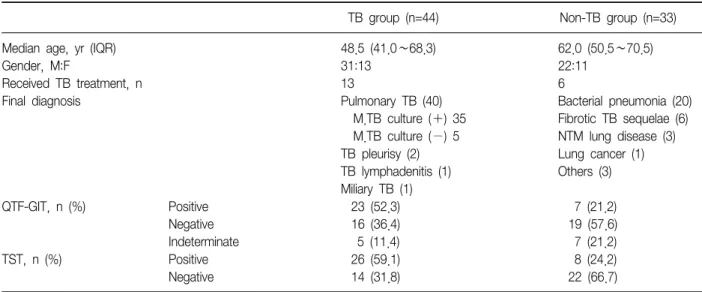
This study was performed on 77 patients with clin- ically suspected active TB, of whom 44 patients were confirmed to have active TB (34 patients with cul- ture-proven TB, 24 patients with positive NAA test of M.TB). The confirmed TB patients consisted of 39 pa- tients with pulmonary TB, 1 patient with miliary TB, 3 patients with TB pleurisy, and 1 patient with TB lymphadenitis. The 33 control group consisted of 20 pa- tients with bacterial pneumonia, 3 patients with NTM lung disease, 1 patient with lung cancer, and 9 patients with fibrotic TB sequelae. The median age of the TB group was shown to be 48.5 (IQR, 41.0∼66.0), and their male to female ratio was shown to be 31 (70.5%):13 (29.5%). Meanwhile, the median age of the control group was shown to be 62.0 (IQR, 50.5∼70.5), and their male to female ratio was shown to be 22 (66.7%):11 (33.3%). No difference in the age and gen- der was found between the TB and control groups (Table 2).

The result of QFT-GIT was shown to be positive in

23 cases (52.3%), negative in 16 cases (36.4%), and in-

determinate in 5 cases (11.4%) in the TB group, where-

as the result of TST was shown to be positive (>10

mm) in 26 cases (59.1%), and negative in 14 cases

(31.8%). Meanwhile, the result of QFT-GIT was shown

to be positive in 7 cases (21.2%), negative in 19 cases

(57.6%), and indeterminate in 7 cases (21.2%) in the

(4)

Table 2. Clinical characteristics and results of QFT-GIT of 77 patients suspected of active pulmonary TB

TB group (n=44) Non-TB group (n=33)

Median age, yr (IQR) 48.5 (41.0∼68.3) 62.0 (50.5∼70.5)

Gender, M:F 31:13 22:11

Received TB treatment, n 13 6

Final diagnosis Pulmonary TB (40) Bacterial pneumonia (20)

M.TB culture (+) 35 Fibrotic TB sequelae (6) M.TB culture (−) 5 NTM lung disease (3)

TB pleurisy (2) Lung cancer (1)

TB lymphadenitis (1) Others (3) Miliary TB (1)

QTF-GIT, n (%) Positive 23 (52.3) 7 (21.2)

Negative 16 (36.4) 19 (57.6)

Indeterminate 5 (11.4) 7 (21.2)

TST, n (%) Positive 26 (59.1) 8 (24.2)

Negative 14 (31.8) 22 (66.7)

QFT-GIT: QuantiFERON-TB Gold In-Tube; TB: tuberculosis; IQR: inter-quartile range; M: male; F: female; M.TB: Mycobacterium tuber- culosis ; NTM: non-tuberculous mycobacteria; TST, tuberculin skin test.

Table 3. QFT-GIT and TST results for 77 patients (data is available for 70 patients) suspected of TB infection and 44 patients (data is available for 40 patients) with confirmed TB disease

QFT-GIT

Total

Negative Positive Indeterminate

TST, n Negative 22/6 7/6 7/2 36/14

Positive 10/8 20/15 4/3 34/26

Total 32/14 27/21 11/5 70/40

Data are presented as number of suspected TB results/confirmed TB results.

QFT-GIT: QuantiFERON-TB Gold In-Tube; TST: tuberculin skin test; TB: tuberculosis.

control group, whereas the result of TST was shown to be positive in 8 cases (24.2%), and negative in 22 cases (66.7%) (Table 3).

In total, 12 patients (15.6%) showed indeterminate re- sult on the QFT-GIT and all of them were due to pos- itive control failure. They included 5 patients with TB, 3 patients with bacterial pneumonia, and 4 patients with fibrotic TB sequelae. Four patients among the non-TB group had the presence of previous TB scar, which in- dicated the possibility of LTBI. The median TB Ag-Nil and the median Mitogen-Nil were shown to be 0.015 (IQR, −0.03∼0.045) and 0.095 (IQR, 0.0825∼0.275) in the indeterminate group, of whom 58.3% (7 cases) showed negative TST results, and 33.3% (3 patients with TB and 1 patient with non-TB group) showed positive

TST results. Among the 4 patients with positive TST re- sults in indeterminate group, 1 patient had a previous history of TB treatment, and the patient was diagnosed with reactivated pulmonary TB at the time of colon can- cer surgery. The other patient had active pulmonary TB with a history of BCG vaccination. Another patient died of respiratory failure caused by multidrug-resistant TB 20 days after mechanical ventilator management at the intensive care unit (ICU). Another patient in non-TB group who had a previous history of TB treatment had bipolar disorder and was hospitalized in the ICU for 15 days with severe sepsis.

The median age of the indeterminate group was

shown to be 70.5 years (IQR, 55.5∼76.0), which was

significantly higher than that of the determinate group

(5)

Figure 1. The proportion of determinate and indeterminate QFT-GIT results in each age group. QFT-GIT: Quanti- FERON-TB Gold In-Tube.

Table 4. Multivariate logistic regression analysis of the indeterminate QFT-GIT results Clinical characteristics

QFT-GIT test

OR (95% CI) p-value Indeterminate (n=12, 15.6%) Determinate (n=65, 84.6%)

Age, yr

≥19 and <65 5 (6.5) 47 (61.0) -

≥65 7 (9.1) 18 (23.4) 11.29 (1.34∼95.38) 0.026

Underlying disease, %

Asthma 3 (25.0) 2 (3.1) 51.66 (1.54∼174.6) 0.028

Hypertension 7 (58.3) 14 (21.5) 1.377 (0131∼14.45) 0.790

Malignant disease 3 (25) 3 (4.6) 5.901 (0.370∼94.04) 0.078

Immunosuppressive treatment 1 (8.3) 0 (0) ND ND

History of the ICU stay 7 (58.3) 12 (18.5) 15.47 (1.59∼150.92) 0.018

Data are presented as number (%), unless otherwise indicated.

QFT-GIT: QuantiFERON-TB Gold In-Tube; OR: odds ratio; CI: confidence interval; ND: not determined; ICU: intensive care unit.

(51.0, IQR 41∼66.0) (p=0.011). The age distribution of patients showing indeterminate results on QFT-GIT test is shown in Figure 1. Indeterminate results were sig- nificantly more frequent among the age bracket of 65 years or higher (25.0% with indeterminate results vs.

18.4% with determinate results) and age bracket of 75 years or higher (33.3% vs. 7.6%). In the comparison of previous disease history, bronchial asthma (25.0% vs.

3.1%, p=0.004), hypertension (58.3% vs. 21.5%, p=

0.008), malignant disease (25.0% vs. 4.6%, p=0.007), history of organ transplantation and steroid admin- istration (8.3% vs. 0%, p=0.019) were significantly high-

er in the indeterminate group than in the determinate group. The history of ICU stay was shown in 7 patients (58.3%) within the indeterminate group, which was sig- nificantly higher than that of the determinate group (18.5%, 12/65) (p=0.003). However, the median hospi- tal stay of the indeterminate group was shown to be 15.0 (IQR, 5.0∼40.0), which showed no difference with that of the determinate group (16.5; IQR, 7.0∼

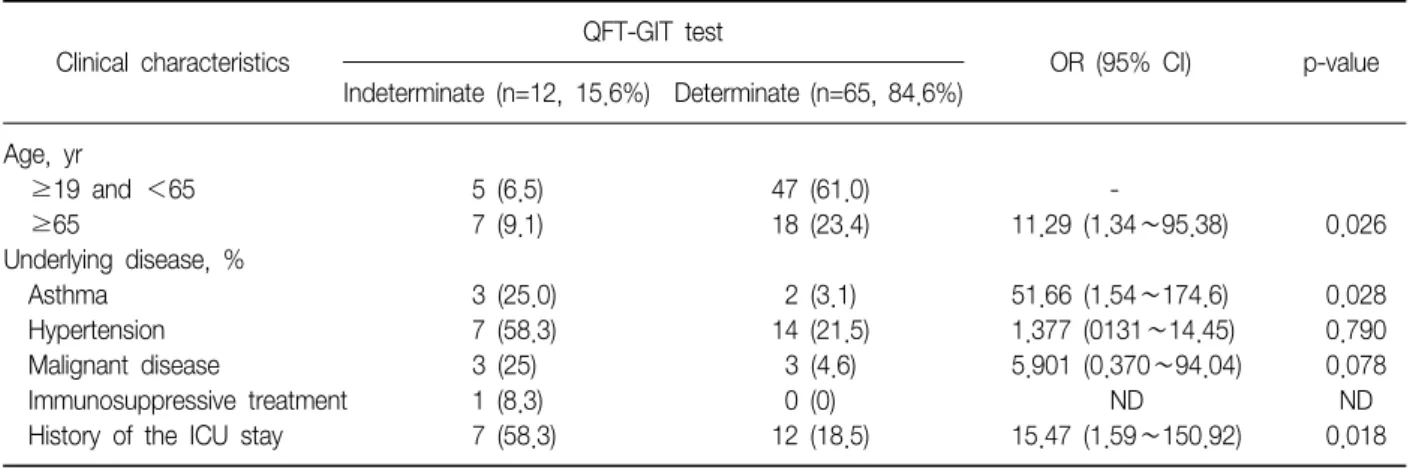
38.0). The death rate of the indeterminate group was shown to be 25.0% (3 patients), which was higher than that of the determinate group (7.7%, 5/65), but was not statistically significant (p=0.071). In multivariate analy- sis, in the cases of age of 65 years or higher (odds ratio [OR], 11.29; p=0.026), bronchial asthma (OR, 51.66;

p=0.028), malignant diseases (OR, 5.90; p=0.078) and history of ICU stay (OR, 15.47; p=0.018), the frequency was shown to be higher in the indeterminate group than in the determinate group (Table 4).

In the blood tests, the lymphocytopenia (0.7; IQR, [0.4∼1.1]×10

3

/mm

3

vs. 1.3; IQR, [0.9∼1.7]×10

3

/mm

3

; p=0.013), particularly CD4 lymphocytopenia (147.0; IQR, 84.9∼390.5/mm

3

vs. 583.5; IQR, 332.3∼849.0/mm

3

; p=0.021), CRP elevation (2.7; IQR, 1.8∼11.8 mg/dL vs.

1.2; IQR, 0.3∼5.0 mg/dL; p=0.014), and hypoprotein-

emia (6.6; IQR, 5.9∼6.8 g/dL vs. 7.2; IQR, 6.5∼7.6

g/dL; p=0.026) were significantly associated with in-

determinate laboratory findings. However, no difference

(6)

Table 5. Comparison of the results of TST and QTF-GIT test between 12 elderly patients and 32 younger patients within TB group

Age≥65 yr (n=12) Age<65 yr (n=32) Total (n=44) p-value

TST 0.019

Positive 4 (36.4) 22 (75.8) 26 (65.0)

Negative 7 (63.6) 7 (24.1) 14 (35.0)

QTF-GIT 0.000

Positive 1 (8.3) 23 (71.9) 24 (54.5)

Negative 7 (58.3) 8 (25.0) 15 (34.1)

Indeterminate 4 (33.3) 1 (3.1) 5 (11.4)

Data are presented as number (%).

TST: tuberculin skin test; QFT-GIT: QuantiFERON-TB Gold In-Tube; TB: tuberculosis.

in the radiologic finding and extension of lesion was found between the two groups.

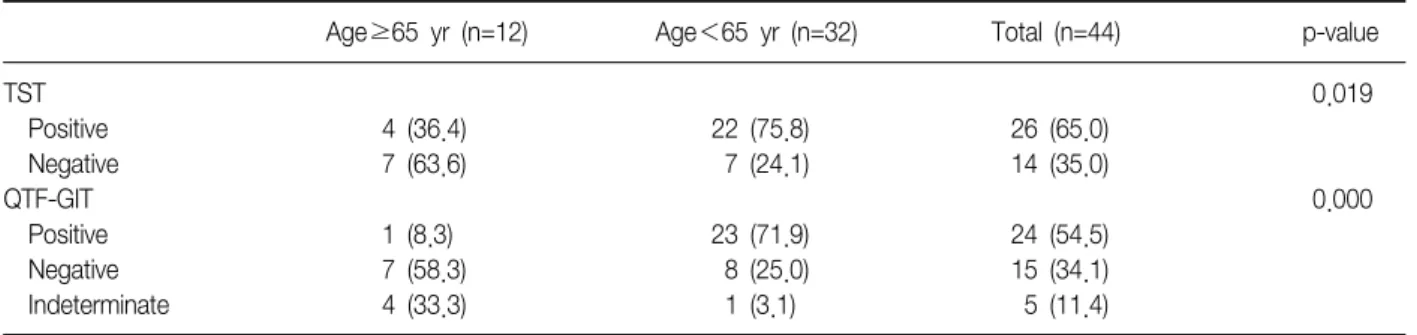
In the TB group, comparisons among the group aged 65 years or higher (elderly patients, n=12) and the group aged less than 65 years (younger patients, n=32), no significant difference in the test results and demo- graphic characteristics was found between the two groups. However, hypertension among underlying dis- eases was significantly higher in the elderly patients than in the younger patients (p=0.013). Thirty-six point four percent (n=4) of the elderly patients were shown to be positive response in TST, whereas 78.5% (n=22) of the younger patients were shown to be positive re- sponse in TST (p=0.019). In addition, the QFT-GIT pos- itive rate was shown to be 54.5% (n=24) in the younger patients, but only 8.3% (n=1) in the elderly patients, which was significantly lower in the elderly patients than in the younger patients (p=0.000). The rate of the indeterminate (33.3%, n=4) and the false negative re- sults (58.3%, n=7) of QFT-GIT were higher in the eld- erly patients than in the younger patients (Table 5).

No lymphocytopenia (<500/mm

3

) was shown in 16 patients (36.4%) who were false negative in QFT-GIT within the TB group. The 16 patients had 2 cases (12.5%) of radiologically extensive lesion, 9 cases (56.3%) of intermediate severity, and 5 cases (31.3%) of mild severity. In addition, in the 21 patients (47.7%) who were false negative or indeterminate in QFT-GIT within the TB group, the result of multivariate analysis

showed that age of 65 years or higher (OR, 65.87; 95%

confidence interval [CI], 3.812∼114.0; p=0.004) and history of ICU stay (OR, 41.90; 95% CI, 2.33∼752.4;

p=0.011) were risk factors.

Discussion

In this study, the result of QFT-GIT showed that

15.6% of the subjects were adjudged indeterminate due

to positive control failure. The median age of the in-

determinate group was 70.5 years, which was sig-

nificantly higher than that of the determinate group

(51.0 years). Indeterminate result was significantly high-

er in the patients with bronchial asthma and a history

of ICU stay. In addition, the results of blood tests

showed that the lymphocytopenia, including CD4 lym-

phocytopenia, CRP elevation, and hypoproteinemia

were higher in the indeterminate group. The rate of in-

determinate results of QFT-GIT was 11.4% in the TB

group, and that of false negative results was 36.4%,

which was higher than that of TST (31.8%). In the TB

group aged 65 years or higher, the indeterminate results

(33.3%) and false negative results (58.3%) accounted for

91.7%, which showed that QFT-GIT alone had a limi-

tation of being used for diagnosis of TB. According to

the national statistics reported by the KNTA

9

, the rate

of new TB cases for the past 10 years has been

increasing. The rate of new TB cases of the elderly

group aged 65 years of higher has been rapidly increas-

(7)

ing from 11.5% in 2001 to 22.9% in 2004, and 27.2%

in 2008. The possibility of the occurrence of TB is an- ticipated to increase in the elderly who have aging, vari- ous concurrent diseases, and resultant decrease in the immunologic status. In previous study in Taiwan, eld- erly patients with pulmonary TB were more likely to present with negative sputum smears and had more pleural effusion but fewer cavity findings on chest radiography. The prognosis is poor for the elderly TB patients with lower body weight, coexisting medical dis- eases, and extensive radiographic disease

6

. In other study in Korea, difference in AFB smear or culture pos- itive rate between the elderly and the younger has not been observed

9

. However, it was suggested that the di- agnostic yield of the elderly TB patients could be im- proved by applying methods such as the induced spu- tum using a saline solution nebulizer or bronchial wash- ing fluid using bronchoscopy

10

. Potentially infectious or fatal patients should undergo diagnosis and treatment via clinical findings and radiologic examination, al- though they have negative results in sputum AFB smears or cultures. However, as it is not easy to diag- nose and treat active TB in this case, NAA test of M.TB, pathologic examination, radiologic examination, TST and IGRAs are required. However, as the function of the T lymphocytes and amplification reaction decrease in the elderly patients

6

, the results of not only TST but also IGRAs should be carefully interpreted in elderly pa- tients with TB.

For countries with high BCG vaccination rate and high TB morbidity, IGRAs rather than TST is particularly anticipated to be more helpful for diagnosis of TB infection. However, despite the usefulness of IGRAs in the diagnosis of LTBI, its usefulness in the diagnosis of active TB is still controversial

11,12

. A recently published meta analysis reported that the sensitivity of blood IGRAs was higher than that of TST for active TB, but its specificity was lower than that of TST, which showed a limitation in the discrimination between LTBI and ac- tive TB. The sensitivity and specificity of blood QFT- GIT was reported to be 80% and 79%, respectively.

However, the indeterminate rate was also reported to

reach 14.9% in adults

1

. QFT is considered limited if the result is indeterminate due to a difficulty in interpre- tation. As its frequency is higher than expected, the in- determinate result was reported to be 11% in a study conducted on healthy medical professionals

13

, most of whom were indeterminate due to positive control failure. Indeterminate result with positive control failure was associated with the decreased number and activity of T lymphocytes or the failure of IFN-γ synthesis in T lymphocytes. In addition, the indeterminate result mainly occurred in patients with human immunode- ficiency virus infection, malignant disease and renal dys- function, which indicated the possibility of abnormal immune system

13

. Ferrara et al.

14

and Kobashi et al.

5

reported that 21% and 10.8% of patients who underwent QFT-G were indeterminate, respectively, and that in ad- dition to receive the immunosuppressive drugs, age of 80 years or higher, lymphocytopenia, and malnutrition such as hypoproteinemia were the risk factors of the indeterminate results.

Because the QFT-GIT contains additional TB-specific antigens (TB7.7), it is speculated that the sensitivity is higher and indeterminate result is lower. However, con- sistent with the results of previous studies using the QFT-G test, the rate of indeterminate results was 15.6%

(12 cases) in the total subjects, and 11.4% (5 cases) in

the TB group, which was lower than that of the non-TB

group in our study. Indeterminate results were due to

positive control failure in all 12 patients, and their me-

dian age was 70.5 years, which was significantly higher

than that of the determinate group (51.0 years). In par-

ticular, no patient was adjudged indeterminate in the

patients in their 40s or lower, and 67% of the in-

determinate group were patients in their 70s or higher,

showing a clear difference in the age bracket. The result

of a Japanese study showed that no significant differ-

ence was found between TST (70%) and QFT-G (87%)

in active TB patients aged less than 80 years, but that

QFT positive rate (76%) was significantly higher than

TST positive rate (27%) in active TB patients aged 80

years or higher. Thus, it was suggested that QFT could

be more useful than TST if the number of lymphocytes

(8)

is normal in the elderly patients

15

. In our study, how- ever, both TST positive rate (36.4% vs. 78.5%) and QFT-GIT positive rate (8.3% vs. 54.5%) were sig- nificantly lower in the elderly patients aged 65 years or higher than in the patients aged less than 65 years with- in the TB group. In addition, the results of in- determinate and false negative rate in the elderly pa- tients aged 65 years or higher were 33.3% and 58.3%, respectively, which accounted that 91.7% in elderly pa- tient was not diagnostic with QFT-GIT. Unlike indeter- minate results due to positive control failure, QFT-GIT negative result refers to the cases of insufficient or no secretion of IFN from T cells that are stimulated by TB antigens despite its proper response to control antigens.

It mainly occurs by the non-responsive state of cellular immune system, but may occur in the normal immune system. In addition, false negative result in QFT was reported to more occur in the cases of small amount of TB pathogen in the cultured sputum, small range of the lesion, and extrapulmonary TB such as TB pleurisy than in the case of lymphocytopenia

15

. But in our study, the patients with false negative QFT-GIT had more ad- vanced disease (radiologically extensive to intermediate severity in 68.7%) and most of whom were pulmonary TB except 2 miliary TB (13.3%) and 1 TB pleurisy (6.7%).

In previous studies reporting that the indeterminate rates of QFT-G and QFT-GIT varied from 0.1 to 40%, patients receiving immunosuppressive drugs and im- munocompromised patients were mainly included in the subjects

7,14-19

. Whereas, in this study, immunocom- promised patients, patients receiving immunosuppre- ssive drugs, and patients with end-stage renal disease accounted for only 7.8% of the total subjects, but the rate of indeterminate result was 15.6%, which was not low. The main reason for this result is likely that our study population had many elderly and severely ill patients. The high indeterminate rate in the elderly pa- tients is currently accepted to be associated with lym- phocytopenia and malnutrition, as suggested by Kobashi et al.

7

. QFT test depends on inflammatory cyto- kines synthesized from T lymphocytes that are activated

by TB-specific antigens. As the amount of IFN-γ pro- duced from the sensitized T cells is measured via ELISA in QFT test, IFN-γ production is likely to decrease in the case of lymphocyte insufficiency

18

. In addition, Ferrara et al.

14

reported that the rate of indeterminate result was higher in patients with the negative TST re- sults, compared with the TST positive results (29% vs.

7%). In our study, the rate of indeterminate result was higher in the patients with negative TST results (19.4%) than positive TST patients (11.8%). In addition, 58.3%

of the indeterminate group had a history of ICU stay.

In the cases of lymphocytopenia, particularly CD4 lym- phocytopenia, CRP elevation, and hypoproteinemia in the blood tests were significantly associated with in- determinate results with the positive control failure. This result may also occur in patients with chronic disease and patients requiring ICU stay as well as in patients receiving immunosuppressive drugs. Thus, it is likely that difference in the immune responses of the elderly, chronic disease, and severely-ill patients could have af- fected the result. In addition, Kim et al.

20

reported that the quantitative amount of IFN-γ secretion and the number of CD4+T cells secreting IFN-γ were in- versely proportional to the severity of pulmonary TB, which was consistent with the results of previous studies. They also reported that the limited sensitivity of QFT was shown in severe pulmonary TB due to the high indeterminate rate (19.0%) in QFT

20

. In this study, however, due to the small number of TB patients within the indeterminate group, no correlation of indeterminate results with the extent of TB lesion was found.

We should consider the limitations of this study.

Although a number of publications have demonstrated

that excessive administration of blood samples to the

tube may dilute IFN-γ concentration, the survived T

cells may be lost due to the delay after blood collection,

and the rate of indeterminate result decreased by ap-

proximately 3% due to manual vortexing before cell cul-

ture

13

, our study includes no information with variables

of QFT-GIT. So, the increased rate of indeterminate re-

sult due to the errors of the test itself cannot be

excluded. In addition, the time from blood collection

(9)

to culturing was not checked in this study, despite the principle that blood collection should be conducted within 2 hours after delivery to the examination organi- zation. Furthermore, although re-sampling is recom- mended to exclude the above test errors in the case of the positive control failure

14

, the re-sampling was not performed in this study. Thus, it is not clear whether non-responsive IFN-γ was attributable to test errors, or it was a transient phenomenon, or non-responsive IFN- γ can be reversible with recovery from TB. Second, the numbers of the elderly patients with active TB and indeterminate group were insufficient to analyze within group. Third, BCG vaccination after birth is mandatory in Korea, and if the response to TST is negative at the time of senior in elementary school, BCG vaccination has been commonly administered again until 1997.

However, it is uncertain to identify BCG vaccination sta- tus in a clinical practice, so we evaluated the status of vaccination with examination based on vaccination scar in some patients.

In this study, the sensitivity and specificity of QFT- GIT were 52.3% and 57.6%, respectively, which were lower than those of previous studies. That is, compared to the previous studies, the rates of false negative and indeterminate result were higher in this study. This is likely to be attributable to the higher proportion of se- verely-ill patients such as patients with chronic diseases and elderly patients, and patients requiring ICU stay and the differences in TB morbidity. In Korea, IGRAs are recommended for screening patients before immuno- suppressive therapy with anti-tumor necrosis factor-α and for confirming TB infection in anyone who is TST-positive after contact with a patient with active pul- monary TB. However, IGRAs have not been recom- mended for use in the diagnosis of active TB.

Nevertheless, based on previous study results, frequent use IGRAs in routine clinical practice suggesting a neg- ative test result could rapidly exclude TB from a differ- ential diagnosis

11

. As it is, however, impossible to dis- criminate LTBI and active pulmonary TB via QFT in countries with a high burden of TB, the use of QFT test for the diagnosis of active pulmonary TB has a spe-

cific concern in Korea with a modest morbidity rate of TB. In addition, in the cases of elderly patients, se- verely-ill patients requiring ICU stay, lymphocytopenia, CRP elevation and hypoproteinemia, indeterminate re- sults that is not useful for diagnosis, or false negative results may be shown. Thus, a precaution should be given in the interpretation of the results. A multicenter IGRAs study, which is conducted on elderly Korean pa- tients with active TB, is required, and a further study is also required to investigate the mechanism of in- determinate or false negative results.

References

1. Sester M, Sotgiu G, Lange C, Giehl C, Girardi E, Migliori GB, et al. Interferon-gamma release assays for the di- agnosis of active tuberculosis: a systematic review and meta-analysis. Eur Respir J 2011;37:100-11.

2. Lee HW, Park HY, Ahn YM, Sohn KC. Clinical sig- nificance of interferon gamma release assay for diag- nosis of tuberculosis in children. Korean J Pediatr Infect Dis 2010;17:137-47.

3. Mazurek GH, Jereb J, Lobue P, Iademarco MF, Metchock B, Vernon A, et al. Guidelines for using the QuantiFERON-TB Gold test for detecting Mycobacter- ium tuberculosis infection, United States. MMWR Recomm Rep 2005;54:49-55.

4. Mazurek GH, Jereb J, Vernon A, LoBue P, Goldberg S, Castro K, et al. Updated guidelines for using interfer- on gamma release assays to detect Mycobacterium tu- berculosis infection - United States, 2010. MMWR Re- comm Rep 2010;59:1-25.

5. Kobashi Y, Sugiu T, Mouri K, Obase Y, Miyashita N, Oka M. Indeterminate results of QuantiFERON TB-2G test performed in routine clinical practice. Eur Respir J 2009;33:812-5.

6. Wang CS, Chen HC, Yang CJ, Wang WY, Chong IW, Hwang JJ, et al. The impact of age on the demo- graphic, clinical, radiographic characteristics and treat- ment outcomes of pulmonary tuberculosis patients in Taiwan. Infection 2008;36:335-40.

7. Kobashi Y, Mouri K, Miyashita N, Okimoto N, Matsushima T, Kageoka T, et al. QuantiFERON TB-2G test for patients with active tuberculosis stratified by age groups. Scand J Infect Dis 2009;41:841-6.

8. Kang YA, Lee HW, Hwang SS, Um SW, Han SK, Shim

YS, et al. Usefulness of whole-blood interferon-gamma

(10)

assay and interferon-gamma enzyme-linked immuno- spot assay in the diagnosis of active pulmonary tuber- culosis. Chest 2007;132:959-65.

9. Shin JY, Jung SY, Lee JE, Park JW, Yoo SJ, Park HS, et al. Characteristics of pulmonary tuberculosis in eld- erly people. Tuberc Respir Dis 2010;69:163-70.

10. Patel YR, Mehta JB, Harvill L, Gateley K. Flexible bron- choscopy as a diagnostic tool in the evaluation of pul- monary tuberculosis in an elderly population. J Am Geriatr Soc 1993;41:629-32.

11. Park SY, Jeon K, Um SW, Kwon OJ, Kang ES, Koh WJ.

Clinical utility of the QuantiFERON-TB Gold In-Tube test for the diagnosis of active pulmonary tuberculosis.

Scand J Infect Dis 2009;41:818-22.

12. Park SY, Park YB, Choi JH, Lee JY, Kim JS, Mo EK.

The diagnostic value of interferon-gamma assay in pa- tients with active tuberculosis. Tuberc Respir Dis 2009;

66:13-9.

13. Miranda C, Yen-Lieberman B, Terpeluk P, Tomford JW, Gordon S. Reducing the rates of indeterminate results of the QuantiFERON-TB Gold In-Tube test during rou- tine preemployment screening for latent tuberculosis infection among healthcare personnel. Infect Control Hosp Epidemiol 2009;30:296-8.

14. Ferrara G, Losi M, Meacci M, Meccugni B, Piro R, Roversi P, et al. Routine hospital use of a new com- mercial whole blood interferon-gamma assay for the diagnosis of tuberculosis infection. Am J Respir Crit

Care Med 2005;172:631-5.

15. Kobashi Y, Mouri K, Yagi S, Obase Y, Miyashita N, Okimoto N, et al. Clinical utility of the QuantiFERON TB-2G test for elderly patients with active tuberculosis.

Chest 2008;133:1196-202.

16. Kobashi Y, Fukuda M, Yoshida K, Oka M. An in- determinate QuantiFERON TB-2G response for miliary tuberculosis, due to severe pancytopenia. J Infect Chemother 2007;13:414-7.

17. Kobashi Y, Mouri K, Obase Y, Fukuda M, Miyashita N, Oka M. Clinical evaluation of QuantiFERON TB-2G test for immunocompromised patients. Eur Respir J 2007;

30:945-50.

18. Kobashi Y, Mouri K, Yagi S, Obase Y, Fukuda M, Miyashita N, et al. Usefulness of the QuantiFERON TB-2G test for the differential diagnosis of pulmonary tuberculosis. Intern Med 2008;47:237-43.

19. Kim EY, Lim JE, Jung JY, Son JY, Lee KJ, Yoon YW, et al. Performance of the tuberculin skin test and inter- feron-gamma release assay for detection of tuberculosis infection in immunocompromised patients in a BCG- vaccinated population. BMC Infect Dis 2009;9:207.

20. Kim YY, Lee J, Lee YJ, Lee SY, Lee YH, Choi KJ, et

al. Sensitivity of whole-blood interferon-gamma release

assay according to the severity and the location of dis-

ease in patients with active tuberculosis. Tuberc Respir

Dis 2011;70:125-31.

수치

Table  1.  Interpretation  criteria  of  QuantiFERON-TB  Gold  In-Tube  test
Table  2.  Clinical  characteristics  and  results  of  QFT-GIT  of  77  patients  suspected  of  active  pulmonary  TB
Table  4.  Multivariate  logistic  regression  analysis  of  the  indeterminate  QFT-GIT  results Clinical  characteristics QFT-GIT  test OR  (95%  CI) p-value Indeterminate  (n=12,  15.6%) Determinate  (n=65,  84.6%) Age,  yr     ≥19  and  <65 5  (6.5) 47
Table 5. Comparison of the results of TST and QTF-GIT test between 12 elderly patients and 32 younger patients within TB  group

참조

관련 문서

XRD analysis, surface roughness test, FE-SEM imaging, and biaxial flexural strength test were performed... Results: In the result of XRD analysis, an phase change occurred

period was prolonged unavoidably, (3) by explaining the risk factors associated with the failure to patients honestly, and subsequently performing

2. The finite element is calculating using tension test of uni-direction 0° and 90°, compression test of uni-direction 0° and 90° and shear test results and, the results

In the change of functional fitness, muscle strength and endurance, cardiopulmonary endurance, wits, and flexibility showed significantly increased results,

Results: In this research, in the group with fibromyalgia patients group, systemic lupus erythematosus patients group and without systemic autoimmune

The main effect according to the results of the repeated measures ANOVA on physical fitness based on test time showed a significant difference in grip

These results confirm that the 12-week swimming exercise based on the swimming program applied in this study has a positive effect on improvement of

• We can solve the statically indeterminate structure but it is more difficult (but possible!).. : Statically