서 론
1. 연구의 필요성
중환자에게 있어 영양공급은 제지방 질량 유지, 면역력 유지뿐 아니라 상처치유, 감염, 병원 재원일 수 및 사망률 등의 임상적 결과 에 중요한 영향을 미치는 요인으로 알려져 있다(Martin et al., 2004;
Terekeci et al., 2009). 이에 따라 중환자에게 적절한 영양을 제공하는 것은 중환자를 돌보는 의료진에게 있어 필수적으로 고려해야 하는 중요한 중재로 부각되고 있다. 중환자에게 영양을 공급하기 위한 다양한 중재 중 경관영양(enteral nutrition)은 중환자의 소화기능을 이용하며 쉽고 안전하게 영양을 공급할 수 있어 구강섭취가 어려운 중환자에게 많이 사용되는 방법이다(Cho et al., 2014). 하지만 정맥
중환자의 경관영양 공급 지표로서 위 잔여량의 임상적 효용성: 체계적 문헌고찰
김현정1·장선주2
1한림대학교 간호학과, 2충북대학교 간호학과
Clinical Usefulness of Gastric Residual Volume as An Indicator to Provide Approximately Enteral Nutrition for Patients in Intensive Care Units: A Systematic Literature Review
Hyunjung Kim
1, Sun Ju Chang
21Department of Nursing, Hallym University, Chuncheon; 2Department of Nursing Science, Chungbuk National University, Cheongju, Korea
Purpose: The practice of enteral nutrition with gastric residual volumes (GRVs) as a clinical indicator is poorly standardized in intensive care units. This study aims to summarize the results from studies that evaluated the clinical outcomes related to the GRVs. Methods:
This systematic review study analyzed 11 studies consisting of four randomized controlled trials, one non-randomized controlled trial, and six observational studies. Results: No consistent relationship between GRV thresholds and clinical outcomes was observed. High- er GRVs were not consistently correlated with clinical outcomes such as higher gastrointestinal complications, aspiration pneumonia, or mortality. Higher GRVs significantly generate complications more often. Findings show that a single GRV more than 200 mL or two consecutive GRVs more than 150 mL should raise concern about negative consequences. Conclusion: Critical care nurses need to monitor GRVs closely during their practice of enteral nutrition. For critically ill patients receiving enteral nutrition, a GRV threshold of 200 ml would be a desirable limit to provide safe and adequate nutrition with a conservative approach.
Key Words: Enteral nutrition; Intensive care units; Review 국문주요어: 경관영양, 중환자실, 문헌고찰
Corresponding author: Sun Ju Chang
Department of Nursing Science, Chungbuk National University, 52 Naesudong-ro, Cheongju 361-763, Korea Tel: +82-43-249-1797 Fax: +82-43-249-1711 Email: [email protected]
* 이 논문은 2013년도 정부(미래창조과학부)의 재원으로 한국연구재단의 지원을 받아 수행된 기초연구사업임(No. NRF-2013R1A1A1006955).
*This work was supported by the National Research Foundation of Korea (NRF) Grant funded by the Korean Government (MSIP) (No. NRF-2013R1A1A1006955).
투고일: 2014년 7월 25일 심사의뢰일: 2014년 7월 31일 게재확정일: 2014년 9월 21일
This is an Open Access article distributed under the terms of the Creative Commons Attribution Non-Commercial License (http://creativecommons.org/licenses/by-nc/3.0) which permits unrestricted non-commercial use, distribution, and reproduction in any medium, provided the original work is properly cited.
을 통해 지속적으로 영양이 공급되는 총 비경구 영양요법(total par- enteral nutrition)과는 달리, 경관영양은 진단적 검사나 수술을 위한 금식, 위장관의 부적응, 앙와위가 필요한 간호활동, 혈액학적 상태 의 악화 등의 이유로 중단이 잦고, 이러한 이유로 중환자의 영양섭 취량 부족의 문제가 지속적으로 제기되고 있다(Elpern, Stutz, Peter- son, Gurka, & Skipper, 2004; Kim, Stotts, Froelicher, Engler, & Porter, 2012). 특히, 경관영양 공급에 대한 위장관의 부적응과 관련된 위 잔 여량 증가, 구토, 설사 등이 영양 공급중단의 주요한 원인으로 여겨 지고 있다(Kim, Shin, Shin, & Cho, 2010; Petros & Engelmann, 2006).
중환자의 위장관 기능 저하로 인해 위 내로 들어온 음식물의 소 화속도가 늦어짐으로써 발생되는 위 잔여량(gastic residual volumes) 증가는 식도역류, 구토, 흡인 및 폐렴 등의 발생을 증가시킨다고 알 려져 있다(Artinian, Krayem, & DiGiovine, 2006). 이에 따라 위 잔여 량이 위의 소화능력 및 위 내용물의 정도를 간접적으로 측정할 수 있는 지표로 생각되어 경관영양 공급을 시작하거나 진행하는 데 있어 중요하게 여겨지며, 중환자를 위한 영양공급 가이드라인에서 도 위장관의 적응도 평가를 위해 위 잔여량 측정을 권고하고 있다 (McClave et al., 2009). 하지만 위 잔여량의 측정방법 및 기준은 의료 진 혹은 의료기관의 개별적 지침에 의해 다양하게 제시되고 있는 실정이다.
앞서 언급한 바와 같이, 위 잔여량이 위 내용물 역류로 인한 흡입 과 상관성이 있을 것이라는 가정하에 위 잔여량의 기준점을 설정 함에 따라, 경관영양 공급을 시작하고 중단하는 기준은 위 잔여량 50 mL에서 500 mL까지 다양하게 설정되어 있다(Ahmad, Le, Kaitha, Morton, & Ali, 2012). 그러나 선행연구에서 위 잔여량과 이로 인한 합병증(구토, 흡인, 폐렴 등)과의 상관관계가 명확하게 밝혀지지 않 았기 때문에 위 잔여량 측정이 불필요한 경관영양 공급 중단을 유 발할 수 있다는 의견이 제시되고 있다(Artinian et al., 2006; Kollef, 2004; Poulard et al., 2010).
대표적인 영양학회인 American Society of Parenteral and Enteral Nutrition (ASPEN)과 Canadian Clinical Practice Guidelines에 따르면, 위 잔여량이 500 mL 또는 250 mL가 초과되지 않고 구토, 복부팽만 등 다른 위장관의 부적응 증상이 나타나지 않는 한 경관영양을 중 단하지 않도록 권유하고 있다(Dhaliwal, Cahill, Lemieux, & Heyland, 2014; McClave et al., 2009). 국내의 병원간호사회와 한국정맥경장영 양학회에서는 위 잔여량을 각각 100 mL와 200 mL까지 허용하도록 권유하고 있다(Kim KS et al., 2012; Korean Society for Parenteral and Enteral Nutrition [KSPEN], 2007). 그러나 높은 위 잔여량의 기준점 사용을 권고하는 여러 국내외 연구결과에도 불구하고, 국내 임상 현장에서는 합병증에 대한 두려움, 기존 연구 결과의 불일치 등의
이유로 위 잔여량 50 mL 정도의 낮은 기준점을 사용하고 있다(Yoo et al., 2010). 또한 병원간호사회와 한국정맥경장영양학회에서 권고 하고 있는 기준점들 또한 일반병동 환자를 기준으로 개발되어(Kim KS et al., 2012; KSPEN, 2007), 특수 임상상황에 처해있는 중환자의 경관영양 공급에 대한 표준화된 위 잔여량 기준의 설정이 필요하 다. 따라서 본 연구에서는 경관영양을 받고 있는 중환자를 대상으 로 위 잔여량 기준점에 따른 임상적 결과를 비교한 국내외 연구들 을 분석함으로써 중환자를 위한 표준화된 위 잔여량 기준점 설정 을 위한 근거를 제공하고자 한다.
2. 연구 목적
본 연구는 중환자실에 입실하여 경관영양을 공급받는 환자를 대상으로 위 잔여량 기준점에 따른 임상적 결과를 평가한 연구의 현황과 결과를 분석하고자 하였다. 이를 통해 중환자의 경관영양 에 대한 표준화된 위 잔여량 기준점 설정의 근거를 파악하고자 한 다. 본 연구의 구체적인 목적은 아래와 같다.
1) 경관영양을 공급받는 중환자의 위 잔여량과 임상적 결과를 평 가한 연구의 특성을 조사한다.
2) 중환자의 경관영양 공급 방법과 위 잔여량 측정 방법을 파악 한다.
3) 경관영양을 공급받는 중환자의 위 잔여량 기준점에 따른 주요 임상적 결과를 평가한다.
연구 방법
1. 연구 설계
본 연구는 경관영양을 공급받는 중환자의 위 잔여량 기준점에 따른 임상적 결과를 평가한 연구를 종합하여 분석한 체계적 문헌 고찰 연구이다.
2. 자료 수집 방법
본 연구의 체계적 문헌고찰은 PRISMA statement에 근거하여 실 시하였다. 자료검색은 연구자 1인과 연구보조원 1인이 2013년 9월부 터 10월까지 시행하였으며, 키워드로 검색된 10편의 연구에 대해 함 께 평가하여 연구자 간 일치도를 조율한 후 독립적으로 데이터베이 스별로 나누어 시행하였다. 문헌검색을 위하여 국외 데이터베이스 인 Pubmed, CINAHL, MD Consult, Cochrane Library와 국내 데이터 베이스인 한국교육학술정보원(www.riss.kr), 의학논문데이터베이 스(KmBase), 코리아메드(KoreaMed), 국회도서관, 과학기술정보통 합서비스(NDSL), 한국학술정보(KISS), 학술데이터베이스서비스
(DBpia)를 이용하였으며, 검색된 논문의 참고문헌을 통하여 관련 문헌을 추가로 검색하였다. 데이터베이스 검색 시 만 19세 이상의 성 인을 대상으로 학술지에 게재된 실험연구 또는 관찰연구 중 영어 또는 한국어로 작성된 논문으로 제한하였다. 또한 2000년 이후에 학술지에 게재된 논문만을 검색에 포함하였는데, 중환자의 영양 공 급을 위해 완전비경구영양 방법을 사용하던 이전 시기와는 달리 2000년대 초반부터 중환자를 위한 경관영양에 대한 논문과 관심이 증가하였기 때문이다(Chulay & Burns, 2012; Robert, Kennerly, Keane,
& George, 2003). 검색 시 키워드는 ‘enteral feeding’ 또는 ‘enteral nutri- tion’으로 설정하고, ‘gastric residual volume’, ‘gastrointestinal intoler- ance’, ‘gastric content’ 또는 ‘gastrointestinal content’를 조합하여 사용 하였으며, 국내 데이터베이스 검색 시에는 추가적으로 ‘경관영양’
또는 ‘경장영양’ 과 ‘위내 잔류량’ 또는 ‘위 잔여량’을 조합한 한글 키 워드도 사용하였다.
논문 검색 결과, 총 173편의 논문이 추출되었고 1차 논문 검토는 연구자들의 제목과 초록 검토를 통하여 시행되었다. 체계적 문헌고 찰의 경험이 있는 2명의 연구자들은 아래의 선정기준과 제외기준 을 통해 독립적으로 논문 검토를 시행하였으며, 2회의 논의를 거쳐 결정하였다. 논문의 선정기준은 1) 경관영양을 공급받고 있는 만 19 세 이상의 성인 중환자를 대상으로, 2) 위 잔여량의 기준점을 제시 하고, 3) 임상적 결과로 위 잔여량 기준점에 따른 구토, 설사, 복부팽
만, 흡인, 폐렴, 경관영양 공급량, 재원일 수, 인공호흡기 적용일, 사 망률 등을 평가한 논문 중, 4) 결과의 평균값과 검정통계량 값이 제 시되어 있는, 5) 무작위대조군 실험연구, 비동등성대조군 실험연구, 서술적 조사연구이다. 제외기준은 1) 주 영양공급방식이 정맥을 통 한 총 비경구 영양요법인 연구, 2) 위 잔여량의 기준점이 기술되지 않 은 연구, 3) 종속변수로 위 잔여량 기준점에 따라 위의 임상적 결과 를 비교하지 않은 연구이다. 이 과정을 통하여 총 173편 중 선정기준 에 부합하지 않는 논문 138편과 선정기준에는 맞으나 데이터베이스 별로 중복된 논문 10편을 제외하였다.
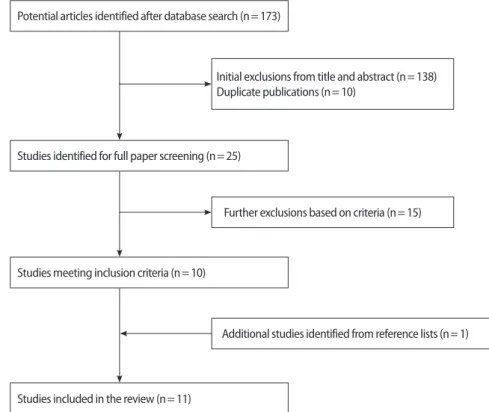
선별된 논문들의 2차 검토는 연구자 1인이 25편 논문의 전문을 확인하는 과정이었다. 이 과정을 통해 위 잔여량의 기준점이 명확 히 구분되지 않는 연구 2편과 임상적 결과의 통계값을 제시하지 않 아 위 잔여량 기준점에 따른 결과를 비교할 수 없는 연구 13편은 제 외되었고, 선정된 논문의 참고문헌 검색을 통해 1편의 연구가 추가 되었다. 결과적으로 총 11편의 논문(실험연구 5편, 관찰연구 6편)이 본 연구의 분석에 포함되었다(Figure 1).
체계적 문헌고찰 결과의 편향을 줄이기 위하여 최종적으로 선정 된 논문은 논문의 질 평가 경험이 있는 연구자 1인이 양적연구의 질 을 평가하는 Critical review form (Law et al., 1998)을 이용하여 평가 하였다. 본 연구에 포함된 논문들은 연구목적, 문헌고찰, 연구설계, 연구대상자, 측정변수, 실험중재, 통계, 연구결과, 결론 및 임상적 의 Potential articles identified after database search (n= 173)
Studies identified for full paper screening (n= 25)
Further exclusions based on criteria (n= 15)
Additional studies identified from reference lists (n= 1) Studies meeting inclusion criteria (n= 10)
Studies included in the review (n= 11)
Initial exclusions from title and abstract (n= 138) Duplicate publications (n= 10)
Figure 1. Flow chart of study selection process.
의에 해당하는 15개 항목 중 14개 항목에 대해 절차를 자세히 기술 하였다(Table 1). 비록 관찰연구는 실험중재에 관련된 3개의 항목에 는 해당되지 않았지만 자료수집 과정을 제시하였으며, 모든 실험연 구는 중재방법을 상세하게 설명하였다. 반면, 표본 수 산정 근거는 3 편의 실험연구만이 제시하였다(Montejo et al., 2010; Pinilla, Sam- phire, Arnold, Liu, & Thiessen, 2001; Reignier et al., 2013). 그러나 근거 를 제시하지 않는 8편의 연구들의 표본 수가 39명에서 360명이며, 이 중 6편의 연구 표본 수가 50명 이상으로 충분히 크기 때문에 본 연구의 분석에 선정된 논문은 전반적으로 질적 수준이 높은 것으 로 판단된다.
3. 분석 방법
수집된 자료는 구조화된 자료분석 양식에 따라 분류되었다. 구 조화된 자료분석 양식에는 저자, 출판연도, 연구설계방법, 중환자 실의 종류, 대상자수, 대상자 평균 나이, 경관영양튜브의 종류, 위 잔여량 기준점, 위 잔여량 측정주기, 측정된 위 잔여량의 처리방법, 위장운동 촉진제의 종류, 영양공급방법(지속적 공급, 간헐적 공급), 자료수집일 수, 임상적 결과 등의 내용이 포함되었다. 임상적 결과 는 각 변수에 대하여 위 잔여량 기준점으로 나눈 그룹 간의 실수, 백분율과 p값으로 기록하였다.
연구 결과
1. 연구논문의 특성
본 연구에서 분석된 논문은 총 11편으로, 무작위대조군 실험연
구 4편(36%), 비동등성대조군 실험연구 1편(9%), 전향적 관찰연구 6 편(55%)이었다. 다기관의 중환자를 대상으로 한 연구는 2편의 실험 연구(Montejo et al., 2010; Reignier et al., 2013)였으며, 그 외의 연구는 단일 병원의 중환자를 대상으로 하였다. 대부분의 연구에서 내과 중환자실과 외과중환자실 환자들을 대상으로 하였으며, 심혈관계 중환자와 외상환자를 포함한 연구는 4편이었다. 분석된 논문의 대 상자 수는 최소 39명에서 최대 499명으로 다양하였으며, 대상자의 평균 연령은 49세에서 65세로 그룹 간의 연령에는 유의한 차이가 없 었다. 국내의 중환자를 대상으로 한 논문은 1편(Yoo et al., 2010) 이었 으며, 대부분(90%)의 연구들은 미국의 중환자를 대상으로 하였다.
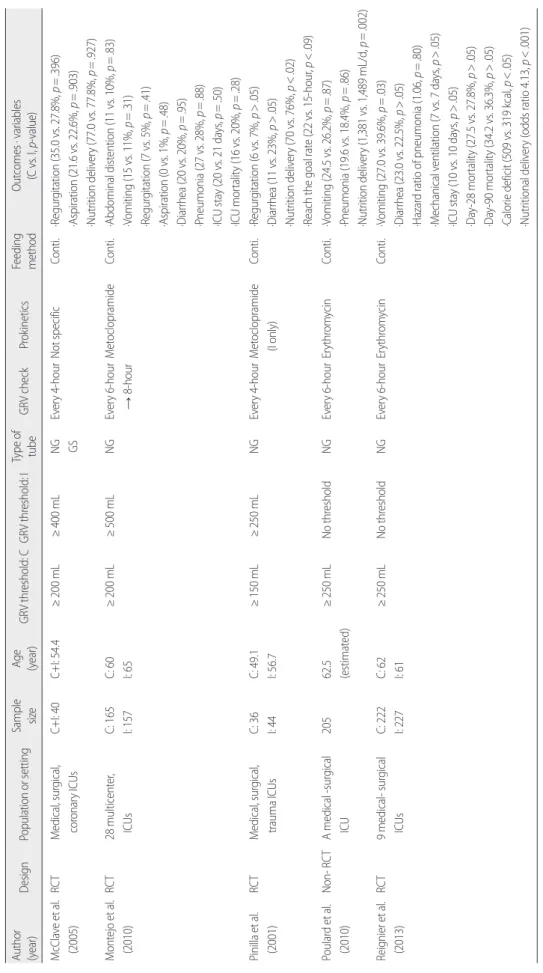
연구에서 위 잔여량에 따라 평가한 임상적 결과 변수는 복부팽만, 설사, 구토, 흡인, 폐렴, 경관영양 공급량, 재원일 수, 인공호흡기 적용 일, 사망률이었다(Tables 2, 3).
2. 경관영양 공급방법, 위 잔여량 측정 및 위장운동 촉진제 Table 2와 Table 3에서 제시한 것과 같이, 경관영양은 주로 영양공 급 펌프를 이용하여 지속적으로 공급되었으며 1편의 국내 논문 (Yoo et al., 2010)의 경우 하루 3회, 간헐적인 방법의 경관영양 공급방 법이 사용되었다. 모든 연구에서 경관영양을 위해 비위관이 사용되 었으나 3편의 연구(Elpern et al., 2004; McClave et al., 2005; Metheny et al., 2006)에서는 비위관과 함께 위루형성술 튜브가 사용되었다.
간헐적으로 경관영양을 공급한 Yoo 등(2010)의 연구에서는 공급 직전에 위 잔여량을 측정하였으며, 지속적 경관영양을 공급한 연 구에서는 4시간에서 6시간마다 주기적으로 위 잔여량을 측정하였 다. 총 9편의 연구에서 위장운동을 촉진하기 위하여 예방적으로 Table 1. Quality Appraisal of the 11 Studies using the Critical Review Form
Quality criteria Elpern
(2004)
McClave (2005)
Mentec (2001)
Metheny (2006)
Metheny (2008)
Montejo (2010)
Pinilla (2001)
Poulard (2010)
Reigner (2013)
Soroksky (2010)
Yoo (2010)
Study purpose + + + + + + + + + + +
Relevant background literature + + + + + + + + + + +
Quantitative study design + + + + + + + + + + +
Detailed sample description + + + + + + + + + + +
Sample size calculation – – – – – + + – + – –
Reliable outcome measure + + + + + + + + + + +
Valid outcome measure + + + + + + + + + + +
Detailed intervention description N/A + N/A N/A N/A + + N/A + N/A N/A
Avoid contamination N/A + N/A N/A N/A + + N/A + N/A N/A
Avoid cointervention N/A + N/A N/A N/A + + N/A + N/A N/A
Reporting of significant results + + + + + + + + + + +
Appropriate analysis method + + + + + + + + + + +
Clinical importance + + + + + + + + + + +
Drop-out rate N/A N/A N/A + N/A + + N/A + N/A N/A
Appropriate conclusion + + + + + + + + + + +
+= Yes; -= No; N/A= Not applicable.
Table 2. Experimental Studies that Evaluated the Clinical Outcomes according to Gastric Residual Volume Threshold Author (year)DesignPopulation or settingSample sizeAge (year)GRV threshold: CGRV threshold: IType of tubeGRV check ProkineticsFeeding method Outcomes · variables (C vs. I, p-value) McClave et al. (2005)RCTMedical, surgical, coronary ICUsC+I: 40 C+I: 54.4≥200 mL≥400 mLNG GSEvery 4-hourNot specificConti.·Regurgitation (35.0 vs. 27.8%, p=.396) ·Aspiration (21.6 vs. 22.6%, p=.903) ·Nutrition delivery (77.0 vs. 77.8%, p=.927) Montejo et al. (2010)RCT28 multicenter, ICUsC: 165 I: 157C: 60 I: 65≥200 mL≥500 mLNGEvery 6-hour → 8-hourMetoclopramideConti.·Abdominal distention (11 vs. 10%, p=.83) ·Vomiting (15 vs. 11%, p=.31) ·Regurgitation (7 vs. 5%, p=.41) ·Aspiration (0 vs. 1%, p=.48) ·Diarrhea (20 vs. 20%, p=.95) ·Pneumonia (27 vs. 28%, p=.88) ·ICU stay (20 vs. 21 days, p=.50) ·ICU mortality (16 vs. 20%, p=.28) Pinilla et al. (2001)RCTMedical, surgical, trauma ICUsC: 36 I: 44C: 49.1 I: 56.7≥150 mL≥250 mLNGEvery 4-hourMetoclopramide (I only)Conti.·Regurgitation (6 vs. 7%, p>.05) ·Diarrhea (11 vs. 23%, p>.05) ·Nutrition delivery (70 vs. 76%, p<.02) ·Reach the goal rate (22 vs. 15-hour, p<.09) Poulard et al. (2010)Non- RCTA medical -surgical ICU20562.5 (estimated)≥250 mLNo thresholdNGEvery 6-hourErythromycinConti.·Vomiting (24.5 vs. 26.2%, p=.87) ·Pneumonia (19.6 vs. 18.4%, p=.86) ·Nutrition delivery (1,381 vs. 1,489 mL/d, p=.002) Reignier et al. (2013)RCT9 medical- surgical ICUsC: 222 I: 227C: 62 I: 61≥250 mLNo thresholdNGEvery 6-hour Erythromycin Conti.·Vomiting (27.0 vs. 39.6%, p=.03) ·Diarrhea (23.0 vs. 22.5%, p>.05) ·Hazard ratio of pneumonia (1.06, p=.80) ·Mechanical ventilation (7 vs. 7 days, p>.05) ·ICU stay (10 vs. 10 days, p>.05) ·Day-28 mortality (27.5 vs. 27.8%, p>.05) ·Day-90 mortality (34.2 vs. 36.3%, p>.05) ·Calorie deficit (509 vs. 319 kcal, p<.05) ·Nutritional delivery (odds ratio 4.13, p<.001) RCT=Randomized controlled trials; ICUs=Intensive care units; C=Control group; I=Intervention group; GRV=Gastric residual volume; NG=Nasogastric; GS=Gastrostomy; Conti.=Continuous.
metoclopramide 또는 erythromycin을 투여하였다. 이 중 Pinilla 등 (2001)의 연구에서는 높은 위 잔여량을 설정한 실험군에게만 위장 운동 촉진제를 투여하였고, Mentec 등(2001)과 Soroksky 등(2010)은 위 잔여량이 한계점을 초과하는 경우에 위장운동 촉진제를 투여 하였다.
3. 위 잔여량에 따른 임상적 결과
본 연구에서 분석한 11편 논문의 위 잔여량에 따른 임상적 결과 분석은 Tables 2, 3과 같다.
1) 위 잔여량 50-100 mL
국내의 중환자 76명을 대상으로 한 Yoo 등(2010)의 관찰연구는 위 잔여량의 한계점을 50-100 mL로 설정하였으며, 임상적 결과로 영양섭취량을 보고하였다. 위 잔여량이 50-100 mL 이상인 군과 이 하인 군의 3일 동안의 경관영양 섭취량은 각각 688 mL/day와 731 mL/day로 유의한 차이가 없었으며, 영양공급량/영양요구량의 비교 시에도 유의한 차이는 없었다.
2) 위 잔여량 150 mL
Elpern 등(2004)은 위 잔여량이 150 mL 이상인 내과중환자실 환 자들과 이하인 환자들 간의 폐렴의 발생률은 유의한 차이가 없는 것으로 보고하였다. 또한 Mentec 등(2001)의 연구에서도 위 잔여량 150 mL를 한계점으로 하는 두 군에서 폐렴 발생률의 유의한 차이 는 발견되지 않았다. 다만, 위 잔여량 150 mL 이상인 경우가 2회 이 상 반복되거나 위 잔여량 500 mL 이상이 1회라도 발생되는 경우 구 토를 하는 환자의 비율이 높은 것으로 나타났으며, 경관영양 공급 량은 적은 것으로 나타났다(Mentec et al., 2001).
3) 위 잔여량 200-250 mL
360명의 중환자들을 대상으로 대단위 관찰연구를 수행한 Metheny 등(2006)은 위 잔여량 200 mL 이상인 군과 이하인 군의 흡 인 발생률은 유의한 차이가 없다고 보고하였다. 2008년에 시행된 추후 연구에 의하면(Metheny, Schallom, Oliver, & Clouse, 2008), 위 잔여량 200 mL 이상 1회 발생하는 경우에는 흡인 위험도가 유의하 지 않았으나, 2회 이상 반복되는 경우 흡인 위험도가 2.3배 증가하였 다. 또한 위 잔여량 250 mL 이상이 1회 이상 관찰된 환자의 흡인 위 험도가 위 잔여량 250 mL 이하의 환자들에 비해 2.2배 높은 것으로 나타났다. Pinilla 등(2001)의 실험연구에서도 위 잔여량 250 mL를 기 준으로 나눈 두 군 사이의 구토와 설사 발생률은 유의한 차이가 없 는 것으로 나타났으며, 위 잔여량 250 mL 이상인 군에서 경관영양 Table 3.
Prospective Observational Studies that Compared the Clinical Outcomes according to the Gastric Residual Volume Threshold Author (year)Population or settingSample sizeAge (year)GRV threshold Type of tubeGRV checkProkineticsFeeding methodOutcome ·Variables (LTG vs. UTG, p-value) Elpern et al. (2004)A medical ICU3960.6≥150 mLNG GSNot specificMetaclopromide, Erythromycin Conti.·Pneumonia (Not specific, p>.05) Mentec et al. (2001)A medical -surgical ICU15365≥500 mL or ≥150 mL more 2 times NGEvery 4-hourErythromycin, CisaprideConti.·Vomiting (20 vs. 39%, p=.02) ·Pneumonia (29 vs. 41%, p=.14) ·Nutrition delivery (20 vs. 15 kcal/kg/d, p<.001) Metheny et al. (2006)Medical, surgical, trauma, coronary ICUs36052.2≥200 mLNG GS TP
Every 4-hourMetoclopramide Conti.·Aspiration (5-time vs. 15-time, p>.05) Metheny et al. (2008)Medical, surgical, trauma, coronary ICUs20651.9≥250 mLNGEvery 4-hourNot specificConti.·Aspiration (odds ratio 2.2, p=.047) Soroksky et al. (2010)General ICUs5259.8 (estimated)≥500 mLNGEvery 4-hourMetoclopramideConti.·Vomiting (# 10 vs. 3, p>.05) ·Pneumonia (Not specific, p>.05) ·ICU stay (11.0 vs. 13.8 days, p=.41) ·30 day mortality (21 vs. 40%, p=.24) Yoo et al. (2010)Medical, surgical ICUs7660.6 (estimated)≥50-100 mLNGBefore feedingNot specificIntermit. (3-time/day)·Nutrition delivery (731 vs. 688 mL/d, p>.05) ICUs=Intensive care units; GRV=Aastric residual volume; NG=Nasogastric; GS=Gastrostomy; TP=Transpyloric; Conti.=Continuous; Intermit.=Intermittent; LTG=Lower threshold group; UTG=Upper threshold group.
공급량이 유의하게 더 높았다.
4) 위 잔여량 400 mL 이상
위 잔여량의 최대 기준점을 400 mL와 500 mL로 설정하여 200 mL의 기준점과 비교한 두 편의 실험연구에서 복부팽만, 구토, 흡인, 설사, 폐렴, 영양공급량, 중환자실 체류기간, 사망률 등의 결과는 유 의한 차이를 보이지 않았다(McClave et al., 2005; Montejo et al., 2010).
또한 위 잔여량 500 mL 이상인 군과 이하인 군을 비교한 관찰연구 에서도 구토, 폐렴, 중환자실 체류기간 및 사망률에서 두 군 간의 유 의한 차이를 보이지 않았다(Soroksky et al., 2010).
다른 두 개의 실험연구에서는 위 잔여량을 측정하지 않은 군과 위 잔여량 250 mL 이상인 군의 임상적 결과를 평가하였다(Poulard et al., 2010; Reignier et al., 2013). 설사 및 폐렴 발생률과 인공호흡기 치 료기간, 중환자실 체류기간, 사망률 등에는 두 군에 유의한 차이가 없었으나 위 잔여량을 측정하지 않은 환자에서 구토 발생률과 경관 영양 공급량이 유의하게 높았다.
논 의
본 연구는 체계적 문헌고찰을 통하여 경관영양을 공급받는 중 환자의 위 잔여량 기준점에 따른 임상적 결과를 종합 분석함으로 써 경관영양 유지를 위한 표준화된 위 잔여량 기준점 설정의 근거 를 제공하고자 하였다.
1992년 시행된 McClave와 Snider의 연구에 따르면 위 잔여량 200 mL를 기준점으로 하여 그 이상인 경우 경관영양 중단을 권고하였 으나, 최근 위장관 적응도 평가에 있어서 위 잔여량 사용에 대한 의 문과 함께 경관영양 공급의 중단을 줄이기 위하여 위 잔여량의 기 준점을 400-500 mL까지 증가할 필요가 있다는 연구결과가 보고되 고 있다(Montejo et al., 2010; Soroksky et al., 2010). 본 연구의 분석 결 과에서도 400-500 mL 이상의 위 잔여량 기준점을 설정하였을 때 구 토, 흡인, 설사, 폐렴 발생에 유의한 차이를 보이지 않았다. 그러나 높 은 위 잔여량 기준점을 제시한 연구들에서 위장관 운동 촉진 약물 의 투여 여부가 위 잔여량의 위장관 적응도 평가에 영향을 미쳤을 수도 있음을 고려해야 한다. 또한 흡인이나 구토를 유발하는 요인에 는 위 잔여량뿐만 아니라 중환자의 자세, 의식수준, 질병의 중등도 등도 포함되기 때문에 다량의 위 잔여량과 흡인의 발생률 간의 통 계적 유의성이 관찰되지 않을 수도 있다(Metheny et al., 2006). 이에 본 연구에 포함된 논문들 중 Metheny 등(2008)은 흡인에 영향을 미 칠 수 있는 다른 변수들의 영향을 통제한 후 회귀분석을 시행하였 는데, 최소 1회 이상 250 mL 이상의 위 잔여량이 측정되는 경우 흡
인 발생 위험도가 증가하는 것을 보고하였다. 이러한 근거를 기반으 로 살펴볼 때, 400 mL 이상의 높은 위 잔여량 기준점은 영양공급량 을 증가시키는 이점이 있을지라도 위장관 부적응을 나타내는 위험 증상으로 고려될 필요가 있다. 그러나 Metheny (2008)의 결과와는 달리 위 잔여량 250 mL 이상을 기준점으로 설정한 다른 연구에서 는 구토, 폐렴, 설사 발생 등의 임상적 결과가 일관되지 않았다(Pini- lla et al., 2001). 따라서 위 잔여량 250 mL를 경관영양의 기준점으로 설정하기에도 근거가 불충분하다.
위 잔여량의 기준점을 50 mL에서 200 mL로 설정한 연구결과를 살펴보면, 임상적 결과인 구토, 흡인, 폐렴의 발생률에 유의한 차이 를 보이지 않았음을 알 수 있다. 그러나 낮은 위 잔여량 기준점은 경 관영양 공급의 진행을 중단시켜 중환자에게 필요한 적절한 영양공 급을 방해할 수 있으며(H. Kim et al., 2012), 정상적인 위액과 타액의 양을 고려해보았을 때 적절하지 않을 수도 있다. Lin과 Van Citters (1997)에 의하면, 일반적으로 하루에 1,500 mL의 타액과 3,000 mL의 위액이 약 188 mL/hr의 속도로 분비되고 경관영양이 25 mL/hr에서 125 mL/hr의 속도로 제공되면, 경관영양 3-6시간 후에 위 잔여량은 232 mL에서 464 mL에서 균형을 이루게 되므로 너무 낮은 위 잔여 량 기준점은 영양공급을 불필요하게 줄이는 원인이 될 수 있다.
이러한 기존 연구들 간의 일관되지 못한 결과에 근거하여 위 잔 여량은 한 번에 측정된 수치보다는 위 잔여량의 변화추세가 더 의 미가 있을지도 모른다는 견해가 제시되고 있다(Ahmad et al., 2012).
이는 150 mL 또는 200 mL 이상이 2회 이상 측정되는 경우 구토와 흡인 발생의 위험도가 증가한 결과가 이를 지지한다(Mentec et al., 2001; Metheny et al., 2008). 그러므로 위 잔여량의 모니터링 시 합병 증을 유발할 수 있는 위험한 수준의 고용량은 아니더라도 더 이상 대사가 되지 않고 지속적으로 남아 있는 위 내용물의 양도 고려해 야 할 것이다.
국내 다수의 의료기관에서는 50 mL에서 100 mL 정도의 위 잔여 량 기준점을 사용하여 중환자의 경관영양을 시행하고 있다. 하지만 이 기준점은 기존 연구들에서 제시하고 있는 수치에 비하여 상대 적으로 낮은 수준이며, 정상적인 생리적 기능을 고려하였을 때에도 낮은 수치이다. 국내의 중환자를 대상으로 평가한 Yoo 등(2010)의 연구에서도 현재보다 높은 위 잔여량 기준점 설정의 필요성을 제시 하고 있다. 비록 국외에서는 위 잔여량의 기준점이 500 mL까지도 허용되고 있는 추세이지만, 간헐적 경관영양 공급 방식을 사용하고 있는 국내의 중환자를 대상으로 한 위 잔여량과 임상적 결과 간의 관계를 평가한 연구가 부족한 실정이므로 국외의 연구결과를 바탕 으로 안전한 수치의 기준점을 설정하여 합병증의 위험을 줄이고 충분한 영양공급을 제공할 필요가 있다.
그러므로 본 연구는 체계적 문헌고찰 결과와 정상적인 생리적 기 능에 근거하여 국내의 중환자의 경관영양 진행을 위한 위 잔여량의 기준점을 200 mL까지 증가시키는 것이 필요하다고 제안한다. 덧붙 여, 위 잔여량이 200 mL까지 도달하지는 않았지만 150 mL 정도의 위 잔여량이 2회 연속으로 측정되는 경우 경관영양의 일시적 중단 을 고려해보아야 함을 제안한다.
본 연구의 결과를 해석할 때, 분석에 포함된 논문들의 위 잔여량 측정방법 및 영양공급 방법이 다름을 유의하여야 한다. 또한 논문 간의 다른 위 잔여량 측정시간 간격, 위장운동 촉진제의 사용여부 가 측정된 위 잔여량 및 임상적 결과에 영향을 줄 수 있으므로 해석 에 주의할 필요가 있다. 또한 논문추출 결과 비교적 적은 수의 논문 이 선정되었음에도 불구하고 선정된 논문들 간의 위 잔여량 기준 과 종속변수가 다양하여 메타분석을 통한 효과크기를 평가하지 못하고 논문들 간의 비교만을 제시하였다는 제한점이 있다. 그러나 체계적으로 논문들의 결과를 비교, 분석하여 위 잔여량의 기준점 을 제시함으로써 임상간호사들의 근거기반 실무를 수행하는 데 기 여할 것이다.
결론 및 제언
위 잔여량은 경관영양을 진행하기 위한 지표로 널리 사용되고 있음에도 불구하고 표준화된 기준점이 명확하지 않다. 이에 본 연 구에서는 경관영양을 공급받는 중환자의 위 잔여량 기준점과 임상 적 결과와의 관계를 평가한 논문들을 체계적 문헌고찰로 분석하여 경관영양 공급 진행의 기준을 제시하고자 하였다. 결과적으로 중환 자에게 적절한 영양공급을 제공하면서 합병증의 위험성이 적은 위 잔여량 200 mL가 안전한 기준점으로 생각된다. 또한 위 잔여량이 200 mL 이하일지라도 150 mL가 2회 이상 연속으로 측정될 시에는 경관영양 공급을 중단하고 위 잔여량을 모니터링하며 위장운동 촉 진제와 같은 중재를 고려할 필요가 있다. 추후연구를 통하여 간헐 적 경관영양 공급방법을 사용하는 국내 중환자들을 대상으로 위 잔여량의 기준점과 임상적 결과 사이의 관계를 파악하여 위 잔여 량 기준점을 검증하는 것이 필요하다.
REFERENCES
Ahmad, S., Le, V., Kaitha, S., Morton, J., & Ali, T. (2012). Nasogastric tube feedings and gastric residual volume: A regional survey. Southern Medical Journal, 105(8), 394-398. http://dx.doi.org/10.1097/SMJ.0b013e31825d9bef
Artinian, V., Krayem, H., & DiGiovine, B. (2006). Effects of early enteral feeding on the outcome of critically ill mechanically ventilated medical patients. Chest,
129(4), 960-967.
Cho, K. S., Kim, H. K., Park, S. O., Bae, Y. S., Hwang, O. N., Kwon, B. E., et al. (2014).
Medical surgical nursing (6th ed.). Seoul: Hyunmoonsa.
Chulay, M., & Burns, S. M. (2012). AACE essentials of critical care nursing (Kim, N.
Y., Kim, Y. H., Kim. E. A., Ryu, S. A., Park, S. J., Yang, J. J., et al. trans.). Seoul:
Hyunmoonsa. (Original work published 2009).
Dhaliwal, R., Cahill, N., Lemieux, M., & Heyland, D. K. (2014). The Canadian criti- cal care nutrition guidelines in 2013: An update on current recommendations and implementation strategies. Nutrition in Clinical Practice, 29(1), 29-43. http://
dx.dor.org/10.1177/0884533613510948
Elpern, E. H., Stutz, L., Peterson, S., Gurka, D. P., & Skipper, A. (2004). Outcomes associated with enteral tube feeding in a medical intensive care unit. American Journal of Critical Care, 13(3), 221-227.
Kim, H., Shin, J. A., Shin, J. Y., & Cho, O. M. (2010). Adequacy of nutritional support and reasons for underfeeding in neurosurgical intensive care unit patients. Asian Nursing Research, 4(2), 102-110. http://dx.doi.org/10.1016/S1976-1317(10) 60010-2
Kim, H., Stotts, N. A., Froelicher, E. S., Engler, M. M., & Porter, C. (2012). Why pa- tients in critical care do not receive adequate enteral nutrition? A review of the literature. Journal of Critical Care, 27(6), 702-713. http://dx.doi.org/10.1016/j.
jcrc.2012.07.019
Kim, K. S., Choi, Y. K., Choi, W. H., Ahn, J. W., Kim, J. A., Park, S. M., et al. (2012). De- velopment of performance measures based on nursing process for fluid intake/
output and tube care. Journal of Korean Clinical Nursing Research, 18(1), 13-28.
Kollef, M. H. (2004). Prevention of hospital-associated pneumonia and ventilator- associated pneumonia. Critical Care Medicine, 32(6), 1396-1405. http://dx.doi.
org/10.1097/01.ccm.0000128569.09113.fb
Korean Society for Parenteral and Enteral Nutrition. (2007). Guidelines of intensive nutritional support. Seoul: Korean Society for Parenteral and Enteral Nutrition.
Law, M., Steward, D., Pollock, N., Letts, L., Bosch, J., & Westmoreland, M. (1998).
Critical review form-Quantitative studies. Retrieved August 16, 2013 from http://
www.srs-mcmaster.ca/Portals/20/pdf/ebp/quanreview_form1.doc
Lin, H. C., Van Citters, G. W. (1997). Stopping enteral feeding for arbitrary gastric residual volume may not be physiologically sound: Results of a computer simu- lation model. Journal of Parenteral and Enteral Nutrition, 21(5), 286-289. http://
dx.doi.org/10.1177/0148607197021005286
Martin, C. M., Doiq, G. S., Heyland, D. K., Morrison, T., Sibbald, W. J., & South- western Ontraio Critical Care Research Network. (2004). Multicentre, cluster- randomized clinical trial of algorithms for critical-care enteral and parenteral therapy (ACCEPT). Canadian Medical Association Journal, 170(2), 197-204.
http://dx.doi.org/10.1177/0115426504019003309
McClave, S. A., Luka, J. K., Stefater, J. A., Lowen, C. C., Looney, S. W., Matheson, P. J., et al., (2005). Poor validity of residual volumes as a marker for risk of aspiration in critically ill patients. Critical Care Medicine, 33(2), 324-330. http://dx.doi.
org/10.1097/01.ccm.0000153413.46627.3a
McClave, S. A., Martindale, R. G., Vanek, V. W., McCarthy, M., Roberts, R., Talyor, B., et al. (2009). Guidelines for the provision and assessment of nutrition support therapy in the adults critically ill patients: Society of Critical Care Medicine (SCCM) and American Society for Parenteral and Enteral Nutrition (A.S.P.E.N.).
Journal of Parenteral Enteral Nutrition, 33(3), 277-316. http://dx.doi.org/10.
1177/0148607109335234
McClave, S. A., & Snider, H. L. (1992). Use of indirect calorimetry in clinical nutri- tion. Nutrition in Clinical Practice, 7(5), 207-221. http://dx.doi.org/10.1177/0115
426592007005207
Mentec, H., Dopont, H., Bocchetti, M., Cani, P., Ponche, F., & Bleichner, G. (2001).
Upper digestive intolerance during enteral nutrition in critically ill patients: Fre- quency, risk factors, and complications. Critical Care Medicine, 29(10), 1955- 1961. http://dx.doi.org/10.1097/00003246-200110000-00018
Metheny, N. A., Clouse, R. E., Chang, Y. H., Steward, B. J., Oliver, D. A., & Kollef, M.
H. (2006). Tracheobronchial aspiration of gastric contents in critically ill tube- fed patients: Frequency, outcomes, and risk factors. Critical Care Medicine, 34(4), 1007-1015. http://dx.doi.org/10.1097/01.ccm.0000206106.65220.59 Metheny, N. A., Schallom, L., Oliver, D. A., & Clouse, R. E. (2008). Gastric residual
volume and aspiration in critically ill patients receiving gastric feedings. Ameri- can Journal of Critical Care, 17(6), 512-519.
Montejo, J. C., Minambres, E., Bordeje, L., Mesejo, A., Acosta, J., Heras, A., et al., (2010). Gastric residual volume during enteral nutrition in ICU patients: The REGAME study. Intensive Care Medicine, 36(8), 1386-1393. http://dx.doi.org/
10.1007/s00134-010-1856-y
Petros, S., & Engelmann, L. (2006). Enteral nutrition delivery and energy expendi- ture in medical intensive care patients. Clinical Nutrition, 25(1), 51-59. http://dx.
doi.org/10.1016/j.clnu.2005.08.013
Pinilla, J. C., Samphire, J., Arnold, C., Liu, L., & Thiessen, B. (2001). Comparison of gastrointestinal tolerance to two enteral feeding protocols in critically ill patients:
A prospective, randomized controlled trial. Journal of Parenteral and Enteral Nu- trition, 25(2), 81-86. http://dx.doi.org/10.1177/014860710102500281 Poulard, F., Dimet, J., Martin-Lefevre, L., Bontemps, F., Fiancette, M., Clementi, E., et
al. (2010). Impact of not measuring residual gastric volume in mechanically ven- tilated patients receiving early enteral feeding: A prospective before-after study.
Journal of Parenteral and Enteral Nutrition, 34(2), 125-130. http://dx.doi.org/
10.1177/0148607109344745
Robert, S. R., Kennerly, D. A., Keane, D., & Geroge, C. (2003). Nutrition support in the intensive care unit: adequacy, timeliness, and outcomes. Critical Care Nurse, 23(6), 49-57.
Reignier, J., Mercier, E., Le Gouge, A., Boulain, T., Desachy, A., Bellec, F., et al.
(2013). Effect of not monitoring residual gastric volume on risk of ventilator-as- sociated pneumonia in adults receiving mechanical ventilation and early enteral feeding: A randomized controlled trial. The Journal of the American Medical As- sociation, 309(3), 249-256. http://dx.doi.org/10.1001/jama.2012.196377 Soroksky, A., Lorber, J., Klinowski, E., Ilgayev, E., Mizrachi, A., Miller, A., et al.
(2010). A simplified approach to the management of gastric residual volumes in critically ill mechanically ventilated patients: A pilot prospective cohort study.
The Israel Medical Association Journal, 12(9), 543-548.
Terekeci, H., Kucukardali, Y., Top, C., Onem, Y., Celik, S., & Oktenli, C. (2009). Risk assessment study of the pressure ulcers in intensive care unit patients. European Journal of Internal Medicine, 20(4), 394-397. http://dx.doi.org/10.1016/j.ejim.
2008.11.001
Yoo, S. Y., Kim, E. M., Cho, Y. Y., Ra, M. Y., Kim, J. Y., Jang, D. K., et al. (2010). Char- acteristics of ICU patients on enteral nutrition according to the gastric residual volume. Korean Journal of Parenteral and Enteral Nutrition, 3(1), 50-53.