• 검색 결과가 없습니다.

Isolation and characterization of microsatellite markers for Hydrangea luteovenosa (Hydrangeaceae), an endangered species in Korea

N/A
N/A
Protected

Academic year: 2021

Share "Isolation and characterization of microsatellite markers for Hydrangea luteovenosa (Hydrangeaceae), an endangered species in Korea"

Copied!
4
0
0

로드 중.... (전체 텍스트 보기)

전체 글

(1)

30 Korean J. Pl. Taxon.

43(1): 30-33 (2013)

http://dx.doi.org/10.11110/kjpt.2013.43.1.30

ISSN 1225-8318 Korean Journal of Plant Taxonomy

Isolation and characterization of microsatellite markers for Hydrangea luteovenosa (Hydrangeaceae), an endangered species in Korea

Takuya Ito, Shingo Kaneko 1 , Masashi Yokogawa 2 , Gwan-Pil Song 3 , Hyeok-Jae Choi 4 * and Yuji Isagi

Graduate School of Agriculture, Kyoto University, Kyoto 606-8502, Japan

1

Department of Symbiotic Systems Science, Fukushima University, Fukushima 960-1296, Japan

2

Laboratory of Botany, Osaka Museum of Natural History, Osaka 546-0034, Japan

3

Research Institute for Environmental Resources of Jeju, Jeju 695-791, Korea

4

Department of Biology, Changwon National University, Gyeongnam 641-773, Korea (Received 11 January 2013; Revised 2 March 2013; Accepted 11 March 2013)

한국 제주도에 자생하는 멸종위기종 성널수국(수국과)의 microsatellite 분자마커 개발

Takuya Ito·Shingo Kaneko 1 ·Masashi Yokogawa 2 ·송관필 3 ·최혁재 4 *·Yuji Isagi

Graduate School of Agriculture, Kyoto University,

1

Department of Symbiotic Systems Science, Fukushima University,

2
Laboratory of Botany, Osaka Museum of Natural History,

3

제주환경자원연구소,

4

창원대학교 생물학과

ABSTRACT : Hydrangea luteovenosa is a critically endangered plant species of Jeju Island in Korea, though it is widely distributed in western Japan. We isolated and characterized five microsatellite loci in this species. The number of alleles ranged from 3 to 27, observed heterozygosity from 0.27 to 0.86, and expected heterozygosity from 0.34 to 0.91. The markers described here will be useful for investigating the genetic diversity, genetic structure, and gene flow of H. luteovenosa, and the genetic findings would contribute to the establishment of effective conservation measures for this species in Korea.

Keywords : Conservation, Endangered species, Hydrangea luteovenosa, Korea, Microsatellite

적 요 : 성널수국은 일본 관서지방에 널리 분포하고 있지만, 한반도에서는 제주도에서만 발견되고 있는 멸

종위기 식물이다. 본 연구에서는 성널수국에서 총 5개의 microsatellite 유전자좌를 형질화하여 마커를 개발하 였다. 유전자좌당 대립유전자수의 범위는 3-27개, 이형접합률의 관측치와 기대치는 각각 0.27-0.86과 0.34- 0.91 로 나타났다. 본 연구에서 개발된 microsatellite 마커는 성널수국의 유전적 다양성 및 구조, 그리고 유전 자 이동을 밝히는데 사용될 수 있을 것이며, 그 결과들은 한국산 성널수국에 대한 효과적인 보전 전략을 제 시하는데 일조할 것으로 기대된다.

주요어 : 보전, 멸종위기종, 성널수국, 한국, Microsatellite 마커

Hydrangea luteovenosa Koidz. (Hydrangeaceae Dumort.) is a deciduous shrub that grows on the forest floor of temperate

forest in Jeju Island of Korea and western Japan (Kim, 2009).

Although H. luteovenosa is common in Japan, it should be listed as a critically endangered plant species in Korea at regional level based on the criteria of IUCN (Kim, 2009) with a noticeably small size population. Only one population has been known in Seongneol-oreum region of Mt. Hallasan in Jeju

*Author for correspondence: [email protected] http://www.pltaxa.or.kr

Copyright © 2013 the Korean Society of Plant Taxonomists

(2)

Korean Journal of Plant Taxonomy Vol. 43 No. 1 (2013)

Microsatellite markers for Hydrangea luteovenosa 31

Island (Moon et al., 2004; C. S. Kim, pers. comm.). In conservation of endangered species with limited distribution like H. luteovenosa in Korea, it is important to understand the ecological status such as its breeding system and clonal distribution (Izuno et al., 2012). At the same time, genetic information is also crucial for designing its management strategy because small sized population are likely to be vulnerable to the impact of genetic factors in extinction such as inbreeding depression and loss of genetic diversity (Frankham, 1995;

Schwartz et al., 2007; Izuno et al., 2012). Furthermore, microsatellite markers will provide effective genetic information with its high variability (Guichoux et al., 2011; Yun et al., 2011).

Therefore, we developed five microsatellite markers in order to understand current genetic status of critically endangered Korean H. luteovenosa comparing with Japanese populations.

Materials and Methods

We obtained samples from four populations of H. luteovenosa in Korea (Jeju Island) and Japan (Hyogo, Kagoshima, and Yamaguchi prefectures). Microsatellite markers were developed using the technique for isolating codominant compound microsatellite markers of Lian and Hogetsu (2002) and Lian et al. (2006). An adaptor-ligated, restricted DNA library for H. luteovenosa was generated according to the following procedure: genomic DNA was extracted from silica-dried leaves using a modified CTAB method (Milligan, 1992) and digested with the blunt-end restriction enzyme EcoRV. The restriction fragments were then ligated with a specific blunt adaptor (consisting of the 48-mer: 5’-GTAATACGACTCACT ATAGGGCACGCGTGGTCGACGGCCCGGGCTGGT-3’

and an 8-mer with the 3’-end capped with an amino residue:

5’-ACCAGCCC-NH

2

-3’) using the Takara DNA ligation kit (Takara). Fragments were amplified by polymerase chain

reaction (PCR) from the EcoRV DNA library using compound SSR primer (AC)

6

(TC)

7

and an adaptor primer (5’-CTATAGG GCACGCGTGGT-3’). The amplified fragments, ranging in size from 400 to 800 bp, were then separated on a 1.5% LO3 agarose gel (Takara) and purified using a QIAquick Gel Extraction Kit (Qiagen). The purified DNA fragments were cloned using the QIAGEN PCR Cloning plus Kit (Qiagen) following the manufacturer’s instructions. The cloned fragments were amplified using the M13 forward and reverse primers from the plasmid DNA. Amplified fragments were sequenced using the BigDye Terminator Cycle Sequencing Kit (Applied Biosystems). For each fragment containing a compound SSR sequence at one end, a specific primer was designed from the sequence flanking the compound SSR using Primer3 (v. 0.4.0, Rozen and Skaletsky, 2000) (National Human Genome Research Institute). PCR amplifications were performed following the standard protocol of the Qiagen Multiplex PCR Kit (Qiagen) in a final volume of 5 µ L, which contained 5 ng of extracted DNA, 5 µ L of 2 × Multiplex PCR Master Mix, and 0.2 µ M of each primer. Compound SSR primers (AC)

6

(TC)

7

were labeled with fluorochromes FAM or PET (Applied Biosystems), respectively. PCR amplifications were performed with the GeneAmp PCR System 2700 thermal cycler (Applied Biosystems) using the following conditions: initial denaturation at 95

o

C for 15 min, followed by 30 cycle of denaturation at 94

o

C for 30 s, annealing at 57

o

C for 1 min 30 s, extension at 72

o

C for 1 min, and extension at 60

o

C for 30 min. The size of the PCR products was measured using the ABI PRISM 3100 Genetic Analyzer (Applied Biosystems) and GENOTYPER analysis software (Applied Biosystems).

Results and Discussion

In total, 170 cloned DNA fragments were screened in a H.

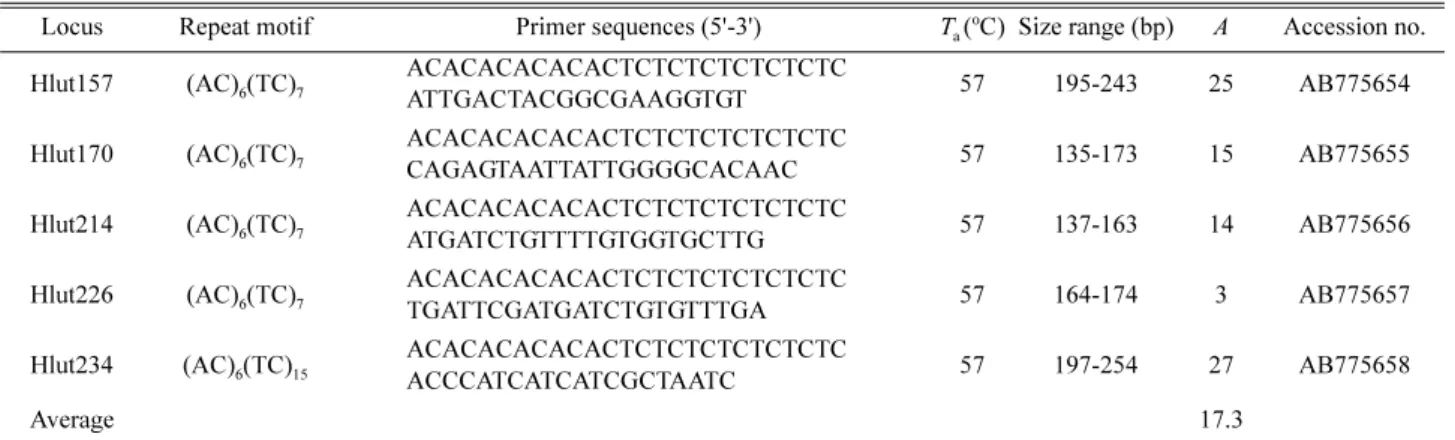
Table 1. Characteristics of the five compound microsatellite loci for Hydrangea luteovenosa.

Locus Repeat motif Primer sequences (5'-3') T

a

(

o

C) Size range (bp) A Accession no.

Hlut157 (AC)

6

(TC)

7

ACACACACACACTCTCTCTCTCTCTC

ATTGACTACGGCGAAGGTGT 57 195-243 25 AB775654

Hlut170 (AC)

6

(TC)

7

ACACACACACACTCTCTCTCTCTCTC

CAGAGTAATTATTGGGGCACAAC 57 135-173 15 AB775655

Hlut214 (AC)

6

(TC)

7

ACACACACACACTCTCTCTCTCTCTC

ATGATCTGTTTTGTGGTGCTTG 57 137-163 14 AB775656

Hlut226 (AC)

6

(TC)

7

ACACACACACACTCTCTCTCTCTCTC

TGATTCGATGATCTGTGTTTGA 57 164-174 3 AB775657

Hlut234 (AC)

6

(TC)

15

ACACACACACACTCTCTCTCTCTCTC

ACCCATCATCATCGCTAATC 57 197-254 27 AB775658

Average 17.3

T

a

= annealing temperature of primer pair, A = total number of allele for each locus.

(3)

Korean Journal of Plant Taxonomy Vol. 43 No. 1 (2013) 32 Takuya Ito, Shingo Kaneko, Masashi Yokogawa, Gwan-Pil Song, Hyeok-Jae Choi and Yuji Isagi

luteovenosa genomic library. A total of 63 positive clones were sequenced, and primers were designed for 23 repeats. From the 23 primer pairs tested five microsatellite loci were identified that showed a clear, strong single band for each allele (Table 1). The polymorphism was evaluated for 143 individuals from four populations of H. luteovenosa in Korea (Jeju Island) and Japan (Hyogo, Kagoshima, and Yamaguchi prefectures) (Table 2). The number of alleles per locus ranged from 3 to 27 with an average of 17.3 (Table 1). The observed and expected heterozygosities (H

O

and H

E

) ranged from 0.27 to 0.86 and from 0.34 to 0.91 with an average of 0.49 and 0.71, respectively. Linkage disequilibrium between loci and deviation from Hardy–Weinberg equilibrium (HWE) were tested with FSTAT (version 2.9.3; Goudet, 1995). Significance levels were adjusted using Bonferroni correction for multiple testing. There was no evidence of significant linkage disequilibrium (P < 0.05) for all pair of loci. However, we cannot check the deviation from HWE in Jeju population, because only two multilocus genotypes were observed through the whole data set (Table 2). Though locus Hlut170 was amplified in Jeju population, it was not amplified in most of the tested Japanese individuals, indicating the high frequency of null allele in Japanese populations (Table 2). In Hlut214 and Hlut234, significant deviation (P < 0.05) from HWE was observed in all the Japanese populations and in the Hygo population only, respectively, indicating the existence of null allele (Table 2).

In conclusion, all the microsatellite markers described here are expected to be useful in understanding the current genetic status of the only known Korean H. luteovenosa population in Jeju Island. The genetic results from the developed markers will therefore be helpful to develop effective conservation strategies for this species in Korea. In addition, three microsatellite markers of Hlut157, Hlut226, and Hlut234 are

also practicable for investigating the genetic diversity, genetic structure, and gene flow among populations of H. luteovenosa in Korea and Japan. Although the other two markers (Hlut170 and Hlut214) are not useful in population genetic studies because of the existence of null alleles, it is expected to be useful in individual identification and in understanding the clonal structure of this species in Korea.

Acknowledgement

We thank S.H. Kang, C.S. Kim, Y. Suyama, T. Abe, and Y.

Ohta for their helpful support of sampling. This research was partly supported by Changwon National University in 2012-2013 and the Environment Research and Technology Development Fund (S-9-2) of the Ministry of the Environment, Japan.

Literatures Cited

Frankham, R. 1995. Conservation genetics. Annual Review of Genetics 29: 305-327.

Goudet, J. 1995. FSTAT (version 1.2): a computer program to cal- culate F-statistics. Journal of Heredity 86: 485-486.

Guichoux, E., L. Lagache, S. Wagner, P. Chaumeil, P. Leger, O.

Lepais, C. Lepoittevin, T. Malausa, E. Revardel, F. Salin and R. J. Petit. 2011. Current trends in microsatellite genotyping.

Molecular Ecology Resources 11: 591-611.

Izuno, A., M. Takamiya, S. Kaneko and Y. Isagi. 2012. Genetic variation and structure of the endangered Lady Fern Athyrium viridescentipes based on ubiquitous genotyping. Journal of Plant Research 125: 613-618.

Kim, C. S. 2009. Vascular plant diversity of Jeju Island, Korea.

Korean Journal of Plant Resources 22: 558-570.

Lian, C., M. A. Wadud, Q. Geng, K. Shimatani and T. Hogetu.

2006. An improved technique for isolating codominant com- Table 2. Variability of five microsatellite loci in four population of Hydrangea luteovenosa in Korea and Japan. X indicates that the locus was not amplified, a significant deviation from Hardy-Weinberg equilibrium expectations is indicated by * (P < 0.05), and

indicates that deviation from HWE cannot be checked because only two genotypes was observed.

Jeju (Korea) (n = 30)

Hyogo (Japan) (n = 31)

Kagoshima (Japan) (n = 45)

Yamaguchi (Japan) (n = 25)

A H

O

H

E

A H

O

H

E

A H

O

H

E

A H

O

H

E

Hlut157 2 1.00

0.50 13 0.81 0.86 18 0.84 0.92 15 0.81 0.83

Hlut170 1 0.00

0.00 X - - X - - X - -

Hlut214 2 1.00

0.50 9 0.45* 0.8 6 0.47* 0.52 2 0.08* 0.18

Hlut226 1 0.00

0.00 3 0.45 0.43 2 0.44 0.47 2 0.04 0.04

Hlut234 2 0.93

0.50 15 0.48* 0.9 21 0.71 0.76 11 0.73 0.83

A = total number of allele for each locus, H

O

= observed heterozygosity, H

E

= expected heterozygosity, n = number of individuals.

(4)

Korean Journal of Plant Taxonomy Vol. 43 No. 1 (2013)

Microsatellite markers for Hydrangea luteovenosa 33

pound microsatellite markers. Journal of Plant Research 119:

415-417.

Lian, C. and T. Hogetsu. 2002. Development of microsatellite markers in black locust (Robinia pseudoacasia) using a dual- supperession-PCR technique. Molecular Ecology Notes 2:

211-213.

Milligan, B. 1992. Plant DNA isolation. In Molecular genetic anal- ysis of populations: a practical approach. Hoelzel, A. R. (ed.), IRL Press, Oxford, Pp. 59-88.

Moon, M. O., Y. J. Kang, C. H. Kim and C. S. Kim CS. 2004. An unrecorded species in Korea flora: Hydrangea luteovenosa Koidz. (Hydrangeaceae). Korean Journal of Plant Taxonomy

34: 1-7. (in Korean)

Rozen, S. and H. Skaletsky. 2000. Primer3 on the web WWW for general users and for biologist programmers. In Bioinformat- ics methods and protocols: methods in molecular biology.

Krawetz, S. and S. Misener (eds.), Humana Press, Totowa, Pp.

365-386.

Schwatrz, M. K., G. Luikart and R. S. Waples. 2007. Genetic mon- itoring as a promising tool for conservation and management.

Trends in Ecology & Evolution 22(1): 25-33.

Yun, Y. E., J. N. Yu, B. Y. Lee and M. H. Kwak. 2011. An intro-

duction to microsatellite development and analysis. Korean

Journal of Plant Taxonomy 41: 299-314. (in Korean)

수치

Table 1. Characteristics of the five compound microsatellite loci for Hydrangea luteovenosa.

참조

관련 문서

Taylor Series

purpose of introducing the representative lawsuits in such a trend, it is necessary to review the status of representative cases and judicial issues in

Although Korea has been playing a leading role in the development of fusion power generation and Korea is playing a leading role in the world stage,

COL-I is widely distributed in the body, and synthesized by fibroblasts, odontoblasts, osteoblasts, and chondroblasts. It weakly interacted with

Characterization of the centromere and pericentromere retrotransposons in Brassica rapa and their distribution in the related Brassica species. Gil-Dong Hong 1,* ,

A revision of the Eleotrid goby genus Odontobutis in Japan, Korea and China... A revision of the eleotrid goby genus Odontobutis in Japan, Korea

 As a affiliated company of Green Cross in the field of genome analysis, we provide disease diagnosis services, such as prenatal genetic test, oncogenomic analysis and

The Dusky Lory ( Pseudeos fuscata ) is a monotypic species of parrot in the Psittaculidae family, and the only species of the genus Pseudeos... platyrhynchos