I. Introduction
Natural dyes is getting an increasing attention in recent dyeing technology because of its
*
Corresponding author : [email protected]
environmental advantages over synthetic dyes unfaded over 900 years, and are brilliant as the and its beautiful color.
1)-5)For example, woad dyed brilliant blue fabrics have remained day
Natural Dyeing Using Tea Extract I - The Effect Of Mordants On Dyeing Characteristics
Of Coffee Extract Dyed Silk Fabric -
Yoo, Hyun-Geun Kim, Sin-Hee ․
*Student, Dept. of Clothing and Textiles, The Catholic University of Korea Assistant Professor, Dept. of Clothing and Textiles, The Catholic University of Korea
*Abstract
Natural dyes have attracted the worldwide attention because of its environmental advantage over synthetic dyes. However, most of natural dyes are expensive for mass production, strongly season and source dependent, and hard to store. In this study, coffee waste were used as natural dye to create beautiful colors. Coffee waste is inexpensive and easy to store, and provides a comparatively regular quality regardless of seasonand source.
The effects of mordant agent concentration and mordanting temperature on dyeing efficiency of silk fabrics were investigated. Coffee extract dyed silk showed brilliant colors, and the colors were different with the kind of mordants. Cu, Sn, and Al mordanted silks showed golden yellow with subtle change of hue and value, while Fe mordanted silk showed a brownish green color. The increase in mordant concentration did not always increase the dyeability, and 0.5% o.w.f. mordant concentration was enough to get a satifactory result.
Mordanting temperature also had little effect on the dyeability in case of Al, Cu, and Sn mordanted fabrics. Only Fe mordanted fabrics showed a better dyeability in the increase in mordating temperature. Coffee extract dyeing is an effective way using waste as resource and can create brilliant colors with minimal amount of mordant and under mild mordanting condition.
Key Words : Natural dyes, Coffee waste, Mordant concentration, Mordant temperature,
Brilliant colors
they were made.
5)The term "natural dyes" refer to the dyes obtained from insects, plants, and mineral substances, and used for dyeing to textile material.
4)The study about natural dyes were mostly focused on the property of antibacterial activity.
6)-14)Most natural dyes studied so far are traditional medicines and strongly season- dependent. In other words, conventional natural dyes are expensive to use as dye for mass production and show irregular qualities upon season, source, storage methods, and etc. In this study, tea waste was used as natural dye source since tea waste is inexpensive and provides a comparatively regular quality compared to conventional natural dyes.
Among tea waste, coffee waste is easy to obtain and easy to store, and coffee extract dyed fabrics showed a brilliant color in our preliminary study. Coffee is one of the most widely and frequently consumed beverage in the world because of its pleasant aroma, taste, and mental stimulating effect.
15)-20)Coffee also has some beneficial aspects such as antioxidant and antibacterial agent. Daglia et al. isolated the active antibacterial components from coffee brew, and proved these components have
<Table 1> Main constituents of coffees from four different countries
21)Santos Padang Guatemala Mocha
Green Roasted Green Roasted Green Roasted Green Roasted
Moisture Apr. 8.75 3.75 8.78 2.72 9.59 3.40 9.06 3.36
Sep. 8.12 6.45 8.05 6.03 8.68 6.92 8.15 7.10
Ash 4.41 4.49 4.23 4.70 3.93 4.48 4.20 4.43
Oil 12.96 13.76 12.28 13.33 12.42 13.07 14.04 14.18
Caffeine 1.87 1.81 1.56 1.47 1.26 1.22 1.31 1.28
Crude fibre 20.70 14.75 21.92 14.95 22.23 15.23 22.46 15.41
Protein 9.50 12.93 12.62 14.75 10.43 11.69 8.56 9.57
Water extract 31.11 30.30 30.83 30.21 31.04 30.47 31.27 30.44 antibacterial activities over Staphyococcus aureus ATCC 25923 and Streptococcus mutans 9102.
16)And it is well-known that coffee contains antioxidants.
18),19)Coffee brew have over 100 different active chemicals depending brew method.
19),21)The organic constituents of the coffee bean include representatives of carbohydrates, proteins, fats, oils, waxes, and a considerable number of other groups of organic compounds, including caffeine and trimethyl xanthin.
21)Table 1. shows the constituents of raw and roasted coffee been from four different countries. Coffee color is generated from roasting green bean by caramelizing sugars and starches.
21)However, there is no study related to coffee colorants and coffee extract dyeing.
As mentioned earlier, the quantity of coffee consumption is very large, and therefore, the coffee waste also come out in large quantity.
Coffee waste has no usage so far, although coffee waste would still have many biologically or chemically active components.
Therefore, we want to use coffee waste as the
source of dyeing material and study the effect
of metal mordants and mordanting conditions
on dyeing characteristics of silk fabric.
II. Experimental
1. Materials
Ungummed silk fabric was kindly supported by KSRI (Korea Silk Research Institute). Used coffee powder (Jamaica Blue mountain) was also kindly supplied by Krema Coffee Company (Seoul, Korea). Ferrous sulfate heptahydrate (FeSO
47H
2O), cupric sulfate pentahydrate (CuSO
45H
2O), aluminum ammonium sulfate dodecahydrate (AlNH
4(SO
4)
212H
2O), and stannous chloride dihydrate (SnCl
22H
2O) were purchased from DaeJung Chemical Co.
(Gyeonggido, Korea).
2. Preparation of coffee extract solution
Used coffee powder was completely dried at the oven at 110C for 6 hours before use. Coffee extract solution prepared by boiling used coffee powder in water ( 5% o.w.b.) for 10 min. The solution was cooled down to room temperature and subsequently used as dyeing stock.
3. Mordanting silk
with various metal compounds
Silk fabrics were mordanted with Al, Sn, Cu, and Fe, respectively. Mordant concentration was varied with the predetermined mordanting condition. In general, silk fabric was immersed with tap water, mordanted with metal mordant at room temperature for 5 min., and subsequently at 40 ℃ for 30 min. The mordanted silk fabrics were washed several times with running tap water, and dried under shade. To study the effect of mordanting temperature on dyeing efficiency, mordanting at 20 ℃ and 60 ℃ were also conducted.
4. Dyeing silk with coffee extract
Mordanted silk fabrics with various mordanting agents and concentrations were immersed with tap water sufficiently, and dyed with prepared coffee extract solution. Dyeing started at room temperature, and subsequently 40 ℃ for 30 min.
Dyeing batch was cooled down to room temperature, and dyed silk was washed several times with running tap water until no colorant come out. Coffee extract dyed silk fabrics were dried under shade and pressed.
5. Color measurement
The L*a*b* and delta Lab values were measured using colorimeter (Pantone color cue TX, Accuracy Microsensors, Inc., NY, USA).
Color value of each sample was measured five times and averaged. E value was calculated from the following equation;
delta E = (delta L
2+ delta a
2+ delta b
2)1/
2delta L = L
1-L
2delta a = a
1-a
2delta b = b
1-b
26. Washfastness
Coffee extract dyed silk fabrics were laundered
with Drum washing machine (Tromm, WD-
910-D, LG, Korea) setting delicate wool/silk
cycle. The L*a*b* and delta Lab values of
laundered silk fabrics were measured with the
same colorimeter and delta E value were
calculated with the same equation stated above.
III. Result and Discussion
Silk fabrics were very well dyed by coffee extract showing various colors upon different mordanting agents. Copper mordanted silk showed a luxurious gold tan color (pantone number 16-1334 TC), tin mordanted silk showed a bright gold taffy color (pantone number, 16- 0940 TC), aluminium mordanted silk showed a beautiful curry color (pantone color, 16-0928 TC),
<Table 2> The effect of mordant concentration on the L*a*b*
and delta Lab values of coffee extract dyed silk fabrics Mordants Concentration
(o.w.f.) L* a* b* delta L delta a delta b delta E
Control 90.9 -2.04 2.7 - - - -
Cu
0.5% 68.3 4.50 26.60 -22.6 6.56 23.90 33.56
1.0% 70.7 -1.08 25.13 -20.2 0.96 22.43 30.23
1.5% 65.9 6.92 26.20 -25.1 8.96 23.50 35.50
2.0% 65.5 4.84 29.20 -25.5 6.88 26.54 37.41
2.5% 69.9 3.97 24.26 -21.0 6.01 21.56 30.70
3.0% 68.3 5.57 23.99 -22.6 7.61 21.30 31.98
Sn
0.5% 75.5 2.22 31.80 -15.5 4.26 29.06 33.19
1.0% 76.4 2.35 26.51 -14.6 4.39 23.81 28.27
1.5% 78.1 5.23 31.90 -12.9 7.27 29.20 32.74
2.0% 79.4 3.66 29.70 -11.5 5.70 27.00 29.89
2.5% 79.9 2.85 31.30 -11.0 4.89 28.63 31.06
3.0% 77.7 3.48 32.90 -13.3 5.52 30.21 33.46
Al
0.5% 75.0 1.99 24.39 -16.0 4.03 21.70 33.34
1.0% 77.2 2.65 21.21 -13.7 4.69 18.52 30.58
1.5% 76.6 5.73 22.69 -14.3 7.77 19.99 35.97
2.0% 76.9 4.07 21.77 -14.1 6.11 19.07 34.84
2.5% 76.1 4.34 21.61 -14.9 6.38 18.91 37.31
3.0% 76.3 5.04 22.15 -14.6 7.08 19.45 36.14
Fe
0.5% 59.5 2.61 12.67 -31.5 4.65 9.97 27.24
1.0% 62.3 1.45 12.73 -29.7 3.49 10.03 23.53
1.5% 56.9 1.80 13.58 -34.1 3.84 10.88 25.79
2.0% 58.0 2.33 13.01 -33.0 4.37 10.31 24.48
2.5% 54.9 2.48 11.26 -36.0 4.52 8.56 24.90
3.0% 56.5 2.04 12.93 -34.4 4.08 10.23 25.33
a similar color with Tumeric (WoolGeum)
dyed silk fabrics, and iron mordanted silk showed
a elegant Elmwoodcolor (pantone number,
17-0919 TC). Copper, tin, and aluminium
mordanted silk all showed a similar hue, yellow
gold, while iron mordanted silk showed a totally
different color, dark shade brownish green.
<Table 2> shows the effect of mordant concentration on the L*a*b* and delta Lab values of coffee extract dyed silk fabrics. Fe mordanted silk showed the lowest delta L, which means the darkest shade, then, Cu mordanted silk, followed by Al mordanted, and Sn mordanted silk. And Sn showed the highest delta b value, which means the strongest yellow color, followed by Cu, Al, and Fe mordanted silk.
And delta a showed similar values in all mordants.
The L*a*b* and delta Lab values are different with different mordanting agents, however, in the same mordanting agent, the concentration of mordant did not affect the L*a*b* and delta Lab values, that is, dyeing efficiency. And therefore, only 0.5% mordant concentration is enough to dye silk fabrics in deep value.
<Fig. 1> shows the effect of mordant concentration on the delta E value of coffee extract dyed silk. Cu, Sn, and Fe mordanted silk showed similar delta E ranging from 32 to 36 at 3% mordant concentration. Al mordanted silk showed a little lower delta E, 25 at 3% mordant concentration.
0 5 10 15 20 25 30 35 40 45 50
0.5 1 1.5 2 2.5 3
M ordant concentration (%)
delta E
Cu Sn Al Fe
<Fig. 1> The effect of mordant concentration on the delta E value
of coffee extract dyed silk fabrics
Table 3. shows the effect of mordanting temperature on L*a*b*and delta Lab values of coffee extract dyeing with various metal mordants. Except Sn, all other three mordants showed a little lower L* value in case of 60℃
mordanted samples, which means a better dyeability. And the mordant temperature 20℃
and 40 ℃ samples did not show any significant difference in dyeing characteristics. In Fe mordanted fabric, L* decreased with an increase in temperature, however, Cu, Sn, and Al mordanted samples did not show any specific tendency.
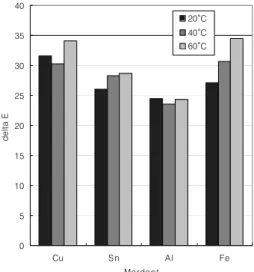
<Fig. 2> shows the effect of mordanting temperature on delta E value of coffee extract dyeing. In case of Cu and Al, no specific tendency in delta E was observed according to mordanting temperature. In case of Sn and Fe showed an increase in delta E as the increase of mordanting temperature. Especailly, Fe showed a distinct increase in delta E as mordanting temperature increased from 20 ℃ to 60 . ℃
0 5 10 15 20 25 30 35 40
Cu Sn Al Fe
Mordant
delta E
20°C 40°C 60°C
<Fig. 2> The effect of mordanting
temperature on delta E value of coffee
extract dyeing with various metal mordants
<Table 3> The effect of mordanting temperature on L*a*b*
and delta Lab values of coffee extract dyeing with various metal mordants
Mordants Temperature L* a* b* delta L delta a delta b delta E
Control 90.9 -2.04 2.7 - - - -
Cu
20℃ 71.7 7.46 25.80 -19.3 9.50 23.10 31.56
40℃ 76.4 2.35 26.51 -20.2 0.96 22.43 30.23
60℃ 66.7 6.65 25.00 -24.2 8.69 22.33 34.08
Sn
20℃ 78.5 5.13 24.42 -12.4 7.17 21.72 26.03
40℃ 76.4 2.35 26.51 -14.6 4.39 23.81 28.27
60℃ 77.1 7.37 25.98 -13.8 9.41 23.28 28.67
Al
20℃ 76.9 4.07 21.80 -14.1 6.11 19.07 24.48
40℃ 77.2 2.65 21.21 -13.7 4.69 18.52 30.58
60℃ 74.0 2.37 19.70 -16.9 4.41 17.03 34.50
Fe
20℃ 66.5 2.17 13.54 -24.4 4.21 10.85 27.06
40℃ 62.3 1.45 12.73 -29.7 3.49 10.03 23.53
60℃ 58.1 1.45 12.72 -32.8 3.49 10.02 24.40
<Table 4> shows L*a*b* and delta Lab values of coffee extract dyed silk fabrics using various mordant agents after laundry. In case of Cu, delta L varied from 0.5 to 4.0, delta a varied from 5.57 to 1.73, and delta b varied from 0.4 to 4.86. In case of Sn, delta L varied from 1.6 to 2.6, delta a varied from 5.15 to 0.82, and delta b varied from 0.15 to 6.62. In case of Al, delta L varied from 3.0 to 0.2, delta a varied from 0.32 to 1.98, and delta b varied from 0.34 to 3.44. In case of Fe, delta L varied from 0.04 to 3.4, delta a varied from 1.19 to 0.06, and delta b varied from 0.32 to 3.92. And there is no specific correlation with mordant concentration and washfastness in all kinds of mordants. And color change upon laundry is very small.
0 5 10 15 20 25 30 35 40 45 50
0.5 1 1.5 2 2.5 3
M ordant concentration (%)
delta E
Cu Sn Al Fe
<Fig. 3> Delta E value of coffee extract
dyed silk fabrics with various mordants at
various mordanting temperature after laundry.
<Table 4> L*a*b* and delta Lab values of coffee extract dyed silk fabrics using various mordant agents after laundry Mordants Concentration
(o.w.f.) L* a* b* delta L delta a delta b delta E
Cu
0.5% 67.0 7.52 23.48 1.3 -3.00 3.12 4.53
1.0% 70.0 4.49 20.66 0.7 -5.57 4.47 7.17
1.5% 66.0 7.28 23.98 -0.1 -0.35 2.22 2.25
2.0% 66.0 6.57 24.37 -0.5 -1.73 4.86 5.19
2.5% 65.9 7.98 23.59 4.0 -4.01 0.67 5.72
3.0% 65.9 7.98 23.59 2.4 -2.40 0.40 3.43
Sn
0.5% 77.1 7.37 25.98 -1.6 -5.15 5.77 7.91
1.0% 76.3 5.04 22.15 0.0 -2.69 4.36 5.12
1.5% 75.5 2.22 31.75 2.6 3.01 0.15 3.96
2.0% 77.4 7.82 24.30 2.0 -4.16 5.39 7.10
2.5% 79.3 7.30 29.66 0.6 -4.46 1.66 4.80
3.0% 78.9 4.30 26.28 -1.2 -0.82 6.62 6.78
Al
0.5% 78.0 1.53 20.95 -3.0 0.46 3.44 4.59
1.0% 79.2 2.20 18.02 -2.0 0.45 3.19 3.77
1.5% 76.4 4.88 21.05 0.2 0.85 1.64 1.86
2.0% 77.6 2.09 21.08 -0.7 1.98 0.68 2.22
2.5% 76.3 4.66 21.27 -0.2 -0.32 0.34 0.50
3.0% 76.4 4.88 21.05 0.0 0.16 1.10 1.11
Fe
0.5% 59.1 2.57 12.34 0.4 0.05 0.32 0.50
1.0% 59.3 1.39 11.96 3.0 0.06 0.77 3.06
1.5% 54.6 2.72 10.61 2.3 -0.92 2.97 3.87
2.0% 54.6 2.72 10.61 3.4 -0.39 2.40 4.18
2.5% 55.0 3.67 7.34 -0.04 -1.19 3.92 4.10
3.0% 54.6 2.72 10.61 2.0 -0.68 2.32 3.11
<Fig. 3> shows delta E value of coffee extract dyed silk fabrics with various mordants after laundry. All mordants showed a small color change, (delta E<10), and did not show any tendency upon mordant concentration with washfastness. Al mordanted silk showed the lowest delta E especially in high mordant concentration (over 2.5%).
L*a*b* and delta Lab values of coffee extract
dyed silk fabrics with various mordants at
various mordanting temperature after laundry
are shown in Table 5. In case of Cu, delta L
varied from 0.4 to 0.7, delta a varied from 5.57
to 1.77, and delta b varied from 0.66 to 4.47. In
case of Sn, delta L varied from 0 to 2.5, delta a
varied from 2.69 to 3.58, and delta b varied
from 2.14 to 4.36. In case of Al, delta L varied from 2.0 to -0.2, delta a varied from 0.26 to 1.77, and delta b varied from 0.5 to 3.19. In case of Fe, delta L varied from 1.5 to 3.25, delta a varied from 2.03 to 0.35, and delta b varied from 0.77 to 4.73. Fe mordanted fabrics showed the largest color change among coffee extract dyed silk with various mordants, however, the extent of change is very small. And it is hard to see any correlation with mordanting temperature to washfastness except Fe mordanted fabric.
<Fig. 4> shows delta E value of coffee extract dyed silk fabrics with various mordant agents at various mordanting temperature after laundry.
Delta E change is very small (less than 10) and did not show any effect of temperature on washfastness except Fe mordanted fabric. Fe mordanted silk showed an increased delta E as the increase in temperature, though the extent of color change is very small.
<Table 5> L*a*b* and delta Lab values of coffee extract dyed
silk fabrics with variousmordants at various mordanting temperature after laundry
Mordants Temperature L* a* b* delta L delta a delta b delta E
Control 90.9 -2.04 2.7 - - - -
Cu
20℃ 71.2 5.69 23.04 0.4 1.77 2.76 3.31
40℃ 70.0 4.49 20.66 0.7 -5.57 4.47 7.17
60℃ 66.0 6.57 24.37 0.7 0.08 0.66 0.97
Sn
20℃ 76.1 4.34 21.61 2.5 0.79 2.81 3.81
40℃ 76.3 5.04 22.15 0.0 -2.69 4.36 5.12
60℃ 74.6 3.79 23.84 2.5 3.58 2.14 4.85
Al
20℃ 77.4 2.30 20.63 -0.6 1.77 1.14 2.19
40℃ 79.2 2.20 18.02 -2.0 0.45 3.19 3.77
60℃ 77.4 2.30 20.63 -0.2 0.26 0.50 0.60
Fe
20℃ 65.0 1.82 12.04 1.5 0.35 1.50 2.17
40℃ 59.3 1.39 11.96 3.0 0.06 0.77 3.06
60℃ 54.9 3.48 7.99 3.25 -2.03 4.73 6.08
0 5 10 15 20 25 30 35 40
Cu Sn Al Fe
Mordant
delta E
20°C 40°C 60°C
<Fig. 4> Delta E values of coffee extract
dyed silk fabrics with various mordants at
various mordanting temperature after laundry
IV. Conclusion
From the study, coffee extract dyeing with various mordanting agents was successfully done, and the following conculsions were made;
1. Coffee extract from coffee waste can effectively dye silk fabrics with beautiful colors.
2. Different metal mordants, Cu, Sn, Al, and Fe, treatments resulted in different colors.
Copper, tin, and aluminium mordanted silk fabrics showed a golden yellow color with subtle changes of hue and value, and iron mordanted silk showed a brownish green color.
3. Low concentration of mordant is enough to get a satisfactory result, and an increase in mordant concentration did not always concur with a better dyeability.
4. Temperature in mordanting has a little effect on the dyeability, and only iron mordanting showed a temperture-dependent dyeability.
5. Coffee extract dyed textiles does not show a severe change in delta Lab and delta E after laundry.
6. Coffee extract dyeing is an innovative way using waste as resource, and can create brilliant colors with minimal amount of mordant and mild mordanting condition.
Acknowledgment : This research was supported by the research fund 2005 of the Catholic University of Korea.
References
1) Bechtold, T., Turcanu, A., Ganglberger, E., &
Geissler, S. (2003), "Natural dyes in modern textile dyehouses how to combine experiences of two centuries to meet the demands of the
future?", Journal of Cleaner Production , 11, pp.499-509
2) Katti, .M. R., Kaur, R., & Shrihari, N. (1996),
"Dyeing of silk with mixture of natural dyes", Colorouge , 43(12), pp.37-40
3) Lokhande, H. T. & Dorugade, V. A. (1999),
"Dyeing nylon with natural dyes“, American Dyestuff Reporter , 88(2), pp.29-34
4) Mondal, S., Cutta, C., Bhattacherya, S., Ganguly, D., Ganguly, S., Bandyopadhyay, S., Chattopadhyay, S., & Sau, M. (2004),
"The effect of dyeing conditions on fastness properties of natural dyes on silk fibers", Colourage , 51(8), pp.33-36
5) "Natural dyes and dyeing", (1995), Textile Magazine , 24(1), p.15-17
6) Choi, H., Shin, Y. S., Hong, S. H., Choi, C.
N., & Kim, S. Y. (2004), "Preparation of yarns by natural dyeing and antimicrobial deodorization activity", Journal of Korean Society of Dyers and Finishers , 16(2), pp.25 -33
7) Han, M. H. (2000), "Dyeing of silk fabrics by Cochineal extracts", Journal of Korean Society of Dyers and Finishers , 12(2), pp.51-59
8) Han, M. H. (2000), "The dyeability and antibacterial/deodorization activity of silk fabrics by Gromwell extracts", Journal of Korean Society of Dyers and Finishers , 12(5), pp.29-35
9) Han, S. Y. & Choi, S. C. (2000),
"Antibacterial characteristic of the extracts of yellow natural dyes", Journal of Korean Society of Dyers and Finishers , 12(5), pp.43 -50
10) Han, S. Y. & Choi, S. C. (2002),
"Antibacterial activity and identification of
the active compound from Tumeric extract",
Journal of Korean Society of Dyers and
Finishers , 14(1), pp.11-17
11) Kim, B. H. & Song, W. S. (1999), "The dyeability and antimicrobial activity of Artemisia princeps extracts", Journal of Korean Society of Dyers and Finishers , 11(5), pp.30-37
12) Kim, J. I., Choi, Y. H., & Kwon, O. K.
(2004), "Dyeability and antimicrobial activity of Gingko Biloba leaf extract using three kinds of aqueous extraction solvents", Journal of Korean Society of Dyers and Finishers , 16(2), pp.8-14
13) Lee, J. E., Kim, H. J., & Lee, M, C. (2001),
"Dyeing properties of polyamide fabrics dyed with onion shell extract", Journal of Korean Society of Dyers and Finishers , 13(3), pp.11-17
14) Park, S.Y., Nam, Y.J., & Kim. D. H. (2002),
"The dyeability and antimicrobial activity of Sophora Radix ethanol extracts Characteristics of dyed silk ", J ournal of Korean Society of Dyers and Finishers , 14(1), pp.1-10
15) Bosco, M., Toffanin, R., de Palo, D., Zatti, L, & Segre, A. (1999), "High-resolution
1