The Effectiveness of Using a Spinal Column Thermal Massage Device on Muscle Pain, Depression and Stress
Mi-Hyun Lee
1, Ka-Eun Kim
2*, Hong-Young Jang
3, Il-Young Cho
41
Adjunct Professor, Dept. of Physical Education, Sungkyul University
2
Researcher, College of Medical Sciences, Jeonju University
3
Research Professor, Convergence Research Center for Medical Sciences, Jeonju University
4
Professor, College of Medical Sciences, Jeonju University
척주 온열 마사지 기기를 이용한 근육통, 우울감 및 스트레스 개선 효과
이미현
1, 김가은
2*, 장홍영
3, 조일영
41
성결대학교 체육교육과 겸임교수
2
전주대학교 의과학대학 연구원
3
전주대학교 의과학융합연구소 연구교수
4
전주대학교 운동처방학과 교수
Abstract This study aims to examine whether the use of a spinal column thermal massage device for patients with muscle pain is effective in improving muscle pain, and to verify whether it is also effective in improving affective depression and stress. To this end, 16 study participants (male 31.25%) were treated with a thermal massage device during 5 sessions a week for 4 weeks and 40 minutes per session.
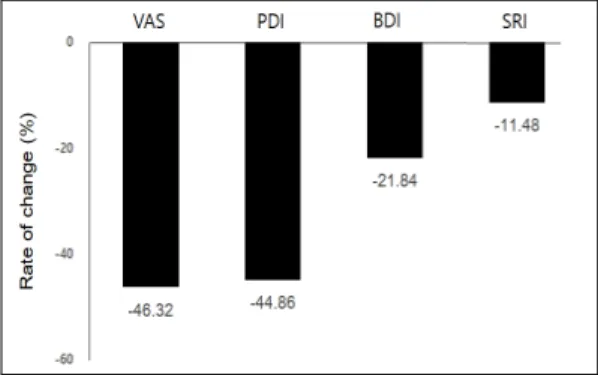
According to the study results, the subjective pain level changed by a rate of VAS -46.32% and PDI -44.86%; a significant decrease was observed in, both, VAS and PDI. The depression and stress levels changed by a rate of BDI –21.84% and SRI –11.48%; a significant decrease was observed in, both, BDI and SRI. Therefore, the use of a thermal massage device to treat patients with muscle pain is expected to have a positive effect in improving not only subjective muscle pain, but also depression and stress.
Key Words : Muscle pain, Spinal column thermal massage device, Visual analogue scale, Pain disability index, Depression inventory, Stress response inventory
요 약 본 연구는 근육통 환자들의 척주온열마사지 기기 사용이 근육통 개선에 효과가 있는지를 살펴보고, 정서적 부분인 우울감, 스트레스 개선에도 효과가 있는지 검증하는데 목적이 있다. 이를 위해 연구참여자 16명(남자, 31.25%) 은 온열 마사지 기기에 대한 처치로 4주간 주 5회, 1회당 40분을 실시하였다. 연구결과, 주관적 통증정도는 VAS -46.32%, PDI -44.86%의 변화율을 보였으며, VAS, PDI 모두 유의한 감소를 보였다. 기타 우울감 및 스트레스 정도 에서는 BDI –21.84%, SRI –11.48%의 변화율을 보였으며, BDI, SRI 모두 유의한 감소를 나타내었다. 따라서 근육통 환자 치료 시 온열마사지 기기를 활용한다면 주관적 근육통, 우울감 및 스트레스 개선에서 긍정적인 효과가 있을 것으 로 기대된다.
주제어 : 근육통, 척주온열마사지 기기, 시각적 사상 척도, 통증장애 척도, 우울 척도, 스트레스 반응척도
*Corresponding Author : Ka-Eun Kim([email protected]) Received June 11, 2020
Accepted July 20, 2020 Revised July 3, 2020
Published July 28, 2020
1. Introduction
With the recent industrialization and development of IT devices, the number of people with musculoskeletal disorders are rapidly increasing due to unstable posture, long working hours, stress and limited movement.
Musculoskeletal disorders do not result in immediate shortening of life or complications, but are accompanied by severe pain[1].
Clinically, muscle pain itself may be caused by repeated damage or a constant increase in muscle tension, and it can be caused by muscle imbalance or poor posture[2]. Muscles are very important for maintaining the stability of the spinal column, and among them, paraspinal muscles play an important role in the causes, symptoms, and treatments of various spinal diseases[3]. Although the classification of the paraspinal muscles varies slightly depending on the subjectivity, Mayer[4] classified them as Iliopoas, multifidus and erector spinae. In addition, the trapezius, which is located in the upper layer of the erector spinae across the neck, occipital bone, thoracic line, and shoulders, is also known to play an important role in the balance of the human body[5].
Imbalance of the muscles for spinal stabilization due to poor habits and posture can cause various malalignment syndromes such as, Turtle Neck posture (anterior head syndrome), rounded shoulders and kyphosis, accompanied by muscle soreness[6]. If such muscle soreness persists, the patient tends to maintain an abnormal posture to avoid pain and discomfort, and there is a risk that this action will increase the burden on other muscles, thus, causing other muscle pains[7].
Moreover, the hypothesis of pain acting as the main stress has been suggested since the 1980s, and studies have shown that chronic pain affects the hypothalamic pituitary adrenal (HPA) axis, causing stress and depression[8,9]. Chronic pain can be a physical manifestation of unknown
depression, and depression can also be the result of pain[10]. Therefore, it could be assumed that the improvement of pain would lead to the improvement of depression. Proposed treatments to relieve muscle pain include physical therapy, manual therapy, drug treatment, and trigger point injection. Physical therapy is performed by combining ultrasound, thermal therapy, and electric therapy. For manual therapy, methods such as spray and stretch, deep pressure soft tissue massage, and ischemic compression are used[11]. Patient education may include self-stretching exercises, thermotherapy and massage, exercise, good posture and relaxation.
Of these, thermotherapy and massage are the
most popular and oldest alternative
treatments[12-15]. It is known that
thermotherapy relieves pain and muscle spasm,
and these effects are related to the effect of
warming on the neuromuscular system. Type II
afferent muscle spindles primarily change the
rate of firing due to muscle stiffness or static
stretching reactions. At this time, raising the
muscle temperature to about 42°C (107.6°F)
reduces the rate of firing of type II afferent nerve
fibers and increases the rate of firing of typeⅠb
afferent nerve fibers in Golgi tendon organs
(GTOs). Therefore, the firing of α-motor neurons
decreases as the rate of firing of type II afferent
nerve fibers decreases and the fiber activity in
Golgi tendon organs increases, resulting in
reduced activity of tonic extrafusal fibers and
relieved muscle spasm and pain[16]. In addition,
thermotherapy increases nerve conduction
velocity, reduces ischemic pain with increased
blood flow and vasodilation, and relieves pain by
releasing pain mediators to cause changes in
nerve conduction and cell membrane
permeability[17]. The information of physical
compression and tactile stimulation caused by
massage is transmitted from the peripheral
nerves to the central nervous system through
thick medullated fibers and interferes with the
input of pain signals[18]. Massage also promotes blood circulation, increases lymph drainage, and improves elastic and inelastic properties in connective tissues and muscles. Due to its effects, including the reduction in muscle pain, relaxation of rigid muscles and systemic relaxation, massage is used for the treatment of various musculoskeletal disorders[19-21].
Devices for the prevention and treatment of musculoskeletal pain and rehabilitation, such as medical devices, assistive devices, and accessories that are easily accessible at home, are being continually developed and released.
Among them, Ceragem V3 (CGM MB-1401), known as a spinal column thermal massage bed, is a medical device approved by the Ministry of Food and Drug Safety that intensively provides heat and pressure stimulation to the spinal column to relieve muscle pain [22]. The effects on the stress response, fatigue relief, blood and biochemical variables in adolescents[23], athletes[24,25] and chronic patients[26] have been studied so far, but there is a lack of research on the effectiveness of spinal column thermal massage devices for patients with muscle pain. If a personal spinal column thermal massage device providing, both, thermal therapy and massage makes a positive change in relieving pain for patients with muscle pain, it will provide the data necessary for selecting scientific and effective home-use healthcare devices and contribute to enhancing their therapeutic effects.
Therefore, this study aims to examine the effectiveness of a spinal column thermal massage device (Ceragem V3; CGM MB-1401) by observing the effects that the use of the device has on subjective pain level, depression and stress in patients with muscle pain.
2. Methods 2.1 Study Participants
This study was conducted on general patients
with muscle pain in one or more areas of the shoulder, back and waist who visited the Rehabilitation Clinic Y in Jeonju.
Following a basic blood test, patients with rheumatoid diseases or other diseases that could cause systemic pain were excluded. Out of 20 participants, characteristics of 16 (male, 31.25%) were analyzed. The remaining 4 participants dropped out of the study and thus, were excluded. The average age of the study participants was 48.0±15.99 years, the average body mass index was 26.07±2.86m
2/kg, and the average duration of pain was 3±14.83 months.
All participants participated voluntarily after receiving a sufficient explanation of the purpose and experimental procedure of the study. This study was approved by the Institutional Review Board (IRB).
2.2 Study Design
In order to investigate the effects of spinal column thermal massage, the volunteers included in this study were screened through medical examination by interview, physical examination, and special tests. They were also pre-adapted within 7 days before the scheduled clinical trial date before starting the clinical trial. Once a volunteer was deemed to be a suitable clinical trial participant, and after obtaining their consent, they were registered into the clinical trial. Baseline measurements were obtained from participants who had provided informed consent prior to treatment.
Treatment using the spinal column massage device was performed for a total of 4 weeks, with 5 sessions per week and 40 minutes per session.
Within the temperature range of 30 to 60 degrees, the temperature and intensity suitable for the participant were set. Remeasurement was taken at the completion of the 4-week treatment.
2.3 Metrics and Measurement Tools
2.3.1 Spinal Column Thermal Massage Device The spinal column thermal massage device used in this study was Ceragem Personal Thermal Therapeutic Bed V3, CGM MB-1401 (CERAGEM Inc., Cheonan, Korea). CGM MB-1401 has the characteristics of a warmer applied with a special heating element to the main body and the auxiliary mat that promotes physiological functions by causing a thermal action. It also has the characteristics of a physiotherapeutic medical device with chiropractic principles as the ceramic inside the device is designed to move horizontally and vertically along the curve of the spine by the curved guide rail, and to compress and stimulate around the spinal column[22].
2.3.2 Subjective Pain Level 1) Visual Analog Scale (VAS)
To measure pain intensity in the study participants, a highly reliable VAS was used as a pain scale. The VAS is a 10 cm visual analog scale, with the left end indicating “no pain” and the right end indicating “very severe pain”[27].
Participants were asked to mark their subjective pain level on the image using numbers from 1 to 10. A visual indication was used to help quantify the pain of the patient, and the calculation was made in 0.5 units when marked in the middle of one point.
2) Pain Disability Index (PDI)
A commonly used PDI questionnaire was used to evaluate the degree of dysfunction caused by pain. The original questionnaire consisted of seven items: family and home responsibilities, recreation, social activity, occupation, sexual behavior, self-care and life support activity (eating, sleeping and breathing[28]. However, the sexual behavior items were excluded because they were difficult to apply to domestic patients.
Each item was scored 0 if there was no disability and 10 if there was total dependence; the overall
score was calculated as a percentage. Summing up the scores of the most severe level of disabilities in all items would give 60 points, thus indicating a 100% disability. If no disability was marked at all, it would give a 0 point, indicating a 0% disability.
2.3.3 Additional Tests
1) Beck Depression Inventory (BDI)
The depression-related questionnaire used BDI developed by Beck in 1961 to measure the level of depression[29]. BDI consisted of 21 diagnostic questions that determine the affective, cognitive, motivational, somatic and other symptoms of depression. Each question consisted of 4 statements describing the severity of the symptoms of depression. Questions were scored on a scale of 0-3 depending on how the participant felt. Therefore, the total score could be evaluated from 0 to 63 points, and a higher score indicated more serious symptoms of depression.
2) Stress Response Inventory (SRI)
An SRI questionnaire was used to measure the stress response (affective, somatic, cognitive, and behavioral responses)[30]. This questionnaire was scored on a 5-point scale from “Not at all” (0 points) to “Slightly” (1 point), “Much enough” (2 points), “Quite much” (3 points), and “Very much”
(4 points). A higher score indicated a higher stress intensity.
2.4 Statistical Methods
All data obtained in this study were processed
using SPSS Ver 21.0 Program. Descriptive statistics
were performed to present the mean (M) and
standard deviation (SD) for each measurement
item. The rate of change of the measurement
variables before and after using the thermal
massage device was presented using the formula
([after use]-[before use])/(before use)*100. A
paired sample t-test was conducted on the
difference between before and after using the thermal massage device. The significance level of all data in this study was set to α=.05.
3. Results
3.1 Changes in Subjective Pain Level and affective Evaluations After the Use of Spinal column thermal Massage
Fig. 1 shows the results of examining VAS and PDI as well as BDI and SRI to verify changes in subjective pain levels before and after 4 weeks of using the thermal massage device. VAS decreased by 46.32% and PDI by 44.86%. Further, BDI was decreased by 21.84% and SRI by 11.48%.
Fig. 1. Rate of change in subjective pain level
Table 1 shows the results of the paired sample t-test used to compare differences in subjective pain response levels before and after 4 weeks of using the thermal massage device. VAS and PDI as well as BDI and SRI were analyzed. There was a statistically significant difference in subjective pain level in both VAS (t=13.217, p<.001) and PDI (t=6.789, p<.001). BDI (t=5.775, p<.001) and SRI (t=6.820, p<.001) also showed significant differences before and after use.
Table 1. Change in subjective pain level and affective evaluations according to before and after use of Spinal column thermal massage device
Pre-test Post-test t p-value
VAS 5.38
±1.15 3.00
±1.37 13.217 <.001
PDI 7.19
±3.95 4.25
±3.00 6.789 <.001
BDI 10.31
±3.79 8.13
±3.81 5.775 <.001
SRI 72.94
±11.56 64.19
±7.77 6.820 <.001