국내 여성우울 중재연구에 관한 분석-통합적 고찰
최은영1·이은희2·현혜진3·변미경4
경동대학교 간호학과1, 강릉원주대학교 간호학과2, 강원대학교 춘천캠퍼스 간호학과3, 송호대학교 간호학과4
An Integrative Review of Depression Related to Intervention Studies for Women in Korea Journals
Choi, Eun Young
1· Lee, Eun Hee
2· Hyun, Hye Jin
3· Byeon, Mi Kyeong
41Department of Nursing, Kyungdong University, Wonju
2Department of Nursing, Gangeung-Wonju National University, Wonju
3Department of Nursing, Chuncheon College of Medicine, Kangwon National University, Chuncheon
4Department of Nursing, Songho College, Hoengseong, Korea
Purpose: The aim of this study was to provide basic data on the intervention for depression program development and application by analyzing the depression intervention studies for women that were published in Korea Journal (2000~2014). Methods: The research method used was the integrative review. Nine studies were reviewed from the Nursing Articles and National Assembly Library of which 41 studies were from 126 research papers that met the in- clusion criteria and analyzed using MINORS (Methodological Index for Non-Randomized Studies) and according to general characteristics. Results: There were non-equivalent control group pre-post test design (78%) in research design. 44% of articles in sample size were 14~26 participants and measuring tools were used CES-D (29%), BDI (I & II, 22%), GDSSF-K (22%). In quality of research according to MINORS, most of the papers got 2 scores except for the items of sample size calculation standard. Even though the similar intervention program were reported, the results could not compare because of diverse contents, duration, methods, and measuring tool with intervention program. As the results, aroma, massage, and counseling programs seemed to have significant effects of depression alleviation. Conclusion: The standard tailored program and measuring tool for depression alleviation of women was needed to develop.
Key Words: Depression, Intervention studies, Systematic review
주요어: 우울, 중재연구, 체계적 고찰 Corresponding author: Lee, Eun Hee
Department of Nursing, Gangeung-Wonju National University, 150 Namwon-ro, Heungup-myun, Wonju 220-711, Korea.
Tel: +82-33-760-8645, Fax: +82-33-870-8004, E-mail: [email protected] Received: Jun 1, 2015 / Revised: Nov 3, 2015 / Accepted: Dec 11, 2015
This is an open access article distributed under the terms of the Creative Commons Attribution Non-Commercial License (http://creativecommons.org/licenses/
by-nc/3.0), which permits unrestricted non-commercial use, distribution, and reproduction in any medium, provided the original work is properly cited.
서 론
1. 연구의 필요성
현대사회의 급속한 의료기술 발달과 생활수준 향상에도 불 구하고 각종 정신질환은 증가 추세에 있고, 그 중에서도 우울 증이 가장 크게 증가하고 있는데, 우울 증상은 두려움, 불안, 슬픔, 분노, 놀라움, 즐거움 등의 정서상태가 비정상적이고 부 적응 상태일 때 나타난다[1]. 또한 우울은 자신에 대한 부정적
인식의 결과로 나타나며, 근심, 침울, 실패감, 상실감, 무기력 및 무가치감 등을 보이고, 정신 ‧ 신체적 활동의 일반적인 저하 가 수반된 저항할 수 없는 정서적 태도로 부적절한 감정과 절 망감이 일상적인 우울로부터 병적인 상태에 이르기까지의 다 양한 정서장애이다[2,3].
특히 우울증은 남자보다 여자에게 2배 정도 많이 발생하는
데, 여자는 평생 동안 10~25%가, 남자는 평생 동안 5~12%가
적어도 한 번은 우울증에 걸린다[1]. 여성 우울증 발생빈도가
높은 이유는 성에 따른 생물학적차이 뿐만 아니라 여성만이
경험하는 사회적, 경제적, 정서적 요소가 특별하게 작용하기 때문이다. 여성의 경우 70대의 연령대에서 가장 높게 나타났 으며 나머지 연령별로 큰 차이가 없었으나 30대 이후에 연령 이 증가 할수록 우울증 역시 높게 증가 되고 있는 것으로 나타 났다[4,5].
이러한 여성의 우울을 완화시키기 위한 간호중재 연구들은 꾸준히 수행되고 있다. 우울완화에 적용된 중재로는 운동요법 [3,6-8], 아로마 요법[9-11], 인지 프로그램[12,13] 등이 있다.
이러한 중재 프로그램들은 생리적 ‧ 행동적 ‧ 심리적 효과가 있 는 것으로 제시되긴 하였으나 대상자들에게 시행되어진 연구 의 측면에서 연구설계, 측정도구 및 측정방법 등에 일관성을 찾기 어려웠다. 연구설계에서는 사전 사후 측정이 되지 않고 사후 측정만 수행된 연구, 단일군 실험 설계로 수행된 연구가 있었고, 중재방법도 내용이나 기간 및 횟수 등에 있어서 동일 한 중재방법이 적용된 연구가 거의 없었으며, 유사한 중재방법 이라도 측정도구가 다양하여 중재간의 효과를 종합하고 요약 하는데 어려움이 있었다. 따라서 현재까지 국내 여성을 대상 으로 한 우울중재 연구의 방법과 프로그램의 효과를 분석하여 좀 더 질적이고 효과적인 중재 프로그램을 제시하고자 한다.
통합적 고찰(integrative review)은 기존의 실험연구만을 대상으로 하는 메타분석방법보다도 확대된 개념으로 다양한 연구를 포괄적으로 고찰할 수 있는 문헌고찰 연구방법으로 근 거기반 간호 실무에 있어서 중요한 역할을 하게 하는 잠재력 을 가지고 있으므로 본 연구에 적용하여 분석하고자 한다[14].
통합적 고찰방법을 이용하여 특정한 간호중재방법을 분석한 논문들은 있지만, 우울이라는 개념을 특성화하여 분석한 논문 은 없었으며, 우울을 완화시키기 위한 프로그램 개발을 위해 서는 기존의 중재효과가 있다고 제시된 프로그램들을 고찰할 필요가 있다. 그러나 연구 디자인 및 측정도구의 문제로 인해 중재효과를 판단하기 어렵기 때문에 기존의 논문을 체계적으 로 분석하여 효과가 있는 중재내용, 기간, 방법 및 측정도구 등 을 분석할 할 필요가 있어 본 연구를 시도하게 되었다. 또한 남 성들보다 여성들에게서 우울이 더 많이 발생한다는 기존 문헌 [1]에 따라 여성을 대상으로 우울을 완화시키는 프로그램 개발 이 더욱 필요하다는 전제하에 여성대상 연구로 한정하였다.
따라서 본 연구에서는 최근 14년간 대한간호학회지와 분야 별 학회지에 게재된 여성 대상 우울 중재방법 연구를 고찰하 고, 그 결과들을 통합, 분석함으로써 우울예방을 위한 실질적 인 교육 및 중재 프로그램 개발에 지침을 제공하며, 근거기반 실무의 기초를 마련하고자 한다.
2. 연구목적
본 연구는 기존문헌의 체계적 고찰을 통해 국내 성인여성을 대상으로 수행된 우울중재에 관한 연구를 분석, 평가하여 우 울중재연구의 새로운 발전방향 제시를 위한 근거자료를 제공 하고자 하는 것이며, 구체적 목적은 다음과 같다.
여성대상 우울중재 연구의 현황과 특성을 파악한다.
여성대상 우울중재 연구의 질적인 평가를 MINORS[15]
를 이용하여 실시한다.
여성대상 우울중재 연구의 프로그램의 내용, 방법, 도구 및 효과를 분석한다.
연 구 방 법
1. 연구설계
본 연구는 국내에서 수행된 우울 중재효과를 객관적으로 규 명하기 위한 통합적 고찰방법을 적용한 문헌고찰 연구이다.
2. 분석 대상 논문
분석 대상 논문을 선정하기 위한 핵심질문(clinical ques- tions)은 선정기준 영역의 윤곽을 잡기 위해 널리 사용하는 Po- pulations, Interventions, Comparisons, Outcomes (PICO) 틀에 근거하였다. 본 연구의 대상은(P)은 국내 연구이며, 중재 방법(I)은 우울을 결과변수로 한 중재연구이다. 대조군(C)은 우울중재를 받지 않은 군이다. 결과(O)는 각 결과변수의 측정 도구인 우울측정도구를 사용하여 측정한 결과이다. 분석대상 이 된 논문의 구체적인 선정기준은 1) 2000년부터 2014년 12 월까지 대한간호학회지와 한국간호과학회 분야별 학회의 9개 학회지에 게재된 연구논문으로서, 2) 간호학 분야의 연구, 3) 우울을 결과변수로 간호중재를 적용한 연구, 4) 여성을 대상 으로 실시된 연구, 5) 한국어, 영어로 제시된 연구였다. 분석 대상에서 제외기준으로 1) 대상자가 남 ‧ 여 혼합그룹인 경우, 2) 대상자가 18세 미만인 여성을 포한한 경우, 3) 우울측정 시 복합도구를 사용(불안과 우울)한 연구는 제외하였다.
3. 자료수집 과정
자료수집 및 분석기간은 2014년 12월부터 2015년 1월까지
였으며, 우선 RISS를 통하여 Keyword ‘우울’, ‘중재연구’,
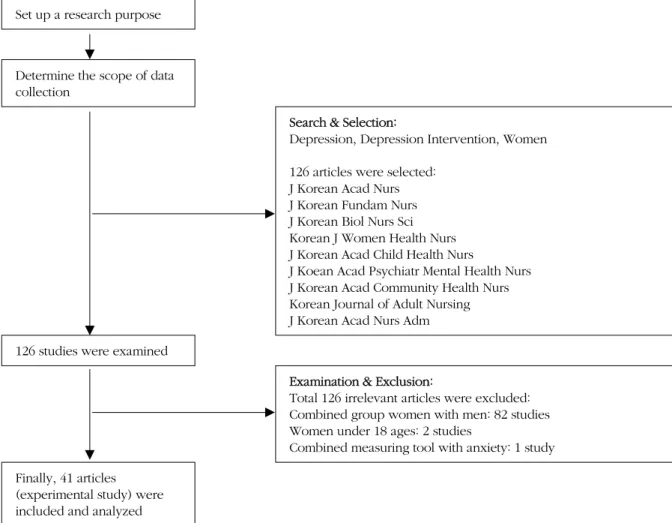
Set up a research purpose
Determine the scope of data collection
Search & Selection:
Depression, Depression Intervention, Women 126 articles were selected:
J Korean Acad Nurs J Korean Fundam Nurs J Korean Biol Nurs Sci Korean J Women Health Nurs J Korean Acad Child Health Nurs
J Koean Acad Psychiatr Mental Health Nurs J Korean Acad Community Health Nurs Korean Journal of Adult Nursing J Korean Acad Nurs Adm 126 studies were examined
Examination & Exclusion:
Total 126 irrelevant articles were excluded:
Combined group women with men: 82 studies Women under 18 ages: 2 studies
Combined measuring tool with anxiety: 1 study Finally, 41 articles
(experimental study) were included and analyzed
Figure 1. Flowchart of included studies through database search.
‘Depression’, ‘여성 우울’로 검색하였다. 이 결과 너무나 다 양한 학회지에서 논문들이 검색되어 논문의 질 평가의 효율성 과 간호학 분야의 연구 분석을 위하여 한국간호과학회 산하 회원기관 9개 학회지(대한간호학회지, 기본간호학회지, 기초 간호자연과학회지, 여성건강간호학회지, 아동간호학회지, 정 신간호학회지, 지역사회간호학회지, 간호행정학회지, 성인간 호학회지)로 국한하였다. 이에 1차 검색한 논문은 126편으로, 이를 논문 수집 양식에 기록하였으며, 논문 선정기준에 부합 되는지 확인을 위하여 Cochrane hand-book에서 제시하는 실험군과 대조군의 특성, 중재의 적용, 연구결과를 비교 분석 하여 기술할 수 있는 기준을 바탕으로 논문 수집 양식을 구성 하였다[16]. 2차 선정으로 우울중재에 대한 효과가 제시된 국 내 간호학회지 논문 중 대한간호학회지 13편, 여성간호학회 지 6편, 아동간호학회지 2편, 지역간호학회지 6편, 기본간호 학회지 4편, 기초간호학회지 3편, 정신간호학회지 7편으로 총 42편이었다. 이 과정을 통해 선정된 42편의 원본을 확보하여
연구자들이 함께 선정기준 부합 여부를 확인하는 과정을 거쳤 다. 선정과정에서 혼용된 도구를 사용한 논문 1편을 제외한 41편을 최종분석에 사용되었다. 선정된 논문은 연도, 학회지 명, 대상자 수, 설계방법, 도구의 신뢰도, 중재종류, 중재기간 을 기록하였으며, 논문 선정기준에 부합되지 않는 논문은 원 문검색 후 제외하였다(Figure 1).
4. 분석 논문의 질 평가
Whittemore와 Knafl (2005)에 의하면 통합적 고찰은 다
양한 연구설계의 논문들을 통합하는 작업이므로 한 가지 논문
의 질 평가도구를 사용하는 것은 적합하지 않을 수 있다고 하
여 명확한 근거를 두고 연구의 선정기준과 제외기준을 적용하
는 것이 중요하다고 하였다[14]. 본 연구에서도 4인의 공동 연
구자들이 통찰력과 심도 있는 논의를 통해 엄격한 선정기준을
적용하였으며, 각 논문의 발표연도, 연구설계, 연구대상자, 연
구방법론, 주요 변수 및 주요 연구결과 등으로 구분하여 매트 릭스를 작성하고 분석하면서 각각의 논문의 질을 평가하였다.
비무작위 대조군연구(Non-Randomized Controlled Clinical Trial., NRCCT)에서 적용되는 MINORS (Methodological Items for Non Randomized Studies) 질 평가 도구는[15,17]
는 평가문항이 간단하고 평가하기 쉬운 장점이 있는 도구로 12문항(분명한 목적 진술, 대상자 선정기준 준수, 전향적 자 료수집, 연구목적에 맞는 결과 도출, 연구결과에 대한 합리적 인 평가, 적절한 추적기간, 5% 미만의 탈락률, 표본 수 산정기 준 제시, 적절한 대조군 유무, 실험군과 대조군의 동시적 관 리, 실험 전 그룹 간 동질성, 적절한 통계분석)으로 구성된 3점 척도의 도구이다[15]. 이와 같은 방법을 통하여 분석대상이 된 논문들의 결과를 종합, 일치되지 않는 사항에 대해서는 논의 후 합의를 거쳤으며 불일치의 경우 세 명의 연구자가 합의를 한 경우에만 최종 평가하였다. 분석대상이 된 논문들은 연구 주제가 명료하고 연구방법과 절차가 연구목적에 부합하여 통 계에 오류가 없으며, 의미 있는 결과가 도출된 41편이 적절하 다고 판단하였다.
5. 자료분석
분석대상 논문의 모든 자료를 빠짐없이 추출하기 위해 연구 자들이 작성한 코딩 표를 이용해 변수들의 특성을 정리하였 다. 코딩표는 대상논문의 일반적 특성, 연구설계, 도구 유형 및 신뢰도, 중재방법, 질 평가, 내용분석으로 구성하였다.
연 구 결 과
1. 연구논문의 일반적 특성
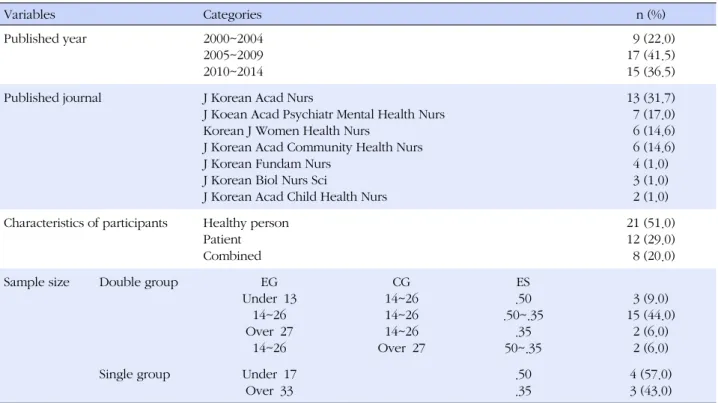
우울중재를 적용한 총 41편의 연구논문의 특성을 분석한 결과는 다음과 같다(Table 1). 연구논문이 출판된 시기는 2000~2004년 9편, 2005~2009년 17편, 2010~2014년 15편 이었다. 우울중재 대상자 중 일반인 경우가 21편, 환자군 12 편, 혼합군 8편이었다. 중재 참여자의 수는 일반적으로 ⍺=
.05 Power .80 effect size .35~.50을 많이 적용하므로, 그것 을 기준으로 두 그룹일 경우는 14~26명을 대상자로 선정한 연 구가 15편으로 가장 많았으며, ⍺=.05 Power .80 effect size .35 이상 대상자를 27명 이상으로 적용한 연구가 12편으로 조 사되었다. 단일군에서는 ⍺=.05, Power .80, size .50 이하에 서 17명 이하가 4편, ⍺=.05, Power .80, size .35 이상에서
의 33명 이상 적용한 연구가 3편으로 나타났다.
2. 연구의 설계, 도구유형 및 신뢰도
연구설계는 비동등성 대조군 전후 설계가 32편, 비동등성 대조군 전후 시차 설계가 1편, 단일군 전후 설계가 7편, 단일군 반복 설계가 1편으로 조사되었다. 사용된 측정도구는 CESD (Center Epidemiologic Studies Depression)가 12편으 로 가장 많이 사용되었으며, GDSSK (Geriatric Depression Scale Short Korea)가 9편이었고, BDI-I (Beck Depression Inventory) 6편, SDS (Self-rating Depression Scale) 5편, BDI-II (Beck Depression Inventory) 3편이었다. 모든 도 구에서 신뢰도는 0.7~0.9였으며, 50% 이상의 논문에서 0.8 이상이었으며, 0.7 이하의 신뢰도는 없는 것으로 보고되었다 (Table 2).
3. 우울 중재연구의 방법론적 질 평가
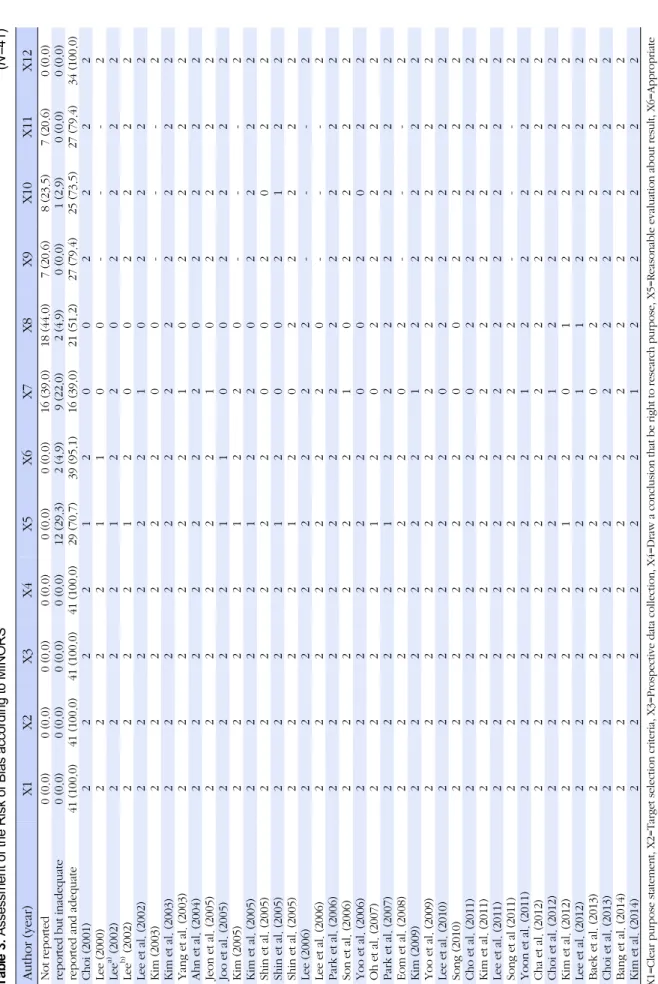
우울 중재연구의 방법론적 질 평가 결과에서는 ‘분명한 목 적 진술’, ‘대상자 선정기준 준수’, ‘전향적(연구계획서에 기술 된 대로) 자료수집’, ‘연구목적에 맞는 결과 도출’ 및 ‘적절한 통계분석’ 항목에서는 모든 항목에서 41편(100%) 모두 적절 하게 평가되었다. ‘연구결과의 합리적인 평가’ 항목에서 2점 인 항목은 29편(70.7%), ‘연구목적에 적절한 추적기간’ 항목 은 2편을 제외한 39편(95.1%)이 2점을 받았다. ‘5% 미만의 추적탈락’ 항목에서 16편(39.0%), ‘연구크기에 대한 전향적 계산(유의 수준에 근거하여 표본 크기 산정함)’ 항목에서 21 편(51.2%)으로 평가되었다. ‘적절한 대조군’ 항목에서 27편 (79.4%), ‘실험군과 대조군의 동시적 관리’ 항목에서 25편 (73.5%), ‘실험 전 상태에서의 유사성(대조군과 실험군의 동 질함)’ 항목은 27편(79.4%)으로 대체로 우수하게 평가되었다 (Table 3).
4. 우울 중재연구의 내용분석
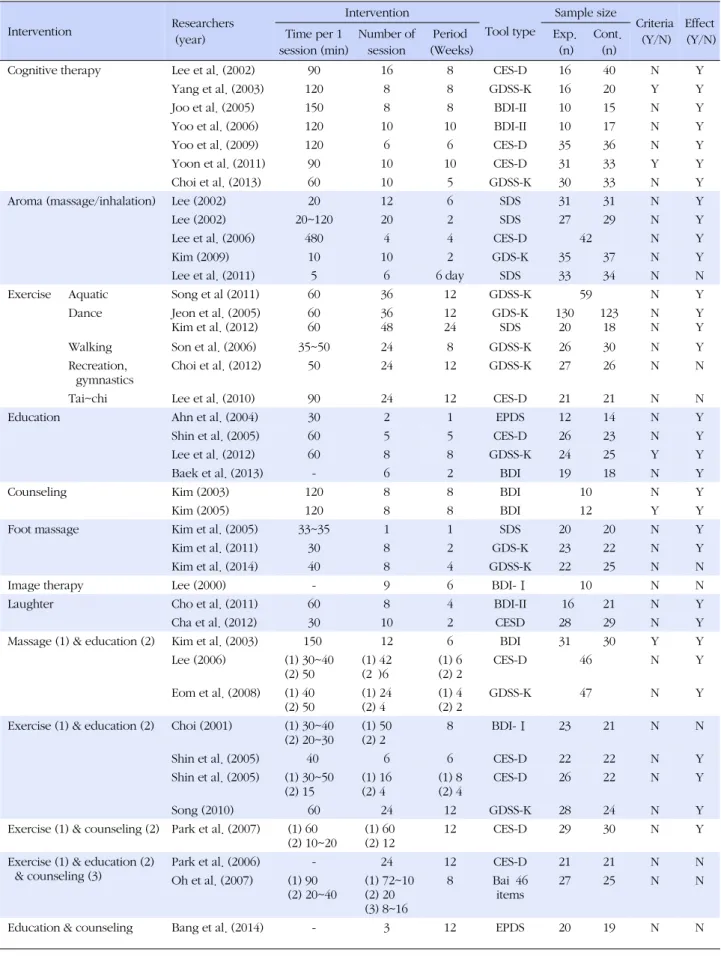
우울 중재연구 중 개별 프로그램을 적용한 연구는 총 30편 이었고, 두 가지 이상의 요법을 혼합한 복합중재연구는 총 11 편이었다(Table 4).
1) 단일 중재연구
인지요법을 적용한 논문은 총 7편으로 가장 많았다. 대상자
Table 1. Analysis of Research Articles according to General Characteristics (N=41)
Variables Categories n (%)
Published year 2000~2004
2005~2009 2010~2014
9 (22.0) 17 (41.5) 15 (36.5) Published journal J Korean Acad Nurs
J Koean Acad Psychiatr Mental Health Nurs Korean J Women Health Nurs
J Korean Acad Community Health Nurs J Korean Fundam Nurs
J Korean Biol Nurs Sci
J Korean Acad Child Health Nurs
13 (31.7) 7 (17.0) 6 (14.6) 6 (14.6) 4 (1.0) 3 (1.0) 2 (1.0) Characteristics of participants Healthy person
Patient Combined
21 (51.0) 12 (29.0) 8 (20.0)
Sample size Double group EG
Under 13 14~26 Over 27
14~26
CG 14~26 14~26 14~26 Over 27
ES .50 .50~.35
.35 50~.35
3 (9.0) 15 (44.0)
2 (6.0) 2 (6.0)
Single group Under 17
Over 33
.50 .35
4 (57.0) 3 (43.0) EG=experimental Group; CG=control group; ES=effect size.
Table 2. Type of Research Design, Tools and their Reliability (N=41)
Characteristics Categories n (%)
Research design Non-equivalent control group pre-post test design Non-equivalent control group pre-post time series design One group pre-post test design
One group repeated measured design
32 (78.0) 1 (2.4) 7 (17.1)
1 (2.4) Tools and their
reliability
Over 0.7 Over 0.8 CES-D
BDI-Ⅰ GDSSF-K SDS GDS-K BDI-II EPDS
Bai (1997) 46 items 4-point scale
2 1 5 2 1
10 5 4 3 2 3 2 1
12 (29.3) 6 (14.6) 9 (22.0) 5 (12.2) 3 (7.3) 3 (7.3) 2 (4.9) 1 (2.4) CESD=center epidenilolgic studies depression scale; BDI=beck depression inventory; GDSSF~K=geriatric depression scale short form Korea;
SDS=self-rating depression scale; GDS~K=geriatric depression scale Korea; BDI~II=beck depression inventory-II; EPDS=edinburgh postnatal depression scale.
는 실험군의 경우 평균 21명이었고, 대조군은 평균 28명이었 다. 1회 적용시간은 60분에서 150분으로 다양하였고, 중재 횟 수도 6회에서 16회로 다양하였으며, 적용기간은 5~10주였다.
측정도구는 CES-D 3편, BDI-Ⅱ 2편, GDSS-K 2편이었으며, 중재효과는 6편에서 효과가 있었고, 1편만이 효과가 없는 것 으로 나타났다.
아로마요법을 적용한 논문은 총 5편이었다. 대상자는 2그
룹인 경우 실험군은 평균 32명, 대조군은 평균 33명이었으며,
단일군은 42명이었다. 아로마 중재 1회 적용 시간은 5분에서
480분으로 다양하였고, 중재 횟수는 4회에서 20회로 다양하
였으며, 적용기간은 6일~6주 사이었다. 측정도구로는 SDS 3
편, CES-D 1편, GDS-K 1편이었으며, 중재효과는 5편 모두에
Table 3. Assessment of the Risk of Bias according to MINORS(N=41) Author(year)X1X2X3X4X5X6X7X8X9X10X11X12 Not reported0(0.0)0(0.0)0(0.0)0(0.0)0(0.0)0(0.0)16(39.0)18(44.0)7(20.6)8(23.5)7(20.6)0(0.0) reported but inadequate0(0.0)0(0.0)0(0.0)0(0.0)12(29.3)2(4.9)9(22.0)2(4.9)0(0.0)1(2.9)0(0.0)0(0.0) reported and adequate41(100.0)41(100.0)41(100.0)41(100.0)29(70.7)39(95.1)16(39.0)21(51.2)27(79.4)25(73.5)27(79.4)34(100.0) Choi(2001)222212002222 Lee(2000)22221100---2 Leea) (2002)222212202222 Leeb) (2002)222212002222 Lee et al.(2002)222222102222 Kim(2003)22222200---2 Kim et al.(2003)222222222222 Yang et al.(2003)222222102222 Ahn et al.(2004)222222202222 Jeon et al.(2005)222222102222 Joo et al.(2005)222211002222 Kim(2005)22221220---2 Kim et al.(2005)222212202222 Shin et al.(2005)222222002022 Shin et al.(2005)222212002122 Shin et al.(2005)222212022222 Lee(2006)22222222---2 Lee et al.(2006)22222220---2 Park et al.(2006)222222222222 Son et al.(2006)222222102222 Yoo et al.(2006)222222002022 Oh et al.(2007)222212022222 Park et al.(2007)222212222222 Eom et al.(2008)22222202---2 Kim(2009)222222122222 Yoo et al.(2009)222222222222 Lee et al.(2010)222222022222 Song(2010)222222002222 Cho et al.(2011)222222022222 Kim et al.(2011)222222222222 Lee et al.(2011)222222222222 Song et al(2011)22222222---2 Yoon et al.(2011)222222122222 Cha et al.(2012)222222222222 Choi et al.(2012)222222122222 Kim et al.(2012)222212012222 Lee et al.(2012)222222112222 Baek et al.(2013)222222022222 Choi et al.(2013)222222222222 Bang et al.(2014)222222222222 Kim et al.(2014)222222122222 X1=Clear purpose statement, X2=Target selection criteria, X3=Prospective data collection, X4=Draw a conclusion that be right to research purpose, X5=Reasonable evaluation about result, X6=Appropriate follow-up period, X7=Less than 5% of the eliminated, X8=Sample size calculation standard, X9=Appropriate control group, X10=Simultaneous administration of the test and control groups, X11=Homogeneous test between groups, X12=Appropriate statistical analyzes.
Table 4. Content Analysis of Intervention Studies (N=41)
Intervention Researchers
(year)
Intervention
Tool type
Sample size
Criteria (Y/N)
Effect (Y/N) Time per 1
session (min)
Number of session
Period (Weeks)
Exp.
(n) Cont.
(n)
Cognitive therapy Lee et al. (2002) 90 16 8 CES-D 16 40 N Y
Yang et al. (2003) 120 8 8 GDSS-K 16 20 Y Y
Joo et al. (2005) 150 8 8 BDI-II 10 15 N Y
Yoo et al. (2006) 120 10 10 BDI-II 10 17 N Y
Yoo et al. (2009) 120 6 6 CES-D 35 36 N Y
Yoon et al. (2011) 90 10 10 CES-D 31 33 Y Y
Choi et al. (2013) 60 10 5 GDSS-K 30 33 N Y
Aroma (massage/inhalation) Lee (2002) 20 12 6 SDS 31 31 N Y
Lee (2002) 20~120 20 2 SDS 27 29 N Y
Lee et al. (2006) 480 4 4 CES-D 42 N Y
Kim (2009) 10 10 2 GDS-K 35 37 N Y
Lee et al. (2011) 5 6 6 day SDS 33 34 N N
Exercise Aquatic Song et al (2011) 60 36 12 GDSS-K 59 N Y
Dance Jeon et al. (2005) Kim et al. (2012)
60 60
36 48
12 24
GDS-K SDS
130 20
123 18
N N
Y Y
Walking Son et al. (2006) 35~50 24 8 GDSS-K 26 30 N Y
Recreation, gymnastics
Choi et al. (2012) 50 24 12 GDSS-K 27 26 N N
Tai~chi Lee et al. (2010) 90 24 12 CES-D 21 21 N N
Education Ahn et al. (2004) 30 2 1 EPDS 12 14 N Y
Shin et al. (2005) 60 5 5 CES-D 26 23 N Y
Lee et al. (2012) 60 8 8 GDSS-K 24 25 Y Y
Baek et al. (2013) - 6 2 BDI 19 18 N Y
Counseling Kim (2003) 120 8 8 BDI 10 N Y
Kim (2005) 120 8 8 BDI 12 Y Y
Foot massage Kim et al. (2005) 33~35 1 1 SDS 20 20 N Y
Kim et al. (2011) 30 8 2 GDS-K 23 22 N Y
Kim et al. (2014) 40 8 4 GDSS-K 22 25 N N
Image therapy Lee (2000) - 9 6 BDI-Ⅰ 10 N N
Laughter Cho et al. (2011) 60 8 4 BDI-II 16 21 N Y
Cha et al. (2012) 30 10 2 CESD 28 29 N Y
Massage (1) & education (2) Kim et al. (2003) 150 12 6 BDI 31 30 Y Y
Lee (2006) (1) 30~40 (2) 50
(1) 42 (2 )6
(1) 6 (2) 2
CES-D 46 N Y
Eom et al. (2008) (1) 40 (2) 50
(1) 24 (2) 4
(1) 4 (2) 2
GDSS-K 47 N Y
Exercise (1) & education (2) Choi (2001) (1) 30~40 (2) 20~30
(1) 50 (2) 2
8 BDI-Ⅰ 23 21 N N
Shin et al. (2005) 40 6 6 CES-D 22 22 N Y
Shin et al. (2005) (1) 30~50 (2) 15
(1) 16 (2) 4
(1) 8 (2) 4
CES-D 26 22 N Y
Song (2010) 60 24 12 GDSS-K 28 24 N Y
Exercise (1) & counseling (2) Park et al. (2007) (1) 60 (2) 10~20
(1) 60 (2) 12
12 CES-D 29 30 N Y
Exercise (1) & education (2)
& counseling (3)
Park et al. (2006) - 24 12 CES-D 21 21 N N
Oh et al. (2007) (1) 90 (2) 20~40
(1) 72~10 (2) 20 (3) 8~16
8 Bai 46 items
27 25 N N
Education & counseling Bang et al. (2014) - 3 12 EPDS 20 19 N N
서 효과가 있는 것으로 확인되었다.
운동을 중재로 적용한 논문은 총 6편이었다. 운동의 유형은 복합(레크레이션과 체조), 수중, 율동, 걷기, 타이치이었으며, 대상자는 2그룹인 경우 실험군은 평균 45명, 대조군은 평균 44명이었으며, 단일군은 59명이었다. 운동중재 1회 적용 시 간은 35분에서 90분으로 다양하였고, 중재 횟수는 24회에서 48회였으며, 적용기간은 8주에서 24주로 다양하였다. 측정도 구로는 GDSS-K 3편, GDS-K 1편, SDS 1편, CES-D 1편이었 으며, 중재효과는 복합(레크레이션과 체조), 율동과 걷기에서 효과가 있었으며, 수중과 타이치에서는 효과가 없었다.
교육을 중재로 적용한 논문은 총4편이었다. 대상자는 두 그 룹인 경우 실험군은 평균 18명, 대조군은 평균 19명이었다. 1 회 적용 시간은 30분이 1편, 60분이 2편이었으며, 제시되지 않은 논문도 1편이었다. 중재 횟수는 2~8회, 적용기간은 1~5 주였다. 측정도구로는 EPDS, CES-D, GDSS-K, BDI-I로 각 1 편씩이었으며, 중재효과는 3편에서 효과가 있었으며, 1편만 이 효과가 없는 것으로 확인되었다. 발 마사지를 적용한 논문 은 총 3편이었다. 대상자는 두 그룹인 경우 실험군은 평균 22 명, 대조군은 평균 22명이었다. 1회 적용 시간은 33~40분, 중 재 횟수는 1~8회였다. 적용기간은 1~4주였다. 측정도구로는 SDS, GDSS-K, GDS-K였으며, 중재효과는 3편 모두에서 효 과가 있는 것으로 확인되었다.
상담을 중재로 적용한 논문은 2편으로, 대상자는 모두 단일 군으로 평균11명이었다. 상담중재 1회 적용 시간은 120분이 었으며. 중재 횟수는 8회, 적용기간은 8주였다. 중재 시 사용 한 도구로는 BDI-I 이며, 중재효과는 2편 모두에서 효과가 있 었다. 웃음요법을 적용한 논문은 2편으로, 두 그룹인 경우 실 험군은 평균 22명, 대조군은 평균 25명이었다. 1회 적용 시간 은 30~60분, 중재 횟수는 8~10회, 적용기간은 2~4주였다. 측 정도구로 BDI-Ⅱ에서는 효과가 있었으나, CES-D에서는 효 과가 없는 것으로 나타났다. 심상요법을 적용한 논문은 1편으 로, 단일군이며 6주간 9회 적용 하였고, 측정도구는 BDI-I로 중재효과는 없었다. 대상자 선정시 우울기준을 적용하여
또한 단일 중재연구에서 대상자 선정 시 정해진 우울의 중 등도 기준을 적용하여 대상자 선정 후 중재한 연구는 30편 중 4편으로 나타났다.
2) 두 가지 이상의 복합 중재연구
교육과 마사지를 함께 적용한 논문은 총 3편이었다. 대상자 는 두 그룹인 경우 실험군은 평균 46명, 대조군은 평균 47명이 었다. 운동중재 1회 적용 시간은 30~50분이었고, 적용횟수는
4~42회였다. 적용기간은 2~6주였다. 단일군의 경우는 실험 군 31명, 대조군 30명, 1회 적용 시간은 150, 적용회수는 12 회, 적용기간은 6주였다. 측정도구는 BDI-I, CES-D, GDSS-K 로 각 1편씩이었으며, 중재효과는 3편 모두에서 효과가 있는 것으로 확인되었다. 교육과 운동을 함께 중재로 적용한 논문 은 총 4편이었다. 대상자는 두 그룹인 경우 실험군은 평균 25 명, 대조군은 평균 22명이었다. 교육과 운동중재 1회 적용 시 간은 15~60분, 적용횟수는 2~55회였다. 적용기간은 4~12주 였다. 측정도구는 BDI-I 2편, CES-D 2편, GDSS-K 1편이었 으며 중재효과는 3편에서 효과가 있었으며, 1편만이 효과가 없는 것으로 확인되었다.
운동과 상담을 함께 중재로 적용한 논문은 1편으로, 대상자 는 실험군 29명, 대조군 30명이었다. 운동과 상담중재 1회 적 용시간은 실험군은 60분이었고, 대조군은 10~20분이었으며, 적용횟수는 실험군은 60회, 대조군은 12회였다. 적용기간은 12주였다. 측정도구는 CES-D로 효과가 있는 것으로 나타났 다. 교육과 상담을 함께 중재로 적용한 논문은 1편으로, 대상 자는 실험군 20명, 대조군 19명이었다. 교육과 상담중재 1회 적용 시간은 제시되지 않았다. 적용횟수는 3회, 적용기간은 12주, 측정도구는 EPDS로 효과가 없었다. 교육과 운동 및 상 담을 함께 중재로 적용한 논문은 총 2편이었다. 대상자는 실험 군은 평균 24명, 대조군은 평균 23명이었다. 교육과 운동 및 상담중재 1회 적용 시간은 1편은 20~40분이었고, 한편은 제 시되지 않았다. 적용횟수는 8~120회, 적용기간은 8~12주였 다. 측정도구는 CES-D는 효과가 없었고, Bai 46 items는 효 과가 없었다.
또한 복합 중재연구에서도 대상자 선정 시 정해진 우울의 중등도 기준을 적용하여 대상자 선정 후 중재한 연구는 11편 중 1편이었다.
논 의
우울 인구가 증가함에 따라 그 중요성이 강조되고 있고 이
를 극복하기 위한 노력으로 우울 중재를 적용한 논문들이 지
속적으로 이루어지고 있다. 1990년 이후부터 국내에서 우울
중재를 내용으로 한 학위논문과 주요 학회지에 논문은 매년
증가하였으며 이는 우울과 관련된 건강에 관심이 높아지면서
우울증 회복을 위한 간호중재에 관심을 두고 이에 대한 실험
연구가 점차 활발해진 것으로 생각되며, 이는 간호학문이 근
거기반 간호실무로 발전되어야 하는 긍정적인 현상으로 여겨
진다.
우울중재 연구가 게재된 시점을 보면 2005년에서 2009년 사이에 17편이 게재되어 2004년 이후 더 많은 중재연구가 이 루어진 것을 알 수 있다. 우울중재 프로그램의 참여자 특성 중 대상자에 건강한 일반인을 대상으로 하는 연구가 21편으로 가 장 많았지만, 일반인군과 환자군이 혼합된 연구도 다양하게 분석되었는데, 이는 환자나 건강인의 혼합된 대상으로 할 경 우에 질병의 유 ․ 무 정도나 건강수준에 따라서도 중재효과의 차이가 있을 수 있다. 그리고 각 도구마다 우울의 정도는 다르 게 제시되었으나 대상자 선정 시 우울기준을 적용하여 중재한 연구는 5편에 불과하였다. 우울중재 프로그램의 효과의 극대 화를 위해서는 연구설계와 대상자 선정기준에 충족할 수 있도 록 주의를 기울여야 할 것이다.
또한 연구설계에서 실험군과 대조군이 있는 유사실험설계 와 대조군 없이 단일군을 대상으로 프로그램 전후의 결과만을 비교한 단일군 전후 실험설계의 경우를 확인할 수 있어 추후 연구에서는 실험군과 대조군으로 설계하여 인과관계를 잘 나 타낼 수 있도록 실험연구가 진행될 필요가 있음을 시사한다.
또한 연구의 대상이 인간일 경우 순수실험설계가 유사실험설 계에 비해 시행하기 어려움을 알 수 있다. 그 이유는 동등한 대 상자 확보와 무작위 선정이 어렵기 때문에 비동등성 대조군 전후설계의 유사실험 32편(78%)으로 이루어지고 있으며, 비 중이 높은 것은 인정하나 비동등성 대조군 사후 설계나 단일 군 전후설계를 한 것은 앞으로의 연구에서 개선되어야 할 문 제이며, 그 연구의 결과를 해석 하는 것 또한 주의할 필요가 있 다. 무작위 대조군 연구를 중심으로 각 중재에 따른 효과를 보 고한 외국의 연구와는 달리[18,19], 국내의 경우 무작위 대조 군 연구가 적어 무작위 대조군 연구만으로는 중재에 대한 효 과를 확인하기에 어려움이 있어 근거등급이 높은 무작위 대조 군 연구를 중심으로 보다 활발한 중재연구가 요구된다.
실험연구에 있어서 근거기반으로 활용되기 위해서는 체계 적으로 보고되어야 하므로 방법론적 질 평가가 필요하며 그로 인해 실험연구결과의 오류를 줄이고 질 향상에 기여할 수 있 다[15]. 기존 연구들은 학회지위주의 분석이라서 본 연구와 차 이점을 논하기에 제한이 있으나, 5% 미만의 추적탈락에서 16 편(39.0%), 표본수 산정기준 21편(51.2%), 적절한 대조군 27 편(79.4%), 실험군과 대조군의 동시적 관리 25편(73.5%), 대 조군과 실험군의 동질함 27편(79.4%)에서의 개선이 필요한 것으로 나타남에 있어 오류를 줄일 수 있는 다양한 방안이 모 색되어야 할 것으로 사료된다. 신뢰도 역시 대부분의 논문에 서 0.7~0.9였으며, 50% 이상의 논문에서 0.8 이상으로 확인 되어 신뢰도가 높은 것을 알 수 있어 현재까지의 연구에서 신
뢰도 검증에 대한 부분은 비교적 명확한 것으로 알 수 있다.
모아상호작용을 적용한 19편의 중재연구를 MINORS 방법 으로 분석한 결과 대부분의 기준에서 적절하게 수행되었으나, 연구결과에 대한 합리적 평가 1점 이하 17편(89.4%), 전향적 자료수집 항목에서 1점 이하 18편(94.7%)으로 매우 부족하다 고 지적되었고[17], 가정의학회지에 실린 비무작위연구논문 분석에서는 연구목적에 맞는 결과, 연구결과에 대한 합리적 평가, 적절한 추적기간, 전향적인 연구크기 및 대조군과의 적 절한 통계분석 항목이 낮은 점수를 받았지만 연도에 따라 점 점 상당히 진전되는 양상을 보였다고 보고하였다[20], 결국 연 구주제와 대상자에 따라, 그리고 연구자들의 편향된 평가에 따라 항목평가가 달라질 수 있으므로 좀 더 세밀한 평가기준 이 마련되는 것이 필요하다.
MEDLINE에 수록된 우울증 연구 동향을 분석한 연구에서 우울증 환자에게 적용한 보완 대체요법 관련 국내 간호연구가 점차 증가하고 있는 경향을 보고되었으며[21], 이는 본 연구결 과와 일치됨을 알 수 있다. 이에 따라 추후 연구에서는 다양한 방법의 보완 대체요법을 개발 및 적용이 필요함을 알 수 있다.
간호학술지 연구논문 중 우울 완화에 도움을 주는 아로마 요 법에 대해 다양한 분야에서 관심을 많이 가지고 있는 것으로 확인되어, 개인 선호도에 따른 간호중재의 반복연구로 개별화 된 질 높은 간호중재 개발이 필요할 것으로 생각한다.
운동, 마사지 또한 직접적인 신체접촉이 이완 및 우울감소 에 영향을 미쳐 우울완화에 좀 더 효과적이었다고 생각된다.
운동중재의 유형 중 수중운동과[22] 태극권으로[23] 진행한 연 구에서는 우울감소에 효과를 볼 수 없었으며 걷기, 율동을 이 용한 중재에서 우울감소 효과를 보인 것으로 나타났으나, 본 연구에서의 수중운동과 태극권은 그 편수가 적으므로 추후 반 복적인 연구를 통하여 중재효과를 확인할 필요가 있겠다.
단일 중재연구 중 인지 중재는 총39편 중 6편으로, 여대생, 중년여성, 노인이었으며 신체상의 개선 프로그램을 적용한 여 대생 대상 연구1편[24]에서만 우울 감소 효과가 없었다. 앞으 로는 대상자 선정 시 사전 선별하여 적절한 대상자들에 적용 하는 반복연구를 통하여 실제적 효과를 검증할 필요가 있다고 생각한다.
발 마사지 중재로 적용한 논문은 3편으로, 유방수술 환자,
재가여성, 골관절염 환자대상으로 진행된 것으로 모든 연구에
서 우울감소 효과를 보여 주었다. 이와 같은 결과에서 만성질
환자와 장기 입원 환자에게 표준화된 간호중재를 적용할 수
있도록 발 마사지 빈도와 기간에 대해 반복연구를 하여 근거
기반실무 간호에 기반이 될 것이다. 상담중재를 적용한 논문
은 2편으로, 1인의 저자가 진행한 2편의 저소득층여성노인 대 상인 연구는 우울감소에 효과를 나타냈으며 소외된 사회 저소 득층 노인에게는 적극적으로 진행되어야 할 지역사회간호중 재로, 현재 진행되는 방문보건사업을 더욱 활성화 할 수 있는 인적자원 지원이 요구된다. 유방암생존자와, 폐경기 여성에게 적용한 웃음중재 연구에서는 폐경기 여성에서 우울감을 감소 시킨 것으로 보였고, 대학생을 대상으로 심상요법 중재연구는 심상체험의 모든 단계를 진행하여 반복연구를 통한 효과검증 을 해보는 것이 필요하다고 본다.
두 가지 이상의 중재방법을 혼합한 복합 중재연구 에서는 교육과 마사지 중재, 교육과 운동 중재, 운동과 상담중재, 운 동과 상담중재, 교육과 운동 및 상담중재가 진행되었으며 그 중 교육과 마사지 중재 3편과 운동과 상담중재 2편에서는 우 울을 감소시키는 효과를 나타내었는데 대상자는 여대생, 중년 여성. 노인으로 모든 간호대상자 에게 적용할 수 있을 것으로 사료된다. 또한 단일중재에서 마사지와 상담은 모든 대상자에 게 우울감소를 보여준 것으로 상담과 마사지를 이용한 중재방 법을 적용하여 근거기반 간호실무를 진행하는 것이 필요하다.
전체적으로 동일 간호중재이든 복합중재이든 실제 유사한 간호중재라 해도 그 내용이 다양하고 효과검증 또한 다양하 다. 프로그램의 내용, 중재방법, 기간 및 횟수, 측정도구 등이 너무나 다양하여 여성의 우울완화 중재 프로그램으로 어떠한 프로그램이 적절한 것인가에 대하여서는 결정할 수 없다. 따 라서 앞으로는 효과가 있다고 분석된 프로그램에 대한 반복연 구가 필요하다고 하겠다.
결 론
본 연구는 국내 우울증 여성을 대상 우울 중재 프로그램 개 발을 위한 근거제공을 위해 통합적 문헌고찰 방법을 이용하여 현재까지의 우울과 관련된 국내 중재연구를 통합적으로 고찰 하였다.
2000년 이후의 연구논문들은 도구의 신뢰도, 참여 대상자 수의 적정성, 실험군과 대조군의 동질성 검사 등 중재연구로 써 갖추어야 할 항목들에 대해서는 비교적 우수하게 보고하고 있다. 그러나 유사한 중재 프로그램이라도 프로그램의 내용, 방법, 측정도구의 다양성으로 인해 효과분석을 하기 어려웠 다. 따라서 개별 논문들의 질적 평가를 통하여 분석한 결과 아 로마 요법, 마사지, 인지요법 등에서 효과를 보고한 연구논문 들이 많았으므로 향후 우울완화 프로그램에는 그러한 중재방 법들을 적용하는 것이 바람직할 것으로 사료된다.
결론적으로 본 연구는 우울중재 논문 분석을 통하여 지난 15년간의 선행연구들을 종합, 정리하여 객관적인 결과를 도 출 하여, 우울과 관련된 예측 요인의 통합적 모델 수립을 위한 기초적 근거를 제시하였으며, 또한 우울에 영향을 미치는 요 인들을 통합적으로 분석하였으므로 우울예방 프로그램의 개 발 및 상담 및 치료적 접근 방법을 모색하는 데 실질적인 자료 를 제공하였다는 데 의의가 있다.
REFERENCES
1. Park CK, Lee JR. Analysis of factors affecting the change of de- pression of Korean adult male and female. Journal of Health and Social Sciences. 2011;29:99-128.
2. Beck AT. Depression: clinical, experimental and theoretical aspects. New York: Hoeber Medical Division, Harper & Row;
1967.
3. Park JK, Jang SH, Min S. Effects of stretching exercise on qual- ity of life, depression, total cholesterol in the elderly. Journal of Korean Biological Nursing Science. 2002;4(2):139-150.
4. Kwame MK. Depression. Jeon WT translator. Seoul: Acade- mia; 2005
5. Korea Health Statistics. Korea National and Nutrition Exami- nation Survey (KNHANES V-2) [Internet]. Cheongju: Korea Health Statistics; 2011 [cited 2015 May 15]. Available from:
http://Knhanes.cdc.go.kr.
6. Jeon MY, Bark ES, Lee EG, Im JS, Jeong BS, Choe ES. The ef- fects of a Korean traditional dance movement program in eld- erly women. Journal of Korean Academy Nursing. 2002;35 (7):1268-1276.
7. Kim DO, Lee HS, Kwon YS. The effects of dance sports pro- gram on health promotion in rural women. Journal of Korean Biological Nursing Science. 2012;14(2):84-93.
8. Son JU, Lee JH. The effects of the walking exercise on phys- iological index, physical fitness, self esteem, depression and life satisfaction in the institutionalized elderly women. Jour- nal of Korean Academy of Community Health Nursing. 2006;
17(1):5-16.
9. Roh KH, Park HA. A meta-analysis of the effects of aroma- therapy on psychological variables in nursing. Journal of Korean Academy Community Health Nursing. 2009;20(2):
113-122.
10. Lee SH. Effects of aromatherapy program on depression and fatigue in middle aged women. Korean of Journal of Women Health Nursing. 2002;8(3):435-445.
11. Kim SM. The effects of aromatherapy and hand massage on anxiety, sleep, and depression in the female aged at residen- tial facilities. Journal of Korean Academy of Community Health Nursing. 2009;20(4):493-502.
12. Yoo YS, Kang HY. Effects of a bereavement intervention pro- gram on depression and life satisfaction in middle aged wid- ows in Korea. Journal of Korean Academy Nursing. 2006;36 (8):1367-1373.
13. Yoo MS, Lee H, Yoon JA. Effects of a cognitive-behavioral nursing intervention on anxiety and depression in women with breast cancer undergoing radiotherapy. Journal of Korean Academy Nursing. 2009;39(2):157-165.
14. Whittmore R, Knafl K. The integrative review: Updated methodo- logy. Journal of Advanced Nursing. 2005;52(5):546-553.
15. Slim K, Nini E, Forestier D, Kwiatkowski F, Panis Y, Chipponi J. Methodological index for non-randomized studies (MINORS):
Development and Validation of a new instrument. ANZ Jour- nal of Surgery. 2003;73(9):712-716.
16. Higgins JPT, Green S, Cochrane. Handbook for systematic re- views of intervention: The cochrane collaboration [Internet].
NJ: John Wiley & Sons, Ltd; 2008. [cited 2011 December 27].
Available from: http://www.cochrane-handbook.org 17. Park SJ, Kim SJ, Kang KA. Integrative review of nursing inter-
vention studies on mother-infant interactions. Child Health Nursing Research. 2014;20(2):75-86.
18. Zhang JM, Wang P, Yao JX, Zhao L, Davis MP, Walsh D, et al.
Music interventions for psychological and physical outcomes in cancer: A systematic review and meta-analysis. Supportive
Care in Cancer. 2012;20(12):3043-3053.
19. Conn VS, Hafdahl AR, Porock DC, McDaniel R, Nielsen PJ. A meta-analysis of exercise interventions among people treated for cancer. Supportive Care in Cancer. 2006;14(7):699-712.
20. Kim HJ, Kim SY. Quality assessment of non-randomized stud- ies in the Korean Journal of Family Medicine. Korean Journal of Family Medicine. 2009:30(2):129-137.
21. Jun MH, Uhm DC, Jeong S. The analysis of the Korean nurs- ing research trends on complementary and alternative thera- pies for cancer patients. Journal of Korean Oncology Nurs- ing. 2009;9(1):67-75.
22. Song MS, Kim SK, Yoo YK, Kim HJ, Kim NC. Effects of the aquatic exercise program on body fat, skeletal muscle mass, physical fitness and depression in elderly women. Journal of Korean Biological Nursing Science. 2011;13(3):276-282.
23. Lee SR, Park HS, Cho GY. The effects of tai chi exercise on phy- sical function, stress and depression in middle aged women with osteoarthritis. Journal of Korean Academy of Funda- mental Nursing. 2010;17(2):159-168.
24. Lee SE, Chung KS. Effects of body image improvement pro- gram on self-assertiveness and depression in college women.
Journal of Korean Academy Psychiatric and Mental Health Nursing. 2002;11(3):363-374.
Summary Statement
■
What is already known about this topic?
There are some integrative reviews on other concepts, but not the depression studies for women.
■
What this paper adds?
This article reviewed articles on depression studies for women and presented the quality of articles and analysis results according to MINORS (Methodological Index for Non-Randomized Studies). As the results, aroma, massage, and counseling programs were seemed to have the effect of depression alleviation but there were no standard depression intervention program for women.
■
Implications for practice, education and/or policy
This article suggests the need for the development of tailored program for women in order to provide the basic data on the depression intervention program development and application.
Appendix: Review Paper List
1. Choi SY. The effect of exercise program on chronic low back pain in female teachers of elementary school. Korean Journal of Women Health Nursing. 2001;7(2):169-187.
2. Lee HK. The effects of image psychotherapy on self-actualiza- tion, depression and self-esteem of nursing students. Journal of Korean Academy of Psychiatric and Mental Health Nurs- ing. 2000;9(1):20-34.
3. Lee SH. Effects of aromatherapy massage on depression, self- esteem, climacteric symptoms in the middle aged women.
Korean Journal of Women Health Nursing. 2002;8(2):278- 288.
4. Lee SH. Effects of aromatherapy program on depression and fatigue in middle aged women. Korean Journal of Women Health Nursing. 2002;8(3):435-445.
5. Lee SE, Jeong GS. Effects of body image improvement pro- gram on self-assertiveness and depression in college women.
Journal of Korean Academy of Psychiatric and Mental Health Nursing. 2002;11(3):363-374.
6. Kim HM. The effect of the solution-focused group counseling on the self-efficacy and depression of low-income female fa- mily heads. Journal of Korean Academy of Psychiatric and Mental Health Nursing. 2003;12(4):493-502.
7. Kim YH, Choe US. Effects of foot reflexology education pro- gram on bowel function, anxiety and depression in nursing students. Korean Journal of Women Health Nursing. 2003;9 (3):277-286.
8. Yang S, Jung ES. Effects of the group program by reality ther- apy on depression, self control and stress coping strategies in the elderly. Journal of Korean Academy of Psychiatric and Mental Health Nursing. 2003;12(4):512-523.
9. Ahn YM, Lee SM. The effects of the integrated NICU hospi- talization education on maternal attachment, maternal self- esteem, and postpartum depression in the mothers of high-risk infants. Child Health Nursing Research. 2004;13(3):340-349.
10. Jeon MY, Bark ES, Lee EG, Lm JS, Jeong BS, Choe ES. The ef- fects of a Korean traditional dance movement program in eld- erly women. Journal of Korean Academy of Nursing. 2005;35 (7):1268-1276.
11. Joo HJ, Cho KM. Effects of cognitive-behavioral program by improving self-esteem on the problem-solving ability, depres- sion in nursing students. Journal of Korean Academy of Psy- chiatric and Mental Health Nursing. 2005;14(3):260-267.
12. Kim HM. The effect of the solution-focused group counseling program on the self-esteem and depression of low-income women. Journal of Korean Academy of Psychiatric and Mental Health Nursing. 2005;14(1):5-12.
13. Kim TH, Kim JI. Effects of foot massage on preoperative anxi-
ety, depression and sleep pattern in patients with breast sur- gery. Journal of Fundamentals of Nursing. 2005;12(2):240- 246.
14. Shin KR, Shin SJ , Kim JS, Kim JY. The effects of fall pre- vention program on knowledge, self-efficacy, and preventive activity related to fall, and depression of low-income elderly women. Journal of Korean Academy of Nursing. 2005; 35(1):
104-112.
15. Shin GN, Kim JS, Kim JY, Yi HR. Effects of a drug misuse and abuse prevention program on knowledge, attitude, and pre- ventive behaviors related to drug misuse and abuse, and de- pression in low-income elderly women. Journal of Korean Academy of Nursing. 2005;35(5):763-773.
16. Shin GN, Kim JS. The effects of exercise program on knowl- edge and attitude of exercise and depression in low-income elderly women. Journal of Korean Academy of Nursing. 2005;
35(6):1144-1152.
17. Lee YM. Effects of foot reflexology massage on climacteric symptom, fatigue and physiologic parameters of middle aged women. Journal of Korean Academy of Nursing. 2006;18(2).
284-292
18. Lee IS, Lee GJ. Effects of lavender aromatherapy on insomnia and depression in women college students. Journal of Korean Academy of Nursing. 2006;36(1):136-143.
19. Park NH, An HG. Effects of the weight management program based self-efficacy for body composition, blood lipid profile, weight self-efficacy lifestyles, depression in middle-aged obese women. Journal of Korean Academy of Nursing. 2006;36(8):
1359-1366.
20. Son JU, Lee JH. The effect of the walking exercise on physio- logical index, physical fitness, self esteem, depression and life satisfaction in the institutionalized elderly women. Journal of Korean Academy of Community Health Nursing. 2006;17(1):
5-16.
21. Yoo YS, Kang HY. Effects of a bereavement intervention pro- gram on depression and life satisfaction in middle aged wid- ows in Korea. Journal of Korean Academy of Nursing. 2006;
36(8):1367-1373.
22. Oh HE, Lee YS, Shim MJ, Kim JS. Effects of a postpartum back pain relief program for Korean women. Journal of Korean Academy of Nursing 2007;37(2):163-170.
23. Park NH, Han CI, Choi EO. The effect of a combined exercise program and telephone counseling on physiological functions, self-efficacy and depression obese middle-aged women. Jour- nal of Korean Academy of Community Health Nursing. 2007;
18(1):69-78.
24. Eom MR, Kim EK, Oh HY, Kim HS, Kwak KH. The effects of
self foot reflexology on depression, sleep and low back pain in community dwelling elderly women. Journal of Funda- mentals of Nursing. 2008;15(4):504-512.
25. Kim SM. The effects of aromatherapy and hand massage on anxiety, sleep, and depression in the female age dat residen- tial facilities. Journal of Korean Academy of Community Health Nursing. 2009;20(4):493-502.
26. Yoo MS, Lee HJ, Yoon JA. Effects of a cognitive-behavioral nursing intervention on anxiety and depression in women with breast cancer undergoing radiotherapy. Journal of Korean Academy Nursing. 2009;39(2):157-165.
27. Lee SR, Park HS, Cho GY. The effects of Tai Chi exercise on physical function, stress and depression in middle aged women with osteoarthritis. Journal of Fundamentals of Nursing. 2010;
17(2):159-168.
28. Song MS. Effects of recreation combined exercise program in body composition, physical fitness and depression in elderly.
Journal of Korean Biological Nursing Science. 2010;12(3):157- 165.
29. Cho EA, Oh HE. Effects of laughter therapy on depression, quality of life, resilience and immune responses in breast can- cer survivors. Journal of Korean Academy of Nursing. 2011:
41(3):285-293
30. Kim CS, Hong SH, Kim SR, Kim YJ. The effects of foot reflex- ology on sleep, depression and skin temperature of the fe- male elderly at home. Journal of Korean Academy of Com- munity Health Nursing. 2011;22(4):409-419.
31. Lee SO, Hwang JH. Effects of aroma inhalation method on subjective quality of sleep, state anxiety, and depression in mothers following cesarean section delivery. Journal of Fun- damentals of Nursing. 2011;18(1):54-62.
32. Song MS, Kim SK, Yoo YK, Kim HJ, Kim NC. Effects of the aquatic exercise program on body fat, skeletal muscle mass, physical fitness and depression in elderly women. Journal of
Korean Biological Nursing Science. 2011;13(3):276-282.
33. Yoon HS, Kim GH, Kim, JY. Effectiveness of an interpersonal relationship program on interpersonal relationships, self-es- teem, and depression in nursing students. Journal of Korean Academy of Nursing. 2011;41(6):805-813
34. Cha MY, Na YK, Hong HS. An effect of optimum, self-esteem and depression on laughter therapy of menopausal women.
Korean Journal of Women Health Nursing. 2012;18(4):248- 256.
35. Choi, YH, Lee CJ. Effects of a recreational combination gym- nastics program for old-old women. Journal of Korean Acad- emy of Nursing. 2012;42(6):843-852.
36. Kim DO, Lee HS, Kwon YS. The effects of dance sports pro- gram on health promotion in rural women. Journal of Korean Biological Nursing Science 2012;14(2):84-93.
37. Lee SH, Jun SS. Effects of an empowerment program on self- esteem and depression for low-income elderly women living alone. Journal of Korean Academy of Psychiatric and Mental Health Nursing. 2012;21(4):311-320.
38. Baek ES, Park HJ. Effects of a case management program on self-efficacy, depression and anxiety in pregnant women with gestational diabetes mellitus. Korean Journal of Women Health Nursing. 2013;19(2):88-98.
39. Choi YH, Jeon EY. Effects of art therapy on cognition, depres- sion, and quality of life in elderly. Journal of Korean Academy of Community Health Nursing. 2013;24(3):323-331.
40. Bang KS, Huh BY, Kwon MK. The effect of a postpartum nurs- ing intervention program for immigrant mothers. Child Health Nursing Research. 2014;20(1):11-19.
41. Kim CS, Yoo KS, Hong SH. The effects of foot reflexology on arthralgia, ankylosis, depression, and sleep in community- dwelling elderly women with osteoarthritis. Journal of Kore- an Academy of Community Health Nursing. 2014;25(3):207- 216.