JESK
http://dx.doi.org/10.5143/JESK.2016.35.6.595 http://jesk.or.kr eISSN:2093-8462Ergonomic Design of Medic Work Table (MWT) for Medical Technologist
Kyeong-Hee Choi, Sung-Yong Lee, Jun-Hyub Lee, Yong-Ku Kong Department of Industrial Engineering, Sungkyunkwan University, Suwon, 16419
Corresponding Author Yong-Ku Kong
Department of Industrial Engineering, Sungkyunkwan University, Suwon, 16419 Mobile : +82-10-2417-0779
Email : [email protected]
Received : September 07, 2016 Revised : September 13, 2016 Accepted : October 04, 2016
Copyright@2016 by Ergonomics Society of Korea. All right reserved.
○ccThis is an open-access article distributed under the terms of the Creative Commons Attribution Non-Commercial License (http://
creativecommons.org/licenses/by-nc/3.0/), which permits unrestricted non-commercial use, distribution, and reproduction in any medium, provided the original work is properly cited.
Objective:The purpose of this study was to develop and validate the guidelines for Medic Work Table (MWT) based on the anthropometric data of medical technologists.
Background: Users' anthropometric data such as sitting height, sitting elbow height, knee height, and so on are significant factors for designing comfortable and useful furniture. Thus, many guidelines for different types of desks and chairs based on the users' anthropometric data have been suggested to many researchers. However, few researches have been conducted to provide design guidelines for MWT for blood collecting task. Medical technologists often use their upper extremities to perform blood collecting task with high repetitions. These repeated motions could be a critical factor in the prevalence rate of Work-related Musculoskeletal Disorders (WMSDs).
Therefore, a study on ergonomic design of MWT would be essential in preventing the WMSDs and improving the quality of the working environment of medical technologists.
Method: This study suggested design guidelines for ergonomic MWT by focusing on the heights of the upper side and underside, depths of the inside and outside, and width of MWT through anthropometric studies and literature reviews. Afterwards, a new MWT was made using the suggested design guidelines for this study. Five healthy medical technologists participated to evaluate the original MWT and new MWT. All participants took part in the range of motion (ROM) test, electromyography (EMG) muscle activity test, and usability test to validate the suggested guidelines in this study. EMG signals of related muscles (Flexor Carpi Ulnaris, Extensor Carpi Ulnaris, Deltoid Anterior, and Biceps Branchii) were recorded through the surface electromyography system from both the original MWT and the new MWT. The ROM test of the shoulder and elbow flexion was also assessed using motion sensors.
Results: The newly designed MWT showed decreased ROMs of the shoulder and elbow up to 22% and 18% compared to the original MWT. The muscle activities in the new MWT also showed a decrease of 13% in Anterior Deltoid, 6% in Biceps Brachii, 5% in Flexor Carpi Ulnaris, and 8% in Extensor Carpi Ulnaris muscle groups, compared to the original MWT. In the usability test, the satisfaction score of the new MWT was also 56.1% higher than that of the original MWT.
Conclusion: This study suggested guidelines for designing MWT and validating the guidelines through qualitative and quantitative analyses. The results of motion analysis, muscle activity, and usability tests demonstrated that the newly designed MWT may lead to less physical stress, less awkward posture, and better physical user interface.
Application: The recommended guidelines of the MWT would be helpful information for designing an ergonomic MWT that reduces physical loads and improves the performance of many medical technologists.
Keywords: MWT (Medic Work Table), Medical technologist, Motion analysis, Muscle activity, Usability test, Ergonomic design, Musculoskeletal disorders
1. Introduction
The risk of work-related musculoskeletal disorders (WMSDs) increases due to improper working posture and physical work load.
Therefore, many workers such as visual display terminal (VDT) workers, dental technicians and medical technologist have high risk of prevalence of WMSDs due to improper working posture and long work hours. Therefore, the design of a suitable work table is essential (Alexopoulos et al., 2004; Cha et al., 2007; Jeong, 2008).
According to the Park et al. (2012)'s research, the VDT work and inspection work ratios were 42% and 37% for nurses, respectively, and most of them were reported to suffer from WMSDs in the upper extremities such as in the shoulder, back, wrist, and elbow.
Similarly, medical technologist is also exposed to repetitive work, awkward posture and long working hours which are linked to increased risk of WMSDs and therefore studies about improvement of working environment for medical technologist is needed.
However, very few studies on the working environment of medical technologists can be found unlike those on nurses, and previous studies are limited to job satisfaction only (Huh, 1986).
The blood collecting task is most frequently observed among the tasks of medical technologist; thus, the ergonomic design of an MWT (Medic Work Table) is required to reduce a medical technologist's physical loads as he/she conducts blood collecting task.
However, in most hospitals, general office table which didn't reflect the characteristic of blood collecting task are used in Korea.
Therefore discomforts to medical technologists are increased.
Upon designing a desk or a work table, a use's physical structure and anthropometric data should be sufficiently considered in order to reduce a user's discomforts and improve work efficiency (Hira, 1980). In a study of Park et al. (1995) sitting popliteal height, thigh clearance, and elbow height were measured to design a proper desk for the students. According to existing similar studies, the height of the underside and upper side of a work table should be designed in consideration of the height of the knee and elbow.
For the work table height of general office work, the elbow height (Bex, 1971) or higher than the height of 3~4cm (Chaffin and Andersson, 1991) was presented as the proper guideline.
Existing studies, however, targeted students or VDT environment workers mostly, and thus there is a limitation in applying the results of those studies to medical technologists. Given that blood collecting task is carried out through interactions with patients, MWT needs to be designed to mainly reflect women's physical features (since most medical technologists are women), as well as the anthropometric data of medical technologists and patients.
This study drew the suitable dimensions of MWT through an analysis of blood collecting task and a research on the anthropometric data of patients and medical technologists. To validate the suitability of the MWT design improvement suggested in this study, this study performed a comparative analysis of the MWT, original design and new design applied the guideline of this study, by conducting qualitative and quantitative analyses.
2. Method
2.1 Definition of design variable (dimension)
Before analyzing the MWT, this study defined the following important factors in designing a medic work table: ① Upper side height, ② Underside height, ③ Depth, ④ Inner depth, and ⑤ Width as shown in Figure 1. ① Upper side height referred to the height from the ground to the upper side of an MWT. ② Underside height was defined as the table height (underside) of an MWT. ③ Depth was defined as the length of an MWT. ④ Inner depth was defined as the depth of an MWT up to the fence based on a medical technologist. ⑤ Width was defined as the width of an MWT.
2.2 Analysis of original MWT (GNT-7 of ENERGIUM Co., Ltd)
For the analysis of problems of the original MWT (MWT before improvements were made), this study evaluated medical technologists' satisfaction with MWT's dimensions using a 5-point scale (5: very satisfied, 4: satisfied, 3: moderate, 4: unsatisfied, 5: very unsatisfied) on the following: ① Upper side height, ② Underside height, ③ Depth, ④ Inner depth, and ⑤ Width. A questionnaire survey on the discomforts or requirements of the original MWT was additionally conducted.
As a result of questionnaire analysis on satisfaction, the satisfaction score of ③ Depth was the lowest at 2.2. The reason seems that discomfort such as excessive arm expansion or flexion occurs, while medical technologist collects blood, due to the short depth of the original MWT. A satisfaction score on ① Upper side height was 2.9, slightly higher than that of ③ Depth, but an opinion that the MWT was still high to use was presented by some medical technologists, given that most of the medical technologists were women. Concerning the analysis of the satisfaction score of ④ Inner depth, it was 4.0 and showed relatively high satisfaction score. Some medical technologists expressed discomfort when work with patients using a wheelchair and tall people because they have to twist their body for blood collecting task.
There was an opinion that there was much discomfort for a medical technologist who is left handed because the ⑥ Button, ⑦ Tube return, and ⑧ Tray return of the original MWT (Figure 1) were all located on the right side only. Especially, ⑥ Button was located too far to reach and this caused awkward working posture.
Consequently, it was judged that improvements on ① Upper side height and ③ Depth, whose satisfaction scores were low, need to be conducted. An improvement for balanced use of both hands was also deemed necessary. Table 1 shows the dimension Figure 1. Definitions of the Original MWT Dimensions
[1. Upper side height; 2. Underside height; 3. Depth; 4. Inner depth; 5. Width; 6. Button; 7. Tube return; 8. Tray return]
information on the original MWT.
2.3 Improvements of original MWT
To improve the original MWT's problems, this study aimed to draw optimum dimension guidelines using the anthropometry data (Size Korea) of medical technologists (Korean women in their 20~60s) and patients (men and women in their teens-80s). The guidelines were drawn on the basis of the following important factors for the usability of the MWT: ① Upper side height, ② Underside height, ③ Depth, ④ Inner depth, and ⑤ Width dimensions. To reflect the requirements of medical technologists drawn through the usability test, this study presented MWT's design for the use of both hands.
2.3.1 Upper side height
The ① Upper side height (Figure 1) of the MWT means the height of the work table where work is conducted. Concerning the table height, this study established the guidelines indicating ① Upper side height should be higher than the sum of popliteal height and elbow height according to KS G 4203 Guidelines, specifying that design considering the space height for lower extremities should be made, and a study result asserting that the height of a work table for office work should be of elbow height (Bex, 1971).
Based on the guidelines drawn in this study, a suitable range for the upper side height using the 5th percentile, 50th percentile, and 95th percentile dimensions of the women in their 20~60s, as shown in Table 2, was drawn. As a result, this study made the guidelines asserting that the suitable range for an MWT for female medical technologists is 552~695mm and that a measurement longer than 695mm of the upper side height for an MWT is ideal.
Table 1. Dimensions of original MWT (GNT-7)
Dimensions (mm)
Upper side height Underside height Depth Inner depth Width
Original MWT 800.0 581.0 595.0 305.0 1100.0
Table 2. Recommended ranges of "upper side height" for 20- to 60-year-old female medical technologists Anthropometric data (mm)
Popliteal height (a) Elbow height (b) Upper side height = (a) + (b)
5th percentile 212.5 339.5 552.0
50th percentile 251.5 373.5 625.0
95th percentile 286.5 408.5 695.0
2.3.2 Underside height
According to the Guidelines of Desks and Chairs for Students (KS G 2010), the ② underside height of a desk should be designed to secure enough area in the lower extremities for the hip to move freely around the underside of the desk. This study made guidelines specifying that the underside height of an MWT should be higher than the sum of popliteal height and thigh clearance in order to avoid contact stress in which a user's lower extremities contact the underside of an MWT and to secure a user's extra space for the legs.
This study presented the suitable range for the underside height of MWT using the popliteal height and thigh clearance dimensions corresponding to the 5th percentile, 50th percentile, and 95th percentile of medical technologists, based on the related guidelines (Table 3). The suitable range of the underside height for an MWT is 469.0~580.0mm, and this study suggested that it should be longer than 580.0mm upon applying the maximum value design.
2.3.3 Depth
Because blood collecting task is carried out while a medical technologist grabs a patient's arm, the anthropometric data of the patient and medical technologist should be considered when the ③ Depth of an MWT is designed. The patient holds out his/her hand towards the medical technologist, and the medical technologist collects blood from the vein around the supinator muscle while holding the patient's arm. The depth of an MWT should be designed in consideration of the length from elbow to hand, which is the medical technologist's normal work area (Pheasant and Steenbekkers, 2005), and the patient's upper-arm length (Table 4).
To suggest the suitable range of the depth of an MWT, this study used shoulder-elbow length corresponding to the 5th percentile, 50th percentile, and 95th percentile of male and female patients aged 10~80. After assuming the patient's upper arm angle as 15°, this study drew upper arm horizontal length (shoulder-elbow length x cos15°). 15°, a frequently observed position through blood collecting task, was thereby selected as the patient's upper arm angle.
This study used female medical technologists' elbow grip length in their 20~60s corresponding to the 5th percentile, 50th percentile, Table 3. Recommended ranges of "underside height" for 20- to 60-year-old female medical technologists
Anthropometric data (mm)
Popliteal height (a) Thigh clearance (b) Underside height = (a) + (b)
5th percentile 339.5 129.5 469.0
50th percentile 373.5 148.5 522.0
95th percentile 408.5 171.5 580.0
and 95th percentile. As a result, the suitable range of the depth of an MWT taking into account patients and medical technologists was 534.8~669.8mm, and this study drew the guideline specifying the MWT's depth as lower than 535.0mm by applying the minimum value design principle.
2.3.4 Inner depth
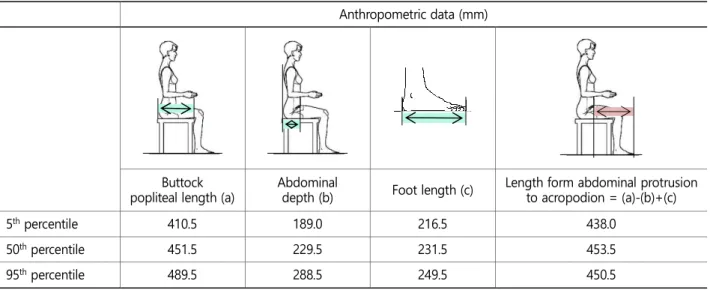
Based on the standard KS G 4203 specifying that the ④ Inner depth of an MWT should secure sufficient available space for the lower extremities, this study presented suitable inner depth in consideration of the length up to a medical technologist's abdominal protrusion and acropodion length.
The depth of an MWT should be able to encompass the length from the medical technologist's abdominal protrusion to acropodion.
Therefore, this study calculated the length from abdominal protrusion to acropodion (buttock popliteal length - abdominal depth + foot length) using medical technologists' (women in their 20~60s) buttock popliteal length, and foot length data corresponding to the 5th percentile, 50th percentile, and 95th percentile (Table 5). The suitable inner depth of an MWT drawn is 438.0~450.5mm, and the final guidelines for the ④ Inner depth were presented as longer than 451.0mm by applying the maximum value design.
Additionally, this study designed the adjustable MWT to freely change the inner depth to cover the various patients from children to wheelchair users.
2.3.5 Width
Concerning the ⑤ Width of an MWT, it should be designed to have enough area for work according to the Notice of the Ministry of Labor. This study also referred to the guidelines of the U.S. Ergonomics Standard ANSI/HFES 100-2007 specifying that width of Table 4. Recommended ranges of "depth" for 20- to 60-year-old female medical technologists and 10- to 80-year-old male and female patients
Anthropometric data (mm)
Patient Medical
technologist Depth
Shoulder-elbow length
Upper arm horizontal length (a)
= shoulder-elbow length × cosθ (θ=15°)
Elbow-grip length (b)
Depth
= (a) + (b)
5th percentile 270.5 261.3 273.5 534.8
50th percentile 317.5 306.7 299.5 606.2
95th percentile 356.5 344.3 325.5 669.8
work table needs to be more than 700mm minimum.
This study made the guidelines specifying that the MWT's width should be shorter than the sum of shoulder width and length of both arms. this study drew the suitable MWT's width using the shoulder width and the length of both arms of the medical technologists (women in their 20~60s) corresponding to the 5th percentile, 50th percentile, and 95th percentile. Consequently, the suitable range of an MWT width was selected as 1321.0~1543.0mm (Table 6). Since the MWT also needs to be designed for a medical technologist corresponding to the 5th percentile to work, this study suggested the final guidelines on the MWT width as shorter than 1321.0mm by applying the minimum value design.
Table 5. Recommended ranges of "inner depth" for 20- to 60-year-old female medical technologists Anthropometric data (mm)
Buttock popliteal length (a)
Abdominal
depth (b) Foot length (c) Length form abdominal protrusion to acropodion = (a)-(b)+(c)
5th percentile 410.5 189.0 216.5 438.0
50th percentile 451.5 229.5 231.5 453.5
95th percentile 489.5 288.5 249.5 450.5
Table 6. Recommended ranges of "width" for 20- to 60-year-old female medical technologists Anthropometric data (mm)
Shoulder width (a) Length of arm (b) Width= [(a) + (2 × (b))]
5th percentile 323.5 498.5 1321.0
50th percentile 354.5 535.5 1426.0
95th percentile 382.5 580.0 1543.0
2.3.6 MWT for both hands tasks
The original MWT's switch button, tube feeding entrance, and tray return were all located on the right side only (Figure 2, left).
Therefore there were opinion that left-handed workers have to take the awkward posture to press the button, and also right handed worker experienced partial fatigue of right upper extremities since work concentrated on the right side. To solve such a problem, this study designed the MWT in a way that the switch button, tube feeding entrance, and tray return should be placed on both the right and left sides so that work can be properly distributed to both hands (Figure 2, right).
3. Results
3.1 Motion analysis
To validate the suitability of the guidelines through a comparison of the new MWT (MWT after improvements were made), and the original MWT, this study carried out a motion analysis. Before the motion analysis, the blood colleting task was classified by unit task, and confirmed the eight following unit tasks: ① Pressing the switch, ② Applying the tourniquet, ③ Disinfecting the venipuncture site, ④ Inserting the needle, ⑤ Pulling the plunger, ⑥ Transferring the blood to the evacuated tube, ⑦ Shaking the tube, and ⑧ Feeding the tube (Figure 3). For each unit task's motion analysis, an Inertial Measurement Unit sensor (MyoMotion, Noraxon, USA) was used, and the original and new MWTs were compared by measuring elbow angle and shoulder angle by unit task (Figures 4 and 5). As for the significant differences between the physical angles of the original MWT and the new MWT, a paired t-test was conducted using SPSS 18.0 (Lead Technologies, Inc., Chicago, USA).
As a result of the motion analysis, the mean elbow angle of the new MWT was 90.9°, showing a statistically significant decrease (18%), compared to the elbow angle (111.3°) of the original MWT (p-value <0.05). The shoulder angle of the new MWT (35.3°) also showed a 22% decrease, compared to that of the original MWT (45.1°) (p-value <0.05). In the tube feeding task, shoulder angle and elbow angle decreased 78% and 41%, respectively, and the biggest improvement was shown (Figure 6). In the case Figure 2. Design for both hands tasks (left: original design vs. right: new design)
Figure 3. Operations of the blood collecting task. ① Pressing the switch, ② Applying the tourniquet, ③ Disinfecting the venipuncture site, ④ Inserting the needle, ⑤ Pulling the plunger, ⑥ Transferring the blood to evacuated tube, ⑦ Shaking the tube, and ⑧ Feeding the tube
Figure 4. Comparison of elbow angles (left: original design vs. right: new design)
Figure 5. Comparison of shoulder angles (left: original design vs. right: new design)
major muscles used the most were selected and attached surface EMG to muscles. The selected muscles were flexor carpi ulnaris, extensor carpi ulnaris, deltoid anterior, and biceps brachii (Table 7). The measured EMG signals were filtered using the bandpass filter in the 10~250Hz after rectification, and they were transformed into RMS (Window size: 1,000), and then analyzed. This study collected EMG signals with a sampling frequency of 1,500Hz.
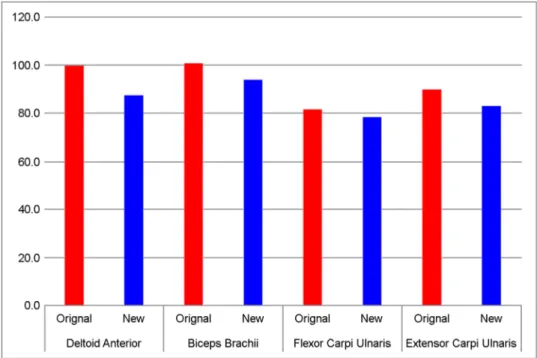
For the comparison of muscle activities of the original and new MWTs, this study conducted a paired-test. Although no statistically significant differences were found between the two MWTs (p=0.09), generally the new MWT showed lower muscle activity overall than that of the original MWT. In particular, the muscle activity of the deltoid anterior (13%) decreased the most, followed by biceps brachii (6%), flexor carpi ulnaris (5%), and extensor carpi ulnaris (8%) (Figure 7).
3.3 Usability test analysis
For a qualitative analysis of the original and new MWTs, this study carried out a usability test targeting five medical technologists.
They were instructed to conduct blood collecting task three times using the original and new MWTS, respectively. After each participant conducted blood collecting task six times in total (two types of MWTs x three times), the usability test was carried out.
The usability test was performed by dividing it into evaluation on satisfaction with four dimensions and symmetric design and evaluation on overall satisfaction with posture and purchasing intention.
Satisfaction with dimensions were evaluated with 5-point scale (5: vary satisfied, 4: satisfied, 3: moderate, 2: unsatisfied, and 1: very unsatisfied) on the four items (upper side height, underside height, depth, and inner depth) and symmetric design. The mean satisfaction score with the original MWT was 15.4 points while the new MWT's mean satisfaction score was 21.4 out of 25 points, which was a 39.0% increase rate (p<0.05). Satisfaction sharply improved in the symmetric design of the button and return, upper side height and depth (Table 8). The original MWT's overall mean satisfaction score was 8.2 points and the new MWT's score was Figure 7. Comparisons of muscle activities associated with original design and new design
Figure 7. Comparisons of muscle activities associated with original design and new design
12.8 points out of 15 points, which was a 56.1% increase rate (p<0.05) (Table 9).
4. Discussion
This study analyzed the problems of the original MWT based on ergonomic research. It suggested the MWT design guidelines considering the anthropometric data of medical technologists and patients. For qualitative and quantitative validation of the MWT design guidelines in this study, the original and new MWTs were comparatively analyzed by performing a muscle activity analysis, motion analysis, and usability test.
The guidelines of MWT were drawn through a literature study of standards and guidelines and an anthropometric data research of medical technologists and patients. This study used the anthropometric data of women in their 20~60s since most medical technologists are women. Because there are various age groups in the case of patients, the anthropometric data of men and women aged 10~80 were used for the guidelines.
This study drew improvements for MWT focusing on the dimensions such as the upper side height, underside height, depth, inner depth and width of MWT because those dimensions correlated with satisfaction of user and work efficiency. In addition, this study designed the MWT by reflecting the voice of customer (VOC) of medical technologists so that symmetric design was applied.
A conclusion that longer than 695.0mm and longer than 580.0mm of MWT's upper side height and underside height were suitable in designing was drawn. Shorter than 535.0mm was suitable for depth, and more than 451.0mm was suitable for inner depth. The inner depth of the MWT was designed to be freely adjusted by moving the fence in consideration of a patient using a wheelchair and a tall patient. The guidelines specifying that width should be designed shorter than 1321.0mm were presented in this study.
In addition, symmetric design was suggested in a way that the tube feeding entrance, switch, and tray return were placed on both the right and left sides so that blood colleting task was evenly distributed to both hands, based on medical technologists' VOC.
Through a comparison between the new MWT which the drawn guidelines were applied and the original MWT, guideline suggested in this study was validated. According to the motion analysis result, the shoulder and elbow angles of the unit tasks, except the tasks Table 8. Satisfaction evaluation for dimensions associated with original design and new design
Satisfaction with dimensions (out of 25 points) Upper side
height Underside
height Depth Inner
depth Symmetric
design Total
Original design 2.8 4.2 2.2 4.0 2.2 15.4
New design 4.6 4.2 4.2 4.0 4.4 21.4
Table 9. Overall satisfaction evaluation associated with original design and new design Overall satisfaction (out of 15 points)
Posture Design Purchasing intention Total
Original design 3.0 2.8 2.4 8.2
New design 4.6 4.0 4.2 12.8
of pressing the switch and transferring the blood to the evacuated tube, decreased 22% and 18%, respectively, and this difference was statistically significant. Shoulder and elbow angles decreased 78% and 41%, respectively, in the case of tube feeding task, which showed the biggest improvement. Both hands can be used, and the shoulder and elbow angles decreased due to suitable task location. According to the previous studies reporting that discomfort increases as shoulder and elbow angles increase (Kong et al., 2010), and that the maximum duration of muscle strength exertion decreases as discomfort increases (Moon et al., 2005), the new MWT is considered to decrease a user's physical loads.
In comparison of muscle activities of the original and new MWTs, statistically significant differences were not shown; however, the new MWT's muscle activity decreased in all muscles, compared to the original MWT. The muscle activity of the deltoid anterior decreased the most by 13%. The muscle activities of biceps brachii, flexor carpi ulnaris, and extensor carpi ulnaris decreased by 6%, 5%, and 8%, respectively. Kim et al. (2005) said that the increase of muscle activity means that muscle fatigue may occur. Given that the muscle activity values of medical technologists decreased when they used the new MWT, the new MWT which applied the guideline derived by this study was conjectured to contribute to the reduction of a user's muscle fatigue.
For the comparison of user satisfaction with the original and new MWTs, this study conducted a usability test on the dimensions and design of the MWTs targeting five medical technologists. Mean satisfaction score on the original MWT dimensions was 15.4 points, while that on the new MWT was 21.4 points out of 25 points, and thus satisfaction score increased 39.0%. The medical technologists' satisfaction with the upper side height, depth and the symmetric design of button and return sharply improved.
Regarding overall satisfaction with design, posture, and attraction on purchase, the mean satisfaction score of the original MWT was 8.2 points, and that of the new MWT was 12.9 points out of 15 points, which showed 56.1% increase rate. When the guidelines of this study were applied, the comfort of users and the medical technologists might be increased.
5. Conclusions
Although various factors in work environment cause biomechanical and physiological stress to workers, the biggest cause is improper working posture (Sanders and McCormick, 1992). This study presented MWT's recommended design dimensions, based on the anthropometric data of the medical technologists and patients. This study also validated the enhancement of users' comfort through users' satisfaction improvement and physical load decrease via qualitative and quantitative evaluations.
The guidelines of the MWT drawn through this study were judged to contribute to improvement of working environment through application to the medical service sites and office environment, as well as the MWT. This study is expected to help in researches targeting various improvements in MWTs.
Acknowledgements
This work was supported by the Industrial Strategic technology development program, 10050810, Development of Disability Independent Accessibility Enhancement Technology for Input and Abnormality of Home Appliances funded By the Ministry of Trade, Industry & Energy (MI, Korea). And this work also supported by the Energium Co., Ltd.
References
Alexopoulos, E.C., Stathi, I.C. and Charizani, F., Prevalence of musculoskeletal disorders in dentists, BMC Musculoskeletal Disorders, 5(1), 1-16, 2004.
Bex, F.H.A., Desk heights, Applied Ergonomics, 2(3), 138-140, 1971.
Cha, J.H., Ryu, T.B., Choi, H.S., Lee, J.B., Kim, M.K. and Chung, M.K., Jeong, C.H., Survey of Musculoskeletal Disorders in Korean Dentists, Journal of the Ergonomics Society of Korea, 26(2), 137-147, 2007.
Chaffin, D.B. and Andersson, G.B.J., Occupational Biomechanics, 2nd ed., John Wiley & Sons, 1991.
Hira, D.S., An ergonomic appraisal of educational desks, Ergonomics, 23(3), 213-221, 1980.
Huh, I.N., A study on the Factors Affecting the Degree of Job Satisfaction of Korean Medical Technologists, Korean Journal of Clinical Laboratory Science, 18(1), 123-130, 1986.
Human Factors and Ergonomics Society. Human Factors Engineering of Computer Workstations (ANSI/HFES 100-2007), 2007.
Jeong, I.H., Investigation on Relevant factors between the Job Stress of the Dental Technicians at the certain areas (Daegu, Gyeongbuk, Ulsan) and the Subjective Symptom for Musculoskeletal System Disorder, Ph. D. Dissertation, University of Daegu Haanny, Korea, 2008.
Moon, C.Y., Na, S.H., Kee, D.H. and Chung, M.K., Comparison of Observational Posture Evaluation Methods based of Maximum Holding Times, Journal of the Korean Institute of Industrial Engineers, 31(4), 289-296, 2005.
Park, J.K., Jang, S.H., Kim, D.S., Hur, K.H., Lee, H.Y., Choi, E.Y., Cho, J.H. and Woo, H.S., Musculoskeletal disorders and job stress risk factors in general hospital nurses: Nursing tasks and musculoskeletal disorder symptoms, Transactions of the Korea Society of Mechanical Engineering B, 35(11), 1105-1110, 2012.
Park, S.C., Kim, J.H. and Kim, C.J., A study on preferred height and range of discomfort recognition for designing educational desks and chairs, Journal of the Ergonomics Society of Korea, 14(2), 41-50, 1995.
Kim, S.H., Lee, T.W., Ko, D.Y., Jung, C.K., Kim, I.S., Kang, W.H., and Lee, H.Y., A study on the Design of Low back Muscle Evaluation System Using Surface EMG, The Transactions of the Korean Institute of Electrical Engineering D, 54 (5), 338-347, 2005.
Kong, Y.K., Kim, D.M., Han, J.G. and Lim, C,M., The effect of shoulder and elbow angles on the grip force and EMG signal, Proceedings of 2010 Fall Conference of the Ergonomics Society of Korea, Pyeongchang, Korea, 36-39.
Korea Ministry of Employment and Labor. Employment and Labor Policy in Korea (No. 2004-50); The management guideline for the VDT task workers.
KS A ISO 9241:11 - Ergonomic requirements for office work with visual display terminals (VDTs)-Part 11: Guidance on usability.
KS G 4203, Office furniture-desks and tables.
KS G 2010, Chairs and tables for educational institutions.
Pheasant, S.T. and Steenbekkers, L.P.A., Anthropometry and the design of workspaces, 3rd ed., 2005.
Sanders, M.S. and McCormick, E.J., Human Factors in Engineering and Design, Seventh Edition, New York, McGraw-Hill, Inc, 1992.
Size Korea Home Page, http://sizekorea.kats.go.kr (retrieved December 1, 2015).
Author listings
Kyeong-Hee Choi: [email protected]
Highest degree: M.S., Department of Industrial Engineering, Sungkyunkwan University Position title: Ph.D., Candidate, Department of Industrial Engineering, Sungkyunkwan University Areas of interest: Physical Ergonomics, Hand Functionality, Hand Modeling
Sung-Yong Lee: [email protected]
Highest degree: B.S., Department of Industrial Engineering, Hanbat National University Position title: M.S., Candidate, Department of Industrial Engineering, Sungkyunkwan University Areas of interest: Physical Ergonomics, Workload Evaluation
Jun-Hyub Lee: [email protected]
Highest degree: B.S., Department of Industrial Management Engineering, Namseoul University Position title: M.S. Candidate, Department of Industrial Engineering, Sungkyunkwan University Areas of interest: Occupational Ergonomics, Musculoskeletal Disorders
Yong-Ku Kong: [email protected]
Highest degree: Ph.D., Department of Industrial and Manufacturing Engineering, Pennsylvania State University Position title: Professor, Department of Industrial Engineering, Sungkyunkwan University
Areas of interest: Physical Ergonomics, WMSDs, Finger/Hand Modeling