JESK
http://jesk.or.kr eISSN:2093-8462The Effects of Sign Language Video Location in e-Learning System for the Hearing-impaired
Seung Ho Muhn, Kwang Tae Jung
Koreatech, Industrial Design Engineering, Chungnam, 32153
Corresponding Author Kwang Tae Jung
Koreatech, Industrial Design Engineering, Chungnam, 32153
Mobile : +82-10-8838-9306 Email : [email protected]
Received : September 22, 2015 Revised : November 10, 2015 Accepted : November 11, 2015
Objective: The purpose of this study is to identify the effects of sign language video location in e-learning system for the hearing-impaired.
Background: E-learning education is a good way to resolve the inequality of education for the disabled. Providing a sign language video in e-learning education for the hearing-impaired is very important for their learning. Although the location of sign language video is an important factor in the design of the video, the effect of its location in learning using the e-learning system was not studied.
Method: In order to identify the effect of sign language video location on the learning of the hearing-impaired using the e-learning system, the prototypes of the system with different locations were developed. Eighteen people with hearing impairment participated in this experiment. Learning presence, learning immersion, and learning satisfaction were used to measure learning effects with sign language video location.
Results: Bottom right position was more preferred through preference evaluation for sign language video location. The learning effect with sign language video location (bottom-left and bottom-right) was not significant. That is, the effects of learning presence, immersion, and satisfaction were not statistically significant with video location.
Conclusion: From this study, the following have to be considered in e-learning system design for the hearing-impaired. Although the location of a sign language video is not a significant factor from the experiment, the bottom right position in the design is proposed because learning presence and satisfaction is slightly higher at the bottom right position, and the position is preferred from subjective evaluation. From the analysis of interview data, it was also proposed that the design of a sign language video should be improved for the hearing-impaired.
Application: The result of this study can be applied to the e-learning system design for the hearing-impaired.
Keywords: The hearing-impaired, Sign language video, Learning presence, Learning immersion, Learning satisfaction
Copyright@2015 by Ergonomics Society of Korea. All right reserved.
○ccThis is an open-access article distributed under the terms of the Creative Commons Attribution Non-Commercial License (http://
creativecommons.org/licenses/by-nc/3.0/), which permits unrestricted non-commercial use, distribution, and reproduction in any medium, provided the original work is properly cited.
1. Introduction
To improve disabled people's quality of life, the employment of them needs to increase, and the solution to education inequality should be preceded preferentially to increase the employment of the disabled. Especially, one of the best methods to solve disabled people's education inequality is to expand and diffuse the e-learning
system in the contemporary information era (Ahn, 2008).
E-learning means learning based on electronic foundation. E-learning is interpreted as the meaning like remote education and online education. E-learning is an education system transcending time and space, and can be used as customized learning tuned to individual needs or possibilities by offering learning opportunities to the socially underprivileged such as disabled people having difficulties in participating in learning (Shin, 2003).
In learning using the e-learning system, however, the efficiency of learning may decline according to the disability type of disabled people. Hearing impairment belongs to a serious case, and learning ability or perception capability tend to be lower than other types of disabilities, due to limitation of no hearing sound, although hearing impairment is more excellent than other types of disabilities in physical condition such as mobility and activity. Because of such characteristics, learning efficiency is to be enhanced by providing sign language video on the e-learning system screen (Park, 2004).
Hearing impairment refers to the case that impairment is caused in communication, due to the defect of hearing organs or loss of hearing, which is derived from hearing defect and equilibrium function impairment. Hearing impairment is classified according to the degree of loss of hearing. When a person has more than 90dB in hearing loss, he/she is judged as the disabled person with second or first class hearing impairment (Lee, 2013).
The information reception of the hearing impaired hugely depending on vision is far behind in abstractive thinking area than normal people having no hearing impairment. Generally, the cognitive ability of the hearing impaired is similar to the normal people in quantitative aspect; however, it is lower than the mean in the language-related test. The intelligence of the hearing impaired can be within the normal range, but they show intellectual capacity lower than the mean value, when high level of intellectual capacity is required. However, this can be improved through effective education and experience (Lee, 2013). The hearing-impaired are inattentive and poor in concentration in the learning process, and they have anxiety on whether their words are delivered to others well, or whether they understand others well in many cases.
By reflecting the characteristics mentioned above, e-learning for the hearing impaired enhances the efficiency of learning by offering the sign language video at the corner of the screen; however, there has been no study on the location of the sign language video to provide better learning efficiency. Due to such a need, this study researched the effects of sign language video location in e-learning system for the hearing impaired.
2. Methodology
2.1 E-learning system for studying
In this study, an e-learning sites was selected for identifying learning effect according to the sign language video location in e- learning, which was designed in consideration of the hearing impaired.
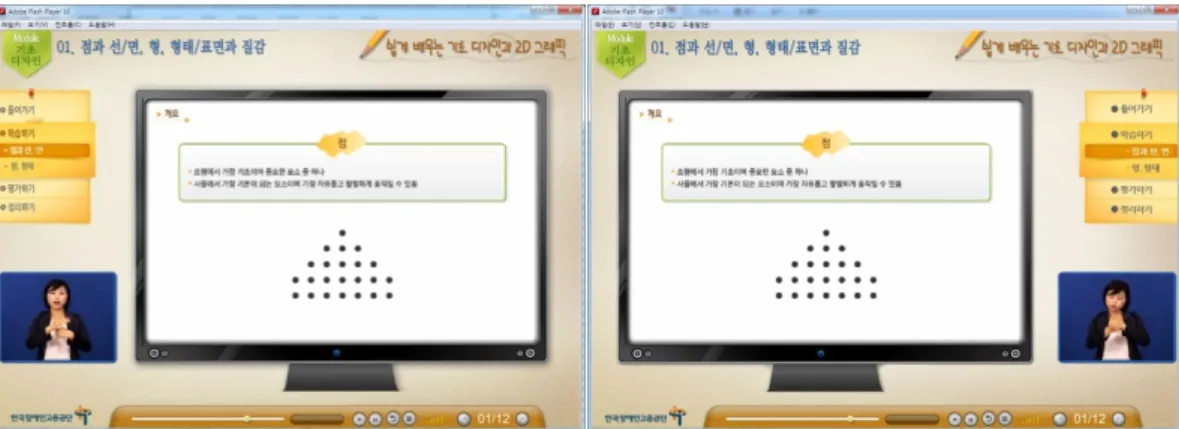
The e-learning site produced and operated by the Digital Capability Development Institute of the Korea Employment Agency of the Disabled (KEAD) in 2011 offers the sign language video on the learning screen, and was developed in consideration of the hearing impaired in overall interface and learning content. Among many established courses, this study targeted design basics and 2D graphics that can be easily learned. The selection of an e-learning site was made by three Web designers (Those with more than ten years of Web design: one in 30s and two in 40s). Figure 1 shows the basic screen and structure of the e-learning system.
As shown in Figure 1, the current system shows the sign language video at the bottom left mainly, and there has been no study on whether the location is effective for learning so far.
2.2 Measurement of learning effect
To find out the effects of sign language video location in the e-learning for the hearing impaired, the scale or measure to evaluate learning effect is required. Looking at previous studies related with learning effect evaluation, they evaluated learners' academic achievement, learning participation, learning presence, learning satisfaction, motivation, capability using the Internet, learning immersion, or learning continuity (Choi & Jun, 2011; Kang et al., 2007; Suh, 2008).
Learning presence means the perception on learning content or learning situation, and it enables a learner to realize his/her participation in learning in the e-learning environment, and offers meaningful learning experience and successful learning result.
When the level of learning presence that learners perceive improves, learners conduct meaningful learning on learning content or situation. They also immerse themselves in learning by actively participating in learning, and produce positive learning result.
Therefore, learning presence is an essential factor to consider in the process of experiencing meaningful learning. In particular, learning presence is more emphasized in the e-learning environment, where learner's self-initiation is premised (Kang et al., 2008).
Jackson & Marsh (1996) defined that immersion is the state perfectly connected with the training or education that a trainee receives, and they explained immersion as a concept similar to the top level training/education. Clarke & Haworth (1994) defined immersion as a technical experience accompanied when the challenge of a given task or activity is performed in a situation that it matches one's own technique and competence level. From the results of those studies, learning immersion can be defined as prime concentration experience focusing all mental processes and activities on just thinking to solve a task by being completely immersed in learning task solution or a learning activity. Learning immersion not only promotes the reduction of learning time and active participation in learning activity, but positively affects learning achievement including academic achievement improvement (Kang et al., 2008; Park & Kim, 2006). A learner immersed in learning process experiences positive emotions like curiosity, fun and passion, challenges difficult tasks, makes more efforts, and shows strong concentration for learning achievement as he/she studies.
Meanwhile, a learner not immersed in learning is passive in learning, uses superficial learning strategy, and tends to easily give up difficult tasks. He/she may drop out of learning or fails in learning, since he/she feels dull on learning activity. From those studies, it is known that learning immersion has been used as an effective measure evaluating the efficiency of e-learning.
Learning satisfaction can be examining students' subjective responses on education experience. Although learning satisfaction can be used as an indicator to estimate the quality and effectiveness of education, it does not demonstrate the objective quality Figure 1. An e-learning system and structure
and effectiveness of education. Nonetheless, the evaluation of satisfaction in learning situation can be usefully used for prediction of effective education (Choi & Jun, 2011).
Shin & Chan (2004) defined learning satisfaction as the level that a learner is satisfied with lectures he/she took. When a learner is satisfied with learning process him/herself, it works as an important factor for knowledge acquirement. Learning satisfaction can have an effect on whether a learner selects the same teaching method, after he/she finishes a course that used a new teaching method or teaching medium. In e-learning, motivation to actively participate in learning process increases, as learning satisfaction is higher, due to the feature that learner's voluntary role becomes a key premise. Because learning satisfaction can have a positive effect on learning goal achievement, the evaluation of learning satisfaction is important (Lee & Yoon, 2011).
From the study results mentioned above, this study used learning presence, learning immersion and learning satisfaction as tools to evaluate the learning effect of e-learning.
1) Learning presence
This study used the tool developed from a study of Kang et al. (2008) to evaluate learning presence. For the evaluation of learning presence, the following ten questions were used, and the 5-point Likert scale was used for the evaluation of each question:
• The learning goal of this e-learning was clear.
• The content of this e-learning was systematic.
• I can understand of the structure of this e-learning content.
• I will additionally search the information related with this e-learning content.
• The content learned from this e-learning is likely to be used for my work.
• I solved something that I did not know by asking a friend of mine in the course of learning this e-learning.
• It was comfortable to participate in this e-learning.
• This e-learning was fun.
• I had no hardship, although assignment or learning process was not progressed well in this e-learning.
• I solved unpleasant emotion experienced in this e-learning over time.
2) Learning immersion
This study used the questions used in a study of Jackson & Marsh (1996) to evaluate learning immersion by revising the questions in line with the context of this study. Learning immersion consisted of ten questions, and the 5-point Likert scale was used for the evaluation of each question:
• I was completely focused on the e-learning.
• I lost the sense of time, while I was learning through the e-learning.
• It was really joyful to learn through the e-learning.
• I was committed to the e-learning content, although I specially tried hard in the course of learning through the e-learning.
• I conducted the e-learning naturally.
• I clearly understood the goal of the e-learning.
• I can say how much I achieved from the e-learning.
• I was completely focused on the e-learning, and just thought about the e-learning.
• When I learned through e-learning, I was not distracted to the extent that I did not worry about other things.
• When I learned through e-learning, I felt as if time had flown fast.
3) Learning satisfaction
For learning satisfaction, this study evaluated the degree of satisfaction on learning content, and used the questions used in a study of Shin (2003) by revising them to be suitable for this study. The evaluation questions consisted of nine questions as follows,
and each question was evaluated with the 5-point Likert scale:
• I am satisfied with the content of the e-learning overall.
• It was valuable to learn through this e-learning.
• I think I learned a lot through this e-learning.
• I do not regret learning through this e-learning.
• I think I have grown through this e-learning.
• I felt a sense of achievement, while I was taking this e-learning.
• I like the fact that I took this e-learning.
• I felt I was fulfilled, while taking this e-learning.
• I want to recommend this e-learning to my friends.
3. Preference Evaluation for Sign-Language Video Location
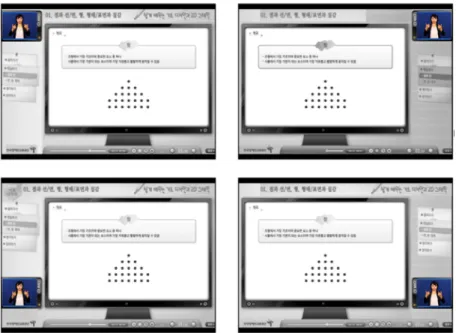
Although the sign language video can be located anywhere on the e-learning screen, it is rational to locate it on the four corners of the screen, due to the placement of learning content or menu for learning. Generally, the sign language video is presented on the bottom left of the screen in the e-learning system. A study, however, on whether this location is the most effective has yet to be performed. This study tried to select the most highly preferable location through the preference evaluation of the sign language video location, and carried out a research comparing with and evaluating the bottom left location currently selected generally.
Preference evaluation targeted 18 hearing impaired people and 162 normal people. Although it is desirable to make the number of hearing impaired people more, this study targeted just 18 people, because there was limitation to seek the subjects. Actually, the lacking aspect was complemented with the evaluation of normal people.
As for the survey on the preference of sign language video location, this study showed the illustrations located at the four corners
Figure 2. Screens for the preference evaluation of sign language video location
of the e-learning screen as shown in Figure 2, and let the subjects select their preferred location. Table 1 shows the preference evaluation result.
According to the preference survey result on the sign language video location, normal people and impaired people showed similar preference trend, and they preferred the bottom right location the most, followed by top right location. From the result, the subjects prefer the location of sign language video on the right, and the bottom left location presented by the current system is lower than the bottom right location in preference. Consequently, this study aims to examine whether significant difference exists in terms of learning effect between the bottom right presented by this study in the preference evaluation and the bottom left location adopted in the current system through an experiment.
4. Experiment
4.1 SubjectsBecause the purpose of this study is to find out the effects of sign language video location on the learning efficiency of the hearing impaired, this study selected 18 hearing impaired people who use the sign language as the subjects for the experiment.
The subjects participating in the experiment were the disabled people with the first and second classes hearing impairment.
Among them 17 were males, and 14 were in their 20s, and 16 were high school graduates.
4.2 E-learning prototype
Based on the preference survey result on the sign language video location, this study made two prototypes: A type (the location of sign language video is at the bottom left) and B type (the location of sign language video is at the bottom right). This study used them in the experiment. Figure 3 shows the produced prototypes.
4.3 Experimental method
The experiment was carried out by dividing the 18 subjects into two groups consisting of nine impaired people, respectively. To ensure homogeneity of the two groups' leaning capabilities to some degree, this study conducted grouping on the basis of basic academic ability evaluation result at the time of their enrollment. As a result of the analysis of variance to analyze whether a significant difference existed in the basic academic ability evaluation result at the time of enrolment of the two groups (mean of Korean, English and Math), no significant difference was shown at the significance level of 0.05 between the two groups (p=0.60>0.05).
The experiment was conducted for about an hour at an education institution for the hearing impaired. The experiment was carried out after sufficient explanation on the study purpose and task performing method was offered through a sign language interpreter.
The subjects in the two groups conducted only one type e-learning system between the A type and B type e-learning systems.
Table 1. Preference evaluation result for sign language video location
Subject Top left Top right Bottom left Bottom right
Normal person 13 39 23 87
The hearing impaired 2 5 4 7
After the subjects studied through the e-learning prototypes for an hour, they filled out the survey evaluation on learning presence, learning immersion and learning satisfaction.
An in-depth interview was performed targeting 16 subjects among the 18 subjects participating in the experiment. The interview was conducted for two people at a time: When a researcher asked questions prepared in advance orally, the sign language interpreter interpreted in sign language, and the subjects answered. Then, the sign language interpreter simultaneously interpreted orally the answers, and the oral answers were recorded. Figure 4 are an experiment scene and an interview scene.
5. Results
5.1 Learning presence
This study analyzed whether a significant difference in learning presence existed according to the sign language video location, based on the evaluation result of questions on learning presence. As a result, no significant difference was shown in all questions except No. 9 question, "I had no hardship, although assignment or learning process was not progressed well (p=0.05)". Also, no significant difference was shown on the mean of the ten questions on learning presence (p=0.182>0.05). Although the sign Figure 3. Screens of e-learning system prototypes
Figure 4. Experiment scene (left) and in-depth interview scene (right)
language video location did not significantly affect learning presence, the presentation at the bottom right was slightly higher in learning presence than the case of presenting at the bottom left according to the mean of learning presence as shown in Figure 5.
5.2 Learning immersion
The sign language video location did not significantly affect at the significance level of 0.05 in all ten questions on learning immersion. No significant difference was shown on the mean of ten questions on learning immersion (p=0.946>0.05). Looking at real mean values, the mean immersion was 2.97, when the location was at the bottom left, and it was 3.00, when the location was at the bottom right; therefore, they were almost the same. In other words, the location of sign language video did not almost affect learning immersion.
5.3 Learning satisfaction
The sign language video location did not significantly affect learning satisfaction at the significance level of 0.05 in all nine questions.
From Figure 6 showing mean on learning satisfaction, no significant difference existed (p=0.565>0.05); however, learning satisfaction in the case of presenting at the bottom right was slightly higher than the case of presenting at the bottom left.
From the analytic results mentioned above, learning presence, learning immersion and learning satisfaction showing learning effect did not demonstrating statistically significant differences between the bottom left and the bottom right sign language video locations. However, the learning effect at the bottom right was slightly higher than that at the bottom left.
5.4 In-depth interview analysis
Significant effects were not presented in the three such properties as learning presence, learning immersion and learning satisfaction demonstrating the learning effects of the hearing impaired according to sign language video location, unlike the initial prediction. Through the result analysis on the in-depth interview carried out to find out the causes in more detail, the following causes were ascertained in this study:
First, the hearing impaired using the sign language tend to learn, focusing on learning content, rather than focusing on sign Figure 5. Mean of learning presence
language video through e-learning. Second, when the sign language and learning content are simultaneously presented, the hearing impaired tend to mainly look at the learning content, rather than the sign language video, because the hearing impaired become anxious about losing the learning content, while looking at the sign language, and also it is difficult to precisely express major field content into the sign language. Third, it is difficult to accurately identify expressions using fingers, since the sign language video size is too small, and there are many cases that the hearing-impaired do not look at learning content, because their vision is focused on one location. Fourth, there are some cases that the hearing-impaired do not understand the standard sign language, because there are diverse sign languages according to regions and individuals.
6. Conclusion
This study aims to identify whether the location of sign language video significantly affects the learning effects of the hearing impaired in e-learning for the hearing impaired. This study used learning presence, learning immersion and learning satisfaction as evaluation tools for learning effect evaluation: no significant differences were found in all the three properties. Although statistically significant differences were not found, this study confirmed that the bottom right location is more desirable than the bottom left location from the preference evaluation result and learning presence and satisfaction aspects.
The reason why no significant difference was found between the bottom left and bottom right locations of the sign language video was that the sign language video utilization was not high, due to various reasons in e-learning, according to the in-depth interview result. Through the results in this study, the utilization of the sign language video can be enhanced through the following design improvement:
Firstly, the sign language video needs to be produced using easy sign language, if possible. Rather than grammatical sign language that translates words literally, the video needs to be produced with the sign language easily interpreted as idiomatic sign language.
Secondly, the sign language video screen needs to be about half the e-learning screen, or various sizes can be selected to make the hearing impaired easily recognize. Also, the sign language video should be produced to ensure the angle of view so that the hearing impaired can look at the learning content and the sign language video screen simultaneously to some degree. Thirdly, the function to stop and play the sign language video needs to be added and the video should be separately manipulated from the learning content, rather than the learning content and sign language video are simultaneously played. Fourthly, when a hearing impaired person clicks the difficult words or the words in a major field, the sign language video should be played, and those words need to be explained in the idiomatic sign language, rather than the grammatical sign language. Lastly, it is good to design the Figure 6. Mean of learning satisfaction
sign language video location to move according to individual taste, since the preference of the sign language video location is different depending on individual hearing impaired person; however, if the location should be fixed, it will be better to design it at the bottom right than at the bottom left.
If an e-learning site is produced in consideration of the suggestions from the results of this study, the learning effects of the hearing impaired are judged to increase furthermore.
References
Ahn, S., Method of Scholarship Recognition for the Adult Disable by e-learning. The Journal of the Korea Contents Association, 8(7), 252-258, 2008.
Choi, B. and Jun, J., A Structural Equation Modeling among Social Presence, Course Satisfaction, and Academic Achievement of Learners at a Cyber University. Asian Journal of Education, 12(4), 315-334, 2011.
Clarke, S. and Haworth, J., Flow experience in the daily lives of sixth-form college students. British Journal of Psychology, 85(4), 511-523, 1994.
Jackson, S. and Marsh, H., Development and validation of a scale to measure optimal experience: The Flow State Scale. Journal of Sport and Exercise Psychology, 18, 17-35, 1996.
Kang, M., Kim, J. and Park, M., Investigating presence as a predictor of learning outcomes in e-Learning environments. Proceeding of World Conference on Educational Multimedia, 4175-4180, 2008.
Kang, M., Park, J. and Shin, S., Developing a Cognitive Presence Scale for Measuring Students' Involvement during e-Learning Process. Proceedings of World Conference on Educational Multimedia, 2823-2828, 2007.
Lee, J. and Yoon, S., The Effects of Learners' Motivation, Teaching Presence, Learning Flow on Learning Outcomes in Cyber University.
Asian Journal of Education, 12(1), 141-166, 2011.
Lee, K., Development of the design guidelines of e textbook for deaf children. Doctoral Dissertation of Daegu University, 2013.
Park, M., A study on the research on an effective graphic interface design of the web environment for the people with disability:
focused on the people with hearing impairment, Master's Thesis of Sejong University, 2004.
Park, S. and Kim Y., An Inquiry on the Relationships among Learning - Flow Factors, Flow Level, Achievement under on-line Learning Environment. The Journal of Yeolin Education, 14(1), 93-115, 2006.
Shin, N., Transactional presence as a critical predictor of success in distance learning. Distance Education, 24(1), 69-86, 2003.
Shin, N. and Chan, J., Direct and indirect effects of online learning on distance education. British Journal of Educational Technology, 35(3), 275-288, 2004.
Suh, H., Relationships among Presence, Learning Flow, Attitude toward Usability, and Learning Achievement in an Augmented Reality Interactive Learning Environment. The Journal of Educational Information and Media, 14(3), 137-165, 2008.
Author listings
Seung Ho Muhn: [email protected]
Highest degree: BS, Department of Industrial Design Engineering, Koreatech
Position title: Graduate Student, Department of Industrial Design Engineering, Koreatech.
Areas of interest: Applied Ergonomics and Design, Design for the disabled
Kwang Tae Jung: [email protected]
Highest degree: PhD, Department of Industrial Engineering, KAIST
Position title: Professor, Department of Industrial Design Engineering, Koreatech.
Areas of interest: Applied Ergonomics and Design, Emotional Design, HCI