1. Introduction
Transparent conducting oxide (TCO) thin films have been widely employed in various electro-optical devices such as flat panel displays and solar cells because these films have a wide band gap (> 3.2 eV), low resistivity (10
-3-10
-4Ω·cm) and a very good optical transmittance across the visible region (80-90%).
Indium tin oxide (ITO) thin films have attracted the most attention among TCO materials due to their high transmittance in the visible range (90%), low resistivity, high infrared reflectance and absorbance in the microwave region. However, one of the obstacles to their use is the high cost of indium
1-5).
ZnO thin films have recently drawn a great deal of attention as an alternative TCO material due to their cost effectiveness.
ZnO thin films are n-type II-VI compound semiconductors with a wide and direct band gap (3.3 eV) at room temperature that have the desirable properties of being nontoxic and high chemical stability against the environment. These films are also inexpensive because they consist of low cost abundant elements.
To improve the electrical and optical properties of ZnO, group-III donor elements such as Al, B, In and Ga are usually doped.
Aluminum-doped ZnO (AZO) is one of the prospective materials for use in TCO thin films owing to its suitable properties for electro-optical applications
4-7).
AZO thin films are prepared by various techniques including magnetron sputtering, sol-gel process, pulsed laser deposition, and chemical vapor deposition. Magnetron sputtering is generally considered the best technique for preparation of large-area ZnO thin films because of the many advantages it provides, which includes a high deposition rate, process stability, good endurance of deposited films, and reliability
2,6-10). Deposition of AZO thin films has been extensively studied by many researchers to achieve optimization of the deposition process. The effects of deposition parameters such as dc power, pressure and substrate temperature on film properties have been reported
1,8,10,11-14). However, few studies of the effects of the annealing process on the structural, electrical and optical properties of the films have been conducted. In this study, AZO thin films were prepared by dc magnetron sputtering followed by heat-treatment using various annealing temperatures and times. The relationship among micro-structural, electrical and optical properties of
Influence of Heat Treatment on the Structural, Electrical and Optical Properties of Aluminum-Doped Zinc Oxide Thin Films
Prepared by Magnetron Sputtering
Sung Hee Jung ․ Seon Mi Kong ․ Chee Won Chung*
Department of Chemical engineering, Inha University, 253 Yonghyun-dong, Nam-gu. Incheon 402-751, Korea
ABSTRACT: Aluminum-doped zinc oxide (AZO) thin films were prepared by dc magnetron sputtering at room temperature and the effect of heat treatment on the structural, electrical and optical properties of the films were examined. As the annealing temperature and time increased, the resistivity decreased and the transmittance improved. All AZO films had c-axis oriented (002) plane of ZnO, regardless of the annealing process employed. As the annealing temperature and time increased, the crystallinity of AZO thin films increased due to the formation of a new ZnO phase in which Al was substituted for Zn. However, at the high annealing temperature of 400°C, the resistivity of the films increased via separation of Zn and Al from ZnO phase due to their low melting points. X-ray diffraction, field emission scanning electron micrograph and Hall effect measurement confirmed the formation of uniformly distributed new grains of ZnO substituted with Al. The variation of Al contents in AZO films was shown to be the primary factor for the changes in resistivity and carrier concentration of the films.
Key words: Al-doped ZnO, dc magnetron sputtering, Transparent conducting oxide, Annealing
*Corresponding author: [email protected]
Received November 20, 2013; Revised December 2, 2013;
Accepted December 9, 2013
ⓒ 2013 by Korea Photovoltaic Society
This is an Open Access article distributed under the terms of the Creative Commons Attribution Non-Commercial License (http://creativecommons.org/licenses/by-nc/3.0)
which permits unrestricted non-commercial use, distribution, and reproduction in any medium, provided the original work is properly cited.
97
ethanol, and DI water. The dc power was 180 W and the distance between the substrate and target was fixed at 7.5 cm. To ensure uniform deposition, the substrate was rotated at 10 rpm, and the thickness of all films was fixed to 2,500 Å. After the deposition chamber was evacuated to 0.93-1.2 × 10
-4Pa, sputtering was performed using pure Ar gas at 0.67 Pa. Prior to the deposition process, pre-sputtering was carried out for 15 min to remove the contaminants on the target surface. To improve the film properties, an annealing process was employed in an Ar atmosphere after deposition. The annealing temperature and annealing time were varied from 100
oC to 400
oC and from 10 to 30 min, respectively.
Ar gas was introduced at a flow rate of 5 l/min in a three-zone tube furnace.
The thickness of AZO thin films was measured using a surface profiler (Tencor-P1) and the resistivity was measured with a 4-point probe. An UV-Vis spectrometer (Cary 300, Varian) was used to measure the transmittance of the films and X-ray diffraction (XRD) (Philips X’Pert PRO MRD) was employed to examine their crystallinity. The microstructure and surface morphology of the deposited AZO thin films were observed by field emission scanning electron microscopy (FESEM) (HITACHI S-4300) and Energy Dispersive X-ray Spectroscopy (Inca Energy) (EDX) was used to examine the composition of the films. The carrier concentration and resistivity of the CIGS films were measured using the Van der Pauw method through a Hall effect measurement system (HMS-3000) in a 0.55T magnetic field at room temperature.
In soldering was applied onto the surface as the ohmic contact.
3. Results and Discussion
AZO thin films of 2,500 Å were deposited by dc magnetron sputtering at room temperature. The films were then heat-treated at various annealing temperatures and annealing times to examine
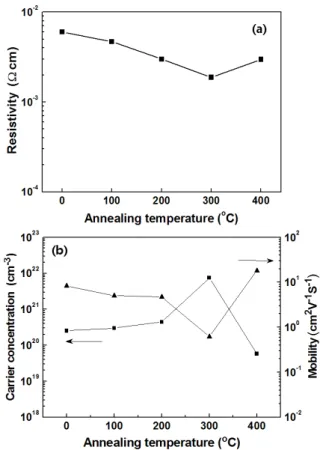
mobility of AZO films as a function of annealing temperature.
The carrier concentration was highest at an annealing temperature of 300
oC and then decreased at 400
oC. The mobility of the films showed the opposite change when compared to that of carrier concentration. These results indicated that there must be a critical annealing temperature for reducing the resistivity in AZO thin films.
Fig. 2 shows the transmittance of AZO thin films heat-treated at different annealing temperatures. The transmittance of the films increased as the annealing temperature increased.
Fig. 1. Electrical properties resistivity (a) and carrier concentration and mobility (b) of AZO thin films annealed at different temperatures for 20 min
Fig. 2 shows the transmittance of AZO thin films heat-treated at different annealing temperatures. The transmittance of the films increased as the annealing temperature increased. Specifically, as the annealing temperature was varied from 100
oC to 400
oC, the root mean square (RMS) values decreased from 4.368 to 3.812 and the RMS value of the as-deposited AZO film was 8.728. This was caused by the enhanced surface morphology of the films at high annealing temperature. Since the film surface became smooth, less scattering on the film surface occurred, resulting in high transmittance of the films.
The effect of annealing temperature on the microstructure of AZO thin films was investigated by XRD analysis. Fig. 3 shows the XRD patterns of AZO thin films annealed at different temperatures. The XRD patterns revealed that all of the AZO thin films had a strong c-axis oriented (002) plane of ZnO.
In general, thin films preferentially grow to minimize the surface free energy. It is known that the (002) plane had the
lowest surface free energy in AZO films
13). As-deposited AZO thin films at room temperature showed a (002) peak of ZnO with good intensity. ZnO thin films were well ordered to the c-axis orientation and the doped Al atoms were expected to primarily exist as other phases separated from the ZnO phase of (002).
After AZO films were heat-treated at an annealing temperature of 100
oC for 20 min, the (002) peak of the ZnO phase decreased greatly. These findings imply the evolution of a new ZnO crystalline phase in which Al atoms are substituted for Zn and/or the formation of AZO solid solution. As the annealing temperature increased from 100
oC to 300
oC, the (002) peak of ZnO increased.
This was attributed to the greater involvement of Al atoms in the ZnO structure as a result of substitution of Al for Zn atoms and/or the formation of AZO solid solution. However, the (002) peak of the AZO thin film annealed at 400
oC decreased again.
Under these annealing conditions, Al and Zn atoms appeared to be separated from the crystalline phase of ZnO due to their low melting points
6). As the annealing temperature increased from 100
oC to 300
oC, the crystallinity of the films increased and the doped Al was electrically activated and substituted to the Zn site. As a result, the resistivity of the films decreased due to the increased carrier concentration (Fig. 1)
7).
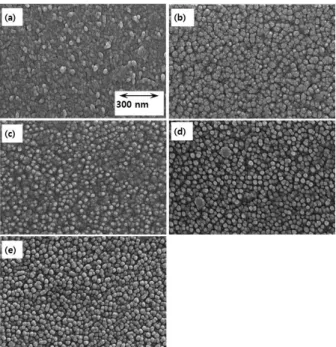
Fig. 4 shows the FESEM micrographs of AZO thin films annealed at different temperatures. The micrographs were taken at uniform brightness and contrast to enable precise comparison.
Fig. 2. Transmittance of AZO thin films annealed at different annealing temperatures for 20 min
Fig. 3. X-ray diffraction patterns of AZO thin films annealed at different annealing temperatures for 20 min; (a) as- deposited, (b) 100°C, (c) 200°C, (d) 300°C, and (e) 400°C
Fig. 4. FESEM micrographs of AZO thin films annealed at different annealing temperatures for 20 min; (a) as- deposited, (b) 100°C, (c) 200°C, (d) 300°C, and (e) 400°C
and Al involvement in the crystalline structure was not complete.
The grains of AZO films annealed at 300
oC had a circular shape and bright color (Fig. 4(d)). These findings were attributed to the substitution of Al to the Zn site and/or the formation of AZO solid solution. As a result, the resistivity of AZO films decreased as the annealing temperature increased to 300
oC. These results coincide with those of the XRD analysis and measurement of the electrical properties (Figs. 1 and 3). AZO thin films annealed at 400
oC contained well developed and much brighter grains than those annealed at 300
oC. Since the FESEM observation shows only the surface morphology of the film, it cannot explain the decrease in the (002) peak of the ZnO phase. However, the decreased crystallinity of the ZnO phase at 400
oC can be explained by the fact that Al and/or Zn atoms were separated from the ZnO phase at high temperature, maintaining bright grains.
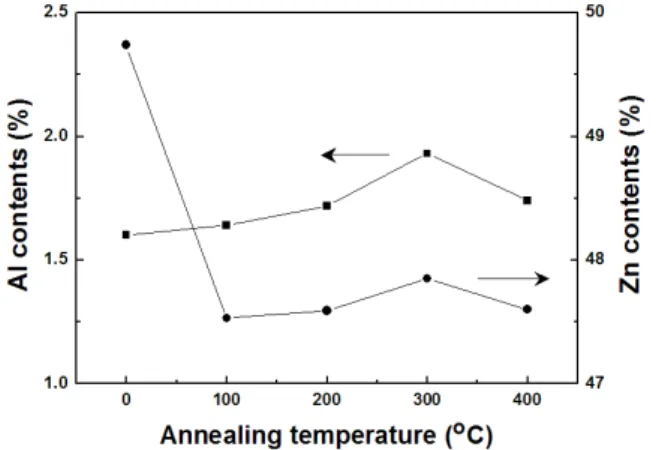
EDX analysis of the surface of the AZO films was performed.
Fig. 5 shows the Al and Zn contents of the films annealed at different temperatures. The AZO films deposited at room temperature had a high Zn content and very low Al content, indicating that the as-deposited films have a ZnO structure with little Al
concentration of the AZO films.
The effects of annealing time on the properties of the films were also examined at a constant annealing temperature of 250
oC. The resistivity and transmittance of the AZO thin films annealed for various annealing times are shown in Fig. 6. As the annealing time increased, the resistivity of the films decreased slightly and the transmittance improved. This decrease in resistivity was likely related to the crystalline structure and stoichiometry of the AZO films, while the transmittance was mainly affected by the surface morphology of the films.
Fig. 7 shows the XRD patterns of AZO thin films annealed
Fig. 5. EDX analysis of the surface of AZO thin films annealed at different annealing temperatures for 20 min
Fig. 6. (a) Resistivity and (b) transmittance of AZO thin films annealed at different annealing times
for different annealing times. All of the AZO films had a dominant c-axis oriented (002) peak of ZnO. As-deposited AZO thin film had an intense (002) peak of ZnO. After annealing for 10 min at 250
oC, the (002) peak of ZnO decreased greatly, which was in accordance with the result of XRD analysis of the film annealed for 20 min at 100
oC shown in Fig. 2(b). These results can be attributed to the formation of an AZO solid solution phase involved with Al. As the annealing time increased from 20 min to 30 min, the (002) peak increased slightly due to greater substitution of Al to the Zn site and/or greater formation of AZO solid solution phase. The slight decrease in the resistivity of the AZO thin films with increasing annealing time was explained by the increase in the (002) peak observed upon XRD analysis, which indicated an increase in the carrier concentration by the substitution of Al for Zn.
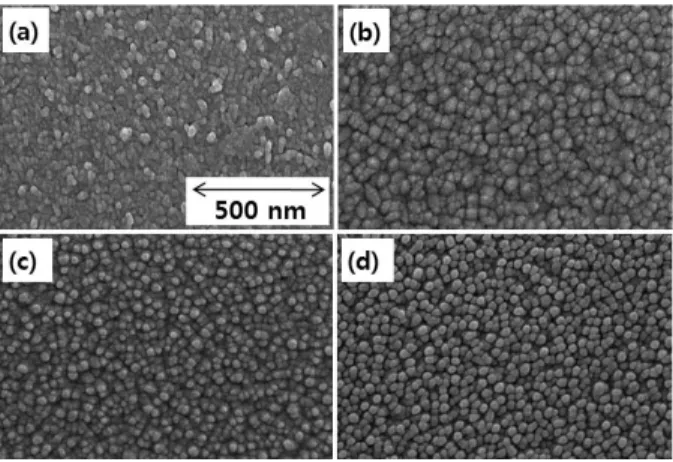
Fig. 8 shows SEM micrographs of AZO thin films annealed
for different annealing times. The AZO thin film annealed for 10 min at 250
oC had newly formed grains composed of a new ZnO phase involved with Al. As shown in Figs. 8(c) and 8(d), as the annealing time increased to 30 min, the grains of AZO films grew uniformly with a circular shape and became bright.
This was caused by the growth of grains with the substitution of Al for Zn and the formation of AZO solid solution. The change in grain size and grain shape in response to the variation of annealing time coincides with the results of XRD analysis.
4. Conclusions
AZO thin films were deposited on soda lime glass by dc magnetron sputtering at room temperature. The effects of annealing temperature and annealing time were then explored in terms of the electrical, optical and structural properties of the films. As the annealing temperature and annealing time increased, the resistivity decreased and the transmittance improved. AZO thin films were dominantly ordered to the c-axis oriented (002) plane of ZnO. Before annealing, the as-deposited AZO films appeared to consist of a ZnO phase with little involvement of Al to the Zn site. As the annealing temperature and time increased, the crystallinity of the AZO thin films increased due to the formation of a new ZnO phase with the substitution of Al for Zn and/or the formation of AZO solid solution, resulting in decreased resistivity of the films. However, AZO films annealed at 400
oC showed increased resistivity because Zn and/or Al atoms started to be separated from the ZnO phase owing to their low melting points. These findings confirmed that new ZnO grains in which Al was substituted for Zn were created by the annealing process.
In addition, evolution of the grain formation in Al-doped zinc oxide thin films was disclosed through this study. The variation of Al contents in AZO films was found to be the primary factor responsible for the changes in resistivity and carrier concentration of the films.
Acknowledgments
This work was supported by the Pioneer Research Program (2011-0002123) through the National Research Foundation funded by the Ministry of Education, Science, and Technology, Korea.
Fig. 7. X-ray diffraction patterns of AZO thin films annealed at 250°C for different annealing times; (a) as-deposited, (b) 10 min, (c) 20 min and (d) 30 min
Fig. 8. FESEM micrographs of AZO thin films annealed annealed at 250°C for different annealing times; (a) as-deposited, (b) 10 min, (c) 20 min and (d) 30 min
netron sputtering at room temperature following rapid thermal annealing”, J. Mater. Sci. Mater. Electron Vol. 21, pp 33-37, 2010.
4. G. Fang, D. Li, and B. L. Yao, “Fabrication and vacuum an- nealing of transparent conductive AZo thin films prepared by DC magnetron sputtering”, Vacuum, Vol. 68, pp 363-372, 2003.
5. H. Wang, J. Xu, M. Ren, and L. Yang, “Room temperature deposition and properties of ZnO:Al thin films by nonreasctive DC magnetron sputtering”, J. Mater. Sci. Mater. Electron, Vol.
19, 1135-1139, 2008.
6. D. G. Lim, G. S. Kang, S. I. Kwon, M. W. Park, and D. J.
Kwak, “Influence of positive substrate bias on the electrical properties of ZnO:Al films prepared by DC magnetron sputter- ing”, J. Kor. Phys. Soc., Vol. 50, No. 6, pp 1697-1700, 2007.
7. H. Bo, M. Z. Quan, X. Jing, Z. Lei, Z. N. Sheng, L. Feng, S.
Cheng, S. Ling, Z. C. Yue, Y. Z. Shan, and Y. Y. Ting,
“Characterization of AZO/p-Si heterojunction prepared by DC magnetron sputtering”, Materials Science in Semiconductor Processing Vol. 12, pp248-252, 2009.
8. Y. S. Park, S. H. Lee, and P. G. Song, “Characterization of
tering”, Thin Solid Films, Vol. 220, pp 327-332, 1992.
12. T. Minami, T. Miyata, T. Yamamoto, and H. Toda, “Origin of electrical property distribution on the surface of ZnO:Al films prepared by magnetron sputtering”, J. Vac. Sci. Technol. A, Vol. 18, No. 4, pp 1584-1589, 2000.
13. K. I. Lee, E. K. Kim, H. D. Kim, H. I. Kang, and J. T. Song,
“Low temperature Al doped ZnO films on a flexible substrate by DC sputtering”, Phys. Stat. Sol. (c), Vol. 5, No. 10, pp 3344-3347, 2008.
14. S. H. Cho and H. T. Kim, “Effect of deposition temperature on the properties of nitrogen-doped AZO thin films grown on glass by rf reactive magnetron sputtering”, Mater. Sci. Eng. B, Vol.
172, pp 327-330, 2010.
15. S. H. Park, S. E. Park, J. C. Lee, P. K. Song, and J. H. Lee,
“Photoluminescence Characterization of Al-doped ZnO films deposited by using DC magnetron sputtering”, J. Kor. Phys.
Soc. Vol. 54, No. 3, pp1344-1347, 2009.
16. Y. K. Moon, S. H. Kim, and J. W. Park, “The influence of sub- strate temperature on the properties of aluminum-doped zinc oxide thin films deposited by DC magnetron sputtering”, J.
Mater. Sci. Mater. Electron, Vol. 17, pp 973-977, 2006.