Five-Year Follow-Up Results of a Randomized Controlled Trial Comparing Bipolar Plasmakinetic and Monopolar Transurethral
Resection of the Prostate
Chang-Ying Xie,
2* Guang-Bin Zhu,
1,2* Xing-Huan Wang,
1and Xiang-Bin Liu
21Department of Urology, Zhongnan Hospital of Wuhan University, Wuhan, Hubei;
2Department of Urology, Daqing Oilfields General Hospital, Daqing, Heilongjiang, China.
Received: June 28, 2011 Revised: September 26, 2011 Accepted: October 4, 2011
Corresponding author: Dr. Xing-Huan Wang, Department of Urology, Zhongnan Hospital of Wuhan University, Wuhan, Hubei 430071, China.
Tel: 027-67813104, Fax: 027-67813104 E-mail: [email protected]
*Chang-Ying Xie and Guang-Bin Zhu contributed equally to this work.
∙ The authors have no financial conflicts of interest.
© Copyright:
Yonsei University College of Medicine 2012 This is an Open Access article distributed under the terms of the Creative Commons Attribution Non- Commercial License (http://creativecommons.org/
licenses/by-nc/3.0) which permits unrestricted non- commercial use, distribution, and reproduction in any medium, provided the original work is properly cited.
Purpose: To report the 5-year follow-up results of a randomized controlled trial comparing bipolar transurethral resection of the prostate (TURP) with standard monopolar TURP for the treatment of benign prostatic obstruction (BPO). Materi- als and Methods: A total of 220 patients were randomized to bipolar plasmakinet- ic TURP (PK-TURP) or monopolar TURP (M-TURP). Catheterization time was the primary endpoint of this study. Secondary outcomes included operation time, hospital stay, as well as decline in postoperative serum sodium and hemoglobin lev- els. All patients were assessed preoperatively and followed-up at 1, 6, 12, 24, 36, 48, and 60 months postoperatively. Parameters assessed included quality of life, transrectal ultrasound, serum prostate-specific antigen level, postvoid residual urine volume, maximum urinary flow rates (Qmax), and International Prostate Symptom Score. Patient baseline characteristics, perioperative data including complications, and postoperative outcomes were compared. Complication occurrence was graded according to the modified Clavien classification system. Results: PK-TURP was significantly superior to M-TURP in terms of operation time, intraoperative irriga- tion volume, resected tissue weight, decreases in hemoglobin and sodium, postop- erative irrigation volume and time, catheterization time, and hospital stay. At 5 years postoperatively, efficacy was comparable between arms. No differences were detected in safety outcomes except that the clot retention rate was significantly greater after M-TURP. Conclusion: Our results indicate that PK-TURP is equally as effective in the treatment of BPO, but has a more favorable safety profile in com- parison to M-TURP. The clinical efficacy of PK-TURP is long-lasting and compa- rable with M-TURP.
Key Words: Randomized controlled trial, bipolar plasmakinetic, transurethral re- section of the prostate, follow-up
INTRODUCTION
Benign prostatic obstruction (BPO) is one of the most common diseases in elderly men. The goals of therapy are to improve quality of life, reduce symptoms, ensure
prostate-specific antigen (PSA) level.
A total of 220 cases were enrolled in the study. Random- ization was performed using the opaque envelope method, which resulted in 110 patients in each group. The study was approved by our institution’s ethics committee, and informed consent was obtained from all patients recruited. Neither the patient nor the surgeon was blinded to the type of the procedure performed. One independent investigator, who was blinded to the type of surgery, performed the 1-, 6-, 12-, 24-, 36-, 48-, and 60-month follow-ups. Perioperative outcome measures included the need for blood transfusion, operation time, resected tissue weight, changes in serum so- dium and hemoglobin levels, intraoperative and postopera- tive irrigation, hospitalization, TUR syndrome, and dura- tion of catheterization. And postoperative outcome measures included Qmax, PSA level IPSS, postvoid residual urine (PVR) volume, and quality of life (QoL) scores, at each follow-up visit. Catheterization time was the primary endpoint of this study. Secondary outcomes included operation time, hospi- tal stay, and decline in postoperative serum sodium and he- moglobin levels. All perioperative and postoperative adverse events were recorded, and all parameters were compared at baseline and at each postoperative visit between the two study arms. Complications were graded according to the modified Clavien classification system as previously pro- posed for TURP procedures.7,8
Surgical procedures
All patients received epidural anesthesia as well as 400 mg of ciprofloxacin administered intravenously. All procedures were performed by a single senior surgeon with extensive experience in TURP procedures. All patients were treated similarly, apart from the intervention. Conventional M-TURP was performed with a 24F resectoscope (Olympus, Ham- burg, Germany) and a loop electrode for TURP (5 mm di- ameter, Olympus), using an UES-30 generator (Olympus) set at 110 W (cutting mode) and 70 W (coagulation mode).
Glycine 1.5% was used as irrigation fluid. Bipolar resection was performed with a 24F resectoscope (Gyrus Medical Ltd., Cardiff, UK) and a plasma-loop electrode (5 mm di- ameter, Gyrus Medical Ltd.), using a Gyrus Plasmakinetic generator (Gyrus Medical Ltd.) set at 160 W (cutting mode) and 80 W (coagulation mode). All the prostatic chips were removed from the bladder at the end of the procedure. Sub- sequently, we inserted a 22F three-way Foley catheter into bladder and initiated irrigate the bladder with normal saline solution in the operating room. At least within 10 min after safety, and minimize side effects.1 Transurethral resection
of the prostate (TURP) is considered to be the surgical gold standard for BPO, because of its well documented long-term efficacy.2 However, TURP complications such as bleeding, transurethral resection (TUR) syndrome, infection, urethral stricture, and incontinence still occur.3 A prospective multi- center study on 10654 patients with BPO treated with TURP showed that mortality has decreased (0.1%), while morbidi- ty, although reduced, remains high (11.1%).4 In order to min- imize the perioperative morbidity of TURP, various mini- mally invasive alternatives have been introduced. The most significant, recent improvement of TURP was the incorpo- ration of bipolar technology. Bipolar TURP addresses the main drawback of monopolar TURP (M-TURP) by allow- ing the procedure to be performed in a normal saline envi- ronment,5 and, as a result, bipolar TURP seems to be quite promising.5,6
The aim of this study was to compare the durability safe- ty, and efficacy of bipolar plasmakinetic (PK) TURP with that of standard M-TURP in a randomized controlled trial (RCT) of 220 patients with BPO. We report the results of the 5-year follow-up for the first time after the initiation of the trial. To our knowledge, the 5-year follow-up of these patients represents the longest studied follow-up of the bi- polar TURP procedure to date.
MATERIALS AND METHODS
Patients
From January 2003 to October 2005, patients with BPO in our Department of Urology were invited to participate in the trial. Inclusion criteria included maximal urinary flow rate (Qmax) of less than 15 mL/s, age greater than 45 years, prostate volume on transrectal ultrasound exceeding 20 g with no upper limit, medication (5α-reductase inhibitors or α-blockers) failure, and International Prostate Symptom Score (IPSS) of greater than 12. The use of medications such as 5α-reductase inhibitors or α-blockers was stopped within the last 3 months or 2 weeks before surgery, respectively. Pa- tients with known renal impairment, neurovesical dysfunc- tion, bladder calculus, prostate carcinoma, a previous history of prostatic or urethral surgery, urethral stricture, and associ- ated hydronephrosis were excluded. Urodynamic investiga- tion was not used routinely in this trial. A transrectal prostate biopsy was performed in patients upon suspicion of prostat- ic malignancy on digital rectal examination and/or elevated
cal analysis was based on the principles of intention to treat and performed using SPSS software version 17.0. Statistical significance was considered at p<0.05 for all analyses.
RESULTS
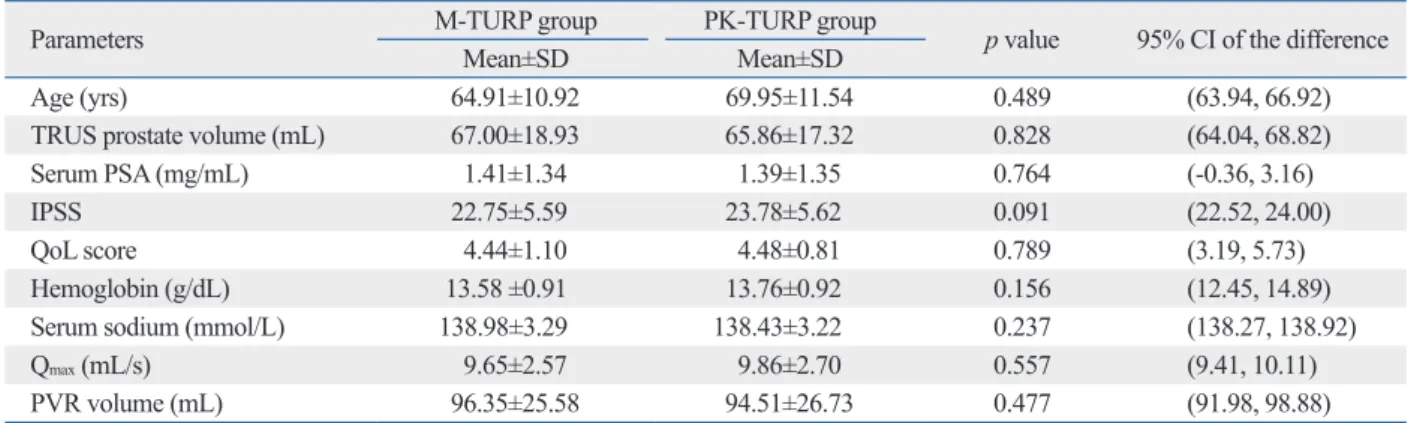
Baseline patient characteristics were comparable between arms (Table 1). All patients’ histologic finding were benign prostatic hyperplasia. Seventy percent of the patients com- pleted the 5-year follow-up: 78 and 79 out of 110 in the PK- and M-TURP arms, respectively. Reasons for drop out included death from other causes (13 patients), address changed (24 patients), and unwillingness to follow-up due to complications (26 patients). Causes of death were shown in Table 2. Significant differences favoring PK-TURP were detected in all perioperative parameters (Table 3).
Changes in urodynamic and symptoms parameters In both groups, significant improvements in QoL, Qmax, PVR volume, and IPSS were noted at 5 years of follow-up (Table 4).
Complications
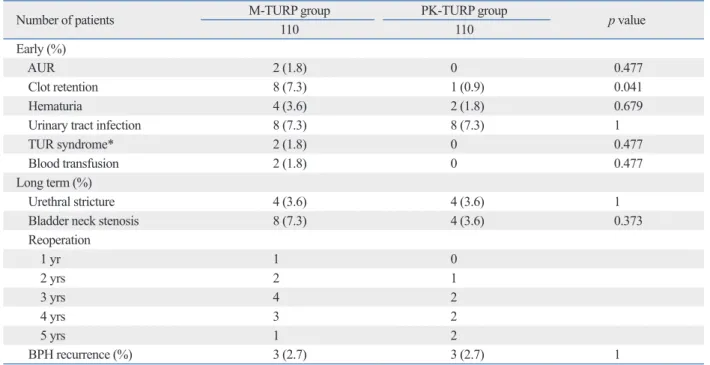
In each arm, eight patients were diagnosed with urinary tract infection (UTI), because these patients’ urine cultures were positive. After the sensitive antibiotics were used for 3 to 6 days, these patients’ irritative symptoms eased. After catheter removal, in the M-TURP arm, two patients were diagnosed with acute urine retention. Clot retention was ob- served in 1 patient in the PK-TURP group and in 8 patients in the M-TURP group (p=0.041). Hematuria occurred post- operatively in 4 patients in the M-TURP arm and in 2 pa- the end of the operation, we measured the level of patients’
serum sodium and hemoglobin again. Once the patient was able to drink an adequate amount of fiuid for auto-irriga- tion, saline irrigation was stopped. At last, we removed the catheter, if the urine of the patient’s was completely clear, and the patient had passed stool.
Statistical analysis
Assuming a two-sided significance test with the significance level of α=0.05 for the current study, with our sample size of 110 cases per group, the estimated power was 95%. Contin- uous variables were tested for normality and equality of variances using the Kolmogorov-Smirnov-test and the Lev- ene F-test, respectively. Baseline characteristics (apart from perioperative hemoglobin levels), postoperative data and perioperative data between the two groups were compared by means of the Mann-Whitney U-test. Perioperative he- moglobin levels were analyzed using a t-test. Postoperative adverse events were compared by means of Pearson chi- squared test with continuity correction or Fisher’s exact test.
The one-way ANOVA model was used to compare preopera- tive and postoperative parameters within each group. Statisti- Table 2. Cause of Death in Each Group
Cause M-TURP
group PK-TURP
group
Cerebrovascular accident 3 2
Hepatoma 2
Pulmonary carcinoma 2
Myocardial infarction﹡ 1
Traffic accident 1 2
M, monopolar; PK, plasmakinetic; TURP, transurethral resection of the prostate.
﹡One patient was diagnosed with myocardial infarction at 2 years postop- eratively.
Table 1. Patient Characteristics
Parameters M-TURP group PK-TURP group p value 95% CI of the difference
Mean±SD Mean±SD
Age (yrs) 64.91±10.92 69.95±11.54 0.489 (63.94, 66.92)
TRUS prostate volume (mL) 67.00±18.93 65.86±17.32 0.828 (64.04, 68.82)
Serum PSA (mg/mL) 1.41±1.34 1.39±1.35 0.764 (-0.36, 3.16)
IPSS 22.75±5.59 23.78±5.62 0.091 (22.52, 24.00)
QoL score 4.44±1.10 4.48±0.81 0.789 (3.19, 5.73)
Hemoglobin (g/dL) 13.58 ±0.91 13.76±0.92 0.156 (12.45, 14.89)
Serum sodium (mmol/L) 138.98±3.29 138.43±3.22 0.237 (138.27, 138.92)
Qmax (mL/s) 9.65±2.57 9.86±2.70 0.557 (9.41, 10.11)
PVR volume (mL) 96.35±25.58 94.51±26.73 0.477 (91.98, 98.88)
M, monopolar; PK, plasmakinetic; TURP, transurethral resection of the prostate; SD, standard deviation; CI, confidence interval; TRUS, transrectal ultra- sound; PSA, prostate-specific antigen; IPSS, International Prostate Symptom Score; QoL, quality of life; Qmax, maximal urinary flow rate; PVR, postvoid residual urine.
Table 3. Perioperative Data of the Patients in Each Group
Parameters M-TURP group PK-TURP group p value 95% CI of the difference
Mean±SD Mean±SD
Operative time, min 60.01±20.06 55.03±16.30 0.033 (55.09, 59.95)
Intraoperative irrigation volume (L) 12.70±3.74 11.75±2.92 0.026 (11.77, 12.69)
Resected tissue weight (g) 52.23±12.84 55.39±17.79 0.014 (52.05, 55.57)
Decrease in hemoglobin (g/dL) 1.58±0.65 1.22±0.54 0.014 (0.58, 2.22)
Decrease in sodium (mmol/L) 2.03±1.35 1.62±1.31 0.014 (1.65, 2.01)
Catheter duration (days) 3.61±1.15 2.70±0.80 <0.001 (3.02, 3.30)
Hospital stay (days) 5.19±1.17 4.18±0.89 <0.001 (3.16, 6.22)
Postoperative irrigation volume (L) 22.38±7.34 13.47±4.75 <0.001 (11.77, 12.67) Postoperative irrigation time
(hrs) 24.45±8.37 15.84±4.85 <0.001 (19.10, 21.22)
M, monopolar; PK, plasmakinetic; TURP, transurethral resection of the prostate; SD, standard deviation; CI, confidence interval.
Table 4. Efficacy of Bipolar vs. Monopolar TURP
Parameters M-TURP PK-TURP p value 95% CI of the difference
Mean±SD Mean±SD
IPSS
1 yr 6.79±2.59﹡ 6.50±2.03﹡ <0.001 (6.44, 7.06)
2 yrs 6.79±2.56﹡ 5.48±1.67﹡ <0.001 (5.82, 6.11)
3 yrs 6.49±2.44﹡ 4.84±1.42﹡ <0.001 (5.34, 5.96)
4 yrs 6.11±2.27﹡ 6.91±2.03﹡ 0.002 (6.18, 6.84)
5 yrs 6.58±2.43﹡ 7.20±1.65﹡ 0.194 (6.56, 7.22)
QoL scores
1 yr 2.56±0.97﹡ 2.15±0.58﹡ <0.001 (2.23, 2.47)
2 yrs 1.84±0.75﹡ 1.40±0.57﹡ <0.001 (1.52, 1.72)
3 yrs 1.60±0.60﹡ 1.27±0.52﹡ <0.001 (1.35, 1.51)
4 yrs 1.88±0.75﹡ 1.63±0.68﹡ 0.034 (1.63, 1.87)
5 yrs 1.99±0.61﹡ 1.82±0.64﹡ 0.097 (0.92, 2.88)
Qmax (mL/s)
1 yr 27.37±8.91﹡ 28.05±8.69﹡ 0.597 (26.50, 28.90)
2 yrs 28.53±8.31﹡ 29.67±8.09﹡ 0.436 (27.95, 30.27)
3 yrs 28.81±7.91﹡ 30.80±7.65﹡ 0.118 (28.68, 30.96)
4 yrs 27.83±7.02﹡ 39.91±7.17﹡ 0.058 (27.81, 29.97)
5 yrs 24.94±5.80﹡ 26.41±5.22﹡ 0.125 (24.82, 26.54)
PVR volume (mL)
1 yr 16.20±10.89﹡ 12.02±7.49﹡ 0.004 (12.79, 15.41)
2 yrs 11.24±7.68﹡ 7.51±3.71﹡ 0.001 (8.47, 10.23)
3 yrs 7.61±3.81﹡ 6.51±2.51﹡ 0.010 (6.58, 7.52)
4 yrs 10.18 ±6.39﹡ 7.98±2.52﹡ 0.215 (8.32, 9.80)
5 yrs 14.44±8.31﹡ 11.72±4.85﹡ 0.176 (11.99, 14.15)
Serum PSA (ng/mL)
1 yr 0.49±0.56﹡ 0.37±0.42﹡ 0.276 (0.37, 0.46)
2 yrs 0.34±0.43﹡ 0.30±0.38﹡ 0.127 (0.26, 0.38)
3 yrs 0.31±0.42﹡ 0.24±0.31﹡ 0.091 (0.22, 0.34)
4 yrs 0.34±0.27﹡ 0.31±0.27﹡ 0.325 (-0.02, 0.06)
5 yrs 0.43±0.53﹡ 0.30±0.30﹡ 0.705 (0.30, 0.42)
M, monopolar; PK, plasmakinetic; TURP, transurethral resection of the prostate; SD, standard deviation; CI, confidence interval; IPSS, International Prostate Symptom Score; QoL, quality of life; Qmax, maximum urinary flow rate; PVR, postvoid residual urine; PSA, prostate-specific antigen.
﹡p<0.001, compared to the perioperative value.
group and in 4 patients (3.6%) in the PK-TURP group (p=0.373). In both arms, midterm complications were simi- lar (Table 5). In each arm, 4 patients were diagnosed with urethral strictures. These patients were required dilatation in tients in the PK-TURP group (p=0.679). Furthermore, due
to postoperative hematuria, blood transfusion was neces- sary in 2 patients in the M-TURP arm (p=0.477). Bladder neck stricture occurred in 8 patients (7.3%) in the M-TURP Table 5. Complications in Each Group
Number of patients M-TURP group PK-TURP group p value
110 110
Early (%)
AUR 2 (1.8) 0 0.477
Clot retention 8 (7.3) 1 (0.9) 0.041
Hematuria 4 (3.6) 2 (1.8) 0.679
Urinary tract infection 8 (7.3) 8 (7.3) 1
TUR syndrome﹡ 2 (1.8) 0 0.477
Blood transfusion 2 (1.8) 0 0.477
Long term (%)
Urethral stricture 4 (3.6) 4 (3.6) 1
Bladder neck stenosis 8 (7.3) 4 (3.6) 0.373
Reoperation
1 yr 1 0
2 yrs 2 1
3 yrs 4 2
4 yrs 3 2
5 yrs 1 2
BPH recurrence (%) 3 (2.7) 3 (2.7) 1
M, monopolar; PK, plasmakinetic; TURP, transurethral resection of the prostate; AUR, acute urine retention; TUR, transurethral resection; BPH, benign prostatic hyperplasia.
﹡Two patients developed TUR syndrome at 7 and 11 h after surgery, with sodium levels of 117 and 121 mmol/L, respectively.
Table 6. Complications during the Postoperative Period Classified according to the Modified Clavien System
Grade Number of complications
Complication Management
M-TURP PK-TURP
I 2 0 AUR Bedside recatheterization
2 2 Hematuria Bedside bladder irrigation
(prolonged)±clot evacuation ±catheter traction
8 1 Clot retention Bedside clot evacuation via
catheter±catheter change ±bladder irrigation
4 4 Urethral stricture Dilation
Rate (%) 16/36 (44.4) 7/19 (36.8)
p value 0.401
II 8 8 Urinary tract infection Antibiotics
2 0 Hematuria Transfusion
Rate (%) 10/36 (27.8) 8/19 (42.1)
p value 0.218
IIIb 8 4 Bladder neck stenosis Bladder neck incision
Rate (%) 8/36 (22.2) 4/19 (21.1)
p value 0.603
IVb 2 0 TUR syndrome Admission to ICU
Rate (%) 2/36 (5.6) 0/19 (0)
p value 0.424
M, monopolar; PK, plasmakinetic; TURP, transurethral resection of the prostate; AUR, acute urine retention; TUR, transurethral resection; ICU, intensive care unit.
bin was significantly higher in the M-TURP group than in the PK-TURP group. These findings are also in agreement with the two recent RCTs of Chen, et al.19 and Fagerström, et al.20 The authors concluded that bipolar TURP reduced overall perioperative and total surgical bleeding by 34%.20 These results, however, did not translate into significant dif- ferences in blood transfusion rates. Although none of the patients (0%) in the PK-TURP arm required blood transfu- sions, these occurred in 2 patients (1.8%) in the M-TURP arm due to a postoperative hematuria. These excellent hae- mostatic characteristics resulted in significantly less periop- erative bladder irrigation, as well as shorter catheter dura- tion and hospital stay for PK-TURP patients.
The present study’s demonstration of a statistically signifi- cant decrease of serum sodium between the two resection techniques was confirmed in two other studies.19,21 TUR syn- drome was detected in two of the M-TURP patients (1.8%), while none of the PK-TURP group patients (0%) devel- oped TUR syndrome. These results did not translate into significant differences in TUR syndrome rates, however, as previously reported in individual RCTs.6,8,21 Nevertheless, these results suggest that PK-TURP eliminates the danger of TUR syndrome by using normal saline as an irrigation fluid, thus making it a safer choice for patients with heart disease. Mamoulakis, et al.6 concluded in their very detailed meta-analysis that their results provided strong evidence to support the notion that ‘‘with B-TURP, dilutional hypona- tremia of TUR syndrome is a historical event in the 21st century’’.22 However, Rassweiler, et al.23 indicated bipolar technology does not prevent fluid absorption, which re- mains possible and should always be kept in mind.
In addition to the advantages mentioned above, bipolar TURP also allows for more rapid catheter removal and a shorter hospital stay. Recently, Ahyai, et al.9 reported in their meta-analysis that the length of catheter time (mean: 2.7 d) after bipolar TURP was slightly shorter compared to monop- olar TURP. Similarly, in our study, the mean catheterization time in PK-TURP patients was shorter than that in the M- TURP patients (2.70±0.80 d vs. 3.61±1.15 d). Consequently, the average hospital stay was also shorter in the PK-TURP group compared with the M-TURP group (4.18±0.89 d vs.
5.19±1.17 d).
TURP is associated with proven durability of improved micturition. According to the analysis of Ahyai, et al.9 in their recent review, TURP resulted in a substantial improve- ment of mean Qmax (+162%) and a significant reduction of mean IPSS (-70%), mean QoL scores (-69%), and mean the office without internal urethrotomies.
Reoperations due to late complications consisted of blad- der neck stricture (n=12), a second PK-TURP (n=3), and a second M-TURP (n=3). Specific complication rates and their grading based on the modified Clavien classification system are shown in Table 5 and 6. No differences were de- tected in Clavien grade between arms.
DISCUSSION
BPO can be managed by medical treatments or surgical procedures. TURP, developed in 1920s, is considered the cornerstone of surgical management for BPO, due to the procedure’s outstanding, well-documented, long-term treat- ment efficacy.2 Meanwhile, the associated morbidity of TURP has been reported to be as high as 11.1%.4 The UTI rate is 3.6%, TUR syndrome is found in 1.4% of patients, and blood transfusion is required by 2.9% of patients.4 Fur- thermore, the urethral stricture rate is 2.2 to 9.8% and 0.3 to 9.2% of patients may have bladder neck stricture in the lon- ger term.3 After five years, the retreatment rate range is 3 to 14.5%.3
The bipolar TURP system appears promising in regards to minimizing the morbidity of standard monopolar TURP.
The fact that bipolar shares durable in time with monopolar TURP, similar clinical efficacy with low long-term compli- cation rates, which has already confirmed by previous re- view and meta-analysis.5,6,9-11 Several prior RCT studies12-15 have reported improvements in both flow rates and symp- toms with minimal complications. But, these latter studies were limited by a short-term follow-up (1 year)12-14 or a mod- est sample size.15 We report 5-year follow-up data from a RCT comparing M-TURP and PK-TURP in a relatively large sample size. To our knowledge, this effort represents the longest follow-up on bipolar TURP.
The degree of bleeding is less with bipolar TURP, because plasma can create the cut and seal effect.16 In a previous study, intraoperative monopolar coagulation zones were re- ported to be lower than bipolar ones, signifying that the he- mostatic efficacy of bipolar TURP might be better.17 Previous RCTs comparing bipolar resection with M-TURP demon- strated that blood loss was significantly less in the bipolar group.14,18 Nevertheless, in the recent meta-analysis of Ahyai, et al.,9 the risk of blood transfusion in both techniques was comparable, suggesting a similar blood loss for monopolar and bipolar TURP. In this study, the decrease in hemoglo-
here was in agreement with the previously reported 3 to 14.5% retreatment rate.3
In conclusion, to the best of our knowledge, our study is the only RCT to compare PK-TURP with standard TURP that includes 5 years of follow-up data. Our results indicate that PK-TURP is as effective as M-TURP in the treatment of BPO with an improved safety profile. The clinical effica- cy of PK-TURP was comparable to that of M-TURP during the 5-year follow-up. Future studies, including an even larg- er number of patients and a longer follow-up period are necessary to reinforce the present findings.
ACKNOWLEDGEMENTS
This work was supported by the National Natural Science Foundation of China (No.81172734) and Programs for Sci- ence and Technology Development of Wuhan (No.20096 0223068).
REFERENCES
1. Lowe FC. Goals for benign prostatic hyperplasia therapy. Urology 2002;59(2 Suppl 1):1-2.
2. Reich O, Gratzke C, Stief CG. Techniques and long-term results of surgical procedures for BPH. Eur Urol 2006;49:970-8.
3. Rassweiler J, Teber D, Kuntz R, Hofmann R. Complications of transurethral resection of the prostate (TURP)--incidence, man- agement, and prevention. Eur Urol 2006;50:969-79.
4. Reich O, Gratzke C, Bachmann A, Seitz M, Schlenker B, Her- manek P, et al. Morbidity, mortality and early outcome of trans- urethral resection of the prostate: a prospective multicenter evalu- ation of 10,654 patients. J Urol 2008;180:246-9.
5. Mamoulakis C, Trompetter M, de la Rosette J. Bipolar transure- thral resection of the prostate: the ‘golden standard’ reclaims its leading position. Curr Opin Urol 2009;19:26-32.
6. Mamoulakis C, Ubbink DT, de la Rosette JJ. Bipolar versus mo- nopolar transurethral resection of the prostate: a systematic review and meta-analysis of randomized controlled trials. Eur Urol 2009;
56:798-809.
7. Mamoulakis C, Efthimiou I, Kazoulis S, Christoulakis I, Sofras F.
The modified Clavien classification system: a standardized plat- form for reporting complications in transurethral resection of the prostate. World J Urol 2011;29:205-10.
8. Mamoulakis C, Skolarikos A, Schulze M, Scoffone CM, Rasswei- ler JJ, Alivizatos G, et al. Results from an international multicentre double-blind randomized controlled trial on the perioperative effi- cacy and safety of bipolar vs monopolar transurethral resection of the prostate. BJU Int 2012;109:240-8.
9. Ahyai SA, Gilling P, Kaplan SA, Kuntz RM, Madersbacher S, Montorsi F, et al. Meta-analysis of functional outcomes and com- plications following transurethral procedures for lower urinary tract symptoms resulting from benign prostatic enlargement. Eur
PVR (-77%). de Sio, et al.15 conducted one of the first RCTs including 70 patients, to compare the Gyrus Plas- maKinetic system with M-TURP. Patients were followed up for 6-18 months. Significant improvements, comparable in both arms, were observed in this study at 1-yr follow-up. In the update with a follow-up of 3 years in this population,24 the initially observed significant improvements were report- ed to be maintained for both arms in terms of Qmax, IPSS, PVR, and QoL score, with low long-term complication rates. Similarly, our results also showed that there were sig- nificant improvements in terms of QoL score, PVR, IPSS, and Qmax in both arms. This significant difference was maintained during subsequent follow-up, up to 5 years. At 5 years postoperatively, the IPSS and QoL scores improved 7.0-fold and 5.9-fold in the PK-TURP group compared to 7.1-fold and 5.5-fold improvement in the M-TURP group, respectively. Mean Qmax increased 16.8-fold in the PK-TURP group and 15.7-fold in the M-TURP arm, and mean PVR volume decreased by >85% in both groups.
The two major late complications of monopolar TURP are bladder neck strictures (0.3-9.2%) and urethral stric- tures (2.2-9.8%).3 However, the incidence of urethral stric- tures has not changed significantly over time, despite im- provements in surgical techniques, lubricants, instruments, and electrical technology.3 Bipolar technology minimizes the risk of urethral strictures theoretically. In the recent study of Michielsen and Coomans, they reported a low urethral stricture rate (1.5%) for bipolar TURP, comparable with monopolar TURP (2.4%).25 Higher incidences of urethral complications with bipolar systems have been suggested occasionally.6 In a prior study, Tefekli, et al.26 reported a 6.1% rate of postoperative urethral stricture that the authors suggested might be related to a higher ablative energy and larger resectoscope. Furthermore, longer procedures have also been proposed as a risk factor by Bhansali, et al.18 In the study of Autorino, et al.,24 at 48 months postoperatively, urethral stricture developed in 3% and bladder-neck stric- tures developed in 3% in the PK-TURP group, without any significant difference from the M-TURP group. The results were further confirmed by our study. In our study, at 5 years postoperatively, urethral stricture developed in 4 patients (3.6%) in each group; meanwhile, bladder neck stricture occurred in 8 patients (7.3%) in the M-TURP group and in 4 patients (3.6%) in the PK-TURP group. Overall, seven patients (6.4%) in the PK-TURP group and eleven (10%) in the M-TURP group required reoperation. During the 5 years following TURP, the retreatment rate we reported
lar) versus conventional (monopolar) transurethral resection of the prostate. J Endourol 2009;23:141-5.
19. Chen Q, Zhang L, Fan QL, Zhou J, Peng YB, Wang Z. Bipolar transurethral resection in saline vs traditional monopolar resection of the prostate: results of a randomized trial with a 2-year follow- up. BJU Int 2010;106:1339-43.
20. Fagerström T, Nyman CR, Hahn RG. Bipolar transurethral resec- tion of the prostate causes less bleeding than the monopolar tech- nique: a single-centre randomized trial of 202 patients. BJU Int 2010;105:1560-4.
21. Michielsen DP, Coomans D, Braeckman JG, Umbrain V. Bipolar transurethral resection in saline: the solution to avoid hyponatrae- mia and transurethral resection syndrome. Scand J Urol Nephrol 2010;44:228-35.
22. Issa MM, Young MR, Bullock AR, Bouet R, Petros JA. Dilutional hyponatremia of TURP syndrome: a historical event in the 21st century. Urology 2004;64:298-301.
23. Rassweiler J, Schulze M, Stock C, Teber D, De La Rosette J. Bi- polar transurethral resection of the prostate--technical modifica- tions and early clinical experience. Minim Invasive Ther Allied Technol 2007;16:11-21.
24. Autorino R, Damiano R, Di Lorenzo G, Quarto G, Perdonà S, D’Armiento M, et al. Four-year outcome of a prospective ran- domised trial comparing bipolar plasmakinetic and monopolar transurethral resection of the prostate. Eur Urol 2009;55:922-9.
25. Michielsen DP, Coomans D. Urethral strictures and bipolar trans- urethral resection in saline of the prostate: fact or fiction? J Endou- rol 2010;24:1333-7.
26. Tefekli A, Muslumanoglu AY, Baykal M, Binbay M, Tas A, Altun- rende F. A hybrid technique using bipolar energy in transurethral prostate surgery: a prospective, randomized comparison. J Urol 2005;174(4 Pt 1):1339-43.
Urol 2010;58:384-97.
10. Burke N, Whelan JP, Goeree L, Hopkins RB, Campbell K, Goeree R, et al. Systematic review and meta-analysis of transurethral re- section of the prostate versus minimally invasive procedures for the treatment of benign prostatic obstruction. Urology 2010;75:
1015-22.
11. Mamoulakis C, de la Rosette JJ, Ubbink DT. Re: Burke et al.: sys- tematic review and meta-analysis of transurethral resection of the prostate versus minimally invasive procedures for the treatment of benign prostatic obstruction (Urology 2010;75:1015-1022). Urol- ogy 2010;75:1235-6.
12. Yoon CJ, Kim JY, Moon KH, Jung HC, Park TC. Transurethral resection of the prostate with a bipolar tissue management system compared to conventional monopolar resectoscope: one-year out- come. Yonsei Med J 2006;47:715-20.
13. Yang S, Lin WC, Chang HK, Hsu JM, Lin WR, Chow YC, et al.
Gyrus plasmasect: is it better than monopolar transurethral resec- tion of prostate? Urol Int 2004;73:258-61.
14. Erturhan S, Erbagci A, Seckiner I, Yagci F, Ustun A. Plasmakinet- ic resection of the prostate versus standard transurethral resection of the prostate: a prospective randomized trial with 1-year follow- up. Prostate Cancer Prostatic Dis 2007;10:97-100.
15. de Sio M, Autorino R, Quarto G, Damiano R, Perdonà S, di Lorenzo G, et al. Gyrus bipolar versus standard monopolar trans- urethral resection of the prostate: a randomized prospective trial.
Urology 2006;67:69-72.
16. Ho HS, Cheng CW. Bipolar transurethral resection of prostate: a new reference standard? Curr Opin Urol 2008;18:50-5.
17. Huang X, Wang XH, Qu LJ, Pu XY, Zeng X. Bipolar versus mo- nopolar transurethral resection of prostate: pathologic study in ca- nines. Urology 2007;70:180-4.
18. Bhansali M, Patankar S, Dobhada S, Khaladkar S. Management of large (>60 g) prostate gland: PlasmaKinetic Superpulse (bipo-