• 검색 결과가 없습니다.

Socioeconomic Inequalities in Cervical and Breast Cancer Screening among Women in Korea, 2005–2015

N/A
N/A
Protected

Academic year: 2022

Share "Socioeconomic Inequalities in Cervical and Breast Cancer Screening among Women in Korea, 2005–2015"

Copied!
8
0
0

로드 중.... (전체 텍스트 보기)

전체 글

(1)

INTRODUCTION

Cervical and breast cancers threaten many women’s lives, ac- counting annually for two million newly developed cases and

800000 cancer deaths worldwide.

1

Interestingly, socioeconom- ic and regional differences in the incidences and mortalities of cervical and breast cancer have also been described within countries.

2-4

The striking inequalities in cervical and breast can- cer are, in part, attributable to the availability and accessibility of early detection and treatment services. In several countries, implementing screening programs and services has facilitated substantial progress in raising screening rates.

4,5

However, in- creases in screening rates are not equal from country to coun- try. Indeed, numerous studies have found several socioeco- nomic factors to affect adherence to cervical and breast cancer screening, including lower educational attainment and income, residence in rural areas, ethnicity, and so on.

6-8

Less disparity in cancer screening, however, has been reported among women

Socioeconomic Inequalities in Cervical and Breast Cancer Screening among Women in Korea, 2005–2015

Eunji Choi

1

, Yoon Young Lee

2

, Mina Suh

2

, Eun Young Lee

1

, Tran Thi Xuan Mai

1

, Moran Ki

1

, Jin-Kyoung Oh

1

, Hyunsoon Cho

1

, Boyoung Park

1

, Jae Kwan Jun

2

, Yeol Kim

2

, and Kui Son Choi

1

1

Graduate School of Cancer Science and Policy, National Cancer Center, Goyang;

2
National Cancer Control Institute, National Cancer Center, Goyang, Korea.

Purpose: Consistent evidence indicates that cervical and breast cancer screening rates are low among socioeconomically de- prived women. This study aimed to assess trends in cervical and breast cancer screening rates and to analyze socioeconomic in- equalities among Korean women from 2005 to 2015.

Materials and Methods: Data from the Korean National Cancer Screening Survey, an annual nationwide cross-sectional survey, were utilized. A total of 19910 women were finally included for analysis. Inequalities in education and household income status were estimated by slope index of inequality (SII) and relative index of inequality (RII), along with calculation of annual percent changes (APCs), to show trends in cancer screening rates.

Results: Cervical and breast cancer screening rates increased from 54.8% in 2005 to 65.6% in 2015 and from 37.6% in 2005 to 61.2% in 2015, respectively. APCs in breast cancer screening rates were significant among women with higher levels of household income and education status. Inequalities by household income in cervical cancer screening uptake were observed with a pooled SII estimate of 10.6% (95% CI: 8.1 to 13.2) and RII of 1.4 (95% CI: 1.3 to 1.6). Income inequalities in breast cancer screening were shown to gradually increase over time with a pooled SII of 5.9% (95% CI: 2.9 to 9.0) and RII of 1.2 (95% CI: 0.9 to 1.3). Educational inequalities appeared to diminish over the study period for both cervical and breast cancer screening.

Conclusion: Our study identified significant inequalities among socioeconomically deprived women in cervical and breast can- cer screening in Korea. Especially, income-related inequalities were greater than education-related inequalities, and these were constant from 2005 to 2015 for both cervical and breast cancer screening.

Key Words: Uterine cervical neoplasms, breast neoplasms, healthcare disparities, socioeconomic factors, early detection of cancer pISSN: 0513-5796 · eISSN: 1976-2437

Received: February 7, 2018 Revised: July 31, 2018 Accepted: September 8, 2018

Corresponding author: Kui Son Choi, PhD, Graduate School of Cancer Science and Policy, National Cancer Center, 323 Ilsan-ro, Ilsandong-gu, Goyang 10408, Korea.

Tel: 82-31-920-2912, Fax: 82-31-920-2189, E-mail: [email protected]

•The authors have no financial conflicts of interest.

© Copyright: Yonsei University College of Medicine 2018

This is an Open Access article distributed under the terms of the Creative Com- mons Attribution Non-Commercial License (https://creativecommons.org/licenses/

by-nc/4.0) which permits unrestricted non-commercial use, distribution, and repro- duction in any medium, provided the original work is properly cited.

Yonsei Med J 2018 Nov;59(9):1026-1033

https://doi.org/10.3349/ymj.2018.59.9.1026

(2)

who were commercially insured or were residents of countries with national organized screening programs.

4,5

Notwithstand- ing, most studies have not applied inequality-specific indica- tors with which to analyze and compare trends in changing inequalities.

In Korea, age-standardized rates of cervical for incidence and mortality are 9.0 and 2.1 per 100000 individuals, respective- ly, ranking higher than those in countries in Northern America and Western Europe.

9

Breast cancer in Korean women is the most commonly diagnosed cancer, except for thyroid cancer,

10

and breast cancer screening has proven to be effective in re- ducing breast cancer mortality. Meanwhile, cervical cancer is largely preventable and an easily treatable cancer when detect- ed at early stage of the disease. Therefore, cervical and breast cancer screening programs were implemented in 2002 as part of the National Cancer Screening Program (NCSP) in Korea.

The NCSP is a nationwide organized program, offering cancer screening for major five types of cancer, including breast, cer- vical, liver, stomach, and colorectal cancer, at no charge or an affordable cost, with coverage provided by National Health Insurance. According to national guidelines for cancer screen- ing in Korea, which were recently revised in 2016, biannual Pap smear screening is available for women aged 30 years and over and biannual mammography for women aged 40 years and over.

11

Followed by introduction of the NCSP, lifetime screening rates for cervical and breast cancer screening rates increased up to 76.2% and 83.1% in 2013; screening rates in compliance with the NCSP protocols also rose to 67.0% and 59.3% for cer- vical and breast cancer, respectively.

12

However, as noted in the studies cited above, increases in screening rates might not always appreciate equitably across socioeconomic statuses.

Indeed, a few studies have described inequalities in cervical and breast cancer screening utilization among Korean wom- en. Kim, et al.

13

demonstrated that introduction of the NSCP actually reduced payment from out of pocket money among Korean women intending to undergo breast cancer screening, resulting in a decrease in relative inequalities by achieving over- all increases in the uptake of breast cancer screening, but no changes in absolute differences between the highest and low- est income quartiles. Furthermore, Lee, et al.

14

described spe- cific disparities in cervical cancer screening, indicating that lower educational level and income status were associated with lower screening rates. However, these studies analyzed inequalities with conventional logistic regression or direct simple comparison of rate differences or ratios between high and low socioeconomic groups. Furthermore, data in their analyses did not address the latest trends in screening behav- iors among Korean women. In this study, we utilized the slope index of inequality (SII) and relative index of inequality (RII).

Compared to traditional approaches, these measures have two ideal properties: First, because they are regression-based, they give an inequality measure across the full range of socioeco-

nomic groups, not just a comparison of the two most extreme groups as in conventional logistic regression. Second, they both take into account changes in the distribution of socioeconom- ic groups over time.

This study was conducted to evaluate cervical and breast screening rates in Korea and trends therein from 2005–2015 us- ing data collected via a population-based survey. We also as- sessed socioeconomic inequalities in cervical and breast can- cer screening in Korean women using SII and RII according to education and income levels.

MATERIALS AND METHODS

Study population

Data were derived from the Korean National Cancer Screen- ing Survey (KNCSS) from 2005 to 2015. The National Cancer Center has conducted the KNCSS annually. The KNCSS is a population-based cross-sectional survey of nationally repre- sentative data to investigate cancer screening rates and screen- ing-related behaviors for five major cancers (i.e., stomach, liv- er, colorectal, breast, and cervix uteri).

12

Multi-stage random sampling based on annual resident registration data was ap- plied to obtain a representative sample. Face-to-face interview surveys were conducted by trained interviewers. Cancer-free men between 40 and 74 years of age and cancer-free women between 30 and 74 years of age comprised the eligible popu- lation of the KNCSS. The numbers of respondents were 3952, 2028, 2030, 2021, 2038, 2000, 4056, 4100, 4140, 4100, 4000, and 4000 for every survey year from 2005 to 2015. Sample sizes were doubled from 2010 in order to obtain more reliable and infer- ential data. Using a structured questionnaire, participants were asked about their experiences with screening for five types of cancer, as well as sociodemographic characteristics, including income level. Informed consent was obtained from all study participants.

In accordance with NCSP screening protocols, the present study included women aged 30–74 years for analysis of cervi- cal cancer screening and women aged 40–74 years for analysis of breast cancer screening from 2005 to 2015. A total of 19910 women were finally included for analysis. This study was ap- proved by the Institutional Review Board of the National Can- cer Center, Korea (approval number: NCCNCS-08-129).

Measures

Using a structured questionnaire, participants were asked about their experiences with screening for breast and cervix uteri.

The questions included “Have you ever undergone Pap smear test/mammography for cervical/breast cancer screening?” and

“When did you last undergo Pap smear/mammography screen-

ing?” Screening status was defined as ‘screened’ for women

who underwent Pap smear screening within 2 years for cervical

cancer or who underwent mammography within 2 years in

(3)

compliance with NCSP protocols.

12

Otherwise, women were considered as ‘non-screened’, even if they underwent screen- ing throughout their lives.

We analyzed household income and education levels as so- cioeconomic factors to assess their effects in changing in- equalities in relation to screening participation. The variables have often been indicated in studies of factors affecting screen- ing participation and socioeconomic inequalities in Korea.

13-15

Education level was categorized as elementary school gradu- ates or lower, middle school graduates, high school graduates, and college graduates or higher. Household income was cate- gorized into quartiles. In the KNCSS, monthly household in- come has been collected as a categorical variable with 13 cat- egories, ranging from 1000 USD to 5000 USD in 2005 and from 1000 USD to 10000 USD since 2006. In Stata, we used a default quartile function that automatically makes quartile points of household income for a sample according to income catego- ries. Therefore, different cutoff points were applied for different years to divide income levels by quartile. The 1st quartile repre- sents the lowest income group, whereas the 4th quartile indi- cates the highest income group. For each study year, income levels were divided into four groups for analysis of cervical cancer as follows: <1500, 1500–2499, 2500–2999, and ≥3000 in 2005 and 2006; <2000, 2000–2999, 3000–3499, and ≥3500 in 2007 and 2008; <2000, 2000–2999, 3000–3999, and ≥4000 in 2009; <2500, 2500–3499, 3500–3999, and ≥4000 in 2010 and 2011; <2500, 2500–3499, 3500–4499, and ≥4500 in 2012; <3000, 3000–3999, 4000–4999, and ≥5000 in 2013, 2014, and 2015.

Quartile cut-off values for breast cancers were as follows: <1500, 1500–1999, 2000–2999, and ≥3000 in 2005 and 2006; <1500, 1500–2499, 2500–3499, and ≥3500 in 2007 to 2009; <2000, 2000–3499, 3500–3999, and ≥4000 in 2010 to 2012, and <3000, 3000–3999, 4000–4999, and ≥5000 in 2013 to 2015.

Statistical analysis

Consecutive screening rates over 11 years were calculated with adjustment of weight reflected age structures of Korean women for each study year. Weighted screening rates are pre- sented as annual percent changes (APCs) within a 95% confi- dence interval (CI) to assess significantly changing trends in cervical and breast cancer screening rates. APCs were estimated for levels of each socioeconomic variable, fitted by SEER*Stat software from the National Cancer Institute (Bethesda, MD, USA).

We calculated the slope index of inequality (SII) and the rel- ative index of inequality (RII) as our primary measures to as- sess inequalities in cervical and breast cancer screening rates.

The SII is the coefficient, regressed between the mean of cer- vical and breast cancer screening rates in each socioeconomic group and the midpoint of each cumulative range of hierar- chically lined-up social groups. Therefore, SII reflects an abso- lute difference in screening rates between the theoretically most privileged and the least privileged individuals. With the

identical equation, RII is obtained by dividing the screening rate of women in the most privileged category by that for the least privileged, hence RII reflects relative disparity. RII, rela- tive disparity, provides an indication of progress, and SII, abso- lute disparity, describes an actual context of public health in- tervention in terms of percent changes in screening rates.

Thus, estimation of both measures (RII and SII) is essential to deriving a complete outlook on potential inequalities.

16

The ob- vious strength of these indicators is in comparing screening uptake across all socioeconomic groups, not just between the extreme ends of socioeconomic factors, such as conventional methods to calculate odds between the extreme ends (most privileged and least privileged).

17

Both indices were calculated through age-adjusted Poisson regression.

4

Positive SII values imply that screening rates among women of privileged socio- economic status are absolutely higher than those in women of lower status. An RII value greater than 1 indicates fold changes in screening rates within the highest and lowest socioeconom- ic groups.

Forest plotting was applied to represent the obtained SII and RII values and to visualize statistically significant changes in trends for educational and household income inequalities in cervical and breast cancer screening uptake. Pooled esti- mates of SII and RII across study years were also calculated.

All of the statistical analyses were weighted according to age structures of Korean women in each corresponding year using data from Statistics Korea, and were performed using Stata software (version 13; StataCorp. LP, College Station, TX, USA).

RESULTS

The study population is outlined according to socioeconomic status in Table 1. Women aged 60–74 years comprised one fifth of all women in each study year (Table 1). Women gradu- ating at least high school continuously garnered the highest percentages: the percentages of women with a high school ed- ucation or more increased from 65.2% in 2005 to 84.3% in 2015 (Table 1).

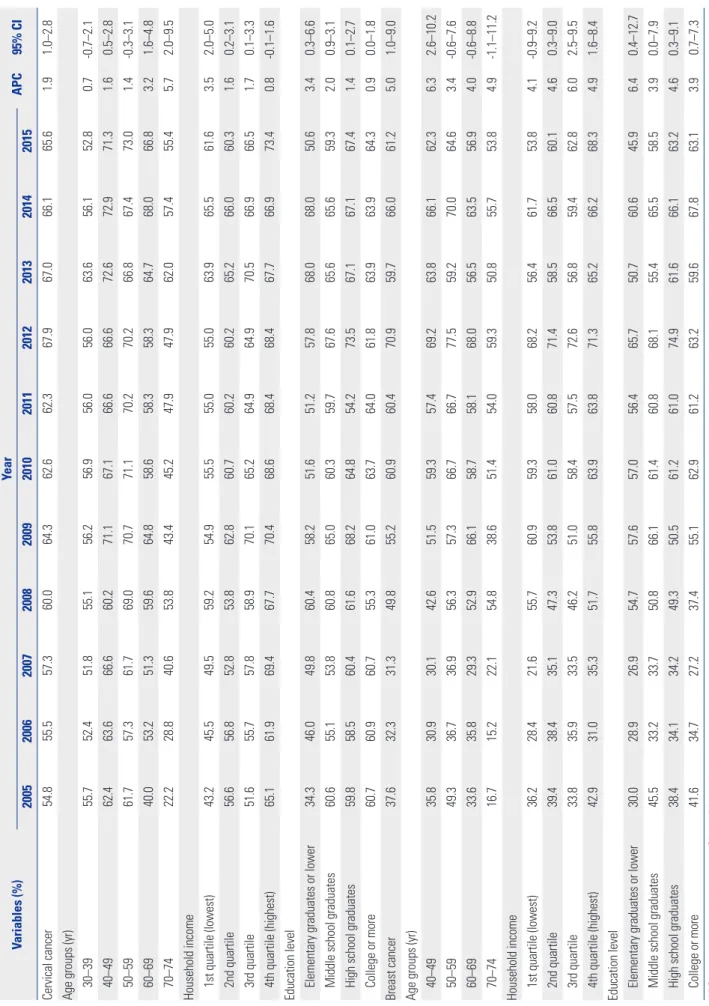
Table 2 provides the percentage of screened population from 2005 to 2015. The cervical cancer screening rates contin- uously increased from 54.8% in 2005 to 65.6% in 2015, with a significant APC of 1.9% (95% CI: 1.0 to 2.8). In particular, cer- vical cancer screening rates were highest in the highest in- come group. The APC in screening rates, however, was highest in the lowest income group (APC=3.5%, 95% CI: 2.0 to 5.0) and lowest in the highest income group (APC=0.8%, 95% CI:

-0.1 to 1.6). Breast cancer screening rates also followed an in-

creasing trend: An APC of 5.0% (95% CI: 1.0 to 9.0) was calcu-

lated for trends in total breast cancer screening during 2005

and 2015. Significant APCs were detected among women aged

40–49 years (APC=6.3%, 95% CI: 2.6 to 10.2); women in the sec-

ond (APC=4.6%, 95% CI: 0.3 to 9.0), third (APC=6.0%, 95% CI:

(4)

2.5 to 9.5), and fourth (APC=4.9%, 95% CI: 1.6 to 8.4) quartiles of household income; and across all educational levels (Table 2).

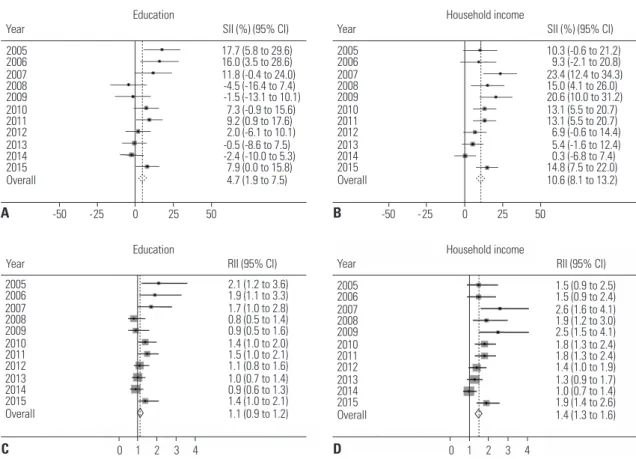
Inequality indicators (SII and RII) revealed changing pat- terns in socioeconomic inequalities in cervical and breast cancer screening participation (Figs. 1 and 2). Regarding edu- cational inequalities in cervical cancer screening participa- tion, absolute and relative inequalities were significant in 2005 (SII: 17.7% and RII: 2.1), 2006 (SII: 16.0% and RII: 1.9), and 2011 (SII: 9.2% and RII: 1.5), favoring women with higher educational attainment (Fig. 1A and C). Inequalities in house- hold income were far higher and frequently observed for cer- vical cancer screening, especially between 2007 and 2011 of the study period. Significant inequalities were detected in 2007, 2008, 2009, 2010, 2011, and 2015 for both SII and RII estimates, demonstrating much higher cervical screening rates in wom- en with higher levels of household income than in women with lower levels thereof (Fig. 1B and D). Overall, educational inequality in absolute terms was significant with a pooled es- timate of 4.7% (95% CI: 1.9 to 7.5). Also, overall absolute in- equality in household income status in cervical cancer screen- ing status was significant (pooled coefficient: 10.6%, 95% CI:

8.1 to 13.2). In relative terms, the pooled estimate of educational inequality was 1.1 (95% CI: 0.9 to 1.2), indicating no significant changes therein over time. Nevertheless, relative inequalities ac- cording to household income followed similar trends as those for absolute inequalities.

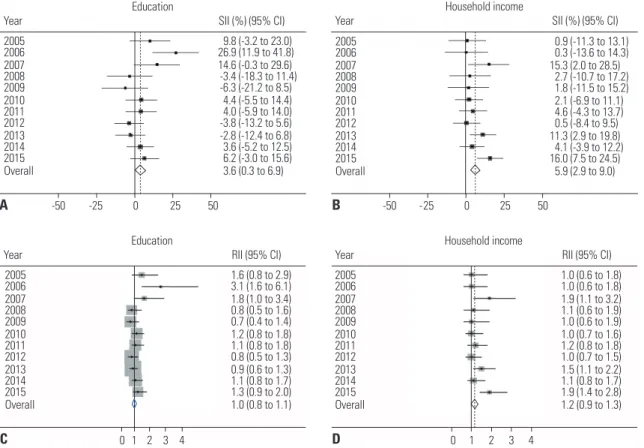
Regarding breast cancer screening, no educational inequal- ities were found between 2005 and 2015, except only in 2006, while SII and RII estimates of inequalities in household in- come were significant in 2007, 2013, and 2015 (Fig. 2). Absolute and relative inequalities in relation to household income were stagnant over the 11-year study period, with a significant pooled SII estimate of 5.9% (95% CI: 2.9 to 9.0) and pooled RII estimate of 1.2 (95% CI: 0.9 to 1.3) (Fig. 2B and D).

DISCUSSION

Consistent evidence throughout the world supports that so-

cially deprived people suffer a heavier burden of cervical and

breast cancer, stemming from disparities in the utilization of

screening services. In the current study, we noted trends of in-

creasing uptake of cervical and breast cancer screening among

Korean women from 2005 to 2015. Educational inequalities

decreased to none for both cervical and breast cancer among

Korean women, while inequalities according to household in-

come remained significant. Despite fluctuations from 2005 to

2015, inequalities in household income status in relation to

cervical cancer screening rates were generally higher than

those in breast cancer screening. In the case of breast cancer

screening uptake, inequalities according to household income

status began very low, but significant values were observed in

2007, 2013, and 2015. Although cervical cancer screening rates

Table 1. Baseline Characteristics of the Study Population in the Korean National Cancer Screening Survey , 2005–2015 2005 2006 2007 2008 2009 2010 2011 2012 2013 2014 2015 Total 1194 (100.0) 1144 (100.0) 1170 (100.0) 1172 (100.0) 1155 (100.0) 2374 (100.0) 2402 (100.0) 2395 (100.0) 2364 (100.0) 2270 (100.0) 2270 (100.0) Age groups (yr) 30–39 372 (31.2) 348 (30.5) 358 (30.6) 354 (30.2) 333 (28.8) 655 (27.6) 641 (26.7) 637 (26.6) 592 (25.0) 557 (24.5) 541 (23.8) 40–49 358 (30.0) 341 (29.8) 328 (28.0) 339 (29.0) 344 (29.8) 684 (28.8) 680 (28.3) 681 (28.5) 665 (28.1) 636 (28.0) 629 (27.7) 50–59 228 (19.1) 228 (20.0) 210 (17.9) 242 (20.7) 246 (21.3) 547 (23.0) 589 (24.5) 587 (24.5) 605 (25.6) 586 (25.8) 590 (26.0) 60–69 172 (14.4) 162 (14.2) 247 (21.1) 170 (14.5) 167 (14.5) 346 (14.6) 347 (14.4) 344 (14.4) 359 (15.2) 346 (15.2) 366 (26.1) 70–74 64 (5.3) 63 (5.5) 27 (2.3) 66 (5.6) 66 (5.7) 142 (6.0) 145 (6.0) 145 (6.0) 144 (6.1) 146 (6.4) 145 (6.4) Household income 1st quartile (lowest) 312 (26.2) 274 (24.0) 352 (30.1) 308 (26.3) 295 (25.5) 731 (30.8) 729 (30.3) 593 (24.8) 578 (24.5) 561 (24.7) 529 (23.3) 2nd quartile 391 (32.7) 359 (31.4) 203 (17.3) 205 (17.5) 320 (27.7) 295 (12.4) 306 (12.7) 750 (31.3) 445 (18.8) 468 (20.6) 509 (22.4) 3rd quartile 155 (13.0) 151 (13.2) 324 (27.7) 399 (34.1) 290 (25.1) 638 (26.9) 646 (26.9) 663 (27.7) 610 (25.8) 670 (29.5) 704 (31.0) 4th quartile (highest) 336 (28.2) 360 (31.5) 291 (24.9) 260 (22.2) 251 (21.7) 709 (29.9) 722 (30.0) 389 (16.2) 731 (30.9) 572 (25.2) 529 (23.3) Education level Elementary graduates or lower 245 (20.5) 258 (22.6) 246 (21.0) 195 (16.6) 220 (19.0) 244 (10.3) 243 (10.1) 262 (11.0) 137 (5.8) 146 (6.4) 147 (6.5) Middle school graduates 169 (14.2) 168 (14.7) 162 (13.8) 188 (16.1) 120 (10.4) 282 (11.9) 274 (11.4) 210 (8.8) 180 (7.6) 193 (8.5) 211 (9.3) High school graduates 552 (46.2) 537 (46.9) 564 (48.2) 559 (47.7) 543 (47.1) 1254 (52.8) 1287 (53.6) 1242 (51.9) 1378 (58.3) 1266 (55.8) 1237 (54.5) College or more 227 (19.0) 181 (15.8) 198 (17.0) 230 (19.7) 272 (23.5) 594 (25.0) 599 (24.9) 681 (28.4) 668 (28.3) 666 (29.3) 675 (29.8) Data are presented as number (%).

(5)

Table 2. Percentage of W omen Screened for Cervical and Breast Cancer within T wo Preceding Y ears according to Socioeconomic Status, 2005–2015 (%) Variables (%) Year APC 95% CI 2005 2006 2007 2008 2009 2010 2011 2012 2013 2014 2015 Cervical cancer 54.8 55.5 57.3 60.0 64.3 62.6 62.3 67.9 67.0 66.1 65.6 1.9 1.0–2.8 Age groups (yr) 30–39 55.7 52.4 51.8 55.1 56.2 56.9 56.0 56.0 63.6 56.1 52.8 0.7 -0.7–2.1 40–49 62.4 63.6 66.6 60.2 71.1 67.1 66.6 66.6 72.6 72.9 71.3 1.6 0.5–2.8 50–59 61.7 57.3 61.7 69.0 70.7 71.1 70.2 70.2 66.8 67.4 73.0 1.4 -0.3–3.1 60–69 40.0 53.2 51.3 59.6 64.8 58.6 58.3 58.3 64.7 68.0 66.8 3.2 1.6–4.8 70–74 22.2 28.8 40.6 53.8 43.4 45.2 47.9 47.9 62.0 57.4 55.4 5.7 2.0–9.5 Household income 1st quartile (lowest) 43.2 45.5 49.5 59.2 54.9 55.5 55.0 55.0 63.9 65.5 61.6 3.5 2.0–5.0 2nd quartile 56.6 56.8 52.8 53.8 62.8 60.7 60.2 60.2 65.2 66.0 60.3 1.6 0.2–3.1 3rd quartile 51.6 55.7 57.8 58.9 70.1 65.2 64.9 64.9 70.5 66.9 66.5 1.7 0.1–3.3 4th quartile (highest) 65.1 61.9 69.4 67.7 70.4 68.6 68.4 68.4 67.7 66.9 73.4 0.8 -0.1–1.6 Education level Elementary graduates or lower 34.3 46.0 49.8 60.4 58.2 51.6 51.2 57.8 68.0 68.0 50.6 3.4 0.3–6.6 Middle school graduates 60.6 55.1 53.8 60.8 65.0 60.3 59.7 67.6 65.6 65.6 59.3 2.0 0.9–3.1 High school graduates 59.8 58.5 60.4 61.6 68.2 64.8 54.2 73.5 67.1 67.1 67.4 1.4 0.1–2.7 College or more 60.7 60.9 60.7 55.3 61.0 63.7 64.0 61.8 63.9 63.9 64.3 0.9 0.0–1.8 Breast cancer 37.6 32.3 31.3 49.8 55.2 60.9 60.4 70.9 59.7 66.0 61.2 5.0 1.0–9.0 Age groups (yr) 40–49 35.8 30.9 30.1 42.6 51.5 59.3 57.4 69.2 63.8 66.1 62.3 6.3 2.6–10.2 50–59 49.3 36.7 36.9 56.3 57.3 66.7 66.7 77.5 59.2 70.0 64.6 3.4 -0.6–7.6 60–69 33.6 35.8 29.3 52.9 66.1 58.7 58.1 68.0 56.5 63.5 56.9 4.0 -0.6–8.8 70–74 16.7 15.2 22.1 54.8 38.6 51.4 54.0 59.3 50.8 55.7 53.8 4.9 -1.1–11.2 Household income 1st quartile (lowest) 36.2 28.4 21.6 55.7 60.9 59.3 58.0 68.2 56.4 61.7 53.8 4.1 -0.9–9.2 2nd quartile 39.4 38.4 35.1 47.3 53.8 61.0 60.8 71.4 58.5 66.5 60.1 4.6 0.3–9.0 3rd quartile 33.8 35.9 33.5 46.2 51.0 58.4 57.5 72.6 56.8 59.4 62.8 6.0 2.5–9.5 4th quartile (highest) 42.9 31.0 35.3 51.7 55.8 63.9 63.8 71.3 65.2 66.2 68.3 4.9 1.6–8.4 Education level Elementary graduates or lower 30.0 28.9 26.9 54.7 57.6 57.0 56.4 65.7 50.7 60.6 45.9 6.4 0.4–12.7 Middle school graduates 45.5 33.2 33.7 50.8 66.1 61.4 60.8 68.1 55.4 65.5 58.5 3.9 0.0–7.9 High school graduates 38.4 34.1 34.2 49.3 50.5 61.2 61.0 74.9 61.6 66.1 63.2 4.6 0.3–9.1 College or more 41.6 34.7 27.2 37.4 55.1 62.9 61.2 63.2 59.6 67.8 63.1 3.9 0.7–7.3 APC, annual percentage change; CI, confidence interval.

(6)

did not increase much, inequalities in cervical cancer screen- ing were wider than those for breast cancer screening and fre- quently significant, which requires careful consideration in public health interventions. A possible explanation for the greater inequalities in cervical cancer than in breast cancer screening is partly explained by the fact that cervical cancer screening involves women in their 30s who typically have low- er income level than women of other age groups. Also, in gen- eral, there are more single women in lower income groups, and single women have been found to be less likely to partici- pate in cervical cancer screening due to the nature of tests.

Thus, some of these factors may explain the greater inequali- ties associated with income status in cervical cancer screen- ing than in breast cancer screening. However, further research is needed to explain the different magnitudes of inequalities between cervical and breast cancer screening.

Educational attainment is considered a more stable indica- tor of various health outcomes than income or occupational status due to its pan-national characteristics, especially among women.

16

In one European study of the utilization of breast and cervical cancer screening services, researchers reported consistently higher educational inequalities in screening par- ticipation in countries without organized cancer screening pro- grams at the regional or national level.

4

Taiwan also reported decreased inequality in cervical cancer screening rates across

educational attainment in a population-based screening pro- gram.

18

In our results, however, educational attainment con- tributed to significant socioeconomic inequalities in cervical cancer screening uptake. We suggest that the inequality is at- tributable, in part, to a recent demographic change toward high- er educational attainment. In our study results, the proportion of women who were elementary school graduates was 20.5%

in 2005, but reduced to 6.5% in 2015, whereas women with educational level of college or more doubled over the 11-year study period. Indeed, rapid increases in educational attainment have been reported for Korean women in a national report.

19

Nonetheless, the magnitude of educational inequality in cervi- cal cancer screening was still higher for Korea than that for oth- er countries, suggesting an area with room for improvement.

Inequalities in household income were even wider than those in educational attainment and were significant for both cervi- cal and breast cancer screening. Income inequalities in several countries with subsidized population-based cancer screening programs have been also demonstrated.

18,20,21

Despite the lack of a nationwide health insurance program, the Medicaid pro- gram in the United States supports cancer screening and di- agnostic services through the Breast and Cervical Cancer Early Detection Program. Nevertheless, several problems in reach- ing uninsured and underinsured women have been shown to affect income inequalities in breast and cervical cancer screen-

2005 2.1 (1.2 to 3.6)

2006 1.9 (1.1 to 3.3)

2007 1.7 (1.0 to 2.8)

2008 0.8 (0.5 to 1.4)

2009 0.9 (0.5 to 1.6)

2010 1.4 (1.0 to 2.0)

2011 1.5 (1.0 to 2.1)

2012 1.1 (0.8 to 1.6)

2013 1.0 (0.7 to 1.4)

2014 0.9 (0.6 to 1.3)

2015 1.4 (1.0 to 2.1)

Overall 1.1 (0.9 to 1.2)

2005 1.5 (0.9 to 2.5)

2006 1.5 (0.9 to 2.4)

2007 2.6 (1.6 to 4.1)

2008 1.9 (1.2 to 3.0)

2009 2.5 (1.5 to 4.1)

2010 1.8 (1.3 to 2.4)

2011 1.8 (1.3 to 2.4)

2012 1.4 (1.0 to 1.9)

2013 1.3 (0.9 to 1.7)

2014 1.0 (0.7 to 1.4)

2015 1.9 (1.4 to 2.6)

Overall 1.4 (1.3 to 1.6)

Education

Year SII (%) (95% CI)

Education

Year RII (95% CI)

Household income

Year SII (%) (95% CI)

Household income

Year RII (95% CI) -50 -25 0 25 50 -50 -25 0 25 50

0 1 2 3 4 0 1 2 3 4

2005 17.7 (5.8 to 29.6)

2006 16.0 (3.5 to 28.6)

2007 11.8 (-0.4 to 24.0)

2008 -4.5 (-16.4 to 7.4)

2009 -1.5 (-13.1 to 10.1)

2010 7.3 (-0.9 to 15.6)

2011 9.2 (0.9 to 17.6)

2012 2.0 (-6.1 to 10.1)

2013 -0.5 (-8.6 to 7.5)

2014 -2.4 (-10.0 to 5.3)

2015 7.9 (0.0 to 15.8)

Overall 4.7 (1.9 to 7.5)

2005 10.3 (-0.6 to 21.2)

2006 9.3 (-2.1 to 20.8)

2007 23.4 (12.4 to 34.3)

2008 15.0 (4.1 to 26.0)

2009 20.6 (10.0 to 31.2)

2010 13.1 (5.5 to 20.7)

2011 13.1 (5.5 to 20.7)

2012 6.9 (-0.6 to 14.4)

2013 5.4 (-1.6 to 12.4)

2014 0.3 (-6.8 to 7.4)

2015 14.8 (7.5 to 22.0)

Overall 10.6 (8.1 to 13.2)

A

C

B

D

Fig. 1. Absolute and relative inequalities in cervical cancer screening from 2005 to 2015. (A) Absolute educational inequalities in cervical cancer screening

rates. (B) Absolute inequalities in household income in cervical cancer screening rates. (C) Relative educational inequalities in cervical cancer screening

rates. (D) Relative inequalities in household income in cervical cancer screening rates. Solid line is line of equality; dotted line is pooled coefficient. SII, slope in-

dex of inequality; RII, relative index of inequality; CI, confidence interval.

(7)

ing.

20

In the UK, women with a car in the household, as an indi- cator of income inequality, were more likely to undergo mam- mography, although possible mechanisms were not defined.

21

The “inverse equity hypothesis” was developed to explain in- come inequalities in Taiwanese cancer screening programs.

18

Although the Taiwanese national cancer screening program also covers cervical cancer screening, inequalities in house- hold income were found to have increased from 2001 to 2009.

The authors explained that household income inequalities could be transient effects of the hypothesis, and also proposed an interaction between urbanization and household income levels.

18

In Korea, lower income levels were shown to lower the odds of undergoing cervical cancer screening.

4

In addi- tion, despite reducing out-of-pocket expenses with the intro- duction the NSCP, inequalities in household income levels did not change much in absolute terms. In potential explana- tion thereof, more advantaged groups have been found to be more likely to participate in both organized and opportunistic screening. This is partly explained by the fact that more ad- vantaged individuals are more concerned about their health.

Further, lack of accessibility and availability of screening facili- ties, lack of time, and economic reasons may be as possible mechanisms causing income inequalities to remain in cancer screening services.

Our study has a few limitations. We administered self-re-

ported surveys to the participants, possibly introducing recall bias in describing past screening experiences or socioeco- nomic variables. Further, several factors influencing partici- pation in cervical and breast cancer screening, beyond educa- tion and income level, such as accessibility and availability of screening facilities, were not considered and should be fur- ther studied.

In spite of the limitations, this study is important in that we analyzed nationwide socioeconomic inequalities in cervical and breast cancer screening uptake among Korean women.

Although the NCSP is designed to increase availability of cancer screening services, inequalities in household income levels remain significant among Korean women. Specifically, socio- economic inequalities in cervical cancer screening participation were found to be more profound than those in breast cancer screening. Thus, further study is needed with additional infor- mation to outline longitudinal trends and identify other fac- tors related with inequalities in cervical and breast cancer screening.

ACKNOWLEDGEMENTS

This study was supported by a Grant-in-Aid for Cancer Re- search and Control from the National Cancer Center of Korea (#1610401). Three authors, Eunji Choi, Mai Tran, and Eun Young

2005 1.0 (0.6 to 1.8)

2006 1.0 (0.6 to 1.8)

2007 1.9 (1.1 to 3.2)

2008 1.1 (0.6 to 1.9)

2009 1.0 (0.6 to 1.9)

2010 1.0 (0.7 to 1.6)

2011 1.2 (0.8 to 1.8)

2012 1.0 (0.7 to 1.5)

2013 1.5 (1.1 to 2.2)

2014 1.1 (0.8 to 1.7)

2015 1.9 (1.4 to 2.8)

Overall 1.2 (0.9 to 1.3)

2005 1.6 (0.8 to 2.9)

2006 3.1 (1.6 to 6.1)

2007 1.8 (1.0 to 3.4)

2008 0.8 (0.5 to 1.6)

2009 0.7 (0.4 to 1.4)

2010 1.2 (0.8 to 1.8)

2011 1.1 (0.8 to 1.8)

2012 0.8 (0.5 to 1.3)

2013 0.9 (0.6 to 1.3)

2014 1.1 (0.8 to 1.7)

2015 1.3 (0.9 to 2.0)

Overall 1.0 (0.8 to 1.1)

Education

Year SII (%) (95% CI)

2005 9.8 (-3.2 to 23.0)

2006 26.9 (11.9 to 41.8)

2007 14.6 (-0.3 to 29.6)

2008 -3.4 (-18.3 to 11.4)

2009 -6.3 (-21.2 to 8.5)

2010 4.4 (-5.5 to 14.4)

2011 4.0 (-5.9 to 14.0)

2012 -3.8 (-13.2 to 5.6)

2013 -2.8 (-12.4 to 6.8)

2014 3.6 (-5.2 to 12.5)

2015 6.2 (-3.0 to 15.6)

Overall 3.6 (0.3 to 6.9)

2005 0.9 (-11.3 to 13.1)

2006 0.3 (-13.6 to 14.3)

2007 15.3 (2.0 to 28.5)

2008 2.7 (-10.7 to 17.2)

2009 1.8 (-11.5 to 15.2)

2010 2.1 (-6.9 to 11.1)

2011 4.6 (-4.3 to 13.7)

2012 0.5 (-8.4 to 9.5)

2013 11.3 (2.9 to 19.8)

2014 4.1 (-3.9 to 12.2)

2015 16.0 (7.5 to 24.5)

Overall 5.9 (2.9 to 9.0)

Education

Year RII (95% CI)

Household income

Year SII (%) (95% CI)

Household income

Year RII (95% CI) -50 -25 0 25 50 -50 -25 0 25 50

0 1 2 3 4 0 1 2 3 4

A

C

B

D

Fig. 2. Absolute and relative inequalities in breast cancer screening from 2005 to 2015. (A) Absolute educational inequalities in breast screening rates.

(B) Absolute inequalities in household income in breast screening rates. (C) Relative educational inequalities in breast screening rates. (D) Relative inequali-

ties in household income in breast screening rates. Solid line is line of equality; dotted line is pooled coefficient. SII, slope index of inequality; RII, relative in-

dex of inequality; CI, confidence interval.

(8)

Lee received funding from the “International Cooperation &

Education Program (#NCCRI·NCCI 52210-52211, 2017).”

ORCID

Kui Son Choi https://orcid.org/0000-0001-5336-3874

REFERENCES

1. Ferlay J, Soerjomataram I, Dikshit R, Eser S, Mathers C, Rebelo M, et al. Cancer incidence and mortality worldwide: sources, methods and major patterns in GLOBOCAN 2012. Int J Cancer 2015;136:

E359-86.

2. Teng AM, Atkinson J, Disney G, Wilson N, Blakely T. Changing so- cioeconomic inequalities in cancer incidence and mortality: Co- hort study with 54 million person-years follow-up 1981-2011. Int J Cancer 2017;140:1306-16.

3. Lundqvist A, Andersson E, Ahlberg I, Nilbert M, Gerdtham U. Socio- economic inequalities in breast cancer incidence and mortality in Europe-a systematic review and meta-analysis. Eur J Public Health 2016;26:804-13.

4. Palència L, Espelt A, Rodríguez-Sanz M, Puigpinós R, Pons-Vigués M, Pasarín MI, et al. Socio-economic inequalities in breast and cer- vical cancer screening practices in Europe: influence of the type of screening program. Int J Epidemiol 2010;39:757-65.

5. Wharam JF, Zhang F, Xu X, Landon BE, Ross-Degnan D. National trends and disparities in cervical cancer screening among com- mercially insured Women, 2001-2010. Cancer Epidemiol Biomark- ers Prev 2014;23:2366-73.

6. Drolet M, Boily MC, Greenaway C, Deeks SL, Blanchette C, La- prise JF, et al. Sociodemographic inequalities in sexual activity and cervical cancer screening: implications for the success of human papillomavirus vaccination. Cancer Epidemiol Biomarkers Prev 2013;22:641-52.

7. Miller JW, Plescia M, Ekwueme DU. Public health national ap- proach to reducing breast and cervical cancer disparities. Cancer 2014;120 Suppl 16:2537-9.

8. Smith-Bindman R, Miglioretti DL, Lurie N, Abraham L, Barbash RB, Strzelczyk J, et al. Does utilization of screening mammography explain racial and ethnic differences in breast cancer? Ann Intern Med 2006;144:541-53.

9. Jung KW, Won YJ, Oh CM, Kong HJ, Lee DH, Lee KH; Community of Population-Based Regional Cancer Registries. Cancer statistics in Korea: incidence, mortality, survival, and prevalence in 2014.

Cancer Res Treat 2017;49:292-305.

10. Choi E, Lee YY, Yoon HJ, Lee S, Suh M, Park B, et al. Relationship between cancer worry and stages of adoption for breast cancer screening among Korean women. PLoS One 2015;10:e0132351.

11. Yoo KY. Cancer control activities in the Republic of Korea. Jpn J Clin Oncol 2008;38:327-33.

12. Suh M, Choi KS, Park B, Lee YY, Jun JK, Lee DH, et al. Trends in cancer screening rates among Korean men and women: results of the Korean National Cancer Screening Survey, 2004-2013. Cancer Res Treat 2016;48:1-10.

13. Kim S, Kwon S, Subramanian SV. Has the National Cancer Screen- ing Program reduced income inequalities in screening attendance in South Korea? Cancer Causes Control 2015;26:1617-25.

14. Lee M, Park EC, Chang HS, Kwon JA, Yoo KB, Kim TH. Socioeco- nomic disparity in cervical cancer screening among Korean wom- en: 1998-2010. BMC Public Health 2013;13:553.

15. Park MJ, Park EC, Choi KS, Jun JK, Lee HY. Sociodemographic gra- dients in breast and cervical cancer screening in Korea: the Korean National Cancer Screening Survey (KNCSS) 2005-2009. BMC Can- cer 2011;11:257.

16. Renard F, Demarest S, Van Oyen H, Tafforeau J. Using multiple measures to assess changes in social inequalities for breast cancer screening. Eur J Public Health 2014;24:275-80.

17. Lee JT, Huang Z, Basu S, Millett C. The inverse equity hypothesis:

does it apply to coverage of cancer screening in middle-income countries? J Epidemiol Community Health 2015;69:149-55.

18. Chiou ST, Wu CY, Hurng BS, Lu TH. Changes in the magnitude of social inequality in the uptake of cervical cancer screening in Tai- wan, a country implementing a population-based organized screen- ing program. Int J Equity Health 2014;13:4.

19. OECD. Education at a Glance 2017: OECD Indicators. Paris: OECD Publishing; 2017.

20. Sabik LM, Tarazi WW, Bradley CJ. State Medicaid expansion deci- sions and disparities in women’s cancer screening. Am J Prev Med 2015;48:98-103.

21. Moser K, Patnick J, Beral V. Inequalities in reported use of breast

and cervical screening in Great Britain: analysis of cross sectional

survey data. BMJ 2009;338:b2025.

수치

Table 2. Percentage of Women Screened for Cervical and Breast Cancer within Two Preceding Years according to Socioeconomic Status, 2005–2015 (%)  Variables (%)YearAPC95% CI 20052006200720082009201020112012201320142015 Cervical cancer54.855.557.360.064.362.
Fig. 1. Absolute and relative inequalities in cervical cancer screening from 2005 to 2015
Fig. 2. Absolute and relative inequalities in breast cancer screening from 2005 to 2015

참조

관련 문서