INTRODUCTION
Human respiratory syncytial virus (RSV), an enveloped, non- segmented negative-sense RNA virus of the family Paramyxo- viridae is the leading cause of severe lower respiratory tract infection in both infants and the elderly, despite limited viral variation and protective immunity.1 Most infants are infected during the first year of life, and re-infections occur throughout life. The immature immune system of infants is associated with pathologic symptoms and mortality as well as RSV vaccine- enhanced disease. Additionally, RSV infection is likely to be associated with specific side effects, such as asthma-like le- sions following RSV re-infection. RSV infection is also a serious problem in elderly persons due to their weak immune systems.
According to a retrospective cohort study, adult hospitalization
due to RSV infection is associated with substantial rates of com- plications and mortality.2 These facts have increased the pub- lic health concern related to RSV worldwide; however, no ap- proved vaccine for RSV is available. Developing an effective RSV vaccine is problematic, as the major target populations are infants and immunocompromised adults. The efficacy and safety of any vaccine are important aspects in its development.
In this review, we discuss the latest research on protective immunity against RSV infection and suggest what should be considered for the development of safe and effective vaccines against RSV infection.
RSV INFECTION AND INNATE IMMUNITY
Viruses are recognized mainly by Toll-like receptors (TLRs) and other pattern recognition receptors, which detect structural components including viral nucleic acids and surface glycopro- teins as pathogen-associated molecular patterns. The recogni- tion of viruses by these innate immune receptors commonly induces type I interferon (IFN) production, which mediates strong antiviral defenses. Similar to other viruses, RSV infection elicits host innate immune responses, in which innate recep- tors expressed on resident leukocytes and lung epithelial cells play key roles.3,4 TLRs are directly involved in activating innate
In Hot Pursuit of the First Vaccine Against Respiratory Syncytial Virus
Joo Young Kim and Jun Chang
Graduate School of Pharmaceutical Sciences, Ewha Womans University, Seoul, Korea.
Human respiratory syncytial virus (RSV) is the leading cause of severe lower respiratory tract infection, such as bronchiolitis, bronchitis, or pneumonia, in both infants and the elderly. Despite the global burden of diseases attributable to RSV infection, no clinically approved vaccine is available, and a humanized monoclonal antibody for prophylaxis is not readily affordable in devel- oping countries. There are several hurdles to the successful development of RSV vaccines: immune-vulnerable target populations such as premature infants, pregnant women, and immunocompromised people; safety concerns associated with vaccine-enhanced diseases; repeated infection; and waning memory. To develop successful strategies for the prevention of RSV infection, it is neces- sary to understand the protective and pathologic roles of host immune responses to RSV infection. In this review, we will summa- rize the positive and negative relationship between RSV infection and host immunity and discuss strategies for the development of the first successful RSV vaccine.
Key Words: Immunity, respiratory syncytial viruses, vaccine, vaccine-enhanced diseases Yonsei Med J 2016 Jul;57(4):809-816
http://dx.doi.org/10.3349/ymj.2016.57.4.809 pISSN: 0513-5796 · eISSN: 1976-2437
Received: March 22, 2016
Corresponding author: Dr. Jun Chang, Graduate School of Pharmaceutical Sci- ences, Ewha Womans University, 52 Ewhayeodae-gil, Seodaemun-gu, Seoul 03760, Korea.
Tel: 82-2-3277-2549, Fax: 82-2-3277-3051, E-mail: [email protected]
•The authors have no financial conflicts of interest.
© Copyright: Yonsei University College of Medicine 2016
This is an Open Access article distributed under the terms of the Creative Com- mons Attribution Non-Commercial License (http://creativecommons.org/licenses/
by-nc/3.0) which permits unrestricted non-commercial use, distribution, and repro- duction in any medium, provided the original work is properly cited.
immunity against RSV by recognizing certain conserved viral motifs.5,6 For instance, the fusion (F) protein of RSV has been observed to activate TLR4.7 Moreover, RSV induces produc- tion of inflammatory cytokines and chemokines through TLR2 and TLR6, which activate innate immunity by promot- ing TNF-α, interleukin (IL)-6, MCP-1, and RANTES produc- tion.8 The early inflammatory signals generated by RSV-TLR interactions during RSV infection are likely to recruit neutro- phils and natural killer (NK) cells into the lung, which are im- portant for clearing RSV-infected cells. Indeed, TLR4-deficient mice challenged with RSV, though not influenza virus, exhib- ited impaired NK cell and CD14+ cell pulmonary trafficking, deficient NK cell function, impaired IL-12 expression, and im- paired virus clearance compared to control mice.9 However, Ehl, et al.10 reported that the absence of TLR4 had no impact on NK cell recruitment, NK cell activity, or recruitment of oth- er pulmonary inflammatory cells, arguing against a significant role for TLR4 in primary murine RSV infection. In humans, Awomoyi, et al.11 suggested that a defect in TLR4 signaling is linked to RSV-induced pathology in preterm, high-risk infants.
Supporting these findings, Tulic, et al.12 demonstrated that pe- ripheral blood mononuclear cells isolated from children with variant forms of TLR4 exhibited reduced expression of the re- ceptor on the surface and reduced response to RSV, suggest- ing that weakened immune responses contribute to enhanced susceptibility to RSV infection in these individuals. Thus, it is likely that TLR-dependent signaling is important for activating early inflammatory responses to RSV and that aberrant TLR signaling contributes to RSV-induced disease in humans. The RIG-I-like receptors (RLRs), including RIG-I and MDA5, detect viral dsRNA, 5’-triphosphorylated uncapped viral RNA, or ss- RNA genome bearing 5’-triphosphates, and activate the down- stream NF-κB and IRFs pathways through the common adap- tor, mitochondrial anti-viral signaling protein (MAVS). Bhoj, et al.3 demonstrated in vitro and in vivo that MAVS is essential for the production of type I IFN and many inflammatory cyto- kines in response to RSV infection. However, Myd88-/-Mavs-/- mice mounted a normal cytotoxic T-lymphocyte response and exhibited delayed yet effective viral clearance, suggesting that comparable adaptive immune responses could be induced in the absence of innate immunity mediated by the MAVS and MyD88 pathways.3 Therefore, it is clear that innate immunity is involved in RSV recognition and the subsequent immune response, and further studies of anti-RSV innate immunity are required for the development of effective vaccines and thera- peutics against RSV infection.
B-CELL IMMUNITY TO RSV AND VACCINE DEVELOPMENT
Although natural infection with RSV induces neutralizing anti- bodies, the levels of which are correlated with protection against
reinfection with RSV of the same strain, it does not provide long-lasting protective immunity.1,13 In humans, levels of RSV- specific antibodies decline more than 4-fold within 1 year fol- lowing a natural RSV infection,14 and this decline was reported to correlate with susceptibility to recurrent symptomatic RSV infection.1 In particular, RSV-specific nasal IgA was correlated more strongly with protection from RSV infection, although the levels were less well maintained than those of serum neutral- izing antibodies.15 As RSV antibodies are important for protec- tion following RSV infection, strategies to modulate antibody persistence and confer protection against RSV are needed.
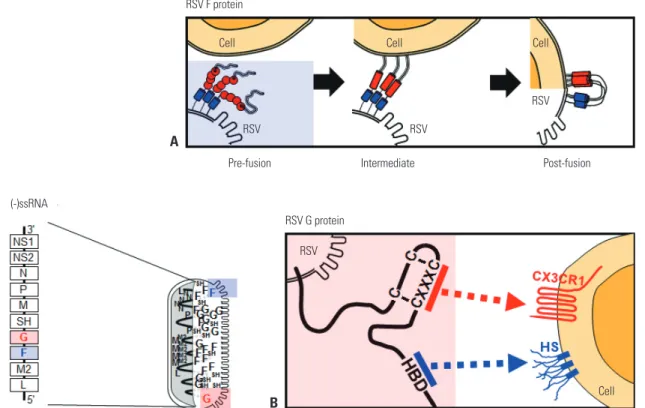
The major glycoproteins on the surface of RSV, the F and at- tachment (G) proteins, control the initial phases of viral infec- tion and are the major protective antigens targeted by neutral- izing antibodies.16 The F protein is highly conserved between RSV A and B subtypes (90% similarity) and elicits production of neutralizing antibodies and a T cell response against RSV challenge. F protein mediates virus entry via membrane fusion and exists on the RSV membrane in both prefusion (pre-F) and postfusion (post-F) conformations. Briefly, F-protein trimers in the envelope of resting RSV (pre-F form) are triggered, re- folded, and attached to the target cell membrane (intermedi- ate stage). The trimer then folds in half, and the viral and cellu- lar membranes fuse (post-F form) (Fig. 1A). Although epitopes for neutralizing antibody production reside in both conforma- tions, post-F exhibits less effective neutralization through im- munoglobulins produced via natural infection with RSV, sug- gesting that pre-F has greater potency.17 The atomic-level structure of pre-F has increased our understanding of the targets of neutralizing antibodies produced via vaccination with RSV F protein. Identification of neutralization-sensitive epitopes in pre-F as a candidate for a subunit vaccine or for prophylactic monoclonal antibody development is a promising strategy for the development of an RSV vaccine.
The RSV G protein is involved in attachment.16 The heparin- binding domain and the third and fourth cysteines separated by three amino acids (CX3C) in the cysteine noose of the membrane-anchored G protein bind their respective targets, heparan sulfate18 and CX3CR1, on the surface of most cell types (Fig. 1B).18,19 The RSV A- and B-type G proteins share only 53%
identity,20 and the antigenic variability of RSV is a barrier to vaccine development. However, recent research suggests that the G protein has a conserved region from amino acids 148 to 198, which contains four conserved cysteine residues forming a noose (amino acid positions 173, 176, 182, and 186), and the central conserved region is targeted by antibodies protective against RSV challenge.17 The cysteine noose has a CX3C che- mokine motif within amino acids 182 to 186 that shares struc- tural similarity with the chemokine fractalkine (CX3CL1) and can bind to CX3CR1-expressing leukocytes competitive with CX3CL1.21 Although a monoclonal antibody against the CX3C region of the G protein was found to have no neutralizing ac- tivity in RSV-infected Hep2 cells,22 it directly blocked the bind-
ing between CX3C and CX3CRl and reduced viral replication in both prophylaxis and treatment mouse models of RSV chal- lenge.23 A non-neutralizing monoclonal antibody against a G protein epitope (amino acid positions 174–187) was reported to provide passive protection via both ADCC and comple- ment-mediated cytolysis.24 Previous works suggested that a re- combinant G protein core fragment of amino acids 131 to 230 (Gcf) induced strong immunoglobulin responses (RSV-spe- cific IgG and IgA) in mice as well as potent chemotactic activi- ty in a cell migration assay.25 An excellent vector-based muco- sal vaccine comprising a recombinant replication-deficient adenovirus expressing the tandem repeats of Gcf also induced strong RSV-specific B-cell responses and showed protective efficacy against human RSV A and B.26,27
As prophylactic vaccine candidates or therapeutics, con- served RSV antigens and neutralizing and/or non-neutralizing antibodies to these target antigens could play a role in provid- ing protection against RSV infection.
T-CELL IMMUNITY AGAINST RSV INFECTION
T cells are believed to be essential for the clearance of RSV from the lungs and host defense. In mice, adoptive transfer of RSV-
specific memory T cells cleared primary RSV infection,28 and depletion of CD4 or CD8 T cells markedly prolonged the dura- tion of RSV shedding,29 suggesting that T cells contribute to the elimination of infected cells during acute RSV infection. In hu- mans, the numbers and functional capacity of RSV-specific T cells might be implicated in viral clearance, as aging and/or im- munodeficiency affecting T-cell function resulted in more se- vere disease and higher levels of virus shedding.30,31 A recent human study has shown that a CD8 resident memory T cell subset was maintained at an increased level during the recov- ery period, and their abundance was highly correlated with vi- rus clearance and protection against RSV infection, despite lower cytotoxicity compared with peripheral blood CD8 T cells.32 In addition, a number of RSV gene products are impli- cated in the modulation of the immune system, including T- cell immunity (reviewed in Openshaw and Chiu33). For exam- ple, RSV infection of DCs impairs their activation of protective T cells yet promotes their proliferation and activation of pathologic Th2 cells.34 RSV infection might modulate the as- sembly of immunological synapses35 or affect the expression of co-stimulatory molecules and cytokine production.36 Thus, it is clear that a greater understanding of the role of T-cell im- munity in RSV infection and viral counter-regulation is re- quired for the development of a vaccine that provides long- term protective immunity.
RSV F protein
Cell
Pre-fusion
(-)ssRNA
Intermediate Post-fusion
Cell Cell
Cell RSV
RSV RSV
RSV RSV G protein
Fig. 1. RSV genome, proteins, and their functions. In the schematic diagram of the RSV genome, 10 genes are indicated in the order NS1-NS2-N-P-M-SH- G-F-M2-L. Filled square, genes encoding proteins targeted by neutralizing antibodies. (A) Simplified diagram of RSV F protein-mediated membrane fusion.
(B) Attachment of RSV G protein to the host cell membrane is mediated by HS and HBD and/or the CX3C-CX3CR1 interaction. Pre-fusion, pre-fusion form of the F protein; Intermediate, refolding of the F protein to initiate membrane attachment; Post-fusion, membrane fusion between RSV and the target cell;
HS, heparan sulfate; HBD, heparin-binding domain; RSV, respiratory syncytial virus.
A
B
Despite their importance in RSV clearance, T cells are also associated with RSV disease severity. For example, transfer of CTLs augmented lung pathology,28 and in vivo depletion of CD8 T cells29 resulted in reduced illness in mice. In the 1960s, formalin-inactivated RSV (FI-RSV) underwent a clinical trial as a vaccine candidate yet failed to induce protective immu- nity to RSV challenge.37 Instead, the vaccinated subjects devel- oped exacerbated symptoms that were associated with strong Th2 responses such as severe lung eosinophilia.38,39 This aber- rant response can be mimicked in murine models by priming with inactivated RSV40 or recombinant vaccinia virus express- ing RSV G protein,29,41 which is associated with Th2 cytokines and a specific oligoclonal CD4 T-cell response.42 In a mouse model, a strong RSV M2-specific CD8 T-cell response suppressed Th2-type cytokine production and subsequent pulmonary eo- sinophilia, suggesting that CD8 T cells play a regulatory role in the differentiation and activation of Th cells.43 However, it is un- likely that Th2-biased responses and vaccine-enhanced diseas- es are an intrinsic property of G antigen, as other vaccine plat- forms targeting G protein did not exhibit these properties.44 Nonetheless, the data from animal models and humans con- cerning vaccine-associated pathology can be used to form a consensus that Th2-biased CD4 T-cell responses and subse- quent vaccine-enhanced diseases should be avoided in future RSV vaccine trials. However, other studies failed to find an as- sociation between clinical severity and Th2-like T-cell respons- es.45,46 Thus, it remains to be determined whether the balance between Th1- and Th2-type responses induced by vaccination has an effect on subsequent RSV infection and RSV-induced disease severity.
Recently, emerging evidence has suggested that IL-17 and possibly Th17-type responses are involved in the pathophysiol- ogy of RSV infection and airway inflammation.47-49 In mice, neu- tralization of IL-17 during RSV infection resulted in reduced inflammation, inhibition of mucus production, decreased vi- ral load, and increased RSV-specific CD8 T cells.49 The level of IL-17 in tracheal aspirates from hospitalized infants also in- creased significantly compared to the control, suggesting a pathogenic role for IL-17. Tregs might also play an important role in the regulation of cellular infiltration in the lungs and disease severity following acute RSV infection. Depletion of Tregs following RSV infection resulted in increased cellular trafficking and enhanced disease severity without affecting viral clearance.50,51 However, the significance of Th17-type and Treg responses to RSV infection requires further studies in both humans and animal models.
T cells are essential for the generation of protective immu- nity against RSV. A successful RSV vaccine should elicit a bal- anced immune response without vaccine-enhanced disease as well as protective memory. Our understanding of T-cell–medi- ated immunity is a work in progress, and further studies on the protective and pathologic roles of T cells are required.
RSV VACCINES IN CLINICAL TRIALS
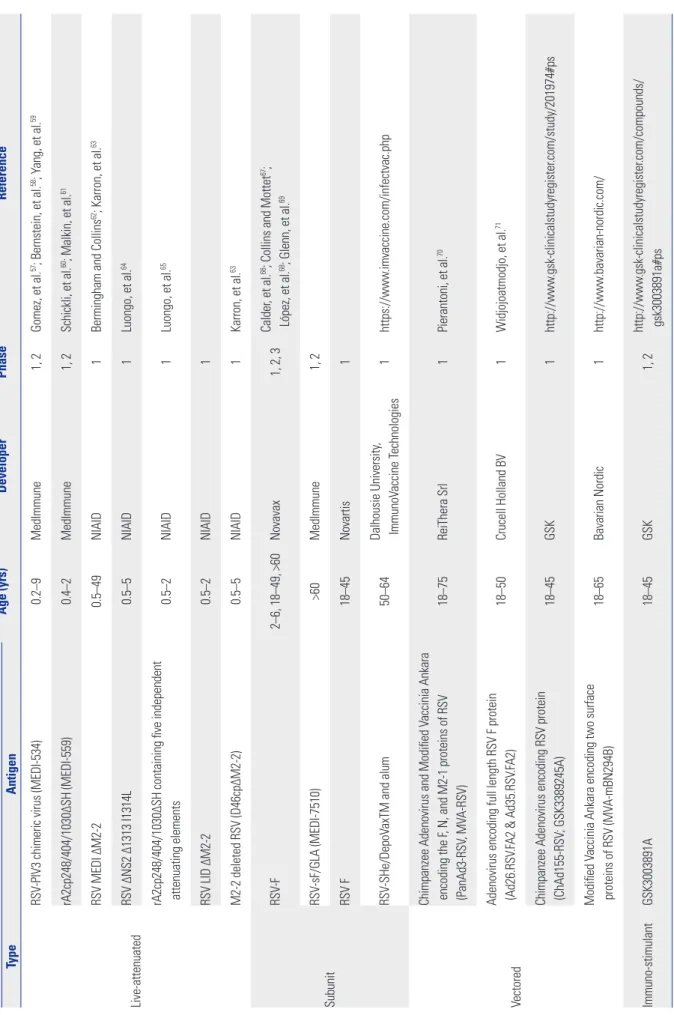
Vaccination might be the most effective and economic strate- gy for obtaining protective immunity against RSV. Since the fail- ure of the FI-RSV vaccine, many groups have investigated RSV immunity and vaccine-enhanced disease. Several RSV vac- cine candidates are undergoing clinical trials (Table 1).
Live-attenuated RSV vaccines that lack vaccine-associated enhanced RSV disease might be suitable for RSV-naïve infants and young children.52 These vaccines offer several advantag- es: 1) needle-free administration via the nasal cavity, 2) upper respiratory tract infection of the live-attenuated RSV and local mucosal immunity even in the presence of maternal neutral- izing antibody, and 3) broad stimulation of innate, humoral and cellular immunity.53 Despite the fact that balancing atten- uation and immunogenicity is difficult54 and that the vaccine itself is extremely unstable,53 several candidate live-attenuated vaccines that use temperature sensitivity and/or reverse ge- netics to derive attenuation are currently undergoing clinical trials (Table 1).
Infants less than 0.5 years old, children from 0.5 to 2 years of age, pregnant women, and the elderly are the target popula- tions for RSV vaccines. The immature and/or pre-existing im- munity in certain groups necessitates effective vaccine plat- forms. Although subunit vaccines are expected to elicit a strong neutralizing antibody response,21 animal and human studies indicate that some subunit vaccine candidates weaken cellular immunity and elicit a Th2-skewed immune response accom- panied by severe vaccine-enhanced disease.55 Currently, sub- unit vaccine candidates including F and SHe proteins are be- ing evaluated in clinical trials (Table 1).
Since the advent of recombinant vector technology, many vectored vaccines have been used as gene carrier systems, and viral vectors such as adenovirus and vaccinia virus have un- dergone clinical trials for RSV vaccine development. According to the delivery methods, the vectored vaccines might direct the production of mRNA and protein antigens inside host cells and induce both cellular and humoral immune responses.56 As shown in Table 1, various RSV genes of interest–such as F, G, N, and M2-1–are delivered to human subjects by means of these vectored vaccine platforms.
CONCLUSION
For many decades, RSV vaccine development has been a high priority in global healthcare, and much effort has been devot- ed to the study of host immunity and the development of safe and effective vaccine strategies to prevent and/or treat RSV in- fection. Presently, several vaccine candidates are being evaluat- ed in clinical trials targeting children, pregnant women, and the elderly, and this will continue until an effective vaccine is developed. The greater our understanding of the host immu-
Table 1. Clinical Trials of Vaccines for RSV Infection Vaccine Age (yrs)DeveloperPhaseReference TypeAntigen Live-attenuated
RSV-PIV3 chimeric virus (MEDI-534)0.2–9MedImmune1, 2Gomez, et al.57; Bernstein, et al.58; Yang, et al.59 rA2cp248/404/1030ΔSH (MEDI-559)0.4–2MedImmune1, 2Schickli, et al.60; Malkin, et al.61 RSV MEDI ΔM2-20.5–49NIAID1Bermingham and Collins62; Karron, et al.63 RSV ΔNS2 Δ1313 I1314L0.5–5NIAID1Luongo, et al.64 rA2cp248/404/1030ΔSH containing five independent attenuating elements0.5–2NIAID1Luongo, et al.65 RSV LID ΔM2-20.5–2NIAID1 M2-2 deleted RSV (D46cpΔM2-2)0.5–5NIAID1Karron, et al.63 Subunit
RSV-F2–6, 18–49, >60Novavax1, 2, 3Calder, et al.66; Collins and Mottet67; López, et al.68; Glenn, et al.69 RSV-sF/GLA (MEDI-7510)>60MedImmune1, 2 RSV F18–45Novartis1 RSV-SHe/DepoVaxTM and alum50–64Dalhousie University, ImmunoVaccine Technologies1https://www.imvaccine.com/infectvac.php Vectored
Chimpanzee Adenovirus and Modified Vaccinia Ankara encoding the F, N, and M2-1 proteins of RSV (PanAd3-RSV, MVA-RSV)18–75ReiThera Srl1Pierantoni, et al.70 Adenovirus encoding full length RSV F protein (Ad26.RSV.FA2 & Ad35.RSV.FA2)18–50Crucell Holland BV1Widjojoatmodjo, et al.71 Chimpanzee Adenovirus encoding RSV protein (ChAd155-RSV; GSK3389245A)18–45GSK1http://www.gsk-clinicalstudyregister.com/study/201974#ps Modified Vaccinia Ankara encoding two surface proteins of RSV (MVA-mBN294B)18–65Bavarian Nordic1http://www.bavarian-nordic.com/ Immuno-stimulantGSK3003891A18–45GSK1, 2http://www.gsk-clinicalstudyregister.com/compounds/ gsk3003891a#ps RSV, respiratory syncytial virus; PIV3, parainfluenza virus type 3; cp, cold-passaged; NIAID, National Institute of Allergy and Infectious Diseases; GSK, GlaxoSmithKline.
nity, viral immune evasion, and immunopathology of RSV in- fection, the closer we move towards the first licensed RSV vac- cine.
ACKNOWLEDGEMENTS
This study was supported by a grant of the Korean Health Technology R&D Project, Ministry of Health & Welfare, Repub- lic of Korea (Grant number: HI13C0826).
REFERENCES
1. Hall CB, Walsh EE, Long CE, Schnabel KC. Immunity to and fre- quency of reinfection with respiratory syncytial virus. J Infect Dis 1991;163:693-8.
2. Volling C, Hassan K, Mazzulli T, Green K, Al-Den A, Hunter P, et al. Respiratory syncytial virus infection-associated hospitalization in adults: a retrospective cohort study. BMC Infect Dis 2014;14:
665.
3. Bhoj VG, Sun Q, Bhoj EJ, Somers C, Chen X, Torres JP, et al. MAVS and MyD88 are essential for innate immunity but not cytotoxic T lymphocyte response against respiratory syncytial virus. Proc Natl Acad Sci U S A 2008;105:14046-51.
4. Kawai T, Akira S. TLR signaling. Semin Immunol 2007;19:24-32.
5. Rudd BD, Smit JJ, Flavell RA, Alexopoulou L, Schaller MA, Gruber A, et al. Deletion of TLR3 alters the pulmonary immune environ- ment and mucus production during respiratory syncytial virus infection. J Immunol 2006;176:1937-42.
6. Schlender J, Hornung V, Finke S, Günthner-Biller M, Marozin S, Brzózka K, et al. Inhibition of toll-like receptor 7- and 9-mediated alpha/beta interferon production in human plasmacytoid den- dritic cells by respiratory syncytial virus and measles virus. J Virol 2005;79:5507-15.
7. Kurt-Jones EA, Popova L, Kwinn L, Haynes LM, Jones LP, Tripp RA, et al. Pattern recognition receptors TLR4 and CD14 mediate re- sponse to respiratory syncytial virus. Nat Immunol 2000;1:398-401.
8. Murawski MR, Bowen GN, Cerny AM, Anderson LJ, Haynes LM, Tripp RA, et al. Respiratory syncytial virus activates innate immu- nity through Toll-like receptor 2. J Virol 2009;83:1492-500.
9. Haynes LM, Moore DD, Kurt-Jones EA, Finberg RW, Anderson LJ, Tripp RA. Involvement of toll-like receptor 4 in innate immunity to respiratory syncytial virus. J Virol 2001;75:10730-7.
10. Ehl S, Bischoff R, Ostler T, Vallbracht S, Schulte-Mönting J, Poltor- ak A, et al. The role of Toll-like receptor 4 versus interleukin-12 in immunity to respiratory syncytial virus. Eur J Immunol 2004;34:
1146-53.
11. Awomoyi AA, Rallabhandi P, Pollin TI, Lorenz E, Sztein MB, Boukhvalova MS, et al. Association of TLR4 polymorphisms with symptomatic respiratory syncytial virus infection in high-risk in- fants and young children. J Immunol 2007;179:3171-7.
12. Tulic MK, Hurrelbrink RJ, Prêle CM, Laing IA, Upham JW, Le Souef P, et al. TLR4 polymorphisms mediate impaired responses to respiratory syncytial virus and lipopolysaccharide. J Immunol 2007;179:132-40.
13. Glezen WP, Taber LH, Frank AL, Kasel JA. Risk of primary infec- tion and reinfection with respiratory syncytial virus. Am J Dis Child 1986;140:543-6.
14. Falsey AR, Singh HK, Walsh EE. Serum antibody decay in adults following natural respiratory syncytial virus infection. J Med Virol 2006;78:1493-7.
15. Habibi MS, Jozwik A, Makris S, Dunning J, Paras A, DeVincenzo
JP, et al. Impaired antibody-mediated protection and defective IgA B-cell memory in experimental infection of adults with respi- ratory syncytial virus. Am J Respir Crit Care Med 2015;191:1040-9.
16. McLellan JS, Ray WC, Peeples ME. Structure and function of re- spiratory syncytial virus surface glycoproteins. Curr Top Microbi- ol Immunol 2013;372:83-104.
17. Graham BS, Modjarrad K, McLellan JS. Novel antigens for RSV vaccines. Curr Opin Immunol 2015;35:30-8.
18. Feldman SA, Hendry RM, Beeler JA. Identification of a linear heparin binding domain for human respiratory syncytial virus at- tachment glycoprotein G. J Virol 1999;73:6610-7.
19. Tripp RA, Jones LP, Haynes LM, Zheng H, Murphy PM, Anderson LJ. CX3C chemokine mimicry by respiratory syncytial virus G gly- coprotein. Nat Immunol 2001;2:732-8.
20. Oshansky CM, Zhang W, Moore E, Tripp RA. The host response and molecular pathogenesis associated with respiratory syncytial virus infection. Future Microbiol 2009;4:279-97.
21. Jorquera PA, Oakley KE, Tripp RA. Advances in and the potential of vaccines for respiratory syncytial virus. Expert Rev Respir Med 2013;7:411-27.
22. Anderson LJ, Bingham P, Hierholzer JC. Neutralization of respira- tory syncytial virus by individual and mixtures of F and G protein monoclonal antibodies. J Virol 1988;62:4232-8.
23. Collarini EJ, Lee FE, Foord O, Park M, Sperinde G, Wu H, et al. Po- tent high-affinity antibodies for treatment and prophylaxis of re- spiratory syncytial virus derived from B cells of infected patients. J Immunol 2009;183:6338-45.
24. Corbeil S, Seguin C, Trudel M. Involvement of the complement system in the protection of mice from challenge with respiratory syncytial virus long strain following passive immunization with monoclonal antibody 18A2B2. Vaccine 1996;14:521-5.
25. Kim S, Joo DH, Lee JB, Shim BS, Cheon IS, Jang JE, et al. Dual role of respiratory syncytial virus glycoprotein fragment as a mucosal immunogen and chemotactic adjuvant. PLoS One 2012;7:e32226.
26. Yu JR, Kim S, Lee JB, Chang J. Single intranasal immunization with recombinant adenovirus-based vaccine induces protective immunity against respiratory syncytial virus infection. J Virol 2008;
82:2350-7.
27. Jang JE, Lee JB, Kim KH, Park SM, Shim BS, Cheon IS, et al. Evalu- ation of protective efficacy of respiratory syncytial virus vaccine against A and B subgroup human isolates in Korea. PLoS One 2011;6:e23797.
28. Cannon MJ, Openshaw PJ, Askonas BA. Cytotoxic T cells clear vi- rus but augment lung pathology in mice infected with respiratory syncytial virus. J Exp Med 1988;168:1163-8.
29. Graham BS, Bunton LA, Wright PF, Karzon DT. Role of T lympho- cyte subsets in the pathogenesis of primary infection and rechal- lenge with respiratory syncytial virus in mice. J Clin Invest 1991;88:
1026-33.
30. Cherukuri A, Patton K, Gasser RA Jr, Zuo F, Woo J, Esser MT, et al.
Adults 65 years old and older have reduced numbers of functional memory T cells to respiratory syncytial virus fusion protein. Clin Vaccine Immunol 2013;20:239-47.
31. Hall CB, Powell KR, MacDonald NE, Gala CL, Menegus ME, Suf- fin SC, et al. Respiratory syncytial viral infection in children with compromised immune function. N Engl J Med 1986;315:77-81.
32. Jozwik A, Habibi MS, Paras A, Zhu J, Guvenel A, Dhariwal J, et al.
RSV-specific airway resident memory CD8+ T cells and differential disease severity after experimental human infection. Nat Com- mun 2015;6:10224.
33. Openshaw PJ, Chiu C. Protective and dysregulated T cell immu- nity in RSV infection. Curr Opin Virol 2013;3:468-74.
34. Munir S, Hillyer P, Le Nouën C, Buchholz UJ, Rabin RL, Collins
PL, et al. Respiratory syncytial virus interferon antagonist NS1 pro- tein suppresses and skews the human T lymphocyte response.
PLoS Pathog 2011;7:e1001336.
35. González PA, Prado CE, Leiva ED, Carreño LJ, Bueno SM, Riedel CA, et al. Respiratory syncytial virus impairs T cell activation by preventing synapse assembly with dendritic cells. Proc Natl Acad Sci U S A 2008;105:14999-5004.
36. Wythe SE, Dodd JS, Openshaw PJ, Schwarze J. OX40 ligand and programmed cell death 1 ligand 2 expression on inflammatory dendritic cells regulates CD4 T cell cytokine production in the lung during viral disease. J Immunol 2012;188:1647-55.
37. Kim HW, Canchola JG, Brandt CD, Pyles G, Chanock RM, Jensen K, et al. Respiratory syncytial virus disease in infants despite prior administration of antigenic inactivated vaccine. Am J Epidemiol 1969;89:422-34.
38. Kapikian AZ, Mitchell RH, Chanock RM, Shvedoff RA, Stewart CE. An epidemiologic study of altered clinical reactivity to respi- ratory syncytial (RS) virus infection in children previously vacci- nated with an inactivated RS virus vaccine. Am J Epidemiol 1969;
89:405-21.
39. Cohn L, Herrick C, Niu N, Homer R, Bottomly K. IL-4 promotes airway eosinophilia by suppressing IFN-gamma production: de- fining a novel role for IFN-gamma in the regulation of allergic air- way inflammation. J Immunol 2001;166:2760-7.
40. Waris ME, Tsou C, Erdman DD, Zaki SR, Anderson LJ. Respiratory synctial virus infection in BALB/c mice previously immunized with formalin-inactivated virus induces enhanced pulmonary inflam- matory response with a predominant Th2-like cytokine pattern. J Virol 1996;70:2852-60.
41. Openshaw PJ, Clarke SL, Record FM. Pulmonary eosinophilic re- sponse to respiratory syncytial virus infection in mice sensitized to the major surface glycoprotein G. Int Immunol 1992;4:493-500.
42. Varga SM, Wang X, Welsh RM, Braciale TJ. Immunopathology in RSV infection is mediated by a discrete oligoclonal subset of anti- gen-specific CD4(+) T cells. Immunity 2001;15:637-46.
43. Srikiatkhachorn A, Braciale TJ. Virus-specific CD8+ T lympho- cytes downregulate T helper cell type 2 cytokine secretion and pulmonary eosinophilia during experimental murine respiratory syncytial virus infection. J Exp Med 1997;186:421-32.
44. Chang J. Current progress on development of respiratory syncy- tial virus vaccine. BMB Rep 2011;44:232-7.
45. Brandenburg AH, Kleinjan A, van Het Land B, Moll HA, Timmer- man HH, de Swart RL, et al. Type 1-like immune response is found in children with respiratory syncytial virus infection regardless of clinical severity. J Med Virol 2000;62:267-77.
46. Garofalo RP, Patti J, Hintz KA, Hill V, Ogra PL, Welliver RC. Macro- phage inflammatory protein-1alpha (not T helper type 2 cyto- kines) is associated with severe forms of respiratory syncytial vi- rus bronchiolitis. J Infect Dis 2001;184:393-9.
47. Kallal LE, Hartigan AJ, Hogaboam CM, Schaller MA, Lukacs NW.
Inefficient lymph node sensitization during respiratory viral infec- tion promotes IL-17-mediated lung pathology. J Immunol 2010;
185:4137-47.
48. Lukacs NW, Smit JJ, Mukherjee S, Morris SB, Nunez G, Lindell DM. Respiratory virus-induced TLR7 activation controls IL-17-as- sociated increased mucus via IL-23 regulation. J Immunol 2010;
185:2231-9.
49. Mukherjee S, Lindell DM, Berlin AA, Morris SB, Shanley TP, Her- shenson MB, et al. IL-17-induced pulmonary pathogenesis dur- ing respiratory viral infection and exacerbation of allergic disease.
Am J Pathol 2011;179:248-58.
50. Fulton RB, Meyerholz DK, Varga SM. Foxp3+ CD4 regulatory T cells limit pulmonary immunopathology by modulating the CD8
T cell response during respiratory syncytial virus infection. J Im- munol 2010;185:2382-92.
51. Lee DC, Harker JA, Tregoning JS, Atabani SF, Johansson C, Schwar- ze J, et al. CD25+ natural regulatory T cells are critical in limiting innate and adaptive immunity and resolving disease following re- spiratory syncytial virus infection. J Virol 2010;84:8790-8.
52. Wright PF, Karron RA, Belshe RB, Shi JR, Randolph VB, Collins PL, et al. The absence of enhanced disease with wild type respira- tory syncytial virus infection occurring after receipt of live, attenu- ated, respiratory syncytial virus vaccines. Vaccine 2007;25:7372-8.
53. Karron RA, Buchholz UJ, Collins PL. Live-attenuated respiratory syncytial virus vaccines. Curr Top Microbiol Immunol 2013;372:
259-84.
54. Collins PL, Murphy BR. New generation live vaccines against hu- man respiratory syncytial virus designed by reverse genetics. Proc Am Thorac Soc 2005;2:166-73.
55. Malloy AM, Falsey AR, Ruckwardt TJ. Consequences of immature and senescent immune responses for infection with respiratory syncytial virus. Curr Top Microbiol Immunol 2013;372:211-31.
56. Loomis RJ, Johnson PR. Gene-based vaccine approaches for re- spiratory syncytial virus. Curr Top Microbiol Immunol 2013;372:
307-24.
57. Gomez M, Mufson MA, Dubovsky F, Knightly C, Zeng W, Loson- sky G. Phase-I study MEDI-534, of a live, attenuated intranasal vaccine against respiratory syncytial virus and parainfluenza-3 virus in seropositive children. Pediatr Infect Dis J 2009;28:655-8.
58. Bernstein DI, Malkin E, Abughali N, Falloon J, Yi T, Dubovsky F;
MI-CP149 Investigators. Phase 1 study of the safety and immuno- genicity of a live, attenuated respiratory syncytial virus and para- influenza virus type 3 vaccine in seronegative children. Pediatr Infect Dis J 2012;31:109-14.
59. Yang CF, Wang CK, Malkin E, Schickli JH, Shambaugh C, Zuo F, et al. Implication of respiratory syncytial virus (RSV) F transgene se- quence heterogeneity observed in Phase 1 evaluation of MEDI-534, a live attenuated parainfluenza type 3 vectored RSV vaccine. Vac- cine 2013;31:2822-7.
60. Schickli JH, Kaur J, Tang RS. Nonclinical phenotypic and genotypic analyses of a Phase 1 pediatric respiratory syncytial virus vaccine candidate MEDI-559 (rA2cp248/404/1030ΔSH) at permissive and non-permissive temperatures. Virus Res 2012;169:38-47.
61. Malkin E, Yogev R, Abughali N, Sliman J, Wang CK, Zuo F, et al.
Safety and immunogenicity of a live attenuated RSV vaccine in healthy RSV-seronegative children 5 to 24 months of age. PLoS One 2013;8:e77104.
62. Bermingham A, Collins PL. The M2-2 protein of human respirato- ry syncytial virus is a regulatory factor involved in the balance be- tween RNA replication and transcription. Proc Natl Acad Sci U S A 1999;96:11259-64.
63. Karron RA, Luongo C, Thumar B, Loehr KM, Englund JA, Collins PL, et al. A gene deletion that up-regulates viral gene expression yields an attenuated RSV vaccine with improved antibody re- sponses in children. Sci Transl Med 2015;7:312ra175.
64. Luongo C, Winter CC, Collins PL, Buchholz UJ. Respiratory syn- cytial virus modified by deletions of the NS2 gene and amino acid S1313 of the L polymerase protein is a temperature-sensitive, live- attenuated vaccine candidate that is phenotypically stable at physiological temperature. J Virol 2013;87:1985-96.
65. Luongo C, Winter CC, Collins PL, Buchholz UJ. Increased genetic and phenotypic stability of a promising live-attenuated respiratory syncytial virus vaccine candidate by reverse genetics. J Virol 2012;
86:10792-804.
66. Calder LJ, González-Reyes L, García-Barreno B, Wharton SA, Ske- hel JJ, Wiley DC, et al. Electron microscopy of the human respira-
tory syncytial virus fusion protein and complexes that it forms with monoclonal antibodies. Virology 2000;271:122-31.
67. Collins PL, Mottet G. Post-translational processing and oligomer- ization of the fusion glycoprotein of human respiratory syncytial virus. J Gen Virol 1991;72(Pt 12):3095-101.
68. López JA, Bustos R, Orvell C, Berois M, Arbiza J, García-Barreno B, et al. Antigenic structure of human respiratory syncytial virus fu- sion glycoprotein. J Virol 1998;72:6922-8.
69. Glenn GM, Smith G, Fries L, Raghunandan R, Lu H, Zhou B, et al.
Safety and immunogenicity of a Sf9 insect cell-derived respiratory syncytial virus fusion protein nanoparticle vaccine. Vaccine 2013;
31:524-32.
70. Pierantoni A, Esposito ML, Ammendola V, Napolitano F, Grazioli F, Abbate A, et al. Mucosal delivery of a vectored RSV vaccine is safe and elicits protective immunity in rodents and nonhuman pri- mates. Mol Ther Methods Clin Dev 2015;2:15018.
71. Widjojoatmodjo MN, Bogaert L, Meek B, Zahn R, Vellinga J, Custers J, et al. Recombinant low-seroprevalent adenoviral vectors Ad26 and Ad35 expressing the respiratory syncytial virus (RSV) fu- sion protein induce protective immunity against RSV infection in cotton rats. Vaccine 2015;33:5406-14.