The Influence of Hypothermia on Transfusion Requirement in Patients Who Received Clopidogrel in Proximity
to Off-Pump Coronary Bypass Surgery
Bo Ra Lee,
1Jong Wook Song,
1,2Young Lan Kwak,
1,2,3Kyoung Jong Yoo,
4and Jae Kwang Shim
1,21Department of Anesthesiology and Pain Medicine, 2Anesthesia and Pain Research Institute, 3Severance Biomedical Science Institute and
4Division of Cardiovascular Surgery, Yonsei University College of Medicine, Seoul, Korea.
Received: March 28, 2013 Revised: June 3, 2013 Accepted: June 7, 2013
Corresponding author: Dr. Jae Kwang Shim, Department of Anesthesiology and Pain Medicine, Anesthesia and Pain Research Institute,
Yonsei University College of Medicine, 50 Yonsei-ro, Seodaemun-gu, Seoul 120-752, Korea.
Tel: 82-2-2228-8514, Fax: 82-2-364-2951 E-mail: [email protected]
∙ The authors have no financial conflicts of interest.
© Copyright:
Yonsei University College of Medicine 2014 This is an Open Access article distributed under the terms of the Creative Commons Attribution Non- Commercial License (http://creativecommons.org/
licenses/by-nc/3.0) which permits unrestricted non- commercial use, distribution, and reproduction in any medium, provided the original work is properly cited.
Purpose: Hypothermia adversely affects the coagulation that could be of clinical significance in patients receiving clopidogrel. We evaluated the influence of hypo- thermia on transfusion requirements in patients undergoing isolated off-pump coro- nary artery bypass surgery (OPCAB) who continued clopidogrel use within 5 days of surgery. Materials and Methods: Protocol-based, prospectively entered data of 369 patients were retrospectively reviewed. The time-weighted average of intraoper- ative temperatures and the temperature upon ICU admission (TWA-temp) was as- sessed. Patients were divided into normothermia (≥36°C, n=224) and hypothermia (<36°C, n=145) group. The transfusion requirement for perioperative blood loss was assessed and compared. Results: Patients with hypothermia were older and had lower body surface area (BSA) than patients with normothermia. Age and BSA ad- justed transfusion requirement was significantly larger in the hypothermia group [patients requiring transfusion: 64% versus 48%, p=0.003; number of units: 0 (0-2) units versus 2 (0-3) units, p=0.002]. In multivariate analysis of predictors of periop- erative multiple transfusion requirements, hypothermia was identified as an indepen- dent risk factor along with age, female gender, BSA, chronic kidney disease, and congestive heart failure. Conclusion: Hypothermia was associated with increased transfusion requirement in patients undergoing OPCAB who received clopidogrel in proximity to surgery. Considering the high prevalence and the possibility of hypo- thermia being a modifiable risk factor, aggressive measures should be undertaken to maintain normothermia in those patients.
Key Words: Clopidogrel, hypothermia, off-pump coronary artery bypass surgery, transfusion
INTRODUCTION
With an increasing amount of evidence suggesting an ischemic benefit of some de- gree of platelet inhibition at the time of coronary artery bypass graft surgery (CABG), off-pump coronary artery bypass surgery (OPCAB) is gaining renewed interest in patients who continue clopidogrel as it is devoid of platelet dysfunction or throm-
>5 days before surgery (n=166), preexisting hypothermia (<36°C) or hyperthermia (>38°C, n=1), already enrolled in another randomized controlled trial (n=207), required emergent or salvage operations (n=21), required emergent conversion to an on-pump procedure (n=2), a postoperative temperature >38°C (n=2). After careful examination of the clinical data, 369 patients were enrolled and analyzed.
All patients received standard perioperative care, which was described previously.12 Briefly, standard monitoring in- cluded a pulmonary artery (PA) catheter and transesopha- geal echocardiography. Anesthesia consisted of sufentanil and sevoflurane, and a median sternotomy was performed in all surgical procedures. A cell salvage device was used intraoperatively in all patients and the salvaged blood was returned to the patient before the end of surgery. In all pa- tients, a fluid warmer, a warm mattress, and a forced warm- air blanket were used to maintain blood temperature be- tween 36°C and 37°C which was measured by the PA catheter. During grafting, activated coagulation time was maintained around 250 sec using heparin (80 U/kg), and was neutralized using protamine after completion of the graft. After surgery, all patients were transferred to the ICU.
During the perioperative period, packed erythrocytes were transfused when the hematocrit was less than 25%. Patients received fresh frozen plasma when the postoperative inter- national normalized ratio was ≥1.5 with a rate of bleeding
>200 mL/hr for two consecutive hours. Platelet concen- trates were transfused when the postoperative platelet count was below 50000/mm3 with a same rate of bleeding as de- scribed above. All data were retrieved from a protocol- based, and the prospectively entered institutional OPCAB database.
Variables
Assessed preoperative variables included demographic data;
the presence of diabetes mellitus (DM), hypertension, con- gestive heart failure (New York Heart Association class III or IV), left ventricular ejection fraction (LVEF), chronic kidney disease (serum creatinine >1.4 mg/dL), or left main disease (>70% stenosis); history of recent myocardial in- farction (MI) within the past week of surgery; as well as he- matocrit level and medications. The number of patients who received clopidogrel within 2 days of surgery was also assessed.
Assessed operative variables included the duration of sur- gery, number of grafts performed, use of saphenous vein grafts, vasopressor requirement (amount of norepinephrine bocytopenia inherent to cardiopulmonary bypass (CPB).1-3
Still, continued dual antiplatelet therapy carries the risk of hemorrhagic complications. Notwithstanding the clear as- sociation between the transfusion of allogeneic blood prod- ucts and adverse outcome in cardiac surgical patients, any modifiable risk factors should be sought and corrected.4
Hypothermia is frequently encountered during and/or af- ter surgical procedures requiring admission to the intensive care unit (ICU).5 Although hypothermia is known to de- crease the metabolic demand of the body and provide toler- ance to ischemia, it is also associated with deleterious phys- iologic alterations. Hypothermia results in coagulopathy,6 acidosis with a leftward shift of the oxygen-hemoglobin dissociation curve,7 impaired immune function/infectious complications,8 and arrhythmias/hemodynamic instability.9 Indeed, previous studies depicted the predictive role of hy- pothermia at the time of ICU admission on adverse out- comes after CABG.10,11
However, no previous study has addressed the relation- ship between hypothermia and transfusion requirement in patients undergoing OPCAB. This is of interest since hypo- thermia is potentially modifiable risk factor of bleeding and transfusion requirement. The core temperature of a post-sur- gical patient at the time of ICU admission should be influ- enced by intraoperative temperature changes considering the temporal relation. As most of the perioperative bleeding and transfusion usually occur within a few hours after surgery, the time-weighted average of intraoperative temperatures and the temperature upon ICU admission (TWA-temp) may be associated with an increased transfusion requirement.
The aim of this retrospective study was to evaluate the influence of TWA-temp on perioperative transfusion re- quirement in patients undergoing OPCAB who continued clopidogrel use within 5 days of surgery.
MATERIALS AND METHODS
Patients and perioperative management
After approval by the Institutional Review Board, we retro- spectively reviewed electronic medical records of 768 con- secutive patients who underwent elective, isolated OPCAB between January 2009 and February 2012 at the Cardiovas- cular Hospital of Yonsei University College of Medicine.
The need to obtain written consent from patients was waived by the Institutional Review Board. Exclusion criteria for patients were as follows: discontinued clopidogrel therapy
<0.05 between patients who required multiple transfusions or not were first introduced to a univariate logistic regres- sion analysis. Variables with a p value of <0.05 in the uni- variate analysis were further introduced to multivariate lo- gistic regression analysis to identify independent risk factors.
Odds ratios and associated 95% confidence interval were estimated. The same methods were applied to identify risk factors of composite of morbidity/mortality endpoints. Con- tinuous variables are shown as mean±standard deviation (SD) or median (interquartile range), categorical variables were shown as number (percentage). A p value of <0.05 was considered significant.
RESULTS
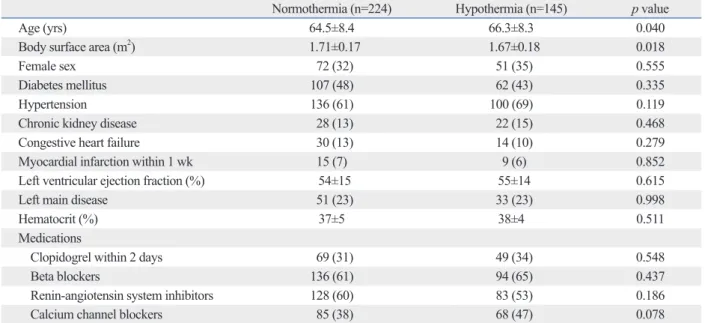
Of the 369 patients, 145 patients were classified as having hypothermia (range; 34.2-35.9°C) based on their TWA- temp measured by the PA catheter during the surgery and upon arrival at the ICU. Accordingly, 224 patients were clas- sified as having normothermia (range; 36-37.5°C). Compari- sons of preoperative variables between patients with hypo- thermia and normothermia are listed in Table 1. Patients with hypothermia were older and had lower body surface area than patients with normothermia. Other characteristics in- cluding the presence of co-morbid diseases and left ventricu- lar ejection fraction were all similar between the groups.
Operative characteristics and postoperative outcome vari- ables are listed in Table 2. Operative data including the num- ber of grafts performed were all similar between the groups.
In-hospital mortality rate was significantly higher in the hy- pothermia group (4 vs. 0), two patients died due to aspiration pneumonia and two patients due to cardiac failure. However, we found no difference between other outcome variables in- cluding the endpoints of composite morbidity/mortality be- tween the groups. The trend towards a longer length of hos- pital stay in the hypothermia group was observed when compared with the normothermia group.
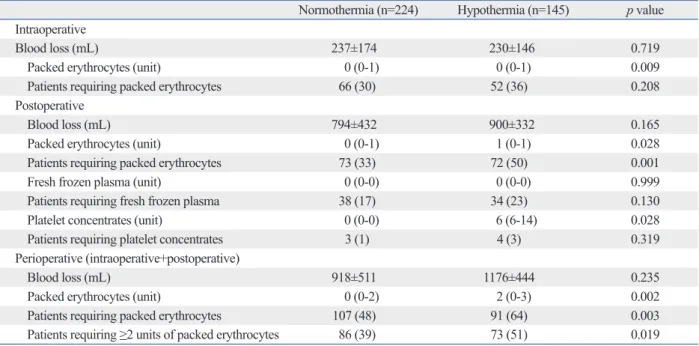
Age and body surface area adjusted comparisons of peri- operative blood loss and transfusion requirement are listed in Table 3. Overall, a significantly larger percentage of pa- tients in the hypothermia group required packed erythro- cytes transfusion compared with the normothermia group.
In addition, significantly more units of packed erythrocytes were transfused in the hypothermia group compared with the normothermia group. The percentage of patients requir- ing multiple transfusions was significantly higher in the hy- infused and number of patients requiring vasopressin), and
transfusion requirement. The amount of re-infused blood volume from the cell salvage device was considered as the intraoperative blood loss.
Assessed postoperative variables included highest cre- atine kinase-MB, number of patients who required milri- none, amount of blood loss, transfusion requirement, length of stay in the ICU and hospital. Composite morbidity/mor- tality endpoints were also assessed and were defined as having more than one of the following: MI (an increase in creatine kinase-MB 5 times or greater over the upper nor- mal limit, when associated with newly developed Q wave or left bundle branch block on electrocardiogram),13 perma- nent stroke, acute kidney injury (increase of serum creati- nine to >2.0 mg/dL, 2 times higher than most recent preop- erative creatinine level or a new requirement for dialysis), hemostatic re-exploration, deep sternal wound infection, ventilator care >48 hr, and in-hospital mortality.14
Temperature measurements
The TWA-temp for each patient was calculated as the area under the curve divided by the time from first to last mea- surement. The time points included were: after anesthetic induction, Y-graft construction, during grafting, sternal clo- sure, and upon arrival at the ICU.
Study end points
The primary endpoint was to compare the amount of periop- erative blood loss and transfusion requirement between pa- tients with hypothermia (TWA-temp <36°C) and normo- thermia (TWA-temp ≥36°C). Independent risk factors of multiple transfusion requirements (≥2 units of packed eryth- rocytes) were also analyzed.
The secondary endpoint was to compare the incidence of composite morbidity/mortality endpoints between patients with hypothermia and normothermia. Independent risk fac- tors of composite of morbidity/mortality endpoints were also analyzed.
Statistical analysis
All analyses were performed with SPSS 15.0 (SPSS Inc., Chicago, IL, USA). Intergroup comparisons were done with t-test, Mann-Whitney U test, ANCOVA (for adjust- ment of age and body surface area), and χ2 test or Fisher’s exact test as appropriate. To identify independent predictors of a multiple transfusion requirements, logistic regression models were used. Variables demonstrating a p value of
disease were identified as independent predictors (Table 5).
DISCUSSION
In the current retrospective study, we found that hypothermia (TWA-temp measured during the intraoperative period and upon arrival at the ICU) was associated with an increased pothermia group compared with the normothermia group.
In the multivariate analysis of predictors of perioperative multiple transfusion requirements, hypothermia was identi- fied as an independent risk factor along with age, female gender, body surface area, chronic kidney disease and con- gestive heart failure (Table 4).
In the multivariate analysis of predictors of composite of morbidity/mortality endpoints, recent MI and chronic kidney Table 1. Preoperative Patients’ Characteristics
Normothermia (n=224) Hypothermia (n=145) p value
Age (yrs) 64.5±8.4 66.3±8.3 0.040
Body surface area (m2) 1.71±0.17 1.67±0.18 0.018
Female sex 72 (32) 51 (35) 0.555
Diabetes mellitus 107 (48) 62 (43) 0.335
Hypertension 136 (61) 100 (69) 0.119
Chronic kidney disease 28 (13) 22 (15) 0.468
Congestive heart failure 30 (13) 14 (10) 0.279
Myocardial infarction within 1 wk 15 (7) 9 (6) 0.852
Left ventricular ejection fraction (%) 54±15 55±14 0.615
Left main disease 51 (23) 33 (23) 0.998
Hematocrit (%) 37±5 38±4 0.511
Medications
Clopidogrel within 2 days 69 (31) 49 (34) 0.548
Beta blockers 136 (61) 94 (65) 0.437
Renin-angiotensin system inhibitors 128 (60) 83 (53) 0.186
Calcium channel blockers 85 (38) 68 (47) 0.078
Values are mean±SD or number of patients (%). Hypothermia was defined as time-weighted average of intraoperative temperatures and the temperature upon intensive care unit admission <36°C.
Table 2. Operative Data and Postoperative Outcome
Normothermia (n=224) Hypothermia (n=145) p value
Operative data
Operation time (mins) 314±53 319±52 0.393
Number of grafts 3.3±0.8 3.3±0.7 0.585
Use of vein graft 55 (25) 41 (29) 0.432
Norepinephrine during grafting (µg) 169±139 170±133 0.910
Vasopressin 91 (41) 62 (43) 0.696
Postoperative data
Highest creatine kinase-MB 11.9±12.2 11.5±15.3 0.761
Milrinone 45 (21) 31 (22) 0.805
Intensive care unit stay (days) 2.8±3.3 2.7±2.0 0.633
Hospital stay (days) 15.0±10.5 18.6±19.2 0.065
Composite of morbidity/mortality endpoints 62 (28) 35 (24) 0.470
Myocardial infarction 14 (6) 9 (6) 0.983
Permanent stroke 1 (0.5) 0 (0) 1.000
Acute kidney injury 59 (27) 31 (22) 0.273
Hemostatic re-operation 1 (1) 3 (2) 0.305
Deep sternal wound infection 8 (4) 2 (1) 0.327
Ventilator care >48 h 9 (4) 1 (1) 0.096
In-hospital mortality 0 (0) 4 (3) 0.023
Values are mean±SD or number of patients (%).
in the hypothermia group, no association was observed be- tween hypothermia and a composite of morbidity/mortality endpoints.
Dual antiplatelet therapy comprised of aspirin and clopi- dogrel has long been accepted as an essential therapy for perioperative transfusion requirement in patients undergo-
ing OPCAB who continued clopidogrel use within 5 days of surgery. Moreover, hypothermia was also found to be an independent risk factor of perioperative multiple transfu- sion requirements. Although the mortality rate was higher Table 3. Perioperative Blood Loss and Transfusion Requirement
Normothermia (n=224) Hypothermia (n=145) p value Intraoperative
Blood loss (mL) 237±174 230±146 0.719
Packed erythrocytes (unit) 0 (0-1) 0 (0-1) 0.009
Patients requiring packed erythrocytes 66 (30) 52 (36) 0.208
Postoperative
Blood loss (mL) 794±432 900±332 0.165
Packed erythrocytes (unit) 0 (0-1) 1 (0-1) 0.028
Patients requiring packed erythrocytes 73 (33) 72 (50) 0.001
Fresh frozen plasma (unit) 0 (0-0) 0 (0-0) 0.999
Patients requiring fresh frozen plasma 38 (17) 34 (23) 0.130
Platelet concentrates (unit) 0 (0-0) 6 (6-14) 0.028
Patients requiring platelet concentrates 3 (1) 4 (3) 0.319
Perioperative (intraoperative+postoperative)
Blood loss (mL) 918±511 1176±444 0.235
Packed erythrocytes (unit) 0 (0-2) 2 (0-3) 0.002
Patients requiring packed erythrocytes 107 (48) 91 (64) 0.003
Patients requiring ≥2 units of packed erythrocytes 86 (39) 73 (51) 0.019
p values are age and body surface area adjusted.
Table 4. Predictive Power of Risk Factors for Perioperative Multiple Transfusion Requirements According to Logistic Regres- sion Analysis
Variables Univariate analysis Multivariate analysis
Odds ratio (95% CI) p value Odds ratio (95% CI) p value
Age 1.08 (1.05-1.12) <0.001 1.06 (1.02-1.09) 0.001
Female gender 3.47 (2.20-5.46) <0.001 2.09 (1.12-3.88) 0.020
Body surface area 0.03 (0.01-0.09) <0.001 0.12 (0.02-0.74) 0.022
Diabetes mellitus 1.84 (1.21-2.80) 0.004 1.41 (0.87-2.27) 0.165
Hypertension 1.68 (1.08-2.61) 0.021 1.34 (0.80-2.23) 0.265
Chronic kidney disease 2.82 (1.50-5.29) 0.001 2.98 (1.48-6.00) 0.002
Congestive heart failure 2.95 (1.50-5.81) 0.002 2.11 (1.00-4.44) 0.049
Clopidogrel within 2 days of surgery 1.55 (0.97-2.44) 0.098
Hypothermia 1.74 (1.14-2.65) 0.010 1.49 (1.07-2.42) 0.011
CI, confidence interval.
Table 5. Predictive Power of Risk Factors for the Composite of Morbidity/Mortality Endpoints According to Logistic Regres- sion Analysis
Variables Univariate analysis Multivariate analysis
Odds ratio (95% CI) p value Odds ratio (95% CI) p value
Diabetes mellitus 2.01 (1.25-3.21) 0.004 1.55 (0.94-2.56) 0.086
Myocardial infarction within 1 wk 2.47 (1.43-4.28) 0.001 1.96 (1.04-3.67) 0.037
Chronic kidney disease 5.10 (2.74-9.50) <0.001 4.15 (2.16-7.96) <0.001
Left ventricular ejection fraction 0.98 (0.96-1.00) 0.010 0.97 (0.98-1.01) 0.996
Hypothermia 0.83 (0.51-1.34) 0.451
CI, confidence interval.
coronary patients presenting for surgery with some degree of platelet inhibition to maximize the ischemic benefit of an- tiplatelet therapy. Mild hypothermia was shown to counter- act the platelet-inhibitory effect of clopidogrel, when clopi- dogrel was administered concomitantly in the presence of hypothermia.24,25 However, binding of clopidogrel to the P2Y12 receptor is irreversible and the influence of hypo- thermia on the clopidogrel’s platelet-inhibitory function in patients who already reached steady-state by previous con- tinuous administration remains elusive.
In a previous study, even mild hypothermia (<0.5°C) has been shown to be associated with increased blood loss and transfusion requirement in patients undergoing hip arthro- plasty although none of the patients studied were exposed to antiplatelet therapy in proximity to surgery.26 Of particu- lar interest, a follow-up study reported that aggressive warm- ing reduced blood loss during the same surgical procedure implicating that hypothermia may be a modifiable risk fac- tor of perioperative bleeding and transfusion requirement.27 As of yet, no comprehensive data exist regarding the influ- ence of hypothermia on bleeding and transfusion require- ment in patients undergoing OPCAB who continued dual antiplatelet therapy within 5 days of surgery.
In the current study, despite the application of a fluid warmer, warm mattress, and a forced warm-air blanket in all patients, 39% of the patients were hypothermic. The amount of the perioperative blood loss was greater in the hypothermia group; however, this finding was without sta- tistical significance. This may be attributable to the inaccu- rate assessment of intraoperative blood loss. In the current study, intraoperative blood loss was assessed only as the amount of blood salvaged by a cell salvage device not ac- counting for the other unmeasured and insensible blood loss.
Still, transfusion requirement was significantly greater in patients with hypothermia despite that other risk factors of bleeding and transfusion requirement including the baseline hematocrit values. In addition, the number of grafts per- formed was similar between patients with normothermia and hypothermia. Moreover, hypothermia was found to be an independent risk factor of multiple transfusion require- ments along with the previously known factors such as age, female gender, body surface area, chronic kidney disease, and congestive heart failure. Thus, the results of the current study clearly implicate the association between hypother- mia and transfusion requirement in patients undergoing OPCAB who continued dual antiplatelet therapy.
Of interest and in contrast to the findings of the previous patients with coronary artery disease.15 Accordingly, an in-
creasing number of patients presenting for CABG are ex- posed to platelet inhibition and are at increased risk of hem- orrhagic complications. Yet, considering the existence of an ischemic and even a mortality benefit imposed by the anti- platelet therapy outweighing the bleeding risk, recent litera- ture advocates the importance of some degree of platelet in- hibition at the time of CABG.1,3 In order to maximize the ischemic benefit and minimize the bleeding risk, OPCAB has been proposed as an alternative technique to on-pump CABG, as it is associated with limited deterioration in plate- let function and counts frequently observed after CPB.16 However, several studies backed the safety of OPCAB in patients who continued clopidogrel in terms of bleeding and transfusion requirement, thus transfusion is not uncommon in OPCAB.2,17,18
Transfusion of allogeneic blood products is known to be associated with adverse outcomes that carry risks far be- yond that of transmitting infectious diseases.4 Thus identifi- cation of risk factors would be of major clinical importance not only for risk stratification, but also for the future devel- opment of therapeutic measures aimed at modifying the identified risk factors resulting in improved patients’ out- come. Previously known risk factors of bleeding and trans- fusion requirement in patients undergoing CABG are multi- ple. These include age, female gender, weight, DM, chronic kidney disease, poor LVEF, preoperative hematocrit value, and a history of MI.18,19 Yet, most of these factors are not readily amenable to modifications at the time of CABG.
Hypothermia is a frequently accompanied phenomenon in patients undergoing major surgical procedures. In the case of OPCAB, 46.7% of the patients were reported to be hypothermic after leaving the operating room.11 Apart from its beneficial influence of providing organ protection against ischemia-reperfusion injury, hypothermia is associated with a multitude of adverse physiologic alterations. In terms of coagulation, hypothermia has been shown to be associated with platelet dysfunction as well as a mild decrease in plate- let counts.20 Proposed mechanisms include impaired throm- boxane A2 release and inhibited exposure of P-selectin on the platelet surface.21 Moreover, hypothermia has been shown to inhibit coagulation enzyme activities delaying the onset of thrombin generation.22 Hypothermia is also often ac- companied by acidosis, which in turn results in profound in- hibition of thrombin generation in the propagation phase.22,23 These adverse influences of hypothermia, especially on platelet function, may exert significant clinical influence in
line hematocrit level was similar between both groups and that all other operative data were similar, we can only spec- ulate that intraoperative blood loss may have been greater in the hypothermia group.
In conclusion, perioperative hypothermia assessed by TWA-temp was associated with an increased transfusion requirement in patients undergoing OPCAB who continued dual antiplatelet therapy until 5 days of surgery. Consider- ing the high prevalence of hypothermia and the possibility of hypothermia being a modifiable risk factor of transfusion requirement, more aggressive measures should be under- taken to maintain normothermia in those patients.
REFERENCES
1. Montalescot G, Hulot JS, Collet JP. Antiplatelet therapy and coro- nary artery bypass graft surgery a fallow land. J Am Coll Cardiol 2010;56:2003-5.
2. Shim JK, Choi YS, Oh YJ, Bang SO, Yoo KJ, Kwak YL. Effects of preoperative aspirin and clopidogrel therapy on perioperative blood loss and blood transfusion requirements in patients undergo- ing off-pump coronary artery bypass graft surgery. J Thorac Car- diovasc Surg 2007;134:59-64.
3. Mehta SR, Yusuf S; Clopidogrel in Unstable angina to prevent Recurrent Events (CURE) Study Investigators. The Clopidogrel in Unstable angina to prevent Recurrent Events (CURE) trial pro- gramme; rationale, design and baseline characteristics including a meta-analysis of the effects of thienopyridines in vascular disease.
Eur Heart J 2000;21:2033-41.
4. Hajjar LA, Vincent JL, Galas FR, Nakamura RE, Silva CM, San- tos MH, et al. Transfusion requirements after cardiac surgery: the TRACS randomized controlled trial. JAMA 2010;304:1559-67.
5. Karalapillai D, Story D. Hypothermia on arrival in the intensive care unit after surgery. Crit Care Resusc 2008;10:116-9.
6. Krause KR, Howells GA, Buhs CL, Hernandez DA, Bair H, Schuster M, et al. Hypothermia-induced coagulopathy during hemorrhagic shock. Am Surg 2000;66:348-54.
7. Frank SM, Higgins MS, Fleisher LA, Sitzmann JV, Raff H, Bres- low MJ. Adrenergic, respiratory, and cardiovascular effects of core cooling in humans. Am J Physiol 1997;272(2 Pt 2):R557-62.
8. Ishikawa K, Tanaka H, Shiozaki T, Takaoka M, Ogura H, Kishi M, et al. Characteristics of infection and leukocyte count in severely head-injured patients treated with mild hypothermia. J Trauma 2000;49:912-22.
9. Frank SM, Higgins MS, Breslow MJ, Fleisher LA, Gorman RB, Sitzmann JV, et al. The catecholamine, cortisol, and hemodynamic responses to mild perioperative hypothermia. A randomized clini- cal trial. Anesthesiology 1995;82:83-93.
10. Insler SR, O’Connor MS, Leventhal MJ, Nelson DR, Starr NJ.
Association between postoperative hypothermia and adverse out- come after coronary artery bypass surgery. Ann Thorac Surg 2000;70:175-81.
11. Hannan EL, Samadashvili Z, Wechsler A, Jordan D, Lahey SJ, Culliford AT, et al. The relationship between perioperative tem- perature and adverse outcomes after off-pump coronary artery by-
studies, we did not observe any association between hypo- thermia and the composite morbidity/mortality endpoints in the current study. These conflicting results may be attribut- able to the fact that the previous studies only used a single measurement of temperature upon arrival at the ICU and that patient management was not according to a standard- ized protocol.10,11,28 In addition, a recent study involving the largest cohort of cardiac surgical patients depicted that tran- sient hypothermia was not associated with adverse out- come.29 In that study, only persistent postoperative hypo- thermia was associated with increased mortality, whereas none of the patients in the current study were persistently hypothermic in the postoperative period by way of active warming. Thus, addressing the influence of postoperative hypothermia on outcome was not possible in the current tri- al. Although we observed a significantly higher mortality rate in the hypothermia group, the sample size is too small to draw a definite conclusion regarding the association be- tween hypothermia and death from the current study.
The strengths of this study are that all of the data were col- lected from a prospectively enrolled database and that tem- perature measurements were protocol-based using the TWA- temp instead of a single measurement. Due to the temporal continuity, intraoperative temperatures essentially influence the temperature upon ICU arrival, and only the latter had been validated in most of the previous studies.10,11,28 Postop- erative persistent hypothermia may affect bleeding as well, however, it was not possible to address this relationship, as all of the patients were normothermic within 2 hr after the surgery. Also, considering that most of the postoperative bleeding occurs within the first 4 hr after the surgery, TWA- temp seems to be the ideal variable to address the influence of hypothermia on perioperative bleeding and transfusion requirement. Nonetheless, the retrospective nature of this study is a significant limitation. Another limitation is that we did not assess the inter-individual variability of clopido- grel responsiveness. This may also affect the bleeding and transfusion requirement.30 Yet, there is currently no stan- dardized test assessing the clopidogrel responsiveness with enough clinical evidence to support its association with hemorrhagic complications. Another limitation is that we could not accurately assess the amount of intraoperative blood loss, instead we used the volume of salvaged blood as a surrogate. Despite significant differences in transfusion requirements, intraoperative blood loss was similar among patients, whereas postoperative blood loss only slightly greater in the hypothermia group. Considering that the base-
20. Valeri CR, Khabbaz K, Khuri SF, Marquardt C, Ragno G, Fein- gold H, et al. Effect of skin temperature on platelet function in pa- tients undergoing extracorporeal bypass. J Thorac Cardiovasc Surg 1992;104:108-16.
21. Michelson AD, MacGregor H, Barnard MR, Kestin AS, Rohrer MJ, Valeri CR. Reversible inhibition of human platelet activation by hypothermia in vivo and in vitro. Thromb Haemost 1994;71:
633-40.
22. Martini WZ, Pusateri AE, Uscilowicz JM, Delgado AV, Holcomb JB. Independent contributions of hypothermia and acidosis to co- agulopathy in swine. J Trauma 2005;58:1002-9.
23. Romsi P, Heikkinen J, Biancari F, Pokela M, Rimpiläinen J, Vain- ionpää V, et al. Prolonged mild hypothermia after experimental hypothermic circulatory arrest in a chronic porcine model. J Tho- rac Cardiovasc Surg 2002;123:724-34.
24. Bjelland TW, Hjertner Ø, Klepstad P, Kaisen K, Dale O, Haugen BO. Antiplatelet effect of clopidogrel is reduced in patients treated with therapeutic hypothermia after cardiac arrest. Resuscitation 2010;81:1627-31.
25. Högberg C, Erlinge D, Braun OO. Mild hypothermia does not at- tenuate platelet aggregation and may even increase ADP-stimulat- ed platelet aggregation after clopidogrel treatment. Thromb J 2009;7:2.
26. Schmied H, Kurz A, Sessler DI, Kozek S, Reiter A. Mild hypo- thermia increases blood loss and transfusion requirements during total hip arthroplasty. Lancet 1996;347:289-92.
27. Winkler M, Akça O, Birkenberg B, Hetz H, Scheck T, Arkiliç CF, et al. Aggressive warming reduces blood loss during hip arthro- plasty. Anesth Analg 2000;91:978-84.
28. Lahtinen J, Biancari F, Ala-Kokko T, Rainio P, Salmela E, Pokela R, et al. Pulmonary artery blood temperature at admission to the intensive care unit is predictive of outcome after on-pump coro- nary artery bypass surgery. Scand Cardiovasc J 2004;38:104-12.
29. Karalapillai D, Story D, Hart GK, Bailey M, Pilcher D, Cooper DJ, et al. Postoperative hypothermia and patient outcomes after elective cardiac surgery. Anaesthesia 2011;66:780-4.
30. Kwak YL, Kim JC, Choi YS, Yoo KJ, Song Y, Shim JK. Clopido- grel responsiveness regardless of the discontinuation date predicts increased blood loss and transfusion requirement after off-pump coronary artery bypass graft surgery. J Am Coll Cardiol 2010;56:
1994-2002.
pass graft surgery. J Thorac Cardiovasc Surg 2010;139:1568-75.
12. Oh SY, Shim JK, Song JW, Kim JC, You KJ, Kwak YL. Cardiac displacement-induced hemodynamic instability during off-pump coronary artery bypass surgery and its predictors. Acta Anaesthe- siol Scand 2011;55:870-7.
13. Thygesen K, Alpert JS, White HD; Joint ESC/ACCF/AHA/WHF Task Force for the Redefinition of Myocardial Infarction, Jaffe AS, Apple FS, et al. Universal definition of myocardial infarction.
Circulation 2007;116:2634-53.
14. Antunes PE, de Oliveira JF, Antunes MJ. Risk-prediction for post- operative major morbidity in coronary surgery. Eur J Cardiothorac Surg 2009;35:760-6.
15. Anderson JL, Adams CD, Antman EM, Bridges CR, Califf RM, Casey DE Jr, et al. ACC/AHA 2007 guidelines for the manage- ment of patients with unstable angina/non-ST-Elevation myocar- dial infarction: a report of the American College of Cardiology/
American Heart Association Task Force on Practice Guidelines (Writing Committee to Revise the 2002 Guidelines for the Man- agement of Patients With Unstable Angina/Non-ST-Elevation Myocardial Infarction) developed in collaboration with the Ameri- can College of Emergency Physicians, the Society for Cardiovas- cular Angiography and Interventions, and the Society of Thoracic Surgeons endorsed by the American Association of Cardiovascu- lar and Pulmonary Rehabilitation and the Society for Academic Emergency Medicine. J Am Coll Cardiol 2007;50:e1-157.
16. Casati V, Gerli C, Franco A, Della Valle P, Benussi S, Alfieri O, et al. Activation of coagulation and fibrinolysis during coronary sur- gery: on-pump versus off-pump techniques. Anesthesiology 2001;
95:1103-9.
17. Maltais S, Perrault LP, Do QB. Effect of clopidogrel on bleeding and transfusions after off-pump coronary artery bypass graft sur- gery: impact of discontinuation prior to surgery. Eur J Cardiotho- rac Surg 2008;34:127-31.
18. Frankel TL, Stamou SC, Lowery RC, Kapetanakis EI, Hill PC, Haile E, et al. Risk factors for hemorrhage-related reexploration and blood transfusion after conventional versus coronary revascu- larization without cardiopulmonary bypass. Eur J Cardiothorac Surg 2005;27:494-500.
19. Kapetanakis EI, Medlam DA, Petro KR, Haile E, Hill PC, Dullum MK, et al. Effect of clopidogrel premedication in off-pump cardi- ac surgery: are we forfeiting the benefits of reduced hemorrhagic sequelae? Circulation 2006;113:1667-74.