stress https://doi.org/10.17547/kjsr.2020.28.2.90
여대생의 외모만족도와 자아존중감이 성적자기주장에 미치는 영향
강희순
1
ㆍ고 은1
ㆍ김혜영2
1
국립순천대학교 생명산업과학대학 간호학과,2
전북대학교 간호대학, 간호과학연구소The Impact of Appearance Satisfaction and Self-Esteem on Sexual Assertiveness among Female University Students
Hee Sun Kang 1 , Eun Ko 1 , Hye Young Kim 2
1
Department of Nursing, College of Life Science and Natural Resources, Sunchon National University, Suncheon,
2College of Nursing, Research Institute of Nursing Science, Jeonbuk National University, Jeonju, Korea
Received April 26, 2020 Revised June 14, 2020 Accepted June 15, 2020 Corresponding author Eun Ko
Department of Nursing, College of Life Science and Natural Resources, Sunchon National University, 255 Jungang-ro, Suncheon 57922, Korea
Tel: +82-61-750-3886 Fax: +82-61-750-3880 E-mail: [email protected] ORCID:
Hee Sun Kang
(https://orcid.org/0000-0003-3808-306X) Eun Ko
(https://orcid.org/0000-0002-1343-8760) Hye Young Kim
(https://orcid.org/0000-0002-1593-3933)
Copyright © 2020 by stress. All rights reserved.Key messages
대학생은 성에 대한 올바른 의식과 가치관을 가져야 하며, 성적자기주장은 여대생에게 필수적인 의사소 통전략이다. 이에 본 연구는 여대생의 외모만족도, 자아존중감 및 성적자기주장 간의 관련성을 파악하고, 성적자기주장에 영향을 미치는 요인을 확인하기 위해 시도되었다. 연구대상자는 일대학교에 재학중인 여대 생 166명으로, 구조화된 설문지를 이용하여 자료수집하였다. 연구결과 여대생의 성적자기주장은 외모만족 도와 자아존중감과 정적 상관관계가 있었으며, 전공에 대한 만족도와 자아존중감이 성적자기주장을 48.3% 설명하는 것으로 나타났다. 따라서, 여대생의 성적자기주장 증진을 위한 상담이나 중재를 계획할 때, 여대생 스스로가 자신의 외모를 긍정적으로 수용하고, 자아존중감을 높이는 것이 중요한 부분이 되어야 할 것이다.
중심단어: 성적 자기주장, 여대생, 외모만족도, 자존감
Abstract
Background: University students belong to the life stage of early adulthood, where they are required to establish a right attitude and value system about sexual matters. When teenagers go to college, they have more chances to contact with the other sex and become to live a relatively freer life, which make them face novel situations of dealing with sexual issues. Sexual assertiveness is a mandatory communication strategy for university students, especially for female students, who are living in this rapidly changing sexual culture. So, this study aimed to examine the relationship among appearance satisfaction, self-esteem and sexual assertiveness and identify the influencing factors on sexual assertiveness in female university students.
Methods: A total of 166 female undergraduate students participated in this study. Data were collected through self-reported questionnaires consisted of the Body Esteem Scale, Self-esteem Scale, and Sexual Assertiveness Scale, between September and October 2018. Data were analyzed with SPSS/WIN25.0 for descriptive statistics using t-test, one-way ANOVA, Pearson’s correlation coefficient, and multiple linear regression.
Results: Sexual assertiveness was positively correlated with appearance satisfaction (r=.50, p < .001) and self-esteem (r=.64, p < .001). Multiple regression showed that satisfaction with major ( β =.12, p=.043) and self-esteem ( β =.10, p < .001) explained 48.3% of the variance in sexual assertiveness (F=52.28, p < .001).
Conclusions: Thus, in order to improve sexual assertiveness, it may be helpful to positively accept one’s appearance and self-esteem and to incorporate appearance satisfaction and self-esteem when planning to counseling and intervention about sexual assertiveness for female university students.
Key Words: Sexual assertiveness, Female university students, Physical appearance, Self-esteem ORIGINAL ARTICLE
Introduction
University students belong to the life stage of early adulthood, where they are required to make
specific plans for future, develop a good character, and establish a right attitude and value system about sexual matters (Lee YR
et al
., 2013). When teenagers go to college, they have more chancesto contact with the other sex and become to live a relatively freer life, which make them face novel situations of dealing with sexual issues. Although they are fully mature in a physical sense, however, university students may not be so in terms of establishment of values which enables controlling sexual impulses and making decisions. Therefore, many sexual conducts are done neither based on independent decision making nor by their own choices (Jeon GS
et al
., 2004). This can cause both physical and mental health problems, and women are especially vulnerable compared to men if such problems arise. In order to minimize such dangers, it is required for women to assert for their sexual rights themselves (Choi MSet al
., 2014).As the recent cases of sexual harassment and sexual assault have become issues, the ‘Me Too movement’ is spreading in the world. Especially, the spreading of ‘Me Too movement’ in university campuses revealed sex-related incidents and has raised the awareness of sexual violence issues in the university. To prevent and solve sexual harass- ment in the university, individual characteristics that can have large impact on not hiding the harm, controlling sexual situations, communicating opinions or thoughts are important (Roh ES, 2016). Yet, women’s sexual assertiveness tends not to be accepted actively in Korean culture and society due to sexually discriminating social norms and attitudes (Lee YR
et al
., 2013), to which our attention is required.We are living in a society where skinny body is idealized and appearance is emphasized more than almost anything (Heo NR, 2018). The ap- pearance satisfaction describes the overall satis- faction of the body using the individual satis- faction with one’s face and appearance, including subjective and comprehensive evaluation on the image of how an individual oneself thinks about one’s appearance and how an individual thinks others perceive about one’s appearance (Kim HK, 2018). We can tell that female college students consider appearance very seriously, according to a research conducted by Gallup Korea in 2015 where 88% of respondents aged 19
∼
29 thought that appearance is important in life, and 80% ans- wered that they paid attention to how they appear (Gallop Korea, 2015). For many women,satisfaction with their appearance is related with satisfaction with themselves: when the appearance satisfaction is higher, they show more active attitude and higher self-esteem. When a woman has a sense of inferiority on her appearance, on the other hand, it can affect her self-concept negatively and thus cause low self-esteem (Nho JH
et al
., 2014).Self-esteem is the evaluation and judgment that an individual consciously maintains about oneself.
People with higher self-esteem would have characteristics of respecting oneself and thinking one is worthy, and have ability of self-expression, self-assurance and good impression (Rosenberg, 1965). That is, the level of self-esteem is considered as an index for an individual’s socio-cultural adaptation and as a motivational factor that controls one’s behavior, which makes self-esteem an important concept in terms of psychosocial health (Heo NR, 2018). Female university students’ body image and self-esteem have a positive correlation (Nho JH
et al
., 2014), and stress from appearance does affect one’s self-esteem (Heo NR, 2018).Sexual assertiveness is a vital element to protect oneself and maintain sexual health (Zerubavel
et al
., 2013). In sexually conservative cultures, not many university students are assertive in sexual situations. Female students especially tend to manifest less sexual assertiveness than male students (Jang HSet al
., 2019), because stricter norms are applied to women than men when it comes to sexual practices and female students thinks that they are sexually powerless and have fear (Zerubavelet al
., 2013). So, female university students need to have the autonomous and re- sponsible manner regarding their sexual situation (Kim YJet al
., 2019). Sexual assertiveness is a mandatory communication strategy for university students in their early adulthood, especially for female students, who are living in this rapidly changing sexual culture (Lee HL, 2019).Previous research shows that sexual assertiveness of university students are related with gender role stereotypes (Choi SH, 2016), self-esteem (Woo CH
et al
., 2019), parent-child communication (Kim BMet al
., 2015), relation satisfaction (Lee JY, 2017) and so on, and self-esteem is especially known to be a factor that have a positive impact on self-assertiveness (Jang HSet al
., 2019; WooCH
et al
., 2019). But, the positive or negative feelings about one’s body is related to preventive sexual behaviors (Auslanderet al
., 2012) and female students have a higher stress about their appearance relatively than male students (Heo NR, 2018). But, there is a lack of study identifying how the feelings about female student’s body and their satisfaction or stress with appearance affect sexual assertiveness (Chae HJ, 2019). Also, sexual value system is different by one’s gender, so female and male university students are expected to show difference not only in their sexual asser- tiveness but also in the factors that have influence on it. It is thought that the gender difference should be necessarily taken into account in iden- tifying the influencing factors on sexual assertiveness.However, this aspect has not been dealt with seriously enough in previous studies (Lee SY, 2015;
Jang HS
et al
., 2019; Kim YJet al
., 2019).Thus, this study aimed to examine the relationship among appearance satisfaction, self- esteem and sexual assertiveness and identify the influencing factors on sexual assertiveness in female university students. It would be useful in providing the baseline data for developing the sexual assertiveness im- provement program for female university students.
Materials and Methods
1. Study design
This study is a descriptive survey study to identify the effect of appearance satisfaction and self-esteem on the sexual assertiveness in female university students.
2. Study participants
The participants for this study was female university students who are currently studying in the S university. They are 166 students who agree voluntarily in participating in this study and write the informed consent.
To determine the sample size, G*power 3.1.9, a statistical power calculation program based on Cohen’s sampling formula was used. As a result of calculating with a two-tailed significant level of .05 for multiple regression analysis, an effect size=.15, and a statistical power=.90, number of predictors=10, and the minimum sample size was 147. A total of 184 questionnaires were distributed
in consideration of the dropout rate of 20% of the subjects, and 170 questionnaires were returned (response rate 92.4%). 166 parts were used for final analysis, except for 4 with insufficient responses.
3. Measurements
1) Appearance satisfaction
To measure the satisfaction with the ap- pearance, this study used the Lee JA (2005) translated version of Body Esteem Scale of Mendelson
et al
.(1985). This scale is consisted of total of 20 items, which are 5 items on physical charm, 7 items on physical strength, and 8 items on physical condition. Each item is a Likert’s 5-point scale, and the possible scores ranges from a minimum of 20 to a maximum of 100. The score closer to 20 means the more negative appearance satisfaction, while the score closer to 100 means the more positive appearance satisfaction. In terms of the reliability of this scale, its Cronbach'sα
was .85 in the study of Lee JA (2005) and .91 in this study.2) Self-esteem
The translated version of the Self-Esteem Scale (RSES) developed by Rosenberg (1965) are used to measure self-esteem. The translated version of the survey was used in a previous study by Lee HJ
et al
.(1995). This scale is consisted of total of 10 items, which are 5 items on positive self-esteem and 5 items on negative self-esteem. Each item is a Likert’s 5-point scale, where ‘strongly disagree (1 point)’, ‘disagree (2 point)’, ‘undecided (3 point)’,‘agree (4 point)’ and ‘strongly agree (5 point)’.
The negative self-esteem items will be counted in reverse, and the higher calculated score means the higher degree of self-esteem. In terms of the reliability of this scale, its Cronbach's
α
was .89 in the study of Lee HJet al
.(1995), and .89 in this study.3) Sexual assertiveness
The sexual assertiveness was measured by sexual assertiveness factor from the Sexual Development Assessment Scale developed by Ha EH
et al
.(2007). There are 12 items in this scale, including items on self-determination of sexual behavior through the heterosexual relationships,consensual decision ability of sex-related be- haviors, effective communication and self-asser- tiveness. This measurement was developed for high school students but the validity and reliability were also identified for university students (Lee KI
et al
., 2017). Each item is a Likert’s 5-point scale, where ‘strongly disagree (1 point)’, ‘disagree (2 point)’, ‘undecided (3 point)’,‘agree (4 point)’ and ‘strongly agree (5 point)’.
The higher score means the higher degree of sexual assertiveness. In terms of the reliability of this scale, its Cronbach's
α
was .86 in the study of Ha EHet al
.(2007), .90 in the study of Lee KIet al
.(2017), and .84 in this study.4. Data collection and ethical consideration
This study was performed on the female students who are taking courses in Female University Students Career Development Center in the S university located in Jeollanam-do. The researchers got the ethical approval from the institutional review board at S University before collecting data (IRB No. 040173-201807-HR-022-04). Data collection was conducted from September to October in 2018. The researchers explained the purpose of the study to charge of Female university students career development center, visited each classroom to account for this study, and recruited the participants. The subjects of this study were female university students who voluntarily stated their intention to participate in the study. The participants were informed about confidentiality, anonymity, and ability to withdrawal from research at any time depending on the participant’s in- tentions without any disadvantages. The question- naire was filled out by participants in a private and comfortable setting. The participant sealed completed questionnaire and put it in the col- lection box located in the classrooms. The questionnaire took about 10 minutes to complete for each participant.5. Data analysis
The collected data were analyzed using SPSS/WIN 25.0 program. The statistical significance was set as p
<
0.05. The general characteristics, appearance satisfaction, self-esteem and sexual assertiveness of the participants were statistically analyzed descriptively using frequencies, percentages, means,standard deviations, minimum and maximum, skewness, and kurtosis. The differences in relevant variables in the general characteristics of the participants were analyzed by independent t-test and one way ANOVA. Scheffe’ test was used as post-hoc test. The relationship among the variables were analyzed using Pearson's correlation coeffi- cient. The factors that affect sexual assertiveness were analyzed using stepwise linear multiple regression.
Results
1. General characteristics of participants
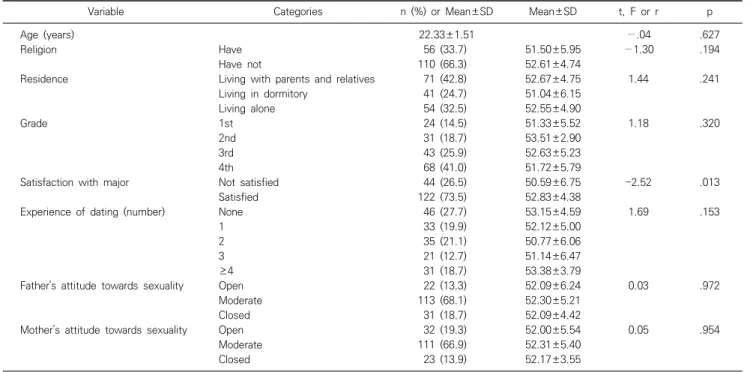
The average age of study participants was 22.33±1.51. Of the participants, 56 (33.7%) an- swered to have religion. For residence of parti- cipants, 72 (42.8%) lived with parents or relatives, 54 (32.5%) lived alone and 41 (24.7%) lived in dormitory. In terms of the grade of participants, 4th grade was 68 (41.0%), followed by 3rd grade with 43 (25.9%). 122 (73.5%) satisfied with their major. In terms of the experience of dating, 46 (27.7%) had no experience, 33 (19.9%) dated once, 35 (21.1%) dated twice, and 31 (18.7%) dated 4 or more times. 22 (13.3%) answered father’ attitude towards sexuality was open, 32 (19.3%) answered mother’s attitude towards sexuality was open (Table 1).
2. The score for appearance satisfaction, self- esteem, and sexual assertiveness
The participants’ average score was 58.81±0.95 for appearance satisfaction, 35.16±0.49 for self- esteem and 52.60±8.56 for sexual assertiveness. For the subscale scores in appearance satisfaction, physical charm was 13.27±3.74, physical strength was 21.71±4.72, and physical condition was 24.23±4.80. The subscale scores in self-esteem were 18.60±3.38 for positive self-esteem and 16.56±3.46 for negative self-esteem. Lastly for the subscale scores in sexual assertiveness, self- determination of sexual behavior was 11.57±1.66, consensual decision ability of sex-related behaviors was 13.33±1.43, and effective communication and self-assertiveness was 26.38±2.95 (Table 2).
Table 1. Differences of sexual assertiveness by general characteristics of the participants (N=166)
Variable Categories n (%) or Mean±SD Mean±SD t, F or r p
Age (years) 22.33±1.51 − .04 .627
Religion Have 56 (33.7) 51.50±5.95 − 1.30 .194
Have not 110 (66.3) 52.61±4.74
Residence Living with parents and relatives 71 (42.8) 52.67±4.75 1.44 .241
Living in dormitory 41 (24.7) 51.04±6.15
Living alone 54 (32.5) 52.55±4.90
Grade 1st 24 (14.5) 51.33±5.52 1.18 .320
2nd 31 (18.7) 53.51±2.90
3rd 43 (25.9) 52.63±5.23
4th 68 (41.0) 51.72±5.79
Satisfaction with major Not satisfied 44 (26.5) 50.59±6.75 -2.52 .013
Satisfied 122 (73.5) 52.83±4.38
Experience of dating (number) None 46 (27.7) 53.15±4.59 1.69 .153
1 33 (19.9) 52.12±5.00
2 35 (21.1) 50.77±6.06
3 21 (12.7) 51.14±6.47
≥ 4 31 (18.7) 53.38±3.79
Father's attitude towards sexuality Open 22 (13.3) 52.09±6.24 0.03 .972
Moderate 113 (68.1) 52.30±5.21
Closed 31 (18.7) 52.09±4.42
Mother's attitude towards sexuality Open 32 (19.3) 52.00±5.54 0.05 .954
Moderate 111 (66.9) 52.31±5.40
Closed 23 (13.9) 52.17±3.55
SD: standard deviation.
Table 2. Appearance Satisfaction, Self-esteem, and Sexual Assertiveness of the Participants (N=166)
Variable Mean±SD Min Max Possible range Skewness Kurtosis
Appearance Satisfaction 58.81±0.95 27 94 20 ∼ 100 0.01 0.00
Physical charm 13.27±3.74 6 22 5 ∼ 25
Physical strength 21.74±4.72 8 35 7 ∼ 35
Physical condition 24.23±4.80 10 37 8 ∼ 40
Self-esteem 35.16±0.49 17 50 10 ∼ 50 − 0.04 − 0.15
Positive self-esteem 18.60±3.38 10 37 5 ∼ 25
Negative self-esteem 16.56±3.46 10 25 5 ∼ 25
Sexual Assertiveness 52.60±8.56 36 60 12 ∼ 60 − 1.58 2.41
Self-determination of sexual behavior 11.57±1.66 9 15 3 ∼ 15
Consensual decision ability of sex-related behaviors 13.33±1.43 8 15 3 ∼ 15
Effective communication and self-assertiveness 26.38±2.95 16 30 6 ∼ 30
SD: standard deviation.
Table 3. Relationship among Appearance Satisfaction, Self-esteem, and Sexual Assertiveness (N=166)
Variables Appearance satisfaction Self-esteem
r (p) r (p)
Self-esteem .64 ( < .001)
Sexual assertiveness .50 ( < .001) .69 ( < .001)
3. Differences in the participants’ sexual assertiveness in relation to their general characteristics
For the score differences in the sexual assertiveness based on the general characteristics of participants, the satisfaction with major (t=
−
2.52, p=.013) was statistically significant (Table 1).4. Relationship between appearance satisfaction, self-esteem, and sexual assertiveness
The appearance satisfaction of participants had positive correlation with self-esteem and sexual assertiveness respectively (r=.64, p
<
.001; r=.50, p<
.001). The self-esteem also had positive correlation with sexual assertiveness (r=.69, p<
.001) (Table 3).5. Factors affecting participants’ sexual assertiveness
Stepwise linear multiple regression analysis was conducted by appearance satisfaction, self-esteem and general characteristics that were significantly associated with sexual assertiveness as the inde- pendent variables to identify the factors that can affect the sexual assertiveness of the participants.In order to test the assumption of linear re-
Table 4. Multiple regression about factors affecting Sexual Assertiveness (N=166)
Variable B β t p 95% CI Tolerance VIF
(constant) 16.68 5.58 < .001
Satisfaction with major (ref. not satisfied) 2.36 .12 2.04 .043 0.07 ∼ 4.68 .874 1.145
Appearance satisfaction 0.07 .05 1.37 .173 − 0.03 ∼ 0.17 .594 1.684
Self-esteem 0.79 .10 7.72 < .001 0.59 ∼ 0.99 .551 1.805
R
2=.492, Adj. R
2=.483, F=52.28, p < .001 Durbin-Watson=1.848 B: unstandardized estimate, β : standardized estimate, CI: confidence interval, VIF: variance inflation factor.
gression analysis, normality and multicollinearity among all variables were checked. To check for multicollinearity among the independent variables for the multiple regression analysis, variation inflation factors (VIF) were calculated, with the range of the VIFs between the variables being determined as 1.145
∼
1.805; VIF values under 10 indicated an absence of multicollinearity. The Durbin-Watson statistic was 1.848, indicating that the error terms were independent from each other, without any autocorrelation. So it is sufficient to satisfy the assumption for multiple regression analysis.The stepwise linear multiple regression analysis showed that the participants' satisfaction with major (
β
=.12, p=.043) and self-esteem (β
=.10, p<
.001) explained approximately 48.3% of sexual assertiveness (F=52.28, p<
.001) (Table 4).The scattering of the standardized residuals and the uniformity of the residuals through the P-P plot and the normality were examined. As a result of verifying the singular value, the standardized residual was less than the absolute value of 3, and it was confirmed that there was no singular value because the range of Cook's distance did not exceed the absolute value of 1.
Discussion
This study was performed to identify the relationship among appearance satisfaction, self- esteem and sexual assertiveness, and the factors that affect sexual assertiveness in female university students.
The appearance satisfaction of female university students turned out to be moderate with 58.51 (mean score 2.94) and this result supports Lee SY (2015)’s result that female university students appearance satisfaction was 3.00, which was measured using the same tool. Also, it supports
the result of Kim MJ
et al
.(2004) that male and female university students’ satisfaction score on their appearance was 2.97, while Kim MJet al
.(2004), though different tools were measured, argued that the university students’ satisfaction with their appearance by self-evaluation was lower than the evaluation by others. Therefore, it seems to be necessary to examine the degree of satisfaction perceived by others as well as by oneself in future studies. Self-esteem of the participants of this study was 35.16 (mean score 3.52), which confirmed the results of Kim MJet al
.(2004) and Choi SH (2016). But it was lower than the findings in other previous research where university students’ self-esteem was 38.40 to 39.68 (Lee KIet al
., 2017; Lee HL, 2019). Males are known to have higher self-esteem than females (Kim BMet al
., 2015), and it seems to be based on the fact that the ratio of male students is higher in many previous research. Self-esteem of university students is influenced by many factors like satisfaction with school life, stress from career finding and from appearance, etc.(Heo NR, 2018). Therefore, it is suggested that a replication study to examine university students’
self-esteem be conducted with such different variables controlled and with more population participating as well.
Female students’ sexual assertiveness scored 52.60 (means score 4.38); by subcategories, con- sensual decision ability of sex-related behaviors was 13.33 (mean score 4.44), effective commu- nication and self-assertiveness was 26.38 (mean score 4.40), and self-determination on sexual behavior was 11.57 (mean score 3.86). The scores in the result are lower than 4.45 by Woo CH
et
al
.(2019) which measured sexual assertiveness with the same tool, but they are higher than 4.26 by Lee KIet al
.(2017). The difference is considered to have stemmed from difference between theparticipant groups. The participants in the previous study were students of nursing school and also included both male and female students. The more general knowledge in sex and information about pregnancy, sexually-transmitted disease they have, the more sexually assertive they are (Kim YH
et al
., 2013). The analysis of the scores for subcategories of sexual assertiveness, the score for self-determination of sexual behavior was the lowest. Therefore, this aspect needs to be fully considered when a counseling or education sessions are planned to foster the sexual asserti- veness of female university students. As for the scores of sexual assertiveness based on the general characteristics of participants, those who are satisfied with their major showed more sexually assertive than those who are not. There is no similar previous study to make comparison in this regard, but considering that satisfaction with a major usually leads to better academic performance, this result supports Choi SH (2016), which showed that students with more than average grade points were better at exhibiting sexual assertiveness than those with lower grade points. Although this study did not identify each participant’s major, future study wll need to examine the difference in sexual assertiveness of participants by their specific majors as well as their satisfaction with the majors. Meanwhile, there was no significant difference in sexual assertiveness by participants’ religion, experience of dating, and parent’s attitude towards sexuality, which supports the result of Woo CHet al
.(2019).However, it needs to be noted that the sexual assertiveness by participant’s religion and dating experience yielded different results by study (Chae HJ, 2019; Kim YJ
et al
., 2019). It would be necessary to conduct a replication study with an enlarged group of participants and with more specific examination and analysis of sexual ex- periences as well.The appearance satisfaction of participants had positive correlation with self-esteem respectively.
This supports the conclusion by Kim MJ
et al
. (2004) that the more positive is others’ perception on their appearance and the greater is the satisfaction with their own appearance, the higher self-esteem the female university students have. As a result of the current study, it wasfound that sexual assertiveness had statistically significant positive relationship with appearance satisfaction and self-esteem. This supports the findings that young college women dissatisfied with their bodies may be less likely to enforce their rights of sexual autonomy (Auslander
et al
., 2012) and that objectified body consciousness decreases sexual assertiveness (Managoet al
., 2015). This result that self-esteem is closely related with sexual assertiveness is supported by many other previous studies (Auslanderet al
., 2012; Kim BMet al
., 2015; Jang HSet al
., 2019;Woo CH
et al
., 2019). It also coincides with the result of Lee HL (2019) that with higher self- esteem, one has higher sexual assertiveness; that is, evaluating oneself highly and worthy leads to having more control in a sexual situation by being able to communicate what one perceives clearly to the other party, such as what she wants and does not want as well as her emotions and thoughts.The female students’ satisfaction with major (
β
=.12, p=.043) and self-esteem (β
=.10, p<
.001) explained approximately 48.3% of sexual asser- tiveness. This supports the results of many previous research that self-esteem is a strong predictor for sexual assertiveness (Kim BMet al
., 2015; Jang HSet al
., 2019; Lee HL, 2019; Woo CHet al
., 2019). As a result of this study, the appearance satisfaction of female college students have not affect sexual assertiveness statistically which was consistent with the previous study of Lee SY (2015). The perception of appearance is significant predictor of sexual assertiveness and more positive views about their appearance and weight was associated with sexual assertiveness (Auslanderet al
., 2010). This is different from this study because of the gap of the social culture and prejudice in the environment to be conducted the study. Korean female students like very skinny body like underweighted and a small and pretty face like a celebrity. They have a tendency to feel satisfied when their body is similar to the ideal appearance (Kim HK, 2018). The body mass index (BMI) and body image did not play a role in their perception of sexual assertiveness (Auslanderet al
., 2010).It is necessary to consider the difference between the real BMI and the perception of BMI
of the female students when we identify the female students’ sexual assertiveness (Chae HJ, 2019). So, we need to replicate the study and to explore the factors influencing the sexual assertiveness including a self-perceived appearance satisfaction, other’s evaluation for subject’s ap- pearance, a perception of weight satisfaction, and BMI delicately. Also it is necessary to compare the sexual assertiveness of female university students among Korea and western countries.
Sexual assertiveness that matches with one’s desires, expectations, thoughts, opinions and emo- tions even in sexual situations can be cultivated and improved by training to enhance sexual consciousness, training to actively express one’s legitimate needs and opinions in respect to individual rights, and training to express one’s desires and expectations in an honest and appropriate manner in relationship. Therefore, in order to improve sexual assertiveness of female university students in Korea, it is necessary to develop the various education or intervention program considering Korean culture and to practice various personality trainings that allow one to positively accept one’s appearance and self- esteem for them. When we plan to develop the program to improve sexual assertiveness, we need to consider interpersonal and attitudinal aspects.
Sexual assertiveness program will be able to include a appropriate sexual value and sexual identity’s estabilishment, emotion-control training for the positive self-internalization, self-asserti- veness and sexual communication education, and integrated intervention for sexual assertive skills and sexual decision-making. It is helpful to conduct a individual counseling or group coun- seling. These intervention or education should be apply systemically and progressively.
This study was conducted on students taking a liberal arts course at the female university students career center in a university, so a caution is needed not to overinterpret the results. Although students from various majors are included in the study, their specific majors were not identified. In the future, a replication study by furthering the range of participants and identifying various demographic factors including participant’s major would be needed to be conducted.
Conflicts of interest
The authors declared no conflict of interest.
References