• 검색 결과가 없습니다.

Interior seeding combined with top seeding for the fabrication of single grain REBCO bulk superconductors

N/A
N/A
Protected

Academic year: 2021

Share "Interior seeding combined with top seeding for the fabrication of single grain REBCO bulk superconductors"

Copied!
5
0
0

로드 중.... (전체 텍스트 보기)

전체 글

(1)

pISSN 1229-3008 eISSN 2287-6251

Progress in Superconductivity and Cryogenics

Vol.19, No.2, (2017), pp.14~18 https://doi.org/10.9714/psac.2017.19.2.014

```

1. INTRODUCTION

High performance single-grain REBa 2 Cu 3 O 7− y (RE123, RE: rare-earth elements) bulk superconductors have been fabricated by a top-seeded melt growth (TSMG) process [1–3]. However, extended heat treatment is needed to grow large single-grain REBCO bulk superconductors because the peritectic growth reaction of REBCO grains is sluggish. Schätler et al. [4] and Jee et al. [5] proposed the multiple seeding as the way to fabricate a large grain YBCO bulk sample in a short time. In order to shorten the processing period further, Kim et al. [6] developed an interior seeding technique that the interior seed has realized three-directional growth into both up and down that resulted in the reduced processing time together with the improvement of material quality. On the other hand, multi-seeding technique has been also used in order to fasten the processing time. Multi-seeding technique needs to control seed orientation in order to match the crystallographic planes of c-axis REBCO grains which were grown from different seeds. In TSMG processes, seeds are placed on the outer surfaces of the powder compacts; in the center [1–3, 4, 5, 7-9], of the top surfaces or on the bottom [10], on the corner [11]. All these seeded melt growth techniques have placed the seed as that the c-axis of seed is normal to the surface of the powder compact in order to fabricate a high performance bulk superconductor. The a-c growth sector grows in depth and a-b growth sector grows laterally when the <001> direction of seeds is perpendicular to the specimen top surface.

In multi-seeding processing, each grains nucleated from corresponding seeds will grow in all the directions of a-axis,

b-axis and c-axis at the same time and the grain growth will be stopped when the grains meet together in the mid-way between the seeds. The cross encounter of grains inevitably leads to the formation of the grain boundaries with different characteristics depending on the crystal orientations of seeds placed on/inside of the powder compacts. Grain boundaries with various orientation relationships have been prepared and their electrical and magnetic characteristics have also been investigated [12, 13]. Alignment of multi-seeds has been an issue because the formation of grain boundaries with second impurity phases disturbs the super-current and leads to the decrease of magnetic properties of melt processed REBCO bulk superconductors. Very recently, Shi et al. [14] have shown that the buffer-bridge seed method forms the impurity-free grain boundaries and single grain behavior of magnetic properties was obtained. However, buffer-bridge seed method does not reduce the processing time. The buffer-bridge seeding also increased the volume fraction of a-c growth sector which shows inferior magnetic properties to a-b growth sector (a- or b-axis grown region) [4].

In this article, 3-D seeding technique is introduced in order to fabricate the single grain REBCO bulk superconductor in a reduced processing time period and to fabricate a high performance REBCO bulk superconductor by enhancing the volume fraction of a-b growth sector. The development of the growth pattern, shape change and the magnetic properties of REBCO grains are discussed.

2. EXPERIMENTALS

Y 1.5 Ba 2 Cu 3 O 7− y (hearafter Y1.5) powder was used as a raw material in this study. Y1.5 powder was made by

Interior seeding combined with top seeding for the fabrication of single grain REBCO bulk superconductors

Hee-Gyoun Lee *

Korea Polytechnic University, Siheung, Korea

(Received 30 April 2017; revised or reviewed 16 May 2017; accepted 17 May 2017)

Abstract

This study presents three dimensional (3-D) seeding technique which is a modification of interior seeding. 3-D seeding is beneficial for shortening the processing period and enhancing the magnetic properties of REBCO bulk superconductors fabricated by melt growth. Oxygen channels were provided by using divided powder compacts instead of by using a rubber insert.

Microstructure observations revealed that the grains grown from the seeds impinged each other and formed low angle grain boundaries of (001)/(001). It has been shown that the 3-D seeding technique reduces the volume fraction of a-c growth sector and thereby maximizes the area of a-b growth sector which attribute to the high magnetic characteristics of single grain REBCO bulk superconductors.

Keywords: REBCO, Bulk superconductors, 3-D seeding, Facet lines, Oxygen channel

* Corresponding author: [email protected]

(2)

mixing 1 mole Y123 (Solvay Germany, 99.9 % purity, 2–3 μm in size) with 0.25 mole Y 2 O 3 (BM-CHEM HI-TECH Co., Ltd, China, 99.99 % purity, 0.12–3 μm in size) powder.

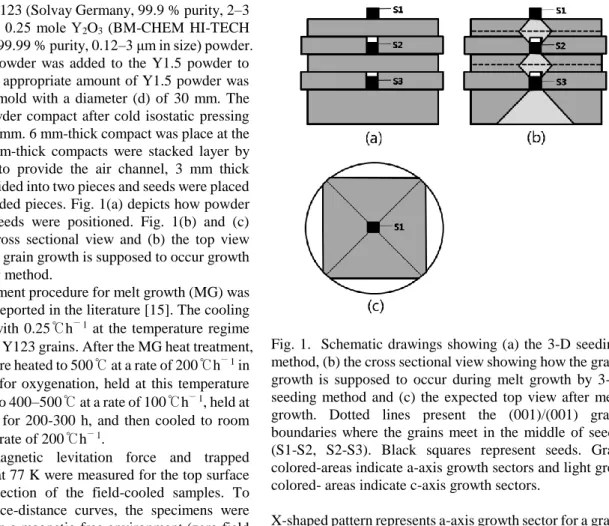
1 wt. % CeO 2 powder was added to the Y1.5 powder to refine Y211. An appropriate amount of Y1.5 powder was put into a steel mold with a diameter (d) of 30 mm. The thickness of powder compact after cold isostatic pressing was 3 mm and 6 mm. 6 mm-thick compact was place at the bottom and 3 mm-thick compacts were stacked layer by layer. In order to provide the air channel, 3 mm thick compact was divided into two pieces and seeds were placed between the divided pieces. Fig. 1(a) depicts how powder compacts and seeds were positioned. Fig. 1(b) and (c) shows (a) the cross sectional view and (b) the top view showing how the grain growth is supposed to occur growth by a 3-D seeding method.

The heat treatment procedure for melt growth (MG) was similar to those reported in the literature [15]. The cooling rate controlled with 0.25℃h − 1 at the temperature regime for the growth of Y123 grains. After the MG heat treatment, Y1.5 samples were heated to 500℃ at a rate of 200℃h − 1 in flowing oxygen for oxygenation, held at this temperature for 50 h, cooled to 400–500℃ at a rate of 100℃h − 1 , held at this temperature for 200-300 h, and then cooled to room temperature at a rate of 200℃h − 1 .

Maximum magnetic levitation force and trapped magnetic fields at 77 K were measured for the top surface and the cross section of the field-cooled samples. To measure the force-distance curves, the specimens were cooled to 77 K in a magnetic-free environment (zero field cooling, ZFC) and the permanent magnets were approached to the cooled superconductors. The maximum magnetic levitation force (F max ) is defined as the force when the distance (d) between the superconductor and the permanent magnet is 0.1 mm. A trapped magnetic field (B) measurement was performed on field-cooled samples.

Permanent magnet with a diameter of 30 mm and a surface field of 4.9 kG was placed on the sample, and liquid nitrogen was poured thereon to cool the sample to 77K (field cooling, FC). When the temperature of the sample reached 77 K, the permanent magnets placed on the superconductor were removed, and the magnetic force trapped in the superconductor was measured on the top surface using a hall probe.

3. RESULTS AND DISCUSSION

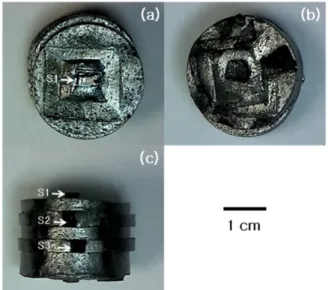
Fig. 2 shows the photos of the top and bottom surfaces of the samples after melt growth (MG) heat treatment. The diameter of the sample was reduced after the MG heat treatment. It is seen that dual X-shaped facet lines have been formed at the top surface; i.e., small X-shaped facet lines are formed inside of outer X-shaped facet lines. Kim et al. showed that the X-shaped facet lines are formed on the top surface for the specimens which were prepared by an interior seeding method [4]. A grain grown from a top seed also forms X-shaped facet lines. However, there is a small difference between these two rectangular patterns.

Fig. 1. Schematic drawings showing (a) the 3-D seeding method, (b) the cross sectional view showing how the grain growth is supposed to occur during melt growth by 3-D seeding method and (c) the expected top view after melt growth. Dotted lines present the (001)/(001) grain boundaries where the grains meet in the middle of seeds (S1-S2, S2-S3). Black squares represent seeds. Gray colored-areas indicate a-axis growth sectors and light grey colored- areas indicate c-axis growth sectors.

X-shaped pattern represents a-axis growth sector for a grain nucleated from a top seed while X-shaped pattern represents c-axis growth sector for a grain nucleated from an interior seed.

Y123 grains from two Sm123 seeds (S1 and S2 in Fig.

1(a)) can nucleate in three different ways;

- A grain nucleates from top seed (S1) first.

- A grain nucleates from either of interior seeds (S2 and/or S3) first.

- All the grains nucleate simultaneously from top seed (S1) and interior seed (S2 and S3), respectively.

Nucleation of Y123 grains will be widely affected by several processing variables such as a melt composition, oxygen partial pressure and seed orientation and so on. There are various factors affecting on the nucleation behavior of Y123 grain. Huang et al. [16] observed that two different lateral overgrowth stages were observed with about 50 times difference in the lateral overgrowth rate of NdBCO crystal by using YBCO film seed. They have suggested that the composition change of Y/Nd ratio in the vicinity of YBCO seed causes the variation of undercooling and leads to the huge difference of growth rate. In this work, the same Sm123 seeds were used as a top seed (S1) and an interior seeds (S2).

Therefore, there might be little difference of composition in

front of seed crystal and any compositional variation hardly

affect on the nucleation temperature.

(3)

Interior seeding combined with top seeding for the fabrication of single grain REBCO bulk superconductors

Fig. 2. Photos of (a) the top surface, (b) the bottom surfaces and (c) the side of a melt grown specimen. S1 denotes a Sm123 top seed and S2 and S3 are the interior seeds.

Fig. 3 Photos of the cross section of the specimen prepared by 3-D seeding melt growth method.

Yan et al. [17] has reported that the growth rate of YBCO crystal is enhanced by performing the melt processing under 1 atm oxygen atmosphere. They suggested that the high growth rate is attributed to the higher solubility of Y in Ba-Cu-O melt under higher oxygen partial pressure. Oxygen atoms are released during a peritectic decomposition reaction as follows;

REBCO → RE 2 BaCuO 5 + Liquid + O 2

There is a possibility that the oxygen partial pressure is higher in a seed channel than on the top surface due to a dimensional constraint retarding the out-diffusion of oxygen. However, it may be reasonable to assume that there is little difference of oxygen partial pressure between seed channel and top surface due to air convection inside of muffle furnace. Therefore, it looks sound to assume that the oxygen partial pressure difference might not affect on the nucleation temperature and growth rate.

From the above discussion, a compositional variation and oxygen partial pressure change might not lead to different nucleation behaviors depending on the seed position at the top surface and the interior of compact.

Therefore, it is considered that two grains has nucleated simultaneously at both of top and interior seeds and met together in the middle between top seed (S1) and interior seed (S2).

Fig. 2(b) shows that the grain grown from the bottom seed has grown down to the bottom of the specimen through the thickness. Fig. 2(c) shows that there was little dimensional distortion of the specimen after the melt growth by 3-D seeding technique. It is seen that the seeds have stayed in their original positions.

Fig. 3 reveals the photos of the cross section of the specimen prepared by 3-D seeding melt growth method.

Specimen was cut along the <100> direction of YBCO grain by using a table-top diamond wheel saw. It is seen that there is thickness and width contractions after the melt processing. It is seen that crack lines are present though the thickness and growth patterns have formed due to the independent nucleation from each seeds of S1, S2 and S3.

All the seeds were placed as the c-axis is normal to the specimen surface and therefore the crack lines are likely to be parallel to a-axis or b-axis. Therefore, it was expected that all the grains nucleated from the seeds grows forming so-called X-shaped facet pattern as reported in both of TSMG and interior seeding melt growth. Fig. 3(b) exhibits the schematic drawing of Fig. 3(a) where dotted lines denotes the <110> facet lines. It can be seen that the diamond-like patterns are built up between S1 and S2 as well as between S2 and S3. The (001)/(001) grain boundaries, which may have very low interfacial energy, are hard to figure out in the Fig.

S2 seed that was in contact with both of upper and lower compact at the same time and S2 grew in both compacts.

Therefore, the grain, which was nucleated from S1, is not able to seen in the Fig. 3(a). The grain, which was nucleated from S1, was ground out during surface polishing and therefore it is not seen in Fig. 3(a). But it is clearly seen that the a-c growth sectors of the grains, which were nucleated from S2 and S3, meet together and form a diamond shape.

From the formation of diamond shaped a-c growth sector, it can be said that the horizontal diagonal of the rhombus is the (001)/(001) boundary where two grains from S1 and S2 have been met.

Fig. 4 shows the magnetic levitation forces at the top surface and the cross section of the specimen. It is seen that the magnetic levitation force at the top surface is measured as 32.1 N which is about two times higher than 14.8 N of the cross section. The seeds were placed as the c-axis of the seeds is perpendicular to the top surface of the specimen. It means that the grown YBCO grain has a crystallographic orientation as that (001) plane is parallel to the specimen surface and the cross section has (100) crystallographic plane. Therefore, the levitation force on the (001) plane is about twice high of that on (100) plane. Jung el al. [18]

16

(4)

0 10 20 30 40 50 -5

0 5 10 15 20 25 30 35

M ag n eti c L ev it ati o n F o rc e [ N ]

Distance [mm]

32.144 N

(a)

0 10 20 30 40 50

0 5 10 15 20 25 30 35

M ag n eti c L ev it ati o n F o rc e [ N ]

Distance [mm]

14.798 N

(b)

Fig. 4. Magnetic levitation forces (a) at the top surface and (b) the cross section of the specimen, respectively.

reported that the levitation forces on (001) plane is 1.4 - 1.6 time higher than that on (100) plane. The weak levitation force on (100) plane may attribute to the presence of seed channel and/or the presence of lots of macro-cracks along the (001) planes. The volume of the seed channel is too small to attribute to the more than 50 % reduction of the levitation force. Therefore, the macro-cracks are likely to be a main cause of large reduction of levitation force because the presence of macro-cracks lowers the current carrying capacity across the cracks. As discussed by Jung et al. [18], the critical current density (Jc) of YBCO is anisotropic with the direction of magnetic field (H) applied to the crystallographic plane; highest Jc under <001>//H and lowest Jc under the magnetic field of <100>//H.

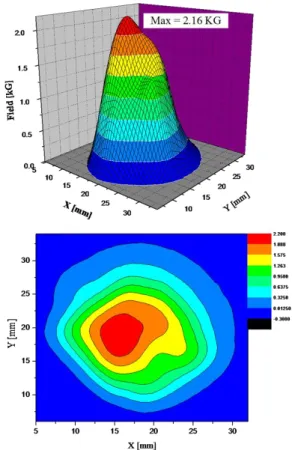
Fig. 5 shows the trapped magnetic field map of the top surface of the specimen prepared by a 3-D seeding method.

A single peak is observed at the center of the trapped field contour map. The peak is not present at the center of the specimen and rather is deviated from the center of the map.

This peak deviation may reflect the non-uniformity of the specimen. There are several experimental factors which might cause the peak shift;

- The center of grain is deviated from the specimen center.

- A subsidiary grain is developed.

- A dimensional change - The presence of seed channel.

Fig. 5. Trapped magnetic field map of the top surface of the specimen prepared by a 3-D seeding method.

In Fig. 2, it was seen that the top seed and the second layer seed (S1 and S2) are displaced to the left from center of the specimen. However, the peak position is not coincided with the position of the top seed. It is clear that the trapped field at the seed channel is zero. Therefore, the presence of the seed channel will result in the shift of the peak position out of the center as appeared from the magnetic field map of the cross section of the specimen. In Fig. 3, it is seen that a huge subsidiary grain has been developed. It is also seen that the macro-cracks in the subsidiary grain are vertical to top surface of the specimen. From the directions of the macro-cracks, it can be said that the <001> axis is parallel to the specimen top surface and (100) plane is parallel to the top surface. It indicates that the asymmetric trapped field might be due to the presence of the subsidiary grain with c-axis parallel to the top surface of the specimen. The maximum trapped field (B max ) at the peak point has been measured as 2.16 kG.

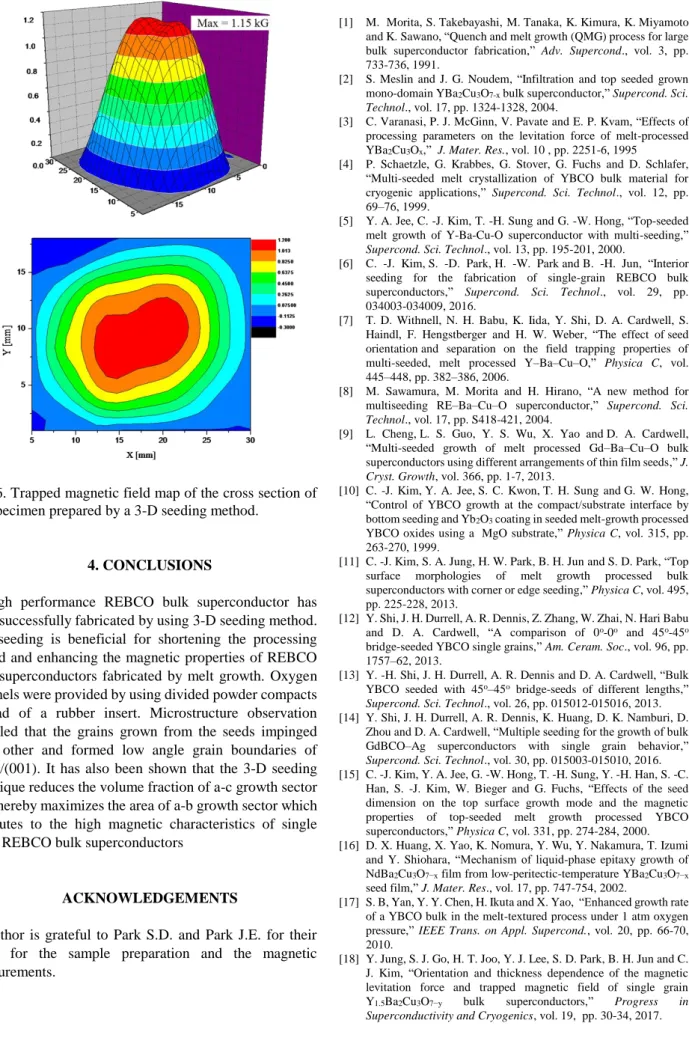
Fig. 6 shows the trapped magnetic field map at the cross

section of the specimen shown in Fig. 3. The B max at the peak

point is 1.15 kG. Double peaks are observed in the trapped

field contour map. The double peaks may attribute to the

presence of the seed channels. Seed channel might reduce the

trapped field because of the decrease of super-currents

resulting from a discontinuity and reduction of the specimen

volume. From the observations of the cross section, it is

evident that the measured specimen is full of microstructural

defects which make it difficult to analyze the magnetic

measurement results systematically

(5)

Interior seeding combined with top seeding for the fabrication of single grain REBCO bulk superconductors

Fig. 6. Trapped magnetic field map of the cross section of the specimen prepared by a 3-D seeding method.

4. CONCLUSIONS

High performance REBCO bulk superconductor has been successfully fabricated by using 3-D seeding method.

3-D seeding is beneficial for shortening the processing period and enhancing the magnetic properties of REBCO bulk superconductors fabricated by melt growth. Oxygen channels were provided by using divided powder compacts instead of a rubber insert. Microstructure observation revealed that the grains grown from the seeds impinged each other and formed low angle grain boundaries of (001)/(001). It has also been shown that the 3-D seeding technique reduces the volume fraction of a-c growth sector and thereby maximizes the area of a-b growth sector which attributes to the high magnetic characteristics of single grain REBCO bulk superconductors

ACKNOWLEDGEMENTS

Author is grateful to Park S.D. and Park J.E. for their helps for the sample preparation and the magnetic measurements.

REFERENCES

[1] M. Morita, S. Takebayashi, M. Tanaka, K. Kimura, K. Miyamoto and K. Sawano, “Quench and melt growth (QMG) process for large bulk superconductor fabrication,” Adv. Supercond., vol. 3, pp.

733-736, 1991.

[2] S. Meslin and J. G. Noudem, “Infiltration and top seeded grown mono-domain YBa 2 Cu 3 O 7-x bulk superconductor,” Supercond. Sci.

Technol., vol. 17, pp. 1324-1328, 2004.

[3] C. Varanasi, P. J. McGinn, V. Pavate and E. P. Kvam, “Effects of processing parameters on the levitation force of melt-processed YBa 2 Cu 3 O x ,” J. Mater. Res., vol. 10 , pp. 2251-6, 1995

[4] P. Schaetzle, G. Krabbes, G. Stover, G. Fuchs and D. Schlafer,

“Multi-seeded melt crystallization of YBCO bulk material for cryogenic applications,” Supercond. Sci. Technol., vol. 12, pp.

69–76, 1999.

[5] Y. A. Jee, C. -J. Kim, T. -H. Sung and G. -W. Hong, “Top-seeded melt growth of Y-Ba-Cu-O superconductor with multi-seeding,”

Supercond. Sci. Technol., vol. 13, pp. 195-201, 2000.

[6] C. -J. Kim, S. -D. Park, H. -W. Park and B. -H. Jun, “Interior seeding for the fabrication of single-grain REBCO bulk superconductors,” Supercond. Sci. Technol., vol. 29, pp.

034003-034009, 2016.

[7] T. D. Withnell, N. H. Babu, K. Iida, Y. Shi, D. A. Cardwell, S.

Haindl, F. Hengstberger and H. W. Weber, “The effect of seed orientation and separation on the field trapping properties of multi-seeded, melt processed Y–Ba–Cu–O,” Physica C, vol.

445–448, pp. 382–386, 2006.

[8] M. Sawamura, M. Morita and H. Hirano, “A new method for multiseeding RE–Ba–Cu–O superconductor,” Supercond. Sci.

Technol., vol. 17, pp. S418-421, 2004.

[9] L. Cheng, L. S. Guo, Y. S. Wu, X. Yao and D. A. Cardwell,

“Multi-seeded growth of melt processed Gd–Ba–Cu–O bulk superconductors using different arrangements of thin film seeds,” J.

Cryst. Growth, vol. 366, pp. 1-7, 2013.

[10] C. -J. Kim, Y. A. Jee, S. C. Kwon, T. H. Sung and G. W. Hong,

“Control of YBCO growth at the compact/substrate interface by bottom seeding and Yb 2 O 3 coating in seeded melt-growth processed YBCO oxides using a MgO substrate,” Physica C, vol. 315, pp.

263-270, 1999.

[11] C. -J. Kim, S. A. Jung, H. W. Park, B. H. Jun and S. D. Park, “Top surface morphologies of melt growth processed bulk superconductors with corner or edge seeding,” Physica C, vol. 495, pp. 225-228, 2013.

[12] Y. Shi, J. H. Durrell, A. R. Dennis, Z. Zhang, W. Zhai, N. Hari Babu and D. A. Cardwell, “A comparison of 0 o -0 o and 45 o -45 o bridge-seeded YBCO single grains,” Am. Ceram. Soc., vol. 96, pp.

1757–62, 2013.

[13] Y. -H. Shi, J. H. Durrell, A. R. Dennis and D. A. Cardwell, “Bulk YBCO seeded with 45 o –45 o bridge-seeds of different lengths,”

Supercond. Sci. Technol., vol. 26, pp. 015012-015016, 2013.

[14] Y. Shi, J. H. Durrell, A. R. Dennis, K. Huang, D. K. Namburi, D.

Zhou and D. A. Cardwell, “Multiple seeding for the growth of bulk GdBCO–Ag superconductors with single grain behavior,”

Supercond. Sci. Technol., vol. 30, pp. 015003-015010, 2016.

[15] C. -J. Kim, Y. A. Jee, G. -W. Hong, T. -H. Sung, Y. -H. Han, S. -C.

Han, S. -J. Kim, W. Bieger and G. Fuchs, “Effects of the seed dimension on the top surface growth mode and the magnetic properties of top-seeded melt growth processed YBCO superconductors,” Physica C, vol. 331, pp. 274-284, 2000.

[16] D. X. Huang, X. Yao, K. Nomura, Y. Wu, Y. Nakamura, T. Izumi and Y. Shiohara, “Mechanism of liquid-phase epitaxy growth of NdBa 2 Cu 3 O 7−x film from low-peritectic-temperature YBa 2 Cu 3 O 7−x

seed film,” J. Mater. Res., vol. 17, pp. 747-754, 2002.

[17] S. B, Yan, Y. Y. Chen, H. Ikuta and X. Yao, “Enhanced growth rate of a YBCO bulk in the melt-textured process under 1 atm oxygen pressure,” IEEE Trans. on Appl. Supercond., vol. 20, pp. 66-70, 2010.

[18] Y. Jung, S. J. Go, H. T. Joo, Y. J. Lee, S. D. Park, B. H. Jun and C.

J. Kim, “Orientation and thickness dependence of the magnetic levitation force and trapped magnetic field of single grain Y 1.5 Ba 2 Cu 3 O 7−y bulk superconductors,” Progress in Superconductivity and Cryogenics, vol. 19, pp. 30-34, 2017.

18

수치

Fig. 2 shows the photos of the top and bottom surfaces of  the  samples  after  melt  growth  (MG)  heat  treatment
Fig. 2.  Photos of (a) the top surface, (b) the bottom surfaces  and (c) the side of a melt grown specimen
Fig. 4. Magnetic levitation forces (a) at the top surface and  (b) the cross section of the specimen, respectively
Fig. 6. Trapped magnetic field map of the cross section of  the specimen prepared by a 3-D seeding method

참조

관련 문서

Different composition between parent and product (Ex. The growth of the B-rich phase into the A-rich α-phase) Growth of the new phase will require long-range diffusion

However, it is expected that in the case of biotech start-ups facing the Valley- of-Death, the shareholders’ equity value has a function of a growth option in real

Since every classical or virtual knot is equivalent to the unknot via a sequence of the extended Reidmeister moves together with the forbidden moves, illustrated in Section 2,

웹 표준을 지원하는 플랫폼에서 큰 수정없이 실행 가능함 패키징을 통해 다양한 기기를 위한 앱을 작성할 수 있음 네이티브 앱과

_____ culture appears to be attractive (도시의) to the

Bulgaria's tourist sector expects a 5 to 7% growth of the number of foreign tourists visiting the country in 2013 compared to 2012, according to reports.. Forecasts have

A frame size error in a frame that could alter the state of the entire connection MUST be treated as a connection error (Section 5.4.1); this includes any frame carrying a

1 John Owen, Justification by Faith Alone, in The Works of John Owen, ed. John Bolt, trans. Scott Clark, &#34;Do This and Live: Christ's Active Obedience as the