Vol.19, No.3, (2017), pp.27~32 http://dx.doi.org/10.9714/psac.2017.19.3.027
```
1. INTRODUCTION
Single grain REBCO (REBa2Cu3O7-y, RE: rare-earth elements) bulk superconductors can be used for the magnetic levitation applications with a very high energy efficiency and a bulk permanent magnet with very high magnetic fields [1-3]. One of the most important problems to be overcome for the practical applications of the single grain REBCO bulk superconductors is the poor mechanical properties, which are originated from the intrinsic brittleness of the ceramic superconductors [4,5].
The large grain REBCO bulk superconductors were often fractured in a high magnetic field environment [6,7]. The magnetic stress induced during the activation process often leads to a fracture of the bulk superconductors including micro-cracks and micro-pores [8].
One possible way to improve the mechanical properties of REBCO is the reinforcement of the ceramic superconductors. Tomita and Murakami attempted the resin/metal impregnation and carbon fiber wrapping for a single grain RE123 bulk superconductor [9]. As the micro-cracks and pores in the vicinity of the sample surface were filled with the resin, the crack propagation was significantly suppressed. In addition to the resin/metal impregnation, an artificial hole was made at the center of the REBCO bodies, and was filled with a metallic phase to reinforce the REBCO bulk superconductor.
Another possible way to reinforce a ceramic superconductor
is the addition of a metallic element such as silver (Ag) to REBCO [4,5,10]. The silver addition was reported to improve the mechanical properties through the fine dispersion of Ag particles in an RE123 matrix, which suppresses the crack propagation. Very high magnetic fields of 17.24 T at 29 K [9]
and 17.6 T at 26 K [10] could be achieved for the resin-impregnated YBCO and GdBCO bulk superconductors with Ag dispersion, respectively.
Artificial holes can be made in ceramic bodies such as powder compacts, and sintered or melt-growth processed RE123 bulk superconductors by mechanical drilling [11-13]. Mechanical drilling is an effective perforation technique that can control the size and number of holes easily. Organic binder materials are often used to soften the powder compact, which suppresses the formation of cracks during mechanical drilling. We recently developed a simple die pressing technique for perforation [14].
Gd1.5Ba2Cu3O7-y (Gd1.5) powder compacts with artificial holes were successfully made using die pressing. Single grain G1.5 bulk samples with a diameter of 25 mm with controlled numbers of artificial holes were successfully fabricated using a top-seeded melt growth (TSMG) process [14]. The presence of artificial holes improved the magnetic levitation forces and the trapped magnetic fields of the single grain Gd1.5 samples.
In this study, we fabricated very large single-grain (diameter of 25 − 42 mm) Y1.5Ba2Cu3O7-y (Y1.5) bulk superconductors with artificial holes. To make artificial holes, cylindrical dies with a diameter (d) of 30 mm and 40 mm, and rectangular dies with a side length (l) of 50 mm,
Effects of artificial holes in very large single-grain Y1.5Ba2Cu3O7-y
bulk superconductors
S.-D. Parka,H.-W. Parkb, B.-H. Juna, and C-J. Kim*,a
a Korea Atomic Energy Research Institute, Daejeon, Korea
b Korea University of Technology and Education, Cheon-an, Korea
(Received 10 July 2017; revised or reviewed 12 September 2017; accepted 13 September 2017)
Abstract
The effects of artificial holes on the trapped magnetic fields and magnetic levitation forces of very large single-grain Y1.5Ba2Cu3O7-y (Y1.5) bulk superconductors were studied. Artificial holes were made for Y1.5 powder compacts by die pressing using cylindrical dies with a diameter of 30 mm or 40 m, or rectangular dies with a side length of 50 mm. The single grain Y1.5 bulk superconductors (25 mm, 33 mm in diameter and 42 mm in side length) with artificial holes were fabricated using a top-seeded melt growth (TSMG) process for the die-pressed Y1.5 powder compacts. The magnetic levitation forces at 77 K of the 25 mm single grain Y1.5 samples with one (diameters of 4.2 mm) or six artificial holes (diameters of 2.5 mm) were 10−17% higher than that of the Y1.5 sample without artificial holes. The trapped magnetic fields at 77 K of the Y1.5 samples with artificial holes were also 9.6-18% higher than that of the Y1.5 sample without artificial holes. The 33 mm and 42 mm single grain Y1.5 samples with artificial holes (2.5 mm and 4.2 mm in diameter) also showed trapped magnetic fields 10−13% higher than that of the Y1.5 samples without artificial holes in spite of the reduced superconducting volume fraction due to the presence of artificial holes. The property enhancement in the large single grain Y1.5 bulk superconductors appears to be attributed to the formation of the pore-free regions near the artificial holes and the homogeneous oxygen distribution in the large Y123 grains.
Keywords: large single grain, Y1.5Ba2Cu3O7-y superconductors, artificial holes, die pressing, trapped magnetic fields, magnetic levitation forces
* Corresponding authors: [email protected]
mixed with 0.25 mole Y2O3 (BM-CHEM HI-TECH Co., Ltd, China, 99.99% purity, 0.12−3 μm in size) powder to make a Y1.5 composition. 1 wt.% CeO2 powder was added to Y1.5 powder to refine Y2BaCuO5(Y211) particles [15].
For uniform mixing, the powder mixture of (Y123−Y2O3−CeO2) was milled using ZrO2 balls for 24 h.
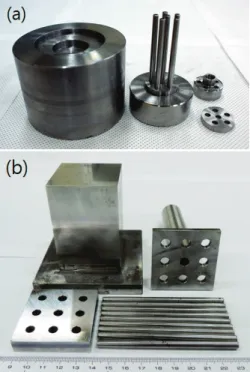
Cylindrical pressing dies with d=30 mm and d=40 mm (Fig.
1(a)) or rectangular pressing dies with l= 50 mm (Fig. 1(b)) were used to make holes in Y1.5 powder compacts. The number and size of the artificial holes in powder compacts were controlled from one to nine using pins with various diameters.
Fig. 2 shows photos of the Y1.5 powder compacts with six artificial holes with diameters of 5 mm (left side) and 3 mm (right side), fabricated using a die pressing. The powder compacts with various numbers and sizes of artificial holes were made without using organic binders.
Not illustrated here, rectangular Y1.5 powder compacts (l=50 mm) with artificial holes were also made using a die pressing technique.
Fig. 1. (a) Cylindrical and (b) rectangular pressing dies designed for making artificial holes in powder compacts.
holes fabricated using pressing dies of Fig. 1(a).
The top-seed melt growth (TSMG) process was applied to the die-pressed Y1.5 powder compacts to fabricate single-grain Y1.5 bulk superconductors. A Sm123 seed was placed at the center of the top surface of the Y1.5 compacts with/without artificial holes. A sintered thin Y211 buffer plate was inserted at the seed/compact interface to prevent samarium diffusion from the seed to the compact [16, 17]. The seeded Y1.5 powder compacts with/without artificial holes were subjected to melt growth heat treatment cycles to fabricate single-grain Y123 on the top seeds. Details of the applied heating cycles have been reported in the literature [18]. After the TSMG heat treatment, Y1.5 samples were heated to 500℃ at a rate of 200℃h-1 in flowing oxygen for oxygenation, held at this temperature for 50 h, cooled to 400℃ − 500℃ at a rate of 100℃h-1, held at this temperature for 200-300 h, and then cooled to room temperature at a rate of 200℃h-1.
To examine the microstructures, the TSMG processed Y1.5 samples were cut along the c-parallel direction using a diamond saw. The surfaces of the samples were ground and polished using SiC papers and Al2O3 powders.
Microstructures of the polished surfaces were examined using an optical microscope. Magnetic levitation forces and trapped magnetic fields at 77 K were measured for the top surface of the field-cooled (FC) or zero field-cooled (ZFC) samples. Nd-B-Fe permanent magnets with a surface field of 520 mT were used for the FC experiment.
The trapped magnetic fields of the top surfaces of the FC samples were measured using a hall probe. Force-distance (F-d) curves at 77 K were estimated for the ZFC samples.
For the levitation force measurement, Nd-B-Fe permanent magnets with a diameter of 30 mm were used. The maximum magnetic levitation force at 77 K was defined as the force at a gap distance of 0.1 mm of the F-d curves.
3. RESULTS AND DISCUSSION
Fig. 3 shows a typical example of the top surface morphology of the single-grain Y1.5 bulk superconductor with six artificial holes, fabricated using a TSMG process.
It can be seen that five artificial holes are observed on the top surface. The other hole is not visible because it is located just below the seed/buffer disc. The value of d was
Fig. 3. Top surface view of a 25 mm single grain Y1.5 sample with six 4.2 mm artificial holes fabricated by a TSMG process.
reduced from 30 mm to 25 mm after the TSMG process. In addition to the reduction in sample diameter, the diameter of the artificial holes was also reduced from 5 mm to 4.2 mm owing to the volume contraction of the powder compacts during the TSMG heat treatment.
As can be seen in Fig. 3, the four <110> diagonal facet lines beginning at the rectangular Sm123 seed, are extended to the buffer disc and finish at the sample edges.
The extension of the facet lines from the center to the edges of the sample indicates that the presence of the artificial holes did not disturb the growth of a single Y123 grain.
Other disc-shape single grain Y1.5 samples with d=25 mm and various numbers and sizes of artificial holes were also successfully made. The top surfaces of single grain disc-shaped Y1.5 samples with/without artificial holes were grounded, and the artificial holes were filled with a Bi-Pb-Sn-Cd metal solder to measure the magnetic levitation forces and trapped magnetic fields (see Fig. 4).
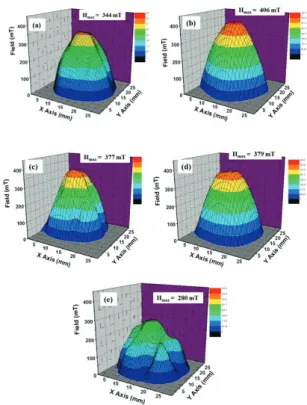
Fig. 5 shows a contour map of the trapped magnetic field (H) at 77 K estimated for the top surfaces of 25 mm single grain Y1.5 samples (a) without holes, (b) with one 2.5 mm hole, (c) six 2.5 mm holes (d) one 4.2 mm hole, and (e) six 4.2 mm holes. The samples were field-cooled using a Nd-B-Fe permanent magnet with a surface field of 530 mT.
All H contour maps show a single peak point at the center of the map. Sometimes, groove lines associated with weakly linked regions are observed in the H contour map of samples (c). The grooves of sample (e) are much deeper than those of the other samples due to the presence of the large artificial non-superconducting holes. The maximum trapped field (Hmax) of a sample without artificial holes is 344 mT. The value of Hmaxs for samples (b) – (d) are 406 mT, 377 mT, 379 mT, respectively, which are 18%, 9%
and 10% higher than that of sample (a). This result indicates that the presence of the artificial holes improved the material quality [11]. However, the value of Hmax of sample (e) is 280 mT, which is 18.6% lower than that of
Fig. 4. Single grain Y1.5 samples with (a) one 2.5 mm hole, (b) one 4.2 mm hole, (c) six 2.5 mm holes, and (d) six 4.2 mm holes. The artificial holes were filled with Bi-Pb-Sn-Cd metal solder.
Fig. 5. Trapped magnetic field (H) contour maps at 77 K estimated for the top surfaces of 25 mm single grain Y1.5 samples (a) without holes, (b) with one 2.5 mm hole, (c) six 2.5 mm holes (d) one 4.2 mm hole, (e) six 4.2 mm holes.
the sample without artificial holes. This is because of the significant reduction in superconducting volume owing to the presence of the large artificial holes.
Fig. 6 shows the F-d curves at 77 K of the single-grain Y1.5 samples (d=25 mm) with/without artificial holes. The
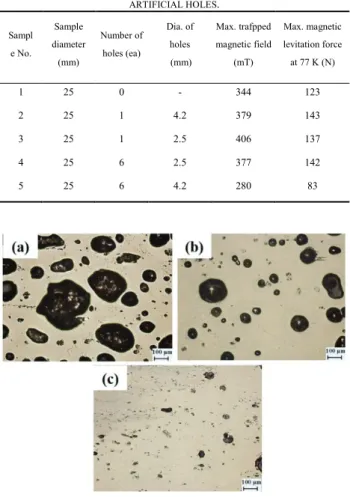
with a lot of small artificial holes [13]. The trapped magnetic of the sample with the small artificial holes was higher than the sample without artificial holes. The improved material properties was thought to be the accelerated oxygen diffusion through the hole surface and the reduced volume of the defects such as microcracks, pores and void. In our previous work for the single grain Gd1.5 bulk superconductor, the number of pores near the hole surfaces was significantly reduced [14]. However, the Frep. of the sample with six artificial holes with a diameter of 4.2 mm is 32.5% lower than that of the samples with artificial holes, similar to the result of the trapped magnetic field of Fig. 5. The magnetic levitation forces and trapped magnetic fields of single grain disc-shape Y1.5 samples with/without artificial holes are summarized in TABLE I.
Fig. 7 shows the microstructures for the cross sections of a single-grain Y1.5 bulk superconductor (a) without holes (taken from the center region), (b) with six 2.5 mm holes, and (c) with six 4.2 mm holes (regions far from the artificial holes), respectively. Pores with round surfaces and a size of a few-few tens of μm are observed in all samples. They are formed by the gas release during the melt growth process [19, 20]. The pore size and number of sample (a) is larger than that of samples (b) and (c). When more artificial holes are present, fewer and smaller pores form. The reduced size and number of pores are strong evidence of the accelerated diffusion of gas phase (O2) through the hole surfaces during the high-temperature melt processing [11, 19].
Fig. 6. Force-distance (F-d) curves at 77 K of 25 mm single grain Y1.5 samples with/without holes, zero field-cooled.
Fig. 7. Optical micrographs for the cross sections of 25 mm single grain Y1.5 samples without holes, and (b) with one 2.5 mm hole and (c) six 4.2 mm holes. The dark regions correspond to pores.
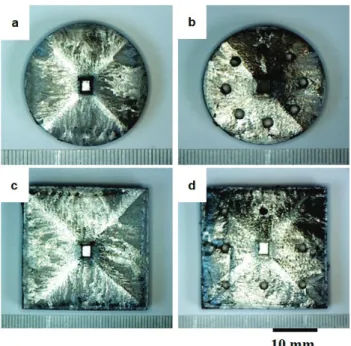
We fabricated a very large single-grain, disc-shaped Y1.5 sample (d=33 mm) without holes and with nine 2.5 mm holes, and a rectangular shaped Y1.5 sample (l=42 mm) without holes and with nine 2.5 mm holes (see Fig.
8).A magnetic levitation force measurement was carried out for the large single-grain samples, zero-field cooled to 77 K, the results of which are shown in Fig. 9. The value of Frep. of the 33 mm samples without artificial holes is 191. 4 N, whereas that of Frep. of the 33 mm samples with the nine artificial holes is 216.4 N , which is 13.1 % higher than that of the sample without artificial holes. The value of Frep. of the 42 mm samples without artificial holes is 242 N, whereas that of the Frep. of the 42 mm sample with nine artificial holes is 258 N, which is 6.6% higher than that of the samples without holes. These results indicate that the presence of artificial holes in large grain samples have a positive effect on the magnetic levitation forces.
The trapped magnetic field at 77 K of the large single grain Y1.5 samples of Fig. 8 were estimated using a Nd-B-Fe permanent magnet with a diameter of 50 mm and a surface magnetic field of 365 mT. The value of Hmax of the 33 mm Y1.5 sample without artificial holes was 191 mT, whereas that of Hmax of the 33 mm Y1.5 sample with nine holes is 216 mT, which is 13% higher than that of the
Fig. 8. Single grain disc Y1.5 samples with a diameter of 33 mm : (a) with no holes, and (b) with nine 2.5 mm holes, and single grain rectangular Y1.5 samples with a side length of 42 mm: (c) with no holes, and (b) with nine 2.5 mm holes.
Fig. 9. Force-distance (F-d) curves at 77 K of (a) 33 mm single grain Y1.5 samples with no holes and with nine 2.5 mm holes, and (b) 42 mm rectangular Y1.5 samples with no holes and with nine 2.5 mm holes.
sample without holes. The value of Hmax of the 42 mm Y1.5 sample without holes was 337 mT, whereas that of Hmax of the 42 mm Y1.5 sample with nine holes is 344 mT, which is 2 % higher than that of the sample without holes
Fig. 10. Photo of 42 mm single grain Y1.5 sample with nine holes filled with Bi-Pb-Sn-Cd solder. (a) is a top view, (b) and (c) are trapped magnetic field contour maps at 77 K.
Fig. 10 shows (a) a 42 mm single grain rectangular Y1.5 bulk superconductor with 4.2 mm nine artificial holes that were filled with a Bi-Pb-Sn-Cd metal solder, and (b) and (c) are trapped magnetic field contour maps. As can be seen in Figs (b) and (c), the trapped magnetic fields around the artificial holes (marked regions by circles in Fig. 8(c)) are relatively weak in comparison with the other regions owing to the presence of the large artificial holes that are in non-superconducting phases. In spite of the presence of the non-superconducting regions, the maximum trapped magnetic flux of the sample is 350 mT, which is10.6%
higher than that (337 mT) of the sample without holes.
In this study we fabricated very large single- grain Y1.5 bulk superconductors (with d=25 mm, 33 mm and l=42 mm) with artificial holes. The magnetic levitation forces and the trapped magnetic fields of the samples were examined. It was confirmed that the presence of artificial holes in the larger single grain Y1.5 samples had a positive effect in improving the properties of the single-grain Y1.5 bulk superconductors. However, a large reduction of the superconducting volume due to the presence of large artificial holes decreased the material properties of the large grain Y1.5 bulk superconductors. The improved material properties are basically attributed to the pore elimination in the superconducting grains [19] and the formation of high-Tc superconducting phase [11]. The hole surfaces appear to have an important role in improving the material quality through diffusion-out of oxygen during the high-temperature heat treatment and diffusion-in of oxygen during the low-temperature oxygenation process.
In the trapped field measurement (field cool), the magnetic fields were trapped in almost the whole sample (from top to bottom), whereas in the magnetic levitation measurement (zero field cool), the magnetic field affects only near the top surface regions of the samples. In other words, the level of the magnetic fields trapped in the superconductors determines the quality of the superconducting volume, whereas the magnetic levitation forces determine the quality of the top surface layer of the bulk superconductors. Therefore, there will be an optimum fraction (the number and size) of artificial holes for the
present in the very larger single-grain Y1.5 bulk superconductors were effective in improving the magnetic levitation forces and the trapped magnetic fields. The property enhancement associated with the artificial holes is attributed to the pore elimination [19] by the accelerated oxygen diffusion through the hole surfaces during high-temperature melting and the peritectic growth state as well as the formation of the high Tc and Jc phase during the low-temperature oxygenation [11]. However, the presence of large artificial holes decreased the magnetic levitation forces and the trapped magnetic fields owing to the reduced superconducting volume. The numbers and sizes of the artificial holes versus the sample size should be optimized for the magnetic levitation force and the trapped magnetic field, respectively.
ACKNOWLEDGMENTS
This research was financially supported by the National Research Foundation Grant (NRF-2013M2A8A1035822) from Ministry of Science, ICT and Future Planning (MSIP) of Republic of Korea, and also partially supported by the Ministry of Trade, Industry and Energy (MOTIE) and Korea Institute for Advancement of Technology (KIAT) through the Promoting Regional Specialized Industry.
REFERENCES
[1] M. Murakami, “Progress in application of bulk high temperature superconductors,” Supercond. Sci. Technol., vol. 13, pp. 448-450, 2000.
[2] F. N. Werfel, U. Floegel-Delor, R. Rothfeld, T. Riedel, B. Goebel, D. Wippich and P. Schirrmeister, “Superconductor bearings, flywheels and transportation,” Supercond. Sci. Technol., vol. 25, pp.
014007, 2012.
[3] Y. Arai, H. Seino, K. Yoshizawa and K. Nagashima, “Development of superconducting magnetic bearing with superconducting coil and bulk superconductor for flywheel energy storage system,” Physica C, vol. 494, pp. 250-254, 2013.
bulk magnets that can trap magnetic fields of over 17 tesla at 29 K,”
Nature, vol. 421, pp. 517-520, 2003.
[10] J. H. Durrell, A. R. Dennis, J. Jaroszynski, M. D. Ainslie, K. G. B.
Palmer, Y-H. Shi, A. M. Campell, J. Hull, M. Strasik, E. E.
Hellstrom and D. A. Cardwell, “A trapped field of 17.6 T in melt-processed, bulk Gd-Ba-Cu-O reinforced with shrink-fit steel,”
Supercond. Sci. Technol., vol. 27, pp. 082001, 2014.
[11] J. G. Noudem, S. Meslin, C. Harnois, D. Chateigner and X. Chaud,
“Infiltration and top seeded growth mono-domain YBa2Cu3O7-x bulk superconductor,” Supercond. Sci. Technol., vol. 17, pp. 931-936, 2004.
[12] S. Haindl, F. Hengstberger, H. W. Weber, S. Meslin, J. Noudem and X. Chaud, “Hall probe mapping of melt processed superconductors with artificial holes,” Supercond. Sci. Technol., vol. 19, pp 108-115, 2006.
[13] Noudem, S. Meslin, D. Horvath, C. Harnois, D. Chateigner, S. Eve, M. Gomina, X. Chaud and M. Murakami, “Fabrication of textured YBCO bulks with artificial holes,” Physica C, vol. 463-465, pp.
301-307, 2007.
[14] K-M. Kim, S-D. Park, B-H. Jun, T. K. Ko and C-J. Kim, “Simple die pressing for making artificial holes in single-grain Gd1.5Ba2Cu3O7-y superconductors,” Supercond. Sci. Technol., vol.
25, pp. 105016, 2012.
[15] C. J. Kim, K. B. Kim, G. W. Hong, D. Y. Won, B. H. Kim, C. T.
Kim, H. C. Moon and D. S. Suhr, “Microstructure, microhardness, and superconductivity of CeO2-added Y-Ba-Cu-O superconductors,”
J. Mater. Res., vol. 7, pp. 2349-2354, 1992.
[16] C-J. Kim, J. H. Lee, S-D. Park, B-H. Jun, S. C. Han and Y. H. Han,
“Y2BaCuO5 buffer block as a diffusion barrier for samarium in top seeded melt growth processed YBa2Cu3O7-y superconductors using a SmBa2Cu3O7-d seed,” Supercond. Sci. Technol., vol. 24, pp.
015008, 2011.
[17] J-H. Lee, S-D. Park, B-H. Jun, J. S. Lee, S. C. Han. Y. H. Han and C-J. Kim, “A buffer bridge process for growing multiple YBa2Cu3O7-y grains from one top seed,” Supercond. Sci. Technol., vol. 24, pp. 055019, 2011.
[18] C-J. Kim, Y. A. Jee, S-C. Kwon, T-H. Sung and G-W. Hong,
“Control of YBCO growth at the compact/substrate interface by bottom seeding and Yb2O3 coating in seeded melt-growth processed YBCO oxides using a MgO substrate,” Physica C, vol. 315, pp.
263-270, 1999.
[19] C-J. Kim, H-G Lee, K-B. Kim and G-W. Hong, “Origin of the Y2Ba1Cu1O5 free region in melt-textured Y-Ba-Cu-O oxides,” J.
Mater. Res., vol. 10, pp. 2235-2240, 1995.
[20] C-J. Kim, G-W. Hong and S-J. Kang, “Entrapment of elongated and crystallographically aligned pores in YBa2Cu3O7-y melt-textured with BaCeO3 addition,” J. Mater. Res., vol. 14, pp. 1707-1710, 1999.