향사양위탕 혈맥약침이 항암요법으로 인한 구토반응 및 위운동 장애에 미치는 영향
최강민1, 이찬1, 임윤경1, 이현진1*
1대전대학교 한의과대학 경락경혈학교실
서 론
현대의 대표적인 난치성 질환 중 하나인 암은 전 세계적으로 발생률이 지속적으로 증가하고 있는 추세이며, 2015년 우리나라 사망원인 통계자료에 따르면 암은 한국인의 사망원인 중 1위를 차지하고 있는 심각한 질환이다
1). 암 치료는 크게 항암화학요법, 수술요법, 방사선 치료 등 세 가지로 나눌 수 있으며, 이외에 호 르몬 요법, 국소치료, 광역학 치료, 면역요법, 유전자요법, 레이 저 치료 등이 사용되고 있다. 이 중에서 항암화학 요법은 전신에 퍼져있는 암세포에 작용하는 전신적인 치료법으로, 항암제는 DNA와 RNA의 합성 과정과 유사분열을 방해하거나 DNA 분자 자체에 해로운 영향을 미쳐서 암세포를 죽인다. 암세포를 치료하 는 효과가 있지만 위장관의 점막, 생식계, 골수, 머리카락 등의 정상적인 세포에도 영향을 미쳐 백혈구 및 혈소판 수의 감소, 빈 혈, 생식기능의 장애, 점막염, 오심, 구토, 탈모, 설사 등 다양한 부작용을 일으킨다
2). 이러한 여러 부작용 중에서도 치료의 중단을 고민하거나 결정하게 할 수 있는 가장 흔하고 심각한 증상은 오심이
나 구토를 동반한 식욕부진이다
3). 오심과 구토가 유발되는 정확한 기전은 알려져 있지 않지만 최근 다양한 동물 실험에서는 serotonin 이 구토를 유발하는 매개 물질이라고 밝혀졌는데, serotonin은 중추 신경과 말초신경의 신경세포와 장점막의 chromaffin 세포에 존재하 는 신경전달물질로서, serotonin 수용체에 작용하여 광범위한 오심 과 구토를 유발하는 것으로 알려져 있다
4).
Cisplatin (CDDP, cis-Diammineplatinum (II) dichloride)은 백금 화합물로서 뛰어난 항암 효과를 가지고 있어 임상에서는 주로 고형암의 치료에 가장 많이 사용되는 대표적인 항암 화학 요법제 중 하나로, 특히 두경부, 폐, 난소, 유방, 고환 및 방광의 다양한 악성 종양치료에서 중요한 역할을 차지하고 있으며 매우 효과적이다
5,6). 하지만 매우 뛰어난 항암 효과를 지니고 있음에 도 불구하고 신장 손상, 이독성 (auditory toxicity), 위장관 장 애, 말초 신경 장애 등의 다양한 부작용을 유발하여 치료효과가 제한적인 것으로 알려져 있어서 사용이 제한되고 있다
7). 뿐만
The Effects of Hyangsayangwi-tang (Xiangshayangwei-tang) Intravenous Herbal Acupuncture on Chemotherapy-induced Emesis and Gastric Motility in Rats
Kang-Min Choi
1, Chan Lee
1, Yun-Kyoung Yim
1, Hyun-Jin Lee
1*1 Department of Meridian & Acupoint, College of Korean Medicine, Daejeon University
Objectives : The purpose of this study is to investigate the effects of Hyangsayangwi-tang (Xiangshayangwei-tang) intravenous herbal acupuncture (HYT-IVHA) on emesis and gastric hypomotility induced by chemotherapy in rats. Methods : The experimental animals were randomly allocated into six groups (normal, cisplatin, saline, HYT-1, HYT-2, HYT-3), and each group included five rats. The rats in the normal group did not receive any treatment. Those in the cisplatin group had no additional treatment after intraperitoneal injection of cisplatin (7 ㎎/㎏). Those in the saline group were injected with saline 0.4 ㎖ via the tail vein after the injection of cisplatin. Those in the HYT-1 group, HYT-2 group, HYT-3 group were injected with 0.4 ㎖ of Hyangsayangwi-tang (Xiangshayangwei-tang) intravenous herbal acupuncture solution (HYT-IVHAS) via tail vein after the injection of cisplatin, and the concentrations were 0.199 g/kg, 0.066 g/kg, 0.022 g/kg respectively. Then we measured body weight, food intake and kaolin con- sumption before and at 12h, 24h and 36h after the injection of cisplatin. The remaining amount of food within the rat’s stomach was also measured at 36h after cisplatin injection. Results : Kaolin consumption was significantly increased in the cisplatin group com- pared to the normal group, while significantly reduced in HYT-1, HYT-2, HYT-3 groups compared to the cisplatin group. The re- maining amount of food in stomach was significantly increased in the cisplatin group and HYT-1 group compared to the normal group, but significantly reduced in the HYT-3 group compared to the cisplatin group. Conclusions : HYT-IVHA has an therapeutic effect on chemotherapy-induced emesis and gastric hypomotility.
Key words : Hyangsayangwi-tang, Xiangshayangwei-tang, Intravenous herbal acupuncture, Cisplatin, Chemotherapy-induced emesis, Gastric motility
아니라 시스플라틴은 식욕부진 뿐만 아니라 미각 및 후각의 변 화, 오심과 구토, 음식 혐오, 점막염증, 변비, 설사, 입안 마름증, 복통, 장폐색, 복부팽만 등의 심한 위장관계 합병증을 유발하며, 특히 투여 시 구토를 유발할 위험성이 90%이상 높은 약물로 알 려져 있다
8,9).
항암치료 중 발생하는 이러한 문제들을 해결하기 위한 일환으 로 최근 한의계에서는 한약을 이용하여 이러한 항암요법들의 부 작용을 감소시키고 면역력을 향상시켜 직, 간접적으로 삶의 질을 개선하는데 도움을 주기 위한 항암제 부작용 억제에 대한 연구 가 활발히 진행되고 있다
10-12). 이러한 치료요법 중 하나가 혈맥 약침이다.
혈맥약침은 한약을 주사용으로 가공 처리하여 혈맥 내로 주입 하는 방식으로, 혈맥으로 약물을 직접적으로 주입하기 때문에 투 여용량을 정확히 조절할 수 있고 체내 작용이 빠르며, 위점막 관 문 (gastric mucosal barrier)을 거치지 않고 혈맥으로 주입하기 때문에 소화계가 약물에 미치는 영향을 배제할 수 있는 장점이 있다
13). 특히 전신 마취 하에서 자유롭게 투여하거나 의식이 불 분명할 때도 투여할 수 있기 때문에 약물의 경구투여가 어려운 상황이나 응급상황, 수술 시에도 쉽게 응용할 수 있어 우리나라 도 많은 연구가 필요할 것으로 사료된다
14).
본 연구에서는 한의학에서 소화계통 치료제로 다용되고 있는 향사양위탕을 이용한 혈맥약침이 대표적인 항암제인 cisplatin으 로 인해 유발된 구토반응 및 위운동 장애에 미치는 영향을 관찰 하여 유의한 결과를 얻었기에 이를 보고하고자 한다.
재료 및 방법
1) 동물
동물은 7주령의 수컷 wistar rat (253.2±9.47 g, DBL, Chungcheong buk-do, South Korea)을 사용하였다. 사육실은 온도 22±2℃와 습도 40~60%, 12시간 낮밤주기를 유지하였다. 모든 동물은 일 반 고형사료 (Samtako, Osan, South Korea), kaolin 사료 (Junse i, Tokyo, Japan)와 물을 자유롭게 섭취하였으며, 1주일 동안 사 육실 환경과 kaolin 사료에 적응한 후 실험에 사용하였다. 본 실험 은 대전대학교 동물실험윤리규정을 준수하여 수행하였다 (승인번호: DJ UARB2016-001).
2) Kaolin
Kaolin 사료는 Yamamoto
15)의 방법에 따라 제조하였다. 먼저 c hemical pure 등급의 kaolin (Junsei, Tokyo, Japan)에 1% (w/
w) arabic gum (Junsei, Tokyo Japan)을 넣은 후, 1차 증류수를 이용하여 잘 섞이게 반죽하여, 일반 고형사료와 비슷한 무게와 형 태로 잘랐다. 이후, 습기가 없는 실온 환경에서 완전히 말린 후, 사 용할 때까지 건조한 곳에 보관하였다.
3) 약침액 제조
향사양위탕의 약재 구성은 Table 1과 같으며, 본 실험에서 사용 한 약재는 모두 옥천당 (Busan, Korea)에서 구매하였다. 약재는 사용하기 전에 초음파세척기를 이용하여 60분 동안 세척하였으며, 실온에서 완전히 말린 후 사용하였다. 향사양위탕 156 g의 약재를 잘게 잘라 플라스크에 담고, 10배수의 70% 에탄올 용액을 플라스 크에 첨가하였다. 이후, 환류추출기를 이용하여 80℃에서 1시간 동안 추출하였다. 추출액은 여과지 (No.1 Filter Paper, Whatman, USA)를 이용하여 여과하였으며, 여과액은 감압농축기를 이용하여 감압농축 하였다. 그 결과 추출물 21.127g을 얻어 수율은 13.54%였 다. 추출물은 사용하기 전까지 –20℃에 보관하였다.(Table 1.)
Herbs Scientific name Dose(g)
人蔘 Panax ginseng C. A. Meyer 6
半夏 Pinellia ternata (Thunb.) Breitenbach 4
白豆蔲 Amomum cadamomum L 4
白芍藥 Paeonia lactiflora Pallas 4
白朮 Atractylodes macrocephala Koidzumi 4
砂仁 Amomum villosum Lour 4
山査肉 Crataegus pinnatifida Bunge 4
陳皮 Citrus unshiu Markovich 4
香附子 Cyperus rotundus L 4
炙甘草 Glycyrrhiza uralensis Fischer 4
乾薑 Zingiber officinale Roscoe 4
大棗 Zizyphus jujuba var. inermis Rehder 3
生薑 Zingiber officinale Roscoe 3
Total amount 52
Table 1. The Compositions of Hyangsayangwi-tang (Xiangs hayangwei-tang)(HYT)
정맥주사를 실시하기 전에 향사양위탕 추출물을 세 가지 농도 (0.199 g/kg, 0.066 g/kg, 0.022 g/kg)로 생리식염수에 희석한 후, clean bench에서 0.22 ㎚ membrane으로 여과하여 혈맥약침 제제로 사용하였다. 향사양위탕 혈맥약침액 (Hyangsayangwi-tan g (Xiangshayangwei-tang) intravenous herbal acupuncture s olution; HYT-IVHAS)은 사용 전에 제조하여 즉시 사용하였다.
4) 실험군
실험군은 normal군, cisplatin군, saline군, HYT-1군, HYT-2군, HY T-3군의 6군으로 나누고, 환경 적응이 끝난 실험동물을 군당 5마 리씩 무작위 배정하였다. Normal군은 cisplatin, 정맥주사 등 아무 런 처치도 하지 않았다. Cisplatin군은 cisplatin (7 ㎎/㎏)을 복강 주사한 후 아무런 처치도 하지 않았다. Saline군은 cisplatin (7 ㎎ /㎏)을 복강 투여 후 saline 0.4 ㎖을 꼬리정맥을 통해 주입하였다.
HYT-1군, HYT-2군, HYT-3군은 cisplatin (7 ㎎/㎏)을 복강 투여
후 각각 0.199 g/kg, 0.066 g/kg, 0.022 g/kg 투여량에 맞춰 혈
맥약침액 0.4 ㎖를 꼬리정맥을 통해 주입하였다.
5) Saline 주입 및 혈맥약침 시술
Cisplatin 주사 직후 rat를 특수 제작한 restrainer에 고정시키 고, 꼬리를 restrainer 밖으로 노출시킨 상태에서, 향사양위탕 혈 맥약침액 0.4 ㎖을 rat의 꼬리정맥을 통해서 주입하였다. Saline 군은 향사양위탕 약침액과 동일량의 생리식염수를 동일 방식으 로 주입하였다.
6) 데이터 측정 (1) 몸무게
Cisplatin 주사 직전과 cisplatin 주사 후 12h, 24h, 36h에 전 자저울 (CAS, East Rutherford, USA)을 이용하여 0.5 g 단위까 지 몸무게를 측정하여, 몸무게 변화량을 계산하였다.
(2) 사료 섭취량
Cisplatin 주사 직전과 cisplatin 주사 후 12h, 24h, 36h에 사료통 에 남아 있는 일반사료의 무게를 전자저울 (CAS, East Rutherford, USA)을 이용하여 0.001 g 단위까지 측정하여, 매 12h 동안의 일반 사료 섭취량을 계산하였다.
(3) Kaolin 섭취량
Cisplatin 주사 직전과 Cisplatin 주사 후 12h, 24h, 36h에 사료통에 남아 있는 kaolin 사료의 무게를 전자저울 (Mettler-Toledo, Columbus, USA)을 이용하여 0.001 g 단위까지 측정하여, 매 12h 동안의 kaolin 섭 취량을 계산하였다.
(4) 위 내 음식 잔여량 측정
위 내 음식 잔여량을 측정하기 위해, cisplatin 주사 36h부터 1 2시간 동안 실험동물을 금식시키고, cisplatin 주사 48h 후 diethy lether 마취 상태에서 경추탈골을 이용하여 실험동물을 희생시킨 후, 복부 정중선을 따라 피부와 복막을 절제하여 위를 외부로 노 출시켰다. 위식도접합부와 유문, 간위인대를 절제한 후, 위 전체를 rat의 복강 내에서 꺼냈다. 위식도접합부와 유문을 잇는 선을 따 라 위를 절제한 후 위 안에 남아 있는 음식 잔여물을 plate에 모 아 물기를 제거한 다음 전자저울 (Mettler-Toledo, Columbus, US A)을 이용하여 0.001 g 단위까지 무게를 측정하였다.
7) 통계 분석
통계분석은 SPSS version 18.0 (IBM, USA) 프로그램을 이용 하였다. 결과값은 means±SD (standard deviation)로 나타냈다.
군간 비교는 Kruskal-Wallis test를 실시한 후, Mann-Whitney U test를 실시하여 확인하였다. 분석 결과가 p<0.05 일 경우, 통계적 유의성이 있는 것으로 판단하였다.
결 과
1) 몸무게 변화량
Cisplatin 주사 후 각 군의 실험동물의 체중변화를 확인한 결 과, cisplatin 주사 후 24h에 normal군 (4.63±1.18 g)에 비하여 cisplatin군 (-7.63±2.90 g)에서 체중이 유의하게 감소하였다 (Figure 1).
2) 사료 섭취량
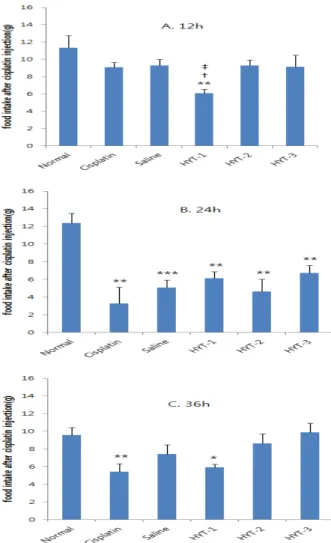
Cisplatin 주사 후 사료 섭취량을 확인하였다. Cisplatin 주사 후 12h에는 HYT-1군에서 normal군, cisplatin군 및 saline군에 비하여 사료 섭취량이 유의하게 감소하였다. Cisplatin 주사 후 24h에는 normal군에 비하여 다른 모든 실험군에서 사료 섭취량 이 유의하게 감소하였다. Cisplatin 주사 후 36h에는 normal군 에 비하여 cisplatin군과 HYT-1군의 사료 섭취량이 유의하게 감 소하였다 (Figure 2, Table 2).
Figure 1. Body weight change after cisplatin injection
Rats were treated with Hyangsayangwi-tang (Xiangshayangwei-tang) intravenous herbal acupuncture (HYT-IVHA) after cisplatin injection.Body weight change was monitored every 12 hours after cisplatin i njection. Each value and vertical bar represent mean±S.D.(n=5) Normal : Normal rats.
Cisplatin : Rats treated with cisplatin (7 mg/kg).
Saline : Rats treated with cisplatin (7 mg/kg) and saline injection (0.4
㎖).
HYT-1 : Rats treated with cisplatin (7 mg/kg) and HYT-IVHA (0.4 ㎖, 0.199 g/kg)
HYT-2 : Rats treated with cisplatin (7 mg/kg) and HYT-IVHA (0.4 ㎖, 0.066 g/kg)
HYT-3 : Rats treated with cisplatin (7 mg/kg) and HYT-IVHA (0.4 ㎖, 0.022 g/kg)
* : P<0.1 vs normal group by Mann-Whitney U Test
그림
Figure 2. Food intake after cisplatin injection
Rats were treated with Hyangsayangwi-tang(Xiangshayangw ei-tang) intravenous herbal acupuncture (HYT-IVHA) after cisplatin injection. Food intake was monitored every 12 ho urs after cisplatin injection. Each value and vertical bar r epresent mean±S.D.(n=5)
Normal : Normal rats.
Cisplatin : Rats treated with cisplatin (7mg/kg).
Saline : Rats treated with cisplatin (7mg/kg) and saline injection (0.4㎖).
HYT-1 : Rats treated with cisplatin (7mg/kg) and HYT-IVHA (0.4㎖, 0.199g/kg)
HYT-2 : Rats treated with cisplatin (7mg/kg) and HYT-IVHA (0.4㎖, 0.066g/kg)
HYT-3 : Rats treated with cisplatin (7mg/kg) and HYT-IVHA (0.4㎖, 0.022g/kg)
*** P<0.01, ** P<0.05, * P<0.1 vs normal group by Mann-Whitney U Test
† : P<0.05 vs cisplatin group by Mann-Whitney U Test
‡ : P<0.05 vs saline group by Mann-Whitney U Test
Groups 12h 24h 36h
Normal 11.34±1.39 g 12.40±1.09 g 9.59±0.84 g Cisplatin 9.09±0.57 g 3.26±1.89 g
**5.40±0.92 g
**Saline 9.29±0.67 g 5.07± 0.84g
***7.44±1.03 g HYT-1 6.07±0.64 g
**†‡6.13±1.40 g
**5.93±1.09 g
*HYT-2 9.28±1.34 g 4.62±0.84 g
**8.63±1.06 g
HYT-3 9.14±1.35 g 6.74±1.85 g
**9.87±2.03 g
Value are expressed Mean±S.D.
*** P<0.01, ** P<0.05, * P<0.1 vs normal group by Mann-Whitney U Test
† : P<0.05 vs cisplatin group by Mann-Whitney U Test
‡ : P<0.05 vs saline group by Mann-Whitney U Test
Table 2. Food intake after cisplatin injection
3) Kaolin 섭취량
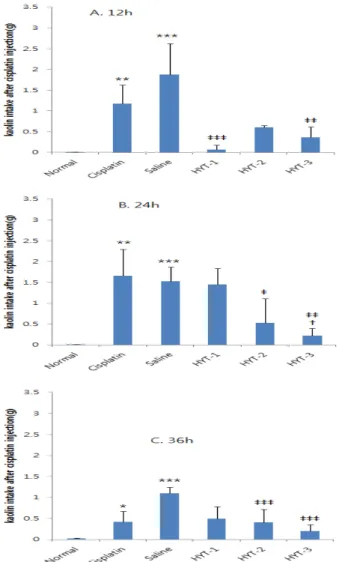
Cisplatin 주사 후 kaolin 섭취량을 확인하였다. Cisplatin 주 사 후 12h, 24h, 36h에 normal군에 비하여 cisplatin군과 saline 군의 kaolin 섭취량이 유의하게 증가하였다. HYT-1군은 cisplatin 주사 후 12h에 saline군에 비해 kaolin 섭취량이 유의 하게 감소하였다. HYT-2군은 cisplatin 주사 후 24h와 36h에 saline군에 비해 kaolin 섭취량이 유의하게 감소하였다. HYT-3 군은 cisplatin 주사 후 24h에 cisplatin군에 비해, 12h, 24h, 36h에 saline군에 비해 kaolin 섭취량이 유의하게 감소하였다 (Figure 3, Table 3).
4) 위 내 음식 잔여량
Cisplatin 주사 후 48h에 쥐를 희생시키고 위 내 음식 잔여량을 확인하였다. Normal군에 비하여 cisplatin군, saline군, HYT-1군에 서 위 내 음식 잔여량이 유의하게 증가하였으며, HYT-3군은 cisplatin군과 saline군에 비하여 위 내 음식 잔여량이 유의하게 감 소하였다 (Figure 4, Table 4).
고 찰
본 연구는 향사양위탕 혈맥약침이 항암요법으로 인한 대표적
인 부작용 중 구토 및 위운동 장애를 완화시키는 효능이 있음을
확인하고자 하는 연구이다. 암환자가 증가함에 따라 그 치료로
인한 부작용 또한 증가하여 치료에 어려움을 겪고 있는 만큼 그
부작용의 완화를 위한 향사양위탕 혈맥약침의 사용 가능성을 확
인하기 위하여 수행되었다.
Figure 3. Kaolin intake after cisplatin injection
Rats were treated with Hyangsayangwi-tang(Xiangshay angwei-tang) intravenous herbal acupuncture (HYT-IV HA) after cisplatin injection. Kaolin intake was monito red every 12 hours after cisplatin injection. Each val ue and vertical bar represent mean±S.D. (n=5) Normal : Normal rats.
Cisplatin : Rats treated with cisplatin (7mg/kg).
Saline : Rats treated with cisplatin (7mg/kg) and saline injection (0.4㎖).
HYT-1 : Rats treated with cisplatin (7mg/kg) and HYT-IVHA (0.4㎖, 0.199g/kg)
HYT-2 : Rats treated with cisplatin (7mg/kg) and HYT-IVHA (0.4㎖, 0.066g/kg)
HYT-3 : Rats treated with cisplatin (7mg/kg) and HYT-IVHA (0.4㎖, 0.022g/kg)
*** P<0.01, ** P<0.05, * P<0.1 vs normal group by Mann-Whitney U Test
† : P<0.05 vs cisplatin group by Mann-Whitney U Test
‡‡‡ : P<0.01, ‡‡ : P<0.05 ‡ : P<0.1 vs saline group by Mann-Whitney U Test
Groups 12h 24h 36h
Normal 0.01±0.01 g 0.00±0.01 g 0.02±0.01 g
Cisplatin 1.17±0.45 g
**1.66±0.63 g
**0.42±0.25 g
*Saline 1.88±0.75 g
***1.52±0.35 g
***1.09±0.15 g
***HYT-1 0.06±0.05 g
‡‡‡1.45±0.59 g 0.49±0.31 g
HYT-2 0.60±0.25 g 0.52±0.17 g
‡‡0.40±0.15 g
‡‡‡HYT-3 0.36±0.22 g
‡‡0.22±0.20 g
†‡‡0.20±0.17 g
‡‡‡Value are expressed Mean±S.D.
*** P<0.01, ** P<0.05, * P<0.1 vs normal group by Mann-Whitney U Test
† : P<0.05 vs cisplatin group by Mann-Whitney U Test
‡‡‡ : P<0.01, ‡‡ : P<0.05 ‡ : P<0.1 vs saline group by Mann-Whitney U Test
Table 3. Kaolin intake after cisplatin injection
Figure 4. The amount of food remained in the stomach
Rats were treated with Hyangsayangwi-tang (Xiangshayangwei-ta ng) intravenous herbal acupuncture (HYT-IVHA) after cisplatin inj ection. 48 hours after cisplatin injection, rats were sacrificed and the amount of gastric remaining food was measured. Each value a nd vertical bar represent mean±S.D. (n=5)Normal : Normal rats.
Cisplatin : Rats treated with cisplatin (7 mg/kg).
Saline : Rats treated with cisplatin (7 mg/kg) and saline injection(0.4 ㎖).
HYT-1 : Rats treated with cisplatin (7 mg/kg) and HYT-IVHA (0.4 ㎖, 0.199 g/kg)
HYT-2 : Rats treated with cisplatin (7 mg/kg) and HYT-IVHA (0.4 ㎖, 0.066 g/kg)
HYT-3 : Rats treated with cisplatin (7 mg/kg) and HYT-IVHA (0.4 ㎖, 0.022 g/kg)
** P<0.01, * P<0.05, vs normal group by Mann-Whitney U Test
† : P<0.05 vs cisplatin group by Mann-Whitney U Test
‡‡ : P<0.01 vs saline group by Mann-Whitney U Test
Groups 36h
Normal 0.70±0.16 g
Cisplatin 3.88±1.07 g
*Saline 3.92±1.21 g
**HYT-1 4.98±1.95 g
**HYT-2 1.03±0.59 g
HYT-3 0.42±0.08 g
†‡‡Value are expressed Mean±S.D.
** P<0.01, * P<0.05, vs normal group by Mann-Whitney U Test
† : P<0.05 vs cisplatin group by Mann-Whitney U Test
‡‡ : P<0.01 vs saline group by Mann-Whitney U Test
Table 4. The amount of food remained in the stomach
Cisplatin은 화합물 중심에 백금이 함유되어 있는 대표적인 백 금 착화 항암제로 암세포 DNA에 비가역적으로 반응함으로서 DNA 구조를 변화시켜 암세포를 사멸시키거나 calcium transduction channel을 방해하여 암세포의 손상을 일으킨다
16). Cisplatin은 고환, 난소, 방광 및 두경부의 다양한 악성종양 치료 에 사용되고 있는 광범위한 화학 요법제 중 하나로 비교적 우수 한 항암효과를 지니고 있지만
17)위장관계의 손상과 더불어 위장 의 배출능력을 크게 억제하여 위장 내 음식물의 정체를 초래하 는 등 다양하고 심각한 위장관 독성을 유발하는 것으로 알려져 있다
18). Cisplatin은 호흡기계, 소화기계, 신장, 혈액계, 청각기계, 정신신경계, 심혈관계, 내분비계 등에 다양하게 부작용을 나타내 는데, 특히 소화기계에서 나타나는 식욕부진, 구역, 설사, 구토, 변비, 복부팽만감 등은 거의 모든 환자들에게서 나타나는 것으로 보고되고 있다. 또한 cisplatin은 신체를 구성하는 세포나 실질 조직에 심각한 손상을 유발하는 활성 산소를 만들어 내는 대표 적인 redox cycler로 작용하며
19)위장관 점막 세포 DNA의 손 상 및 기능 손상을 초래하여 소화관의 기능적 이상, 특히 운동장 애를 유발한다
20).
따라서 cisplatin에 의한 소화기계 부작용의 제어는 이 약물의 강력한 항암효과를 활용하는데 매우 중요한 관점이 되고 있으며 현재 항구토제를 포함한 다양한 소화기계 약물의 개발에 있어 대표적인 소화기 장애 모델의 유발에 시스플라틴이 이용되고 있 다
21).
한의학적으로 구토와 위장장애는 脾胃虛弱, 脾胃失調, 氣機鬱滯 등을 원인으로 보고 있는데 《東醫壽世保元》에 수록된 처방인 향 사양위탕은 胃下垂, 胃無力症, 食慾不振, 腹痛, 胸痛, 胃炎 등의 소 화계 장애에 예부터 널리 쓰여온 처방으로 人蔘, 半夏, 白豆蔲, 白 芍藥, 白朮, 砂仁, 山査肉, 陳皮, 香附子, 炙甘草, 乾薑, 大棗, 生薑 의 13가지 약재로 구성되어있다
22).
砂仁은 모든 氣의 不利를 다스리는 효능이 있어 水穀難消나 心腹痛 등의 증상을 개선해 주며, 脾胃를 溫暖하게 하는 효능이 있어 癨亂이나 寒冷性 泄痢 등의 증상을 해소하기도 한다. 山査
는 健脾開陽의 작용을 통해 食滯와 宿滯를 헤쳐 풀어내고 結氣 를 疏通하키기 때문에 血塊나 痰塊 등과 같이 쌓여 뭉친 각종 덩어리들을 풀어낸다. 白朮은 健脾降胃의 효능이 있고 砂仁, 白 荳蔲, 乾薑은 溫裡暖胃의 작용을 하게 된다. 또한 白荳蔲, 生薑, 陳皮는 강한 下氣의 효능을 지니고 있으며 香附子는 開鬱行氣의 작용을 한다. 半夏는 痰鬱解消, 山査는 積結解消의 작용을 하며, 乾薑과 芍藥은 溫經止痛의 효능이 있다.
향사양위탕에 대한 실험연구로는 최 등
23)이 노화 흰쥐의 위 장, 비장, 췌장세포의 항산화능에 미치는 영향을 연구한 동물 실 험 연구가 있고, 김
24)은 쥐의 중추신경 및 소화관에 대한 향사양 위탕의 작용을 관찰하여 장관수축운동의 억제효과와 해열, 진통 효과 및 항경련 효과가 있는 것을 확인하였다
25).
향사양위탕은 한의학에서 대표적인 위장장애 치료제로 오랜 시 간 쓰여 왔으며 그 효과 또한 잘 알려져 있지만, 항암요법으로 인한 구토 및 위운동 장애에 대한 실험적 연구는 특히 서
26)등이 향사양위탕이 시스플라틴 유발 랫트의 위장관 기능 장애에 미치 는 영향이 유일하다. 이 논문 또한 위장관 기능에 대한 연구를 하였을 뿐, 구토반응에 대한 연구는 이루어지지 않은 상태이다.
본 연구에서는 향사양위탕의 정맥 투여가 cisplatin으로 유발된 rat의 구토 및 위운동 장애에 미치는 영향을 평가하기 위해 cisplatin으로 위장장애를 유발하고 세 가지 농도의 향사양위탕 혈 맥약침액을 꼬리정맥을 통해 주입한 후 몸무게와 사료섭취량, kaolin 섭취량, 위 내 음식 잔여량 측정을 통해 결과를 분석하였다.
Cisplatin 주사 후 각 군의 실험동물의 체중변화를 확인한 결 과, cisplatin 주사 24h 후에 normal군에 비하여 cisplatin군에서 체중이 유의하게 감소하였고 (Figure1), 사료 섭취량 또한 cisplatin 주사 후 유의하게 감소하였다 (Figure2).
함암제 투여에 의해 발생하는 오심과 구토는 식욕부진을 유발 하거나 촉진하는 원인이 될 수 있다
27). 항암제의 용법과 치료 주 기에 따라 다소 차이가 있으나, cisplatin을 포함한 대다수 항암 제는 30~50%정도가 식욕부진을 유발한다
28). 특히 cisplatin은 장의 뉴런에 독성작용을 일으켜 위장관의 활동정도를 감소시켜 영양섭취를 저하시키는 것으로 밝혀져 있으며, 항암화학요법을 받는 환자의 식욕부진이 심할수록 단백질과 열량의 섭취량은 유 의하게 적어지고, 섭취하는 음식의 다양성이 유의하게 낮아지는 것으로 나타났다
29,30). 또한, 진행성 암환자에서 식욕부진은 음식 섭취의 감소를 유발하여 불량한 예후가 예상된다는 연구결과가 있으며, 항암화학 요법을 받는 암환자는 식욕부진으로 음식섭취 량이 저하될 시 이로 인해 영양불량 상태가 되고 심하면 치료를 지속할 수 없는 상태가 된다고 하였다
31,32).
본 연구에서 cisplatin 주사 후 실험동물의 체중변화를 확인한
결과, cisplatin 주사 후 24h에 normal군에 비하여 cisplatin군에
서 체중이 유의하게 감소하였고 다른 군에서는 유의한 변화가
없었다. 사료섭취량은 cisplatin 주사 후 36h에는 normal군에 비
하여 cisplatin군과 HYT-1군에서만 유의하게 감소하였고,
HYT-2,HYT-3군에서는 사료섭취량이 감소하지 않았다. 이러한
결과를 통해 항사양위탕 혈맥약침이 cisplatin으로 유발된 식욕 감소를 완화하는 효과가 있는 것으로 판단할 수 있다.
Kaolin은 기능성 설사를 치료하는 지사제로도 많이 쓰이는데, 흡착제 역할을 해서 장관이 독소 배출 시 변이 장관을 지나는 속도를 늦추게 해주어 묽은 변을 예방하며, 위벽을 보호하는 효 과가 있어 소화 장애나 대변 문제에 널리 쓰이는 약물 중 한 가 지이다. 특히 설치류의 경우 구토반사가 없고 영양소가 없는 화 합물을 먹는 Pica라는 행동을 보이는데 Kaolin도 Pica 반응 시 섭취하는 물질이다
33). 그러므로 Kaolin의 섭취량이 증가한 것은 구토반응이 증가하는 것으로, Kaolin의 섭취량이 줄어든 것은 구 토반응이 완화되는 것으로, Kaolin의 섭취량이 없는 것은 구토반 응이 없는 것으로 볼 수 있다.
본 연구에서 cisplatin 주사 후 normal군에 비하여 cisplatin군 과 saline군의 kaolin 섭취량이 유의하게 증가한 반면, 향사양위 탕 혈맥약침을 시술한 HYT-1, HYT-2, HYT-3 군에서는 cisplatin군과 saline군에 비해 kaolin 섭취량이 유의하게 감소하 였다 (Figure 3). 이러한 결과는 향사양위탕 혈맥약침이 cisplatin으로 유발된 구토반응을 억제하는 효과가 있음을 보여 주는 것으로 해석할 수 있다.
위내 음식 잔여량은 cisplatin 투여군에서 normal 군에 비해 유 의하게 증가하였지만, 향사양위탕 혈맥약침을 0.022 g/kg 투여한 군에서 대조군에 비해 위 내 음식 잔여량이 유의하게 감소하였다 (Figure 4). 이러한 결과로부터 향사양위탕이 항암화학요법으로 저하된 위장 운동을 활성화시켜 위 내 음식물을 소화시키는데 유 의한 효과가 있는 것을 알 수 있다.
이상의 결과로 보아 향사양위탕 혈맥약침은 cisplatin으로 유발 된 구토반응 및 위운동 장애에 대해 유의한 효과가 있는 것으로 관찰되었다. 따라서 임상에서 항암 요법으로 인한 위장 장애의 치료에 유효할 것으로 기대되나, 명확한 기전에 대한 연구와 향 후 임상적 활용을 위한 지속적인 연구가 필요하리라 생각된다.
결 론
향사양위탕의 정맥투여가 cisplatin으로 유발된 rat의 구토반 응 및 위운동 장애에 미치는 영향을 평가한 결과 다음과 같은 결 론을 얻었다.
1) HYT-1군에서 cisplatin 주사 후 12h에, HYT-2군에서 24h와 36h에, HYT-3군에서 12h, 24h, 36h에 대조군에 비해 kaolin 섭취량이 유의하게 감소하였다.
2) HYT-3군에서 대조군에 비해 위 내 음식 잔여량이 유의하게 감 소하였다.
References
1. Statistics Korea. Cause-of-death statistics in the Republic of Korea, 2015. Daejeon : Statistics Korea.
2016 : 13.
2. Yoon SS. Management of Hematologic. Asian Oncol Nurs. 2008 ; 8(1) : 67-75.
3. Davis MP, Dreicer R, Walsh D, Langman R, LeGrand SB.
Appetite and cancer-associated anorexia : A review. J Clin Oncol. 2004 ; 22(8) : 1510-7.
4. Ahn SM, Chae GJ, Oh BC, Kim JD. Anti-Emetic Efficacy of Ondansetron Plus Desamethasone in Cisplatin-Based Combination Chemotherapy. Obstet Gynecol Sci. 1994 ; 37(5) : 976-94.
5. Decatris MP, Sundar S, O’Byrne KJ. Platinum-based che- motherapy in metastatic breast cancer : current status.
Cancer Treat Rev. 2004 ; 30(1) : 53-81.
6. Lebwohl D, Canetta R. Clinical development of platinum complexes in cancer therapy : an historical perspective and an update. Eur J Cancer. 1998 ; 34(10) : 1522-34.
7. Hafermann MJ, Namdar R, Seibold GE, Page RL 2nd.
Effect of intravenous ondansetron on QT interval pro- longation in patients with cardiovascular disease and additional risk factors for torsades: a prospective, ob- servational study. Drug Healthc Patient Saf. 2011 ; 3 : 53-8.
8. Van Cutsem E, Arends J. The causes and consequences of cancer-associated malnutrition. Eur J Oncol Nurs.
2005 ; 9 Suppl 2 : S51-63.
9. American Society of Clinical Oncology, Kris MG, Hesketh PJ, Somerfield MR, Feyer P, Clark-Snow R, et al. American Society of Clinical Oncology guideline for antiemetics in oncology: update 2006. J Clin Oncol. 2009
; 24(18) : 2932-47.
10. Kim JC, Lee KM, Byun BH, Lim SC, Jung TY, Seo JC, et al. Inhibitory Effects of Sophora flavescens on the Hepatic & Renal Side Effects of Chemotherapy by Cisplatin. Korean J Acupunct. 2005 ; 22(3) : 165-74.
11. Nam JY, Sung JS, Jun HI, Lee JW, Kwon SK, Kim DI.
Increasing Effects of Apoptosis When Co-treated Scutellaria barbata D. Don. with Anti-cancer Drugs.
The Journal of Oriental Obstetrics & Gynecology. 2009
; 22(1) : 125-39.
12. Kim HK, Kang YH, Kwak SY, Jung GH, Bae SM, Park
EK, et al. Effects of cell growth inhibition on the com-
bination of cisplatin with green tea extracts. Journal of
Gynecologic Oncology. 2005 ; 16(4) : 347-53.
13. Zhao XX. Studies of Chinese Herbal Injections.
Guangzhou : Guangdong Science & Technology Press.
2008 : 3-4.
14. Yang SK, Yong JS. Perception of Artificial Hydration for Terminally Ill Cancer Patients: Patients, Families and General Public. Korean J Hosp Palliat Care. 2009 ; 12(4) : 220-7.
15. Yamamoto K, Takeda N, Yamatodani A. Establishment of an Animal Model for Radiation-induced Vomiting in Rats Using Pica. J Radiat Res. 2002 ; 43(2) : 135-41.
16. Ravi R, Somani SM. Rybak LP. Mechanism of cisplatin oto- toxicity : Antioxidant system. Pharmacol Toxicol. 1995 ; 76(6) : 386-94.
17. Kishibayashi N, Ichikawa S, Yokoyama T, Ishii A, Karasawa A. Pharmacological properties of KF18259, a novel 5-HT3-receptor antagonist, in rats : inhibition of the distal colonic function. Jpn J Pharmacol. 1993 ; 63(4) : 495-502.
18. Tyers MB. 5-HT3 receptors and the therapeutic po- tential of 5-HT3 receptor antagonists. Therapie. 1991 ; 46(6) : 431-5.
19. Chirino YI, Pedraza-Chaverri J. Role of oxidative and nitrosative stress in cisplatin induced nephrotoxicity.
Exp Toxicol Pathol. 2009 ; 61(3) : 223-42.
20. Chang B, Nishikawa M, Sato E, Utsumi K, InoueM.
L-Carnitine inhibits cisplatin induced injury of the kid- ney and small intestine. Arch Biochem Biophys. 2002 ; 405(1) : 55-64.
21. Andrews PL, Horn CC. Signals for nausea and emesis : Implications for models of upper gastrointestinal diseases. Auton Neurosci. 2006 ; 125(1-2) : 100-15.
22. National federation of department of sasang constitutional medicine, colleges of oriental medicine. Sasang constitu- tional medicine. 2nd Ed. Seoul : Jipmoondang. 2004 : 260, 265, 276, 394-5, 442-80.
23. Choi BC, Ahn TW. Anti-Oxidant Effect of Hyangsayangyi-tang Decoction in Stomach, Spleen and Pancreas Cell of SD Rat. J Sasang Constitut Med. 2008 ; 20(2) : 72-84.
24. Kim KY. An Experimental Study on Some Effects of Soeumin-Hyangsayangwi-tang(Xiangshayangwei-tang). J Sasang Constitut Med. 1989 ; 1(1) : 153-70.
25. Choi BC, Ahn TW. Anti-oxidant Effect of Hyangsayangwi-tang(Xiangshayangwei-tang) Decoction in Stomach, Spleen and Pancreas Cell of SD Rats. J Sasang
Constitut Med. 2008 ; 20(2) : 72-84.
26. Seo EH, Kim ST, Bae NY, Choi AR. Beneficial Effect of Hyangsayangwi-tang on the Cisplatin-Induced Gastrointestinal Dysfunctions in Rats. J Sasang Constitut Med. 2013 ; 25(4) : 343-58
27. Holland JB, Rowland J, Plumb M. Psychological aspects of anorexia in patients. Cancer Research. 1977 ; 37(7 Pt 2) : 2425-8.
28. Grand M, Kravits K. Symptoms and their impact onnutrition. Seminars in Oncology Nursing. 2000 ; 16(2) : 113-21.
29. Vera G, Castillo M, Cabezos PA, Charlone A, Martin MI, Gori A, et al. Enteric neuropathy evoked by re- peated cisplatin in the rat. Neurogastroenterol Motil.
2011 ; 23(4) : 370-8.
30. Yang YH. Anorexia, Nausea and Vomiting, and Food Intake Patterns in Patients on Chemotherapy. J Korean Acad Fundam Nurs . 2004 ; 11(2) : 177-85.
31. De Conno F, Groff L, Brunelli C, Zecca E, Ventafridda V, Ripamonti C. Clinical experience with oral meth- adone administration in the treatment of pain in 196 advanced cancer patients. J Clin Oncol. 1996 ; 14(10) : 2836-42.
32. Shaw C. Nutrition and cancer. Nursing Times. 1997 ; 93(41) : 1-6.
33.