• 검색 결과가 없습니다.

Acute Myocardial Infarction in a Young Man; Fatal Blow of the Marijuana: A Case Report

N/A
N/A
Protected

Academic year: 2022

Share "Acute Myocardial Infarction in a Young Man; Fatal Blow of the Marijuana: A Case Report"

Copied!
5
0
0

로드 중.... (전체 텍스트 보기)

전체 글

(1)

Korean Circulation Journal

Introduction

Marijiuna is the most widely used illicit drug in the United States and, marijiuana smoking is rapidly increasing in Europe and in some regions of Turkey.

1)2)

It is well known that marijiuana has several well-defined effects, such as irregularity of heart rate or blood pres- sure, vasospasm, vasodilation, and altered coronary flow to the heart and vascular system.

2)

Although a few cases of myocardial infarction (MI) ascribing to marijuana use have been published,

3-14)

little is known about the as- sociation between the marijuana smoking and acute myocardial in- farction (AMI). Herein, we describe the case of a 26-year-old young man suffering from ST-elevated AMI caused by an acute large th- rombosis of the right coronary artery associated with marijuana abuse.

Print ISSN 1738-5520 • On-line ISSN 1738-5555

Acute Myocardial Infarction in a Young Man;

Fatal Blow of the Marijuana: A Case Report

Mustafa Yurtdas¸, MD 1 and Mehmet Kasım Aydın, MD 2

1

Department of Cardiology, Medisina Hospital, Van,

2
Department of Internal Medicine, University of Mersin, Mersin, Turkey

Marijuana is known to have been used for medicinal and recreational purposes for thousands of years. Although marijuana has some di- verse effects on cardiovascular system, there is insufficient knowledge concerning acute myocardial infarction (AMI) associated with mari- juana and its underlying mechanism. We report the case of a 26 year-old young man suffering from ST-elevated AMI caused by marijuana abuse, which was successfully treating with percutaneous coronary intervention. It should be kept in mind that marijuana could be one of the most probable causes of AMI observed in apparently healthy young persons who use this drug. (Korean Circ J 2012;42:641-645) KEY WORDS: Cannabis; Myocardial infarction.

Received: December 30, 2011 Revision Received: February 6, 2012 Accepted: February 13, 2012

Correspondence: Mustafa Yurtdas¸, MD, Department of Cardiology, Medi- sina Hospital, Medisina Van Hastanesi, Kardiyoloji Bölümü, Van 65200, Turkey

Tel: 090 432 214 68 68, Fax: 090 432 212 10 08 E-mail: [email protected]

• The authors have no financial conflicts of interest.

This is an Open Access article distributed under the terms of the Creative Commons Attribution Non-Commercial License (http://creativecommons.

org/licenses/by-nc/3.0) which permits unrestricted non-commercial use, distribution, and reproduction in any medium, provided the original work is properly cited.

Case

A 26-year-old man with no relevant risk factors for coronary ar- tery disease, other than tobacco smoking, was admitted to our clinic because of retrosternal chest pain radiating to both arms for approximately 2 hours. On physical examination, he was distressed and sweaty, his blood pressure was 100/60 mm Hg. An electrocar- diogram (ECG) showed sinus rhythm, heart rate of 55-60 bpm, and 2-3 mm ST-segment elevation formations on lead II, III and aVF deri- vations (Fig. 1A). The patient was not taking any medications. Later on, it was determined that patient had been smoking cannabis 2 times a week for the prior 8 years (last consumption 3 hours before onset of symptoms) and, in addition, smoked 10-15 tobacco cigar- rettes per day over the same time period. In the emergency room, the patient was given aspirin first, followed by clopidogrel (a load- ing dose of 600 mg) and intravenous heparin (10000 IU). The pa- tient was not given any thrombolytic therapy or the glycoprotein IIb/IIIa inhibitor before percutaneous coronary intervention (PCI).

Thereafter, the patient was taken immediately to the coronary an-

giography laboratory for PCI. On coronary angiogram, it was ob-

served that patient had minimal coronary irregularities, except for

the total occlusion of proximal portion of the right coronary artery

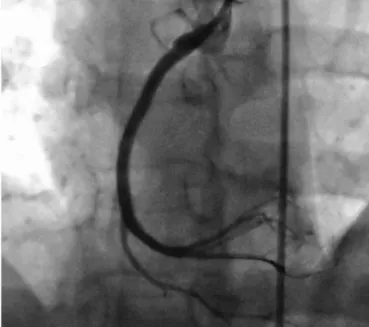
with a large thrombus burden (Fig. 2). A 0.014 inch intermediary

guidewire was passed through the occlusion into the distal vessel,

resulting in thrombolysis in myocardial infarction (TIMI)-0 flow. It

was not possible to aspirate the large clot due to a lack of aspiration

catheter at that moment. The large thrombotic burden and long

coronary irregularities were seen after the culprit lesion was first

(2)

predilated with 3.0×10 mm and 3.0×20 mm sized balloon cathe- ters. We administered 200 microgram of nitroglycerin to the pa- tient via the intracoronary route. Because of a large thrombus bur- den, a long irregularity of the right coronary artery and distal em- bolization, 3 differently sized stents were implanted, followed by intracoronary and intravenous infusion of the glycoprotein IIb/IIIa inhibitor, tirofiban, during PCI. Final angiography displayed no re- sidual lesion with TIMI-III flow (Fig. 3). Patient’s symptoms rebound- ed significantly after PCI. Then, ECG gradually showed the resolution of ST-segment elevation with Q-wave in the inferior leads (Fig. 1B).

Creatine kinase (CK)-MB fraction of CK (CK-MB) and Troponin T val- ues rose to 4461 IU/L (normal range: 22-200 IU/L), 386 U/L (normal range: <25 U/L) and 34 ng/mL (normal range: <0.04 ng/mL), respec- tively. Other hematological and biochemical tests revealed the fol- lowing: Fibrinogen 2.1 g/L (normal range: 2.0-4.5 g/L), homocysteine 3.5 µmol/L (normal range: <12 µmol/L), total cholesterol 185 mg/dL (normal range: 125-200 mg/dL), triglyceride 94 mg/dL (normal range: 50-150 mg/dL), antithrombin III activity 107% (normal range:

70-125%), prothrombin time 11 second (normal range: 10-14 sec- ond), and activated partial thromboplastin time 29 second (normal range: 25-36 second). Factor V Leiden and prothrombin gene muta- tion tests were performed and found to be in the normal range. The patient was discharged without any complications after 4 days.

Discussion

Marijuana, which is drived from the plant Cannabis sativa, has been used for more than thousand years and for many different me- dicinal and recreational purposes.

1)2)

Although marijuana is known to contain at least 60 separate chemical products, the main bio- logical effects of smoking marijuana result from delta-9-tetrahy- drocannabinol (THC) and other cannabinoids (CBs). The effects of CBs are chiefly mediated by the activation of CB receptors. Two main subtypes of CB receptors have been determined and cloned (CB1 and CB2). While CB2 receptors are localized primarly to cells of the immune system, CB1 reseptors are found mainly in the central ner- vous system and, to a lesser extent, in certain peripheral tissues, such as the heart, adrenal gland, adipose tissue, liver, lung, and pre- A  

B  

Fig. 1. Electrocardiogram shows sinus rhythm and ST-segment elevation in the emergency room (A), and nearly complete resolution of ST-segment elevation with Q-wave in the inferior leads after percutaneous coronary in- tervention (B).

Fig. 2. Left anterior oblique view of a large thrombotic occlusion of the proxi- mal part of the right coronary artery.

Fig. 3. Right anterior oblique cranial view of a thrombolysis in myocardial in-

farction-III flow after successfully treated with percutaneous coronary inter-

vention of the thrombotic right coronary artery.

(3)

synaptic nerve terminals.

2)

Cases of AMI, including other acute coronary syndromes, have rarely been reported as a consequence of marijuana use in the lit- erature.

3-14)

We were able to determine that only 13 cases have been published with this specific entity through an inclusive search in PubMed. These case findings are displayed in Table 1. The mean age of patients was 30 years, with 92% being male. All patients pre- sented with chest pain and MI, except for one patient case, which presented with palpitations, chest pain, near syncope, and ventric- ular tachycardia. The time from THC consumption to onset of symp- toms ranged from 1 hour to 5 days. Although the underlying mech-

anism is not exactly known, some authors have speculated that the harmful effects of cannabis on the hemodynamic system may have precipitated the occurrence of MI in these cases. The cardiovascu- lar effects of marijuana proceed primarily from a dose-dependent physiological effect on the autonomic nerve system. In acute doses, marijuana leads to a tachycardic effect of up to 160 beats per min- ute or higher, and a minor pressor-effect by increasing the sympa- thetic activity; chronic doses cause hypotension and bradycardia by increasing parasympathetic activity. A previously reported study has shown that marijuana smoking caused elevated carboxyhae- moglobin levels, resulting in reduced oxygen-carrying capacity, and Table 1. Overview of published reports defining patients with acute coronary syndromes associated with marijuana smoking

Author Age/

Sex

Time from THC consumption to symptoms

Symptoms ECG Risk factors Thrombus

localization Treatment Maclnnes

and Miller

3)

32/M 12 hours Chest pain Unknown Unknown LAD Death

Rezkalla

et al.

4)

34/M 3 hours

Palpitation, chest pain, shortness of breath, near syncope

Right bundle branch- type ventricular tachycardia

Cigarette smoking Slow flow ECV, medical

Caldicott

et al.

5)

21/M 6 hours Epigastric pain, vomiting, nausea

Inferior infarctus

pattern Slightly overweight Proximal subtotal and distal total on LAD PCI

Tatli et al.

6)

24/M 2 hours Chest pain

Right bundle branch block, anterior infarctus pattern

Cigarette smoking LAD Medical

Dwivedi

et al.

7)

23/M 3 days Chest pain

ST-T wave changes in anterior and inferior leads

Cigarette smoking, alcohol, HT, elevated Lp

No Medical

Dwivedi

et al.

7)

50/M Unknown Chest pain, sweating, vomiting

Anteroseptal and lateral

infarctus pattern Cigarette smoking Unknown Medical Cappelli

et al.

8)

30/M 1 hour Chest pain Anterior infarctus pattern

Cigarette smoking,

overweight LAD PCI

Basnet

et al.

9)

17/M 12 hours Chest pain Lateral infarctus pattern Unknown Normal Medical

Kocabay

et al.

10)

32/M 3 hours Chest pain Inferior infarctus pattern Cigarette smoking,

schizophrenic drugs Mid RCA PCI Bailly

et al.

11)

36/F 5 days Chest pain Anterior infarctus pattern No LAD PCI

Karabulut and Cakmak

12)

35/M 2 hours Chest pain Inferior infarctus pattern Cigarette smoking Slow flow on RCA Medical

Canga

et al.

13)

28/M 2 hours Chest pain Anteroseptal infarctus

pattern Cigarette smoking Proximal LAD PCI

Schmid

and Auer

14)

31/M Unknown Chest pain

Poor R progression, nonspecific repolarization abnomality

Cigarette smoking, iron deficiency, family history

Dissection on LAD Medical

M: male, F: female, ECV: electrical cardioversion, LAD: left anterior descending artery, RCA: right coronary artery, PCI: percutaneous coronary intervention,

HT: hypertension, Lp: lipoprotein, ECG: electrocardiogram, THC: tetrahydrocannabinol

(4)

a reduced exercise time of 48%, until angina is developed, whereas placebo reduced exercise time by 8.6%.

15)

A study by Mittleman et al.

16)

has also provided important evidence indicating that marijuana is a trigger of MI. In this study, it was reported that the risk of MI onset was elevated nearly 5 times over baseline in the hour after marijuana use, and the increased risk progressively decreased there- after. Thus, the striking effects of marijuana may lead to deteriora- tion of the balance between myocardial oxygen demand and sup- ply, which easily prepares for an environment suitable for myocardial tissue ischemia.

The effects of marijuana on coronary circulation in humans have not been well studied. Marijuana has various effects, such as vaso- constriction or vasodilation on different vascular beds and, may also cause coronary vasospasm or slow coronary flow (SCF) by its sym- pathetic or minimal pressor effects, especially in patients with ath- erosclerotic lesions present.

2)4)9)12)15-17)

Karabulut and Cakmak

12)

re- ported a case of inferior MI in a patient who had consumed marijuana regularly over a long period and whose coronary angiography dem- onstrated SCF. The authors concluded that marijuana consumption could be a major precipitating factor for SCF and MI. An additional study by Mukamal et al.

17)

suggested that marijuana may carry par- ticular risk for susceptible persons with known cardiovascular dis- ease. On the other hand, the culprit lesion in the vast majority of MIs usually develops at the site of a disrupted non-stenotic atheroscle- rotic plaque. Some authors have proposed a mechanism by which marijuana induced-spasm eventuates in endothelial denudation at the site of a stenotic or non-stenotic vulnerable atherosclerotic pla- que in response to hemodynamic stressors. Hence, vasoactive and hemostatic factors released by platelets at this point may give rise to occlusive thrombus formation, culminating in AMI.

3)16)17)

A report by Maclnnes and Miller

3)

described a case of 32-year-old man with a ruptured coronary plaque leading to thrombus after marijuana use.

In parallel with this logic, coronary vasospasm and endothelial da- mage at the position of sensitive plaque may be of great import- ance in the pathophysiology of AMI induced by marijuana abuse.

Another plausible explanation is that marijuana may have a di- rect effect on platelets or on the coagulation system. There is con- flicting information on this topic. While some studies have demon- strated an inhibiting effect of large THC concentrations on agonist- induced platelet aggregation, others have reported elevated aggreg- ation of platelets in the presence of THC.

2)

With regard to the effects of marijuana on the coagulation system, it has been reported that marijuana induced a minimal increase in factor VII activity, despite no clinically important changes in the coagulation system.

2)

Based on the availability of limited data, it is not clear as to whether mari- juana alone induces direct thrombosis formation.

A subject of debate is whether marijuana-induced atrial fibrilla-

tion (AF) may result in coronary artery embolism, thus, leading to AMI. The majority of the aforementioned mechanisms are also ac- ceptable in the underlying mechanisms of marijuana-induced AF. In recent years, it has been reported that few cases demonstrate an association between marijuna use and the development of AF.

18)

Such an association may play a crucial role in the clinical setting of patients with AMI caused by marijuana, even in short self-termi- nating episode of AF, in which AF may give rise to thromboembolic events, leading to coronary emboli. A formerly published case has demonstrated that AMI caused by coronary thromboembolism has taken place in patients with AF, even in the absence of the coronary artery disease or other risk factors.

19)

For this reason, it is reasonable to think that one of the most probable causes of AMI in a young in- dividual, in particular related to large thrombosis, as in our case, may be due to marijuana-induced AF.

In conlusion, our report deals with the importance of awareness of the marijuana that may give rise to AMI, through the mechanisms discussed above, in apparently healthy young persons who occa- sionally or habitually use this drug.

References

1. Aktas¸ EÖ, Koçak A, S¸enol E, et al. Evaluation of narcotic and stimulant drugs and abusers captured in Aegean region. Turkiye Klinikleri J Foren Med 2006;3:13-24.

2. Mach F, Montecucco F, Steffens S. Cannabinoid receptors in acute and chronic complications of atherosclerosis. Br J Pharmacol 2008;153:

290-8.

3. MacInnes DC, Miller KM. Fatal coronary artery thrombosis associated with cannabis smoking. J R Coll Gen Pract 1984;34:575-6.

4. Rezkalla SH, Sharma P, Kloner RA. Coronary no-flow and ventricular tachycardia associated with habitual marijuana use. Ann Emerg Med 2003;42:365-9.

5. Caldicott DG, Holmes J, Roberts-Thomson KC, Mahar L. Keep off the grass: marijuana use and acute cardiovascular events. Eur J Emerg Med 2005;12:236-44.

6. Tatli E, Yilmaztepe M, Altun G, Altun A. Cannabis-induced coronary ar- tery thrombosis and acute anterior myocardial infarction in a young man. Int J Cardiol 2007;120:420-2.

7. Dwivedi S, Kumar V, Aggarwal A. Cannabis smoking and acute coro- nary syndrome: two illustrative cases. Int J Cardiol 2008;128:e54-7.

8. Cappelli F, Lazzeri C, Gensini GF, Valente S. Cannabis: a trigger for acute myocardial infarction? a case report. J Cardiovasc Med (Hagerstown) 2008;9:725-8.

9. Basnet S, Mander G, Nicolas R. Coronary vasospasm in an adolescent resulting from marijuana use. Pediatr Cardiol 2009;30:543-5.

10. Kocabay G, Yildiz M, Duran NE, Ozkan M. Acute inferior myocardial in- farction due to cannabis smoking in a young man. J Cardiovasc Med (Hagerstown) 2009;10:669-70.

11. Bailly C, Merceron O, Hammoudi N, Dorent R, Michel PL. Cannabis in-

duced acute coronary syndrome in a young female. Int J Cardiol 2010;

(5)

143:e4-6.

12. Karabulut A, Cakmak M. ST segment elevation myocardial infarction due to slow coronary flow occurring after cannabis consumption.

Kardiol Pol 2010;68:1266-8.

13. Canga Y, Osmonov D, Karatas¸ MB, Durmus¸ G, Ilhan E, Kırbas¸ V. Canna- bis: a rare trigger of premature myocardial infarction. Anadolu Kardiyol Derg 2011;11:272-4.

14. Schmid J, Auer J. Spontaneous coronary artery dissection in a young man - case report. J Cardiothorac Surg 2011;6:22.

15. Aronow WS, Cassidy J. Effect of marihuana and placebo-marihuana smoking on angina pectoris. N Engl J Med 1974;291:65-7.

16. Mittleman MA, Lewis RA, Maclure M, Sherwood JB, Muller JE. Trigger- ing myocardial infarction by marijuana. Circulation 2001;103:2805-9.

17. Mukamal KJ, Maclure M, Muller JE, Mittleman MA. An exploratory pro- spective study of marijuana use and mortality following acute myo- cardial infarction. Am Heart J 2008;155:465-70.

18. Kosior DA, Filipiak KJ, Stolarz P, Opolski G. Paroxysmal atrial fibrillation following marijuana intoxication: a two-case report of possible asso- ciation. Int J Cardiol 2001;78:183-4.

19. Camaro C, Aengevaeren WR. Acute myocardial infarction due to coro-

nary artery embolism in a patient with atrial fibrillation. Neth Heart J

2009;17:297-9.

수치

Fig. 2. Left anterior oblique view of a large thrombotic occlusion of the proxi- proxi-mal part of the right coronary artery.

참조

관련 문서

ƒ Casting is a manufacturing process by which a molten material such as metal or plastic is introduced into a mold made of sand or metal, allowed to solidify within the mold,

Therefore, cTnT is a recommended biomarker for use in the detection of myocardial infarction (MI) and in acute coronary syndromes.[8] Indeed, several authors

 When a symmetry operation has a locus, that is a point, or a line, or a plane that is left unchanged by the operation, this locus is referred to as the symmetry

* When a symmetry operation has a locus, that is a point, or a line, or a plane that is left unchanged by the operation, this locus is referred to as the symmetry element..

• For dry or semi-dry concrete exposed to water, capillary suction pressure has the same effect on flow as a pressure head of 2.4 MPa in saturated concrete.. •

 Casting is a manufacturing process by which a molten material such as metal or plastic is introduced into a mold made of sand or metal, allowed to solidify within the mold,

State or other Participating States, are increasing in such a manner as to cause, or threaten to cause, serious injury to domestic industry that produces like or

In optics and lens design, the Abbe number, also known as the V-number or constringence of a transparent material, is a measure of the material's dispersion (variation