• 검색 결과가 없습니다.

Effects of Ultra-Marathon Running on Pro-inflammatory, Anti-inflammatory and Endothelial Function Factors in Athletes with Exercise-induced Hypertension

N/A
N/A
Protected

Academic year: 2021

Share "Effects of Ultra-Marathon Running on Pro-inflammatory, Anti-inflammatory and Endothelial Function Factors in Athletes with Exercise-induced Hypertension"

Copied!
7
0
0

로드 중.... (전체 텍스트 보기)

전체 글

(1)

https://doi.org/10.5763/kjsm.2016.34.2.169 pISSN 1226-3729 eISSN 2288-6028

Received: October 4, 2016 Revised: November 2, 2016 Accepted: November 9, 2016 Correspondence: Young-Joo Kim

Department of Rehabilitation Medicine, Inje University Sanggye Paik Hospital, 1342 Dongil-ro, Nowon-gu, Seoul 01757, Korea Tel: +82-2-950-1383, Fax: +82-2-938-4109

E-mail: [email protected]

This study was supported by the sports promotion fund from Korea Institute of Sport Science, Seoul Olympic Sports Promotion Foundation (KISS-15-A04004).

Copyright ©2016 The Korean Society of Sports Medicine

CC

This is an Open Access article distributed under the terms of the Creative Commons Attribution Non-Commercial License (http://creativecommons.org/

licenses/by-nc/4.0) which permits unrestricted non-commercial use, distribution, and reproduction in any medium, provided the original work is properly cited.

운동유발성 고혈압 주자의 울트라 마라톤 달리기가 전구염증과 항염증 사이토카인 및 혈관내피세포

기능인자에 미치는 영향

순천향대학교 스포츠의학과

1

, 인제대학교 상계백병원 재활의학과

2

김철현

1

ㆍ강덕호

1

ㆍ김영주

2

Effects of Ultra-Marathon Running on Pro-inflammatory, Anti-inflammatory and Endothelial Function Factors in Athletes with Exercise-induced Hypertension

Chul-Hyun Kim 1 , Duk-Ho Kang 1 , Young-Joo Kim 2

1

Department of Sports Medicine, Soonchunhyang University, Asan,

2

Department of Rehabilitation Medicine, Inje University Sanggye Paik Hospital, Seoul, Korea

Running for a long distance in runners with exercise-induced hypertension (EIH) increases high blood pressure (BP) which causes myocardial burden, inducing elevation of cardiac markers. It is assumed to be associated with end- othelial dysfunction, but has not been studied so far. The purpose of this study is to exam the responses of anti-inflammatory, inflammatory, and endothelial regulation factors to 100 km ultra-marathon of athletes who have EIH. For this study, we obtain and analysis interleukin-6, tumor necrosis factor-α, interleukin-10 (IL-10), monocyte chemoattractant protein-1, creatine kinase and nitric oxide (NO) from 100 km ultra-marathoners before and right after the 100 km race. There were 40 volunteers who had ever won the 100 km marathon race before more than one time. They had the graded exercise test with measurement of BP for assessing EIH. Among them, eight athletes were categorized to normal control group (NCG) and 10 athletes were assessed by EIH group (EIHG). The graded exercise test with treadmill was performed for the maximal strenuous exercise and BP. EIH was diagnosed as

<140/90 mm Hg in normal and ≥210 mm Hg in maximal exercise. Marathoners including EIHG (n=10) and NCG

(n=8) participated in the race and blood extracted from them before the race and right after the race. As results,

EIHG had lower IL-10 than NCG during resting states and after the 100 km race EIHG had significantly lower NO

concentration than NCG. Therefore, the NO in the endothelial is inhibited during strenuous endurance exercise,

resulting in vasoconstriction with increasing the BP.

(2)

Keywords: Cardiovascular disease, Cytokines, Exercise-induced hypertension, Nitric oxide

서 론

규칙적인 운동은 심혈관 위험요인들을 개선시키고 심혈관질 환의 발병률과 사망률을 감소시킨다 1,2) . 또한 적당한 운동수행 은 항염증 기전으로 심장보호 효과를 주는 것으로 알려져 있다 3) . 반면 극심한 운동은 급성심근경색을 촉발하며 급사 및 동맥경 직도를 증가시킬 수 있다 4,5) . 마라톤이나 울트라 마라톤 같은 극심한 운동에서도 심혈관에 부정적 요인이 발생할 수 있는 상황에서 운동유발성 고혈압을 갖고 있는 주자들은 심혈관계에 더 높은 부담을 갖고 달릴 수 있다 . 운동유발성 고혈압은 안정 시에는 < 140/90 mm Hg로 정상이나 최대운동부하 검사에서 수축기 혈압이 ≥ 210 mm Hg 과도하게 상승하는 것을 말한다 6) . 운동유발성 고혈압은 향후 고혈압으로 이환될 비율이 높으며 , 뇌졸중과 심혈관 사망률의 위험예측 인자이다 7,8) .

이제까지 안정 시 고혈압에 대한 연구는 오랫동안 활발하게 연구되어 왔지만 운동 중 높은 혈압에 대한 연구는 안정 시 혈압만큼 그 중요성이 배제되어 왔다. 특히 급사율이 높은 극심 한 장거리 달리기 주자들 중 운동유발성 고혈압을 가지고 있는 경우 대한 연구들은 잘 이루어져 있지 않다 . 일반적으로 35세 이하의 젊은 선수들에게서의 급사는 비후성 심근증이 가장 높은 비율을 차지하며 35세 이상의 선수들은 70%가 관상동맥의 죽상경화에 의한 폐색이 주 원인으로 알려져 있다 9) . 죽상경화는 고혈압, 당뇨, 흡연, 산화된 저밀도 단백, 유전적 요인 같은 위험요인들이며 10) , 이 모든 과정은 염증성 반응으로 시작된다 11) . 죽상경화 내 위험요인들에 의한 염증 반응이 진행되면 경화 반 내에 활성화된 interleukin-2 (IL-2), interferon-γ, tumor necrosis factor-α (TNF-α) 등이 분비되고, 대식세포와 내피세 포에서 IL-1과 같은 사이토카인(cytokine)이 분비된다 12) . 혈관 내피세포 내의 활성화된 단핵구와 혈관 평활근 세포에서의 IL-6, IL-12, IL-18과 같은 사이토카인이 분비되며 13) 생성된 사이토카인은 다시 간에서 전신성 염증반응물질인 C-reactive protein (CRP)를 발현시킨다 14) . CRP는 죽상경화가 진행되면 혈중에 증가하게 되어 관상동맥질환의 위험을 증가시킨다 15) . 반면 염증의 정도를 완화시켜주는 항염증 사이토카인으로 IL-4, IL-10, monocyte chemoattractant protein-1 (MCP-1), soluble TNF receptors, IL-1 receptor antagonist 등이 있다 16) . 이들 사이토 카인은 심혈관외 근육과 혈액세포에서도 기원하는 것으로 알려져 있다 17) . 전구염증 사이토카인은 손상과 치료가 필요한

항염증 사이토카인은 운동유발 염증반응의 정도를 제한하는 기능을 한다 18) . 한편 혈관내피세포 기능인자로 산화질소인 nitric oxide (NO)는 강력한 혈관확장물질로 혈관의 이완 및 확장에 매우 중요한 역할을 하며 산화질소 활성이 저하될 경우 심혈관계 질환의 위험을 높이는 것으로 알려져 있다 19) . 최근 연구에 따르면 운동유발성 고혈압을 가지고 있는 마라톤 주자들은 경기 중 말초혈관의 후부하의 증가로 혈관수축 물질 의 증가와 함께 심근손상 지표와 심근스트레스 지표가 증가했 으며 20) , 울트라 마라톤에서는 운동유발성 고혈압 주자에게서 장시간 달리기가 말초동맥 혈관확장 장애로 인한 활동근의 혈류제한으로 근손상 지표인 creatine kinase (CK)와 염증 지표 인 high sensitive C reactive protein (hsCRP)이 증가한 것으로 보고했다 21) . 이러한 보고들은 운동유발성 고혈압 주자가 운동 중 높은 혈압을 보이는 것이 말초혈관확장 장애로 추측할 수 있지만 혈관확장과 관련된 중요한 NO의 발현에 대해서는 아직까지 연구된 바가 없다. 따라서 본 연구는 운동유발성 고혈압을 가지고 있는 주자의 장거리 달리기에서 염증 사이토 카인인 전구염증물질(IL-6, TNF-α)과 항염증물질(IL-10, MCP-1) 및 혈관내피세포 기능인자(NO)들을 통해 혈관의 생리 학적 반응을 연구하고자 하였다.

연구 방법

1. 연구 대상

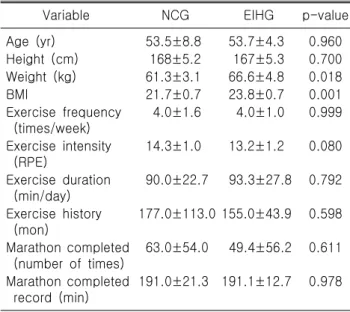
본 연구는 100 km 울트라 마라톤을 1회 이상 완주한 경험이 있는 중년 남성들을 대상자로 하였다. 총 지원자는 40명으로 대회 2개월 전부터 운동부하 검사를 시행하였다. 운동부하 검사 전 안정 시 혈압은 편안한 자세로 앉아서 5분 간격을 두고 2번 측정하여 평균을 구하였으며 안정 시 혈압이 <140/90 mm Hg이면서 최대운동부하 검사 시 수축기 혈압이 ≥210 mm Hg 상승하는 자를 운동유발성 고혈압군(exercise-induced hypertension group, EIHG) 주자로 선정하였다 7) . 지원자 40명 중 대회당일 불참 10명, 중도 포기자 12명으로 최종 완주자는 18명이었다. 이 중 통제집단은 안정 시 혈압이 <140/90 mm Hg이면서 최대운동 시 수축기 혈압이 <210 mm Hg인 정상 혈압군(normal control group, NCG) 8명이 선정되었으며 운동유 발성 고혈압은 10명으로 분류되었다. 두 집단은 모두 비슷한

(NCG vs. EIHG,

(3)

Table 1. Demographic characteristics of the subjects

Variable NCG EIHG p-value

Age (yr) 53.5±8.8 53.7±4.3 0.960 Height (cm) 168±5.2 167±5.3 0.700 Weight (kg) 61.3±3.1 66.6±4.8 0.018

BMI 21.7±0.7 23.8±0.7 0.001

Exercise frequency (times/week)

4.0±1.6 4.0±1.0 0.999

Exercise intensity (RPE)

14.3±1.0 13.2±1.2 0.080

Exercise duration (min/day)

90.0±22.7 93.3±27.8 0.792

Exercise history (mon)

177.0±113.0 155.0±43.9 0.598

Marathon completed (number of times)

63.0±54.0 49.4±56.2 0.611

Marathon completed record (min)

191.0±21.3 191.1±12.7 0.978

Values are presented as mean±standard deviation.

NCG: normal control group, EIHG: exercise-induced hyper- tension group, BMI: body mass index, RPE: rating of perceived exertion.

61.3±3.1 vs. 66.6±4.8 kg; p<0.05)과 BMI (NCG vs. EIHG, 21.7±0.7 vs. 23.8±0.7 kg/m 2 ; p<0.01)에서 EIHG가 NCG보다 유의하게 높았다 (Table 1). 채혈은 출발 2시간 전과 100 km 완주 직후에 실행하였다. 대상자 중 안정 시 혈압이 ≥140/90 mm Hg인 자, 심혈관질환자 , 신장, 간질환자 및 고혈압 약물 복용자, 12시간 (100 km 완주제한시간) 이내로 완주하지 못한 자는 연구에서 제외하였다 . 모든 대상자들의 개인정보는 설문지를 통해 얻어졌 으며 모든 연구를 실행하기 전 인제대학교 상계백병원 연구윤리 위원회에 윤리심의를 거쳐 연구를 실행하였다.

2. 운동부하 검사

운동부하 검사는 트레드밀(Medtrack ST 55; Quinton Instru- ment, Boston, MA, USA)을 이용하여 Bruce protocol에 따라 시행하였다. 호흡가스분석은 Quinton metabolic cart (Quinton Instrument)를 이용하였고, 15초 간격으로 시행하여 최대산소 섭취량(VO 2max ), 호흡교환율을 측정하였으며, 실시간 심전도 감시를 위하여 12채널 Quinton stress test system (Q4500, Quinton Instrument)을 이용하였다. 안정 시 혈압은 자동 혈압 측정기 (Me-del 412, Quinton Instrument)를 이용하여 3분 간격으로 두 번 측정하여 평균값으로 얻어진 혈압을 사용하였다. 운동 중 혈압은 각 운동 단계 2분에 측정하였으며 운동 중 혈압측정은 고성능 마이크폰을 상완 동맥에 위치시켜 헤드폰으로 수축기와

이완기음을 직접 듣고 측정하였다. 검사 중 세부적인 운동중단 요건은 American College of Cardiology/American Heart Associa- tion (AHA)의 지침에 근거하여 검사를 종료하였다 22) .

3. 혈액채혈 및 생리표적물질 분석

혈액채혈은 간호사에 의해 시행되었으며 채혈 장소는 대회 장소 오전 4–5시에 채혈 하였다. 실험대상자들은 울트라 마라 톤 출발 전 , 100 Km 완주 직후 주전정맥(antecubital vein)에서 Clinical and Laboratory Standards Institute guidelines 기준에 따라 채혈(1회 채혈양은 8 cc)하였다. 채혈된 표본은 염증과 항 염증 및 혈관조절인자에 대한 생리표적물질인 TNF-α, IL-6, IL-10, MCP-1, CK를 젤과 혈액응고 촉진제가 들어있는 진공상태의 SST 채혈관(BD vacutainer serum separator tube;

BD, Franklin Lakes, NJ, USA)에 담아 혈청분리하여 –70 o C 냉동고에 보관하였다가 측정하였다. TNF-α는 Quantikine HS human TNF-α kit (R&D, Minneapolis, MN, USA)를 이용하여 분석절차에 따라 분석액을 조제하여 microplate reader (Versa Max Corp., Sunnyvale, CA, USA)로 enzyme-linked immun- osorbent assay (ELISA) 법에 의해 정량 분석하였다. IL-6는 Quantikine HS human IL-6 immunoassay kit (R&D)를 이용하여 샘플을 조제하여 ELISA방식으로 정량하였으며, IL-10, MCP-1 은 human IL-10 Quantikine HS ELISA kit (R&D)와 Quantikine human MCP-1 kit로 시료를 준비하여 ELISA 방식으로 정량 분석하였다. CK는 Vacutainer SST Tubes (BD)를 이용하여 시료 를 조제하여 UV-assay (IFCC Granulat)법으로 분석하여 정량값 을 얻었다. 혈액 내 NO의 분석은 Griess methods의 절차로 분석하였다 23) . 채혈로 얻어진 혈액은 상온에서 30분 이상 응고 후 3,000 rpm에 10분 동안 원심분리한 후 분리된 상층액을 튜브에 옮겨 분석 때까지 혈청을 –70 o C에서 냉동 보관하였다.

얻어진 혈청은 total NO와 nitrate/nitrite assay (R&D)로 반응을 시킨 후 분광광도계(ELISA reader, 540 nm optical density; Versa Max Corp.)의 파장에서 값을 측정하였다. 혈액 분석은 녹십자 랩셀(Yongin, Korea)에 의뢰하여 분석하였으며 탈수에 의한 혈장용적변화는 적혈구용적(hematocrit)과 혈색소(hemoglobin) 로 계산했으며 적용은 혈장용적변화에 따라 계산하였다 24) .

4. 자료 분석

본 연구에서 얻어진 자료는 운동유발성 고혈압 주자와 정상

혈압 대조군을 대상으로 한 운동부하 검사 , 혈액분석, 일반적

인 사항들이었다. 이들 자료는 모두 기술통계인 평균과 표준편

차를 산출하였다. 산출된 자료는 생리표적물질별 집단과 전후

(4)

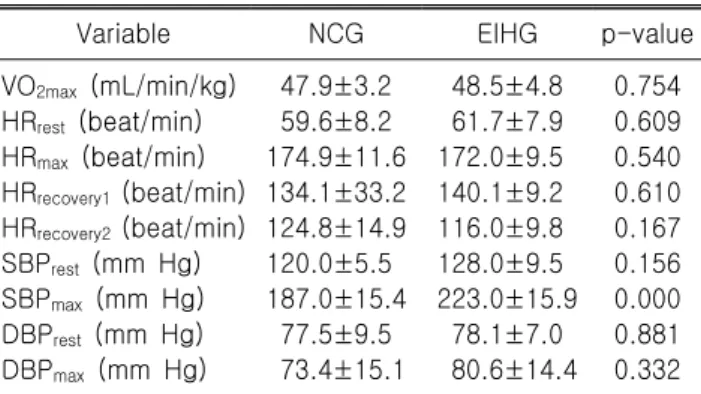
Table 2. Comparison on the graded exercise test between the groups

Variable NCG EIHG p-value

VO

2max

(mL/min/kg) 47.9±3.2 48.5±4.8 0.754 HR

rest

(beat/min) 59.6±8.2 61.7±7.9 0.609 HR

max

(beat/min) 174.9±11.6 172.0±9.5 0.540

HR

recovery1

(beat/min) 134.1±33.2 140.1±9.2 0.610

HR

recovery2

(beat/min) 124.8±14.9 116.0±9.8 0.167

SBP

rest

(mm Hg) 120.0±5.5 128.0±9.5 0.156 SBP

max

(mm Hg) 187.0±15.4 223.0±15.9 0.000 DBP

rest

(mm Hg) 77.5±9.5 78.1±7.0 0.881 DBP

max

(mm Hg) 73.4±15.1 80.6±14.4 0.332 Values are presented as mean±standard deviation.

NCG: normal control group, EIHG: exercise-induced hyper- tension group, HR: heart rate, SBP: systolic blood pressure, DBP: diastolic blood pressure.

에 대한 차이와 상호작용효과를 확인하기 위해서 반복측정 이원변량 분석(repeated-measure two-way analysis of variance) 을 실시하였다 . 상호작용효과가 있는 생리표적물질은 사후개 별 검증을 위해서는 비모수적 방법을 이용하여 운동성 고혈압 군과 정상대조군 간에 평균 차 비교를 Mann-Whitney test로 분석하였고, 운동성 고혈압군과 정상대조군의 마라톤전과 직 후의 평균 차 검증은 Wilcoxon signed-rank test로 하였다. 모든 평균차 검증은 일방검증으로 유의수준을 p<0.05로 하였으며, 통계분석은 SPSS ver. 17.0 프로그램(SPSS Inc., Chicago, IL, USA)을 사용하였다.

결 과

1. 집단 간 운동부하 검사

운동부하 검사상에서 나타난 EIHG과 NCG의 결과는 Table 2에 나타난 바와 같다. 두 집단 간 VO 2max , heart rate (HR) rest , HR recovery1 , HR recovery2 , systolic blood pressure (SBP) rest , diastolic blood pressure (DBP) max 에서는 유의한 차이가 없었지만 SBP max

에서 EIHG (223±15.9)가 NCG (187±15.4)보다 유의하게 높았 다.

2. 100 km 전후와 집단 간 염증, 항염증 및 혈관

조절인자의 변화

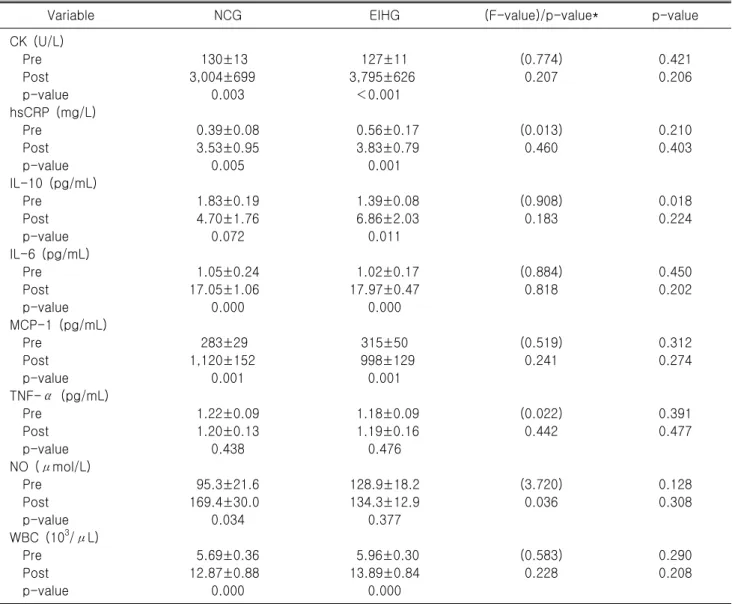
100 km 전후 집단 간 염증, 항염증 및 혈관조절인자의 변화 는 Table 3에 나타난 바와 같다. 100 km 출발 전 CK, hsCRP, IL-6, MCP-1, TNF-α, NO, 그리고 white blood cell (WBC)에서

두 집단 간 모두 유의한 차이가 없었으나 , IL-10에서 EIHG가 NCG보다 유의하게 낮은 것으로 나타났다(p<0.05). 100 km 완주 전후에서는 CK, hsCRP, IL-6, MCP-1, WBC가 두 집단 모두 각각 유의하게 증가하였고, TNF-α는 유의한 차이가 없었다. 반면, IL-10은 NCG에서 100 km 전후에 유의한 차이가 없었으나 EIHG에서만 100 km 전후의 유의한 증가를 나타내었 다. NO는 NCG가 100 km 완주 후에 유의하게 증가하였으나 EIHG는 100 km 전후에 유의한 차이가 없었다.

3. 100 km 전후 염증, 항염증 및 혈관조절인자의

집단 간 차이비교

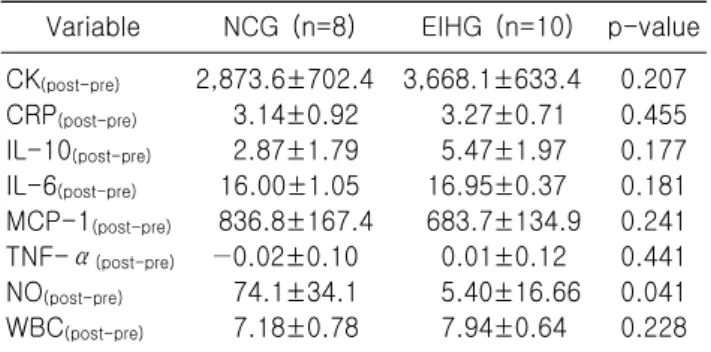
100 km 전후 염증, 항염증 및 혈관조절인자의 집단 간 차이 비교는 Table 4에 나타난 바와 같다. 항염증 인자와 염증 인자에 서 NO를 제외한 모든 항목에서 두 집단의 전후 차에 대한 값을 비교하였을 때 유의한 차이가 없었다 . 그러나 혈관조절 인자 특히 혈관의 확장을 유도하는 NO의 100 km 전후 차이 값을 비교하였을 때 EIHG가 NCG보다 유의하게 낮은 것으로 나타났다.

고 찰
본 연구는 100 km 울트라 마라톤 완주 전후 운동유발성

고혈압이 있는 주자(EIHG)와 정상운동혈압 주자(NCG)의 전

구염증과 항염증 사이토카인 및 혈관내피세포 기능인자인

NO의 변화를 관찰하기 위함이다. 장거리 달리기인 마라톤이

나 울트라 마라톤 대회 이후 근손상 지표인 CK와 염증 지표인

hsCRP의 증가는 잘 알려져 있다 21,25) . 또한 마라톤이나 울트라

마라톤 같은 극심한 장거리대회에서도 염증 전구 물질인 IL-6

와 TNF-α, MCP-1의 증가는 명확하다 26,27) . 본 연구에서도

100 km 완주 전보다 직후에 두 집단 모두 CK, hsCRP, IL-6,

TNF-α, 그리고 MCP-1 모두 유의한 증가를 나타났으나 CK,

hsCRP, IL-6, TNF-α 그리고 MCP-1는 유의한 차이가 발견되지

않았다 . Kim 등 21) 은 운동유발성 고혈압 주자들에게서 울트라

마라톤 완주 직후 CK와 hsCRP가 유의하게 증가되었는데 이는

운동유발성 고혈압 주자들에게서 말초혈관확장 기능장애로

인한 혈류장애가 근손상과 함께 염증발현을 높였을 것이라고

하였지만 본 연구에서는 차이가 나타나지 않았다 . Kim 등 21)

연구에서는 완주제한시간이 15시간이었고 여름에 시행한 연

구였으며 본 대회의 완주제한시간은 12시간으로 초겨울에

시행한 스피드 울트라 마라톤 대회였다 . 이러한 환경적 차이로

인한 원인도 있겠지만 보다 정확한 결과를 얻기 위해 더 많은

(5)

Table 3. Changes of anti-inflammatory, inflammatory, and endothelial regulation factors after 100 km ultra-marathon

Variable NCG EIHG (F-value)/p-value* p-value

CK (U/L)

Pre 130±13 127±11 (0.774) 0.421

Post 3,004±699 3,795±626 0.207 0.206

p-value 0.003 <0.001

hsCRP (mg/L)

Pre 0.39±0.08 0.56±0.17 (0.013) 0.210

Post 3.53±0.95 3.83±0.79 0.460 0.403

p-value 0.005 0.001

IL-10 (pg/mL)

Pre 1.83±0.19 1.39±0.08 (0.908) 0.018

Post 4.70±1.76 6.86±2.03 0.183 0.224

p-value 0.072 0.011

IL-6 (pg/mL)

Pre 1.05±0.24 1.02±0.17 (0.884) 0.450

Post 17.05±1.06 17.97±0.47 0.818 0.202

p-value 0.000 0.000

MCP-1 (pg/mL)

Pre 283±29 315±50 (0.519) 0.312

Post 1,120±152 998±129 0.241 0.274

p-value 0.001 0.001

TNF-α (pg/mL)

Pre 1.22±0.09 1.18±0.09 (0.022) 0.391

Post 1.20±0.13 1.19±0.16 0.442 0.477

p-value 0.438 0.476

NO (μmol/L)

Pre 95.3±21.6 128.9±18.2 (3.720) 0.128

Post 169.4±30.0 134.3±12.9 0.036 0.308

p-value 0.034 0.377

WBC (10

3

/μL)

Pre 5.69±0.36 5.96±0.30 (0.583) 0.290

Post 12.87±0.88 13.89±0.84 0.228 0.208

p-value 0.000 0.000

Values are presented as mean±standard deviation.

NCG: normal control group, EIHG: exercise-induced hypertension group, CK: creatine kinase, hsCRP: high sensitive C reactive protein, IL-10: interleukin-10, IL-6: interleukin-6, MCP-1: monocyte chemoattractant protein-1, TNF-α: tumor necrosis factor-α, NO: nitric oxide, WBC: white blood cell.

*F-value and p-value for interaction of two-way analysis of variance.

대상자와 수 차례의 회복기 시간을 두고 측정하는 것이 보다 나은 결과를 얻을 수 있을 것이다.

항염증 사이토카인으로 알려진 IL-10은 염증의 정도를 완화 시켜주는 항염증 사이토카인으로 임상에서는 동맥경화를 방 지해주는 역할을 한다 28) . 관상동맥질환자에게서 유산소 운동 은 IL-10의 농도를 높여주어 관상동맥질환자의 위험도를 개선 시킬 수 있으며 29) , 울트라 마라톤 같은 장거리 운동 후에도 IL-10가 증가된다 30) . 본 연구에서는 출발 전 안정 시에 EIHG가 유의하게 낮은 상태였지만 100 km 완주 직후 두 집단 모두 증가하여 집단 간 차이는 없었다. Mirhafez 등 31) 은 안정 시

고혈압을 갖고 있는 집단이 정상 혈압 집단에 비해 IL-10 물질의 농도가 더 낮다고 하였다. 지속적인 운동을 수행해 온 장거리 주자들 중 운동유발성 고혈압을 갖고 있는 주자에게 서 안정 시 IL-10이 정상군보다 유의하게 높아져 있다는 것은 주목할 만한 결과이다. 최근까지 EIHG에서 항염증 사이토카 인과 관련하여 보고된 연구는 없기 때문에 본 연구에서의 결과는 향후 추가연구가 필요할 것이다.

NO는 혈관확장물질로서 혈관내피세포의 L-아르기닌

(arginine)-산화질소 경로에 의해 생성되며 규칙적인 운동을

통해 NO의 발현을 높이고 내피기능을 개선시킨다 32) . 내피세

(6)

Table 4. Differences of anti-inflammatory, inflammatory, and endothelial regulation factors after 100 km ultra-marathon

Variable NCG (n=8) EIHG (n=10) p-value

CK

(post-pre)

2,873.6±702.4 3,668.1±633.4 0.207

CRP

(post-pre)

3.14±0.92 3.27±0.71 0.455

IL-10

(post-pre)

2.87±1.79 5.47±1.97 0.177

IL-6

(post-pre)

16.00±1.05 16.95±0.37 0.181

MCP-1

(post-pre)

836.8±167.4 683.7±134.9 0.241 TNF-α

(post-pre)

−0.02±0.10 0.01±0.12 0.441

NO

(post-pre)

74.1±34.1 5.40±16.66 0.041

WBC

(post-pre)

7.18±0.78 7.94±0.64 0.228

Values are presented as mean±standard deviation.

NCG: normal control group, EIHG: exercise-induced hyper- tension group, CK: creatine kinase, CRP: C reactive protein, IL-10: interleukin-10, IL-6: interleukin-6, MCP-1: mono- cyte chemoattractant protein-1, TNF-α: tumor necrosis factor-α, NO: nitric oxide, WBC: white blood cell.

포 기능장애로 NO의 능력이 감소하면 염증반응에 대한 균형 이 깨지며 고혈압 발생의 중요한 요인이 된다 33) . 운동 중 정상 혈압이 유지되는 것은 심박출량이 증가되면서 적절한 말초혈 관확장으로 더 이상 혈압이 증가하지 않지만 운동유발성 고혈 압은 운동 중 심박출량의 증가에 따라 말초혈관의 혈관확장 장애로 후부하를 증가시켜 높은 혈압을 발생하게 된다 34) . 말초 혈관 확장장애는 내피기능부전이 중요한 원인이며 NO의 낮은 발생과 관련 있다 35) . 본 연구에서는 EIHG의 NO가 NCG보다 완주 직후 유의하게 낮은 농도를 보인 것으로 나타났다 . 이러 한 결과는 EIHG에서 경기 중 내피기능부전에 의한 혈관확장 장애를 예상할 수 있으며 운동 중 지속적인 혈압상승을 반영할 수 있을 것이다 . 실제로 Park 등 36) 은 운동부하 검사 중 과도한 수축기 혈압상승을 보이는 환자에서 내피세포의존적 혈관 확장이 감소되어 있었으며 운동 중 NO의 증가에 따른 cyclic-gua-nosine monophosphate (GMP)의 증가가 감소되어 운동 중 과도한 혈압상승이 내피세포의 기능장애와 NO/cyclic-GMP 경로의 이상과 관련 있음을 시사한다고 하였다 . 즉, 운동 중에 는 심박출량 증가에 의해 내피에 대한 전단응력이 증가하고, 이에 따라 내피에서 NO 분비가 증가되어 cyclic-GMP 증가를 유발함으로써 평활근 이완을 통해 혈관 확장이 일어나게 되는 데, EIHG에서 운동 중 NO 분비가 증가하지 않는다는 것은 내피세포 기능장애로 인해 이러한 일련의 과정이 정상적으로 일어나지 않는다는 것을 의미한다 . 본 연구는 100 km를 12시간 이내로 완주해야 하는 높은 운동강도에서 수행된 연구이며 운동유발성 고혈압 주자에게서 안정 시 낮은 항염증 농도 (IL-10)와 완주 직후 낮은 NO 농도가 나타나 이들에 대한 건강한 혈관관리를 위해 지속적인 연구가 필요할 것이다.

Conflict of Interest

No potential conflict of interest relevant to this article was reported.

References

1. Scherr J, Braun S, Schuster T, et al. 72-h kinetics of high-sensitive troponin T and inflammatory markers after marathon. Med Sci Sports Exerc 2011;43:1819-27.

2. Gremeaux V, Gayda M, Lepers R, Sosner P, Juneau M, Nigam A. Exercise and longevity. Maturitas 2012;73:312-7.

3. Petersen AM, Pedersen BK. The anti-inflammatory effect of exercise. J Appl Physiol (1985) 2005;98:1154-62.

4. Siegel AJ. Pheidippides redux: reducing risk for acute cardiac events during marathon running. Am J Med 2012;125:630-5.

5. Vlachopoulos C, Kardara D, Anastasakis A, et al. Arterial stiffness and wave reflections in marathon runners. Am J Hypertens 2010;23:974-9.

6. Lauer MS, Levy D, Anderson KM, Plehn JF. Is there a relationship between exercise systolic blood pressure response and left ventricular mass? The Framingham heart study. Ann Intern Med 1992;116:203-10.

7. Singh JP, Larson MG, Manolio TA, et al. Blood pressure response during treadmill testing as a risk factor for new- onset hypertension: the Framingham heart study. Circulation 1999;99:1831-6.

8. Kurl S, Laukkanen JA, Rauramaa R, Lakka TA, Sivenius J, Salonen JT. Systolic blood pressure response to exercise stress test and risk of stroke. Stroke 2001;32:2036-41.

9. Maron BJ. Sudden death in young athletes. N Engl J Med 2003;349:1064-75.

10. Ross R, Janssen I. Physical activity, total and regional obesity: dose-response considerations. Med Sci Sports Exerc 2001;33(6 Suppl):S521-7.

11. Libby P, Ridker PM, Maseri A. Inflammation and athero- sclerosis. Circulation 2002;105:1135-43.

12. Hasdai D, Scheinowitz M, Leibovitz E, Sclarovsky S, Eldar M, Barak V. Increased serum concentrations of interleukin-1 beta in patients with coronary artery disease. Heart 1996;76:

24-8.

13. Packard RR, Libby P. Inflammation in atherosclerosis: from vascular biology to biomarker discovery and risk prediction.

Clin Chem 2008;54:24-38.

14. Biasucci LM, Vitelli A, Liuzzo G, et al. Elevated levels of

interleukin-6 in unstable angina. Circulation 1996;94:874-7.

(7)

15. Ridker PM. High-sensitivity C-reactive protein: potential adjunct for global risk assessment in the primary prevention of cardiovascular disease. Circulation 2001;103:1813-8.

16. Tedgui A, Mallat Z. Anti-inflammatory mechanisms in the vascular wall. Circ Res 2001;88:877-87.

17. Nieman DC. Immune response to heavy exertion. J Appl Physiol (1985) 1997;82:1385-94.

18. Ostrowski K, Rohde T, Asp S, Schjerling P, Pedersen BK.

Pro- and anti-inflammatory cytokine balance in strenuous exercise in humans. J Physiol 1999;515:287-91.

19. Rubinshtein R, Kuvin JT, Soffler M, et al. Assessment of endothelial function by non-invasive peripheral arterial tonometry predicts late cardiovascular adverse events. Eur Heart J 2010;31:1142-8.

20. Kim YJ, Shin YO, Lee YH, et al. Effects of marathon running on cardiac markers and endothelin-1 in EIH athletes.

Int J Sports Med 2013;34:777-82.

21. Kim YJ, Kim CH, Shin KA, et al. Cardiac markers of EIH athletes in ultramarathon. Int J Sports Med 2012;33:171-6.

22. Gibbons RJ, Balady GJ, Beasley JW, et al. ACC/AHA guidelines for exercise testing: executive summary. A report of the American College of Cardiology/American Heart Association task force on practice guidelines (Committee on Exercise Testing). Circulation 1997;96:345-54.

23. Ding AH, Nathan CF, Stuehr DJ. Release of reactive nitrogen intermediates and reactive oxygen intermediates from mouse peritoneal macrophages: comparison of activating cytokines and evidence for independent production. J Immunol 1988;

141:2407-12.

24. Dill DB, Costill DL. Calculation of percentage changes in volumes of blood, plasma, and red cells in dehydration. J Appl Physiol 1974;37:247-8.

25. Nieman DC, Henson DA, Smith LL, et al. Cytokine changes after a marathon race. J Appl Physiol (1985) 2001;91:109-14.

26. Kim HJ, Lee YH, Kim CK. Biomarkers of muscle and cartilage damage and inflammation during a 200 km run. Eur

J Appl Physiol 2007;99:443-7.

27. Shanely RA, Nieman DC, Zwetsloot KA, et al. Evaluation of Rhodiola rosea supplementation on skeletal muscle damage and inflammation in runners following a competitive marathon.

Brain Behav Immun 2014;39:204-10.

28. Pinderski Oslund LJ, Hedrick CC, Olvera T, et al.

Interleukin-10 blocks atherosclerotic events in vitro and in vivo. Arterioscler Thromb Vasc Biol 1999;19:2847-53.

29. Goldhammer E, Tanchilevitch A, Maor I, Beniamini Y, Rosenschein U, Sagiv M. Exercise training modulates cytokines activity in coronary heart disease patients. Int J Cardiol 2005;100:93-9.

30. Shin YO, Lee JB. Leukocyte chemotactic cytokine and leukocyte subset responses during ultra-marathon running.

Cytokine 2013;61:364-9.

31. Mirhafez SR, Mohebati M, Feiz Disfani M, et al. An imbalance in serum concentrations of inflammatory and anti- inflammatory cytokines in hypertension. J Am Soc Hypertens 2014;8:614-23.

32. Maeda S, Tanabe T, Otsuki T, et al. Moderate regular exercise increases basal production of nitric oxide in elderly women. Hypertens Res 2004;27:947-53.

33. Boos CJ, Lip GY. Is hypertension an inflammatory process?

Curr Pharm Des 2006;12:1623-35.

34. Wilson MF, Sung BH, Pincomb GA, Lovallo WR. Exagge- rated pressure response to exercise in men at risk for systemic hypertension. Am J Cardiol 1990;66:731-6.

35. Jungersten L, Ambring A, Wall B, Wennmalm A. Both physical fitness and acute exercise regulate nitric oxide formation in healthy humans. J Appl Physiol (1985) 1997;

82:760-4.

36. Park IW, Chang HJ, Chung J, et al. Alteration of nitric

oxide/cyclic-GMP pathway in patients with exaggerated

systolic blood pressure response during exercise test. Korean

J Med 2003;65:90-98.

수치

Table  1.  Demographic  characteristics  of  the  subjects
Table 2. Comparison on the graded exercise test between  the  groups
Table  3.  Changes  of  anti-inflammatory,  inflammatory,  and  endothelial  regulation  factors  after  100  km  ultra-marathon
Table 4. Differences of anti-inflammatory, inflammatory, and  endothelial  regulation  factors  after  100  km  ultra-marathon

참조

관련 문서

interaction with anti-apoptotic Bcl-2 family members, we investigated whether Mcl-1 can inhibit the Noxa-induced cell death.. As expected, Mcl-1 significantly inhibits

Wrestler anaerobic exercise on body composition and function by analyzing the impact of physical man wrestler necessary for the efficient exercise

Factors associated with hypertension control in Korean adults: The fifth Korea National Health and Nutrition Examination Survey (KNHANES V-2).. Association of stress

Conclusions: Thus, 25-HC induced odontoclast differentiation through the odontoclastogenesis factor-mediated activation of NF-κB and upregulated inflammatory

In this study, platelet-derived growth factors-BB (PDGF-BB), vascular endothelial growth factor (VEGF), and insulin-like growth factor-1 (IGF-1) were quantified in the PRF

Pro-allergic cytokines were important mediators of allergic inflammation, cell recruitment and allergenic response decided to further investigate the

This study researched the possibility of using natural products for hair growth agents and hair loss prevention materials based on the test for the antioxidant and

부산항 그린 모니터링 시스템 부산항 관광정보 시스템 부산항 e-Marketplace 시스템 부산항 배후물류부지 지원시스템.