Vol. 19, No. 2, pp. 33-39, April 2015
Distance Measurement by Automatic Peak Detection for Indoor Positioning Using Spread Spectrum Ultrasonic
Waves
Akimasa Suzuki*†, Yasuaki Miyara**, Taketoshi Iyota**, Young-Bok Kim***, and Yong-Woon Choi**
(Received 29 December 2014, Revision received 25 March 2015 , Accepted 26 March 2015)
Abstract: In conducting indoor positioning by code division multiple access using spread spectrum ultrasonic waves, it is required to detect signals under the influence of near-far problem occurred by difference on signal power, caused by distance between transmitter and receiver. For discussing robustness to the problem, we verified measuring accuracy on distance from an experiment on a real space with a hardware device where our proposed method is mounted. The proposed method performs automatic signal detection by setting threshold level dynamically. As an experimental result, measurable distance were improved by the proposed method, and measurement errors were up to 50mm in distances from 1000mm to 6000mm; therefore, enough accuracy to realize self-localization or navigation for autonomous mobile robot or human was obtained.
Key Words:indoor positioning, spread spectrum ultrasonic waves, signal detection, near-far problem, and CDMA.
*†Akimasa Suzuki : Department of Software and Information Science, Iwate Prefectural University, Japan
**Yasuyuki Miyara, Taketoshi Iyota and Yongwoon Choi:
Department of Engineering, Soka University, Japan
***Young-Bok Kim: Pukyong National University, Korea
1. Introduction
The fields of application of position information have expanded in tandem with the advancements in our information- driven society. Indoor position information is important to people and robots for navigating along a route. Furthermore, the position information is required to realize the self-localization of the robots. In these cases, the moving targets have to be measured with high accuracy at less than 10 cm by using a battery-powered device.
A positioning system which obtains coordinates for achieving self-localization of robots must also be able to easily inter- face with a virtual reality simulation, such as SIGVerseTM1), although the infrastructure required for providing this position information. The indoor coordinates are also expected when cooperative work is conducted using multiple robots.
Therefore, we have investigated an indoor positioning system using spread-spectrum (SS) ultrasonic signals to satisfy these needs, (i.e., real-time indoor positioning with high accuracy coordinates for robots). Here, we aim to develop automatic peak detection for the simulcasting of multiple SS ultrasonic signals with Code Division Multiple Access (CDMA). Power of signals are
decreased by the simulcasting transmission, thus, a method to accurately detecting the signals are required.
In this paper, we perform an experiment on distance measurement to find the measurable range and measurement error of our proposed method. We measure distances of 1000 to 6000 mm between a transmitter and a receiver, at 1000 mm intervals, and the results indicate that a maximum measurement error were up to 50mm, which is less than the error of conventional detection method.
2. Relevant Studies and Previous Works
Various sensor systems have been investigated for indoor positioning purposes, including pseudolites2) or radio wave sensor3). Of these, ultrasonic-wave-based systems have been found to have lower cost and greater accuracy. However, these systems generally have weak noise resistance and are slow to acquire data as they use the time-division multiplexing method with on-off keying, which grows increasingly cumbersome as the number of objects to be measured grows. Thus, systems using SS ultrasonic signals have been investigated4,5) to overcome these drawbacks.
Analogous to SS radio wave systems (e.g., GPS), we have proposed a real-time 3-D positioning system using SS ultrasonic signals with a band-limited transducer, low-power field programmable gate array (FPGA), and a small microprocessor6,7). Furthermore, we have discussed factors such as positioning errors in indoor environments8), and signal degradation with band-limited transducers9). These studies showed the measurement accuracy of the positioning system using SS ultrasonic signals. We have also proposed a calculation algorithm based on the Newton-Raphson method for continuous signals,
rather than conventional pulse signals. As a result, 3-D coordinates can be obtained every 80 ms using CDMA with continuous signals10).
Signal acquisition is a method for obtaining the absolute coordinate of an unmoving target, while signal tracking is a method for obtaining the relative movement of a moving target. In a positioning system that uses SS radio waves, coordinates are measured through a signal acquisition and tracking process. Meanwhile, in a system using SS ultrasonic signals, position is measured via signal acquisition for unmoving targets and signal tracking for moving targets; the latter of which has been investigated using a limited correlation range11). Signal acquisition requires automatic peak detection for a signal detecting method, however, we have not investigated.
Thus, we need to further investigate the measurable range and effectiveness of this detecting method for simulcasting with CDMA. Unfortunately, there have been few studies on the measurable distance and measurement accuracy by automatic peak detection using simulcasting SS ultrasonic signals.
3. Indoor Positioning Method Using SS Ultrasonic Signals
3.1 Positioning Environment for Indoor Positioning System Using SS ultrasonic signals
An indoor positioning system using SS ultrasonic signals for real-time measurement of the 3-D position of an unmoving target (e.g., unmoving people and robots) has been developed using a signal acquisition method 8). Fig. 1 shows the positioning environment for this system. Four transmitters are installed in a room, and the position of a receiver mounted on a target is measured.
Position at the receiver is obtained by time of flight
(TOF) of SS ultrasonic signal by using our method, shown in previous studies 6, 7, 8, 9, 10).
Tx1
Tx2
Tx3 Tx4
Robot
Receiver (Rx)
Transmitter
Fig. 1 A positioning environment for the self-localization of robots
Generally, a system employing ultrasonic waves is ineffective in near-far problems, because of signal attenuation by the air. However, it is robust around obstacles owing to the diffraction of ultrasonic waves, and even small and slow processors can be utilized with ultrasonic speeds. The positioning system using SS ultrasonic signals possesses these same properties, so we must consider the near-far problem when signals are transmitted by CDMA.
3.2 Automatic Peak Detection
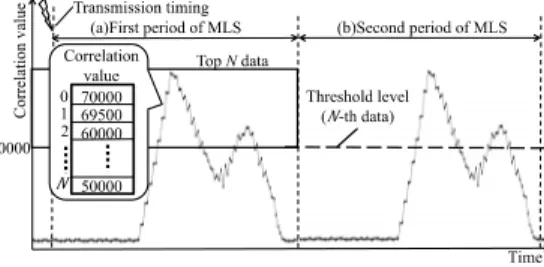
In the phase on the signal acquisition10), we require peak detection. For separating signals and noise, we need to decide a threshold level. It is difficult to set an appropriate threshold level by the peak detection using a static threshold level
Fig. 2 Method for determining threshold level
because signals power, i.e., a peak of correlation value, is dynamically attenuated by near-far problem with CDMA. The signal attenuation also occurs by distances between transmitter and receiver. Thus, we have been proposed a new method for automatic peak detection by setting threshold level dynamically.
In the signal acquisition phase of our proposed method, we utilized two periods of MLS. Fig. 4 indicates the method for our automatic peak detection from correlation values obtained by received signal10). Threshold level is set based on the first period of MLS. As the first procedure, top
( = 0, 1, 2 …..) data for correlation values are memorized and sorted in descending order, as shown in the top table on Fig. 4. During first period of MLS from a timing of starting transmission, shown in Fig. 4 (a), this procedure is repeatedly performed. After this procedure, -th correlation value in Fig. 4 is decided as a threshold level. In this case shown in Fig. 4, 50000 for the correlation value is decided as the threshold level because of -th correlation value in the memory.
After the deciding the threshold, we detect a peak and measure TOF in the next period of MLS, shown in Fig. 4 (b). The period of the MLS is constant and known if receiver is unmoved;
therefore, TOF can be calculated from the not only the first period of MLS, but also next period.
Fig. 3 Movement of the correlation values and our calculation method for TOF at the next period of MLS
Fig. 5 shows a movement of the correlation values and our calculation method for TOF at the next period of MLS, shown in Fig. 4 (b). The first correlation value beyond the threshold level will be detected in the next period, as shown in Fig. 5. The time when this correlation value is obtained is defined as that means central time of a data population in Fig. 5. The data population is defined as a group including multiple correlation values around in Fig. 5. All data in the data population are memorized in a resister in a hardware device. In addition, and are also defined as the least and the largest time in a data population for correlation values, respectively.
The time between and is as same as the time between and . A slope is calculated from the data population using the least squares method. A relative values of time from
defined as (= 1, 2, 3 …..) is given by
(1)
is defined as a number of the data for correlation values. is sequentially accorded from the least time in data population for correlation values.
is equal to the least time . The slope is given by
(2)
where, is correlation values of . If the number
of the data for correlation values is fixed, the total sum of and become constant value and 0, respectively. Thus, slope is given easily by
(3) where, is defined as a constant value. The slopes are calculated repeatedly by using the data population, which is shifted forward by one sample,
when a received sample is obtained. When changed from plus to minus, becomes the time of peak detection. TOF is obtained based on
and the timing of transmission.
4. Distance Measurement by Four Transmitters Using the
Automatic Signal Detection
4.1 Experimental Parameters
The precision of measurement may be degraded in automatic signal detection, as compared to manual detection, because ultrasonic signals, i.e., the peaks of the correlation values, may be not detected accurately. We therefore conducted an experiment to investigate the precision of the measurement using four channels simultaneously for signal tracking, as shown in Fig. 7.
Four transmitters, Tx1, Tx2, Tx3, and Tx4, are installed along an arc line at intervals of 80 mm.
The transmitters and the transmission unit are connected using a 3.5-mm mini-plugged phone connector cable, and the transmission volume is adjusted to 10.5 Vp-p. A receiver, is mounted at the center of the arc where the transmitters are installed in order to equalize the distance between the transmitters and the receiver. The transmission timing is sent via cable to evaluate the effect of the errors induced by the CDMA. We measure distances of 1000 to 6000 mm at 1000 mm intervals using a receiver. In this experiment, continuous signals with four channels are utilized. These four channels are generated by tap positions of {4,9}, {3,4,6,9}, {4,5,8,9}, and {2,3,5,9} in a shift-register, respectively,
Distance between transmitter and receiver mounted on a staying target are measured by using signal acquisition with CDMA. The experiment was conducted 10 times at the each distance and the results were evaluated using the Root Mean Squared
(RMS) of difference between the results and the installed distances. rms is defined as
Fig. 4 Experimental outline of a measurement distance by CDMA
(4)
where and are the measured distance and the true distance between a receiver and i-th transmitter, respectively. The average value of the RMS measuring error is discussed in the following section.
4.2 Experimental Results for Distance Measurement by Signal Tracking with CDMA
Fig. 8 shows the measurement error when four channels of the CDMA are used. The vertical and horizontal axes correspond to the measurement error and measurement distance between the transmitter and receiver, respectively. The bars show the measurement error for the experiment using simulcast signals with four channels.
Fig. 8 indicates that measurement accuracy using automatic peak detection were up to 50 mm.
Generally, the measurement precision decreases when multiple channels are used, as compared to using only one channel, because of the near-far problem and cross-correlation of the CDMA10. From this experimental result, we confirmed that distance measurement of unmoving objects using automatic peak detection could be accurately performed.
Fig. 8 also shows that we could measure the distance even though the distances from transmitter to a receiver are 6000 mm. The more measurement
0 10 20 30 40 50
1000 2000 3000 4000 5000 6000 Measuring error [mm]
Measuring distance [mm]
Tx1 Tx2 Tx3 Tx4
Fig. 5 Measurement error on distance by the automatic peak detection using four transmitters
distance was increased, the more power of reception signals was decreased. In addition, different channels of signals contributed to the noise. Therefore, it was difficult to set an appropriate threshold level to separate peak of correlation values and noise by conventional method. By our proposed method, appropriate threshold level is determined automatically and dynamically; therefore, the measurable distance with simulcasting transmission become enough to realize self-localization or navigation for autonomous mobile robot or human.
5. Distance Measurement under Near-far Problem
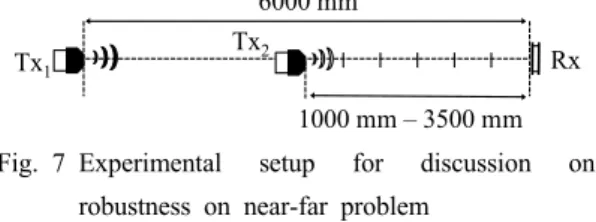
For discussing robustness on near-far problem, other experiment was conducted. Fig. 9 indicates the experimental setup on this experiment. In this
0 10 20 30 40 50
1000 1500 2000 2500 3000 3500 Measuring error [mm]
Measuring distance [mm]
Fig. 6 Measurement error in near-far problem
1000 mm – 3500 mm
6000 mm
Tx2
Tx1 Rx
Fig. 7 Experimental setup for discussion on robustness on near-far problem
experiment, we utilized two transmitters. We measured distances between Tx1 and Rx, where Tx2
mounted on 1000 mm to 3500mm, on each 500mm intervals respectively. Tx1 is fixed at 6000 mm.
Other conditions were same as the first experiment, shown in Section 4.
Fig. 10 shows result on the measuring error on this experiment. In this graph, measurement errors are plotted with height as the vertical axis and measuring distance between transmitter and receiver as the horizontal axis. We could measure 2000 mm and more on distance between Tx2 and Rx in the error up to 50 mm.
6. Conclusions
In this paper, we discussed an indoor positioning system that uses automatic signal detection by simulcasting multiple spread-spectrum (SS) ultrasonic signals with CDMA using low-power FPGA. For a positioning system, we also proposed a new signal detecting method using dynamic threshold level with multiple cycles of MLS.
To examine the effectiveness of this method, we conducted an experiment on distance measurements in order to measure the error involved in using automatic peak detection. The results indicated that measurement error is up to 50 mm, which is enough accuracy for self-localization and navigation.
References
1. J. T. C. Tan and T. Inamura, 2012, "SIGVerse -
A Cloud Computing Architecture Simulation Platform for Social Human-Robot Interaction", International Conference on Robotics and Automation, pp. 1310-1315.
2. J. E. Lee and S. G Lee, 2010,"Indoor initial positioning using single clock pseudolite system", International Conference on Information and Communication Technology Convergence (ICTC), pp. 575-578.
3. D. Manandhar and H. Torimoto, 2011,
"Development of IMES Installation, Setup and Management System", Proceedings of the 24th International Technical Meeting of The Satellite Division of the Institute of Navigation, pp. 1507-1513.
4. A. M. Aly Omar and A. S. Omar, 2005,
"Spread Spectrum Ultrasonic Positioning System", The 2nd Workshop on Positioning, Navigation and Communication (WPNC’05) &
1st Ultra-Wideband Expert Talk (UET'05), pp.
109-114.
5. M. Hazas and A. Ward, 2006, "Broadband Ultrasonic Location Systems for Improved Indoor Positioning", IEEE Transactions on Mobile Computing, pp. 536-547.
6. A. Suzuki, T. Iyota, and K. Watanabe, 2011, "A Performance Comparison of Measurement Distance between OOK and SS Modulation for Indoor Positioning Using Ultrasonic Transducers", IEEE Sensors, October 2011, Open Poster.
7. A. Suzuki, T. Iyota, and K. Watanabe, 2012,
"Real-Time Distance Measurement for Indoor Positioning System Using Spread Spectrum Ultrasonic Waves", Ultrasonic Waves, University Campus STeP Ri Slavka Krautzeka 83/A 51000, Rijeka, Croatia: INTECH, pp. 173-188.
8. A. Suzuki et al., 2009, "Measurement Accuracy on Indoor Positioning System Using Spread Spectrum Ultrasonic Waves", 4th International
Conference on Autonomous Robots and Agents, pp. 294-297.
9. A. Yamane, I. Taketoshi, C. Y. Woon, K.
Yuzuru, and W. Kazuhiro, "A Study on Propagation Characteristics of Spread Spectrum Sound Waves using a Band-limited Ultrasonic Transducer", Journal of Robotics and Mechatronics, pp. 333-341, 2004.
10. K. Kumakura, A. Suzuki, and T. Iyota, 2012,
"Indoor Positioning for Moving Objects Using a Hardware Device with Spread Spectrum Ultrasonic Waves", International Conference on Indoor Positioning and Indoor Navigation (IPIN 2012), pp. 1-6.
11. Y. Itagaki, A. Suzuki, and T. Iyota, 2012,
"Indoor Positioning for Moving Objects Using a Hardware Device with Spread Spectrum Ultrasonic Waves", International Conference on Indoor Positioning and Indoor Navigation (IPIN 2012), pp. 1-6.