http://e-nrp.org
Forecasting obesity prevalence in Korean adults for the years 2020 and 2030 by the analysis of contributing factors
Inkyung Baik
Department of Foods and Nutrition, College of Science and Technology, 77, Jeongnung-ro, Seongbuk-gu, Kookmin University, Seoul 02707, Korea
BACKGROUND/OBJECTIVES: There are few studies that forecast the future prevalence of obesity based on the predicted prevalence model including contributing factors. The present study aimed to identify factors associated with obesity and construct forecasting models including significant contributing factors to estimate the 2020 and 2030 prevalence of obesity and abdominal obesity.
SUBJECTS/METHODS: Panel data from the Korea National Health and Nutrition Examination Survey and national statistics from the Korean Statistical Information Service were used for the analysis. The study subjects were 17,685 male and 24,899 female adults aged 19 years or older. The outcome variables were the prevalence of obesity (body mass index ≥ 25 kg/m
2) and abdominal obesity (waist circumference ≥ 90 cm for men and ≥ 85 cm for women). Stepwise logistic regression analysis was used to select significant variables from potential exposures.
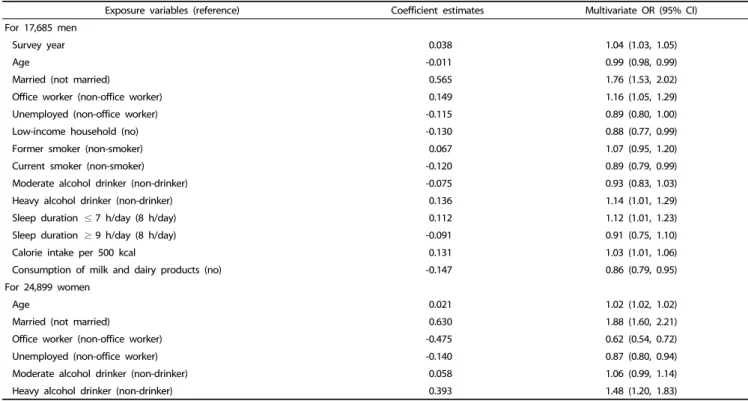
RESULTS: The survey year, age, marital status, job status, income status, smoking, alcohol consumption, sleep duration, psychological factors, dietary intake, and fertility rate were found to contribute to the prevalence of obesity and abdominal obesity. Based on the forecasting models including these variables, the 2020 and 2030 estimates for obesity prevalence were 47% and 62%
for men and 32% and 37% for women, respectively.
CONCLUSIONS: The present study suggested an increased prevalence of obesity and abdominal obesity in 2020 and 2030.
Lifestyle factors were found to be significantly associated with the increasing trend in obesity prevalence and, therefore, they may require modification to prevent the rising trend.
Nutrition Research and Practice 2018;12(3):251-257; https://doi.org/10.4162/nrp.2018.12.3.251; pISSN 1976-1457 eISSN 2005-6168 Keywords: Obesity, abdominal fat, prevalence, risk factors, forecasting
INTRODUCTION *
The increasing rate of obesity in Korea, as well as in western countries, is a growing public health problem. According to the data from the 2015 Korea National Health and Nutrition Examination Survey (KNHANES) for Korean adults aged 19 years or older, the prevalence of obesity defined as a body mass index (BMI) ≥ 25 kg/m
2is about 40% for men and 26% for women.
These data mean that one-third of Korean adults are obese.
Compared to the 1998 obesity prevalence, which was 25% for men and 26% for women, a dramatic increase was observed in men [1]. The prevalence of abdominal obesity, which is defined as a waist circumference ≥ 90 cm for men and ≥ 85 cm for women, increased up to 55% for men, when comparing the 2015 to 1998 data. In contrast, the prevalence of obesity and abdominal obesity in women has minimally increased over 10 years. Thus, serious health effects associated with obesity, including increased risks of chronic diseases, have risen dramatically among males [1].
A recent report revealed that the socioeconomic costs of obesity, which include direct costs related to medical care and
indirect costs related to loss of productivity, are estimated at approximately 6.2 billion U.S. dollars per year. Compared to 2005, this is a 2.2-fold increase, which is greater than the increasing rate of smoking or alcohol drinking. The expenses related to obesity were observed to be primarily due to the direct costs for the treatment of chronic diseases [2].
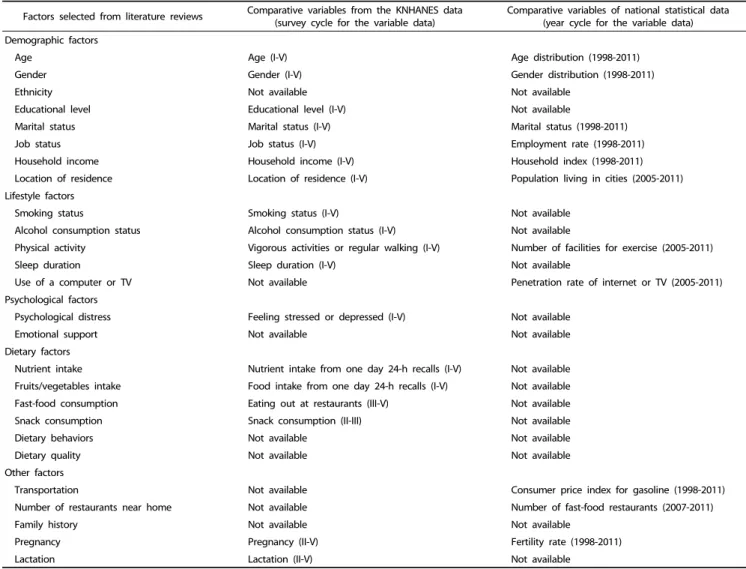
The causes of obesity are numerous, complex, and inter- related. Obesity is reportedly influenced by factors that are biological, behavioral, and environmental [3,4]. The biological factors include age, gender, hormone, and genetic aspects;
behavioral factors include individual lifestyle, emotion, attitude, belief, cognition, and knowledge, and environmental factors are classified as macro- and micro-environments. The macro- environment comprises food costs, vehicle costs, transportation system, and investment costs for leisure activities, while the micro-environment consists of the propensity to consume foods per household, accessibility of fast food restaurants, park areas or exercise facilities, and usability of exercise facilities or sports programs.
Finkelstein et al. [5] considered age, ethnicity, educational level, marital status, economic level, consumption of healthy
This work was supported by a grant (2014P3500100) by Research of Korea Centers for Disease Control and Prevention. The funders have no role in the study.
§