The Relationships among Postpartum Fatigue, Depressive Mood, Self-care Agency, and Self-care Action of First-time Mothers in Bangladesh
Fahima Khatun1 · Lee, Tae Wha2 · Ela Rani3 · Gulshanara Biswash4 · Pronita Raha4 · Kim, Sue2
1College of Nursing, Yonsei University, Seoul
2College of Nursing, Mo-Im Kim Nursing Research Institute, Yonsei University, Seoul, Korea
3Nursing Institute, Mitford, Dhaka
4Dhaka Nursing College, Dhaka, Bangladesh
Purpose: Postpartum fatigue can impact maternal well-being and has been associated with levels of perceived self-care. This study aimed to examine the relationship among fatigue, depressive mood, self-care agency, and self-care action among postpartum women in Bangladesh. Methods: A descriptive cross sectional survey was done with 124 first-time mothers from two tertiary hospitals in Dhaka, Bangladesh. The Modified Fatigue Symptoms check- list, Denyes’ Self Care Instrument, the Edinburgh Postnatal Depression Scale, and items on sociodemographic and delivery-related characteristics, were used in Bengali via translation and back-translation process. Results: High fa- tigue levels were found in 18.5% (n=23) and 73.4% had possible depression (n=91). There was a significant negative relationship between fatigue and self-care agency (r=-.31, p<.001), and self-care action (r=-.21, p<.05). Fatigue differed by level of self-care agency (t=4.06, p<.001), self-care action (t=2.36, p=.023), newborn’s APGAR score (t=-2.93, p=.004), parental preparation class participation (F=15.53, p<.001), and postpartum depressive mood (t=-4.64, p<.001). Conclusion: Findings suggest that high level of self-care efficacy and behaviors can contribute to fatigue management, and highlight the need for practical interventions to better prepare mothers for postpartum self-care, which may, in turn, alleviate postpartum fatigue.
Key Words: Postpartum depression, Fatigue, Postpartum period, Self-care
Corresponding author: Kim, Sue
College of Nursing, Yonsei University, 50 Yonsei-ro, Seodaemun-gu, Seoul 03722 , Korea.
Tel: +82-2-2228-3276, Fax: +82-2-392-5440, E-mail: [email protected] Received: Dec 5, 2017 / Revised: Dec 20, 2017 / Accepted: Dec 21, 2017
This is an open access article distributed under the terms of the Creative Commons Attribution Non-Commercial License (http://creativecommons.org/licenses/
by-nc/3.0), which permits unrestricted non-commercial use, distribution, and reproduction in any medium, provided the original work is properly cited.
INTRODUCTION
Fatigue is one of the most common complaints of post- partum period especially among mothers who delivered first-time [1]. Postpartum fatigue (PPF) is defined as “an overwhelming, sustained sense of exhaustion and decreas- ed capacity for physical and mental work”[2]. It is charac- terized by inability to restore energy even after sleep, nor maintain physical activity. Reported incidence of PPF ranges from 55% in Canada,[3] to 76%[4] and 44~95%[5] in the US. PPF is an unavoidable part of the postpartum peri- od and increases over time, up to the sixth week post- partum [6]. It manifests as a sense of physical and mental exhaustion, lack of energy, concentration [5,7]. The impact of PPF includes reduced maternal cognitive functioning [8,9] and inhibiting maternal self-care actions [10], which
may in turn, affect the mother and infant’s health and well-being.
PPF has been reported to be influenced by maternal age, education, mode of delivery, parity, stress, social support, depression, and other factors [3,11,12]. Although a normal developmental period, the postpartum involves dynamic physiologic changes back to pre-pregnancy state as well as adjusting to the new roles and daily activities of parenting [13].
Maternal ability for self-care action is important in meet- ing postpartum self-care demands [14]. Self-care actions have been reported to be influenced by self-care agency in postpartum, e.g., gathering information and making deci- sions related to the mother’s self-care [15,16]. Due to a short hospital stay, however, mothers have fewer chances to acquire knowledge related to postpartum self-care [13,
15,17].
In Bangladesh, institutional delivery has been increas- ing from 12% in 2004 to 37% in 2014[18], and among the mothers who received postpartum care within 42 days, most received within the first week of delivery. Hospital stay, however, is short, and the lack of postpartum follow- up or opportunity for healthcare [17,19] can pose challenges for self-care actions. Furthermore, for the 62% women who deliver at home [18] there is even lesser chances for post- partum education.
Although numerous studies have been conducted on PPF, they are mostly based on Western countries, which are not contextually fit for Bangladesh. To date no study has investigated PPF, its relationship with postpartum de- pression and self-care, or influencing factors among Ban- gladesh mothers. Therefore, bridging this gap may con- tribute to guide how the healthcare team plans care for new postpartum mothers in Bangladesh, to improve the quality of self-care in mothers and alleviate PPF.
This study aimed to examine the relationships among fatigue, depressive mood, self-care agency, and self-care action of first-time mothers in Bangladesh. A descriptive cross-sectional survey was conducted during the period December, 2014 to March, 2015.
This study utilized Milligan and colleagues’[5] con- ceptualization of fatigue and the concepts of self-care agen- cy and self-care action were derived from Orem’s theory of self-care [20]. Self-care agency, defined as “the complex acquired capability to meet one’s continuing requirements for self”[20], and self-care action were proposed to be in- fluenced by basic conditioning factors that frame PPF. This study postulated that self-care agency, self-care actions, and depressive mood would influence fatigue in the early postpartum period.
METHODS
The study was conducted at two large public tertiary- level hospitals in Dhaka, Bangladesh. Both sites are visited by multi-regional women giving birth, and are homoge- neous in nature. The inclusion criteria were as follows: (1) First-time mothers, (2) normal spontaneous vaginal deliv- ery ≥37 weeks, (3) delivery within 7 days, and (4) willing to participate. Women who had delivered twin babies, ex- perienced assisted delivery, or had postpartum complica- tions (e.g. postpartum bleeding, puerperal sepsis, and psy- chosis) were excluded. Sample size calculation with G*
power with an effect size 0.25, power 0.80, and ⍺ level 0.05, estimated the need for a minimum of 123 mothers.
Roughly 20% was estimated for potentially unusable data
and thus, questionnaires were distributed to 147 eligible participants and 144 were collected (return rate 98%). Ex- cluding missing responses, the data from 124 participants were analyzed.
1. Human Subject Approval
Prior to the study, approval was obtained from the Institutional Review Board (IRB, 2014-0050-1) of the au- thors’ institution in Korea. In addition, approval was ob- tained from the director of nursing services (DNS) in Ban- gladesh, and the director, nursing superintendent, and participants of the settings. Participants were informed of the purpose, risk, and benefits of the study and the princi- ples of voluntary participation. As obtaining written sig- natures may be difficult in cultural settings where agree- ments based upon trust do not require a signature [21], verbal consent was obtained prior to data collection with approval of the IRB.
2. Recruitment of Participants and Data Collection
Participants were recruited by two local research coor- dinators in cooperation with the DNS and the nursing su- perintendent of participating hospitals. As a focal person, the local research coordinator took primary responsibility for data collection and provided the opportunity to ask questions, and clarified as necessary. They also communi- cated with the head nurse of the postpartum ward, identi- fied potential participants, explained the study purpose, and obtained verbal consent. Consenting participants re- ceived the questionnaire set with a small gift (hygiene pro- duct) and the local research coordinators were available on the ward to explain if any questions should arise. A col- lection box was provided in the ward for completed questionnaires.
3. Measurements
A self-report structured questionnaire set was used to measure fatigue, self-care agency, self-care action, depres- sion, and background information (socio-demographic and delivery-related information). There were a total of 104 items, and took about 30 minutes. Permission to use the instruments on fatigue, self-care agency, and self-care action were obtained from the original authors. The so- cio-demographic information and delivery-related in- formation items were developed based on the literature, and the instrument for depressive mood was available via free access to the users. All instruments were translated in-
to Bengali based on translation, back-translation proce- dures, following three steps by independent bilingual ex- perts [22] and reviewed by the researchers.
1) Background information
For socio-demographic characteristics, age, highest ed- ucational level, living status, occupation, monthly family income, and living area were assessed. For delivery-re- lated information, episiotomy, gestational age, postpartum duration, general condition of the newborn, participation in parenting preparation class, and number of antenatal visits was recorded from charts by research coordinators.
2) Fatigue
Fatigue was measured by the Modified Fatigue Symp- toms Checklist scale [5] This scale consists of 30 items with dichotomous responses and a total score range of 0~30.
Although it is not possible to present absolute cutoff scores for levels of fatigue, relative scores are presented using de- scriptive statistics. No fatigue is estimated as scores less than one standard deviation (SD) below the mean, moderate fatigue is scores between one SD above and below the mean, and high fatigue is scores more than one SD above the mean.
Internal consistency (Kuder-Richardson formula) in previous studies for the total ranged from .82 to .95[5] and the Kuder- Richardson-20 coefficient was .93 in this study.
3) Self-Care Agency
The Self-Care Agency Instrument (DSCAI-90©)[23], ori- ginally designed for use with adolescent populations, is a self-report questionnaire consisting of 34 items in six sub- scales: ego strength, valuing of health, health knowledge and decision making capability, energy, feelings, and at- tention to health. In this study, two items were modified for postpartum context, such as the ability to practice peri- neal care, pelvic floor exercise and postpartum nutrition.
A seven-point Likert format (1=strongly disagree, to 7=
strongly agree) was used to obtain a summed score and higher scores reflect higher level of self-care agency. Cron- bach’s ⍺ was .90 in the original study [23] and .92 in this study.
4) Self-Care Action
Self-Care action was measured by the Self-Care Practice Instrument (DSCPI-90©)[23]. This 18-item instrument is a general measure of self-care actions and is appropriate for use with healthy population as well as disease conditions.
In this study, some items were adapted for postpartum context. A seven-point Likert format (1=strongly disagree, to 7=strongly agree) was used and higher scores indicate
higher levels of self-care action. Cronbach’s ⍺ in the origi- nal study was .89[23] and .92 in this study.
5) Postpartum depressive mood
The 10-item Edinburgh Postnatal Depression Scale (EPDS) [24], a widely used and extensively validated mea- sure for antepartum and postpartum depression, was used. The EPDS has multicultural applicability and al- though a cut-off of 12 was used in a prior study in Bangla- desh to detect probable depression [25], we chose to use a conservative cut-off of 9 to capture possible depression in the early postpartum [26], as well as in due consideration of culturally negative attitudes regarding depression that are prevalent in Bangladesh [27]. Cronbach’s ⍺was .86 in the original study [24] and .70 for this study.
4. Data analysis
The data were analyzed using SPSS (IBM SPSS Statistics version 22.0, Armonk, NY). Demographic data was ana- lyzed by descriptive statistics, using frequency, percent- age, mean, and standard deviation. To measure the rela- tionships among self-care agency, self-care action, depres- sive mood, and fatigue, Pearson product moment correla- tion was used. Preliminary data analysis was conducted to test the assumptions of correlation normality and homo- geneity of variance.
RESULTS
1. Demographic Characteristics and Delivery related Information of Postpartum Mothers
The average age of postpartum mothers was 22.40±
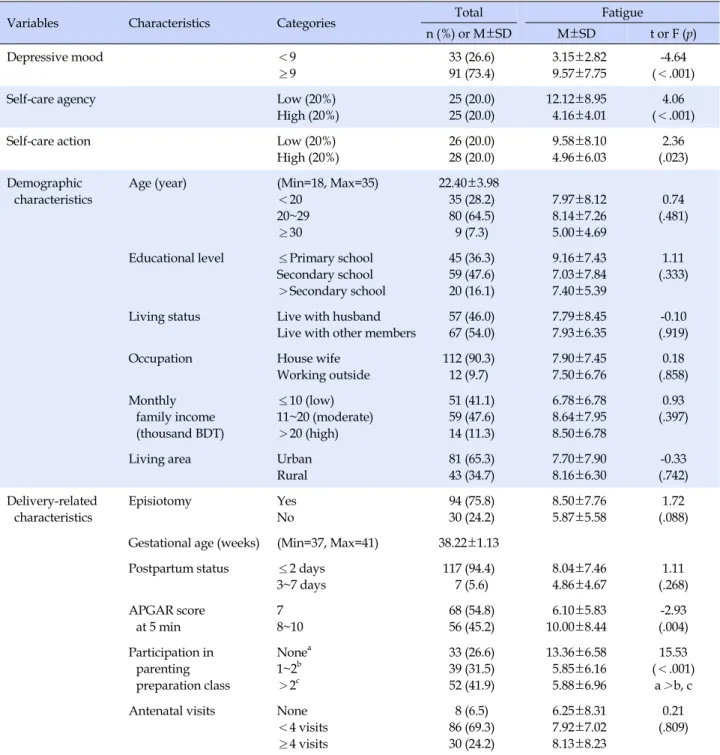
3.98 years. More than half of the mothers were in their twenties (64.5%), and had secondary school or more as educational background (63.7%). Most (90.3%) were house- wives, and more than half lived with their husband as well as other family members (54%), and lived in an urban area (65.3%). Most respondents (88.7%) were of low to middle in- come, i.e., less than 20,000 Bangladeshi Taka (equivalent to approximately 280 US dollars). For delivery-related infor- mation, the average gestational age was 38.22±1.13 weeks and most (75.8%) had received an episiotomy. The majori- ty of mothers (94.4%) were surveyed within 2 postpartum days and about half (45.2%) had newborns with 5 minute APGAR score of 8 or greater. Only a quarter (24.2%) re- ceived adequate antenatal care (4 or more according to rec- ommendations). A quarter (26.6%) had not participated in any parenting preparation classes (Table 1).
Table 1. Differences of Fatigue by Depressive mood, Self-care Agency, Self-care Action, Demographic Characteristics, and
Delivery Related Information (N=124)
Variables Characteristics Categories Total Fatigue
n (%) or M±SD M±SD t or F (p)
Depressive mood <9
≥9
33 (26.6) 91 (73.4)
3.15±2.82 9.57±7.75
-4.64 (<.001)
Self-care agency Low (20%)
High (20%)
25 (20.0) 25 (20.0)
12.12±8.95 4.16±4.01
4.06 (<.001)
Self-care action Low (20%)
High (20%)
26 (20.0) 28 (20.0)
9.58±8.10 4.96±6.03
2.36 (.023) Demographic
characteristics
Age (year) (Min=18, Max=35)
<20 20~29
≥30
22.40±3.98 35 (28.2) 80 (64.5) 9 (7.3)
7.97±8.12 8.14±7.26 5.00±4.69
0.74 (.481)
Educational level ≤Primary school Secondary school
>Secondary school
45 (36.3) 59 (47.6) 20 (16.1)
9.16±7.43 7.03±7.84 7.40±5.39
1.11 (.333)
Living status Live with husband Live with other members
57 (46.0) 67 (54.0)
7.79±8.45 7.93±6.35
-0.10 (.919)
Occupation House wife
Working outside
112 (90.3) 12 (9.7)
7.90±7.45 7.50±6.76
0.18 (.858) Monthly
family income (thousand BDT)
≤10 (low) 11~20 (moderate)
>20 (high)
51 (41.1) 59 (47.6) 14 (11.3)
6.78±6.78 8.64±7.95 8.50±6.78
0.93 (.397)
Living area Urban
Rural
81 (65.3) 43 (34.7)
7.70±7.90 8.16±6.30
-0.33 (.742) Delivery-related
characteristics
Episiotomy Yes
No
94 (75.8) 30 (24.2)
8.50±7.76 5.87±5.58
1.72 (.088) Gestational age (weeks) (Min=37, Max=41) 38.22±1.13
Postpartum status ≤2 days 3~7 days
117 (94.4) 7 (5.6)
8.04±7.46 4.86±4.67
1.11 (.268) APGAR score
at 5 min
7 8~10
68 (54.8) 56 (45.2)
6.10±5.83 10.00±8.44
-2.93 (.004) Participation in
parenting preparation class
Nonea 1~2b
>2c
33 (26.6) 39 (31.5) 52 (41.9)
13.36±6.58 5.85±6.16 5.88±6.96
15.53 (<.001)
a>b, c Antenatal visits None
<4 visits
≥4 visits
8 (6.5) 86 (69.3) 30 (24.2)
6.25±8.31 7.92±7.02 8.13±8.23
0.21 (.809)
BDT=Bangladesh Taka (Approximately 78 BDT=1 US dollar).
Levels of the main variables are as follows: The overall fatigue score (possible score range: 0~30) was relatively low (7.86±7.36). However, calculating relative scores to esti- mate categories of fatigue per the original measurement, most mothers (73.4%) reported moderate levels of fatigue (between one SD above and below the mean). High level of fatigue symptoms (more than one SD above the mean) was
reported by 18.55%. Also, nearly three out of four (73.4%) participants reported depressive mood (≥9 EPDS). For self-care agency (possible score range: 34~238) and self-care action (possible score range: 18~126) the average scores were at mid-level (175.44±21.43 and 96.75±12.60, respec- tively).
2. Differences of Fatigue by Depressive Mood, Self- care Agency, Self-care Action, Demographic Charac- teristics, and Delivery Related Information
Fatigue was significantly higher in mothers with depres- sive symptoms (t=-4.64, p<.001), suggesting vulnerability.
As the self-care instrument does not designate cutoff points for interpretation, for further analysis, roughly 20%
of the lower-end and higher-end scores were taken (i.e., roughly 25 women each) and considered “low” or “high”
self-care agency and self-care action subgroups. Thus, we found that participants at the high end of self-care agency had statistically significantly less fatigue compared to those at the low end (t=4.06, p<.001). Likewise, partici- pants at high end of self-care action had statistically sig- nificantly less fatigue compared to those at the low end (t=2.36, p=.023). Fatigue also differed by higher APGAR scores at 5 minutes (t=-2.93, p=.004) and participation in parenting preparation class. Upon post-hoc analysis, high- er fatigue was found in mothers who had no parenting preparation (f=15.53, p<.001).
3. Relationship between Self-care Agency and Selfcare Action, by Fatigue, Depressive Mood, Demographic Characteristics, and Delivery Related Information
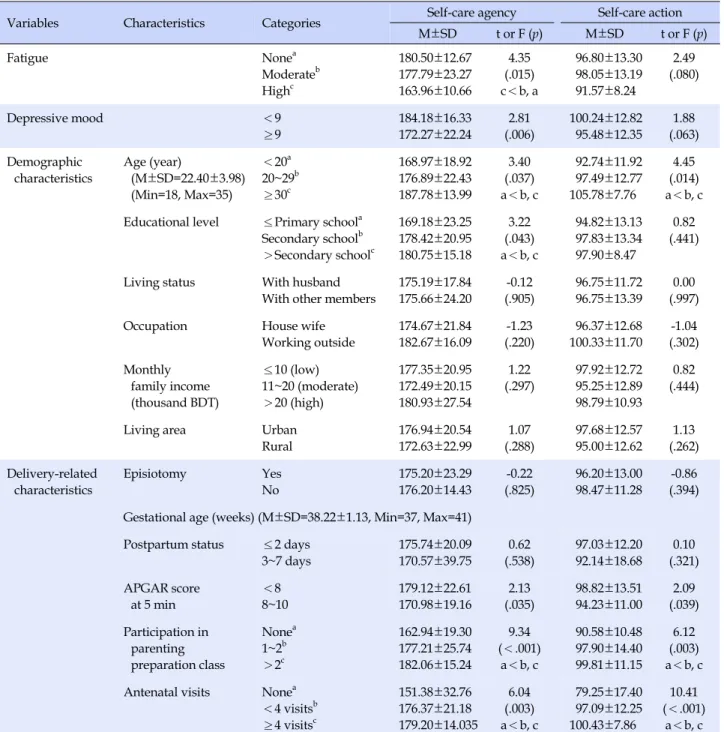
Further analysis of self-care agency and self-care action is shown in Table 2. Self-care agency was significantly dif- ferent by fatigue symptoms, with poor scores in the high fatigue group (F=4.35, p<.01) than those with moderate and no fatigue. Also, lower self-care agency was noted in mothers with depressive mood (t=2.81, p=.006) and low level of education (f=3.22, p=.043) However, such differ- ences were not found for self-care action.
Both self-care agency (f=3.40, p=.037), and self-care ac- tion (f=4.45, p=.014) differed by age, i.e., younger mothers (<20 years-old) presenting lower scores, suggesting greater vulnerability. Self-care agency and self-care ac- tion were significantly lower among mothers who had not participated in parenting preparation classes (f=9.34, p<.001; f=6.12, p=.003 respectively) as well as no ante- natal care (f=6.04, p=.003; f=10.41, p<.001respectively), compared to their counterparts. Lower self-care agency (t=2.13, p=.035) and self-care action (t=2.09, p=.039) were also noted for APGAR 8~10 compared to scores less than 8.
4. Relationships among Fatigue, Depressive Mood, Self-care Agency, and Self-care Action
There was a significant moderate correlation between
fatigue and depressive mood (r=.57, p<.001)(Table 3).
Fatigue was weakly negatively correlated with self-care agency (r=-.31, p<.001) and self-care action (r=-.21, p=
.018). Depressive mood showed weak negative correla- tions with self-care agency (r=-.29, p=.001) and self-care action (r=-.20, p=.023), and self-care agency was strongly positively correlated with self-care action (r=.84, p<.001).
DISCUSSION
Although 18% showed high levels of PPF, the mean score for overall fatigue was somewhat low (7.86±7.36).
This may be an underestimation of general PPF, as the time of measurement occurred within 2 days of post- partum for the majority (94.4%) of respondents. Previous studies have noted that after discharge, mothers at home will gradually experience more fatigue [5] and such in- creased PPF levels have been tied to several potential sour- ces, e.g., infection, lack of rest during the day, pressure to
“get everything done,” interruption in night time sleep, pain, stress associated with new roles, anemia, and social activities [13].
A substantial number of mothers (73.4%) were found to have possible postpartum depression by the EPDS, and underscores the need for close attention to new mothers by health professionals across all clinical contact points.
This is much higher than a prior report [25] using the EPDS with Bangladesh mothers at 6~8 weeks postpartum, which found 9% had probable depression. That particular study used a different timing of measurement as well as a cutoff of 12, but we could not identify their estimates by a cutoff 9 for direct comparison. It is also higher than reports of 29.5% per cutoff of 9 at 1 week postpartum in Western women [28], which may suggest differences in measure sensitivity or perception of items [26]. Furthermore, in this study, mothers with depressive mood were likely to expe- rience more fatigue (r=.57, p<.001), which is consistent with reports that depression levels are positively related to PPF [11, 12]. The postpartum period is a critical tran- sition time for women in terms of physical changes that can influence mental health, among which fatigue and de- pression are two major consequences [29]. As postpartum depression is a serious public health issue and it can inter- act with PPF, early screening for both conditions and in- creasing awareness of high risk populations are needed in Bangladesh. We found statistically significant differences in fatigue across high or low self-care agency and self-care action, which is consistent with previous studies that re- ported maternal physiological, psychological, and situa- tional factors that may put mothers at risk of fatigue and
Table 2. Differences of Self-care Agency, and Self-care Action by Fatigue, Depressive Mood, Demographic Characteristics, and
Delivery-related Information (N=124)
Variables Characteristics Categories Self-care agency Self-care action
M±SD t or F (p) M±SD t or F (p)
Fatigue Nonea
Moderateb Highc
180.50±12.67 177.79±23.27 163.96±10.66
4.35 (.015) c<b, a
96.80±13.30 98.05±13.19 91.57±8.24
2.49 (.080)
Depressive mood <9
≥9
184.18±16.33 172.27±22.24
2.81 (.006)
100.24±12.82 95.48±12.35
1.88 (.063) Demographic
characteristics
Age (year)
(M±SD=22.40±3.98) (Min=18, Max=35)
<20a 20~29b
≥30c
168.97±18.92 176.89±22.43 187.78±13.99
3.40 (.037) a<b, c
92.74±11.92 97.49±12.77 105.78±7.76
4.45 (.014) a<b, c Educational level ≤Primary schoola
Secondary schoolb
>Secondary schoolc
169.18±23.25 178.42±20.95 180.75±15.18
3.22 (.043) a<b, c
94.82±13.13 97.83±13.34 97.90±8.47
0.82 (.441)
Living status With husband With other members
175.19±17.84 175.66±24.20
-0.12 (.905)
96.75±11.72 96.75±13.39
0.00 (.997)
Occupation House wife
Working outside
174.67±21.84 182.67±16.09
-1.23 (.220)
96.37±12.68 100.33±11.70
-1.04 (.302) Monthly
family income (thousand BDT)
≤10 (low) 11~20 (moderate)
>20 (high)
177.35±20.95 172.49±20.15 180.93±27.54
1.22 (.297)
97.92±12.72 95.25±12.89 98.79±10.93
0.82 (.444)
Living area Urban
Rural
176.94±20.54 172.63±22.99
1.07 (.288)
97.68±12.57 95.00±12.62
1.13 (.262) Delivery-related
characteristics
Episiotomy Yes
No
175.20±23.29 176.20±14.43
-0.22 (.825)
96.20±13.00 98.47±11.28
-0.86 (.394) Gestational age (weeks) (M±SD=38.22±1.13, Min=37, Max=41)
Postpartum status ≤2 days 3~7 days
175.74±20.09 170.57±39.75
0.62 (.538)
97.03±12.20 92.14±18.68
0.10 (.321) APGAR score
at 5 min
<8 8~10
179.12±22.61 170.98±19.16
2.13 (.035)
98.82±13.51 94.23±11.00
2.09 (.039) Participation in
parenting preparation class
Nonea 1~2b
>2c
162.94±19.30 177.21±25.74 182.06±15.24
9.34 (<.001)
a<b, c
90.58±10.48 97.90±14.40 99.81±11.15
6.12 (.003) a<b, c Antenatal visits Nonea
<4 visitsb
≥4 visitsc
151.38±32.76 176.37±21.18 179.20±14.035
6.04 (.003) a<b, c
79.25±17.40 97.09±12.25 100.43±7.86
10.41 (<.001)
a<b, c BDT=Bangladesh Taka (Approximately 78 BDT=1 US dollar).
Table 3. Correlations among Self-care Agency, Self-care Action, Depressive Mood, and Fatigue (N=124)
Variables Fatigue Self-care agency Self-care action
r (p) r (p) r (p)
Self-care agency -.31 (<.001)
Self-care action -.21 (.018) .84 (<.001)
Depressive mood .57 (<.001) -.29 (.001) -.20 (.023)
interfere with daily functioning in self-care action [5, 30].
The fact that maternal levels of fatigue differed sig- nificantly by self-care agency, self-care action, and experi- ence of having participated in parenting classes, indicates that healthcare professionals can play an important role in preparing new mothers. This is in line with reports that higher self-care agency and greater self-care action can contribute to prevention of postpartum complications and fatigue [6, 16].
In this study mothers with a newborn of APGAR scores 8~10 were found to have slightly higher fatigue and lower scores of self-care agency and self-care action compared to their counterparts. It is not clear why this was noted and may need to be explored in future studies.
Participation in parenting preparation class was also significantly associated with fatigue, self-care agency, and self-care action. The contents of such classes may recogniz- ing the signs of fatigue, understanding factors associated with fatigue, saving energy (reducing demands, getting supports, setting goal and making plan), and charging up through helpful thinking, better sleeping, resting, diet, and exercise [31]. This supports the literature that educa- tional programs for mothers such as parenting prepara- tion class, health education, provision of nutritional know- ledge, and tiredness management can strengthen mater- nal self care efficacy to manage postpartum fatigue [1, 5, 9]. As young women (<20 years) and women with no an- tenatal care had more vulnerable scores of self-care agency and action, such subgroups of pregnant women would es- pecially benefit from educational opportunities. Under- standing PPF and providing anticipatory guidance is needed among Bangladesh health professionals, as well as devising health policies to raise societal awareness and support for PPF and depression.
The theoretical underpinning of self-care was found to be applicable in this study and the concept of self-care can be considered a good fit culturally in Bangladesh, as child- birth and postpartum recovery are viewed as natural events that do not necessarily require medical interven- tion. As many births take place out of the hospital in Ban- gladesh, facilitating better self-care perceptions and ac- tions could aid in better management of fatigue and im- proved maternal health indices over time.
Future studies may explore further with different sam- ples (e.g., rural areas, home-births, etc.) and measuring at various postpartum periods. This study focused on moth- ers within 7 days of childbirth. Although this may not be an optimal time point to measure fatigue and degree of de- pressive mood, it was done to secure access to partici- pants, considering the dire lack of basic studies in Bangla-
desh. We hope future studies may offer a wider range of assessment points to better understand PPF and depres- sive symptoms across the postpartum spectrum.
CONCLUSION
Postpartum depressive mood, self-care agency, and self- care action were all significantly related with fatigue in this study of first-time mothers in Bangladesh, of which a high proportion had depressive mood. While more re- search is needed on depression and PPF risk factors and effective management, mothers need to be screened for both conditions and informed that PPF may fuel maternal depression. Health professionals working with mothers and families can provide information on the sources of fa- tigue and assist management strategies such as taking rest, sharing workload with others, seeking nursing and medi- cal advice as needed. These findings recommend inter- ventions for alleviating PPF and efforts to develop wom- en’s self-efficacy to protect their health and care for their newborn, especially for first-time mothers.
In Bangladesh, a high proportion of births occur at home and there is a possibility that mothers who deliver at home may experience more fatigue than institution-based child- birth. Such comparative studies are lacking, however, and the PPF level following home delivery is another area for further research.
Acknowledgements
The authors gratefully acknowledge Mr. Nurul Anowar, Mrs. Bilkis Akter, and Mrs. Ferdowsh Jahan for helping in the process of approval of data collection. Also sincere ap- preciation for Mrs. Nelofar Farhad, director of nursing ser- vices, and the hospital directors and nursing superinten- dents of Dhaka Medical College Hospital (DMCH) and Sir Salimullah Medical College Hospital (SSMCH), Mitford, Dhaka, for assistance in access to participants, as well as professor Chung Yul Lee for guidance in data analysis.
ORCID
Kim, Sue https://orcid.org/0000-0003-3785-2445
REFERENCES
1. Eryilmaz G, Kilic M. The determination of women's fatigue levels in the third trimester of pregnancy and in the postpar- tum period. Healthmed. 2011;5(4):826-830.
2. Nanda Nursing Diagnoses. Nursing diagnoses for fatigue [cited 2015 September 21] Available from:
http://nandanursingdiagnoses.blogspot.kr/2011/11/nursing -diagnoses-for-fatigue.html.
3. Ansara D, Cohen MM, Gallop R, Kung R, Schei B. Predictors of women's physical health problems after childbirth. Journal of Psychosomatic Obstetrics & Gynecology. 2005;26(2):115-125.
https://doi.org/10.1080/01443610400023064
4. Declercq ER, Sakala C, Corry MP, Applebaum S, Risher P.
Listening to mothers' report of the first national US survey of women's childbearing experiences. New York: Maternity Cen- ter Association; 2002.
5. Milligan RA, Parks PL, Kitzman H, Lenz ER. Measuring wom- en's fatigue during the postpartum period. Journal of Nursing Management. 1997;5(1):3-16.
6. Troy NW, Dalgas-Pelish P. The effectiveness of a self-care in- tervention for the management of postpartum fatigue. Appli- ed Nursing Research. 2003;16(1):38-45.
https://doi.org/10.1053/apnr.2003.50001
7. Ream E, Richardson A. Fatigue: a concept analysis. Interna- tional Journal of Nursing Studies. 1996;33(5):519-529 . 8. Ashrafinia F, Mirmohammadali M, Rajabi H, Kajemnejad A,
Sadeghniiat K, Amelvalizadeh M. Effect of pilates exercises on postpartum maternal fatigue. Singapore Medical Journal. 2015;
56(3):169-173.
9. Giallo R, Cooklin A, Dunning M, Seymour M. The efficacy of an intervention for the management of postpartum fatigue.
Journal of Obstetric, Gynecologic, and Neonatal Nursing. 2014;
43(5):598-613. https://doi.org/10.1111/1552-6909.12489 10. Runquist J. Persevering through postpartum fatigue. Journal
of Obstetric, Gynecologic, and Neonatal Nursing. 2007;36(1):
28-37. https://doi.org/10.1111/j.1552-6909.2006.00116.x 11. Leahy-Warren P, McCarthy G. Maternal parental self-efficacy
in the postpartum period. Midwifery. 2011;27(6):802-10.
https://doi.org/10.1016/j.midw.2010.07.008.
12. Doering-Runquist JJ, Morin K, Stetzer, FC. Severe fatigue and depressive symptoms in lower-income urban postpartum wo- men. Western Journal of Nursing Research. 2009;31(5):599- 612. https://doi.org/10.1177/0193945909333890.
13. Troy NW, Dalgas-Pelish P. Development of a self-care guide for postpartum fatigue. Applied Nursing Research. 1995;8(2):
92-96.
14. Orem DE. Nursing concepts of practice. 4th ed. New York:
McGraw Hill; 1991.
15. Kwak YH, Lee ML. The effects of education on knowledge and confidence in postpartal self-care and newborn baby care. Ko- rean Journal of Women Health Nursing. 1996;2(2):246-256.
16. Nazik E, Eryilmaz G. The prevention and reduction of post- partum complications: Orem's model. Nursing Science Quar- terly. 2013;26(4):360-364.
https://doi.org/10.1177/0894318413500402
17. Taylor J, Jonson M. How women manage fatigue after child birth. Midwifery. 2010;26:367-375.
https://doi.org/10.1016/j.midw.2008.07.004.
18. National Institute of Population Research and Training (NI PORT). Bangladesh demographic health survey. [cited 2015 September 21] Available from:
http://dhsprogram.com/pubs/pdf/PR56/PR56.pdf 19. Varcho MS, Hill PD, Anderson M. Evaluation of the Tiredness
Management Guide: a pilot study. Applied Nursing Research.
2012;25(2):123-8. https://doi.org/10.1016/j.apnr.2010.04.002 20. Orem DE. Nursing concepts of practice. 6th ed. St. Louis, MO:
Mosby;2001.
21. World Health Organization. Ethical challenges in study design and informed consent for health research in resource-poor settings. 2014. [cited 2015 September 21] Available from:
http://whqlibdoc.who.int/publications/2007/978924156338 3_eng.pdf
22. Sperder AD, Devellis RE. Cross-cultural translation. Journal of Cross Cultural Psychology. 1994;25:501-525.
23. Denyes MJ. Denyes self-care instrument. Detroit, MI: College of Nursing, Wayne state University; 1990.
24. Cox JL, Holden JM, Sagovsky R. Detection of postnatal depres- sion development of the 10-items Edinburgh Postnatal Depres- sion Scale. The British Journal of Psychiatry. 1987;150(6):782-786.
25. Gausia K, Fisher C, Algin S, Oosthuizen J. Validation of the Bangla version of the Edinburgh Postnatal Depression Scale for a Bangladeshi sample. Journal of Reproductive and Infant Psychology. 2007;25(4):308-315.
https://doi.org/10.1080/02646830701644896
26. Gibson J, McKenzie-McHarg K, Shakespeare J, Price J, Gray R.
A systematic review of studies validating the Edinburgh Post- natal Depression Scale in antepartum and postpartum women.
Acta Psychiatr Scand. 2009;119(5):350-364.
https://doi.org/10.1111/j.1600-0447.2009.01363.x
27. Selim N. Cultural dimensions of depression in Bangladesh: A qualitative study in two villages of Matlab. Journal of Health, Population & Nutrition. 2010;28(1):95-106.
28. Dennis CL. Can we identify mothers at risk for postpartum de- pression in the immediate postpartum period using the Edin- burgh postnatal depression scale? Journal of Affective Dis- orders. 2004;78(2):163-169.
29. Ko Y, Yang C, Chiang LC. Effects of postpartum exercise pro- gram on fatigue and depression during "doing-the-month"
period. Journal of Nursing Research. 2008;16(3):177-185.
30. Dunning M, Seymour M, Cooklin A, Giallo R. Wide Awake Parenting: Study protocol for a randomised controlled trial of a parenting program for the management of post-partum fati- gue. BMC Public Health. 2013;13:1.
31. Giallo R, Dunning M, Cooklin A, Seymour M, Graessar H, Zerman N. Acceptability of wide awake parenting: A psycho- educational intervention to manage parental fatigue. Journal of Reproductive and Infant Psychology. 2012;30(5):450-460.
Summary Statement
■ What is already known about this topic?
Due to a limited number of healthcare contacts after delivery in Bangladesh, first-time mothers have fewer chances to acquire knowledge related to postpartum self-care, which may have negative impact on postpartum fatigue.
■ What this paper adds?
Postpartum depressive mood, self-care agency, and self-care action were all significantly related with fatigue and a high proportion of mothers had depressive mood. Increasing self-care perception and behaviors can contribute to fatigue management, which highlights the need for practical interventions to increase maternal self-care actions of Bengali mothers in the postpartum period.
■ Implications for practice, education and/or policy
Mothers in Bangladesh need to be screened for postpartum fatigue and depression during the postpartum period, and be informed that postpartum fatigue may fuel maternal depression. Practical direction to increase self-care agency and promote self-care actions, such as encouraging greater participation in antenatal care and parenting classes, are needed to better prepare mothers for postpartum self-care.