발효홍삼농축액 구형과립 제조 기술 개발
신 명 곤 우송대학교 식품생물과학과
Development of Spherical Granule of Fermented Red Ginseng Extracts
Myung-Gon Shin
Department of Food Science & Biotechnology, Woosong University
ABSTRACT Viscous fermented red ginseng extracts were dried and coated using a fluidized bed coater to increase
convenience and consumer acceptance. The methods for making spherical granules of fermented red ginseng extracts with increasing convenience were established by using indigestible dextrin. Spherical granules of fermented red ginseng extracts with increasing convenience were made by mixing indigestible dextrin at 40% (40% IDD), 50% (50% IDD), and 60% (60% IDD) versus the soluble solid content of fermented red ginseng extracts. Spherical granules of fermented red ginseng extracts showed less angle of repose than powder of fermented red ginseng extracts. This means that spherical granules of fermented red ginseng extracts had good fluency with increased convenience. The more indigestible dextrin showed higher yields. Although 50% IDD showed less yield than 60% IDD, 50% IDD was the best mixing ratio for making spherical granules of fermented red ginseng extracts, as fermented red ginseng extracts is known as a healthy food. The optimized operation conditions of the fluidized bed coater for making 50% IDD were feeding rate 0.54 mL/min, atomization air pressure 2.15 bar, and product temperature 83.03°C.
Key words: fermented, ginseng, spherical granule, fluidized bed coater, convenience
Received 4 March 2015; Accepted 15 May 2015
Corresponding author: Myung-Gon Shin, Department of Food Science & Biotechnology, Woosong University, Daejeon 300-718, Korea
E-mail: [email protected], Phone: +82-42-630-9741
서 론
인삼은 위장병 치료, 혈액순환 촉진, 활력증강 등에 전통 적으로 사용되어 왔으며, 최근에 항당뇨, 항산화, 항암, 면역 증강 및 기억력 개선 효과(1,2)가 있음이 보고된 바 있고 이 들 생리활성은 인삼 속에 함유되어 있는 진세노사이드, 페놀 화합물, 산성다당체 및 플라보노이드에 의한 것으로 알려져 있다(3-5). 이들 화합물 중 인삼의 주성분은 진세노사이드 이며, 진세노사이드는 당 부분과 비당 부분으로 구성된 배당 체의 구조를 하고 있다. 이러한 성분들이 경구투여 되면 장 내세균의 효소 작용을 받아 당 부분이 해리된 compound K 등 입자가 작은 구조가 되어 장내세포를 통과하여 생리활 성을 나타낸다. 그러나 주 ginsenosides의 구강 섭취 시 생 리학적 이용도는 낮아 Rb1은 0.1~4.4%, Rb2는 3.7%, Rg1 은 1.9~18.4%로 인체 내 섭취 이용도가 낮다고 보고된 바 있다(6-8). 최근에 입으로 섭취된 ginsenosides는 인간의 장내미생물에 의해 당 부분이 유리된 ginsenoside 대사산 물이 혈액에 좀 더 쉽게 흡수되어 활성을 갖는 물질로 더 잘 작용하는 것으로 보고된 바 있다(9-11). Ginsenoside
Rb1, Rb2, Rc와 같은 protopanaxadiol-type saponin은 인 간의 장내에서 compound K로 대사된다(12). Compound K는 인삼사포닌이 장내미생물에 의해 당이 제거되어 생성 되는 물질로 장에 분비되는 담즙과 함께 체내로 흡수되는데 인삼의 주요 활성성분으로 알려져 있다(13,14). 최근에 개 인의 특성에 따라 인삼의 유효성분을 체내에서 최대한 흡수 를 용이하게 하기 위하여 홍삼에 ginsenosides 대사에 관여 할 것으로 예상되는
Prevotella oris
(4),Eubacterium
A- 44(15),Bifidobacterium
K506,Bacteroides
JY6,Fuso- bacterium
K-60(16) 등을 접종하여 발효시킨 후 효과를 확인하였다. 즉 발효홍삼은 이러한 생물학적 전환을 사람의 장내 유익 균인 유산균 등을 이용해 장에서 신속하게 흡수되 도록 한 것(17)으로 최근에는 발효홍삼을 농축액의 형태로 판매하고 있다.그러나 진세노사이드의 소화흡수율을 증진시키기 위해 제조된 발효홍삼농축액은 섭취 및 보관 시 많은 불편함이 있는데, 이러한 발효홍삼농축액의 섭취 및 보관 시 불편함을 해결할 수 있는 기술 개발이 절실히 요구되고 있는 실정이 다. 따라서 본 연구에서는 진세노사이드의 체내 흡수가 높은 발효홍삼농축액의 장점을 유지하면서 발효홍삼농축액의 섭 취 및 보관 시 불편함을 해결할 수 있는 발효홍삼농축액 구 형과립 제조방법을 확립하고자 하였다.
Table 1. Experimental design of fluidized bed coater for making spherical granule of red ginseng extracts mixed with various concen- tration of indigestible dextrin (IDD)
Run number
Coded variables Process variables
FR1) AP PT 40% IDD2) 50% IDD 60% IDD
FR AP PT FR AP PT FR AP PT
1 2 3 4 5 6 7 8 9 10 11 12 13 14 15
–1 –1 –1 –1 +1 +1 +1 +1 0 –α +α 0 0 0 0
–1 –1 +1 +1 –1 –1 +1 +1 0 0 0
‒α +α 0 0
–1 +1 –1 +1 –1 +1 –1 +1 0 0 0 0 0
‒α +α
5.00 5.00 5.00 5.00 6.00 6.00 6.00 6.00 5.50 4.50 6.50 5.50 5.50 5.50 5.50
1.5 1.5 2.5 2.5 1.5 1.5 2.5 2.5 2.0 2.0 2.0 1.0 3.0 2.0 2.0
80 86 80 86 80 86 80 86 83 83 83 83 83 77 89
5.00 5.00 5.00 5.00 6.00 6.00 6.00 6.00 5.50 4.50 6.50 5.50 5.50 5.50 5.50
2.5 2.5 3.5 3.5 2.5 2.5 3.5 3.5 3.0 3.0 3.0 2.0 4.0 3.0 3.0
70 80 70 80 70 80 70 80 75 75 75 75 75 65 85
5.00 5.00 5.00 5.00 6.00 6.00 6.00 6.00 5.50 4.50 6.50 5.50 5.50 5.50 5.50
1.5 1.5 2.1 2.1 1.5 1.5 2.1 2.1 1.8 1.8 1.8 1.2 2.4 1.8 1.8
74 80 74 80 74 80 74 80 77 77 77 77 77 71 83
1)FR, feeding rate (mL/min); AP, atomization air pressure (bar); PT, product temperature (°C).
2)Spherical granule of red ginseng extracts mixed with 40, 50, and 60% indigestible dextrin.
재료 및 방법
난소화성 덱스트린 농도를 달리한 발효홍삼농축액 구형과 립 제조
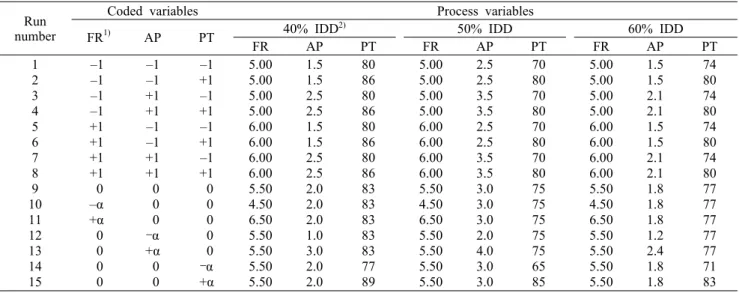
발효홍삼농축액(Metabolab Co., Ltd., Seoul, Korea)은 점성과 흡습성이 강해 발효홍삼농축액 자체로만 구형과립 을 제조하기는 어려움이 있었다. 따라서 본 연구에서는 발효 홍삼농축액이 건강기능식품임을 고려하여 난소화성 덱스트 린(indigestible dextrin)을 발효홍삼농축액 고형분 함량의 40, 50, 60% 수준이 되도록 하여 발효홍삼농축액 구형과립 제조를 시도하였다. 유동층 코팅기(GRE-Lab 1. GR Engi- neering, Gyeonggi, Korea) 운영 조건은 Table 1에 표시하 였으며, 변인은 분무속도(feeding rate, FR)(mL/min), 분무 압력(atomization air pressure, AP)(bar), 제품온도(pro- duct temperature, PT)(oC)로 하고 실험계획은 response surface methodology(RSM)의 design을 이용하였다.
발효홍삼농축액 구형과립 수율 측정
난소화성 덱스트린 농도를 달리하여 유동층 코팅기 운영 조건에 따라 제조한 발효홍삼농축액 구형과립 중 0.8~2.6 mm 크기의 구형과립만 sieve로 선별하여 발효홍삼농축액 구형과립 수율을 측정하였다(18).
발효홍삼농축액 구형과립 흐름성 분석
편리성이 증진된 발효홍삼농축액 구형과립의 흐름성을 평 가하기 위해 입사각(angle of repose)을 측정하였다. 입사각 측정은 발효홍삼농축액 구형과립을 20 g씩 취하여 평평한 유리 바닥으로부터 높이 80 mm의 위치에 설치한 입구 지름 150 mm, 출구 지름 12 mm인 깔때기에 서서히 부은 후에 바닥에 생기는 원뿔 모양의 지름(R)과 높이(H)를 측정한 후
입사각을 아래식과 같이 구하였다(19).
Angle of repose (°)=Arctan H (height of cone) R (diameter of cone)
발효홍삼농축액 구형과립 용해도 분석
편리성이 증진된 발효홍삼농축액 구형과립의 용해성 분 석은 발효홍삼농축액 구형과립 1 g을 50 mL 삼각플라스크 에 각각 취한 다음 25°C의 증류수 10 mL를 넣은 후 교반기 (SK 300 model, Jeio Tech, Gyeonggi, Korea)에서 교반하 여 과립형태의 알갱이가 완전히 분산될 때까지의 시간을 측 정하였다(20).
Ginsenoside 함량 분석
발효홍삼농축액과 난용성 덱스트린 농도를 달리하여 제조 한 발효홍삼농축액 구형과립의 ginsenoside 함량은 HPLC 를 이용하여 분석하였다(21). HPLC(ACME 9000, Young Lin Instrument Co., Ltd., Anyang, Korea)는 ELSD가 부 착된 시스템을 이용하였으며 Prevail carbohydrate ES column(4.6×250 mm, Alltech Associates, Inc., Deer- field, IL, USA)으로 ginsenoside를 분리하였다. Ginseno- side 표준물질 Rh1, Rg2, Rg3, Rg1, Rf, Re, Rd, Rc, Rb2, Rb1, compound K는 Wako사(Osaka, Japan)의 제품을 사 용하였고 내부표준법을 이용하여 정량하였다. 시료에서 ginsenoside는 시료 1 g을 물로 완전히 용해시킨 다음 25 mL 메스플라스크에 정용한 후, 0.45 μm membrane filter 로 여과하여 시험 용액으로 하였다. 이동상 용매는 용매 A (acetonitrile : water : isopropyl alcohol=80:5:15)와 용매 B(acetonitrile : water : isopropyl alcohol=80:25:15)를 사 용하였으며 이들의 혼합비율은 0~28 min 25% B, 28~35 min 85% B, 35~50 min 100% B, 50~55 min 25%로 하였
Table 2. Descriptors, definition, standard references, and standard points for sensory descriptive analysis of spherical granule of fermented red ginseng extracts
Sensory
attributes Descriptors Definition Standard reference Std. score
Appearance Color Uniformness Glossiness Sticky finger
Color related brown
Uniformness of spherical granule Surface glossiness of spherical
granule
Degree of stickiness of spherical granule
Munsell color 5Y5/6
Uniformness from spherical granule in Contec 600 capsule
Glossiness when 0.1 mL starch syrup dropped on aluminum foil surface
Degree of stickiness when 2 g sugar granule dropped on finger
5 15 15 2
Odor
Red ginseng Caramel Coffee
Degree of red ginseng odor Degree of sweet odor Degree of coffee odor
The red ginseng odor from 1% red ginseng extracts The odor from melted caramel between finger The odor from freeze dried coffee granule
2 12 6
Taste
Red ginseng Bitterness Burnt
Degree of red ginseng taste Degree of bitter taste Degree of burnt taste
The ginseng taste from 1% red ginseng extracts Bitterness from 0.0016 M caffeine solution Burnt taste from 0.0016 M caffeine solution
11 9 6
Texture
Crunchiness Mouth melting Roughness
Crunchiness of spherical granule in mouth
Melting properties of spherical granule in mouth
Rough properties of spherical granule in mouth
Crunchiness from ACE cracker (Lotte) Melting properties of 2 g sugar in mouth Melting properties of 2 g sugar in mouth
6 7 13
Aftertaste
Bitterness Unpleasant Red ginseng
Bitter after taste Not fresh after taste Red ginseng after taste
Bitter after taste from 0.0016 M caffeine solution Unpleasant after taste from 0.5% prima solution Aftertaste from 1% red ginseng solution
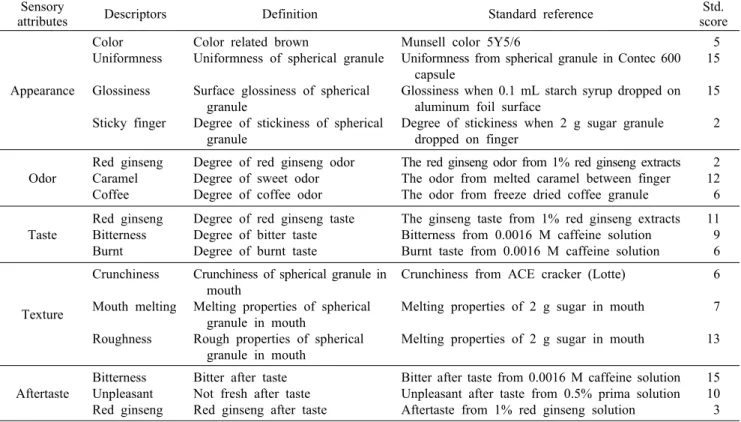
15 10 3 다. 용매의 flow rate는 0.8 mL/min이었고, injection vol-
ume은 10 μL였다. ELSD 분석은 온도 50oC에서 N2 flow rate는 1.4 mL/min으로 실시하였다.
발효홍삼농축액 구형과립 관능 특성 분석
편리성이 증진된 발효홍삼농축액 구형과립의 관능 특성의 평가는 묘사분석(22)을 이용하였다. 묘사분석에 참여한 관 능요원은 경험이 있는 패널 요원 8명(남자 3, 여자 5)을 선발 하여 용어 도출 및 용어의 정의, 표준시료의 결정, 그리고 표준시료를 이용한 훈련과정 세 session을 실시하였으며 각 session에 약 1시간 30분 정도 소요되었다. 관능 특성 평가 를 위해 도출된 용어 및 용어의 정의는 Table 2에 표시하였 다. 묘사분석 본 실험은 15점 척도법을 이용하였으며 평가 시 점수가 높을수록 강도는 높은 것으로 하였다. 외관 평가 를 위한 시료 제시는 각 1 g의 시료를 백색종이(10 cm×10 cm) 위에 올려놓았으며, 맛과 조직감을 위한 시료 제시는 0.25 g을 입안에 한꺼번에 넣고 강도를 평가하도록 하였다.
통계처리
모든 분석은 3반복 하였고, 관능평가 묘사분석은 8명의 결과를 평균±표준편차로 표시하였다. 통계분석은 SPSS (Statistical Package for Social Sciences, SPSS Inc., Chicago, IL, USA)를 이용하여 분산분석(analysis of var- iance, ANOVA)과 다중범위검정(Duncan's multiple range test)을 실시하여 분석하였다(
P
<0.05). RSM 분석의 최적화조건 도출은 Minitab 프로그램(Minitab ver 14, Minitab Inc., State College, PA, USA) 중심합성법을 이용하였고, 도출된 조건에 따른 실험을 실시하여 얻어진 결과로 반응표 면분석을 실시하였다.
결과 및 고찰
발효홍삼농축액 구형과립 수율
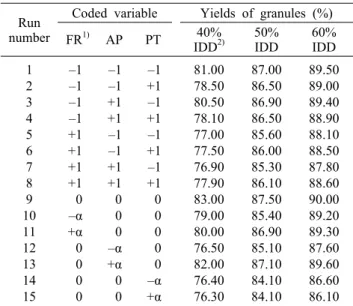
난소화성 덱스트린을 발효홍삼농축액 고형분 함량의 40, 50, 60% 수준이 되도록 하여 발효홍삼농축액 구형과립을 제 조하였을 때 반응표면분석 design을 이용해 얻은 0.8~2.6 mm 크기의 발효홍삼농축액 구형과립 수율은 Table 3에, 그 리고 발효홍삼농축액 구형과립의 최대수율을 이용한 반응 표면분석 상관식은 Table 4에 각각 표시하였다. Table 4에 서 각각의 변인 앞에 있는 상수는 변인의 중요성을 나타내는 것으로 상수의 숫자가 높을수록 최적화에 우세한 영향을 미 친다는 것을 의미한다(23). Table 4의 상관식의 결과를 해 석하면 난소화성 덱스트린을 발효홍삼농축액 고형분 함량 의 40% 수준이 되도록 하여 발효홍삼농축액 구형과립을 제 조하였을 때 가장 중요한 인자는 상수 값 25.301을 갖는 제품온도임을 알 수 있다. 난소화성 덱스트린 50% 혼합에 의한 발효홍삼농축액 구형과립 제조 시 가장 중요한 인자는 상수 값 16.569를 갖는 분무속도임을 알 수 있다. 또한 제일 은 아니지만 상수 값이 큰 15.201 값을 갖는 제품온도 또한 중요한 요소임을 알 수 있다. 난소화성 덱스트린 60% 혼합
Table 3. Yields of spherical granule of fermented ginseng ex- tracts mixed with various concentration of indigestible dextrin (IDD) in RSM experimental design
Run number
Coded variable Yields of granules (%) FR1) AP PT 40%
IDD2) 50%
IDD 60%
IDD 1
2 3 4 5 6 7 8 9 10 11 12 13 14 15
–1 –1 –1 –1 +1 +1 +1 +1 0 –α +α 0 0 0 0
–1 –1 +1 +1 –1 –1 +1 +1 0 0 0 –α +α 0 0
–1 +1 –1 +1 –1 +1 –1 +1 0 0 0 0 0 –α +α
81.00 78.50 80.50 78.10 77.00 77.50 76.90 77.90 83.00 79.00 80.00 76.50 82.00 76.40 76.30
87.00 86.50 86.90 86.50 85.60 86.00 85.30 86.10 87.50 85.40 86.90 85.10 87.10 84.10 84.10
89.50 89.00 89.40 88.90 88.10 88.50 87.80 88.60 90.00 89.20 89.30 87.60 89.60 86.60 86.10
1)FR, feeding rate (mL/min); AP, atomization air pressure (bar);
PT, product temperature (oC).
2)Spherical granule of fermented red ginseng extracts mixed with 40, 50, and 60% indigestible dextrin versus the soluble solid content in fermented red ginseng extracts.
Table 4. Regression equation of yields for spherical granule of fermented red ginseng mixed with various concentration of indigestible dextrin (IDD) in RSM experimental design
Treatment1) Regression equation
40% IDD 50% IDD 60% IDD
Y=-934.438-131.944×FR×AP+25.301×PT-301.111×FR×FR+6.500×AP×FR-3.261×AP×
AP+5.333×PT×FR+0.050×PT×AP-0.171×PT×PT2)
Y=-551.466+16.569×FR+3.368×AP+15.201×PT-147.222×FR×FR-0.500×AP×FR-1.522×AP×
AP+1.750×PT×FR+0.041×PT×AP-0.097×PT×PT
Y=-561.964-65.611×FR+3.594×AP+16.097×PT-82.777×FR×FR-2.006×AP×FR-1.477×AP×
AP+1.833×PT×FR+0.033×PT×AP-0.103×PT×PT
1)Spherical granule of fermented red ginseng extracts mixed with 40, 50, and 60% indigestible dextrin versus the soluble solid content in fermented red ginseng extracts.
2)FR, feeding rate (mL/min); AP, atomization air pressure (bar); PT, product temperature (°C).
Table 5. Predicted levels of optimum preparation conditions for the maximized yields of spherical granule of fermented red gin- seng extracts mixed with various concentration of indigestible dextrin (IDD) by the ridge analysis and superimposing of their response surfaces
Preparation conditions
Levels for the maximum response surfaces 40% IDD1) 50% IDD 60% IDD Feeding rate (FR)
Atomization air pressure (AP) Product temperature
(PT) R2
Morphology Predicted yield (%)
5.30 2.18 82.55 0.67 Maximum
82.22
5.40 2.15 83.03 0.71 Maximum
87.78
5.20 2.15 82.67 0.86 Maximum
90.26
1)Spherical granule of fermented red ginseng extracts mixed with 40, 50, and 60% indigestible dextrin versus the soluble solid content in fermented red ginseng extracts.
에 의해 제조된 발효홍삼농축액 구형과립 제조 시 가장 중요 한 인자는 상수 값 16.097을 갖는 제품온도임을 알 수 있다.
따라서 난용성 덱스트린을 이용하여 발효홍삼농축액을 제 조할 때 유동층 코팅기 운영 조건에 가장 크게 영향을 미치 는 요인은 제품온도임을 알 수 있었다. Ehlers 등(24)은 유 동층 과립기에서 제품온도가 높아지면 입자의 크기가 작은 granule이 형성한다고 보고하여 제품온도가 과립화에 중요 한 인자임을 보고하였다. Fries 등(25)은 유동층 코팅에서 균일하고 크며 안정적인 과립을 제조하는 데 영향을 미치는 요인으로 입자 표면의 젖는 정도(wetting of the particle surface), 입자들의 충돌(collisions), 입자들의 결착(particle adhesion) 등이 있으며 granule 성장 시 용액의 분무가 중요 하다고 보고하였고, Tan 등(26)은 과립이 spray zone에서 particle droplet collision이 일어나 spray-binder에 의해 뭉쳐지면서 형성되는데 이때 spray binder 분무속도와
spray binder의 물성은 매우 중요하다고 보고하여 본 실험 의 결과 발효홍삼농축액 구형과립 제조에서 제품온도와 분 무속도가 중요하다는 결과와 유사함을 알 수 있었다.
발효홍삼농축액 구형과립 제조를 위한 RSM 방식에 의해 최적화된 조건은 Table 5에 표시하였다. RSM 디자인 적용 에 가장 좋은 조건은 IDD 60% 처리구가 가장 적합한 것을 알 수 있었다. 난소화성 덱스트린을 발효홍삼농축액 고형분 함량의 40%가 되도록 혼합하여 발효홍삼농축액 구형과립 을 제조하였을 때 RSM 최적화 조건은 분무속도 5.30 mL/
min, 분무압력 2.18 bar, 제품온도 82.55oC에서 수율이 82.22%가 될 것으로 예측되었다. 이때 자료로는 표시하지 않았지만 분무압력을 높이면 구형과립이 형성되는 것보다 덩어리진 현상이 높아지는 것을 알 수 있었다. 난소화성 덱 스트린 50%를 혼합하여 발효홍삼농축액 구형과립 제조 시 RSM 최적화 조건은 분무속도 5.40 mL/min, 분무압력 2.15 bar, 제품온도 83.03°C에서 수율이 87.78%가 될 것으로 예측할 수 있었다. 난소화성 덱스트린 60%를 혼합하여 발효 홍삼농축액 구형과립 제조 시 RSM 최적화 조건은 분무속도 5.20 mL/min, 분무압력 2.15 bar, 제품온도 82.67°C에서 수율이 90.26%가 될 것으로 예측되었다.
발효홍삼농축액 구형과립의 수율은 다소 낮지만 발효홍
Fig. 1. Picture for fermented red ginseng ex- tracts and the spherical granule of fermented red ginseng extracts improved with convenience.
Fermented red ginseng extracts Spherical granule of fermented red ginseng extracts improved with convenience
Table 6. Physical properties of fermented red ginseng extracts, powder of fermented red ginseng extracts, and spherical granule of fermented red ginseng extracts
Fermented red ginseng
extracts Powder of fermented red
ginseng extracts Spherical granule of fermented red ginseng extracts Soluble time (s)
Angle of repose (°)
11.3±0.31b1)2)
-
15.7±0.82a 40.77±0.84a
6.4±0.31c 14.89±0.32b
1)Mean±standard deviation (n=3).
2)Means with the same letter at same row are not significantly different (P<0.05).
Table 7. Physical properties of spherical granule of fermented red ginseng extracts made with various concentration of in- digestible dextrin (IDD)
40% IDD1) 50% IDD 60% IDD Soluble time (s)
Angle of repose (°)
7.68±0.28a2)3) 15.46±2.74a
7.18±0.19a 14.31±0.59ab
7.74±0.29a 13.26±1.59b
1)Spherical granule of fermented red ginseng extracts mixed with 40, 50, and 60% indigestible dextrin versus the soluble solid content in fermented red ginseng extracts.
2)Mean±standard deviation (n=3).
3)Means with the same letter at same row are not significantly different (P<0.05).
삼농축액의 함량이 상대적으로 높은 난소화성 덱스트린 혼 합비율 50%로 분무속도 5.40 mL/min, 분무압력 2.15 bar, 제품온도 83.03oC의 유동층 코팅기 운영 조건에서 제조된 발효홍삼농축액 구형과립의 모양을 Fig. 1에 표시하였다.
발효홍삼농축액 구형과립 물리적 특성 분석
발효홍삼농축액, 발효홍삼농축액 분말, 발효홍삼농축액 구형과립에 대한 용해시간 및 입사각을 측정한 결과는 Table 6과 같다. 발효홍삼농축액, 발효홍삼농축액 분말, 발 효홍삼농축액 구형과립의 용해시간은 각각 11.3초, 15.7초, 6.4초로 발효홍삼농축액 구형과립이 물에 가장 빨리 용해됨 을 알 수 있었는데(20), 이것은 발효홍삼농축액을 구형과립 형태로 제조하면 발효홍삼농축액의 섭취 시 불편함이 상당 히 개선될 수 있음을 보여 주었다. 특히 입자의 흐름성 정도 를 평가하는 입사각 측정 시(19) 발효홍삼농축액 구형과립 은 14.89도, 발효홍삼농축액 분말은 40.77도로 각각 분석되 었는데, 발효홍삼농축액 구형과립의 아주 높은 흐름성은 액 상 형태인 발효홍삼농축액의 문제점을 해결해 줄 새로운 제 형의 홍삼제품이 될 것으로 판단되었다.
난소화성 덱스트린 40, 50, 60% 비율로 혼합하여 제조된 발효홍삼농축액 구형과립의 물리적 특성은 Table 7과 같다.
난소화성 덱스트린 혼합비율이 높을수록 입사각이 낮아져, 발효홍삼농축액 구형과립의 흐름성 및 편리성을 증진시키 기 위해서는 난소화성 덱스트린의 혼합비율을 높여야 함을 알 수 있었다. 한편 난소화성 덱스트린 혼합비율별 발효홍삼 농축액 구형과립의 용해시간은 통계적으로 유의차가 없음 을 보여 주었다.
발효홍삼농축액 구형과립 ginsenoside 함량 분석
Ginsenosides는 steroids 또는 triterpenes를 비당 부분 으로 갖는 배당체의 일종으로 각 ginsenoside에 결합된 당 사슬의 형태에 따라 생리활성이 다르며, ginsenoside의 당 사슬은 인체의 대장에 존재하는 bacteria에 의해 분해되어 생리활성이 증가하는 것으로 알려져 있다(12). 발효홍삼농 축액은 홍삼에 유산균을 접종한 후 발효시켜 ginsenosides 의 당 부분을 분해하여 생리활성을 증진시키고자 개발한 것 으로 Cho 등(21)은 발효과정 중 총 ginsenosides 함량이 증가하고, Rg3, compound K, Rh1, RG5와 Rk1 등의 대사 후 생성될 수 있는 ginsenoside 화합물들이 증가한다고 보 고하였다.본 연구에서는 유동층 코팅기를 사용하여 발효홍삼농축 액을 구형과립으로 제조 시 ginsenoside 함량의 변화 정도 를 파악하기 위해 발효홍삼농축액 및 난소화성 덱스트린 혼 합비율별 발효홍삼농축액 구형과립에 대한 ginsenoside 함 량을 각각 분석하였으며 그 결과는 Table 8과 같다. 발효홍
Table 8. Ginsenoside analysis results of spherical granule of fermented red ginseng extracts (mg/g)
Type of ginsenosides FRGE1) 40% IDD2) 50% IDD 60% IDD
Rh1 Rg2 Rg3 Rg1 Rf Re Rd Rc Rb2 Rb1 Compound K
Trace 1.23±0.39a3)4) 4.64±0.26a 1.84±0.98a 9.88±0.53a 5.68±0.64a 6.29±0.45a 2.01±0.37a 1.62±0.28a 7.53±0.52a 4.34±0.29a
Trace 1.14±0.16a 4.35±0.48a 1.74±0.28a 9.38±0.68a 5.33±0.51a 5.93±0.40a 1.88±0.21a 1.50±0.25a 7.10±0.50a 4.01±0.31a
Trace 0.95±0.12a 3.63±0.58b 1.45±0.35ab 7.81±0.43b 4.44±0.54ab 4.94±0.39b 1.56±0.12ab 1.25±0.22ab 5.91±0.91ab 3.34±0.19a
Trace 0.76±0.19a 2.90±0.21c 1.16±0.92b 6.25±0.53c 3.55±0.64c 3.95±0.28c 1.25±0.13b 1.00±0.17b 4.73±0.52b 2.67±0.15a Total 45.07±3.75a 42.33±1.74a 35.28±1.63b 28.22±1.68c
1)FRGE: fermented red ginseng extracts with 60% soluble solid content.
2)Spherical granule of fermented red ginseng extracts mixed with 40, 50, and 60% indigestible dextrin versus the soluble solid content in fermented red ginseng extracts.
3)Mean±standard deviation (n=3).
4)Means with the same letter at same row are not significantly different (P<0.05).
Table 9. Sensory descriptive analysis results of spherical granule of fermented red ginseng extracts made with various concentration of indigestible dextrin
Sensory attributes Descriptors 40% IDD1) 50% IDD 60% IDD
Appearance
Color Uniformness Glossiness Sticky finger
10.94±2.70a2)3) 7.93±2.71b 12.64±0.94a 11.79±2.31a
10.69±1.60a 11.43±1.64a 10.64±1.38b 10.21±2.45a
10.57±1.81a 10.79±1.91a 7.50±1.85c 10.93±3.47a Odor
Red ginseng Caramel Coffee
7.64±2.06a 6.21±3.63a 4.17±0.73a
5.64±1.89a 4.80±2.88a 3.07±0.93b
5.79±2.58a 5.61±3.67a 2.64±1.03c Taste
Red ginseng Bitterness Burnt
12.21±2.20a 11.50±3.50a 8.93±5.14a
10.36±2.56a 10.47±3.33a 8.14±4.91a
10.50±2.60a 10.00±3.97a 8.93±3.37a
Texture
Crunchiness Mouth melting Roughness
8.93±4.49a 8.29±4.34a 11.47±3.96a
7.61±4.13a 8.71±3.63a 11.14±2.53a
7.21±4.00a 9.97±3.28a 9.86±1.44a Aftertaste
Bitterness Unpleasant Red ginseng
12.10±2.55a 6.40±3.33a 11.93±1.84a
12.00±1.76a 6.36±2.69a 11.21±2.20a
11.90±1.13a 6.61±2.79a 10.79±2.61a
1)Spherical granule of fermented red ginseng extracts mixed with 40, 50, and 60% indigestible dextrin versus the soluble solid content in fermented red ginseng extracts.
2)Mean±standard deviation (n=8).
3)Means with the same letter at same row are not significantly different (P<0.05).
삼농축액 및 발효홍삼농축액 구형과립의 고형분 함량이 각 각 60% 및 95%임을 감안하면, 발효홍삼농축액을 구형과립 화하는 과정 중 ginsenoside의 함량 변화는 거의 없는 것으 로 파악되었다. 이 결과는 유동층 코팅기를 이용하여 난소화 성 덱스트린 첨가 없이 100% 홍삼농축액만으로 홍삼농축액 알갱이를 제조할 때 ginsenoside Rb1, Rb2, Rb3과 Rc의 변화가 있었지만 변화량은 5% 미만이었으며, Rg1, Rf, Rg2, Rh1, Rd와 Rg3의 변화는 없었다고 보고한 Lee와 Shin(27) 의 결과와도 거의 일치함을 보여 주었다.
발효홍삼농축액 구형과립 관능 특성 분석
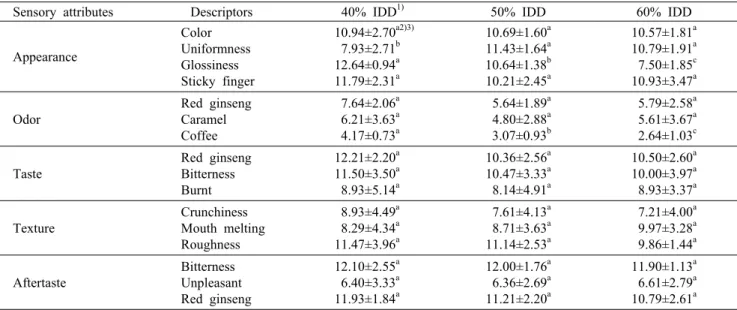
난소화성 덱스트린 혼합비율을 달리하면서 제조된 발효 홍삼농축액 구형과립에 대한 관능 특성 분석 결과는 Table 9와 같다.
외관 특성에서는 발효홍삼농축액 구형과립의 색깔(color of granule) 및 손에 묻는 정도(sticky finger of spherical granule)는 통계적으로 난소화성 덱스트린 혼합비율별 유 의차가 없음을 알 수 있었다. 발효홍삼농축액 알갱이의 균일 한 정도(uniformness of spherical granule)는 50% IDD와 60% IDD 사이에는 통계적 유의차가 없었지만 40% IDD가 가장 균일하지 않음을 보여 주었는데, Bouwman 등(28)은
점도가 있는 용액으로 granule 제조 시 덱스트린의 함량이 적을수록 형태가 일정하지 않은 granule이 제조된다는 보고 와 유사함을 알 수 있었다. 한편 발효홍삼농축액 구형과립 표면의 반짝이는 정도(glossiness of granule surface)는 난소화성 덱스트린의 함량이 높아질수록 표면의 반짝이는 정도가 낮아짐을 보여 주었다.
냄새 특성에서 홍삼향(red ginseng odor)과 카라멜향 (caramel odor)은 난소화성 덱스트린 혼합비율별로 통계적 인 유의차가 없었지만, 커피향(coffee odor)은 난소화성 덱 스트린의 함량이 높아질수록 낮아지는 것으로 분석되었다.
맛 특성에서는 홍삼맛(red ginseng taste), 쓴맛(bitter- ness), 탄맛(burnt taste) 모두 난소화성 덱스트린 혼합비율 별 유의차를 나타내지 않았다.
조직감 특성에서는 입안에서 바삭거리는 정도(crunchi- ness), 입안에서 알갱이가 녹는 정도(mouth melting), 알갱 이가 입안에서 껄끄러운 정도(roughness) 모두 통계적으로 유의차가 없음을 보여 주었다.
요 약
난소화성 덱스트린 혼합비율을 발효홍삼농축액의 40, 50, 60%가 되도록 발효홍삼농축액을 제조한 다음 유동층 코팅 기의 분무속도, 분무압력, 제품온도를 변수로 조정하면서 발 효홍삼농축액 구형과립을 제조하였다. 발효홍삼농축액 구 형과립의 용해시간은 6.4초로 발효홍삼농축액의 11.3초보 다 훨씬 짧아 발효홍삼농축액을 구형과립 형태로 제조하면 발효홍삼농축액의 섭취 시 불편함이 상당히 개선될 수 있음 을 보여 주었다. 특히 발효홍삼농축액 구형과립의 입사각은 14.89도로 발효홍삼농축액 분말의 40.77도와 비교 시 흐름 성이 아주 좋음을 보여 주었는데, 발효홍삼농축액 구형과립 의 아주 높은 흐름성은 액상 형태인 발효홍삼농축액의 문제 점을 해결해 줄 새로운 제형의 발효홍삼제품이 될 것으로 판 단되었다. 난소화성 덱스트린 혼합비율이 높을수록 입사각 이 낮아져 발효홍삼농축액 구형과립의 흐름성 및 편리성을 증진시키기 위해서는 난소화성 덱스트린의 혼합비율을 높 여야 함을 알 수 있었으며, 난소화성 덱스트린 혼합비율별 발효홍삼농축액 구형과립의 용해시간은 통계적으로 유의차 가 없음을 보여 주었다. 난소화성 덱스트린 50% 및 발효홍 삼농축액 고형분 50%를 혼합한 용액으로 분무속도 5.40 mL/min, 분무압력 2.15 bar, 제품온도 83.03°C의 유동층 코팅 조건으로 제조하면 발효홍삼농축액 구형과립의 수율 은 87.78%가 될 것으로 예측되었다.
감사의 글
본 연구는 농림축산식품부 고부가식품기술개발사업에 의해 이루어진 것으로, 그 지원에 감사드립니다.
REFERENCES
1. Wu JY, Gardner BH, Murphy CI, Seals JR, Kensil CR, Recchia J, Beltz GA, Newman GW, Newman MJ. 1992.
Saponin adjuvant enhancement of antigen-specific immune responses to an experimental HIV-1 vaccine. J Immunol 148: 1519-1525.
2. Sato K, Mochizuki M, Saiki I, Yoo YC, Samukawa K, Azuma I. 1994. Inhibition of tumor angiogenesis and meta- stasis by a saponin of Panax ginseng, ginsenoside-Rb2. Biol Pharm Bull 17: 635-639.
3. Liu ZQ, Luo XY, Liu GZ, Chen YP, Wang ZC, Sun YX.
2003. In vitro study of the relationship between the structure of ginsenoside and its antioxidative or prooxidative activity in free radical induced hemolysis of human erythrocytes.
J Agric Food Chem 51: 2555-2558.
4. Noh KH, Son JW, Kim HJ, Oh DK. 2009. Ginsenoside com- pound K production from ginseng root extract by a thermo- stable beta-glycosidase from Sulfolobus solfataricus. Biosci Biotechnol Biochem 73: 316-321.
5. Popovich DG, Kitts DD. 2002. Structure-function relation- ship exists for ginsenosides in reducing cell proliferation and inducing apoptosis in the human leukemia (THP-1) cell line. Arch Biochem Biophys 406: 1-8.
6. Hsu S. 2005. Green tea and the skin. J Am Acad Dermatol 52: 1049-1059.
7. Jukes TH, Cantor C. 1969. Evolution of protein molecules.
In Mammalian Protein Metabolism. Munro HN, ed. Aca- demic Press Inc., New York, NY, USA. p 21-132.
8. Kim SJ, Murthy HN, Hahna EJ, Lee HL, Paek KY. 2007.
Parameters affecting the extraction of ginsenosides from the adventitious roots of ginseng (Panax ginseng C.A. Meyer).
Sep Purif Technol 56: 401-406.
9. Amidon GL, Lennernäs H, Shah VP, Crison JR. 1995. A theoretical basis for a biopharmaceutic drug classification:
the correlation of in vitro drug product dissolution and in vivo bioavailability. Pharm Res 12: 413-420.
10. Kim BG, Choi SY, Kim MR, Suh HJ, Park HJ. 2010.
Changes of ginsenosides in Korean red ginseng (Panax gin- seng) fermented by Lactobacillus plantarum M1 Process Biochem 45: 1319-1324.
11. Park HJ, Jung DH, Joo H, Kang NS, Jang SA, Lee JG, Sohn EH. 2010. The comparative study of anti-allergic and an- ti-inflammatory effects by fermented red ginseng and red ginseng. Korean J Plant Res 23: 415-422.
12. Kim DH. 2009. Metabolism of ginsenosides to bioactive compounds by intestinal microflora and its industrial appli- cation. J Ginseng Res 33: 165-176.
13. Shibata S, Fujita M, Itokawa H, Tanaka O, Ishii T. 1963.
Studies on the constituents of japanese and chinese crude drugs. Ⅺ. Panaxadiol, a sapogenin of ginseng roots. Chem Pharm Bull (Tokyo) 11: 759-761.
14. Han BH, Park MH, Han YN, Woo LK, Sankawa U, Yahara S, Tanaka O. 1982. Degradation of ginseng saponins under mild acidic conditions. Planta Med 44: 146-149.
15. Ko SR, Suzuki Y, Choi KJ, Kim YH. 2000. Enzymatic prep- aration of genuine prosapogenin, 20(S)-ginsenoside Rh1, from ginsenosides Re and Rg1. Biosci Biotechnol Biochem 64: 2739-2743.
16. Mochizuki M, Yoo YC, Matsuzawa K, Sato K, Saiki I, Tono-oka S, Samukawa K, Azuma I. 1995. Inhibitory effect of tumor metastasis in mice by saponins, ginsenoside-Rb2, 20(R)- and 20(S)-ginsenoside-Rg3, of red ginseng. Biol Pharm Bull 18: 1197-1202.
17. Park SJ, Kim DH, Kim SS. 2006. Preparation and quality characteristics of the fermentation product of ginseng by lactic acid bacteria (FGL). J Ginseng Res 30: 88-94.
18. Hamashita T, Nakagawa Y, Aketo T, Watano S. 2007. Gran- ulation of core particles suitable for film coating by agi- tation fluidized bed Ⅰ. Optimum formulation for core par- ticles and development of a novel friability test method.
Chem Pharm Bull (Tokyo) 55: 1169-1174.
19. Maulny APE, Beckett ST, Mackenzie G. 2005. Physical pro- perties of co-crystalline sugar and honey. J Food Sci 70:
E567-E572.
20. Wright BJ, Zevchak SE, Wright JM, Drake MA. 2009. The impact of agglomeration and storage on flavor and flavor stability of whey protein concentrate 80% and whey protein isolate. J Food Sci 74: S17-S29.
21. Cho HJ, Jung EY, Oh SH, Yoon B, Suh HJ, Lee HS. 2010.
Microbial conversion of ginsenoside from the extract of Korean red ginseng (Panax ginseng) by Lactobacillus sp.
J Food Sci Nutr 15: 105-112.
22. Stone H, Sidel JL. 1993. Sensory evaluation. 2nded. Aca- demic Press Inc., San Diego, CA, USA. p 251.
23. Patel YL, Sher P, Pawar AP. 2006. The effect of drug con-
centration and curing time on processing and properties of calcium alginate beads containing metronidazole by response surface methodology. AAPS PharmSciTech 7: E1-E7.
24. Ehlers H, Liu A, Räikkönen H, Hatara J, Antikainen O, Airaksinen S, Heinämäki J, Lou H, Yliruusi J. 2009. Granule size control and targeting in pulsed spray fluid bed gran- ulation. Int J Pharm 377: 9-15.
25. Fries L, Antonyuk S, Heinrich S, Dopfer D, Palzer S. 2013.
Collision dynamics in fluidised bed granulators: A DEM- CFD study. Chem Eng Sci 86: 108-123.
26. Tan HS, Salman AD, Hounslow MJ. 2006 Kinetics of flu- idised bed melt granulation Ⅰ: The effect of process varia- bles. Chem Eng Sci 61: 1585-1601.
27. Lee GH, Shin MG. 2009. Production of spherical granule from viscous red ginseng extracts for improving product flu- ency and preservation and its physicochemical properties.
J Food Sci 74: E519-E525.
28. Bouwman AM, Visser MR, Meesters GM, Frijlink HW.
2006. The use of Stokes deformation number as a predictive tool for material exchange behaviour of granules in the
‘equilibrium phase’ in high shear granulation. Int J Pharm 318: 78-85.