• 검색 결과가 없습니다.

Effects of Continuous Application of Green Manures on Microbial Community in Paddy Soil

N/A
N/A
Protected

Academic year: 2021

Share "Effects of Continuous Application of Green Manures on Microbial Community in Paddy Soil"

Copied!
7
0
0

로드 중.... (전체 텍스트 보기)

전체 글

(1)

Effects of Continuous Application of Green Manures on Microbial Community in Paddy Soil

Sook-Jin Kim, Kwang Seop Kim

1

, Jong-Seo Choi, Min-Tae Kim, Yong Bok Lee

2

, Ki-Do Park*, and Seonggi Hur

Crop Cultivation and Environment research Division, NICS, RDA, Suwon, 16613, Republic of Korea

1

Organic Agriculture Research Institute, Gyeongbuk Agricultural Research & Extension service, Uiseong, Gyeongbuk, 37339, Republic of Korea

2

Institute of Agriculture and Life Science, Gyeongsang National University, Jinju, 52828, Republic of Korea

(Received: September 14 2015, Revised: October 22 2015, Accepted: October 22 2015)

Green manure crops have been well recognized as the alternative for chemical fertilizer, especially N fertilizer, because of its positive effect on soil and the environment. Hairy vetch and green barley are the most popular crops for cultivation of rice in paddy field. This study was conducted to evaluate effects of hairy vetch and green barley on soil microbial community and chemical properties during short-term application (three years).

For this study, treatments were composed of hairy vetch (Hv), green barley (Gb), hairy vetch + green barley (Hv+Gb), and chemical fertilizer without green manure crops (Con.). Hv+Gb treatment showed the highest microbial biomass among treatments. Principal component analysis (PCA) showed that PC1 (73.0 %) was affected by microbial biomass and PC2 (21.5 %) was affected by fungi, cy19:0/18:1 ω7c (stress indicator).

Combined treatment with hairy vetch and green barley could be more efficient than green manure crop treatment as well as chemical fertilizer treatment for improvement of soil microorganisms.

Key words: Green manure, Hairy-vetch, Green barley, Microbial community, Paddy soil, PCA

Hv: hairy vetch, Gb: green barley, Hv+Gb: hairy vetch + green barley

Principal component analysis of the PLFAs extracted on the paddy soil treated with different green manures.

1)

*Corresponding author : Phone: +82316950650, Fax: +82316954095, E-mail: [email protected]

§

Acknowledgement : This study was carried out with the support of “Cooperative Research Program for Agricultural Science & Technology

Development (Project No. PJ008697)”, Rural Development Administration, Republic of Korea.

(2)

Introduction

농경지에서 이용되는 풋거름작물은 토양 유기물 및 무기 양분을 공급해 입단형성을 촉진시키고 미생물의 활동을 증 진시키는 등 토양의 물리적 특성과 미생물적 특성 개선에 효과적이다 (Choi et al., 2010; Jeon et al., 2010; Mac Rae et.al., 1985; Mandal et al., 2003). 작물 재배를 위한 풋거 름작물 이용 연구는 토양의 이화학적 특성 변화, 작물의 생 육 및 수량성에 미치는 영향에 관해 진행되어 왔으며, 특히 작물 생육에 중요한 요소인 질소의 방출패턴 및 양분수지 등에 관한 다양한 연구들이 진행되어왔다 (Aulakh et al., 1998; Aulakh et al., 2001; Choi et al., 2010; Kim et al., 2002; Seo et al., 1998). 또한 효과적인 풋거름작물의 이용 을 위해 적정 풋거름작물의 선발, 두과 녹비작물의 질소축 적 효과, 풋거름작물의 혼파 비율 및 유기농업 적용 등의 연 구들도 수행되었다 (Kim et al., 2013; Stope et al., 1996;

Tosti et al., 2012).

특히 국내에서 벼 재배시 질소비료 대체를 위한 풋거름 작물로 이용되는 헤어리베치는 파종 시기, 파종방법 및 풋 거름작물 생체량 증대를 위한 돈분액비 혼용 기술, 논 관개 량에 미치는 효과 및 토양탄소에 미치는 영향 등의 연구가 활발히 진행되었다 (Cho et al., 2012; Jeon et al., 2011;

Kim et al., 2004).

미생물은 살아있는 토양의 구성요소로 작물의 양분순환 에 중요한 역할을 하고 있으며, DNA 분석이나 PLFA 등을 이용한 토양 미생물의 활동과 미생물군집 구조 등의 연구가 수행되고 있다 (Zhang et al., 2006). 이러한 방법을 통해 무기질 및 유기질비료의 성분별‧시비수준별 토양 미생물군 집분포의 변화에 관한 연구들이 진행되었으며, 국내에서도 과원 및 농경지의 미생물군집분포에 관한 연구결과가 발표 되었다 (Bossio et al., 1998; Peacock et al., 2001; Zhang et al., 2007; Eo et al., 2010; Kim et al., 2015; Kim et al., 2011). 국내 논 토양을 대상으로 한 미생물군집분포에 관한 연구는 무기질비료 장기연용에 의한 영향 및 풋거름보 리, 자운영의 환원에 의한 초기 미생물군집변화에 대하여 주로 이루어졌다 (Daquiado et al., 2013; Kim et al., 2011). 그러나 무기질비료 대체를 위해 논에서 많이 이용되 고 있는 헤어리베치의 연속적인 환원 및 풋거름보리와의 혼 파가 토양 미생물상의 개선 및 미생물의 군집분포에 미치는 영향에 관한 연구는 거의 수행되지 않았다.

이에 본 연구에서는 벼를 재배하는 논토양에서 3년간 헤 어리베치, 풋거름보리 및 헤어리베치와 풋거름보리를 혼파 하여 환원하였을 때 토양미생물 군집분포 양상에 미치는 영 향을 알아보고자 하였다.

Materials and Methods

시험포장 및 풋거름작물 재배 본 연구는 경기도 수

원 소재 국립식량과학원 작물환경시험포장 (N: 30°50′15″, E: 127°02′31″)에서 수행되었다. 시험 전 토양은 세사양토 (강서통)로 total N 1.2 g kg

-1

, 유기물 21.3 g kg

-1

, Av.P

2

O

5

89.4 mg kg

-1

, Av.SiO

2

는 92.4 mg kg

-1

이었다. 공시 벼 품 종은 운광으로 2012년부터 2014년까지 3년간 재배하였다.

각 처리구의 면적은 198 m

2

(5.7×34.7 m)으로 단구제로 하 였으며, 토양조사를 위한 시료채취는 3개의 부표본점 (subplot) 에서 3반복으로 실시하였다.

공시 풋거름작물은 헤어리베치와 풋거름보리를 이용하였 으며, 처리구는 풋거름작물을 환원하지 않고 무기질비료만 시용한 Con, 헤어리베치만 환원한 Hv, 풋거름보리만 환원 한 Gb 그리고 헤어리베치와 풋거름보리를 50:50의 비율로 혼파하여 토양에 환원한 Hv+Gb로 구성하였다. 풋거름작물 의 토양환원과 무기질비료의 시용에 의한 토양 미생물 군집 분포의 차이를 보기 위하여 풋거름작물을 환원한 처리구는 무기질비료를 시비하지 않고 재배하였다.

풋거름작물은 벼 수확 후 10월 초에 헤어리베치 6~9 kg 10a

-1

, 풋거름보리 14 kg 10a

-1

을 조파하여 벼 이앙 2주 전 (5월 중순)에 로터리를 이용하여 2,000 kg 10a

-1

수준으로 토양에 환원하였다. 환원시점의 헤어리베치의 총질소 함량 은 3.4%, 총탄소 함량은 41.7%로 CN율이 12.3이었고, 풋거 름보리의 총질소 함량은 1.1%, 총탄소 함량은 42.4%로 CN 율이 38.5였다. 풋거름작물을 환원한 처리구에는 무기질비 료를 시용하지 않았고 Con 처리구는 표준시비량 (N-P

2

O

5

- K

2

O=9-4.5-5.7 kg 10a

-1

)에 준하여 무기질비료를 시비하였 고, 기타 재배관리는 농촌진흥청 벼 표준 재배법에 준하였 다 (RDA, 2015).

토양 미생물 군집 분석 풋거름작물이 논토양 미생물

군집에 미치는 영향을 조사하기 위한 토양은 2014년 벼 수

확 직후 (3년차)에 각 처리구별 3지점에서 0-15 cm 깊이

(작토층)의 토양을 채취하였으며, 채취 지점별로 3지점의

시료를 혼합하여 분석시료로 이용하였다. PLFA (phospholipid

fatty acid)의 추출과 분석은 Frostegard et al. (1991)의 방

법을 따랐다. 토양시료 2 g과 chloroform 1.9 mL, methanol

3.8 mL, citrate buffer 1.5 mL, Bligh and Dyer reagent 2

mL를 혼합하여 vortex 후 원심분리 하였다. 상층액에

chloroform과 citrate buffer를 첨가해 원심분리 하여 유기

물과 수화물 제거 후 40°C에서 농축시켰다. Chloroform을

가하여 활성화 된 silica column (SUPELCO, Pennsylvania,

USA)을 이용해 neutral-, glycol- 및 phospho-lipid로 분

리하였다. 분리된 phospholipid 시료를 농축한 후 ester 교

환반응 시약을 넣고 15분간 37°C로 가열한 뒤 acetic acid와

(3)

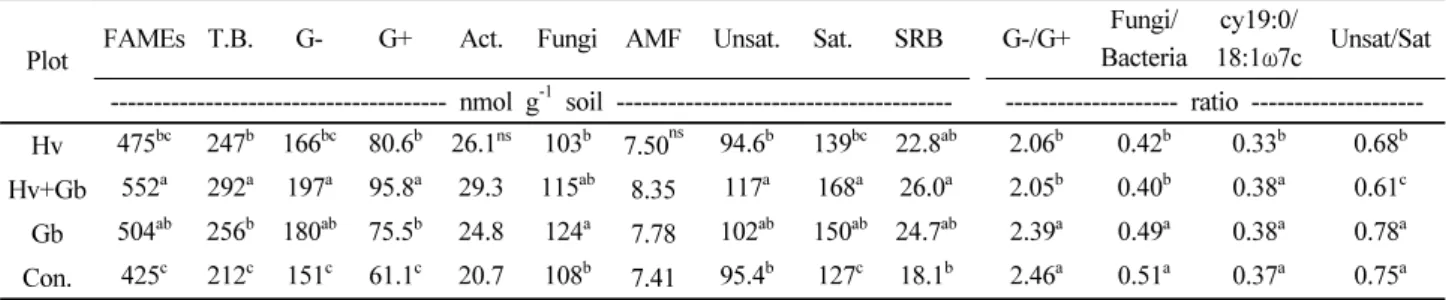
Table 1. Microbial biomass of paddy soils influenced by green manure crops.

Plot FAMEs T.B. G- G+ Act. Fungi AMF Unsat. Sat. SRB G-/G+ Fungi/

Bacteria

cy19:0/

18:1 ω7c Unsat/Sat --- nmol g

-1

soil --- --- ratio --- Hv 475

bc

247

b

166

bc

80.6

b

26.1

ns

103

b

7.50

ns

94.6

b

139

bc

22.8

ab

2.06

b

0.42

b

0.33

b

0.68

b

Hv+Gb 552

a

292

a

197

a

95.8

a

29.3 115

ab

8.35 117

a

168

a

26.0

a

2.05

b

0.40

b

0.38

a

0.61

c

Gb 504

ab

256

b

180

ab

75.5

b

24.8 124

a

7.78 102

ab

150

ab

24.7

ab

2.39

a

0.49

a

0.38

a

0.78

a

Con. 425

c

212

c

151

c

61.1

c

20.7 108

b

7.41 95.4

b

127

c

18.1

b

2.46

a

0.51

a

0.37

a

0.75

a

Hv: hairy vetch, Gb: green barley, Hv+Gb: hairy vetch mixed with green barley, T.B.: total bacterial, G

-

:Gram-negative bacteria, G

+

: Gram-positive bacteria, Act.: Actinomycetes, AMF: Arbuscular mycorrhizal fungi, unsat: monounsaturated, Sat:

saturated, SRB: sulfate reducing bacteria.

Values are expressed as means followed the different regular letters in a column are significantly different (P 〈0.05) by the least significant different (LSD) test.

chloroform을 첨가하여 층을 분리시키고, chloroform 추출 을 반복하여 실온에서 건조시켰다. Hexane으로 시료를 용 해시켜 분석에 이용하였다.

지방산의 정성과 정량은 MIDI software (Microbial ID, Inc., Newark, DE. USA)를 이용하였으며, 지방산 양의 환 산은 19:0 지방산을 이용하였다. GC-MIDI에서 검출된 피크 중에서 탄소수가 10개에서 20개인 인지질 지방산 값 중 미 생물 군집분포 분석에 사용된 인지질 지방산 지표는 6개 이 상의 시료에서 동시에 검출된 지표 지방산 중 32종으로 다 음과 같다.: ①그램음성균: 14:0, 16:0, 18:0, 16:1 2OH, 16:1ω5c, 17:1ω8c, 17:0 cyclo, anteiso 17:1ω9c, 18:1ω7c, 20:1ω9c, 20:4ω6,9,12,15c, ②그램양성균: 14:0 iso, 15:0, 15:0 iso, 15:0 anteiso, 16:0 iso, 17:0, 17:0 iso, 17:0 anteiso, ③불포화 지방산: 15:1 ω6c, 16:1 ω9c, 16:1 ω5c, 17:1ω8c, 18:1ω9c, 18:1ω7c, 19:1ω9c/19:1ω11c, 20:1ω9c, 20:1 ω7c, ④포화지방산: 13:0, 14:0, 15:0, 16:0, 17:0, 18:0, 20:0, ⑤사상균: 18:0 ante/18:2 ω6,9c, 18:1ω9c, 18:3ω6c (6,9,12), 20:0, ⑥방선균: 16:0 10 methyl, 17:0 10 methyl,

⑦균근균: 16:1ω5c, ⑧황환원균: 16:0 10 methyl, 17:0 cyclo (Bossio and Scow, 1998; Daquiado et al., 2013; Eo et al., 2015; Frostegard and Baath, 1996; Kaur et al., 2005; Li et al., 2006; Park and Kim, 2010; Zelles, 1999).

토양 화학적 특성 풋거름작물의 환원에 의한 토양의

화학적 특성변화를 조사하기 위해 벼 수확 후 토양 채취는 토양미생물 분석을 위한 시료채취와 동일한 시기에 같은 지 점에서 3반복으로 수행하였다. 토양의 화학적 특성은 풍건 후 2 mm 체를 통과한 토양시료를 이용해 농촌진흥청 토양 화학분석법에 준하여 분석하였다 (NIAST, 2000). pH (1:5) 는 초자전극법으로 측정하였고, 유기물과 총질소 함량은 원 소분석기 (Vario MAX CN, Elementar, Germany)로 분석하 였으며 유효인산은 Lancaster법, 유효규산은 1N NaOAs (pH 4.0)로 침출하여 분광광도계 (Cintra 404, GBC Scientific

Equipment Ltd.)로 측정하였다.

통계 분석 토양 미생물 군집 분석 값은 R 프로그램 3.2.1 버전 (2015)을 이용하여 ANOVA 분석 후 최소유의차 검정 (LSD, Least Significant Difference)으로 평균간 유의 성 (P<0.05)을 검정하였다.

Results and Discussion

미생물 군집분포 특성 풋거름작물 종류 (헤어리베치, 풋거름보리)와 환원방법 (단독처리, 혼합처리)이 논토양의 미생물 군집분포 특성에 미치는 영향을 알아보기 위한 지방 산분석 (PLFA)의 결과는 Table 1과 같았다. 전미생물 생체 량 (FAMEs)은 풋거름작물이 환원된 처리구가 무기질비료만 시비한 처리구에 비해 높은 값을 보였으며, 특히 Hv+Gb 처 리구에서 가장 높은 값을 보였다; Hv+Gb구 (552 nmol g

-1

)

> Gb구 (504 nmol g

-1

) > Hv (475 nmol g

-1

) > Con처리구 (425 nmol g

-1

). 각각의 미생물 개체 즉 세균, 사상균, 방선 균 및 황환원균에서도 풋거름작물이 환원된 처리구에서 무 기질비료만을 시용한 처리구에 비해 더 높은 값을 보였다.

이러한 결과는 논토양을 포함한 경작지에서 토양 미생물은 토양유기물의 영향을 받으며 그 양과 종류에 따라 미생물 군집분포 특성이 직접적으로 영향을 받는다고 알려진 이전 의 결과들과 유사한 경향을 보였다 (Campbell et al., 1991;

Choi et al., 2010; Robinson et al., 1996). 특히 본 연구에

서는 헤어리베치와 풋거름보리를 각각 단용한 처리구보다

헤어리베치와 풋거름보리를 혼파한 처리구가 미생물 생체

량 증가에 더 큰 영향을 미치는 것으로 조사되었다. Carrera

et al. (2007)에 의하면 헤어리베치와 축분을 토양에 각각

단일처리와 혼합처리 했을 때 혼합한 처리구에서 미생물 총

량이 증가되었다고 하였다. 물론 풋거름작물과 가축분뇨처

럼 서로 다른 특성의 유기물을 혼용한 경우이지만 서로 다

른 특성을 지닌 헤어리베치와 풋거름보리를 혼합했을 때에

(4)

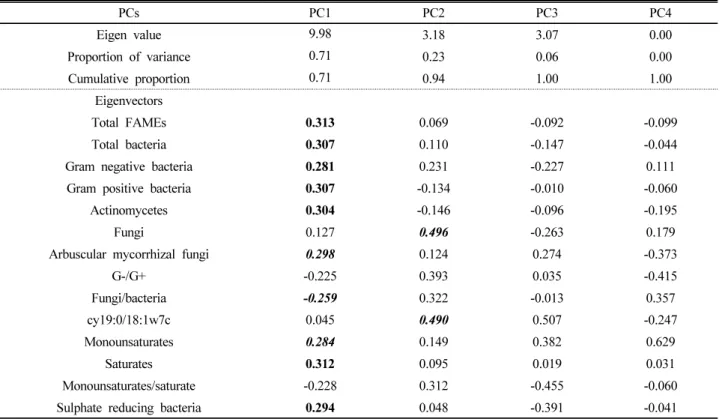
Table 2. Results of principal component analysis of microbial communities on paddy soils.

PCs PC1 PC2 PC3 PC4

Eigen value 9.98 3.18 3.07 0.00

Proportion of variance 0.71 0.23 0.06 0.00

Cumulative proportion 0.71 0.94 1.00 1.00

Eigenvectors

Total FAMEs 0.313 0.069 -0.092 -0.099

Total bacteria 0.307 0.110 -0.147 -0.044

Gram negative bacteria 0.281 0.231 -0.227 0.111

Gram positive bacteria 0.307 -0.134 -0.010 -0.060

Actinomycetes 0.304 -0.146 -0.096 -0.195

Fungi 0.127 0.496 -0.263 0.179

Arbuscular mycorrhizal fungi 0.298 0.124 0.274 -0.373

G-/G+ -0.225 0.393 0.035 -0.415

Fungi/bacteria -0.259 0.322 -0.013 0.357

cy19:0/18:1w7c 0.045 0.490 0.507 -0.247

Monounsaturates 0.284 0.149 0.382 0.629

Saturates 0.312 0.095 0.019 0.031

Monounsaturates/saturate -0.228 0.312 -0.455 -0.060

Sulphate reducing bacteria 0.294 0.048 -0.391 -0.041

*

G-:Gram-negative bacteria; G+: Gram-positive bacteria.

Boldface eigenvectors are considered highly weighted.

Bold-italic factors correspond to the indicators which are considered highly influential on soil microbial community.

Fig. 1. Principal component analysis of the PLFAs extracted on the paddy soil treated different green manures. Hv: hairy vetch, Gb: green barley, Hv+Gb: hairy vetch mixed with green barley.

도 단용처리보다는 미생물체량 증가에 긍정적인 영향을 나 타내었다.

풋거름작물 종류 및 환원방법이 논토양의 미생물 군집에 미치는 영향을 주성분분석 (Principal components analysis) 을 이용한 배열법으로 살펴본 결과, 각 처리구별 상이한 패 턴을 보였다 (Fig. 1). 이러한 미생물 군집 특성은 일차적으 로 전체 미생물을 비롯한 세균, 사상균, 방선균 등의 미생물 생체량에 영향을 받는 PC1 (73.0%, 가로축)에서 Con 처리구 와 Hv+Gb 처리구가 가장 큰 차이를 보였다 (Table 2). 반면 Hv 처리구와 Gb 처리구는 PC1축에서는 큰 차이를 보이지 않았지만, PC2 (21.5%, 세로축)에서는 큰 차이를 보였다.

본 연구에서는 사상균 biomass와 cy19:00/18:1ω7c의 값 이 Gb 처리구에서 Hv 처리구에 비해 높은 값을 보였는데 (Table 2), 이 두 요인의 상호복합적인 영향이 biplot상의 PC2축에서 Gb 처리구와 Hv 처리구 사이의 차이에 주요한 영향을 미친 것으로 판단된다. 이는 풋거름보리에서는 헤어 리베치에 비해 비교적 미생물 분해가 어려운 리그닌과 헤미 셀룰로오스 함량이 많은데 (Ferreira et al., 2014; Kivaisi et al., 1990), 이러한 조건은 Gb 처리구의 사상균 증식을 증가시킨 것으로 보인다 (Neely et al., 1991). 또한 헤어리 베치를 환원한 Hv와 Hv+Gb 처리구에서는 풋거름보리보다 헤어리베치의 C/N율이 3.13배 낮으므로 벼 생육초기에 헤 어리베치의 분해가 대부분 이루어져 (Lee et al., 2002) 수

확기에 사상균 biomass 함량이 Gb 처리구보다 낮아진 것으 로 판단되었다.

PC2에서 미생물 군집분포가 처리구별 다른 패턴을 보이

는 또 다른 주요인으로 작용한 cy19:00/18:1ω7c는 Macdonale

et al. (2004)과 Petersen et al. (2002)에 따르면 토양 중 유

(5)

Table 3. Chemical properties of paddy soils influenced by green manure crops.

Plots pH T-N O.M. Av.P

2

O

5

Av.SiO

2

Ex. cation(cmol

c

kg

-1

)

1:5 --- g kg

-1

--- --- mg kg

-1

--- K Ca Mg

Hv 5.85

b

1.21

a

22.8

ab

91.0

b

52.0

c

0.20

b

4.43

b

0.70

b

Hv+Gb 5.90

ab

1.19

a

23.0

a

97.4

ab

65.1

ab

0.21

ab

4.57

ab

0.75

ab

Gb 5.87

b

1.14

ab

22.4

b

104.9

a

72.7

a

0.32

a

3.55

a

0.84

a

Con. 6.00

a

1.03

b

21.9

c

104.7

a

60.9

b

0.20

b

4.56

ab

0.70

b

Hv: hairy vetch, Gb: green barley, Hv+Gb: hairy vetch mixed with green barley, O.M.: organic matter, T-N: total nitrogen, Av.: available.

Values are expressed as means followed the different regular letters in a column are significantly different (P 〈0.05) by the least significant different test.

기물 부족으로 미생물이 받는 스트레스 지수로 이용된다고 하였다. 본 연구에서는 헤어리베치 처리구에서 다른 처리구 들과 구분되는 패턴을 나타내었는데 이는 벼 생육초기에 헤 어리베치가 조기에 분해되는 특성으로 인해 벼 수확기까지 미생물 군집에 미치는 영향이 풋거름보리 처리구와 다른 양 상을 보인 것으로 판단된다. 그러나 토양중 유기물 함량과 는 정확히 일치하는 양상을 보이지는 않아 이 부분에 대해 서는 추가적인 고찰과 해석이 필요하다고 생각되며 이에 대 한 구체적인 연구는 향후 지속적으로 수행되어야 할 것으로 판단된다. 위의 결과로부터 논토양에 환원된 풋거름작물은 토양내의 미생물 생체량 및 군집특성의 차이에 영향을 주 며, 헤어리베치나 풋거름보리 단용보다는 특성이 다른 헤어 리베치와 풋거름보리를 혼합하여 이용하는 것이 미생물의 생체량 증가에 유리할 것으로 생각된다.

토양의 화학적 특성 풋거름작물의 환원에 의한 토양

의 화학성 분석결과는 Table 3과 같았다. 토양의 유기물 함 량은 Con 처리구에 비해 풋거름작물을 환원한 처리구에서 모두 유의적으로 증가하였으며 헤어리베치를 환원한 Hv와 Hv+Gb 처리구의 유기물함량이 Gb 처리구보다 증가되는 경 향을 보였다. 본 연구에 이용된 헤어리베치와 풋거름보리의 C/N율은 각각 12.3과 38.5로 헤어리베치의 C/N율이 낮았 다. 풋거름보리와 비교하여 C/N율이 낮은 헤어리베치가 먼 저 분해되어 그 결과 헤어리베치를 환원한 처리구의 유기물 함량이 Gb 처리구 보다 높게 나타난 것으로 생각된다.

총질소 함량에서는 Gb 처리구와 Con 처리구간에 유의성 이 없었지만 풋거름작물 처리구와 Con 처리간에는 유의적 인 차이가 있었다. Stopes et al. (1996)에 의하면 두과 풋거 름작물의 환원시 벼과나 타과의 풋거름작물 환원보다 질소 함량이 높게 유지된다고 하였는데 본 연구에서는 유의적인 차이는 보이지 않았지만 두과 풋거름작물인 헤어리베치를 환원한 처리구 (Hv, Hv+Gb)의 총질소 함량이 증가하는 경 향을 보였다. 이러한 경향이 처리구별 미생물 군집분포가 서로 다른 패턴을 나타내는데 영향을 미쳤다고 생각되며 논

토양에서 이에 대한 유의적인 결과를 얻기 위해서는 좀 더 장기적인 연구가 계속되어져야 한다고 생각된다.

Conclusion

논토양에서 많이 이용되는 헤어리베치와 풋거름보리의 연속적인 환원이 벼 재배 후 토양의 미생물 군집특성과 화 학성에 미치는 영향을 검토하였다. 토양 유기물 감소조건에 서 증가하는 fungi/bacteria, unsaturated/saturated의 비 율은 무기질비료를 시용한 Con 처리구와 풋거름보리만 환 원한 Gb처리구에서 높게 나타났으며, 풋거름보리만 환원한 처리구에서 미생물 양분 스트레스 지수인 cy19:00/18:1ω7c 가 헤어리베치 처리구보다 높게 나타났다. 풋거름작물을 환 원한 처리구는 무기질비료만 시용한 처리구와 미생물 군집 분포에서 서로 다른 패턴을 나타내었으며 특히 풋거름작물 처리구간에는 헤어리베치와 풋거름보리를 혼용한 처리구에 서 단용처리와 다른 군집특성을 나타내었다. 풋거름보리 처 리구와 유의적인 차이는 없었지만 미생물체량 증가에도 혼 용처리구에서 증가하는 경향을 나타내었다.

References

Aulakh M.S. and N.S. Pasricha. 1998. The effect of green manuring and fertilizer N application on enhancing crop productivity in mustard-rice rotation in semi-arid subtropical regions. Eur. J. Agron. 8:51-58.

Aulakh M.S., T.S., Khera, John W. Doran and Kevin F.

Bronson. 2001. Managing crop residue sith green manure, urea and tillage in a rice-wheat rotation Soil Sci. Soc. Am.

J. 65:820-827.

Bossio, D. and K.M. Scow, 1995. Impact of carbon and flooding on the metabolic deversity of microbial communities in soils. Appl. Environ. Microb. 61:4043-4050.

Bossio, D and K.M. Scow. 1998. Impacts of carbon and

flooding on soil microbial communities: phospholipid fatty

acid profiles and substrate utilization patterns. Microb. Ecol.

(6)

35:265-278.

Campbell C.A., V.O. Biederbeck, R.P. Zentner and G.P.

Lafond. 1991. Effect of crop rotations and cultural practices on soil organic matter, microbial biomass and respiration on a thin Black Chernozem. Can. J. Soil. Sci. 71:363-376.

Carrera L.M., J.S Buyer., B. Vinyard,. A.A. Abdul-Baki, L.J.

Sikora and J.R. Teasdale. 2007. Effects of cover crops, compost and manure amendments on soil microbial community structure in tomato production system. Appl.

Soil Ecol. 37:247-255.

Cho H.S., K.Y. Seong, T.S. Park, M.C. Seo, W.T. Jeon, W.H.

Yang, H.W. Kang and H.J. Lee. 2012. Changes in carbon amount of soil and rice plant as influenced by the cultivation of different green manure crops. Korean J. Soil Sci. Fert. 45:1058-1064.

Choi B.S., J.A. Jung, M.K. Oh, S.H.Jeon, H.G. Goh, Y.S. Ok and J.K. Sung. 2010. Effects of Green manure crops on improvement of chemical and biological properties in soil.

Korean J. Soil Sci. Fert. 43:650-658.

Daquiado, A.R., T.Y. Kim, and Y.B. Lee. 2013. Microbial community structure of paddy soil under long-term fertilizer treatment using phospholipid fatty acid (PLFA) analysis.

Korean J. Soil Sci. Fert. 46:474-481.

Eo, J., S.B. Kang, K.C. Park, K.S. Han, and Y.K. Yi. 2010.

Effects of cover plants on soil biota: A study in an apple orchard. Korean J. Environ. Agric. 29:287-292.

Eo, J., J.M. Park and K.C. Park. 2015. Effects of cover crops on soil chemical properties and biota in a pear orchard.

Korean J. Soil Sci. Fert. 48:15-21.

Ferreira P.A.A., E. Girotto, G. Trentin, A.Miotto, G. W. de Melo, C. A. Ceretta, J. Kaminski, B.K.

Frostegard, A., A. Tunlid and E. Baath. 1991. Microbial biomass measured as a total lipid phosphate in soils of different organic content. J. Microbiol. Methods. 14:151-163.

Frostegard, A. and E. Baath. 1996. The use of phospholipid fatty acid analysis to estimate bacterial and fungal biomass in soil. Biol. Fertil. Soils. 22:59-65

Jeon, W.T., K-Y. Seong, M.T. Kim, G.J. Oh, I-S. Oh and U.G. Kang. 2010. Changes of soil physical properties by glomalin concentration and rice yield using different green manure crops in paddy. Korean J. Soil Sci. Fert. 43:119- 123.

Jeon, W.T., K.Y.Seong, M.T. Kim, I.S. Oh, B.S. Choi and U.G. Kang. 2011. Effect of biomass and N production by cultivation methods of leguminous and gramineae green manures on rice growth in central regions of Korea. Korean J. Soil Sci. Fert. 44:853-858.

Kaur, A.A. Chaudhary, A. Kaur, R. Choudhary and R.

Kaushik. 2005. Phospholipid fatty acid - A bioindicator of environment monitoring and assessment in soil ecosystem.

Curr. Sci. India 89; 1103-1112.

Kim, C.G., J.H Seo, H.S. Jo, S.H Choi and S.J Kim. 2002.

Effect of hairy vetch as green manure on rice cultivation.

Korean J. Soil Sci. Fert. 35:169-174.

Kim, E.S. and Y.H. Lee, 2011, Response of soil microbial communities to applications of green manures on paddy at an early rice-growing stage. Korean J. Soil Sci. Fert. 44:

221-227.

Kim, J.G., K.B. Lee, D.B. Lee, S.B. Lee and S.Y. Na. 2004.

Influence of liquid pig manure on rice growth and nutrient movement in paddy soil under different drainage conditions.

Korean J. Soil Sci. Fert. 37:97-103.

Kim, M.K., Y.K. Sonn, H.Y. Weon, J.Y. Heo, J.S. Jeong,Y.J.

Choi, S.D. Lee, H.Y. Shin, Y.S. Ok, and H.Y. Lee. 2015.

Impacts of soil texture on microbial community of orchard soils in Gyeongnam province. Korean J. Soil Sci. Fert.

48:81-86.

Kim T.Y., S.Y. Kim, F. Alam, and Y.B. Lee. 2013. Green manuring effect of pure and mixed barley-hairy vetch on rice production. Korean J. Environ. Agric. 32:268-272.

Kivaisi A.K., H.J.M.O. Camp, H.J. Lubberding, J.J. Boon, and G.D. Vogels. 1990. Generation of soluble lignin-derived compounds during degradation of barley straw in an artificial rumen reactor. Appl. Microbiol. Biotechnol. 33:93- 98.

Lee, H.J., J.S. Lee and J.H. Seo. 2002. Decomposition and N release of hairy vetch applied as a green manure and its effects on rice yield in paddy field. Korean J. Crop Sci.

47(2):134-141.

Li, W.H., C.B. Zhang, H.B. Jiang, G.R. Xin, and Z.Y. Yang.

2006. Changes in soil microbial community associated with invasion of the exotic weed. Mikaniamicrantha HBK. Plant Soil 281:309-324.

MacRae R.J., and G.R. Mehuys. 1985. The effect of green manuring on the physical properties of temperate-area soils.

Advan. Soil Sci. 3:71-94.

Macdonald L.M., E. Paterson, L.A. Dawson and A.J.S.

Mcdonald. 2004. Short-term effects of defoliation on the soil microbial community associated with two contrasting Lolium perenne cultivars. Soil Biol. Biochem. 36:489-498.

Mandal U.K., G. Singh, U.S. Victor and K.L. Shrma. 2003.

Green manuring: its effect on soil properties and crop growth under rice-wheat cropping system. Eur. J. Agron.

19:225-237.

National Institute of Agricultural Science and Technology.

2000. Analysis method of soil and plant.

Neely, C.L., M.H. Beare Michael H., W.L. Hargrove, and D.C. Coleman. 1991. Relationships between fungal and bacterial substrate-induced respiration, biomass and plant residue decomposition. Soil Biol. Biochem.23:947-954.

Park, K.C. and S.J. Kim. 2010. Changes of soil microbial phospholipid fatty acid as affected by red pepper cultivation and compost amendment. Korean J. Soil Sci. Fert. 43:

194-199.

(7)

Peacock A.D., M.D. Mullen, D.B. Ringelberg, D.D. Tyler, D.B. Hedrick, P.M. Gale and D.C. White. 2001. Soil microbial community responses to dairy manure or ammonium nitrate applications. Soil Biol. Biochem. 33:1011-1019.

Petersen, S.O., P.S. Frohne and A.C. Kennedy. 2002. Dynamics of a soil microbial community under spring wheat. Soil Sci.

Soc. Am. J. 66:826-833.

RDA. 2015. Nongsaro: Agricultural Technology Information.

http://www.nongsaro.go.kr.

Robinson C.A., R.M. Cruse and M. Ghaffarzadeh. 1996.

Cropping system and nitrogen effects on mollisol organic carbon. Soil Sci. Soc. Am. J. 60:264-269.

Seo, J.H., H.J. Lee, S.J. Kim and I.B. Hur. 1998. Nitrogen release from hairy vetch(Villosa roth) residue in relation to different tillage and plant growth stage. Korean J. Soil Sci.

Fert. 31:137-142.

Stopes C., S. Millington and L. Woodward. 1996. Dry matter and nitrogen accumulation by three leguminous green manure species and the yield of a following wheat crop on

an organic production system. Agric. Ecosyst. Environ. 57:

189-196.

Tosti G, P. Benincasa, M. Farneselli, R. Pace, F. Tei, M.

Guiducci and K. Thorup-Kristensen. 2012. Green manuring effect of pure and mixed barley-hairy vetch winter cover crops on maize and processing tomato N nutrition. Eur. J.

Agron. 43:136-146.

Zelles, L. 1999. Fatty acid patterns of phospholipids and lipopolysaccharides in the characterisation of microbial communities in soil: a review. Biol. Fertil. Soils 29:111- 129.

Zhang, Q.C., and G.H. Wang. 2006. Effect of different fer- tilization treatments on ecological characteristics of micro- organism in paddy soil. J. Zhejiang Sci. A. 11:376-380.

Zhang, Q.C., G.H. Wang, and H.Y. Yao. 2007. Phospholipid

fatty acid patterns of microbial communities in paddy soil

under different fertilizer treatments. J. Environ. Sci. 19:55-

59.

수치

Table 1. Microbial biomass of paddy soils influenced by green manure crops.
Table 2. Results of principal component analysis of microbial communities on paddy soils
Table 3. Chemical properties of paddy soils influenced by green manure crops.

참조

관련 문서

[r]

In conclusion, the growth and yield of potato was not different between mixed fertilizer(chemical fertilizer : liquid pig manure = 1:1) and the

Incheon Metropolitan City's green projects took first place in the 2016 Green Fund Support Program organized by the Korea Forest Welfare Institute. The ‘Eco Garden’ plan

In Jangsu stream, blue-green algae were temporarily increased by 59% due to the eutrophication and reduction of water level in July, but no toxins

During the course of the green clothes attitude education program, this study identified that the green clothes attitude education program makes positive

Green (University of New South Wales), and Reuben Collins (Colorado School of Mines) MRS Bulletin (2008)... World

To promote green jobs through the expansion of green industry, chapter 2(II) examines the concept, objective, promotion field, and scope of green industry; the creation

Polypoid lesions of the gallbladder; Report of 111 cases with surgical reference to operative indication.. Polypoid lesion of GB: Indication of carcinoma