히스토그램 스트레칭을 이용한 효율적인 명암 향상 알고리즘
김 영 로*ㆍ정 지 영**
Efficient Contrast Enhancement Algorithm using Histogram Stretching
Kim, Young RoㆍChung, Ji Yung
<Abstract>
In this paper, an efficient contrast enhancement algorithm using histogram stretching is proposed. Histogram equalization (HE) and histogram stretching (HS) are effective techniques for contrast enhancement. However, HE and HS result often in excessive contrast enhancement. Proposed technique not only produces better results than those of conventional contrast enhancement techniques, but is also adaptively adjusted to image contents.
Key Words : Contrast Enhancement, Histogram Equalization, Histogram Stretching
Ⅰ. Introduction
1)
Contrast enhancement is an important one of image processing applications. Many images may not reveal the details and have unpleasing looks because of acquisition problems and displaying devices. Contrast enhancement eliminates these problems and obtains enhanced images.
Contrast enhancement methods can be categorized to two groups: direct methods such as HPF(High Pass Filter) and indirect methods such as histogram modification. Direct methods using HPF may have halo artifacts around edge. Thus, we focus into the histogram modification method.
* 명지전문대학 컴퓨터정보과 부교수(제1저자) ** 명지전문대학 컴퓨터정보과 부교수(교신저자)
Many contrast enhancement algorithms using histogram modification are proposed to improve the quality of an image.
Algorithms can be categorized into two approaches as a global contrast enhancement (GCE)[1] and a local contrast enhancement (LCE)[2]. GCE use a single mapping function and LCE use a local mapping function, respectively. GCE does not suffer from blocking artifacts and preserves ordering of altered gray levels.
Histogram equalization (HE) is the most popular contrast enhancement technique[1, 6, 8]. HE expands the contrast of the high histogram region and compresses the contrast of the low histogram region.
This technique is simple and effective, but it can produce excessively enhanced and unpleasing images.
Thus, various methods have been proposed to overcome the limiting. Bi-histogram equalization was proposed to reduce mean brightness difference[3].
This method separates one histogram into two histograms with mean intensity and equalizes independently. Dualistic sub-image histogram equalization was also proposed as a similar method [4]. It separates the histogram at the median gray level instead the mean. These techniques usually have better performances than that of the basic HE.
However, they have the same limitations of HE and cannot adjust the level of enhancement.
Another unconventional approach based on the histogram has been proposed. Gray-level grouping (GLG) groups histogram bins and redistributes these bins uniformly over the gray scale, iteratively[5]. GLG can adjust the level of enhancement. However, mean brightness is changed and the approach cannot be used in the video sequence playing.
One of the famous image enhancement techniques is histogram stretching (HS)[7]. The technique stretches histogram maps to darker and brighter.
However, because of limitation of adjusting stretching level, the method creates artifacts.
Existing various contrast enhancement techniques usually perform well. However, they have limitations and cannot obtain a natural looking in the certain classes of images. Our purpose of this paper is to obtain a natural and enhancement method with low computational complexity
The contributions of our proposed method are:
ㆍ To present efficient stretching method with low computational complexity
ㆍ To apply automatically in a various images In the next section, the existing techniques will be
described. In the Section III, the proposed method based on stretching is explained. Then, experimental results are presented in Section IV. Finally, the conclusion is presented in Section V.
Ⅱ. Existing Techniques
Histogram based contrast enhancement techniques are widely developed and used. We introduce the existing histogram equalization and stretching.
A. Histogram Equalization (HE)
HE flattens and stretches the dynamic range of the image’s histogram[6]. Thus, it obtains overall contrast enhancement. However, it may significantly change the brightness of an input image. In HE, the transformation function is given by the following relations.
⌊
⌋
(1)where is the number of bits used to represent the pixel value, ∈ , and is the input pixel of level . The normalized histogram of an image gives the probability density function (PDF) of its pixel intensities. Thus, the cumulative density function (CDF) is obtained from the sum of . The transform function for mapping is as called version of the CDF.
A general framework based on histogram equalization (FHE) was also proposed[8]. The method is implemented given in
, (2)
Fig. 1. Block diagram of the proposed method.
where is modified histogram, is input histogram,
is a diagonal matrix, and is uniformly distributed histogram. is the level of contrast enhancement, and is black and white stretching level.
B. Histogram Stretching (HS)
Histogram stretching is simple but effective technique which is widely used[7]. HS makes dark pixel darker and bright pixel brighter. Thus, it enhances the contrast of the image. HS can be implemented by the linear mapping as follows:
× ≤
×′
× ≤ (3)
where is the maximum gray level to be stretched to black and is the minimum gray level to be stretched to white. , are compression factor.
′ is a linear stretching function. However, HS cannot adjust the level of enhancement according to the image content.
Ⅲ. Proposed Technique
In this section, a histogram distribution information and stretching is presented. The block diagram of the proposed method is illustrated in Fig. 1. It stretches the histogram according to the distribution information. The proposed algorithm adjusts the level of enhancement adaptively to the input image’s contrast. Thus, it can obtain the natural looking image.
Histogram stretching (HS) is widely used in image enhancements. HS stretches histogram distribution to black and white. It makes dark pixel darker and bright pixel brighter. The proposed HS method separates one histogram of an image into two histograms with mean intensity and stretches left region histogram and right region histogram to additionally same expanded length, respectively.
The procedures of HS are as follows.
1) Obtain distribution information of histogram:
Generate histogram and obtain the distribution information as shown in Fig. 2. Boundary and mean intensity information are obtained. Boundaries and
and mean are obtained by accumulation the histogram.
2) Stretch Histogram: Stretch histogram according to the information by the linear mapping is given as
× ≤′
×′ ′ ≤
×′ ′
′ ′ × ′≤
(4)
where is the mean gray level which is not changed while stretching. ′ and ′ are new boundaries according to the histogram distribution. ′ is equal to ′. This length is adjusted as
× ′ ′. is the level of contrast enhancement. ′ is a left stretching function and
′ is a right stretching function. The proposed method stretches histogram while maintaining the original image brightness.
Fig. 2. Distribution information
Fig. 3. Histogram stretching of the proposed method
(a) (b) (c) (d) (e)
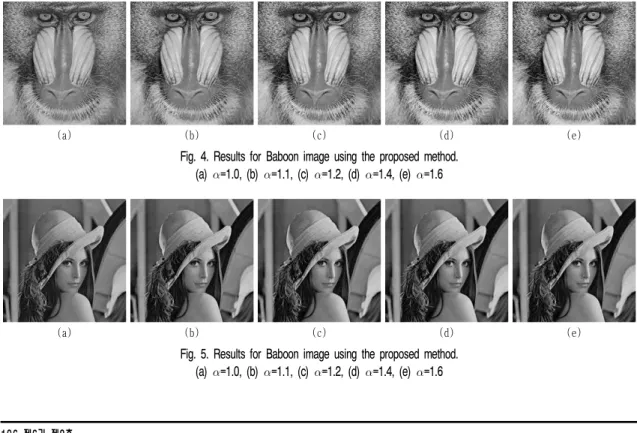
Fig. 4. Results for Baboon image using the proposed method.
(a) =1.0, (b) =1.1, (c)=1.2, (d)=1.4, (e)=1.6
(a) (b) (c) (d) (e)
Fig. 5. Results for Baboon image using the proposed method.
(a) =1.0, (b) =1.1, (c)=1.2, (d)=1.4, (e)=1.6
Ⅳ. Experimental Results
In this section, the proposed algorithm and existing algorithms (HE[6], FHE[8], and HS[7]) are simulated on
several images, and the results are compared. In our proposed method, the level of contrast enhancement is set to 1.2, experimentally. For comparison, we provide results according to several values.
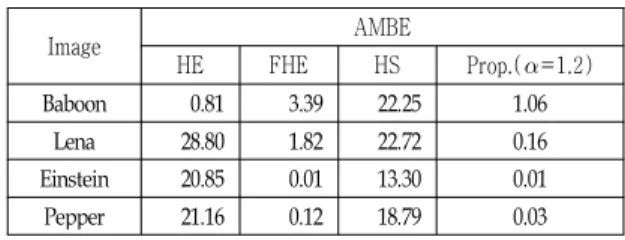
Subjective assessment is used to compare contrast enhancement techniques. Additionally, we use the following quantitative measure such as Absolute Mean Brightness Error (AMBE). If metrics such as standard deviation and entropy are used, HE, FHE, and HS can achieve the better performances even though they may not produce natural looking images.
Fig. 4 and Fig. 5 show contrast enhanced images using the proposed method according to the values.
As shown in Fig. 4 and Fig. 5, results with =1.2 have natural and enhanced looking without artifacts.
As subjective assessment, is set to 1.2, experimently.
Fig. 6. and Fig. 7 show the original test images and their corresponding contrast enhanced images.
<TABLE I> Quantitative Measurement Results
Image AMBE
HE FHE HS Prop.(=1.2)
Baboon 0.81 3.39 22.25 1.06
Lena 28.80 1.82 22.72 0.16
Einstein 20.85 0.01 13.30 0.01 Pepper 21.16 0.12 18.79 0.03
(a) (b) (c) (d) (e)
Fig. 6. Results for Baboon image. (a) Original image, (b) enhanced image using HE, (c) FHE, (d) enhanced image using HS, (e) enhanced image using the proposed algorithm (=1.2)
(a) (b) (c) (d) (e)
Fig. 7. Results for Lena image. (a) Original image, (b) enhanced image using HE, (c) FHE, (d) enhanced image using HS, (e) enhanced image using the proposed algorithm (=1.2)
HE images result in the best transformation of the dynamic range of the pixel values. However, this often does not obtain natural images. Also, the mean value of brightness is changed. This means that HE cannot be used in video playing to flickering. In Fig. 6(b) and Fig. 7(b), these situations are observed. On the other hand, FHE, HS, and the proposed algorithm generate natural images. However, as shown in Fig. 6(c), (d) and Fig. 7(c), (d) the mean brightness is changed. Also, details in the background are lost due to over brightening.
Comparison results of quantitative measures are showed in Table 1. Results show that our proposed algorithm preserves the mean brightness better than the existing methods.
Ⅴ. Conclusions
We proposed an efficient contrast enhancement method without visual artifacts while preserving the mean brightness.
Experimental results show the proposed method has better performance than those of the conventional methods. It obtains visually pleasing and artifact free images. The proposed method can be well used for video applications.
김 영 로 Kim, Young Ro
2003년~현재
명지전문대학 컴퓨터정보과 교수 2001년~2003년
삼성전자 시스템LSI책임연구원 2001년 고려대학교 전자공학과 (공학박사) 1996년 고려대학교 전자공학과 (공학석사) 1993년 고려대학교 전자공학과 (공학사)
관심분야 : 신호 및 영상처리, 멀티미디어 통신 E-mail : [email protected]
정 지 영 Chung, Ji Yung
2002년~현재
명지전문대학 컴퓨터정보과 교수 2005년 아주대학교 대학원 (공학박사) 2000년 아주대학교 대학원 (공학석사) 1998년 아주대학교 컴퓨터공학과 (공학사)
관심분야 : 클러스터 시스템, 결함허용 시스템 E-mail : [email protected]
논문접수일 : 2010년 4월 6일 수 정 일 : 2010년 4월 23일 게재확정일 : 2010년 5월 20일
References
[1] S. A. Stark, “Adaptive image contrast enhancement using generalizations of histogram equalization,” IEEE Trans. Consum. Electron., vol.
9, no. 5, May 2000, pp. 889-896.
[2] J. –Y. Kim, L. –S. Kim, and S. –H. Hwang,
“An advanced contrast enhancement using partially overlapped sub-block histogram equalization,”
IEEETrans. Circuits Syst. Video Technol.,
vol. 11, no. 4, Apr. 2001, pp. 475-484.[3] Y. –T. Kim, “Enhancement using brightness preserving bi-histogram equalization,”
IEEE Trans.
Consum. Electron
., vol. 43, no. 1, Feb. 1997, pp. 1-8.[4] Y. Wang, Q. Chen, and B. Zhang, “Image enhancement based on equal area dualistic sub-image histogram equalization method,”
IEEE Trans. Consum. Electron.,
vol. 45, no. 1, Feb. 1999, pp. 68-75.[5] Z. Y. Chen, B. R. Abidi, D. L. Page, and M. A.
Abidi, “Gray-level grouping (GLG): An automatic method for optimized image contrast enhancement-Part I: The basic method,”
IEEE Trans. Image Process.,
vol. 15, no. 8, Aug. 2006, pp.2290–2302.
[6] R. C. Gonzalez and R. E. Woods, Digital Image Processing, 2nd. Englewood Cliffs. NJ:
Prentice-Hall, 2002.
[7] Adobe System, Inc., Adobe Magazine May/Jun.
2000.
[8] T. Arici, S. Dikbas, and Y. Altunbasak, “A histogram modification framework and its application for image contrast enhancement,”
IEEE Trans. Image Process.,
vol. 18, no. 9, Sep.2009, pp. 1921-1935.
[9] 김영로, 정지영, “시간과 공간정보를 이용한 무손실 압축 알고리즘,” 디지털산업정보학회, 제5권 제3호, 2009. 9.
▪저자소개▪