Fluid Inclusion Study of a Magmatic Cobalt Mineralization at the Boguk Mine, Korea
Chul-Ho Heo
1), Jae-Ho Lee
2)*, Seong-Taek Yun
3)and Chil-Sup So
3)보국 마그마성 열수 코발트 광화작용의 유체포유물연구
허철호1)․이재호2)*․윤성택3)․소칠섭3)
요 약 : 보국 코발트 광산의 열수성 석영 ± 탄산염 ± 녹섬석 맥들은 백악기 후기의 화강암내 열극을 충진했다.
맥의 광물조성은 코발트, 몰리브덴, 구리, 납, 아연, 비스무스 및 금의 광석광물을 함유하고 있는 다금속 성향을 보이며, 광화작용은 5개의 광화시기로 구분된다. 맥상광물은 광화시기에 따라 체계적으로 변화하며 다음과 같은 광물공생군을 보인다: 녹섬석과 석영을 수반한 함코발트 비화물, 유비화물 및 휘수연석 → 천금속 황화물, 금, 철산화물 → 탄산염. 광석광물공생에 대해 평형 열역학을 적용하면 다음과 같다: 광화 1, 2기 코발트 광화작용은 T = 560-360℃, log fs2 = -6.2~-12.0 atm의 광화유체에서 일어났으며, 광화 3기의 천금속 황화물 및 금은 T = 380-275℃, log fs2 = -7.5~-10.6 atm 유체에서 침전되었다. 코발트 광화작용에서 천금속 황화물 침전으로 광화작용 이 진행되면서 온도감소와 산소분압의 증가가 수반되었을 것으로 사료된다. 코발트의 침전은 마그마성 염수의 냉각 및 환원에 의해 야기되었을 것으로 사료된다. 이 냉각 및 희석은 초기 마그마계가 쇠퇴하면서 다량의 천수성 지하수의 혼입에 의해서 발생했으며, 계속해서 천금속 황화물, 금, 비스무스가 침전되었다. 광물학 및 유체포유물 연구에 의하면, 코발트, 비소, 몰리브덴은 마그마 정출작용중 직접 용리된 고온(<~585℃), 고염농도(<67 wt. NaCl) 의 마그마 염수로부터 용리되어 분별된 것으로 사료된다. 마그마 염수가 냉각되면서, 이 금속들은 석영 ± 녹섬석 맥내 비화물과 유비화물로 침전되었다. 약 350℃의 온도에서 마그마성 열수계가 쇠퇴하면서, 천수성 지하수의 거대순환이 마그마성 열수계를 붕괴시키고 점진적으로 열수유체의 냉각, 희석, 산화가 촉진된다. 첨금속, 금, 칼슘 은 천수순환중 주변의 퇴적암에서 용탈되며 광화 3기에서 5기의 광화작용과 관련된 유체를 형성하게 된다.
주요어 : 물질흐름분석, 자원관리, 지속가능한, 자원이용지수
Abstract : Hydrothermal quartz carbonates actinolite veins of the Boguk cobalt mine filled the fractures in a granite stock of Late Cretaceous age. They show the polymetallic nature consisting of Co-, Mo-, Cu-, Pb-, Zn-, Bi-, and Au-bearing ore minerals, and is divided into five stages. The vein mineralogy changes systematically with time:
cobalt-bearing, arsenides and sulfarsenides and molybdenite with actinolite and quartz → base-metal sulfides, gold,and Fe oxides → barren carbonates. Equilibrium thermodynamic considerations of ore mineral assemblages are as follows: cobalt mineralization in stages I and II, T = 560-360℃, log fs2 = -6.2 to -12.0 atm deposition of base-metal sulfides and gold in stage III, T = 380-275℃, log fs2 = -7.5 to -10.6 atm. With the transition from cobalt mineralization toward base-metal sulfide deposition occurred the temperature decrease and concomitant increase in fo2. The deposition of cobalt probably occurred as a result of cooling and reduction of the magmatic brines. This cooling and dilution occurred by mixing with progressively larger volumes of meteoric groundwater as an early magmatic system waned, and resulted in successive deposition of base-metal sulfides, gold and bismuth, Fe oxides, and carbonates. By combining the mineralogic, fluid inclusion and petrochemical data, the following model is proposed for ore genesis at Boguk: during the Late Cretaceous, a micrographic granite stock intruded
Vol. 43, No. 2 (2006) pp. 106-117
2005년 5월 27일 접수, 2006년 3월 20일 채택 1) 국립공원관리공단 국립공원연구원 2) 한국지질자원연구원 지질기반정보연구부 3) 고려대학교 지구환경과학과
*Corresponding Author(이재호) E-mail; [email protected]
Address; Geology & Geoinformation Division, Korea Institute of Geoscience and Mineral Resources, Daejeon 305-350, Korea 연구논문
volcanosedimentary rocks at near surface. Cobalt, arsenic, and molybdenum were partitioned into high-temperature (up to ~585℃), high-salinity (up to 67 wt. % NaCl) magmatic brines exsolved directly from the crystallizing magma.
As the magmatic brine cooled, these metals precipitated as arsenides and sulfarsenides in quartz actinolite veins.
Following the waning of the magmatic hydrothermal system at temperatures around 350℃, a huge circulation of meteoric groundwater formed to collapse the system, resulting in progressively larger degrees of cooling, dilution and oxidation of hydrothermal fluids. Base metals, gold, and possibly calcium were leached from surrounding sedimentary rocks during the meteoric water circulation, and formed the fluids related tostage III to V mineralization.
Key words : Cobalt deposit, Mineralogy, Fluid inclusion
Introduction
There are few cobalt-bearing deposits in Korea, and can be grouped into two genetic types(Nakamura, 1942): (1) deposits associated with hydrothermal Cu, Zn, Au and Ag mineralization in a genetic tie with felsic igneous rocks; (2) deposits associated with nickel in basic igneous rocks, where cobalt-bearing minerals occur only as a by-product. The Boguk cobalt deposits in this study share many features with the granite- related hydrothermal deposits. Until the mining activity was stopped at 1970, the Boguk cobalt mine has produced an average 0.5 to 1.0 wt. % Co per metric ton of ores, with trace amounts of gold.
Only a few studies of cobalt mineralization in South Korea were carried out. Park(1990) and Yun and Youm(1997) have described a xenothermal feature of the Boguk cobalt deposits, based on ore mineralogy.
However, the source and physicochemical conditions of the cobalt ore mineralization have not been understood. The purposes of this study are to describe the complex ore mineralogy, to elucidate the fluid evolution and to propose genetic model for the Co-bearing hydrothermal system.
Geologic Setting
The Boguk cobalt mine, located at latitude of 35°
47’N and longitude of 128°45’E, is situated within the middle western part of the Gyeongsang Basinin which occur the non-marine, sedimentary and volcanic- plutonic rocks of Cretaceous age (Fig. 1). The geology of the mine area is composed mainly of volcano- sedimentary rocks of the Hayang and Yucheon groups that are intruded by a small granite stock (Fig. 2). The Hayang group rocks inthe mine area belong to the
Konchonri Formation which consists mainly of shale with minor intercalations of sandstone and limestone.
The bedding strikes 275° to 320° and dips 5° to 15°SW. The Yucheon group rocks extrude or intrude the Konchonri Formation and consist mainly of andesite and andesite porphyry(Yun and Youm, 1997).
A granite stock with an outcrop size of about 2×4 km intrudes the Hayang and Yucheon group rocks, and hosts the hydrothermal veins of the Boguk cobalt mine (Fig. 2). The granite is composed mineralogically of quartz, plagioclase, orthoclase and biotite with minor amounts of hornblende, apatite, zircon, chlorite and hematite. Along the intrusive contacts with sedime- ntary rocks occur the intrusion-related prophyllitic alteration assemblages. The calc-alkaline granite stock is occasionally uneven in grain size, ranging from fine- to medium-grained. Inward from the margin, the grain size tends to be increased. The granite also shows miarolitic cavities and micrographic texture, suggesting their epicrustal emplacement and the presence of abundant volatile components in magma. A Rb-Sr age dating of the granite suggested a Late Cretaceous age (around 86 Ma) of the intrusion and associated ore mineralization (Yun and Youm, 1997).
Ore Veins and Mineralogy
The hydrothermal mineralization of the Boguk mine
consists of narrow(each 0.1-0.5 m thick), fracture-
filling quartz, carbonate and actinolite veins. These
veins occur within a calc-alkaline granite stock. The
ore mineralogy is relatively complex and consists of
cobalt-bearing arsenides or sulfarsenides(in the decre-
asing order of amounts, loellingite, cobaltite and glau-
codot), arsenopyrite, molybdenite, base-metal sulfides
(chalcopyrite, sphalerite, pyrite, pyrrhotite, etc.), and
rare amounts of oxides(magnetite and hematite) and electrum. Gangue minerals are quartz, carbonates and actinolite.
Based on investigation of the mineral assemblages and textural relationships(e.g., cutting, banding) of veins, the vein miner alization at Boguk is divided into five mineralization stages(I to V; Fig. 3).
During stages I and II, cobalt was deposited as loellingite, cobaltite and glaucodot. These cobalt-bearing minerals are associated intimately with arsenopyrite, molybdenite and pyrrhotite. Stage I veins are charac- terized by the occurrence of green-colored amphibole (actinolite) in association with minor amounts of quartz. Actinolite occurs as massive aggregates which contain cobalt-bearing ore minerals, and is commonly replaced by stage IV brown carbonates(siderite and dolomite). Ore minerals consist mainly of Co-rich loellingite(2.3-11.5 wt. % Co, average 6.9 %) and arsenopyrite(up to 8.9 wt. % Co) with rare amounts of cobaltite, glaucodot, molybdenite and pyrrhotite. Stage II mineralization is characterized by less amounts of Co-bearing loellingite in clear quartz veins without
Fig. 1. Simplified geologic map of the Republic of Korea,showing the location of the Boguk cobalt mine within the Cretaceous Gyeongsang Sedimentary Basin.
Fig. 2. Geologic map of the Boguk cobalt mine area (modified after Yun and Youm, 1997). Hydrothermal veins are developed restrictedly within the granite stock.
Fig. 3. Generalized paragentic sequence of minerals in veins of the Boguk cobalt mine. Temperature scale (*) is based on fluid inclusion temperatures and on thermo- dynamic considerations of ore mineral assemblages. See the “Fluid Inclusions” section for fluid inclusion types.
actinolite. Toward the stage II mineralization, cobalt- bearing minerals abruptly decrease in amounts, whereas arsenopyrite and other sulfides increase. Stage II ore mineralogy consists dominantly of Co-rich arsenopyrite (up to 8.8 wt. % Co) and loellingite(4.7-10.2 wt. % Co, average 7.1 %) with rare amounts of molybdenite, pyrrhotite and pyrite.
Stage IIImineralization is represented by deposition of relatively abundant base-metal sulfides within white quartz veins and consists of quartz, carbonates, arseno- pyrite(mostly <0.5 wt. % Co), chalcopyrite, sphalerite, pyrite, pyrrhotite, tetrahedrite, bismuthinite, native bis- muth, electrum and Fe oxides(magnetite and hematite).
Electrum(39.8-45.6 atom. % Ag) rarely occurs as tiny grains associated with bismuthinite, native bismuth and chalcopyrite along fractures of earlier ore minerals.
Toward the end of stage III mineralization occurs typically the assemblage of pyrite + magnetite + hematite in carbonates, which indicates the oxidation of hydrothermal fluids. Stage IV and Vmineralizations are represented by deposition of barren carbonatesand chalcedony. Stage IV veins characteristically show repeated rhythmic banding which consists of black to pale brown carbonates.
Weak hydrothermal alteration(<0.1 m thick) of host rocks shows potassic, sericitic and chloritic assem- blages. Adjacent to stage I veins occurs the weak potassic alteration(a few millimeters thick) which can be recognized easily by the occurrence of pink-colored K-feldspar, indicating that the chemistry of Co-deposi- ting hydrothermal fluids was largely controlled and buffered by the K-feldspar-rich granite. On the other hand, stage III and IV veins are associated with the wider, pale green-colored sericitic alteration zone which consists of sericite, chlorite, carbonates and pyrite.
In summary, the vein mineralogy of the Boguk cobalt mine changed systematically with time as follows(Fig.
3): actinolite, cobalt-bearing minerals and molybdenite (stages I and II) → base-metal sulfides, Fe oxides and gold(stage III) → barren carbonates(stages IV and V).
Physicochemical Conditions of Mineralization
Equilibrium thermodynamic considerations of miner-
alization are carried out to trace the changes in physicochemical conditions of hydrothermal fluids at Boguk. Representative ore mineral assemblages accor- ding to mineralization stages in veins are summarized in Table 1.
Within stage I and II veins, arsenopyrite is coexisting with loellingite and pyrrhotite. Chemical compositions and elemental substitutional relationships of arsenopyr- ites have been studied by Yun and Youm(1997). Most of stage I and II arsenopyrites are typically cobalt-rich (up to 8.9 wt. % Co; average = 3.9 wt. % and 2.9 wt.
% for stage I and stage II , respectively), resulting in quite restricted applicability of arsenopyrite as a geothermometer(Kretschmar and Scott, 1976). How- ever, small numbers of arsenopyrites with minor amo- unts of Co and Ni(totally <1 wt. %) may indicate their depositional conditions as follows(Table 1): about 440˚
to 560℃ and log fs
2values of 9.3 to 6.2 atm for stage I mineralization; and about 360˚ to 460℃ and log fs
2values of 12.0 to 8.8 atm for stage II mineralization.
Thus, cobalt mineralization(arsenides and sulfarseni- des) of stage I and II veins occurred at high temper- atures between 360°and 560℃ from the ore fluids.
Stage III arsenopyrites occur along vein margins and form an mineral assemblage with pyrrhotite, bismu- thinite and native bismuth. Compositional data of stage III arsenopyrites(31.3-32.2 atom. % As) indicate the formation temperatures of 335°to 380℃ and log fs
2values of 10.6 to 9.2 atm(Kretschmar and Scott, 1976;
Barton and Skinner, 1979). In the middle to late mineralization of stage III veins, stannite(10.9-11.2 wt.
% Zn) and sphalerite(4.9-6.0 mole % FeS) form an ore
mineral assemblage with pyrite. Based on the parti-
tioning of Fe and Zn between stannite and sphalerite
(Nakamura and Shima, 1982; Shimizu and Shikazono,
1985), stannite+sphalerite+pyrite assemblage indicates
the depositional temperature and sulfur fugacity(log fs
2)
values are 345 to 360℃ and 7.8 to 7.6 atm, respe-
ctively. The assemblage of electrum(39.8-45.6 atom. %
Ag) + sphalerite(2.3-4.8 mole % FeS) + chalcopyrite
bismuthinite in central parts of stage III veins also
indicates the depositional temperatures between 275°to
350℃, corresponding to the log fs
2values of 9.8 to 7.5
atm(Barton and Toulmin, 1964; Scott and Barnes,
1971). Therefore, the deposition of base-metal sulfides
and gold in stage III veins occurred at lower tem- peratures(between 275°and 380℃) than that of the cobalt mineralization in stage I and II veins.
The mineralogical change of dominant Fe-bearing minerals from pyrrhotite(in stages I and II) to mag- netite + hematite(in stage III) suggests the progressive oxidation of the Boguk hydrothermal fluids with paragenetic time.
Fluid Inclusion Study
In order to determine the variations of temperature and composition of ore fluids, fluid inclusions in about 80 samples of quartz and calcite from veins were examined by microthermometry. Sphalerite and car- bonates(except calcite) were not suitable for the study because of their opacity and tiny size(if present) of fluid inclusions. Microthermometric data were obtained using a USGS Fluid Inc. gas flow-type heating/freezing system. Salinity data are reported based on the freezing point depression in the system H2O-NaCl(Bodnar,
1993)for aqueous fluid inclusions, and on the dissol- ution temperature of halite for halite-bearing inclusions (Chou, 1987; Sterner et al., 1988).
Three main types of fluid inclusions(<4 to 40µm in size, average about 10µm) were distinguished based on the microthermometric behavior and phase relations at room temperature(Table 2).
Type I inclusions are aqueous two-phase and liquid-rich inclusions with a vapor bubble comprising 5 to 30 volume percent(usually 10 to 20 vol. %) of the total inclusion volume. The bubble is determined to be essentially water vapor by crushing. No gas hydrates formed recognizably during freezing experiments. They homogenize readily into a liquid phase upon heating.
Type I inclusions are the most abundant in samples examined(except stage I quartz which contains typi- cally type III inclusions), and occur as both primary and secondary inclusions(Roedder, 1984).
Type II inclusions are aqueous two-phase and vapor-rich inclusions containing more than 70 percent of vapor bubble, and homogenize to a vapor phase
Table 1. Representative equilibrium mineral assemblages and their calculated depositional conditions, Boguk cobalt mineMineral composition1) Physicochemical environments Stage Mineral
assemblage(s)
apy2) (atom. % As)
sp (mole % FeS)
st (wt. % Zn)
el
(atom. % Ag) Temp. (℃) log fS2
(atm) References
I apy + loe + po 35.3-36.7 (4) 440-560 -9.3--6.2 Kretschmar and
Scott (1976)
II apy + loe + po 34.3-35.6 (7) 360-460 -12.0--8.8 ditto
III
Early-Middle:
apy + po + bi + bm
31.3-32.2 (5) 335-380 -10.6--9.2ditto; Barton and
Skinner (1979)
Middle-Late:
a) sp + st + py
4.9-6.0 (7) 10.9-11.2 (4) 345-360 -7.8--7.6
Nakamura and Shima (1982);
Shimizu and Shikazono
(1985)
b) el + sp
+ cp ± bm 2.3-4.8 (16) 39.8-45.6 (12) 275-350 -9.8--7.5
Barton and Toulmin (1964);
Scott and Barnes (1971)
IV sp + gn ± mt 0.9 2.4 (7)
1) Number of analysis is indicated in parenthesis.
2) Arsenopyrites with high cobalt and nickel contents (>1 wt. % Co + Ni) are not included in the range.
Abbreviations: apy = arsenopyrite, bi = native bismuth, bm = bismuthinite, cp = chalcopyrite, el = electurm, gn = galena, loe = loellingite, mt = magnetite, py = pyrite, po = pyrrhotite, sp = sphalerite, st = stannite.
upon heating(if not decrepitated). They occur charact- eristically in stage II quartz as regular-shaped inclusi- ons with no fracture controls, indicating their primary origin. Type II inclusions in stage II quartz occur locally in the same areas as clusters of type I and type III inclusions, suggesting the existence of hetero- geneous fluids during trapping. Within the stage I quartz rare type II inclusions occur along healed fractures, indicating their secondary origin.
Type III inclusions are high-salinity, multiphase (liquid + vapor + halite other solids) inclusions. The vapor bubble comprises 5 to 25 volume percent of the inclusion volume. They always contain halite crystals which occupies 10 to 85 percent of the inclusion volume. Other solid phases are observed in less than 10% of type III inclusions and include sylvite and unidentified minerals. Halite and sylvite can be easily distinguished by the shape and optical isotropy (Roedder, 1984). The rare unidentified solids are opti- cally birefringent with round or prismatic forms, and do not dissolve upon heating. Type III inclusions are observed only within stage I quartz and stage II quartz as both primary and microfracture-controlled secondary inclusions. These inclusions homogenize finally by halite dissolution upon heating. During heating, the dissolution of sylvite(if present) is the first phase transition and occurs at temperatures between 135°and 227℃(mostly between 170°and 190℃) for primary fluid inclusions. With continued heating, liquid-vapor homogenization by vapor bubble disappearance occurs at temperatures of 287°to 573℃(which are usually
10-20℃ lower than the halite dissolution temperatures).
Microthermometric data
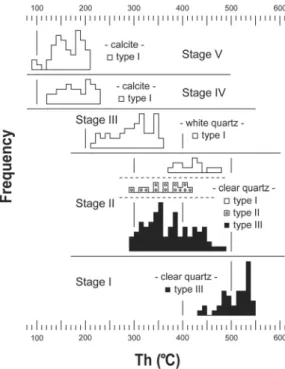
Final homogenization temperature and salinity data of primary fluid inclusions are shown in Figures 4 and 5.
Halite dissolution is the final phase transition observed in type III fluid inclusions in clear quartz of stage I, and occurs at temperatures of 407° to 584℃, with a mode at 480° to 540℃. Assuming an H
2O-NaCl system, these dissolution temperatures indicate salinites between 46 to 67 wt. % NaCl equiv. Final homo- genization temperatures of primary type I, type II, and type III inclusions in stage II quartz are 297°to 495℃
(to liquid), 290°to 403℃(to vapor) and 310° to 487℃
(to a liquid by halite dissolution, corresponding to salinities between 39 and 56 wt. % NaCl equiv.), respectively. Estimated salinities of type I and type II inclusions in stage II quartz range from 9.9 to 20.3 wt.
% and 1.9 to 8.1 wt. % NaCl equiv., respectively.
Quartz and calcite from stage III to V veins contain type I inclusions only. Ranges of homogenization temperature and salinity of primary inclusions are:
219°to 352℃ and 4.8 to 14.8 wt. % NaCl equiv for stage III; 124°to 222℃ and 0.0 to 12.9 wt. % NaCl equiv for stage IV; and 98° to 203℃ and 1.1 to 7.3 wt. % NaCl equiv for stage V.
Figures 4 and 5 show that both temperature and salinity of hydrothermal fluids decreased progressively with increasing paragenetic time, likely due to the increasing amounts of influx of cooler(~100℃) and dilute(~0 wt. % NaCl) meteoric groundwater into the
Table 2. Summary of fluid inclusion characteristics, Boguk cobalt mineInclusion
type Phases present Occurrence and
paragenetic association
Microthermometer data (℃)1) Tm-ice Tm-H Th-L/V
I L + V
predominant in stage II and III quartz and in stage IV and V carbonates (as P and S); abundant in stage I quartz (as S)
-17.1 to 0.0 -
98-495 (L)
II V + L common in stage II quartz (as P) -1.1 to -5.2 - 298-402 (V)
III L + V + H ± Sy
± other solids
predominant in stage I quartz (as P and S); abundant in stage II quartz
- 313-584 287-573
1) Data range for primary fluid inclusions.
Abbreviations: H = halite, L = liquid, P = primary, S = secondary, Sy = sylvite, Th = homogenization temperature, Tm = melting temperature, V = vapor
high temperature(up to ~600℃) and high salinity(up to
~67 wt. % NaCl) fluid. With time, the hydrothermal fluids changed in composition from high-saline, type III(during stages I and II) toward very dilute, type I fluid.
Fluid evolution
The relationships between homogenization tempera- ture(Th) and salinity of primary fluid inclusions are shown in Figure 6. Halite-bearing type III inclusions in stage I quartz have the highesthomogenization tempera- tures(up to ~580℃) and show a positive correlation between salinity and Th because all of the inclusions examined are homogenized by halite disappearance.
These high-temperature and high-salinity brines pro- bably had exsolved from a crystallizing granitic melt, as have suggested for many porphyry copper and/or molybdenite systems(Eastoe, 1978; Henley and McNa- bb, 1978; Kamilli, 1978; Ahmad and Rose, 1980;
Bloom, 1981; Reynolds and Beane, 1985; Samson, 1990; So et al., 1991; Cline and Bodnar, 1994). The high-temperature and high-salinity brines(46-67 wt. % NaCl equiv.) that was trapped in type III inclusions during the stage I quartz do not coexist with any liquid- and vapor-rich fluid inclusions. This fact cannot be explained adequately by the typical aqueous fluid immiscibility model and may likely indicate that the high-salinity fluids were generated by direct exsolution from the crystallizing silicate melt(Cline and Bodnar,
Fig. 4. Homogenization temperatures of primary fluidinclusions in vein minerals from the Boguk cobalt mine.
A systematic temperature decrease with increasing paragenetic time is remarkable. See text for fluid incl- usion type.
Fig. 5. Estimated salinities of primary fluid inclusions in vein minerals from the Boguk cobalt mine. The salinity decreases systematically with increasing paragenetic time. See text for fluid inclusion type.
Fig. 6. Homogenization temperature versus salinity diagram for primary fluid inclusions in vein minerals from the Boguk cobalt mine. See text for fluid inclusion type.
1994). Here, we cannot rule out a specific fluid immi- scibility model as follows: as a granitic magma crystallized down to ~600℃, the residual melt under- gone subcritical aqueous fluid separation and subse- quent fluid immiscibility(due to the release of highly built vapor pressure and the associated adiabatic decompression; Henley and McNabb, 1978; Burnham and Ohmoto, 1980) to forma low-density vapor phase and a high-density brine; the low-density vapor first rose buoyantly and subsequently condensed to form a high-salinity brine(or released out to the surface before the deposition of stage I vein minerals). However, we prefer the direct exsolution model for the genesis of stage I orefluid. Trace amounts of cobalt(and arsenic) accompanied this magmatic brine as it separates directly from the granitic melt, and precipitated as arsenides and sulfarsenides with quartz and actinolite.
All types of inclusions trapped in stage II vein quartz homogenized in a similar temperature range(~300°to 500℃). The absence of salinity values with ~20 to 40 wt. % NaCl equiv. in stage II ore fluids indicates that stage II cobalt mineralization occurred with typical aqueous fluid immiscibility. Boiling effect of ore fluids with moderate-salinity(~10 to 20 wt. % NaCl equiv.) also may explain the origin of high-salinity(~40 to 55 wt. % NaCl equiv.) fluids in stage I and stage II mineralizations. However, this boiling model would require very extensive volatilization of water in the system in order to produce the necessary salinity increase of at least 200%. Therefore, we suggest that immiscibility of subcritical aqueous fluid occurred throughout the stage II mineralization and formed a dilute vapor(trapped as type II fluids) and a high- salinity brine(trapped as type III fluids) at the same time. Type I inclusions with moderate-salinity values may represent either original fluids before the phase separation or condensates of immiscible vapors. Previ- ous studies of hydrothermal W-Mo and Cu deposits in the Gyeongsang Basin of Korea also show that aqueous fluid immiscibility was main mechanism for the ore deposition during hydrothermal fluid evolution in southeastern Korea(e.g., Gyeongchang W-Mo mine, So et al., 1991; Andong area Cu mines, So et al., 1997).
Fluid inclusions in stage III to V minerals are exclusively of type I with low temperature(<350℃) and
low salinity(<15 wt. % NaCl equiv.) and show a general decrease of salinity with decreasing temper- ature(Fig. 6). The relationship of Th vs. salinity indicates that cooling and dilution of hydrothermal fluids by mixing with meteoric water occurred from stage III to V mineralizations(accompanying deposi- tion of base metal sulfides, gold and carbonates). It may suggest that as the early magmatic hydrothermal system(responsible for the stage I and II minerali- zation) waned, progressively larger volumes of me- teoric water inundated the system.
Pressure-depth conditions
As described above, the intimate association of type II inclusions with type I and III inclusions in the stage II quartz indicate that the fluids were trapped along a two-phase boundary in the system H
2O-NaCl. The P-T-X data for the system at temperatures of ~300°to 500℃(Sourirajan and Kennedy, 1962; Bodnar et al., 1985; Chou, 1987) indicate pressures below ~600 bars, corresponding to depths of <2.3 km and <6.5 km under lithostatic and hydrostatic pressure conditions, res- pectively.
Discussions and Conclusions
Hydrothermal cobalt deposits generally have been viewed as the products of deposition directly from hy- drothermal solution of magmatic origin. Recently, however, many cobalt-bearing deposits of non-magmatic hydrothermal origin have been discovered (Kerrich et al., 1986; Kissin, 1988). In fact, Co(and Ni) is rare in minerals from ore deposits of magmatic hydrothermal origin owing to its strong partitioning to the magmatic phase(typically, mafic minerals of crystallizing silicate melts) and depletion in residual hydrothermal fluids, as well as due to very low solubility under general hydrothermal conditions(Crerar et al., 1985; Susak and Crerar, 1985). According to Halls and Stumpfl(1972), the cobalt deposits can be classified into four genetic groups: magmatic/hydrothermal(Badham, 1975, 1976;
Horrall et al., 1993); metamorphic/ hydrothermal(Goodz
et al., 1986; Kerrich et al., 1986); sedimentary syngenetic
(Schneider, 1972); non-magmatic(Kissin, 1988). The
Boguk cobalt deposit shares many features with the
magmatic-hydrothermal group which commonly occurs as Co-sulfarsenides-bearing, fracture- filling veins in Mesozoic terrigeneous or volcanosedimentary rocks (which are intruded by granitoids) within young fold regions(Krutov, 1977).
Hydrothermal quartz carbonates actinolite veins of the Boguk cobalt mine filled the fractures in a granite stock of Late Cretaceous age. The granite intruding the Konchonri Formation consisted of mainly shale shows the petrographic features implying its epicrustal emplacement. Hydrothermal vein mineralization of the Boguk cobalt mine shows the polymetallic nature represented by Co-, Mo-, Cu-, Pb-, Zn-, Bi-, and Au-bearing ore minerals according to five minerali- zation stages. The vein mineralogy changes systemati- cally with paragenetic time: cobalt-bearing, arsenides and sulfarsenides(Co-rich loellingite, cobaltite and glaucodot) and molybdenite with actinolite and quartz (in stages I and II) → base-metal sulfides, gold, and Fe oxides(in stage III) → barren carbonates(in stages IV and V). Equilibrium thermodynamic considerations of ore mineral assemblages yield the following physi- cochemical conditions: (1) cobalt mineralization in stages I and II: T = 560°-360℃, log fs
2= 6.2 to 12.0 atm (2) deposition of base-metal sulfides and gold in stage III: T = 380°-275℃, log fs
2= 7.5 to 10.6 atm.
With the transition from cobalt mineralization toward base-metal sulfide deposition occurred the temperature decrease and concomitant increase in fo
2.
Three types of fluid inclusion were identified in vein quartz and carbonates. These are liquid-rich, low- salinity type I; vapor-rich, low-salinity type II; and halite-bearing type III. Within stage I quartzoccur only the type III inclusions which homogenize by halite dissolution at high temperatures(407° -584℃, correspo- nding to salinities between 46 and 67 wt. % NaCl equiv.). These high-salinity brines were probably gen- erated by direct exsolution from the crystallizing granitic magma, and were related to the transport (probably as chloro complexing such as CoCl
3-and CoCl
42-, Susak and Crerar, 1985; Uchida et al., 1996) and deposition of cobalt(as arsenides and sulfarsenides within actinolite + quartz veins). The deposition of cobalt(and associated arsenic) probably occurred as a
result of cooling and reduction(as suggested by the association of pyrrhotite without Fe oxides) of the magmatic brines(Kissin, 1993).
Primary type I, II, and III inclusions coexist in stage II quartz, and homogenize at similar temperature range (between ~300° and 500℃, in good agreement with the temperature estimates based on the thermodynamic consideration). Type III inclusions have salinities bet- ween 39 and 55wt. % NaCl equiv. These observations indicate that the subcritical aqueous immiscibility occurred during the formation of relatively cobalt-poor, stage II quartz veins. Fluid inclusions in stage III to V minerals record the progressive cooling (from ~350°
down to ~100℃) and dilution(from ~15 down to 0 wt.
% NaCl equiv.) of hydrothermal fluids. This cooling and dilution occurred by mixing with progressively larger volumes of meteoric groundwater as an early magmatic system waned, and resulted in successive deposition of base-metal sulfides(chalcopyrite, sphale- rite, galena, etc.), gold and bismuth, Fe oxides, and carbonates.
Petrochemical analyses of various rocks in the Boguk mine area(Yun and Youm, 1997) show that the granite stock is enriched in cobalt(in average, twelve times higher than worldwide average granitoids) but is relatively depleted in base metals; whereas the Kon- chonri Formation shale is typically enriched in copper (avg. ~90 ppm) and zinc(avg. ~135 ppm) but is depleted in cobalt. These data may support the diverse metal source model: cobalt was derived directly from a granitic magma; base metals(and probably gold) were derived from surrounding sedimentary rocks through remobilization by circulating meteoric water.
By combining the preceding discussions(based on mineralogic, fluid inclusion and petrochemical data), the following model is proposed for ore genesis at Boguk: during the Late Cretaceous micrographic gra- nite intruded volcano-sedimentary rocks at near surface.
Cobalt, arsenic, and molybdenum were partitioned into
high-temperature(up to ~585℃), high- salinity(up to 67
wt. % NaCl) magmatic brines which were exsolved
directly from the crystallizing magma. As the magmatic
brine cooled, these metals precipitated as arsenides and
sulfarsenides in quartz actinolite veins. Following the
waning of the magmatic hydrothermal system at temperatures around 350℃, a huge circulation of meteoric groundwater formed to collapse the system, resulting in progressively larger degrees of cooling, dilution and oxidation of hydrothermal fluids. Base metals(Cu, Zn, etc.), gold, and possibly calcium were leached from surrounding sedimentary rocks(largely the Konchonri Formation shale) during the meteoric water circulation, and formed the fluids related to stage III to V mineralization.
References
Ahmad, S.N., and Rose, A.W., 1980, Fluid inclusions in porphyry and skarn ore at Santa Rita, New Mexico, Economic Geology, V. 75, p. 229-250.
Badham, J.P.N., 1975, Mineralogy, paragenesis and origin of the Ag-Ni, Co arsenide mineralization, Camsell River, N. W. T., Canada, Mineralium Deposita, v. 10, p. 153-175.
Badham, J.P.N., 1976, Orogenesis and metallogenesis with reference to the silver-nickel-cobalt-arsenide ore associ- ation, in Strong, D.F., ed., Metallogeny and Plate Tec- tonics, Geological Association of Canada, Special Paper, v. 14, p. 541-548.
Barton, P.B., Jr.,and Skinner, B.J., 1979, Sulfide mineral stabilities, in Barnes, H.L., ed., Geochemistry of Hydro- thermal Ore Deposits (2nd ed.)., New York, Wiley Intersci., p. 278-403.
Barton, P.B., Jr., and Toulmin, P., III, 1964, The electrum tarnish method for determination of the fugacity of sulfur in laboratory sulfide systems: Geochimica et Cosmochi- mica Acta, v. 33, p. 841-857.
Bloom, M.S., 1981, Chemistry of inclusion fluids; stock- work molybdenum deposits from Questa, New Mexico, Hudson Bay Mountain, and Endako, British Columbia, Economic Geology, V. 76, p. 1906-1920.
Bodnar, R.J., 1993, Revised equation and table for deter- mining the freezing point depression of H2O-NaCl solutions, Geochimica et Cosmochimica Acta, v. 57, p.
683-684.
Bodnar, R.J., Burnham, C.W., and Sterner, S.M., 1985, Synthetic fluid inclusions in natural guartz. III. Deter- mination of equilibrium properties in the system H2O- NaCl to 1000℃ and 1500 bars, Geochimica et Cosmo- chimica Acta, V. 49, p. 1861-1873.
Burnham, C.W., and Ohmoto, H., 1980, Late-stage pro- cesses of felsic magmatism, Mining Geology Special
Issue (Japan), V. 8, p. 1-11.
Chou, I.M., 1987, Phase relations in the system NaCl- KCl-H2O. III: Solubilities of halite in vapor-saturated liquids above 445℃ and redetermination of phase equili- brium properties in the system NaCl-H2O to 1000℃ and 1500 bars, Geochimica et Cosmochimica Acta, v. 51, p.
1965-1975.
Cline, J.S., and Bodnar, R.J., 1994, Direct evolution of brine from a crystallizing silicic melt at the Questa, New Mexico, molybdenum deposit, Economic Geology, V.
89, p. 1780-1802.
Crerar, D.A., Wood, S., Brantly, S., and Bocarsly, A., 1985 Chemical controls on solubility of ore-forming minerals in hydrothermal solutions, Canadian Mineralogist, V. 23, p. 333-352.
Eastoe, C.J., 1978, A fluid inclusion study of the Panguna porphyry copper deposit, Bougainville, Papua New Guinea, Economic Geology, V. 73, p. 721-748.
Goodz, M.D., Watkinson, D.H., Smejkal, V., and Pertold Z., 1986,Sulfur-isotope geochemistry of the silver- sul- farsenide vein mineralization, Cobalt, Ontario, Canadian Journal of Earth Sciences, v. 23, p. 1551-1567.
Halls, C., and Stumpfl, E.F., 1972,The five-element (Ag- Bi-Co-Ni-As) vein deposits - A critical appraisal of the geological environments in which it occurs and of the theories affecting its origin [abs.]: 24th International Geological Congress, Montreal, Section 4, p. 540.
Henley, R.W., and McNabb, A., 1978, Magmatic vapor plumes and groundwater interaction in porphyry copper emplacement, Economic Geology, V. 73, p. 1-20.
Horrall, K.B., Hagni, R.D., and Kisvarsanyi, G., 1993, Mafic and ultramafic plutons associated with the New Madrid Rift Complex - A possible major source of the copper-cobalt-nickel mineralization of southeast Misso- uri, Economic Geology, V. 88, p. 328-343.
Kamilli, R.J., 1978, The genesis of stockwork molybdenite deposits: Implications from fluid inclusion studies at the Henderson mine [abs.], Geological Society of America Abstracts with Programs, V. 10, p. 431.
Kerrich, R., Strong, D.F., Andrews, A.J., and Owsiacki, L., 1986,The silver deposits at Cobalt and Gowganda, Ontario: III. Hydrothermal regimes and source reservoirs -evidence from H, O, D, and Sr isotopes and fluid inclusions, Canadian Journal of Earth Sciences, V. 23, p. 1519-1550.
Kissin, S.A., 1988, Nickel-cobalt-native silver (five- element) veins: A rift-related ore type, in Kisvarsanyi, G., and Grant, S.K., eds., Proceedings of North American
Conference on Tectonic Control of Ore Deposits and the Vertical and Horizontal Extent of Ore Systems. Univ.
Missouri-Rolla, Rolla, p. 268-279.
Kissin, S.A., 1993, The geochemistry of transport and deposition in the formation of five-element (Ag-Ni-Co-- As-Bi) veins, in Maurice, Y.T., ed., Proceedings of the Eighth Quadrennial IAGOD Symposium, Stuttgart, E.
Schweizerbart'sche Verlagsbuchhandlung, p. 773-786.
Kretschmar, U., and Scott, S.D., 1976, Phase relations involving arsenopyrite in the system Fe-As-S and their application, Canadian Mineralogist, v. 14, p. 364-386.
Krutov, G.A., 1977, Deposits of cobalt, inSmirnov, V.I., ed., Ore Deposits of the USSR, London, Pitman Publi- shing, V. 2, p. 80-105.
Nakamura, K., 1942, A report of Korean cobalt mine, Journal of Geology (Japan), V. 49, p. 218-220 (in Ja- panese).
Nakamura, Y., and Shima, H., 1982, Fe and Zn partitioning between sphalerite and stannite [abs.], Joint Meeting of Society of Mining Geologists of Japan, Japanese Asso- ciation of Mineralogists, Petrologists and Economic Geologists, and Mineralogical Society of Japan, 1982, Abstracts, p. A-8.
Park, M.E., 1990, Mineralization and paragenesis of the cobalt-bearing sulfide and arsenide minerals in Gyeon- gsan area, Geological Society of Korea Journal, V. 26, p. 18-31 (in Korean).
Reynolds, T.J., and Beane, R.E., 1985, Evolution of hydro- thermal fluid characteristics at the Santa Rita, New Mexico, porphyry copper deposit, Economic Geology, V.
80, p. 1328-1347.
Roedder, E., 1984, Fluid inclusions, Reviews in Miner- alogy, V. 12, p. 644.
Samson, I.M., 1990, Fluid evolution and mineralization in a subvolcanic granitestock: The Mount Pleasant W- Mo-Sn deposits, New Brunswick, Canada, Economic Geology, V. 85, p. 145-163.
Scott, S.D., and Barnes, H.L., 1971, Sphalerite geothe- rmometry and geobarometry, Economic Geology, v. 66, p. 653-669.
Schneider, H.J., 1972, Stratabound polymetallic and Fe-Ba deposits of the Sarrabus-Gerrei region, southeastern Sardinia: I. Mineral deposits and geology, Neues Jahr- buch fÜr Mineralogie Monatschafte, V. 12, p. 529-541 (in German).
Shimizu, M., and Shikazono, N., 1985, Iron and zinc partitioning between coexisting stannite and sphalerite:
A possible indicator of temperature and sulfur fugacity, Mineralium Deposita, v. 20, p. 314-320.
So, C.S., Shelton, K.L., Chi, S.J., and Yun, S.T., 1991, Geochemical studies of the Gyeongchang W-Mo mine, Republic of Korea: Progressive meteoric water inund- ation of a magmatic hydrothermal system, Economic Geology, V. 86, p. 750-767.
So, C.S., Choi, S.H., and Shelton, K.L, 1997, Geochemistry and genesis of hydrothermal Cu deposits in the Gyeo- ngsang Basin (Andong area), Korea: A link between porphyry and epithermal systems, Neues Jahrbuch fÜr Mineralogie Abhandlungen, V. 171, p. 281-307.
Sourirajan, S., and Kennedy, G.C., 1962, The system H2O- NaCl at elevated temperatures and pressures, American Journal of Science, V. 260, p. 115-141.
Sterner, S.M., Hall, D.L., and Bodnar, R.J., 1988, Synthetic fluid inclusions. V. Solubility of the system NaCl- KCl-H2O under vapor-saturated conditions, Geochimica et Cosmochimica Acta, v. 52, p. 989-1005.
Susak, N.J., and Crerar, D.A., 1985, Spectra and coordi- nation changes of transition metals in hydrothermal solution: Implications for ore genesis, Geochimica et Cosmochimica Acta, V. 49, p. 555-564.
Uchida, E., Goryozono, Y., and Naito, M., 1996, Aqueous speciation of magnesium, strontium, nickel and cobalt chlorides in hydrothermal solutions at 600℃ and 1 kbar, Geochemical Journal, V. 30, p. 99-109.
Yun, S.T., and Youm, S.J., 1997, Temporal variations of ore mineralogy and sulfur isotope data from the Boguk cobalt mine: Implication for genesis and geochemistry of Co-bearing hydrothermal system, Economic and Enviro- nmental Geology (Korea), v. 30, p. 289-301.
허 철 호 이 재 호
현재 국립공원관리공단 국립공원연구원 책임연구원 (本 學會誌 第42卷 第5号 參照)
현재 한국지질자원연구원 지질기반정보연구부 선임연구원 (本 學會誌 第42卷 第5号 參照)
윤 성 택 소 칠 섭
1985년 고려대학교 지질학과 이학사 1987년 고려대학교 대학원 이학석사 1991년 고려대학교 대학원 이학박사
1966년 독일 뮌헨대학교 응용지질․광 물학 이학석사
1968년 독일 뮌헨대학교 응용지질․광 물학 이학박사
현재 고려대학교 지구환경과학과 교수 (E-mail; [email protected])
현재 고려대학교 지구환경과학과 교수 (E-mail; [email protected])