64
한 국 균 학 회 지
The Korean Journal of Mycology
First Report of Ampelomyces quisqualis from Sycamore and Crape Myrtle and Its Potential as a Mycoparasite of Powdery Mildew
Thi Thuong Thuong Nguyen and Hyang Burm Lee*
Division of Food Technology, Biotechnology & Agrochemistry, College of Agriculture and Life Sciences, Chonnam National University, Gwangju 61186, Korea
ABSTRACT : During screening fungi as potential biological control agents for plant parasitic fungi, a fungal strain, EML-FAM3, was isolated from powdery mildew leaf lesions caused by Erysiphe platani on sycamore (Platanus occidentalis L.), and another strain, EML-FAMC1, from Erysiphe australiana on crape myrtle (Lagerstroemia indica L.). Based on the morphological characteristics and phylogenetic analysis of the internal transcribed spacers (ITS1 and ITS2) and 5.8S rDNA, the strains were identified as Ampelomyces quisqualis. To our knowledge, this is the first report of new mycohosts, E. platani and E. australiana, of the mycoparasite A. quisqualis on sycamore and crape myrtle plants. The hyperparasite may represent the potential for controlling E.
platani and E. australiana epidemics.
KEYWORDS : Ampelomyces quisqualis, Hyperparasite, Lagerstroemia indica, Platanus occidentalis, Powdery mildew
Ampelomyces spp. are common intracellular mycopara- sites of powdery mildews. Pycnidial fungi belonging to the haploid ascomycete genus Ampelomyces are common mycoparasites occurring intracellularly in mycelia of powdery mildews (Erysiphaceae) worldwide [1, 2]. The natural co-occurrence of A. quisqualis on various Erysi- phaceae species has been reported in different geogra- phic regions [3-6]. Ampelomyces species have been asso- ciated with ca. 65 fungal species of eight genera of the order Erysiphales in different regions globally [2]. In Korea, Ampelomyces has been revealed on 19 species of the genus Erysiphe and occurs on a wide range of plants [7]. To our knowledge, there were no previous published literature records of this species as a mycoparasite of powdery mildew disease on sycamore (Platanus occiden-
talis L.) and crape myrtle (Lagerstroemia indica L.) hosts.
Many researches on A. quisqualis has focused on its po- tential use as a biocontrol agent against powdery mildews on various crops and woody plants [8, 9]. At present, a few Ampelomyces isolates have already been registered as biocontrol agents of powdery mildews, e.g. AQ10 biofun- gicide is commercially used for the biocontrol of grape powdery mildew [10].
Recent research on the phylogenetic analysis based on the internal transcribed spacer (ITS) rDNA sequences revealed that the species could be classified into five different genetic clades, showing that different physiolo- gical forms exist within genetically diverse strains of the species [11]. P. occidentalis is widely planted as a street tree distributed in South Korea and is useful in the reha- bilitation of various sites with saturated soils. Moreover, it has been used for furniture, veneer, and flooring. Crape myrtle (L. indica) is used as a decorative tree. It flowers early in the summer and produces seedpods that contains the alkaloids of interesting biological activity [12].
Powdery mildew has frequently been observed on syc- amore plants in Jeonnam province, South Korea since it was reported by Lee et al. [13]. The use of biocontrol agents is encouraged for the control of this disease to enhance environmental sustainability.
The objectives of the present study were to investigate the co-occurrence of a mycoparasite, A. quisqualis with
Research Note
*Corresponding author E-mail: [email protected] Received March 18, 2016 Revised March 22, 2016 Accepted March 22, 2016
This is an Open Access article distributed under the terms of the Creative Commons Attribution Non-Commercial License (http://
creativecommons.org/licenses/by-nc/3.0/) which permits unrestricted non-commercial use, distribution, and reproduction in any medium, provided the original work is properly cited.
Kor. J. Mycol. 2016 March, 44(1): 64-67 http://dx.doi.org/10.4489/KJM.2016.44.1.64 pISSN 0253-651X • eISSN 2383-5249
© The Korean Society of Mycology
First Report of Ampelomyces quisqualis from Sycamore and Crape Myrtle and Its Potential as a Mycoparasite of Powdery Mildew
65
E. platani and E. australiana as new mycohosts, which cause powdery mildew on sycamore plants and crape myrtle, to describe the morphological characteristics of Ampelomyces species, and to determine the molecular phylogenetic relationship inferred from the ITS rDNA sequence data of the fungus and related species.
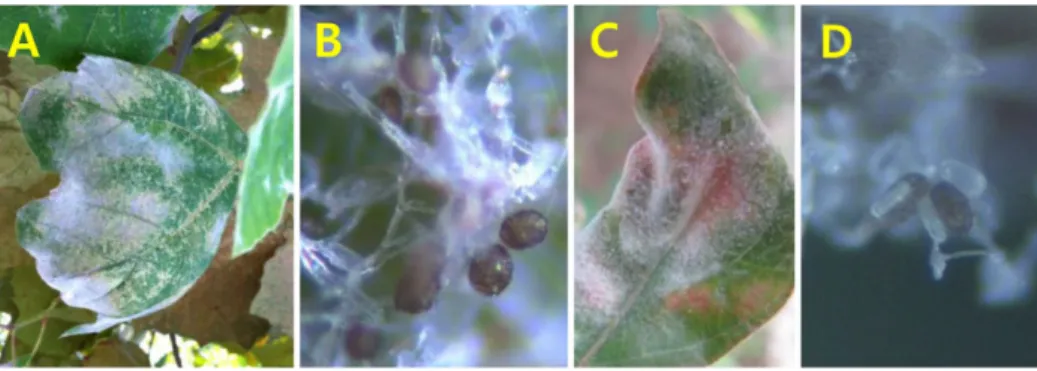
To obtain Ampelomyces isolates, leaves (Fig. 1A, 1C) with powdery mildew symptom caused by Erysiphe pla- tani on sycamore and Erysiphe australiana on crape myr- tle with a higher production of pycnidia were collected.
The samples of infected leaves were examined under a stereo-microscope, and Ampelomyces pycnidia were iso- lated using the single-spore isolation method (Fig. 1B, 1D). They were then transferred with a glass needle to potato dextrose agar (PDA). Pure isolates were trans- ferred to slant tubes, and deposited at the Environmental Microbiology Laboratory Herbarium (EMLH; Chonnam National University, Gwangju, Korea) as EML-FAM3 and EML-FAMC1. Genomic DNA was directly extracted from pycnidia using the HiGene Genomic DNA prep kit for Fig. 1. Co-occurrence of Ampelomyces quisqualis on leaf lesions (A, C) of powdery mildews caused by Erysiphe platani on sycamore and Erysiphe australiana on crape myrtle in Korea and pycnidia of A. quisqualis (B, D) on their hosts.
Fig. 2. Phylogenetic tree based on maximum likelihood analysis of internal transcribed spacer rDNA sequences for EML-FAM3 and EML-FAMC1. Phoma herbarium was used as an outgroup. Bootstrap values are shown above/below branches supported by more than 50% from 1,000 replications. Each clade was made based on the previous phylogenetic system constructed by Pintye et al. [11].
66
Thi Thuong Thuong Nguyen and Hyang Burm Leefungi (Biopact Corp., Daejeon, Korea). The internal tran- scribed spacers (ITS1 and ITS2) and 5.8S gene were am- plified using primers ITS1 (5- CTTGGTCATTTAGAGG AAGTAA-3) and ITS4 (5-TCCTCCGCTTATTGATATGC- 3) following the method by White et al. [14]. The sequ- ences were initially aligned using CLUSTAL X [15], and edited manually. Phylogenetic analyses were performed using MEGA 6 [16] with the default settings. Phylogenetic trees were constructed from the data using maximum likelihood (ML). The sequences of EML-FAM3 and EML- FAMC1 strains were deposited in the GenBank database with accession numbers, KC878305 and KU948156, respec-
tively. A BLASTn search revealed that the rDNA ITS se- quences of EML-FAM3 and EML-FAMC1 represented high similarities of 99.8% (491/492 bp) and 99.1% (313/
316 bp) with A. quisqualis (GenBank accession no. GQ 324135). The phylogenetic tree of the ITS region (Fig. 2) revealed that the isolates EML-FAM3 and EML-FAMC1 were significantly grouped with A. quisqualis. These spe- cies belonged to clade 4, which includes A. quisqualis strains from E. ligustri, P. verniciferae, E. alphitoides, E. ne- cator and G. cichoracearum.
To confirm the molecular species identification, the morphology of the isolates EML-FAM3 and EML-FAMC1
Fig. 3. Sycamore and crape myrtle plants infected powdery mildew with its mycoparasite, Ampelomyces quisqualis. A, B, Leaf les- ion of powdery mildew caused by Erysiphe australiana on crape myrtle plants; C, Mycoparasite A. quisqualis on E. australiana under stereo-microscope; D, Conidia of E. australiana; E, F, Pycnidia and pycnidiospores of A. quisqualis; G, Streak plate with colonies of EML-FAMC1 on potato dextrose agar (PDA) medium; H~K, Fungal masses consisting of pycnidia and pycnidios- pores on colony; L, Leaf lesion of powdery mildew caused by Erysiphe platani on sycamore plant; M, Mycoparasite A. quisqualis on E. platani under stereo-microscope; N, Conidia of E. platani; O, P, Pycnidia and pycnidiospores of A. quisqualis; Q, Streak plate with colonies of EML-FAM3 on PDA medium; R, Fungal masses consisting of pycnidia and pycnidiospores on colony; S, Pycnidiospores exuded from pycnidia; T, Appendages of pycnidia; U, Pycnidiospores (scale bars: D~F, J, K, N, P, T, U = 20 µm;
I, S = 200 µm).
First Report of Ampelomyces quisqualis from Sycamore and Crape Myrtle and Its Potential as a Mycoparasite of Powdery Mildew
67
were examined under light microscope (DFC 290; Leica Microsystems, Wetzlar, Germany).
Ampelomyces strains, EML-FAMC1 and EML-FAM3, were observed on crape myrtle (Fig. 3A~3D) and syca- more (Fig. 3L~3N) with powdery mildew infection, res- pectively. Pycnidia of EML-FAMC1 were vary in shape, globose to obovoid, light brown to dark brown, measured 35~38 × 23.5~26.5 µm. Pycnidiospores were globose to oblong, measured 5.5~6.5 × 2.5~3.5 µm (Fig. 3E, 3F).
While the pycnidia of EML-FAM3 were globose, dark brown, and measured 41.5~51.0 × 33.5~43.0 µm. Pycnidi- ospores were globose to oblong, measured 7.5~8.5 × 3.0~
3.5 µm (Fig. 3O, 3P). The pycnidia and conidia of EML- FAMC1 (Fig. 3G) and EML-FAM3 (Fig. 3Q) isolates were incubated on potato dextrose agar (PDA) to determine their morphological characteristics. The color of the my- celia and pycnidia of EML-FAMC1 (Fig. 3H, 3J) and EML-FAM3 (Fig. 3R, 3T) were observed after 14 and 30 days at 25°C in the dark. EML-FAMC1 isolate: Pycnidia were ovate to lemon-shaped, dark olivaceous. Pycnidios- pores were globose to oblong, measured 6.0~7.0 × 2.5~
3.5 µm (Fig. 3I, 3K). EML-FAM3 isolate: Pycnidia were globose, dark brown. Pycnidiospores exuded from pycni- dia were globose to oblong, measured 5.5~7.5 × 3.0~3.5 µm (Fig. 3S, 3U). Two isolates exhibited slow growth on PDA and an irregular margin, and mycelia were immer- sed or superficially formed.
When fungal masses of A. quisqualis EML-FAM3 were treated on the leaves infected by powdery mildew on ubame oak (Quercus phillyraeoides A. Gray) leaf at 27°C for 24 hr, the conidial germination of the powdery mildew spores were significantly reduced (data not shown). Pow- dery mildew is a notorious disease and generally difficult to control. Our data suggests that the EML-FAM3 strain isolated from sycamore plant may reduce the incidence of powdery mildew by suppressing conidial germination.
More studies on the application of the Ampelomyces strains as biocontrol strategies are needed.
Acknowledgements
This work was supported by the Project on Survey and Discovery of Indigenous Species of Korea by NIBR of the Ministry of Environment (MOE), Republic of Korea.
REFERENCES
1. Falk SP, Gadoury DM, Cortesi P, Pearson RC, Seem RC. Par-
asitism of Uncinula necator cleistothecia by the mycoparasite Ampelomyces quisqualis. Phytopathology 1995;85:794-800.
2. Kiss L. Natural occurrence of Ampelomyces intracellular myco- parasites in mycelia of powdery mildew fungi. New Phytol 1998;140:709-14.
3. Angeli D, Pellegrini E, Maurhofer M, Pertot I, Micheli S, Ress D, Gessler C. Molecular characterization of Ampelomyces spp.
isolates from different host and geographic origins and evalu- ation of their potential to control powdery mildew of cucum- ber. IOBC/WPRS Bull 2009;43:40-4.
4. Kiss L. Genetic diversity in Ampelomyces isolates, hyperpara- sites of powdery mildew fungi, inferred from RFLP analysis of the rDNA ITS region. Mycol Res 1997;101:1073-80.
5. Kiss L, Russell J, Szentiványi O, Xu X, Jeffries P. Biology and biocontrol potential of Ampelomyces mycoparasites, natural antagonists of powdery mildew fungi. Biocontrol Sci Technol 2004;14:635-51.
6. Rankoviæ B. Hyperparasites of the genus Ampelomyces on powdery mildew fungi in Serbia. Mycopathologia 1997;139:
157-64.
7. Park MJ, Choi YJ, Hong SB, Shin HD. Genetic variability and mycohost association of Ampelomyces quisqualis isolates infer- red from phylogenetic analyses of ITS rDNA and actin gene sequences. Fungal Biol 2010;114:235-47.
8. Angeli D, Puopolo G, Maurhofer M, Gessler C, Pertot I. Is the mycoparasitic activity of Ampelomyces quisqualis biocontrol strains related to phylogeny and hydrolytic enzyme produc- tion? Biol Control 2012;63:348-58.
9. Mougou-Hamdane A, Giresse X, Dutech C, Desprez-Loustau ML. Spatial distribution of lineages of oak powdery mildew fungi in France, using quick molecular detection methods.
Ann For Sci 2010;67:212.
10. Hofstein R, Fridlender B. Development of production, formu- lation and delivery systems. In proceedings of Brighton Crop Protection Conference: pests and diseases; 1994 Nov 21-24;
Farnham, England. British Crop Protection Council; 1994. p.
1273-80.
11. Pintye A, Bereczky Z, Kovács GM, Nagy LG, Xu X, Legler SE, Váczy Z, Váczy KZ, Caffi T, Rossi V, et al. No indication of strict host associations in a widespread mycoparasite: grapev- ine powdery mildew (Erysiphe necator) is attacked by phylog- enetically distant Ampelomyces strains in the field. Phytopath- ology 2012;102:707-16.
12. LeeI, Youn U, Kim H, MinB, Kim JS, BaeK. Biphenyl and biphenyl ether quinolizidine N-oxide alkaloids from Lagerst- roemia indica L. Planta Med 2011;77:2037-41.
13. Lee HB, Lee HW, Mun HY. First report of powdery mildew caused by Erysiphe platani on sycamore (Plantanus occidenta- lis) in South Korea. Plant Dis 2013;97:841.
14. White TJ, Bruns TD, Lee SB, Taylor JW. Amplification and direct sequencing of fungal ribosomal RNA genes for phylog- enetics. In: Innis MA, Gelfand DH, Sninsky JJ, editors. PCR protocols: a guide to methods and applications. San Diego:
Academic Press; 1990. p. 315-22.
15. Thompson JD, Gibson TJ, Plewniak F, Jeanmougin F, Higgins DG. The CLUSTAL_X windows interface: flexible strategies for multiple sequence alignment aided by quality analysis tools.
Nucleic Acids Res 1997;25:4876-82.
16. Tamura K, Stecher G, Peterson D, Filipski A, Kumar S. MEGA 6: Molecular Evolutionary Genetics Analysis version 6.0. Mol Biol Evol 2013;30:2725-9.