Phonetics and Speech Sciences Vol. 6 No. 1 (March 31, 2014) www.speechsciences.or.kr
ISSN 2005-8063, pp. 3~10 http://dx.doi.org/10.13064/KSSS.2014.6.1.003
Neutralization of Vowels /ɨ/ and /u/ after a Labial Consonant in Korean:
A Cross-generational Study
Kang, Hyunsook1)
ABSTRACT
This study investigated whether Korean vowels, /ɨ/ and /u/, are distinctively perceived after a labial consonant given the fact that native and Sino-Korean nouns showed only vowel /u/ after a labial consonant while this pattern was massively broken by the recent introduction of loanwords.
For this purpose, a perception experiment was conducted with V1C1V2 sequences in which different vowels /a, i, u/ and consonants /p, t, k/ occurred in V1 and C1 before the target V2, /ɨ/ and /u/. The data was produced by six speakers each from two different age groups, Age20 and Age40/50 in the read speech style. The results showed that consonant /p/ attracted significantly more responses of /u/ from /VCɨ/ sequences and significantly less responses of /u/ from /VCu/ sequence than the other consonants did in both age groups. Furthermore, Age20 group showed significantly less percentage of /u/ responses than Age40 group when the preceding consonant was /p/ regardless of the target vowel.
We suggest therefore that unlike the traditional belief of labial assimilation, there is neutralization after a labial consonant in which vowels /ɨ/ and /u/ are often realized as any sound between two vowels, /ɨ/ and /u/. That is, this vowel change is not categorial but it rather produces an ambiguous stimulus which attracts different responses from different listeners.
Ambiguous stimulus was produced due to coarticulatory efforts in speech production and perceptual compensation. We also argue that there is generational difference such that Age40/50 group speakers showed stronger tendency to produce /u/ after a labial consonant regardless of whether the target vowel was /ɨ/ or /u/.
Keywords: Korean vowels /ɨ/ and /u/, a labial consonant, a perception experiment, neutralization, labial assimilation
1. Introduction
Korean vowels have been undergoing some changes over the years. One such case is (near-)merger between /ɛ/ and /æ/
(Hwang, 1987). Another case is the change currently undergoing between /o/ and /u/ in Seoul Korean (Hwang, 1987; Moon, 2006; Jang & Shin, 2006): Han & Kang (2013) and Kang &
Han (2013) have argued that vowels /o/ and /u/ are getting approximated as speakers are getting younger and that female
1) Hanyang University, [email protected]
This work was supported by the research fund of Hanyang University (HY-2013-G).
Received: December 1, 2013 Revised: December 12, 2013 Accepted: December 13, 2013
speakers are leading this vowel change ahead of males.
Specifically, they showed that /o/ was being raised toward /u/
for female speakers as they were getting younger.
Not only there are these context-free vowel changes, but there are also context-sensitive ones. This paper attempts to analyze one such context-dependent vowel change, the one between /u/ and /ɨ/ after a labial consonant.
Any Korean vowel may occur after any consonant in the same syllable except /ŋ/2). However, a close examination of segment distribution in Korean shows that there are some systematic gaps in vowel distribution when the preceding consonant is an alveopalatal or a labial. For example, when the final syllable of a verbal root has an alveopalatal consonant as an onset, /ɨ/ never follows it. Based on this systematic gap and
2) Consonant /ŋ/ can occur only as a coda in Korean.
some phonological alternations, Kang (1987) argued that some /alveopalatal-i/ sequences were underlyingly /alveopalatal-ɨ/
considering /ɨ/-vowel deletion (cɨ-ə>*cɨə, cə; 'lose, fail') and that assimilation rule changed /ɨ/ to /i/ by the front qualities of the alveopalatal consonant (cɨ-ta>*cɨta, cita; 'lose, fail'): a case of context-sensitive assimilation.
Another systematic gap in Korean vowel distribution occurs for vowels /ɨ/ and /u/ after a labial consonant: /ɨ/ never occurs after a labial consonant in native and Sino-Korean nouns as there is no *pɨ, *Pɨ, *phɨ, *mɨ syllable in nouns. Historical evidence tells that there was labial assimilation (Lee, 1991) that changed vowel /ɨ/ to /u/ after a labial consonant around late 17th Century. For example, many /labial-u/ sequences were historically from /labial-ɨ/ sequences as in mul ‘water’ (<- mɨl), pul ‘fire’ (<- pɨl), and muət ‘what’ (<- mɨsɨkət).
For verbal stems, there are stem-final /labial-ɨ/ sequence.
These are historically from the affixation of the suffix /-pɨ/
‘adjective/static verb forming suffix’ to a stem3) as in kiPɨ- 'be happy' (<- kis-pɨ), sɨlphɨ- 'be sad' (<- sɨlh-pɨ). For these forms, Kim-Renaud (1973) suggested that they were pronounced kiPu- and sɨlphu- with the final /u/ due to labial assimilation, though the change was not recognized in the spelling.
Thus, we have another context-sensitive vowel change: only /u/, not /ɨ/, occurs after a labial consonant in Korean nouns and possibly in all Korean vocabulary.
As for native speakers’ intuition, some Koreans including the author will testify that it is difficult to distinguish /labial-ɨ/
sequence from /labial-u/ sequence. Such confusion in perception can be often shown in written forms. So (2009) showed that many /labial-ɨ/ sequences like iPɨmyənsə ‘pretty but’ and nəlpɨrəcin ‘sprawl out’ were often written as nonstandard forms like iPumyənsə and nəlpurəcin. So (2009) argued these nonstandard forms reflected the perception of native speakers.
However, this is not the only way of confusion between /ɨ/
and /u/. Google website shows that there is confusion in the opposite direction as well: many /labial-u/ sequences are often written as /labial-ɨ/ sequences. For instance, pullosotɨk ‘unearned income’ showed more than seven million instances of nonstandard form pɨllosotɨk and pulkasaɨi ‘mystery’ also showed more than one million instances of nonstandard pɨlkasaɨi.
The confusion between /labial-ɨ/ and /labial-u/ might have been intensified due to the massive introduction of loanwords into Korean in which /labial-ɨ/ sequences frequently occur.
3) I would like to thank Dr. Lee, Phil-young for the consultation on Korean. Needless to say, all errors are my own.
When a foreign word that does not fit to the syllable structure of Korean is introduced, many changes occur including the insertion of vowel /ɨ/ after a stray consonant as in thɨraiɛŋkɨl (<--triangle English). In fact, most Koreans report to hear imaginary vowel /ɨ/ if the released consonant is not followed by a real vowel (cf. Kang, H, 1996; Kang, Y, 2003).
If a stray consonant is labial, again vowel /ɨ/ is inserted as in phɨrinsɨthən (<-- princeton English). Vowel /u/ could also occur after a labial consonant if the original vowel in the donating language was /u/ as in phuthin (<-- Putin Russian).
This opens up the possibility that labial assimilation might no longer apply in Korean phonology so that Koreans now clearly hear and speak vowel /ɨ/ and /u/ after a labial consonant. Note that unlike a labial consonant, stray alveopalatal consonant /ʧ/
triggers /i/-insertion as is shown in mæʧhi (<--match English) since Koreans hear an imaginary vowel /i/ after an English alveopalatal consonant.
To determine the status of vowels /ɨ/ and /u/ after a labial consonant, this study will perform a perception test by examining /ɨ/ and /u/ identification performance after a labial consonant. The stimuli of the experiment are read by speakers of two different age groups, male age 20s (Age20 group) and male age 40/50s (Age40 group). The tokens produced by speakers with about 20 years difference were used to see whether there is difference in the realization of vowels /ɨ/ and /u/ after a labial consonant.
From this experiment, we expect to examine the followings:
First, we will investigate whether the intervening consonant C1
in ‘V1C1V2haseyo’ influences the perception of the following vowel V2, /ɨ/ and /u/. In particular, we will see whether there is significant perceptual confusion between Vpɨhaseyo and Vpuhaseyo compared to other pairs of corresponding stimuli with a different C1. Secondly, we will investigate whether age difference influences the perception of V2. Han & Kang (2013) and Kang & Han (2013) showed that Age40 group use larger and more peripheral vowel space for Korean vowels than Age20 group. We will see what consequences this frequency range difference for vowels has on perception. We expect that answers to these questions will offer a new way of looking at the vowel change between /ɨ/ and /u/ after a labial consonant in current Korean.
2. Method
2.1 Listeners
Sixteen Seoul-dialect speaking XXXX University students in their early twenties participated in the experiment. Subjects were given either a course credit or small amount of money. None reported any hearing problem.
2.2 Speakers
Data from male speakers in their 20's (Age20 group) and male speakers in their 40's/early 50's (Age40 group) were selected from the recordings in Han & Kang (2013)4). Each group had six speakers. We selected these two groups to examine whether age difference influences the realization of vowels.
2.3 Stimulus
The recorded frame sentence was ‘chənchənhi V1CV2haseyo’
(‘Please do (say) ____ slowly’) in which V1 or V2 was one of Korean vowels (/ɑ, ɛ, æ, i, o, u, ɨ, ʌ/) and the consonant one of /p, t, k/. For the specific procedures, refer to Han & Kang (2013).
Stimuli for the perception test were constructed with the second phrase of the frame sentence, ‘V1C1V2haseyo’ in which V1 was one of /a, i, u/, C1 one of /p, t, k/, and V2 /-ɨ/ or /-u/.
Thus, we had total 18 tokens (3V1 * 3C1 * 2V2) from each speaker. Since there were 6 speakers each from male Age20 and male Age40 groups, the total number of tokens were 216 (3V1 * 3C1 * 2V2 * 6 speakers * 2 groups). We chose three vowels, /a/, /i/ and /u/, for V1 since we wanted to reduce the number of tokens to make the experiment last less than 20 minutes, but at the same time, V1 representing different articulatory positions of vowels. Each stimulus was produced as a single AP.
2.4 Procedure
Stimuli were randomized and then presented in one block, in which there were two short breaks each after eighty trials.
Listeners were asked to click again if they are ready to start again for the next eighty trials. The break did not last more than 2 minutes. Between each stimulus there was a 2 second interval.
The experiment was conducted in a quiet office using high quality headphones. Two syllables were displayed on a computer monitor, corresponding to the /pɨ/ & /pu/, /tɨ/ & /tu/,
4) Han & Kang (2013) recorded thirty-six Seoul dialect speakers, specifically six speakers each from six groups, male/female 20’s, male/female 30’s, and male/female 40’s/early 50’s.
and /kɨ/ & /ku/. Participants were asked to click the answer on the computer screen corresponding to what they heard using a mouse. Their responses were recorded on a PC. All participants were first given six practice trials to make sure they could perform the task. Each participant made a total of 216 judgments. The entire experiment lasted about 20 minutes.
2.5 Analysis
We calculated the percentage of stimulus presentations for which participants reported hearing a phrase with /u/ for the target. A repeated-measures ANOVA was conducted with Consonant (/p/, /t/ or /k/) and Age groups as within-subject factors to analyze which factors affect the percentage of /u/
responses.
3. Results
3.1 Comparison between Age20 and Age40 groups In this Section, we will compare the identification responses of two Age groups for each target /ɨ/ or /u/.
3.1.1 /VCɨ/ stimuli
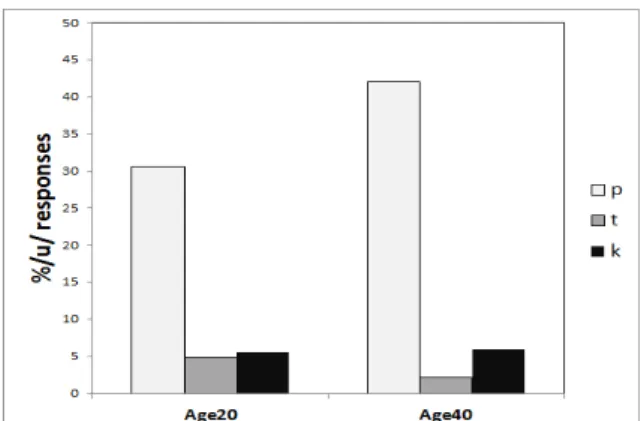
Figure 1. Percentage of /u/ responses for /VCɨ/ stimuli of Age20 & Age40 groups
age con p t k
Age20 30.6 4.9 5.6
Age40 42 2.1 5.9
Table 1.the percentage of /u/ responses for /VCɨ/ for Age20/40 group
<Figure 1> shows the percentage of /u/ responses for /VCɨ/
stimulus for both age groups. The exact percentage of /u/
responses for each sequence was given in <Table 1>. A
repeated-measures ANOVA showed that there were significant main effects of Consonant [F(1.12,16.82)=69.90, p=.000], Age [F(1,15)=8.83, p<.01], and significant interaction of these two factors [F(1.39,20.84)=9.27, p<.005].
Subsequent post-hoc analyses revealed that there was significant difference in percentage of /u/ responses depending on Age: Age20 group showed significantly different percentage of /u/ responses from Age 40 group when the consonant is /p/
(p<.005) and /t/ (p<.05). No significant difference was reported when the consonant was /k/.
Each Age group also showed significant difference in percentage of /u/ responses depending on Consonant: In Age 20 group, /p/ showed significant difference in percentage of /u/
responses from /t/ (p=.000) and /k/ (p=.000). In Age 40 group, /p/ showed significant difference in percentage of /u/ responses from /t/ (p=.000) and /k/ (p=.000) and /k/ showed significant difference in percentage of /u/ responses from /t/ (p<0.05).
Summarizing the results, significantly more responses of /u/
occurred for Age40 group than for Age20 group when the consonant was /p/ and significantly less responses of /u/ when consonant was /t/. In addition, significantly more responses of /u/ occurred in the order of /p/>/k/,/t/ in Age 20 group and in the order of /p/>/k/>/t/ in Age 40 group.
3.1.2 Discussion
The results of /VCɨ/ sequences showed that Consonant and Age are strong and effective cues to the distinction between /ɨ/
and /u/.
First, the results showed that preceding consonant /p/ resulted in significantly more /u/ responses. We suggest that there was progressive labialization process in which labial consonant /p/
affected the following vowel /ɨ/ to be perceived as labialized /u/
regardless of the age. In Age40 group, consonant /k/ attracted significantly more responses of /u/ than consonant /t/. Even so, consonant /k/ attracted mere 6% of /u/ responses.
Secondly, there is Age difference. <Figure 1> shows significantly more /u/ responses for Age40 group than for Age20 group when the intervening consonant was /p/. This show that Age40 group may have stronger assimilatory force between labial consonant and the following /ɨ/. We suggest that this may have something to do with linguistic experience.
Younger speakers have been more exposed in their adulthood to many loanwords in which labial consonants are frequently followed by /ɨ/. As a result, younger speakers may have weaker assimilatory force between a labial segment and /ɨ/.
When the consonant was /t/, there was significantly more /u/
responses for Age20 group than for Age40 group. We speculate that Age40 speakers pronounced the speech material more clearly than Age20 group, and thus, less /u/ responses than Age20 group. However, even the percentage of /u/ after /t/ was mere 5% even for Age20 group. As for the percentage of /u/
after /k/, there was no difference between Age20 and Age40 groups. We suspect that velar characteristics of /k/ affected the following /ɨ/ to be perceived as more /u/-like than the consonant /t/. However, the percentage of /u/ after /k/ was mere 6% for both groups.
The results showed that labial assimilation in Korean is not categorical change. The /u/ responses for both groups were mostly induced from many stimuli with consonant /p/ but each of these stimuli attracted different numbers of /u/ responses from listeners. This argues that these /u/-attracting stimuli contained some fine-grained subphonemic variabilities that were taken as the categorical change for some listeners but not for the other listeners.
3.1.3 /VCu/ stimuli
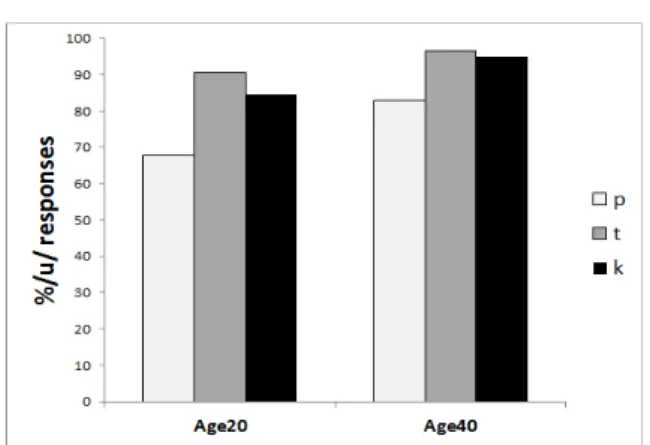
Figure 2. Percentage of /u/ responses for /VCu/ stimuli of Age20 & Age40 groups
age c p t k
Age20 67.7 90.6 84.4
Age40 83 96.5 94.8
Table 2.the percentage of /u/ responses for /VCu/ of Age20/40 groups
<Figure 2> shows the percentage of /u/ responses in /VCu/
sequences for Age20 and Age40 groups. Percentage of /u/
responses for each sequence was given in <Table 2>. A repeated-measures ANOVA showed that there were significant
main effects of Consonant [F(1.39, 19.76)=60.85, p=.000], Age [F(1, 15) = 72.26, p=.000], and no significant interaction of these two factors [F(2, 30)=3.42, p>.05].
Main effects analysis showed that age groups showed significant difference in percentage of /u/ responses from one another in all consonant conditions, /p/ (p=.000), /t/ (p<.01) and /k/ (p=.000).
In each Age group, Consonant showed significant difference in percentage of /u/ responses from other consonants. In Age 20 group, /p/ showed significant difference in percentage of /u/
responses from /t/ (p=.000) and /k/ (p=.001) and /t/ showed significant difference in percentage of /u/ responses from /k/
(p<0.03). In Age 40 group, /p/ showed significant difference in percentage of /u/ responses from /t/ (p=.000) and /k/ (p=.001).
No other difference was reported.
Summarizing the results, significantly less responses of /u/
occurred for Age20 group than for Age40 group for each intervening consonant. In addition, significantly less responses of /u/ occurred in the order of /p/>/k/>/t/ in Age 20 group and /p/>/k/,/t/ in Age 40 group.
3.1.4 Discussion
The results showed that Consonant and Age were also important factors in the perception of /u/ in /VCu/ sequences.
First, the results showed that labial consonant /p/ induced significantly less /u/ responses than the other consonants in both age groups: 83% (Age40) and 68% (Age20) of the stimuli were perceived as /u/ after /p/ whereas 97% (Age40) and 91%
(Age20) after /t/ and 95% and 84% after /k/. We suggest that this may have something to do with speech production and/or perception.
Production wise, articulatory efforts for the lip closure for /p/
and lip rounding for /u/ in /pu/ are more difficult to coarticulate than /pɨ/ sequences which does not contain lip rounding gesture.
As is known, /labial-labial/ sequences were often avoided by the OCP (Yip, 1988).
As vowels /ɨ/ and /u/ are non-distinctive after a labial consonant, ease of articulation was favored over the distinction of different phonemes. On the other hand, for sequences like /tu/ and /ku/, functional load to distinguish /u/ from /ɨ/ becomes more important than ease of articulation and thus, more /u/
responses for these sequences than /pu/.
Perception-wise, perceptual adjustment due to perceptual biases (Mann & Repp, 1980) might have contributed to the less /u/ responses for /pu/. Mann and Repp (1980) showed that
when synthetic fricative noises that ranged from /ʃ/ to /s/ are placed before /u/ or /a/, listeners perceived more instances of /s/
before /u/ than before /a/. They argued that listeners’ knowledge that more /ʃ/-like sound occur before /u/ in natural speech production was automatically incorporated into their speech processing system which in turn made automatic perceptual adjustment when listening these sequences. That is, this perceptual compensation would make listeners perceive the fricative sound before /u/ more often as /s/ even if it would have been judged as /ʃ/ if placed before /a/.
Likewise, we speculate that the labial /p/ before the target vowel /u/ might have triggered perceptual bias for listeners such that the target /u/ was perceived less often as /u/ due to preceding labial segment /p/. Note that there was assimilation between /p/ and /ɨ/ so that when listeners perceived more or less ambiguous stimulus, they may assume that it is the result of assimilation triggered by /p/ on /ɨ/.
In Age20 group, consonant /k/ attracted less /u/ responses than consonant /t/. Close examination showed that /uku/ induced significantly less /u/ responses than /utu/ (p<.05) but the other pairs like /iku/ vs. /itu/ and /aku/ vs. /atu/ showed no significant difference from each other (all p>.05). We speculate that this has to do with grave characteristics of /k/ (Hyman 1975). When the grave consonant /k/ was combined with labial /u/ in the preceding syllable, articulatory and perceptual compensation effects may play a role in the identification of target /u/5). In Age40 group, this factor did not make a difference. We speculate that it was because Age40 group produced stimulus more clearly such that the first vowel had less impact on the identification on the second target vowel.
Secondly, there is Age difference. Less /u/ responses were attracted for Age20 group than for Age40 group with the identical preceding consonant. We suggest that this tendency has to do with the speech style of speakers of Age20 group. As speakers are getting younger, they use less extensive lip rounding for /u/ in the second syllable, which results in more /ɨ/-like sound. Another possibility is that speakers of Age20 group used the reduced vowel space such that their /u/ is nearer to /ɨ/ than /u/ of Age40 group is. As a result, it is perceived more frequently as /ɨ/.
5) The first vowel also affects the identification of the second vowel /ɨ/ and /u/. If the first vowel is /u/, second vowel /ɨ/
is perceived more often as /u/ than if the first vowel is /a/
or /i/. For detailed analysis we will discuss in our future study.
3.2 Comparison between /VCɨ/ and /VCu/
In this Section, we will compare the identification responses of the target /ɨ/ and /u/ in each age group.
3.2.1 Age20 group
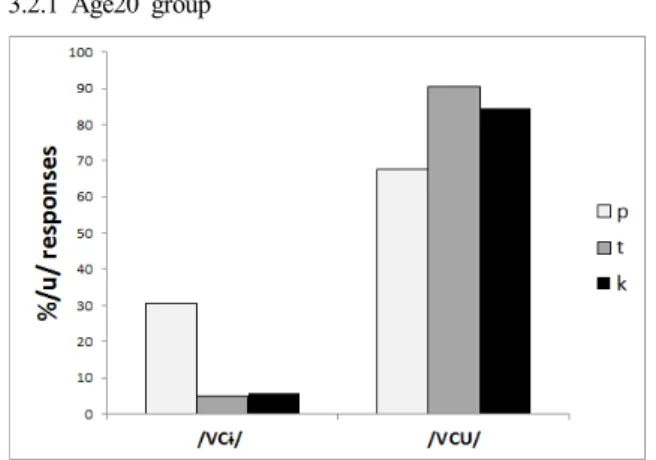
Figure 3. Percentage of /u/ responses for /VCɨ/ and /VCu/
stimuli of Age20 group
age c p t k
ɨ 30.6 4.9 5.6
u 67.7 90.6 84.4
Table 3. the percentage of /u/ responses for Age20 group
<Figure 3> and <Table 3> show percentage of /u/ responses of /VCɨ/ and /VCu/ sequences for Age20 group. A repeated- measures ANOVA showed that there were significant main effect of Target Vowel [F(1,15)=1912.89, p=.000], but no significant main effect of Consonant [F(1.13,16.89)=2.07, p>.05], and significant interaction of these two factors [F(2,30)=113.56, p=.000].
Subsequent post-hoc analyses revealed that Target Vowel /ɨ/
showed significantly low percentage of /u/ responses from Target Vowel /u/ when the consonant is /p/ (p=.000), /t/
(p=.000) and /k/ (p=.000).
3.2.2 Age40 group
<Figure 4> and <Table 4> show percentage of /u/ responses in /VCu/ sequences. A repeated-measures ANOVA showed that there were significant main effects of Consonant [F(1.10,16.54)=
15.63, p=.001], Target Vowel [F(1,15)=1998.64, p=.000], and significant interaction of these two factors [F(1.35,20.24)=94.33, p=.000].
Subsequent post-hoc analyses revealed that for each consonant, there was significant difference in percentage of /u/
responses according to Target Vowel: Target Vowel /ɨ/ showed significantly different percentages of /u/ responses from Target Vowel /u/ when the consonant is /p/ (p=.000), /k/ (p=.000) and /t/ (p=.000).
Figure 4. Percentage of /u/ responses for /VCɨ/ and /VCu/
stimuli for Age40 group
age c p t k
ɨ 42 2.1 5.9
u 83 96.5 94.8
Table 4. the percentage of /u/ responses for Age40 group
3.2.3 Discussion
The results showed that in each age group, significantly different numbers of /u/-responses were obtained depending on the target vowel. If the target vowel was /ɨ/, more responses of /ɨ/ were attracted and if the target vowel was /u/, more responses of /u/ were attracted regardless of the preceding consonant. This shows that there was no categorical assimilation between the target vowel and a labial consonant.
Also noteworthy is the fact that in each age group when the intervening consonant was /k/, the /u/ responses were larger than when the conditioning segment was /t/ with the target /ɨ/.
If the target is /u/, then less /u/ responses were induced when the conditioning segment was /k/ than when the conditioning segment was /t/. We suggest that this has to do with the velar characteristics of /k/ in connection with the preceding vowel:
when the preceding vowel was /u/, it dissimilated the second vowel /u/ more when the intervening consonant was /k/ than when it was /t/. More detailed analysis will be dealt in the future study.
4. General Discussion
The aim of this study was to investigate whether vowels /ɨ/
and /u/ were distinctively identified when preceded by a labial consonant given the fact that native and Sino-Korean nouns showed no distinction of these two vowels after a labial consonant while this distribution was massively broken by the recent introduction of loanwords.
To answer this question, we ran a perception test in which different vowels /a, i, u/ and consonants /p, t, k/ occurred before target vowels, /ɨ/ and /u/. The stimuli of the test were produced in read speech style by speakers of two different age groups, Age20 and Age40 groups.
The results showed that both Consonant and Age affected the perception of target vowels, /ɨ/ and /u/. Specifically, we have shown that underlying /ɨ/ induced 31% of /u/ responses for Age20 group and 42% for Age40 group after a labial consonant whereas underlying /u/ induced 68% of /u/ responses for Age20 group and 83% for Age40 group in the same context.
That is, even if the target segment /ɨ/ or /u/ was more often perceived as the intended segment in this read speech style data, the results showed that considerable percentage of misperceived responses occurred, which, in fact, argued that /ɨ/
and /u/ were more or less neutralized after a labial consonant and that their surface form might be any intermediate sound between the two vowel sounds, /ɨ/ and /u/, as each participant responded differently for different stimulus.
We suggest that vowel neutralization between /ɨ/ and /u/ after a labial consonant were triggered by labial assimilation, ease of articulation in speech production, and perceptual compensation.
This paper has also shown that Age is an important factor in the perception of /ɨ/ and /u/ distinction: stimuli produced by Age20 group attracted more /ɨ/-like responses than those by Age40 group after a labial consonant, regardless of the identity of the target vowel.
Several reasons could be suggested for this change of neutralized vowel quality after a labial consonant. First, this may in fact show the currently undergoing vowel change: the neutralized high back vowel after a labial consonant is changing from more /u/-like sound to more /ɨ/-like sound as speakers are getting younger. This may not be surprising since younger speakers have encountered many more loanwords in which /ɨ/ is distinctively represented after a labial consonant. Consequently, younger speakers may better recognize and pronounce /ɨ/ after a labial consonant, which resulted in the weakening labial
assimilation.
Secondly, this may also have to do with the speech style for the production of the speech material. Speakers of Age40 group might have articulated the stimuli more carefully than speakers of Age20 group. Thus, vowel /u/ of Age40 group attracted more /u/ responses than that of Age20 group. Additionally, less /u/
responses were induced for Age40 group than for Age20 group when the intervening consonant was /t/ and the target was /ɨ/.
We suggest that this is partly due to speakers of Age40 group’s efforts to articulate the vowels more correctly. As for vowel /ɨ/, the careful speech might be in fact /u/ considering labial assimilation in Korean phonology. The best place to examine is after other consonant. Note that vowel /ɨ/ attracted more /ɨ/
responses for Age40 group than for Age20 group when the intervening consonant was /t/, a segment that does not participate in the rounding assimilation.
Thirdly, the results may also reflect different frequency ranges speakers of different age groups use for Korean vowels (cf. Han & Kang, 2003): Speakers of Age40 group utilized larger/more peripheral frequency ranges for Korean vowels compared to those of Age20 group, and as a result, the /u/s by speakers of Age40 group were perceived as /u/s more often than the /u/s produced by speakers of Age20 group.
Conclusively, this study have shown that the traditional assumption that only /u/ but not /ɨ/ occurs after a labial consonant by labial assimilation cannot be sustained (Lee, 1991). Categorical labial assimilation which had taken place in Korean phonology long time ago seems no longer to be categorical. Instead, there is neutralization between /u/ and /ɨ/
after labial consonant in Korean which made its surface form an intermediate sound between /ɨ/ and /u/. Furthermore, this neutralized vowel form seems to be currently undergoing change from more /u/-like to more /ɨ/-like.
Note that in this experiment, we tested vowels /ɨ/ and /u/
after an unaspirated plain bilabial stop. It is our impression that neutralized vowel quality is different depending on whether the intervening consonant is aspirated, unaspirated plain, or tense stop. Specifically, after aspirated stops it seems that more /ɨ/
like vowel occurs than after tense stops. In addition, we believe that casual speech style will induce more neutralized vowels in this position. This study examined the read speech style which gave the speakers the impression that we are testing vowels.
This might have prompted them to make their vowels more carefully. In the future study, we will analyze the relationship between different manners of bilabial or different speech style
on the one hand and the vowel qualities on the other hand and will show whether labial feature of a vowel in this position depends on manners of the preceding labial consonant and speech styles.
References
Han, J. & Kang, H. (2013). Cross-generational change of o and u in Seoul Korean I: Proximity in vowel space. Journal of the Korean Society of Speech Sciences, 5(2), 25-31.
Hyman, L. (1975). Phonology: Theory and analysis. New York:
Holt, Rinehart and Winston.
Hwang, Y. (1987). The e/ȁ merger in modern Seoul Korean.
Harvard Studies in Korean Linguistics, II, 367-376.
Jang, H. & Shin, J. (2006). An acoustic study on the generational difference of the monophthongs in the Daegu Dialect. Malsori, 57, 15-30.
(장혜진, 신지영 (2006). 대구 방언 단모음의 세대 간 차이에 대한 음향 음성학적 연구. 말소리, 57, 15-30).
Kang, H. (1987). Glide formation and Complementary Vowel Lengthening in Korean, Harvard Studies in Korean Linguistics, II, 394-403.
Kang, H. (1996). English loanwords in Korean. Studies in Phonetics, Phonology and Morphology, 2, 21-47.
Kang, Y. (2003). Perceptual similarity in loanword adaptation:
English postvocalic word-final stops in Korean. Phonology, 20, 219-273.
Kang, H. & Han, J. (2013). Cross-generational change of o and u in Seoul Korean II: Spectral Interactions in normalized vowel space. Journal of the Korean Society of Speech Sciences, 5(2), 33-41.
Kim-Renaud, Y. (1973). ‘Irregular’ verbs in Korean revisited.
Language Research, 9, 206-225.
Lee, K. M. (1991). History of Korean language. Top Publishers.
(이기문 (1991) 국어사개설. 탑출판사.)
Mann, V. & Repp, B. (1980). Influence of vocalic context on perception of the [ʃ]-[s] distinction. Perception &
Psychophysics, 28, 213-228.
Moon, S. J. (2006). A fundamental phonetic investigation of Korean monophthongs. Malsori, 62, 1-18.
(문승재 (2006). 한국어 단모음의 음성학적 기반연구. 말소리, 62, 1-18.)
So, S. A. (2009). Phonological interpretation on spelling errors.
The Education of Korean Language, 129, 177-208.
(소신애 (2009) '표기상의 오류에 대한 음운론적 해석' 국어
교육, 129, 177-208)
Yip, M. (1988). The obligatory contour principle and phonological rules: a loss of identity. Linguistic Inquiry, 19, 65-100.
∙Kang, Hyunsook
Department of English Language and Culture Hanyang University, ERICA Campus 1592, Sa-3 Dong, Sangnok-gu, Ansan-si Kyunggi-do, Korea
Email: [email protected]