Merger of Vowels in Cheju Korean:
Methodological implications for doing fieldwork on endangered languages*
1)John Stonham (Pukyong National University)
Stonham, John. 2011. Merger of Vowels in Cheju Korean: Methodological implications for doing fieldwork on endangered languages. The Linguistic Association of Korea Journal. 19(1). 23-40. This study investigates the nature of the non-high front vowels in the Cheju dialect of Korean, based on recordings made in the late 1990s. It focuses on the properties of the two vowels, [e] and [æ], to determine how they are realized in the pronunciation of older generation speakers of Cheju Korean and compares these measurements with data for two speakers of the standard language collected in the 1960s to assess the progress of vowel merger.
Several factors that bear on the analysis of these vowels, including external influence and the role of the lexicon, are examined and principles for the proper examination of segments are proposed, with special attention to the phonetic study of endangered languages.
Key Words: vowel merger, endangered languages, Cheju dialect, vowel formants, phonetic fieldwork
1. Introduction
The Cheju dialect of Korean (henceforth CK) is generally considered to be
* I would like to thank Pukyong National University for their financial support of this research under research grant no. PKS 2006-017 for the project "Study of Cheju dialect." I would also like to thank Eun-Sook Kim for her many helpful suggestions on earlier drafts and the three anonymous reviewers for their careful and detailed comments on this paper.
the most divergent and, at the same time, the most conservative variety of the language. It is divergent because of its low level of mutual intelligibility with other varieties of Korean, and conservative because of its retention of many features of Middle Korean that no longer occur in other varieties. Numerous characteristics distinguish it from the standard variety, including phonological, morphological, syntactic and lexical properties. It is also an endangered variety of Korean, with only the older generation still able to speak it fully.
This paper focuses on one of its special characteristic markers, i.e., the distinction between the non-high front vowels [e] and [æ], which is encoded in the Korean writing system by distinct graphic elements, 에 and 애, respectively.
The phonetic contrast has virtually disappeared in most varieties of modern Korean, resulting in the merger of these two vowels (Ahn 2009, Martin 1993, etc.), leaving only the writing system as an indicator of the former contrast.
Additional support for the claim concerning the general loss of this distinction in Modern Standard Korean (henceforth MSK) comes from the acoustic analysis of audio recordings of two speakers of MSK recorded in the 1960s as teaching materials for second language learners of Korean (Park 1968). These recordings clearly show that the distinction between [e] and [æ] was all but gone by that time, even in Standard Korean.
On the other hand, it appears that the contrast between [e] and [æ] is still alive on Cheju Island, although in danger of disappearing within a generation.
Using evidence from data gathered from Cheju speakers in the 1990s, this paper confirms that the two non-high front vowels, [e] and [æ], are gradually moving towards a total merger just as in the speech of other Korean speakers. As the amount of contact with the outside and the standard language has increased, the robustness of the [e]/[æ] distinction has decreased. Currently, no distinction exists in those Cheju speakers under 50 years of age, while it is variable for speakers over 50 (Kim 2006).
Section 2 provides basic information relevant to the paper and is followed, in Section 3, by an outline of the methodology employed. Section 4 presents the facts of front mid vowels in Korean, while Section 5 presents the phonetic results of the study. This is followed by a discussion of the issue of fieldwork methodology in the context of endangered languages in Section 6.
2. Preliminaries
Data for this paper come principally from the fieldwork recordings made by the late Peter Ladefoged, together with Sun-Ah Jun, during a 1998 visit to Cheju Island. These recordings and detailed information concerning speakers are available under a Creative Commons license on the website of the UCLA Language Archives (henceforth referred to as Ladefoged and Jun 1998).
The materials consist of recordings of native speakers of Cheju Korean between the ages of 55 and 78. Six of the speakers were residents of the capital, Cheju City, and the others were residents of more rural areas of the island.
According to the Cheju Ilbo, a local newspaper (Nov. 2007), there are approximately 50,000 elderly residents of the island, providing a rough estimate of the potential speaker pool. The data was elicited using MSK as a medium of communication, with assistance from local specialists. The recordings were digitized at a rate of 48000Hz with a 16-bit sound depth (bitrate=768kbps).
Research arising from the original fieldwork has been previously discussed in several places, including Cho et al. (2000, 2001, 2002). However, none of these studies examined the full range of speakers on the specific issue of the status of the non-high front vowels and this will be the focus of this paper.
Data on the pronunciation of the [e]/[æ] distinction in MSK comes from recordings made for the Foreign Service Institute course in Korean, developed in the 1960s (Park 1968). The language presented in this course is described as
‘representative of the “standard” speech of educated Koreans in Seoul’ (Park 1968:1). Since the purpose of the materials is to teach the standard language, one might expect that the pronunciation would be as close as possible to that variety, perhaps even overly so. These recordings were digitized at 22050Hz for analysis with the Praat software package.
The vowel system in (1) represents an idealized Standard Korean. The presence or absence of one of the non-high front vowels in CK depends on a number of factors, including dialect, age, location, and gender. Cheju Korean is also noted for having an additional back vowel, a reflex of the Middle Korean vowel arae a, indicated in parentheses in the chart, which Kim (2005) claims to be a mid rounded back vowel, represented as [ɔ] on the basis of its acoustic analysis. This vowel is no longer found in any other variety of the language (see
Kim 2005 for further discussion of the nature and status of this vowel in Cheju Korean).
(1) i ɨ u
e ə o
æ a (ɔ)
3. Methodology
The data from both Ladefoged and Jun (1998) and Park (1968) were analysed using Praat 5.1.19 under Macintosh OSX 10.5. Formants were calculated from the steady state portion of the center of each vowel, using a combination of manual measurement and the built-in averaging function over approximately 30% of the vowel. For each CK speaker in Ladefoged and Jun (1998) there were two or three repetitions of a lexical item and each of these was included in the results.
The data used for the analysis include those lexical items shown in (2).
(2) a. [e]: /pe/ ‘cloth’ /se/ ‘tongue’ /kʰe(ta)/
‘to get torn (of skin)’
b. [æ]: /pæ/ ‘thick rope’ /sæ/ ‘material (roof)’ /kʰæ(ta)/
‘it is kʰæ (yut game)ǃ’
Some data from the original fieldwork has not been included in this study, in particular the cases of k’eəmtʃə/k’etʃimalla versus kæəmsə/ kætʃimalla and t’eətʃə/t’etʃimallaversus t’æətʃə/t’ætʃimalla, which were presented in Cho et al.
(2000, 2001). They are excluded here because of the presence of the tense consonants [k’] and [t’] in the onset of the relevant syllable. These tense consonants are known to have a distorting effect on the voice quality over a significant portion of the following vowel, as discussed in Cho et al. (2002), which in turn can affect the formant frequencies of the vowels under study.
Cho et al. (2000, 2001) note that there was some variation in the lexical items used due to speaker preferences, suggesting possible dialectal/idiolectal variation within CK itself. The lexical items studied here were used by all consultants.1)
For the data from Park (1968), samples were extracted from recorded sentences spoken at a natural rate by one male and one female speaker of MSK.
Vowel formants from both sources were plotted using the JPlotFormants program, v1.4. Vowel formant plots were generated and the resulting graphics were edited for final display consistency. In addition, various combinations of speakers were plotted to show characteristics of the vowels and their relation to specific speaker groups.
One final methodological concern here is the complicating factor that is involved in working with an endangered language. In general, the speaker population of an endangered language is both sparse and elderly, and thus, careful attention must be paid to the data and the means of collecting it, in order to ensure consistency and reliability. Particularly challenging is the situation where the standard language is used to elicit data in an endangered variety of that same language from speakers who are, to a greater or lesser extent, bidialectal.
4. [e] Versus [æ] In Korean
Before examining the pronunciation of [e] and [æ] among speakers of the Cheju dialect, we first examine the phonetic value of these elements in the standard language, as spoken in Seoul. Numerous writers have noted the absence of a distinction between [e] and [æ] in the south eastern dialect area of Kyungsang,2) e.g. Lee & Ramsey (2000), Ahn (2009), Martin (1993), but these
1) In referring to speakers, the abbreviation S is employed along with the reference number for each speaker. One speaker from Ladefoged and Jun (1998), a 24 year old male, has been excluded from this study since he was significantly younger than the other speakers.
2) It is interesting to note that speakers of Busan dialect, for instance, have developed alternative contrasts in at least some cases where homonymy might otherwise pose problems. For instance, the original contrast of kæ ‘dog’ and ke ‘crab’, lost due to the
same writers have observed that the contrast still exists, at least for some speakers, in the Central dialects.
It is quite clear that younger speakers of MSK have no phonemic distinction between the two graphemes representing [e] and [æ], although the writing system may exert some force in suggesting that there is a difference. Lee &
Ramsey (2000:64) observe that, while the distinction is recognized as significant,
‘younger speakers are seldom able to actually hear the difference.’ They provide interesting further support for the loss of the distinction in the form of evidence from the difficulty experienced by Korean learners in distinguishing minimal pairs exhibiting the English [ɛ]/[æ] contrast in words such as pet vs.
pat, men vs. man, or bendvs. band.
What may not be as clear is the fact that this distinction was well on the way to disappearing even in the 1960s. Even speakers of MSK born in the 1930s do not consistently make the distinction and a recording of two speakers made in the 1960s attests to this fact. Acoustic analysis of two speakers described as ‘representative of the “standard” speech of educated Koreans in Seoul’ (Park 1968:1), one male and one female, each uttering the words ne
‘you’, ses ‘three’, phen ‘pen’, kæ ‘dog’, sinæ ‘town’, sæk ‘color’, and pæk ‘one hundred’, reveals that they consistently merge these two vowels. Vowel formant plots for the two speakers are provided in Figure 1 below.
Figure 1: 1960s Seoul speakers' non-high front vowel formants
As can be clearly seen in these formant plots, the two vowels, [e] and [æ],
merger of the two vowels, has been replaced by a new contrast in tensification of initial consonants, i.e. kæ‘dog’ and k’e‘crab’ for many speakers.
are already merged in the speech of these two speakers of MSK, within the range of 550-650Hz, more or less equivalent to [ɛ]. This is clear evidence that the loss of this distinction in MSK was already underway in the 1960s. If we estimate that these speakers are roughly in their 30s at the time of recording, it would place their birth dates in the 1930s, in a similar age group to the speakers of Cheju Korean that serve as the basis for the present study. As Lee & Ramsey (2000:64) further note, this merger was already complete in the regions south of Seoul, i.e., the southern mainland provinces, before the 1960s, and would appear to have been well on the way even in Seoul
Since these recordings were intended to teach the standard language to non-native learners, one might expect hyper-correction towards the standard and there are definitely cases of this; for example, in discussing the numbers, forms such as ‘105’ are pronounced as [pæk̚.o] with a clear hiatus at the morpheme boundary, rather than the more natural [pæ.go] that results from the regular intervocalic voicing of plain plosives. The number ‘six’ is pronounced as [ɲjuk]
in isolation in the recordings, with the nasal clearly audible in the recording and visible on the spectrogram, although this is never found in the citation form of other speakers of MSK, where it is always pronounced as [juk]. The variant with the nasal is clearly a hyper-correction, since it does not even reflect the underlying form of the word, which should contain an initial [l], i.e. [ljuk] as shown by the case of the number sequence [o.ɾjuk] ‘five or six (five-six)’. It is, rather, the result of an attempt to pronounce the underlying initial consonant, which typically results in [n] in initial position among older generation speakers of Korean, e.g. [nacio] for ‘radio’. Thus, we do encounter a number of instances of hypercorrection in this material, but apparently not in the values of [e] and [æ] in the dialogues or exercises. Instead, what we can see is a regular loss of the distinction between these two vowels. Given the tendency towards hypercorrection in other areas of the text, one might assume that, if the two non-high front vowels were in the least bit distinct, the speakers would have made a concerted effort to produce the distinction.
In what follows we will examine the changes that are occurring in the CK pronunciation of these two vowels.
5. Results
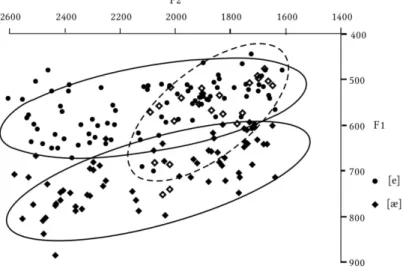
Results of the analysis take the following form: first, the entire range of vowel plots for [e] and [æ] from all the speakers in Ladefoged and Jun (1998) are presented in Figure 2. Here and elsewhere, the symbol <●> is used in the plots to represent the mid front vowel, [e], and <◆> for the low front vowel, [æ]. Where divergent forms are to be isolated, <○> is used for [e] vowel outliers and <◇> for the corresponding [æ] vowel outliers. Following this, specific groupings of speaker-vowel plots illustrating the variation in vowel quality are provided. Finally, the section concludes with the presentation of one seemingly exceptional case.
5.1. Evidence of Merger
As can be seen from Figure 2 below, the vast majority of cases of both [e]
and [æ] are distinct, occupying the F1 range from 450-640Hz and 650-850Hz, respectively. However, for one specific group, the male speakers from Cheju City, there is significant overlap of [e] and [æ], as shown by the dotted circle surrounding a portion of the tokens in Figure 2. The plots for these three speakers, S1-S3, appear in Figure 3, which clearly shows that there is complete overlap for the non-high front vowels [e] and [æ] for these three speakers. In other words, the two vowels have undergone total merger. Even if we separate the plots for the three speakers we can still see that there is still total overlap for each of them. They have, in effect, only a single mid front vowel.
Figure 2: Non-high front vowels for all speakers
5.2. The Majority Case
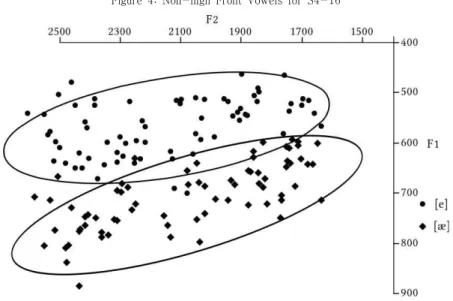
If we remove the formants of the three speakers in Figure 3 from the overall picture in Figure 2, we arrive at a formant plot for the remaining speakers as in Figure 4.
Figure 3: Non-high front vowels for S1-3
Figure 4: Non-high Front Vowels for S4-16
Figure 4 shows the almost complete absence of overlap between [e] and [æ]
for all the remaining Cheju speakers, i.e., excluding the three male speakers from Cheju City, S1-S3. The plotting of the vowel formants of these 13 remaining speakers in the same chart results in a slight overlap due to the range of formant frequencies of the different speakers, a mixture of males and females.
However, if we examine the formant frequency plots for each individual within the group separately, we can see that the results are clear: there is no overlap for any of these speakers. In fact, examining individuals reveals a very tight and discrete grouping for both [e] and [æ] in all cases, except for one which we will examine in the next section.
5.3. Exception or Lexical Choice?
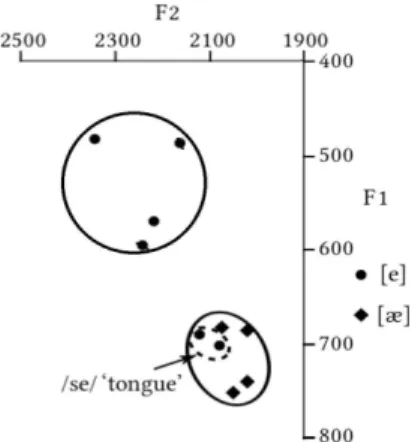
There is one case where we find an exception among the speakers in Figure 4, that of S6. This is labelled an exception since it concerns the vowel formants of only a single lexical item, the word /se/ ‘tongue’, MSK /hjɔ/. Examine the data in Figure 5 (additional examples of [e] have been added from this speaker for confirmation of its status).
Figure 5: Non-high Front Vowels for S6
The exceptional case is clear: the word for ‘tongue’, which has the distinctly CK pronunciation [se], is generally considered to involve a mid front vowel, [e], but in the case of S6 occupies a space inside of the domain of the low front vowel, [æ]. Clearly, there is something wrong here: the speaker makes a clear distinction between [e] and [æ] in other cases, in terms of both F1 and F2, but places this vowel cleanly within the domain of [æ]. How do we explain this?
The most obvious explanation would be that, for this speaker, the lexical item /se/ ‘tongue’ has a different vowel from the other speakers. An alternative, perhaps less interesting, explanation is that the speaker erred when providing this example. Note that it is not just a single occurrence, but two separate instances of this same vowel in the same word that show the higher F1 for S6.
Furthermore, given the direction of merger for speakers S1-3, it would be odd if this were an indicator of vowel merger. In the case of the merged vowels for all three speakers, the final range of vowels is mid front (F1 = 400-600 Hz), not low front, as is evident from Figure 3, and the F1 values specifically for the two instances of the word /se/ ‘tongue’ for each of these three speakers were 585/610, 496/483 and 557/594, respectively. Thus, none of them show a higher F1 for this word, unlike the case of S6.
S6’s exceptional vowel is within the low front tongue range (F1 >700Hz). For anyone who has done fieldwork on endangered languages, this is perhaps not surprising. One often meets such idiosyncratic lexical effects among elderly speakers, especially those who are bilingual in the standard variety. What is
striking about this case is that there is no ambiguity in the roles of the two vowels, [e] and [æ], no middle-of-the-road fluctuation of vowel formants, but rather a clear re-assignment of the value of the vowel of a specific lexical item.
This may be symptomatic of an imminent merger, but it is not an indicator of an existing one.
This highlights an important issue in the study of endangered languages: one must be prepared to encounter such unanticipated results and not jump immediately to the conclusion that there is only a single answer to the exception.
6. Methodological Considerations
One important issue that is prominent in this paper is the special circumstances concerning the conducting of research on endangered languages.
As noted in Section 1, CK is an endangered language and exhibits the characteristics commonly found in such languages. The relevant issues for this study include dialect interference, the existence of lexical differences and of free variation, speaker difficulties and the procedures for doing vowel measurement and comparisons. We will examine each of these in turn in the following.
The main study relied on data gathered by linguists who conducted the original fieldwork, Ladefoged and Jun (1998), documented in Cho et al. (2000, 2001, 2002). In the published materials, the authors state that all of the speakers
‘understood Korean, were literate, and above average in their socio-economic status’ (Cho et al. 2001:804). This statement seems to imply that all the consultants were bidialectal, that is, they were familiar with both the standard language and their own Cheju dialect. In this situation, it would not be surprising to encounter a certain amount of dialect interference, whereby one’s pronunciation of a word is influenced by one’s knowledge of its value in the other dialect. Cho et al. (2000, 2001) note this in passing as one possible explanation for why certain forms were not employed in their analysis. There is no such danger for the speakers of MSK used here to establish the earlier status of the non-high front vowels in that variety, since there is little reason for speakers of the standard, prestige form of the language to adopt non-standard
(3) Modern Standard Korean
Cheju Korean English
pæ pe ‘pear’
næ ne ‘smoke’
t’æ t’e ‘time’
son t’æ son tʰe ‘dirt on hands’
features.
The existence of lexical differences between Standard Korean and Cheju Korean is well known. There are a number of words that have come down from Middle Korean (13th–16thc.) into Cheju Korean that are no longer found in MSK, such as MK puzɔp, CK pusɔp ‘charcoal burner’ or MK kokoli, CK kokoli
‘ear of grain’. In addition to such forms, there are also words that have parallels in both varieties, but with modifications. For instance, CK variants of MSK words containing a velar stop followed by a palatal glide or high front vowel are subject to palatalization, e.g. MSK [kirɨm] ‘oil’, CK [tʃirɨm] or MSK [kimtʃi] ‘kimchi’, CK [tʃimtʃi]. This kind of variation is explainable by phonological rule and, therefore, does not pose too much difficulty, but there are other cases where a regular rule cannot so easily explain the difference. The latter type of case may involve variation in the vowel quality, for instance.
Thus, there are a number of cases such as those in (3) below where the MSK vowel is different from the CK vowel.
Thus, one must be careful when assigning a vowel quality to a particular vowel, since this may be different in the two varieties, as illustrated by the cases in (3). Dialect variation must be treated independently of vowel merger.
Further consideration when conducting research on vowel merger should be given to the accurate determination of vowel type and the assignment of tokens to the proper type. One way to plot vowel formants on a chart is to simply indicate the position of occurrence of the F1 and F2 of each token without reference to a differentiated type. This shows us the range of possibility of vowels within the data but says nothing about the domain of a specific vowel.
In this situation, where all we are doing is plotting the vowel formants without commitment to the assigned value of the individual token, there is no problem with type assignment, since we can simply draw a line and assign vowels accordingly.
An alternative to this, more commonly employed in studies concerned with the relationship between vowel type and formant frequency, is to examine the domain and range of individual vowels, plotting them on the chart with an indication of each underlying type. This approach assumes that a particular vowel has been assigned to a specific phoneme of the language or at least to a specific, lexically-contrastive value. In doing so, we can determine how variable such a vowel is within the system.
In the case where one follows this latter approach, if there is total overlap of two underlyingly contrastive vowels within a system, this provides us with a useful indicator that the contrast no longer obtains. Again, this poses no problem for vowel type assignment, since, even if we incorrectly assign a token to a vowel type, we can still conclude that the two vowel types have merged.
However, when examining a less than complete overlap, we must exercise caution in assigning a particular occurrence of vowel formants to a specific, underlyingly contrastive vowel type. We must be sure that the assigned vowel’s value is, in fact, the actual, current lexical value of that vowel. The fact that a word contains a particular vowel in dialect A does not necessarily imply that the same word in dialect B contains the same underlyingly contrastive vowel.
For example, the word aunt in some American dialects contains the vowel [ɑ], but in other American dialects and in Canadian English the vowel is more typically [æ]. The difference involves lexically-contrastive vowels in both systems, and thus anyone studying the vowels of one variety must ensure that a given word is pronounced as expected in the other variety before assigning a token to a specific type. For this reason, claims about overlapping systems must be made with careful consideration of the possibility that the lexical assignment of contrastive elements is not the same in dialect B.
In the situation where there is only partial (ostensible) overlap, the correct determination of vowel type for each token is crucial. Assigning a token to the wrong vowel type will result in incorrect conclusions regarding the nature of the relationship between the vowels under investigation. If our aim is to
determine whether or not two or more vowels are merging, then the first step must be to accurately assign each token to its appropriate vowel. This may involve scouring dictionaries or probing the consultant(s) intuitions or some other strategy, but, especially in the case where only a few tokens overlap in radically divergent ways, we should be suspicious of the underlying value of the tokens involved.
This brings me to my final point regarding methodology: the challenges of working with endangered languages and bidialectal speakers. Any competent fieldworker will attest to the pros and cons of working with bilingual speakers of endangered languages: on the pro side, you can make faster headway and gain greater insight into a language that may not be around for much longer; on the con side, such speakers’ grammars may have been affected to varying degrees by the other language or dialect. When the consultant’s two languages are radically different, the influence may be obvious, or at least recognizable.
However, when the consultant is bidialectal, the differences may be far more subtle and the properties of one variety may be difficult to disentangle from those of the other.
Add to this the fact that most competent speakers of highly endangered languages are elderly, possibly with hearing deficits, missing teeth, or faulty memories and one can appreciate the challenges involved in such fieldwork. At the same time, there is usually a pressing need to gather the information before it is no longer available, so the importance of such research cannot be overemphasized.
If the information gathered from such speakers is to be of the greatest potential value, then it is crucial to confirm every piece of data by comparison with other speakers or by re-elicitation at a later time. Furthermore, use of the standard language and particularly the standard orthography is to be avoided as much as possible in order to obviate the influence of the standard variety as much as possible. Even taking these things into consideration, one must exert caution in the analysis of such data. Normal elicitation practices may have to be modified to suit the context of an endangered language.
7. Conclusions
Several important results arise in this paper. First, it is clear that the merger of [e] and [æ], which is complete for the vast majority of speakers of mainland varieties of Korean, is ongoing in Cheju Korean, as noted by Cho et al. (2000, 2001, 2002). However, it is also clear that it is not so simple as an urban versus rural dichotomy. Only the Cheju City males exhibited the total loss of the distinction, and both the older generation Cheju City females and all the +60 year old rural speakers appear to retain the contrast between [e] and [æ].
Secondly, an examination of exceptional cases of variable non-high front vowels revealed that some lexical items in Cheju Korean have different lexical vowel assignments from their standard counterparts and therefore the assignment of vowels to particular types must be conducted carefully with attention to possible lexical variation.
Finally, we observe a relatively common situation that must be taken into account when working with speakers of endangered languages: elderly speakers sometimes have difficulties with recall/memory and bilingual or bidialectal speakers often run the risk of providing mixed data. A basic principle of doing phonetic analysis of data in highly endangered languages must be the determination of a baseline for lexical items: if item A exhibits free variants /x/
and /y/, then this item may not provide reliable evidence for the merger of the same /x/ and /y/. The first step must be to confirm the status of each lexical item employed. Of course, when confirming total merger, there is less danger of error, since the total overlap of vowel tokens is unambiguous.
References
Ahn, Sang Cheol. (2009). Korean Phonology. London: Eastern Art Publishing.
Cheju Special Autonomous Province. (2006). Melthi-midi.e Ceycwu Minsok Kwankwang Taesacen.(=CSAP).
Cho, Taehong, Sun-Ah Jun, Seung-Chul Jung, and Peter Ladefoged. (2000). The
vowels of Cheju. Fieldwork Studies of Targeted Languages VI: 81.
Cho, Taehong, Sun-Ah Jun, Seung-Chul Jung and Peter Ladefoged. (2001). The Vowels of Cheju. Eon-eo, 26;4, 801-819.
Cho, Taehong, Sun-Ah Jun, and Peter Ladefoged. (2002). Acoustic and aerodynamic correlates of Korean stops and fricatives. Journal of Phonetics 30; 2: 193–228.
Kim, Won-bo. (2005). Ceycwu pang.on.eys.e [·] um.ui umhyang pwunsek. En.e Kwahak Yen.gwu33: 23–38.
Kim, Won-bo. (2006). Ceycwu pang’on hwaca ui seytaepyel (20 tae, 50 tae, 70 tae) tan mwoum ui umhyang pwunsek kwa mwoum chyeykyey. En.e Kwahak Yen.gwu39: 125–36.
Ladefoged, Peter and Sun-Ah Jun. (1998). Cheju fieldwork materials. UCLA Language Archives, Cheju Korean. (http://archive.phonetics.ucla.edu/
Language/KOR_CHEJU/kor_cheju.html). Licensed under Creative Commons at http://creativecommons.org/licences/by-nc/2.0/.
Lee, Hee-Seung. (2007). Kwuk.e Taesacen. Seoul: Minjung Seorim.
Lee, Iksop and S. Robert Ramsey. (2000).The Korean Language. Buffalo, NY: State University of New York Press.
Lee, Ki-Mun (comp). (1997). Sae Kwuk.e Sacen. Seoul: Dong-A Chulpan.
Martin, Samuel E. (1993). A Reference Grammar of Korean. Rutland, Vt: Tuttle Publishing.
Martin, Samuel E., Yang Ha Lee and Sung-Un Chang. (1967). A Korean-English Dictionary. New Haven, Conn: Yale University Press.
Park, Byong-Nam. (1968). Recordings for Korean: Basic Course. Washington, D.C.:
Foreign Service Institute.
Song, Sang-Jo. (2007). Ceycwumal Kun Sacen. Seoul: Hankuk Munhwasa.
John Stonham
Division of English Language and Literature Pukyong National University
599-1, Daeyeon 3 Dong, Nam-Gu, Busan Tel: 051 629 5385
Email: [email protected]
Received: 18 January, 2011 Revised: 13 February, 2011 Accepted: 14 March, 2011