1. Introduction
With the use of different prosodic patterns, speakers can express diverse linguistic and paralinguistic aspects of their utterance.
Among the various aspects of prosody, some studies have focused on how speakers chunk their speech into different prosodic phrases and what triggers different phrasing patterns (e.g., Choe & Redford, 2015; Frazier et al., 2006; Krivokapić, 2007; Schafer & Jun, 2001).
For example, research on prosodic disambiguation suggested that speakers often locate prosodic phrase boundaries to indicate syntactic structures of a sentence (Frazier et al., 2006; Price et al., 1991). Also, Krivokapić (2007) showed that speakers put stronger
phrase boundaries before and after producing longer and more complex phrases. Her results suggested that speakers chunk their speech into different prosodic phrases, which to be served as a speech planning unit.
Before moving onto other functions of prosody, let me briefly introduce the hierarchy of prosodic phrases assumed in the current study. Although there is discordance among different theories with respect to the way of defining prosodic phrases (see Shattuck- Huffnagel & Turk, 1996 for an overview), most agree to postulate the Intonational Phrase (hereafter IP) as the highest prosodic phrase, defined by a complete intonational contour, a pause, and pre-boundary lengthening (e.g., Selkirk, 1984). However, different
* Dong-A University, [email protected]
Received 1 November 2016; Revised 13 December 2016; Accepted 20 December 2016 ISSN 2005-8063
2016. 12. 31.
Vol.8 No.4 pp. 31-38
말소리와 음성과학
http://dx.doi.org/10.13064/KSSS.2016.8.4.031
Acquisition of prosodic phrasing and edge tones by Korean learners of English
Wook Kyung Choe
*Abstract
The purpose of the current study was to examine the acquisition of the second language prosody by Korean learners of English. Specifically, this study investigated Korean learners' patterns of prosodic phrasing and their use of edge tones (i.e., phrase accents and boundary tones) in English, and then compared the patterns with those of native English speakers. Eight Korean learners and 8 native speakers of English read 5 different English passages. Both groups’ patterns of tones and prosodic phrasing were analyzed using the Mainstream American English Tones and Break Indices (MAE_ToBI) transcription conventions. The results indicated that the Korean learners chunked their speech into prosodic phrases more frequently than the native speakers did. This frequent prosodic phrasing pattern was especially noticeable in sentence-internal prosodic phrases, often where there was no punctuation mark. Tonal analyses revealed that the Korean learners put significantly more High phrase accents (H-) on their sentence-internal intermediate phrase boundaries than the native speakers of English. In addition, compared with the native speakers, the Korean learners used significantly more High boundary tones (both H-H% and L-H%) for the sentence-internal intonational phrases, while they used similar proportion of High boundary tones for the sentence-final intonational phrases. Overall, the results suggested that Korean learners of English successfully acquired the meanings and functions of prosodic phrasing and edge tones in English as well as that they are able to efficiently use these prosodic features to convey their own discourse intention.
Keywords: prosodic acquisition, prosodic phrasing, phrase accent, boundary tone, Korean learners of English
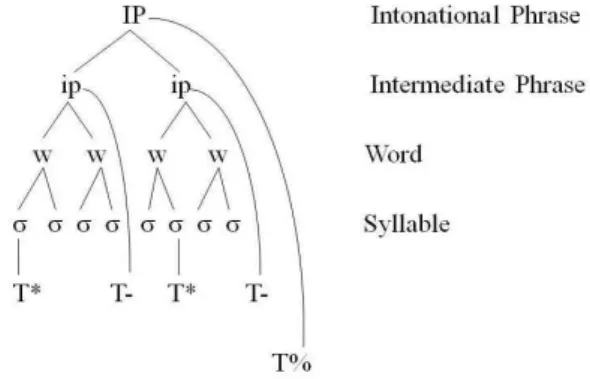
theories disagree with the number and the nature of prosodic phrases below an IP level. Following the theory focusing more on suprasegmental features (e.g., Beckman & Pierrehumbert, 1986), the current study assumed that an intermediate phrase (hereafter ip) is embedded in an IP, defined by a nuclear pitch accent and a phrase accent. This prosodic hierarchy is demonstrated in Figure 1.
Figure 1. Prosodic constituents (adapted from Krivokapić, 2007). T*
stands for different types of pitch accents, T- for phrase accents and T%
for boundary tones.
Another function of prosody is to mark discourse information (see Couper-Kuhlen, 2001 for an overview). Among various discourse information, phrase accents and boundary tones are often used to indicate the relationship between an already-produced phrase & an upcoming phrase (Du Bois et al., 1993; Pierrehumbert
& Hirschberg, 1990). For example, Pierrehumbert & Hirschberg (1990) suggested that High edge tones—High phrase accents (H-) and High boundary tones (H%)—are used to indicate the relatedness or continuity between the preceding and the following phrases.
Specifically, Pierrehumbert & Hirschberg argued that speakers use High phrase accents (H-) at the end of an ip when they want the current ip to be considered as a part of a larger interpretive unit.
Speakers also tend to mark an IP with High boundary tones (H%) as a so-called “forward-looking” function so that hearers can pay more attention to the upcoming IP. That is, according to Pierrehumbert &
Hirschberg, a High edge tone at the end of a prosodic phrase is used to signal that the currently produced phrase is highly connected with the upcoming phrase.
As suggested in these previous studies, prosody plays an important role in language production with its various functions. In addition, some second language (hereafter L2) studies reported that inappropriate prosodic patterns by non-native speakers had similar or even more influence on the extent of foreign accents than inappropriate segmental patterns (e.g., Anderson-Hsieh et al., 1992;
Munro & Derwing, 1999). Nevertheless, there has been a relatively small amount of research on the L2 acquisition of prosodic features compared with segmental acquisition, and moreover, many of these studies have focused more on the acquisition of word-level prosodic features (Anderson-Hsieh et al., 1992; Trofimovich & Baker, 2006) or speech rate (e.g., Guion et al., 2000). Some research, however, has examined the tonal patterns and prosodic phrasing of L2 learners’ production. Huang & Jun (2011) analyzed Mandarin Chinese learners’ English production with Mainstream American English Tones and Break Indices (MAE_ToBI) transcription conventions (Beckman & Ayers, 1997; Beckman & Hirschberg,
1994; Beckman et al., 2005). The study revealed that the L2 learners used significantly more High boundary tones (H%) than the native speakers did. It also showed a trend that the L2 learners more frequently put phrasal breaks than the native speakers did. Huang &
Jun suggested that these non-native tonal patterns were because L2 learners could not fully understand the prosody and meaning relationship.
The scarcity of the studies on the L2 acquisition of prosodic phrasing and tones is retained in the studies on Korean learners’
production of English, but some studies investigated Korean learners’ realization of pitch accents in English sentences (e.g., Kang et al., 2012; Kim, 2003; Kim, 2008; Lee, 2005a). Most of the studies on the pitch accent acquisition revealed that Korean learners of English frequently failed to put pitch accents on the native-like positions, such as on stressed syllables (Kim, 2008), on focused words (Kang et al., 2012; Kim, 2003). These studies also indicated that the types and acoustic characteristics of pitch accents that Korean learners used were different from those of native speakers of English; in that Korean speakers often put High pitch accents (H*) where native speakers put Low pitch accents (L*) (Kim, 2003) or the acoustic properties of Korean learners’ Low pitch accents (L*) were significantly different from those of English speakers’ ones (Lee, 2005a).
However, contradictory results have been obtained with respect to the acquisition of edge tones by Korean learners of English.
Specifically, Lee (2005b) analyzed Korean learners’ realization of edge tones (phrase accents and boundary tones) in the sentences with coordinate or subordinate conjunctions. The results showed that most Korean learners used the correct edge tones (either H- for ip or H% for IP) for sentence-internal prosodic phrase boundaries.
The successful use of edge tones suggested that Korean learners could correctly indicate the relatedness between the currently produced phrase and the upcoming phrase. On the other hand, Korean learners sometimes had difficulty in using the right boundary tones at sentence-final IP boundaries (Lee, 2008; Park et al., 2000). For example, Park and colleagues (2000) investigated whether Korean learners of English could successfully encode different discourse information (certainty/confidence vs. uncertainty /hesitance) into different boundary tones. They found that Korean learners could not convey the assigned discourse information with native-like boundary tones (e.g., L-L% for certainty and L-H% for uncertainty), suggesting that Korean learners could not fully match a certain intonational contour with the appropriate higher-level discourse information.
The purpose of the current study was to examine the production of L2 prosody by Korean learners of English. Especially, the current study was designed to investigate Korean learners’ patterns of prosodic phrasing and their use of edge tones (phrase accents for ips and boundary tones for IPs), which have not been well-studied in the literature. Furthermore, to analyze more natural and various prosodic patterns of L2 speech, the current study used relatively longer passages with various sentence length and structures. In order to explore the extent to which the Korean learners acquired these prosodic features, the study analyzed the phrasing and tonal patterns of Korean learners’ speech using MAE-ToBI transcription conventions, and then compared the results with those of native speakers.
Based on the previous research, the following prosodic patterns
were expected. As for the prosodic phrasing patterns, the previous findings showed a trend for L2 speakers to frequently chunk their speech into different prosodic phrases (e.g., Huang & Jun, 2011;
Ueyama & Jun, 1998). Therefore, the Korean learners of English in the current study were expected to produce their speech with more prosodic phrases than the native speakers. Regarding the acquisition of edge tones, it was expected that the Korean learners’ choice of sentence-final boundary tones might be different from native speakers’ choice (e.g., Lee, 2008; Park et al., 2000). On the other hand, if the Korean learners successfully understood the function of High edge tones (H- for ips and H% for IPs) and were able to correctly realize these tones (e.g., Huang & Jun, 2011; Lee, 2005b), they would mark their sentence-internal prosodic phrase boundaries with High edge tones.
2. Method
2.1. Participants
Eight female Korean learners of English (hereafter KL) participated in the current study. All were undergraduate students at a university located in Seoul, and none of them have spent more than 9 months in English-speaking countries. Their English proficiency level was determined by the self-reported scores of TOEIC. The average TOEIC score of the 8 Korean speakers were 755, ranging between 695 and 810. These TOEIC scores led us to decide that their English was much above a beginner level, but did not reach a near-native level. Therefore, the current participants could be considered as intermediate learners. Eight female native speakers of English (hereafter NS) also participated in the study as a control group. All of them were either undergraduate or graduate students a university located in Oregon. The speakers in both groups voluntarily participated in the current study.
2.2. Stimuli
Five English passages were used as a reading material. Two of the passages were the extracts from children’s stories (Little Red Riding Hood and Three Little Pigs), and the rest were the articles from TIME for Kids (one is about polar bears, another about hurricanes, and the other about Pandas). This was both to minimize the possibilities that the Korean learners’ prosodification might be affected by their vocabulary knowledge and to maximize the possibilities that the analyzed prosodic patterns from the speakers of both groups represent more natural or real-life prosodic patterns.
The average number of sentences
1in one passage was 17.8, ranging from 10 to 21 sentences. The average number of words in one passage was 240.4, ranging from 195 to 277 words. In order to elicit natural phrasing and intonation patterns, all the punctuation marks were left as presented in the original text.
2.3. Procedure & Analysis
Each participant was asked to read the passages aloud. Before reading each passage aloud, a participant was asked to look through
the passage to get familiar with the content and the vocabulary with as much time as she wanted. She was also able to ask the pronunciation of less familiar words, but when asked, the experimenter only produced the word in isolation in order not to influence the participant’s own prosodification. Only after each participant fully understood the content and the vocabulary of each passage, she was asked to read the passage aloud at her natural pace.
When there was a noticeable speech error, a self correction, or a hesitance, the participant was asked to re-read the very sentence from the beginning. This process was to exclude the effect of a speech error, a self-correction, or a hesitance on a speaker’s phrasing and tonal patterns.
The experiment was conducted in a quiet laboratory room or in a quiet meeting room. The KL group used a head-worn microphone (Audio-Techinica PRO 8HE) and their speech was digitally recorded to a Marantz PMD 661. The NS group used Shure ULXS4 wireless receiver and lavaliere microphone, and their speech was also digitally recorded to a Marantz PMD 660.
All participants’ speech was recorded and then analyzed using Mainstream American English Tone and Break Indices (MAE_ToBI) transcription conventions. The detailed decision of tones and prosodic phrases (i.e., an IP and an ip) was based on ToBI labelling guidelines (Beckman & Ayers, 1997). Pitch tracks of all productions were examined with the Praat software (Boersma &
Weenink, 2014).
3. Results
In order to investigate the Korean learners’ acquisition of prosodic phrasing, the numbers of ips and IPs produced by the KL group were compared with those produced by the NS group. The number of prosodic phrase boundaries was calculated across sentences within a passage and a speaker. Mann-Whitney U tests indicated the significant group differences for the number of ips [U = 246.5, p <
.001] and IPs [U = 393.0, p < .001]. Specifically, the Korean learners produced significantly more ip boundaries (M = 17.85, SD
= 6.26) than the native speakers (M = 10.65, SD = 2.60) as well as the Korean learners produced significantly more IP boundaries (M = 32.08, SD = 8.61) than the native speakers (M = 24.48, SD = 5.84).
These patterns are shown in Figure 2.
Figure 2 shows that the Korean learners more frequently chunked their speech into different prosodic phrases (either ips or IPs) than the native speakers did. As expected, this pattern was consistent with Huang and Jun’s (2011) findings. Furthermore, this result also implied that the KL put more prosodic phrase boundaries within a sentence (M = 1.74, SD = 1.45) than the NS did (M = 1.08, SD = 1.04) since each of the participants produced the same number of sentences in total.
1 Here, a sentence refers to a unit presented to a speaker with a period, an exclamation mark, or a question mark at the end. One exception was for the passage, Little Red Riding Hood, which includes some sentences with a direct quotation. In this case, a quoted phrase (e.g., "To my grandma's, Mr. Wolf!") and a quo- tative frame (e.g., she answered) were considered as one sentence.
Figure 2. Mean numbers of prosodic phrase boundaries as a function of phrase type (ip vs. IP) and group (KL vs. NS)
with 95% confidence interval error bars.
Then, where did the participants put prosodic phrase boundaries?
Because prosodic phrases often reflect sentence structures, one of the locations frequently triggering prosodic phrase boundaries is known as the place where a punctuation mark is. Again, the total number of sentences within a passage was the same for both groups and the participants always put prosodic phrase boundaries at sentence-final positions, so the analyses were focused on the places where the KL and the NS put prosodic phrase boundaries within a sentence. The effect of the presence of punctuation marks
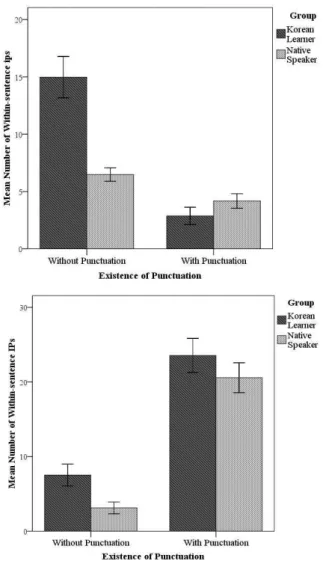
2on the existence of prosodic phrase boundaries was tested in two-way ANOVAs. The dependent variables were the numbers of sentence-internal ip and IP boundaries calculated for each passage across sentences within the factors of interest (the existence of a punctuation mark and the speaker). The results revealed a significant interaction between group (KL vs. NS) and punctuation (with vs. without a punctuation mark) on the number of sentence-internal ip boundaries [F(1, 156) = 85.66, p < .001], but not for the number of sentence-internal IP boundaries [F(1, 156) = 0.69, p = .406]. The significant interaction for sentence-internal ip boundaries and the patterns for sentence-internal IP boundaries are shown in Figure 3.
As the significant interaction for sentence-internal ips suggested, the left two bars and the right two bars in the top panel of Figure 3 present the opposite direction. That is, the KL put significantly more ip boundaries than the NS where no punctuation mark was presented [F(1, 78) = 81.86, p < .001], whereas the NS put significantly more ip boundaries than the KL where there was a sentence-internal punctuation mark [F(1, 78) = 7.08, p = .009]. Interestingly, the KL consistently put more sentence-internal IP boundaries than the NS no matter whether there was a sentence-internal punctuation mark or not, as shown in the bottom panel of Figure 3. However, it was noticeable that the KL put significantly more sentence-internal IP boundaries only where there was no punctuation mark. An one-way
ANOVA revealed this significant difference [F(1, 78) = 28.81, p <
.001]. In sum, these results informed that Korean learners tended to put significantly more ip or IP boundaries where there was no punctuation mark than the native speakers did. Then, this suggested that the Korean learners often put prosodic phrase boundaries in the less conventional places where the native speakers did not usually mark with prosodic phrase boundaries.
The last analyses were to compare the two groups’ tonal patterns for different prosodic phrases. Prior to the analyses, recall the contradictory results from Korean learners’ L2 speech with respect to the realization of edge tones. The noticeable factor for the contradictory results was the sentence position of prosodic phrases:
Korean learners had difficulty in marking their sentence-final IPs with appropriate boundary tones (Lee, 2008; Park et al., 2000), while they were able to successfully put High edge tones for sentence-internal prosodic phrases (Lee, 2005b).
2 A total of 68 sentence-internal punctuation marks were noticed; 49 of them were commas, 11 were quotation marks, 7 were exclamation marks, and 1 was a dash. In the current study, an apostrophe was not considered as a within-sentence punctuation mark.
Figure 3. Mean numbers of sentence-internal ips (top) and mean numbers of sentence-internal IPs (bottom) as a function of the existence of
punctuation marks and group (KL vs. NS) with 95% confidence interval error bars.
Therefore, the current analyses focused on the percentage of High edge tones for each type of prosodic phrases (ips and IPs) as well as for each sentence position (sentence-internal and sentence-final)
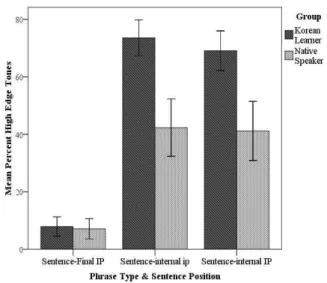
3. Due to the differences between the frequencies of ips and IPs for the two groups, the percentages were used for the analyses instead of the actual number of High edge tones. Mann-Whitney U tests with the percentage of High edge tones for the three categories revealed the significant group difference for sentence-internal ips [U = 359.5, p < .001] and for sentence-internal IPs [U = 346.0, p < .001], but not for sentence-final IPs [U = 781.0, p = .846]. These results are presented in Figure 4.
Figure 4. Mean percentage of High edge tones as a function of phrase type (ip vs. IP), sentence position (sentence-final vs. -internal), and group
(KL vs. NS) with 95% confidence interval error bars.
In detail, the KL and the NS put similar proportion of High boundary tones (H%) at sentence-final IP boundaries. This result suggested that the Korean learners were able to mark their sentence -final IP boundaries with native-like boundary tones, which did not coincide with the findings from the previous research that Korean learners used significantly different boundary tones from native speakers did (Lee, 2008; Park et al., 2000).
However, the Korean learners of English used High edge tones (both H- for ips and H% for IPs) significantly more often than the native speakers when the prosodic phrase was located in sentence-internal positions. It is noticeable that the Korean learners marked more than 70% of sentence-internal ip boundaries with High phrase accents (M = 73.58, SD = 19.53) and that they also marked around 70% of sentence-internal IP boundaries with High boundary tones (M = 69.09, SD = 21.60). On one hand, the frequent use of High edge tones for sentence-internal phrases could suggest that the Korean learners successfully acquired the discourse meaning of High edge tone, as argued in Lee (2005b). On the other hands, the significant difference between the frequency of High edge tones by the KL and the NS could provide evidence that the Korean learners were in their process of acquiring the function of High edge tones.
4. Discussion and Conclusion
The current study was designed to investigate the acquisition of prosodic phrasing and edge tones (phrase accents for intermediate phrases and boundary tones for intonational phrases) by intermediate Korean learners of English. The four main findings from the current study are as follows: (a) the intermediate Korean learners of English more frequently chunked their speech into either intermediate phrases or intonational phrases than the native speakers did, (b) the Korean learners’ frequent phrasing was primarily due to inserting prosodic phrase boundaries at “no-punctuation-mark”
positions, (c) the Korean learners used similar types of boundary tones for sentence-final intonational phrases as the native speakers’
ones, and (d) the Korean learners marked their sentence-internal prosodic phrases with High edge tones (H- for intermediate phrases and H% for intonational phrases) more frequently than the native speakers did. These findings will be discussed with respect to the extent to which Korean learners could successfully understand and utilize phrasing patterns and edge tones of English. The possible explanations for the Korean learners’ L2 prosodic patterns will also be suggested.
First, of all examined prosodic features, the only successfully acquired one by the intermediate Korean learners seems to be sentence-final intonational phrase boundary tones. That is, the current study found that both the KL and the NS group marked only 7% of their sentence-final IPs with H% as in Figure 4. Recall, however, the results from the previous literature that Korean learners did not successfully use the native-like boundary tones to express the assigned discourse information (Park et al., 2000). One possible reason for these contradictory results between the previous and the current studies could be the nature of the tasks. Specifically, Park and colleagues’ study asked the participants to convey somewhat implicit or complex discourse information like indicating either certainty or uncertainty about a lexically-identical sentence via boundary tones. The current study, whereas, asked the participants to read the passages without any specific instruction about discourse information or intention. Therefore, the current participants needed to select the kinds of sentence-final boundary tones mostly based on their own understanding of sentence types (i.e., declarative or interrogative sentences). In other words, the types of boundary tones denoting different sentence types are relatively straightforward and consistent between languages as well as the L2 speakers would have sufficient experiences with encoding sentence types with appropriate English intonational contours, so the Korean learners in the current study could show successful acquisition of sentence-final IP boundary tones.
On the other hand, the intermediate Korean learners in the current study did not seem to fully acquire prosodic phrasing and the use of edge tones for sentence-internal prosodic phrase boundaries.
Namely, compared with the native English speakers, the Korean learners more frequently put prosodic phrase boundaries within a sentence, and then often marked these boundaries with High edge tones. Especially, the frequent prosodic phrasing by intermediate Korean learners was noteworthy because there has not been much
3 Since only 1 sentence-final ip appeared in the current speech data (from one of the KL participants), this category was excluded for later analyses.
research on the frequency of prosodic phrasing in L2 speech. The lack of research on L2 speakers’ prosodic phrasing could be either because researchers might not be interested in this prosodic feature or because L2 learners’ prosodic phrasing pattern was successful enough to be noticed by researchers. If the latter is the case, we should pay attention to the factor that could lead to the inconsistent acquisition patterns of prosodic phrasing between the L2 speakers in the previous studies and those in the current study.
One explanation for the possibly successful acquisition of prosodic phrasing in the previous studies could be the types of reading materials they used. Specifically, most of the studies often used either a list of a certain type of sentences (e.g., sentences with focus in Ueyama & Jun, 1998 and Kang et al., 2012; sentences with conjunctions in Lee, 2005b) or relatively short reading passages (e.g., a 4-sentence-long paragraph in Huang & Jun, 2011)
4. Then, it is possible to argue that L2 speakers in these studies did not have enough chances to show their less fully-acquired sentence-internal prosodic phrasing patterns. The current study, meanwhile, used long enough reading passages with relatively various sentences in their length and structures. Therefore, it might be harder for the participants—with their intermediate level of English proficiency—
to fully understand the contents, vocabulary, and pronunciation of the whole passage, even with self-controlled preparation time prior to the actual reading. This lower level of understandability of a passage then could cause the learners to more frequently chunk their speech for preparing the upcoming chunk(s) of the speech. This explanation can also be supported by the trend from Huang & Jun (2011); in that, though not significant, the adult-arrival L2 speakers chunked their speech into either intermediate or intonational phrases more frequently than the child-arrival learners of English (as shown in Figure 4 of their study). That is, even with their short reading passages, the learners with less-sufficient English proficiency (i.e., adult-arrivals) tended to put more prosodic phrase boundaries than more advanced English learners (i.e., child-arrivals).
Another piece of evidence for this argument can be the finding that the intermediate Korean learners frequently put sentence- internal prosodic phrase boundaries at so-called “no-punctuation- mark” positions. This finding was accounted for as that the Korean learners chunked their speech at less conventional locations, where native speakers do not generally put phrase boundaries. In other words, with the aforementioned assumption about the lack of understandability, it is possible to argue that the learners in the current study chunked their speech not only based on the structure of the sentences (i.e., with punctuation marks) but also based on their speech planning schedule (i.e., without punctuation marks). As Krivokapić (2007) showed that speakers put stronger prosodic phrase boundaries before producing longer and more complex sentences, we could suggest that our learners frequently put sentence-internal prosodic phrase boundaries to better prepare (or plan) their upcoming speech.
Then, are the less conventional places which the Korean learners put sentence-internal prosodic phrases always ungrammatical? If this is the case, we should account for the Korean learners’ prosodic phrasing was not due to speech planning rather due to hesitation or
preparation for articulation. Detailed examination of the prosodic phrasing in (1) proved against the hypothesis that Korean learners’
less conventional locations for sentence-internal phrase boundaries are ungrammatical.
(1) a. Though monster storms / can hit at any point / during this season, // like Sandy in late October of 2012, // September is // historically the biggest month for hurricanes //.
b. Though monster storms can hit at any point during this season, // like Sandy in late October of 2012, // September is historically the biggest month for hurricanes //.
The sentences in (1) show how a Korean learner (1a) and a native speaker (1b) prosodified the same sentence. A single slash (/) represents an intermediate phrase boundary, and a double slash (//) does a intonational phrase boundary. As shown in (1a), despite the lack of punctuation marks, the Korean learner did not put the phrase boundaries on random places within a sentence, rather did so on acceptable places such as between a subject (monster storms) and an auxiliary verb (can) or between a verb (is) and an adverb (historically). This pattern of prosodic phrase boundaries at reasonable places (i.e., structurally acceptable) was quite consistently found across all of the KL speakers. This suggested that Korean learners understood the sentence structures and pre-planned their prosodic structures before actual articulation. Therefore, it is possible to argue that the Korean learners’ frequent sentence- internal prosodic phrases does not represent their less successful acquisition of prosodic phrasing. This finding rather reflects that Korean learners successfully and efficiently plan and utilize prosodic phrases to compensate their non-native-like English (e.g., less fluent segmental articulation or slower speech rate).
The current results also indicated that the intermediate Korean learners often marked their sentence-internal prosodic phrases with High edge tones. In detail, the Korean learners used High edge tones for approximately 70% of their sentence-internal phrases while the native speakers did for only less than 50% of the phrases. However, this result also shows contradictoriness with the previous findings.
Recall the finding from Lee (2005b) that Korean learners of English successfully used High edge tones for sentences with conjunctions.
She argued that Korean learners fully acquired the functions and the use of High edge tones (H- for the relatedness between the current and the following ips and H% for the “forward-looking” function from Pierrehumbert & Hirschberg (1990)). Then, it needs to be accounted for why the current participants, compared with the ones in Lee (2005), excessively used High edge tones for sentence- internal prosodic phrases.
One explanation could be over-generalization process, which is common in L2 acquisition (e.g., Lightbown & Spada, 2006).
Specifically, as the participants in Lee (2005b), the intermediate Korean learners seemed to understand the discourse functions of High edge tones. However, the significantly more frequent use of High edge tones in the current study might correlate with the previously suggested explanation that the Korean learners put much more sentence-internal prosodic phrase boundaries than the native
4 One noticed exception was Lee (2008), which asked the participants to read a total of 98 sentences from 4 passages. However, she only analyzed 31 senten- ces due to the purpose of the research.
speakers did. Since the learners planned to chunk a sentence into more prosodic phrases, they might want to excessively signal the relatedness or continuity between the currently produced and the subsequent prosodic phrases. In other words, with the strong intention to inform hearers of that the current phrase was not at the end of a sentence, the learners over-used the High edge tones for sentence-internal phrases. Also, in the same vein as the frequent phrasing, the participants in the current study needed to read relatively long passages with various kinds of sentences compared with the ones in the previous studies, so they might not elaborately alter the sentence-internal edge tones based on the detailed contexts or structures.
Another explanation for the frequent use of High edge tones comes from L1 transfer. It is well known that Seoul Korean has a unique level under an IP in its prosodic hierarchy called Accentual Phrase (e.g., Jun, 1998, 2005). An accentual phrase is tonally demarcated, and an accentual phrase in Seoul Korean is defined by one of the two tonal patterns Low-High-Low-High or High-High- Low-High. One relevant aspect is that a sentence-internal accentual phrase in Seoul Korean always ends with a High tone, no matter which tonal patterns an accentual phrase chooses. That is, since the Seoul Korean learners of English frequently marked sentence- internal prosodic phrases with High tones in their first language production, the frequent use of High edge tones in L2 speech can be understood as the influence of L1 prosody. In order to more specifically test this hypothesis, it will be better to compare the sentence-internal edge tones for Seoul-Korean learners’ English reading with those for Chonnam-Korean learners’ one as sentence-internal accentual phrases in Chonnam Korean always ends with Low tones (i.e., the tonal pattern is either Low-High-Low or High-High-Low) (Jun, 1998).
In sum, the findings from the current study suggested that intermediate Korean learners of English successfully acquired the meanings and functions of both prosodic phrasing and edge tones in English as well as that they are able to efficiently use these prosodic features to convey their discourse intention. Specifically, intermediate Korean learners can mark their sentence-final intonational phrase boundaries with appropriate boundary tones to indicate the sentence types (e.g., declarative or interrogative sentences). Korean learners also can chunk their speech into complete prosodic phrases based on their own speech plan. In addition, although somewhat excessively using, they can mark these sentence-internal prosodic phrase boundaries with High edge tones to indicate the relatedness and/or the continuity of the currently produced phrase with its subsequent one.
References
Anderson-Hsieh, J., Johnson, R., & Koehler, K., (1992). The relationship between native speaker judgements of nonnative pronunciation and deviance in segmentals, prosody, and syllable structure. Language Learning, 42, 529-555.
Beckman, M., & Ayers, G. M. (1997). Guidelines for ToBI labelling.
Version 3.0, March 1997, The OSU Research Foundation, 3.
Beckman, M., & Hirschberg, J. (1994). The ToBI annotation conventions. Columbus, OH: Ohio State University.
Beckman, M., & Pierrehumbert, J. (1986). Intonational structure in Japanese and English. Phonology Yearbook, 3, 5-70.
Beckman, M., Hirschberg, J., & Shattuck-Hufnagel, S. (2005). The
Original ToBI System and the evolution of the ToBI framework. In S. Jun (Ed.), Prosodic typology: The phonology of intonation and phrasing (pp. 99-116). Oxford: Oxford University Press.
Boersma, P., & Weenink, D. (2014). Praat: doing phonetics by computer (Version 5.3.66) [Computer Program]. Retrieved from
http://www.praat.org/ on March 11, 2014.Choe, W., & Redford, M. A. (2015). The effect of interpretation bias on the production of disambiguating prosody. Phonetics and Speech Sciences, 7, 55-64.
Couper-Kuhlen, E. (2001). Intonation and discourse: Current views from within. In D. Schiffrin, D. Tannen, & H. Hamilton (Eds.), The Handbook of Discourse Analysis (pp. 13-34). Malden, MA:
Blackwell Publishers.
Du Bois, J. W., Schuetze-Coburn, S., Cumming, S., & Paolino, D.
(1993). Outline of discourse transcription. In J. A. Edwards, & M.
D. Lampert (Eds.), Talking data: Transcription and coding in discourse research (pp. 45-89). Hillsdale, NJ: Lawrence Erlbaum.
Frazier, L., Carson, K., & Clifton Jr., C. (2006). Prosodic phrasing is central to language comprehension. TRENDS in Cognitive Sciences, 10, 244-249.
Guion, S. G., Flege, J. E., Liu, S. H., & Yeni-Komshian, G. H. (2000).
Age of learning effects on the duration of sentences produced in a second language. Applied Psycholinguistics, 21, 205-228.
Huang, B. H., & Jun, S.-A. (2011). The effect of age on the acquisition of second language prosody. Language and Speech, 54, 387-414.
Jun, S.-A. (1998). The accentual phrase in the Korean prosodic hierarchy. Phonology, 15, 189-226.
Jun, S.-A. (2005). Korean intonational phonology and prosodic transcription. In S.-A. Jun (Ed.), Prosodic typology: The phonology of intonation and phrasing (pp. 430-458). Oxford:
Oxford University Press.
Kang, S., Ahn, H., & Hong, M. (2012). The acquisition of L2 English Focus by Korean learners. The Korean Journal of Language, 37, 1-23.
Kim, O. (2008). Native influence on the production of English intonation. Speech Sciences, 15, 25-36.
Kim, S. (2003). Effects of the L1 intonation on the intonation of Korean English speakers. Journal of the Korean English Education Society, 2, 65-79. (김성아 (2003). 한국어 화자의 영어 억양에 미
치는 L1 억양구조의 영향과 억양교육. 영어교과교육 , 2, 65-79.)
Krivokapić, J. (2007). Prosodic planning: Effects of phrasal length and complexity on pause duration. Journal of Phonetics, 35, 162-179.
Lee, J. (2005a). The problem with Korean speakers’ L* production in English and their implications for teaching English Intonation.
Studies in Phonetics, Phonology and Morphology, 11, 353-366.
(이주경 (2005a). 한국인 학습자의 영어 저성조 피치액센트 발 화의 문제점. 음성 · 음운 ·· 형태론 연구 , 11, 353-366.)
Lee, J. (2005b). Korean speaker’s edge tone patterns of English conjunctive utterances. Speech Sciences, 12, 141-152. (이주경 (2005b). 한국인 학습자의 영어 접속사 발화에 나타난 가장자 리성조 패턴. 음성과학 , 12, 141-152.)
Lee, J. (2008). An intonational assessment of English communicative competence of Korean college students with the 7
thcurriculum.
Modern English Education, 9, 256-282. (이주경 (2008). 7차 교육 과정을 수료한 대학생들의 영어 억양패턴에 나타난 의사소통 능력 평가. 현대영어교육 , 9, 256-282.)
Lightbown, P., & Spada, N. M. (2006). How languages are learned.
Oxford: Oxford University Press.
Munro, M. J., & Derwing, T. M. (1999). Foreign accent, comprehensibility, and intelligibility in the speech of second language learners. Language Learning, 49, 285-310.
Park, S., Skrypiczajko, G., & Kim, K. (2000). A study on the realization of intonational tunes depending on the difference of meaning in English: In comparison of English native speakers with Korean speakers. Speech Sciences, 7, 97-112. (박순복·Greg Skrypiczajko·김기호 (2000). 영어문장의 의미변화에 따른 억양 음조 실현양상에 대한 고찰: 영어 모국어 화자와 한국인 화자 를 비교하여. 음성과학 , 7, 97-112.)
Pierrehumbert, J., & Hirschberg, J. (1990). The meaning of intonational contours in the interpretation of discourse. In P.
Cohen, J. Morgan, & M. Pollack (Eds.), Intentions in Communication (pp. 271-311). Cambridge, MA: MIT Press.
Price, P., Ostendorf, M., Shattuck-Hufnagel, S., & Fong, C. (1991).
The use of prosody in syntactic disambiguation. Journal of the Acoustical Society of America, 90, 2956-2970.
Schafer, A. J., & Jun, S.-A. (2001). Effects of focus on prosodic reflections of phrase structure in American English. Paper presented at the Prosody in Processing Workshop, Utrecht University, Utrecht, Netherlands.
Selkirk, E. (1984). Phonology and Syntax: The Relation between Sound and Structure. Cambridge, MA: MIT Press.
Shattuck-Hufnagel, S., & Turk, A. E. (1996). A prosody tutorial for investigators of auditory sentence processing. Journal of Psycholinguistic Research, 25, 193-247.
Trofimovich, P., & Baker, W. (2006). Learning second language suprasegmentals: Effect of L2 experience on prosody and fluency characteristics of L2 speech. Studies in Second Language Acquisition, 28, 1-30.
Ueyama, M., & Jun, S.-A. (1998). Focus realization in Japanese English and Korean English intonation. Japanese and Korean Linguistics, 7, 629-645.
● Wook Kyung Choe