Inhibition of α-Glucosidase by a Semi-Purified Ethyl Acetate Fraction from Submerged-Liquid Culture of Agaricus blazei Murill
Kwan Ju Jung
1, Yeon Gyu Moon
1, Jung Min Kwon
1, Chae Rin Ahn
1, Jeong Ok Kim
2and Yeong Lae Ha
1*
1
Division of Applied Life Science (BK21 programs), Institute of Agriculture and Life Science, Graduate School of Gyeongsang National University, Jinju 660-701, Korea
2
HK Biotech Co., Ltd. Jinju 660-972, Korea
Received September 7, 2011 /Revised November 17, 2011 /Accepted November 18, 2011
Natural anti-diabetic semipurified ethyl acetate fraction was isolated from the submerged-liquid cul- ture of Agaricus blaze Murill (AB) in a medium containing soybean flakes. Hot-water extract of AB (HEAB) was prepared by extraction at 121℃ for 60 min, followed by filtering through a filter presser filled with diatomate. The β-glucan-free HEAB, which was a supernatant fraction from HEAB by precipitation in an 80% ethanol solution, was fractionated into hexane, chloroform, ethyl acetate, and butanol fractions. The inhibition of the α-glucosidase activity by fractions was 59.0, 17.0, 61.6, and 37.9%, respectively, suggesting that ethyl acetate fraction was the most active. A subfraction having a strong α-glucosidase inhibitory activity (80.4%) was isolated from the ethyl acetate fraction. This subfraction contained isoflavones (genistin and daidzin) and their conjugates with sugars as potent inhibiters of α-glucosidase activity. These results suggest that the ethyl acetate fraction or HEAB con- taining isoflavones and their sugars conjugates could be useful sources for controlling blood sugar levels in humans.
Key words : Agaricus blazei Murill (AB), α-glucosidase, isoflavone, isoflavone conjugates with sugars
*Corresponding author
*Tel:+82-55-772-1964, Fax:+82-55-772-1969
*E-mail : [email protected]
서 론
당뇨병은 인슐린 작용의 이상(제2형 당뇨병) 또는 인슐린 분비의 이상(제1형 당뇨병)으로 발생하는 대사장애 증후군이 며, 이로 인하여 고혈당이 만성으로 지속됨에 따라 망막, 신경, 신장, 심혈관계 등에서 합병증이 유발되어 환자의 수명을 단 축시키는 심각한 문제를 야기시킨다[1,27,30]. 최근 우리나라 당뇨병 환자는 약 250만명(인구의 약 5%)으로 추정되고 있으 며 서구화된 식습관 및 수명연장 등 생활패턴의 변화로 인해 환자수가 지속적으로 증가하고 있다[17].
당뇨병 치료방법으로 식이요법, 운동요법과 함께 약물요 법 등이 자주 사용되며, 임상에서 많이 사용되는 약물로는 인슐린 제제, sulfonylurea 제제, biguanide 제제, troglita- zone 제제, α-glucosidase 저해제 등이 있다[33]. 특히, 제2형 당뇨병 치료제로 α-glucosidase저해제인 acarbose, voglibose 등의 경구혈당강하제가 자주 이용된다. 하지만 이러한 약제 들은 공통적으로 복부팽만, 설사 등의 위장관련 부작용이 나 타나고 있는 실정이다[31]. 최근에는 부작용이 우려되는 약 물치료 외에 건강식품 등을 통해 혈당을 정상상태로 유지하 고자 하는 경향이 있어 천연물이나 버섯 등으로부터 혈당강 하 소재를 개발하고자 하는 연구가 활발히 진행되고 있다
[12,18,24].
식물체나 버섯자실체는 생육기간이 길어 원료공급이 제한 적이기 때문에 배양기간이 짧고, 대량배양이 용이하며, 특정 유용소재를 대량으로 생산할 수 있는 장점을 가진 버섯균사체 를 활용하여 기능성 소재개발에 많이 활용되고 있다. 담자균 류에 속하는 식용버섯인 신령버섯(Agaricus blazei Murill; AB) 은 국내에서는 아가리쿠스버섯 또는 흰들버섯으로 불리우며, 항암효과는 물론 당뇨, 고혈압, 고지혈증, 항돌연변이 등에도 우수한 효능을 나타내는 것으로 보고되고 있다[8,20,21,37]. 또 한 탈지대두가 함유된 배지에서 배양한AB균사체의 항당뇨 효 과 및 액체배양액의 항당뇨 소재개발 관련 연구도 일부 수행 되었지만 구체적인 물질은 확인되지 않았다[23]. AB균사체의 액체배양에는 기본적으로 사용하는 배지도 있지만, 이 기본배 지에 첨가하는 물질에 따라 상이한 기능성 소재가 생산된다.
따라서 AB균사체 액체배양법이 항당뇨성 소재를 개발할 수 있는 좋은 방법이 될 수 있을 것이다.
본 연구에서는 대두박분해물에서 액체배양한 AB균사체배
양물로부터 glucan을 제거한 fraction에서 강력한 α-glucosi-
dase 저해활성이 있음을 밝혔다. 이 저해효과는 genistin과
daidzin을 포함한 isoflavones과 이들 genistein과 daidzein의
sugar conjugate에 기인하였다.
재료 및 방법
재료
AB균주는 균주보관소에 등록이 된 균주를 ㈜HK 바이오텍 (Jinju, Korea)에서 분양 받아 사용하였다. 대두박은 태평양 (Seoul, Korea), 황백당은 제일제당(Seoul, Korea), proline, xy- lose, KH
2PO
4, MgSO
4·7H
2O는 Shinyo사(Osaka, Japan)에서 구입하였다. p-Nitrophenyl-α-D-glucopyranoside, α-glucosi- dase, daidzin, genistein, genistin은 Sigma사(St. Louis, MO.
U.S.A)에서, ethanol, methanol, hexane, chloroform, ethyl acetate, butanol, acetonitrile은 J.T.Baker사(Phillipsurg. NJ, U.S.A)에서 HPLC grade를 구입하였다. Silica gel 60 (230~400 mesh ASTM)과 TLC plate (Silica 60 F-254 plate, 20×20 cm, 0.25 mm, glass)는 Merck사(Germany)로부터 구입하였다. 그 외 사용된 시약은 reagent grade 이상이었다.
AB 액체 배양
Protease로 분해한 대두박(100 ml/l)에 황백당 20 g, proline 10 g, xylose 10 g, MgSO
4·7H
2O 0.5 g, KH
2PO
40.5 g을 첨가하 여 삼각플라스크에 300 ml분주하고 121℃에서 30분간 고압멸 균한 후 액체배지로 사용하였다. AB 버섯균을 접종하고 shak- ing incubator (120 rpm, 25℃)에서 7일간 배양한 후 50 l fer- menter (KoBioTech, Incheon, Korea)로 3일간 배양(120 rpm, 25℃, 1 v/v/m)하였다.
Sample 조제
배양된 AB 균사체 배양물을 121℃에서 60분간 열수추출 한 시료(HEAB) 50 l를 ultra-membrane filter로 여과한 여액을 농축기(BUCHI, Swiss)를 이용하여 75℃에서 Brix 50으로 감압 농축하고 동결건조(Ilshin, Gyeonggi-do, Korea)하였다. 동결 건조물 시료 50 g에 증류수(150 ml)와 95% ethanol (800 ml)을 첨가하고 혼합하여 4℃ 냉장고에서 하루 방치한 후 원심분리 (10,000 rpm, 30 min)하여 상등액과 침전물을 분리하였다(3번 반복). 농축한 상등액(β-glucan-free HEAB)을 극성에 따라 hexane, chloroform, ethyl acetate (EA), butanol 순으로 용매 분획 하였다. 분획에 사용한 용매는 각각 1.0 l였고, 3회 반복 추출하였다.
α -Glucosidase 활성 측정
시료의 α-glucosidase 활성 저해능은 Watanabe 등[34]의 방 법에 따라 측정하였다. 즉, 시료와 대조물질로 사용한 acar- bose는 증류수에 일정 농도가 되게 용해한 후 여과(0.2 μm filter, Millipore)하여 사용하였다. α-Glucosidase (0.7 U/ml) 50 μl와 acarbose 용액 또는 시료용액 10 μl를 96-well plate에 가한 후, microplate reader (Model 550, Biorad, USA)를 사용 하여 OD
405를 측정하였다. 5분 후에 기질용액(5 mM p-nitro-
phenyl-α-D-glucopyranoside/0.1 M phosphate buffer, pH 7.0) 50 μl를 첨가하고 실온에서 5분간 반응시킨 후, 다시 OD
405를 측정하여 흡광도 변화로부터 효소저해활성을 계산하였다.
α -Glucosidase 저해제 분리
Open-column chromatographic analysis
시료 3 g을 silica gel (50 g)로 충진 한 open glass column (5 cm, I.D)에 chloroform:methanol을 gradient로(1:0→0:1, v/v) 1차 분리하였다. α-Glucosidase 저해활성이 강하게 나타난 Fr.Ⅳ (chloroform:methanol, 8:1, v/v), Fr.Ⅴ (chloroform:methanol, 5:1, v/v)를 합쳐서 다시 open column (2 cm, I.D.)에 silica gel (50 g)을 충진 한 후 acetonitrile:H
2O (12:1, v/v)을 사용하 여 분리하였다. 용출속도는 1 drop/sec로 300 drops씩 collec- tion하였다.
TLC analysis
시료를 silica gel plate를 사용하여 분리하였다. 전개용매는 butanol:ethanol:H
2O (5:3:3, v/v/v)를 사용하거나 acetoni- trile:H
2O (12:1, v/v)를 사용하였다. 화합물의 확인은 diphe- nylamine aridine phosphate (DAP) 또는 10% H
2SO
4으로 발 색시켰으며, UV 흡광을 확인하기 위해서는 UV lamp (short wave)로 조사하였다.
UV/Vis spectrophotometeric analysis
시료의 UV 흡광도는 시료를 methanol에 용해시켜 UV/Vis 흡수 pattern을 Beckman DU-650 model UV/Vis spectropho- tometer (Brea, California, U.S.A.)를 이용하여 220~400 nm scan하였다.
HPLC analysis
시료는 Dionex HPLC system (Sunnyvale, California, U.S.A.)을 이용하여 분석하였다. Column은 3.9×300 mm μ- Bondapak C
18column (Waters, Milford, MA)을 사용하였고, mobile phase는 methanol:1 mM ammonium acetate (1:3, v/v) 을 isocratic으로 사용하였다. Flow rate는 1 ml/min, peak의 detection은 UV/VIS wavelength 254 nm에서 측정하였다.
결 과
β -Glucan-free HEAB 분획물의 α-glucosidase 활성저 해 효과
HEAB 배양농축액(Brix 50)의 동결건조물 시료 50 g의 80%
ethanol 침전물(β-glucan, 약간의 다른 다당체 포함 됨) 10.4
g을 제외한 나머지 상등액을 hexane, chlorofrom, EA, butanol
순으로 분획하여 각각 고형분 0.6, 4.8, 7.9, 12.1 g과 수용성
분획 고형분 14.2 g을 얻었다(Table 1). 이들 β-glucan-free
HEAB 용매분획물의 α-glucosidase 저해 활성은 EA 분획 10
mg/ml 농도 에서 61.6%로 가장 강하게 저해되었고, hexane
Table 1. Amount of principal fractions of freeze-dried materials of β-glucan-free HEAB1
Fraction Amount
(g)2 Composition (%) Precipitate3 in 80% ethanol 10.4 20.8
Hexane 0.6 1.2
Chloroform 4.8 9.6
Ethyl acetate 7.9 15.8
Butanol 12.1 24.2
Others (water soluble fraction) 14.2 28.4
Total 50 100
1β-glucan-free HEAB (50 g dry weight) was used for fractionation.
2Average of three independent experiments.
3β-Glucan is a major constituent.
Table 2. Inhibition of α-glucosidase activity by fractions from β-glucan-free HEAB
Fraction Amount used
for test (mg) Inhibition (%)
Acarbose1 2.5 22.7±0.92,f
5.0 39.5±0.9c Precipitate in 80% ethanol 10 14.9±0.4h
Crude extract 10 32.9±1.0e
Ethyl acetate 10 61.6±0.5a
Hexane 10 59.0±0.8b
Butanol 10 37.9±1.3d
Chloroform 10 17.0±0.3g
1Acarbose was used as a positive control.
2Mean±SD of triplication. Means with same superscript small letters represent significantly different at
p
<0.05 by Duncan's multiple range test.분획(59.0%), butanol 분획(37.9%), chloroform 분획(17.0%) 순 으로 α-glucosidase의 활성이 저해되었다. HEAB 농축물인 crude sample과 80% ethanol 침전물의 α-glucosidase 활성 저 해율은 각각 32.9%와 14.9%였다. β-Glucan-free HEAB 전체 고형분(crude)의 α-glucosidase 제해활성은 32.9%로 chloro- form 분획, 80% ethanol 침전물 보다 높았다. Acarbose의 α- glucosidase (5 mg/ml) 저해활성은 39.5%로 나타났다. 따라서 분획물 중 EA 분획이 α-glucosidase 활성을 가장 강하게 저해 하였다.
α -Glucosidase 활성저해물질의 분리
α -Glucosidase 저해 활성이 가장 높았던 EA 분획으로부 터 활성물질을 분리하였다(Fig. 1). EA 분획을 silica gel col- umn chromatography (chloroform:methanol, gradient)를 이용하여 얻은 8개의 분획 중 α-glucosidase 저해활성이 높 았던 Fr.Ⅳ, Fr.Ⅴ를 합쳐 다시 acetonitrile:H
2O (12:1, v/v)를 전개용매로하여 silica gel column chromatography로 분리
Fig. 1. A flow diagram for the fractionation of active component from EA fraction by silica gel column chromatography.
Fig. 2. Inhibition of α-glucosidase activity by EA subfraction shown in Fig. 1.
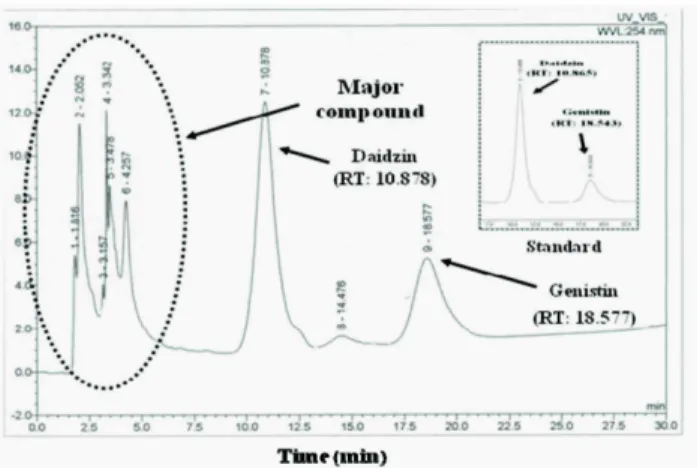
한 후 11개의 EA subfraction을 얻었다. 이들 각 subfraction 5 mg/ml 농도에서 α-glucosidase 활성 저해율을 측정한 결 과 acarbose (5 mg/ml)가 31.5%인 것에 비하여 1~3번 sub- fraction이 각각 30.8%, 80.4%, 41.1%였고, 특히 2번 sub- fraction이 80.4%로 acarbose (31.5%)보다 2.5배 이상의 활성 저해율을 나타내었다(Fig. 2). α-Glucosidase 저해율이 높았 던 1~3번 subfraction의 UV/Vis 흡수 패턴을 확인한 결과 267~268 nm에서 최대 흡광을 나타내었으며, 이는 iso- flavone류 중 genistein, genistin의 흡광범위와 동일하였다 (Fig. 4). 그 중에서 α-glucosidase 활성 저해율이 가장 높았 던 2번 subfraction은 0.8679로 가장 높은 흡광도를 나타내 었으며, 1번(0.5439), 3번(0.4343) 순이었다. 또한 이들 EA subfraction 1, 2 및 3번을 TLC를 이용하여 분리하고 DAP 로 발색시킨 결과 당이 함유된 것으로 확인 되었다(Fig. 3).
따라서 EA 분획물에서 α-glucosidase 활성을 저해하는 물질
은 isoflavone 배당체로 추정할 수 있었고, 가장 강력한 α-
glucosidase 저해활성을 갖는 EA subfraction 2번을 C
18re-
versed-HPLC column으로 분석하였다(Fig. 5). EA sub-
1 2 3 EA subfraction
Fig. 4. UV spectra of EA subfraction 1, 2 and 3 in methanol shown in Fig. 1 and 2.
Fig. 3. TLC pattern of EA subfraction shown in Fig. 1. A mixture of acetonitrile: H2O (12:1, v/v) was used to separate EA subfractions. Spots were visulalized with DAP and detected under UV light.
fraction 2번에는 genistin과 daidzin이 함유되어 있었고, 또 한 이들 보다 극성 큰 물질들이 다소 함유되어 있었다. 극성 이 강한 이들 물질은 동정되지 않았지만, TLC 분석에서 당 이 함유되어있었고(Fig. 3), UV 흡광도에서 isoflavone과 유 사한 것으로 확인되어 이들은 당이 isoflavone과 con- jugation된 isoflavone 배당체로 생각된다. 이들은 genistin이 나 daidzin보다 훨씬 빨리 유출되었기에 isoflavonoide에 glucose가 하나 결합된 배당체가 아니라 AB가 배양되는 과 정에서 효소반응에 의해 합성된 분자량이 genistin이나 daidzin보다 큰 glycoside 결합의 isoflavone 배당체로 추정 된다.
EA 분획물의 α-glucosidase 활성저해 물질
Isoflavone인 genistein, genistin (genistein의 glycoside)과 daidzin (daidzein의 glycoside) (각각 0.5 mg/ml), 그리고 EA subfraction 2의 α-glucosidase 활성 저해율을 측정한 결과 배 당체가 아닌 genistein이 배당체인 daidzin, genistin보다 저해
Fig. 5. HPLC chromatogram of EA subfraction 2 in Fig. 3. C18
reversed HPLC-column was applied for separation of the constituents of the EA subfraction 2 and isoflavonoids.
Mobile phase was a mixture of methanol:1 mM ammo- nium acetate (1:3, v/v).
Fig. 6. The inhibition of α-glucosidase activity by EA subfraction 2 and isoflavones (daidzin, genistein and genistin). The amount of acarbose and EA subfraction 2 for the assay was 5 mg, and other isoflavonoids was 0.5 mg.
율이 높게 나타났다(Fig. 6). 0.5 mg/ml genistein은 78.5%의
저해율을 보여 5 mg/ml 농도의 acarbose (27.2%)보다 약 2.8
배 이상의 α-glucosidase 활성 저해율을 나타내었다. 그러나 EA subfraction에 함유된 isoflavone 배당체인 genistin과 daidzin의 활성은 상대적으로 높지 않았지만 EA subfraction 2 (5 mg/ml)는 약 80%의 저해활성을 나타내었다. 이와 같은 결과는 EA subfraction 에 함유된 genistin과 daidzin 및 이들 당 conjugate의 복합적인 효과로 추정된다.
고 찰
β -Glucan 분획을 제거한 신령버섯균사체 액체배양액(β- glucan-free HEAB)으로부터 acarbose 보다 α-glucosidase 저 해 활성이 강한 EA 분획을 분리하였다. 이 분획의 유효물질 은 isoflavone (genistin과 daidzin)과 isoflavone과 당의 con- jugate 된 물질이 함유되어 있었다. Genistin과 daidzin은 대 두로부터 유래되었고, 당과 conjugate 된 물질은 신령버섯균 사체 액체배양과정에서 genistein과 daidzein 또는 genistin 과 daidzin으로부터 생성된 것으로 추정된다.
α -Glucosidase는 소장의 상피세포 내막에 존재하면서, amylase에 의해 생성된 이당류나 올리고당류를 glucose로 분 해하여 체내 당 흡수를 도와 식후 혈당을 높이는데 역할을 한다. 따라서 당뇨병 환자는 식후 혈당을 안정화시키기 위해 서 acarbose나 voglibose와 같은 α-glucosidase 저해제를 복용 한다. 그러나 이들 경구혈당 강하제는 장기복용 시 복통, 설사, 복부팽만감 등의 부작용이 발생[31]하여 최근 화살나무 (Euonymus alatus)[15], 오갈피나무[19], 갈근[25] 등의 천연물 로부터 α-glucosidase 활성저해제가 개발되었다.
신령버섯 β-glucan은 당뇨환자의 혈당지표로 활용되는 당화 헤모글로빈 수치를 낮추었고[4], 신령버섯 균사체 배양 액은 흰쥐에서 당뇨 합병증 질환의 원인이 되는 LDL-콜레 스테롤 농도를 낮추는 반면, 총 콜레스테롤에 대한 HDL-콜 레스테롤 농도는 증가시켰다[14]. 신령버섯 이외에도 표고버 섯 균사체[36], 영지버섯(Ganoderma lucidum)[11], 상황버섯 (Phellinus linteus)[9] 등의 버섯류에 대하여도 항당뇨 효과 및 α-glucosidase 활성저해 소재가 개발되었다. 그러나 이와 같은 방법으로 개발된 소재는 지속적인 공급에 문제가 있지 만 β-glucan을 제거한 신령버섯 균사체 액체배양액으로부터 개발한 α-glucosidase 활성 저해소재는 원료공급이 가능 할 것이다.
β -Glucan-free HEAB 분획물의 α-glucosidase (10 mg/ml) 활성저해 효과는 EA 분획이 61.6%로 가장 우수하였으며, hexane 분획(59.0%), butanol분획(37.9%), crude분획(32.9%), chloroform분획(17.0%), 80% ethanol 침전물(14.9%) 순으로 저해되었다. 이와 같은 결과는 작약(Paeonia lactiflora) 종자의 EA 분획이 95.8%[2]였던 것에 비해 다소 낮았다. 그러나 EA 분획을 silica gel column chromatography로 분리한 EA subfraction 2번은 5 mg/ml 농도에서 acarbose가 31.5%인
것에 비해 80.4%로 2.5배 이상의 높은 저해율을 타나내어 작 약의 EA 분획과 유사하였고, 콩나물의 EA 분획 36.3%의 저 해율[10]보다 2배 이상 높은 수치였다. 이와 같은 결과는 β -glucan-free HEAB에 함유된 isoflavone과 glycoside 결합의 isoflavone배당체에 의한 결과 일 것이다.
Isoflavone은 식물체에 들어있는 페놀계화합물의 배당체로 서 당뇨병, 심혈관질환, 골다공증, 고지혈증 등에 유익하다 [29]. 특히 대두는 식후 혈당치 증가를 완만하게 하여 당뇨의 예방 및 치료효과가 있다[13]. 대두에 함유되어 있는 iso- flavone은 glycoside 형태인 genistin과 daidzin이 약 96~98%
로 주를 이루고 있으며[32], 발효식품의 경우 발효과정에서 aglycone형태의 genistein, daidzein 등으로 전환된다[5]. 그리 고 genistein은 강력한 α-glucosidase 활성저해제라고 보고된 바 있다[16]. 그러나 본 연구는 대두박분해물을 기본배지로하 여 신령버섯균사체를 배양한 배양물임에도 발효식품과는 달 리 glycoside 형태의 isoflavone이 대부분이었고, aglycon 형태 의 isoflavone의 함량은 낮았다(Fig. 5). 그리고 Fig. 5에서 gly- coside 결합의 isoflavone배당체로 추정되는 peak가 생성되어 이들이 강력한 α-glucosidase 활성을 저해하는 것으로 추정되 고 있다.
버섯균사체는 생장과정에서 섬유소 분해효소, 단백질 분해 효소, 지방질 분해효소 등의 다양한 가수분해 효소를 생성한 다[7,26]. 또한 액체배양을 할 경우 배지의 조성과 생육조건에 따라 배지에 함유된 성분을 다양한 기능성을 갖는 물질로 생 물전환 할 수 있다[38]. 이러한 과정에서 isoflavone과 glyco- sidic bond가 형성되었을 것이다. 추정되는 isoflavone 배당체 (di-, triglycoside 형)는 천연에 존재[22,28]하며 합성으로도 가능하지만, α-glucosidase 활성 저해효과나 항당뇨 효과에 대하여 아직 구체적으로 밝혀진 바는 없다. 최근 당뇨, 고혈 압, 고지혈증 등에 효능이 있고 건강식품 소재로 주목 받고 있는 대지콩(Apios americana Medik)으로부터 추정물질과 유 사한 genistein의 배당체인 genistein-7-O-genitiobioside (isoflavone diglycoside)가 새로운 소재로 분리되었으며, 항 산화 활성이 있음이 보고되었다[6,22]. 따라서 본 연구에서 강 한 α-glucosidase 저해제인 isoflavone이 glycoside 형태로 conjugate된 물질은 신령버섯균사체 액체배양중에 trans- glycosidase[35] 작용으로 합성되었을 것이다. 버섯균사체의 식후 혈당 상승억제 효과는 식이섬유 함량과 균사체에 함유 된 당, 폴리페놀 등의 α-glucosidase에 대한 저해활성의 결과 로 추정[3]한 것과 유사하게 본 연구에서 EA subfraction의 α -glucosidase 활성저해효과는 배양과정에서 생성된 대두박 분해물 유래 genistin, daidzin과 이들의 glycoside 형태로 conjugate된 물질에 의한 복합적인 효과로 추정된다.
결론적으로 대두를 기본배지로 한 신령버섯균사체 배양물
의 EA 분획으로부터 α-glucosidase 활성저해는 isoflavone
(glycoside 형)과 glycoside 결합의 isoflavone 배당체의 시너
지 효과에 기인한 것이다. Isoflavone의 glycoside 형은 glyco- side 형보다 강한 α-glucosdiase 저해활성이 있는 것으로 추정 되었다. 또한 EA 분획이 함유된 β-glucan-free HEAB는 혈당 을 낮추는 좋은 소재로 활용될 수 있을 것이다.
References
1. Bantle, J. P., J. W. Rosett, A. L. Albrigh, C. M. Apovian, N. G. Clark, M. J. Frans, B. J. Hoogwerf, A. H. Lichtensterin, E. M. Davis, A. D. Mooradian, and M. L. Wheeler. 2000.
Nutrition recommendation and principles for people with diabetes mellitus (Position Statement).
Diabetes Care
23, 843-846.2. Choi, C. W., Y. H. Choi, M. R. Cha, J. H. Park, Y. S. Kim, Y. K. Kim, S. U. Choi, G. H. Yon, K. S. Hong, Y. H. Kim, and S. Y. Ryu. 2009. α-Glucosidase inhibitiors from seed ex- tract of
Paeonia lactiflora
.J. Korean Soc. Appl. Biol. Chem.
52, 638-642.3. Choi, H. D., H. M. Seog, Y. K. Park, Y. D. Park, and J. A.
Kim. 2007. Hypoglycemic effects of basidiomycetes mycelia and cereals fermented with basidiomycetes.
J. Korean Soc.
Food Sci. Nutr.
36, 1257-1262.4. Choi, J. M. and S. J. Koo. 2000. Effects of β-glucan from
Agaricus blazei
Murill on blood glucose and lipid composi- tion in db/db mice.Korean J. Food Sci. Technol.
32, 1418-1425.5. Coward, L. and S. Barnes. 1993. Genistein, daidzein and their β-glycoside conjugates: Antitumor isoflavones in soybean foods from American and Asian diets.
J. Agr. Food Chem.
41, 1961-1967.
6. Iwai, K. and M. Hajime. 2007. Ingestion of
Apios americana
Medikus tuber suppresses blood pressure and improves plasma lipids in spontaneously hypertensive rats.Nutr. Res.
27, 218-224.
7. Jung, I. C., S. Park, K. S. Park, and C. H. Ha. 1996.
Antioxidative effect of fruit body and mycelia extracts of
Pleurotus ostreatus
.Korean J. Food Sci. Technol.
28, 464-469.8. Kawagish, H., R. Inagaki, and T. Kanao. 1989. Fraction and antitumor activity of the water-insoluble residue of
Agaricus blazei
fruiting bodies.Carbohydr. Res.
186, 267-273.9. Kim, D. H., H. J. Choi, E. A. Bae, M. J. Han, and S. Y. Park.
1998. Effect of artificially cultured
Phellinus linteus
on harm- ful intestinal bacterial enzymes and rat intestinal α -glucosidases.J. Fd Hyg. Safety
13, 20-23.10. Kim, J. I., M. J. Kang, and S. Y. Bae. 2003. Hypoglycemic effect of the methanol extract of soybean sprout in strepto- zotocin-induced diabetic rats.
J. Korean Soc. Food Sci. Nutr
. 32, 921-925.11. Kim, S. D. and J. N. Hong. 2004. Isolation and character- ization of α-glucosidase inhibitor from the fungus
Ganoderma lucidum
.J. Microbiol.
42, 223-227.12. Kim, Y. Y., R. W. Cho, S. H. Chung, and S. J. Koo. 1999.
Anti-hyperglycemic effect of
Cortex Mori radicis
in db/db mice.Korean J. Food Sci. Technol.
31, 1057-1064.13. Koh, J. B. 1998. Effects of raw soy flour (yellow and black)
on serum glucose and lipid concentrations in streptozotocin- induced diabetic rats.
J. Korean Soc. Food Sci. Nutr.
27, 313-318.14. Koh, J. B. and J. Y. Kim. 2004. Effects of liquid culture of
Agaricus blazei
Murill on lipid metabolism in rats fed choles- terol diet.J. Life Sci.
14, 531-536.15. Kwon, G. J, D. S. Choi, and M. H. Wang. 2007. Biological activities of hot water extracts from
Euonymus alatus
leaf.Korean J. Food Sci. Technol.
39, 569-574.16. Lee, D. S. and S. H. Lee. 2001. Genistein, a soy isoflavone, is a potent α-glucosidase inhibitor.
FEBS Letters
501, 84-86.17. Lee, S. L., Y. C. Park, and J. B. Kim. 2007. Effects of hambag mushroom (
Grifola Frondosa
)-powder on hyperglycemia and hyperlipemia in STZ and high fat diet-induced diavetic rats.J. Life Sci.
17, 1387-1393.18. Lee, Y. R., S. H. Nam, and M. Y. Kang. 2006. Hypoglycemic effect of the giant embryonic rice supplementation on strep- tozotocin-induced diabetic rats.
Korean J. Food Sci. Technol.
38, 427-431.
19. Lim, S. H., Y. H. Park, C. J. Kwon, H. J. Ham, H. N. Jeong, K. H. Kim, and Y. S. Ahn. 2010. Anti-diabetic and hypo- glycemic effect of
Eleutherococcus
spp.J. Korean Soc. Food Sci.
Nutr.
39, 1761-1768.20. Menoli, R. C. R. N., M. S. Mantovani, L. R. Ribeiro, G. Speit, and B. Q. Jordao. 2001. Antimutagenic effects of the mush- room
Agaricus blazei
Murrill extracts on V79 cells.Mutat.
Res.
496, 5-13.21. Mizuno, T., R. Inagaki, T. Kanao, and T. Hagiwara. 1990.
Antitumor activity and some properties of water-insoluble hetero-glucans from “Himematsutake” the fruiting body of
Agaricus blazei
Muril.Agr. Biol. Chem.
54, 2897-2905.22. Nara, K., K. I. Nihei, Y. Ogasawara, H. Koga, and Y. Kato.
2011. Novel isoflavone diglycoside in groundnut (
Apios americana
Medik).Food Chem.
124, 703-710.23. Oh, T.W., Y. A. Kim, W. J. Jang, J. I. Byeon, C. H. Ryu, J. O. Kim, and Y. L. Ha. 2010. Semipurified fractions from the submerged-culture broth of
Agaricus blazei
Murill reduce blood glucose levels in streptozotocin-induced diabetic rats.J. Agr. Food Chem.
58, 4113-4119.24. Ortiz-Andrade, R. R., S. Garcia-Jimenez, P. Castillo-Espana, G. Ramirez-Avila, R. Villalobos-Molina, and S. Estrada-Soto.
2007. α-Glucosidase inhibitory activity of the methanolic ex- tract from
Tournefortia hartwegiana
: ananti-hyperglycemic agent.J. Ethnopharmacol.
109, 48-53.25. Park, J. H., M. R. Baek, B. H. Lee, G. H. Yon, S. Y. Ryu, Y. S. Kim, S. U. Park, and K. S. Hong. 2009. α-Glucosidase and α-amylase inhibitory activity of compounds from roots extract of
Pueraria thunbergiana
.Korean J. Medicinal Crop Sci.
17, 357-362.
26. Song, C. H., J. H. Kim, B. K. Yang, and K. W. Kim. 1996.
Anti-complementary polysaccharides produced from sub- merged mycelial culture of
Pleurotus sajo-caju
.Korean J.
Mycol.
24, 104-110.27. Stratton, I. M., A. I. Adler, H. A. Neil, D. R. Matthews, S.
E. Manley, C. A. Cull, D. Hadden, R. C. Turner, and R.
R. Holman. 2000. Association of glycaemia with macro-
초록:신령버섯균사체 액체배양물의 α-glucosidase 저해 효과 정관주
1․문연규
1․권정민
1․안채린
1․김정옥
2․하영래
1* (
1경상대학교 응용생명과학부,
2(주)HK바이오텍)
β -Glucan 분획을 제거한 신령버섯 균사체 액체 배양액(β-glucan-free HEAB)으로부터 새로운 형태의 α-gluco- sidase 활성저해 소재를 개발하였다. β-Glucan-free HEAB를 용매분획하여 10 mg/ml 농도에서 α-glucosidase 저 해활성을 측정한 결과 EA분획이 가장 강한 활성(61.6% 저해)을 나타내었고, 경구혈당강하제인 acarbose (5 mg/ml; 39.5% 저해) 보다 강하였다. EA분획을 더 분획하여 α-glucosidase 저해활성이 80.4%인 분획을 얻었다.
이 분획에는 α-glucosidase 저해 활성을 갖는 daidzin 및 genistin과 같은 isoflavone과 isoflavone의 sugar con- jugate된 물질이 함유되어 있었다. 따라서 α-glucosidase 저해 활성을 나타내는 β-glucan-free HEAB나 EA분획물 은 인체의 혈당을 조절할 수 있는 소재로 활용될 수 있을 것이다.
vascular and microvascular complications of type 2 diabetes (UKPDS 35), prospective observational study.
Br. Med. J.
321, 405-412.
28. Tang, U. P., H. X. Zhu, and J. A. Duan. 2008. Two new isoflavone triglycoside from the small branches of
Sophora japonica
.J. Asian Nat. Prod. Res.
10, 65-70.29. Tham, D. M., C. D. Gardner, and W. L. Haskell. 1998.
Potential health benefits of dietary phytoestrogens: a review of the clinical, epidemiological, and mechanistic evidence.
J. Clin. Endocrinol. Metabol.
83, 2223-2235.30. Tovar, J. M., O. V. Bazaldua, and R. S. Poursani. 2007. LDL levels in diabetes: how low should they go.
J. Fam. Pract.
56, 634-640.
31. Tsujimoto, T., E. Shioyama, K. Moriya, H. Kawaratani, Y.
Shirai, M. Toyohara, A. Mitoro, J. Yamao, H. Fujii, and H.
Fukui. 2008. Pneumatosis cystoides intestinalis following al- pha-glucosidase inhibitor treatment: a case report and re- view of the literature.
World J. Gastroenterol.
14, 6087-6092.32. Tsukamoto, C., S. Shumada, K. Igita, S. Kudou, M. Kokubun, K. Okudo, and K. Kitamura. 1995. Factor effecting iso- flavone contents in soybean seeds.
J. Agr. Food Chem.
43, 1184-1192.33. Wansi, J. D., M. C. Lallemand, D. D. Chiozem, F. A. A. Toze, L. M. Mbaze, S. Naharkhan, M. C. Iqbal, F. Tillequin, J.
Wandji, and Z. T. Fomum. 2007. α-Glucosidase inhibitory constituents from stem bark of
Terminalia superba
(Combretaceae).Phytochemistry
68, 2096-2100.34. Watanabe J., J. Kawabata, H. Kurihara, and R. Niki. 1997.
Isolation and identification of α-glucosidase inhibitors from Tochu-cha (
Eucommia ulmoides
).Biosci. Biotechnol. Biochem.
61, 177-178.
35. Xu, M. S., M. F. Luo, X. H. Xing, and H. Z. Chen. 2006.
Characteristics of quercetin transglycosidation catalysed by
Penicillium Decumbens
glycosidase.Food and Bioproducts Processing
84, 237-241.36. Yang, B. K., D. H. Kim, and C. H. Song. 2002. Production of
Lentinus edodes
Mycelia in submerged culture and It's hy- porglycemic effect in diabetic rats.Korean J. Mycol.
30, 131-135.37. Yoshiaki, F., K. Hidekazu, O. Koichi, S. Ryo, and E.
Takusaburo. 1998. Tumoricidal activity of high molecular weight polysaccharides derived from
Agaricus blazei
via oral administration in the mouse tumor model.Nippon Shokuhin Kagaku Kaishi
45, 246-252.38. Yu, H. E., S. M. Cho, G. S. Seo, B. S. Lee, D. H. Lee, and J. S. Lee. 2006. Screening of bioactive compounds from mushroom