식물병연구
Res. Plant Dis. 18(4) : 396−398 (2012)
Research in Plant Disease
© The Korean Society of Plant Pathology
http://dx.doi.org/10.5423/RPD.2012.18.4.396Trichothecium roseum에 의한 토마토 분홍빛열매썩음병 발생
한경숙*·이성찬·이중섭·소재우 국립원예특작과학원 원예특작환경과
First Report of Pink Mold Rot on Tomato Fruit Caused by Trichothecium roseum in Korea
Kyung-Sook Han*, Seong-Chan Lee, Jung-Sup Lee and Jae-Woo Soh
Horticultural & Herbal Environment Division, National Institute of Horticultural and Herbal Science, Rural Development Administration, Suwon 441-440, Korea
(Received on October 2, 2012; Revised on November 16, 2012; Accepted on December 30, 2012)
Pink mold rot of tomato occurred very severly on tomato farm in Paju, Gyounggi Province, Korea, in July 2005. The infected fruits were dropped and abandoned and the symptoms were similar to calcium deficient tomatoes. But symptom was a slight water-soaked area on or near the blossom end of the fruit and firm greyish-brown lesions were most found at the blossom-end of affected fruits. lesions caused by the pink mold fungus possess a water soaked margin and rise to characteristic orange-pink spores. Also when the diseased tomato was cut, the inside of tomatoes showed completely rotted with pink mold. The causal fungus was identified as Trichothecium roseum based on mycological characteristics. This is the first report of T. roseum infecting greenhouse tomatoes in Korea.
Keywords : Pink Mold Rot, Tomato, Trichothecium roseum
토마토(Solanum lycopersicum)는 대표적인 가지과 작물 로서 세포의 산화를 방지하여 항암효과를 나타내는 리코 핀 색소를 다량 함유하고 있고, 최근의 웰빙문화의 확대 와 함께 재배면적과 생산량이 꾸준히 증가추세에 있다.
2005년 7월 경기도 파주시 토마토 재배농가에서 과실 의 배꼽 부위가 암갈색으로 변하면서 낙과되는 피해가 발 생하였다. 처음에는 칼슘 결핍에 의한 배꼽썩음 증상과 유사한 것으로 여겨졌으나, 병반 표면에 옅은 분홍색의 곰팡이가 형성된 것을 확인할 수 있었다. 특히 병든 과실 을 잘라보았을 과실 내부까지 갈변되어 있었으며, 과방과 씨앗까지 분홍색 곰팡이로 뒤덮혀 있었다. 병든 토마토 과실에서 형성된 분홍색 곰팡이를 분리하여 균학적 특징 을 파악하고 배양적 특성을 검토한 결과 Trichothecium roseum으로 동정되었다. 우리나라에서 토마토에 발생하는 병해는 궤양병 등 31종이 보고되어 있으며, T. roseum에
의한 병으로는 멜론 분홍빛열매썩음병(Kwon 등, 1998), 딸기 분홍빛열매썩음병(Kwon 등, 2010), 배 붉은빛썩음 병(Park, 1961), 사과 붉은썩음병(Nakata와 Takimoto, 1928) 이 발생하는 것으로 보고된 바 있다(The Korean Society of Plant Pathology, 2009). 따라서 본 연구에서는 우리나 라의 토마토에서 처음 발생이 확인된 분홍빛열매썩음병 의 병징, 병원균의 균학적 특징과 병원성 검정 결과를 보 고한다.
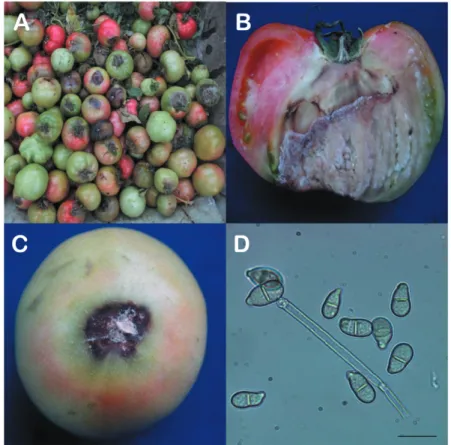
병징. 2005년 7월 경기도 파주시 유기농으로 토마토 를 재배하는 시설 농가에서 수확기 토마토 과실의 배꼽 부위가 암갈색으로 변하면서 낙과되는 피해가 발생하였 다(Fig. 1A). 피해받은 과실은 성숙 여부에 상관없이 발생 하였으며, 처음에는 칼슘 결핍에 의한 배꼽썩음 증상과 유사하였으나, 배꼽썩음 증상과는 달리배꼽 부위가 함몰 되지 않았으며 피해 부위에 옅은 분홍색의 곰팡이가 형 성된 것을 확인할 수 있었다. 특히 병든 과실을 잘랐을 경우 과실 내부까지 갈변되어 있었으며, 과방과 씨앗까지 분홍색 곰팡이로 뒤덮혀 있었다(Fig. 1B). 또한 심하게 병 징을 나타내는 과실은 꼭지 부위까지도 진전되어 낙과를
*Corresponding author
Phone) +82-31-290-6233, Fax) +82-31-290-6259 Email) [email protected]
Note Open Access
Trichothecium roseum에 의한 토마토 분홍빛열매썩음병 397
유발하는 것으로 관찰되었다. 그러나 과실을 제외한 토마 토 식물체에서는 어떠한 병징도 발견되지 않았다.
병원균 분리 및 특성. 병든 토마토 과실로부터 병원균 을 분리하기 위하여 감염된 조직을 잘라 1% 차아염소산 나트륨(NaOCl) 용액에 표면 살균하고 살균수로 3회 세척 한 후 멸균된 여과지에서 물기를 말린 다음 한천배지(WA) 위에 치상하였다. 병든 조직을 26oC 항온기에서 3일간 배 양 후 균사 선단부를 떼어 내어 감자한천배지(PDA)에서 배양하면서 배양적, 형태적 특징을 조사하였다. 또한 병든 과실 병반 표면 위에 형성된 분홍색 곰팡이를 핀셋으로
직접 떼어 내어 한천배지에 배양 후 단포자를 분리한 결 과 조직에서 배양된 병원균과 동일한 균임을 확인할 수 있었다.
분리한 병원균의 생육적온은 25−30oC에서 PDA에 배양 할 경우 균사 생장이 가장 왕성하였으며, 균총색깔은 처 음에 흰색이고 배양기간이 경과됨에 따라 배지표면이 분 홍색 가루모양 형태의 분생포자를 많이 형성하였다. 분생 포자는 2개의 세포로 이루어진 서양배 모양이었으며(Fig.
1D), 크기는 12−19 × 7.5−10 µm였다. 분생포자경은 직립 형으로 가지를 치고 있으며 분생자경 선단에 분생포자를 Fig. 1. Pink mold rot on tomato fruit caused by Trichothecium roseum. (A) Natural symptoms on tomato dropped and abandoned in field, (B) Internal symptoms of the rotten fruit, (C) Symptom on tomato fruit by artificial inoculation, (D) Conidiophores and conidia (Bar = 20µm).
Table 1. Comparison of morphological characteristics of Trichothecium roseum isolated from pink mold rot of tomato fruit and described
Structure Present isolate T. roseuma
Conidiophores Shape elect elect
Size (µm) 98−250 × 2−4 80−175 × 2.5−4.5 Conidia Shape ellipsoidal to pyriform ellipsoidal to pyriform
Size (µm) 12−19 × 7.5−10 12.5−23 × 6.5−9.5
Septum uniseptate uniseptate
Colony pinkish pale orange
Optimum growth temperature 25−30oC 25−28oC
aDomsch et al. (1980).
398 한경숙·이성찬·이중섭·소재우 형성하고 있으며, 크기는 98−250 × 2−4 µm였다(Table 1).
병원성 검정. T. roseum의 병원성 검정을 위해 접종원 은 PDA에서 26oC 항온기에 7일 동안 배양하였다. 균이 배양된 샤레에 멸균수를 붓고 붓으로 긁어낸 뒤, 멸균된 가아제를 이용하여 포자현탁액(5 × 10⁶ spores/µl)을 제조하 였다. 접종을 위한 완숙토마토 과실은 초록색 미성숙과와 빨갛게 숙성된 성숙과에 대해 병원성 검정을 실시하였 다. 플라스틱통(25 × 15 × 6 cm)에 2겹의 키친타올을 깔고 여분의 물이 흐르지 않을 정도 키친타올이 젖도록 물기 를 주어 습도 유지하도록 한 후 접종용 과실을 일정한 간 격으로 놓고 실험하였다. 접종방법은 토마토 과실의 배꼽 부위에 곤충용 핀으로 상처를 유도한 것과 무상처로 구 분하였으며, 각각 10 ml씩 포자현탁액을 점적으로 접종하 였다. 접종 후 26oC로 유지되는 항온기에 두고 병징을 관 찰하였다. 접종 3일 후부터 병징이 나타나기 시작하였으 며, 7일 후에는 자연감염과 같은 정도의 병징이 나타났다 (Fig. 1C). 또한 과실의 성숙 여부와 상관없이 병징이 진 전됨을 확인할 수 있었으나, 과실 내부까지의 부패정도는 빨갛게 익은 토마토에서 다소 심한 것으로 관찰되었다.
이상과 같이 병원균의 균학적 특성을 조사한 결과 Barnett 과 Hunter(1972)에 의해 보고된 T. roseum와 형태적, 배 양적 특성과 병원성이 일치하였다. 세계적으로 T. roseum 에 의한 토마토 분홍빛열매썩음병 발생은 미국(Welch, 1975)과 브라질(Inacio 등, 2011)에서 발생하는 것으로 보 고되었으며, Bello(2008)는 수확 후 저장 및 유통 중에 발 생할 경우 mycotoxins을 생성하기 때문에 상품성을 저하 시키는 것을 보고한 바 있다. 따라서 본 연구에서 얻어진 결과를 가지고 이 병을 T. roseum에 의한 토마토 분홍빛 열매썩음병으로 제안하고자 한다.
요 약
2005년 7월 경기도 파주시 시설재배 농가에서 완숙토 마토 과실의 배꼽 부위가 암갈색으로 변하면서 낙과되는
피해가 발생하였다. 병반 표면에 옅은 분홍색의 곰팡이가 형성된 것을 확인할 수 있었으며, 병든 식물체에서 병원 균을 분리하여 균학적 특징을 검토한 결과 Trichothecium roseum으로 동정되었다. 따라서 본 연구에서 얻어진 결과 를 가지고 이 병을 T. roseum에 의한 토마토 분홍빛열매 썩음병으로 제안하고자 한다.
References
Barnett, H. L. and Hunter, B. B. 1972. Illustrated genera of imperfect fungi, 3rd ed. Burgess Publ. Co., NewYork. 241 pp.
Bello, G. D. 2008. First report of Trichothecium roseum causing postharvest fruit rot of tomato in Argentina. Australasian Plant Dis. 3: 103−104.
Domsch, K. H., Gams, W. and Anderson, T. H. 1980. Compendium of soil fungi. Academic Press, London, 859 pp.
Inacio, C. A., Pereira-Carvalho, R. C. and Morgado, F. G. 2011. A Tomato fruit rot caused by Trichothecium roseum in Brazil.
Plant Dis. 95: 1318.
Nakata, K. and Takimoto S. 1928. Diseases of cultivated plants in Korea. J. Agric. Exp. Stat. Gov. Gen. Chosen 15: 122. (In Japanese)
Kwon, J. H., Kang, S. W., Lee, J. T., Kim, H. K. and Park, C. S.
1998. Matured fruit cucumis melo caused by Trichothecium roseum (Pers.) Link ex Gray in Korea. Plant Pathology J. 14:
642−645.
Kwon, J. H., Shen, S. S. and Kim, J. W. 2010. Occurrence of pink mold rot of strawberry caused by Trichothecium roseum in Korea. Plant Pathology J. 26: 296.
Park, J. S. 1961. Fungous Diseases of Plants in Korea (2). Bulletin No. 2, p. 12. College of Agriculture, Chungnam National University, Daejeon, Korea.
The Korean Society of Plant Pathology. 2009. List of plant diseases in Korea. 5th ed. 853 pp. (In Korean)
Welch, A. W., Jenkins, S. F. and Averre, C. W. 1975. Trichothecium fruit rot on greenhouse tomatoes in North Carolina. Plant Dis.
Reptr. 59: 255−257.