• 검색 결과가 없습니다.

Eating Behavior and Physical Activity among College Students: A Descriptive Approach to the Gender Difference

N/A
N/A
Protected

Academic year: 2021

Share "Eating Behavior and Physical Activity among College Students: A Descriptive Approach to the Gender Difference"

Copied!
6
0
0

로드 중.... (전체 텍스트 보기)

전체 글

(1)

INTRODUCTION

Obesity is becoming a serious problem in the United States.

According to the National Health and Nutrition Examination Survey (NHANES) data, about 65% of U.S. adults (i.e., the age of 20 or more) are overweight or obese (Kim, Ahn, & No, 2012). In fact, college students, as part of the U.S. adult population, are more vulnerable to weight gain than the general population (Strong, Parks, Anderson, Winett, & Davy, 2008). This is no small problem, particularly in light of 2010 U.S. Census Bureau data that reflects a significant increase in the college student popu- lation-there were about 19 million college students in 2008.

Many researchers have identified that students entering college are faced with many stresses, which often lead to unhealthy changes in eating and exercise behaviors (Shaffer, Donato, LaBrie, Kidman, & LaPlante, 2005). One research even indicated that co- llege freshmen experienced an average weight gain of 15 po- unds or more (Hoffman, Policastro, Quick, & Lee, 2006).

Food-nutritionally balanced meals-is a critical factor for influ- encing people’s desire to adequately maintain their health (Rozin, Fischler, Imada, Sarubin, & Wrzesniewski, 1999). In the context of college students, one research study specifically showed that most college students used fast-food restaurants 6 to 8 times a week (Driskell, Kim, & Goebel, 2005). With these troubling study results in mind, more work is needed to better understand eating behavior among college students and how these students can

develop healthy lifestyle in their college years. Physical activity is also an important factor when college students are deciding whether to adequately maintain their health life. College stu- dents become more sedentary and their physical activity level decreases during college years. This can lead to higher Body Mass Index (“BMI”), weight increase, obesity, and a host of other health issues. Therefore, it is important to understand physical activity levels among college students and to develop a way to increase these levels during their college years in order to provide cues that can help college students lose weight or at least keep from gaining weight. Furthermore, it is also important to understand if there are any differences between male and female college stu- dents with respect to food behaviors and consumption. Some previous research studies indicated behavioral differences bet- ween genders, such as different food selection cues (Kwun, 2011) and social behaviors on the foodservice settings (Han & Ryu, 2006) between gender groups.

Eating behavior and physical activity among college students have been well-documented quantitatively and qualitatively.

However, little is known about the behavioral differences (e.g., eating behavior and physical activity) between genders. There- fore, the current study examined college students’ overall eating behavior and physical activity and the behavioral difference between male and female students.

LITERATURE REVIEW

Eating Behavior and Physical Activity among College Students:

A Descriptive Approach to the Gender Difference

Hyun-Woo Joung 1 , Joo Ahn 2 and Hak-Seon Kim 3,¶

1 Dept. of Nutrition and Hospitality Management, The University of Mississippi University, USA

2 Dept. of Nutrition, Hospitality, and Retailing, Texas Tech University, USA

3 Dept. of Foodservice Management, Kyungsung University, Busan 608-736, Korea

ABSTRACT: The current study examined college students’ overall eating behavior and physical activity, highlighting differences between male and female students attending a public university in the southwestern United States. Research findings indicated that many college students did not eat enough fruits, fruit juices, and green salad. Furthermore, the results of Chi-square analysis showed that there were significant differences in consumption amounts of green salad, hamburgers/hot dogs/sausage, and French fries/

potato chips between male and female students. Study findings showed that when students were asked about attributes of food/

restaurant choice, female students were more concerned about nutritional aspects when they chose the foods compared with male students. In terms of physical activity levels among college students, male students were more likely to participate in sports activities and weight training. On the other hand, female students were more inclined to walking or bicycling.

Keywords: College Student, Eating Behavior, Physical Activity, Gender Difference

§ Corresponding Author: Hak-Seon Kim, Ph.D., Assistant Professor, Dept. of Foodservice Management, Kyungsung University, 309 Suyeong-ro, Nam-gu, Busan 608- 736, South Korea, Tel. +82-10-663-4473, Fax. +82-51-627-6830, E-mail: [email protected]

Received: 18 August, 2014, Revised: 7 October, 2014, Accepted: 20 October, 2014.

(2)

Eating Behavior

Eating disorders among college students are widespread, cau- sing serious public and societal concern (Striegel-Moore, Sil- berstein, Frensch, & Rodin, 1988). These eating disorders have resulted from various factors, such as time management, con- venience, costs, and weight control in a food selection (Driskell et al., 2005). A plausible reason for eating disorders is that many college students skip breakfast to save some time and grab any convenient foods while rushing between classes (Davy, Benes, &

Driskell, 2006). This occurs because most college students highly relate good grades to their future career success. However, se- veral studies indicate the importance of a balanced diet, in- cluding eating a balanced breakfast, for college students in order to maximize academic performance (Benton & Sargent, 1992;

Berkey, Rockett, Gillman, Field, & Colditz, 2003; Pollitt, 1995).

College students’ eating behavior tends to become worse during college years than other young adulthoods because they often do not meet dietetic recommendations for the consumption of nutrients (Grace, 1997). In addition, the usual college students’

diets are high in fat and sodium due to consuming fast food, and low in fruits and vegetables (Galore, Walker, & Chandler, 1993).

One previous study indicated that only 26.3% of college students eat fruits and vegetables every day and that over 20% of college students eat foods of high fat contents three times or more a day (Freisling, Haas, & Elmadfa, 2010). The problem with this unba- lanced eating disorder is that inadequate fruit and vegetable consumption is associated with several psychosocial lives, such as weight dissatisfaction and poor academic performance (Neu- mark-Sztainer, Story, Resnick, & Blum, 1996), as well as with phy- sical health, such as obesity, diabetes, etc.

Physical Activity

Physical activity is defined as any body movements produced by skeletal muscles that result in energy expenditure (Paffen- barger, Blair, & Lee, 2001). The terms of physical activity and exercise have been used interchangeably; however, the exercise is considered to be a subset of physical activity, specifically pla- nned and structured physical activity (Hedley, Ogden, Johnson, Carroll, Curtin, & Flegal, 2004). In terms of physical activity among college students, one previous study indicated that college stu- dents’ poor behavioral pattern (i.e., physical activity) can con- tribute to overweight and obesity among adults (Racette, Deu- singer, Strube, Highstein, & Deusinger, 2005). Douglas et al. (1997) found from the 1995 College Health Risk Behavior survey that 35

% of college students were overweight and/or obese and that poor nutritional life and physical activity could lead to health pro- blems in their future. In this regard, National Survey (U.S. De- partment of Education, 2009) suggested that college students play a significant role for reducing the overweight population among adulthood by promoting health education, such as wei- ght management practices. Furthermore, physical activity among college students through health promotion can reduce the risks of several chronic diseases, such as excess adiposity, hyperten- sion, heart disease, stroke, and some cancers (U.S. Department of Health and Human Service, 1996). Some previous research stu- dies also indicated that college students are less involved in physical activities in their college years. One research study st-

ressed the serious problems with the lack of college students’

physical activity, showing that about 50% of college students had insufficient physical activity and that about 20% of college students did not exercise (Keating, Guan, Pinero, & Bridges, 2005).

Strong et al. (2008) found that exercise in people’s college years was an important factor associated with health behaviors; how- ever, they reported a decline in physical activity and exercise among college students.

Gender Differences on Eating Behavior and Physical Activity among College Students

The amounts of food energy consumed by males and females are usually different due to the difference of recommended ca- lorie intakes. Even so, eating behavior between males and fe- males has shown differently. In fact, Kwun (2011) indicated that perceptions between males and females about foods and attri- butes of food selection were shown differently. In addition, fe- male students tend to consider their beauty and appearance as a critical factor for social and career success, significantly affecting their diet, eating behavior, physical attractiveness, etc. (Pipher, 1994). Therefore, female students are more likely to lose weight and to diet while male students try to lose weight through physical activity and/or exercise more than dieting (Page & Fox, 1998). One research study also indicated that, biologically, wo- men are more likely to worry about their body fat and appea- rance than men are (Rodin, Silberstein, & Striegel-Moore, 1984).

Despite this theoretical evidence, more empirical research is nee- ded to study gender differences on eating behavior and physical activity among college students.

Method

A convenience online sampling method and cross-sectional study was conducted to examine eating behavior and physical activity among college students attending a public university in the southwestern United States. Participants completed surveys about eating-related behavior, level of physical activity, and restaurant choice in February 2010. Out of 280 potential samples (estimated number of students who attended six different cla- sses), 251 usable questionnaires were collected and used for the analysis. Frequencies, t-test, and chi-square analyses were used in order to describe college students’ eating behavior and physical activity and to compare behavioral difference between male and female students.

RESULTS Sample

Table 1 presents the socio-demographic characteristics of the sample, showing that 48.6% of the respondents (n=122) were male and 51.4% (n=129) were female. The average age of the respondents was 21.98 (SD=3.78). About 42% of respondents were junior students, followed by sophomore (21.5%), senior (21.1%), etc. The majority of the respondents (68.1%) were White, followed by Asian (15.1%), Hispanic (12.4%), and African-Ame- rican (2.8%).

Description of Eating Behavior

(3)

Table 1. Demographic profile of the sample (N=251)

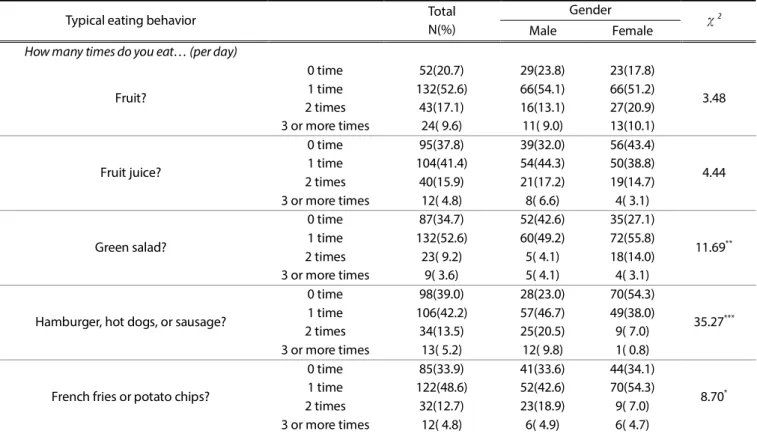
Table 2. Gender comparison in typical eating behavior (N=251)

Note: * p<.05, ** p<.01, *** p<.001.

Typical eating behavioral questions among college students were asked, and the results were described in Table 2. Further- more, eating behavioral differences between male and female students were also presented. In terms of fruit and fruit juice, there was no difference between male and female students.

However, the results show many students have not been eating fruit (male: 23.8%; female: 17.8%) and fruit juice (male: 37.8%;

female: 43.4%). In terms of green salad, hamburger/hot dog/sau- sage, and French fries/potato chips, chi-square analysis found that there were significant differences between male and female students. About 57% of male students eat green salad at least once a day while about 73% female students eat it at least once a day (χ 2 =11.69, p<.01). The results also showed that male stu- dents tend to eat more hamburger/hot dog/sausage (χ 2 =35.27,

Characteristics Category N %

Gender Male 122 48.6

Female 129 51.4

Age

Under 20 years 107 42.6

21~25 years 110 43.8

26~30 years 20 8.0

Over 30 years 11 4.4

Classification

Freshman 11 4.4

Sophomore 54 21.5

Junior 105 41.8

Senior 53 21.1

Graduate 28 11.2

Ethnicity

White 171 68.1

Hispanic 31 12.4

African-American 7 2.8

Asian 38 15.1

Other 4 1.6

Typical eating behavior Total

N(%)

Gender

χ 2

Male Female

How many times do you eat… (per day) Fruit?

0 time 52(20.7) 29(23.8) 23(17.8)

3.48

1 time 132(52.6) 66(54.1) 66(51.2)

2 times 43(17.1) 16(13.1) 27(20.9)

3 or more times 24( 9.6) 11( 9.0) 13(10.1)

Fruit juice?

0 time 95(37.8) 39(32.0) 56(43.4)

4.44

1 time 104(41.4) 54(44.3) 50(38.8)

2 times 40(15.9) 21(17.2) 19(14.7)

3 or more times 12( 4.8) 8( 6.6) 4( 3.1)

Green salad?

0 time 87(34.7) 52(42.6) 35(27.1)

11.69 **

1 time 132(52.6) 60(49.2) 72(55.8)

2 times 23( 9.2) 5( 4.1) 18(14.0)

3 or more times 9( 3.6) 5( 4.1) 4( 3.1)

Hamburger, hot dogs, or sausage?

0 time 98(39.0) 28(23.0) 70(54.3)

35.27 ***

1 time 106(42.2) 57(46.7) 49(38.0)

2 times 34(13.5) 25(20.5) 9( 7.0)

3 or more times 13( 5.2) 12( 9.8) 1( 0.8)

French fries or potato chips?

0 time 85(33.9) 41(33.6) 44(34.1)

8.70 *

1 time 122(48.6) 52(42.6) 70(54.3)

2 times 32(12.7) 23(18.9) 9( 7.0)

3 or more times 12( 4.8) 6( 4.9) 6( 4.7)

(4)

p<.001) and French fries/potato chips (χ 2 =8.70, p<.05) than female students, indicating male students are having more high- calorie foods than female students.

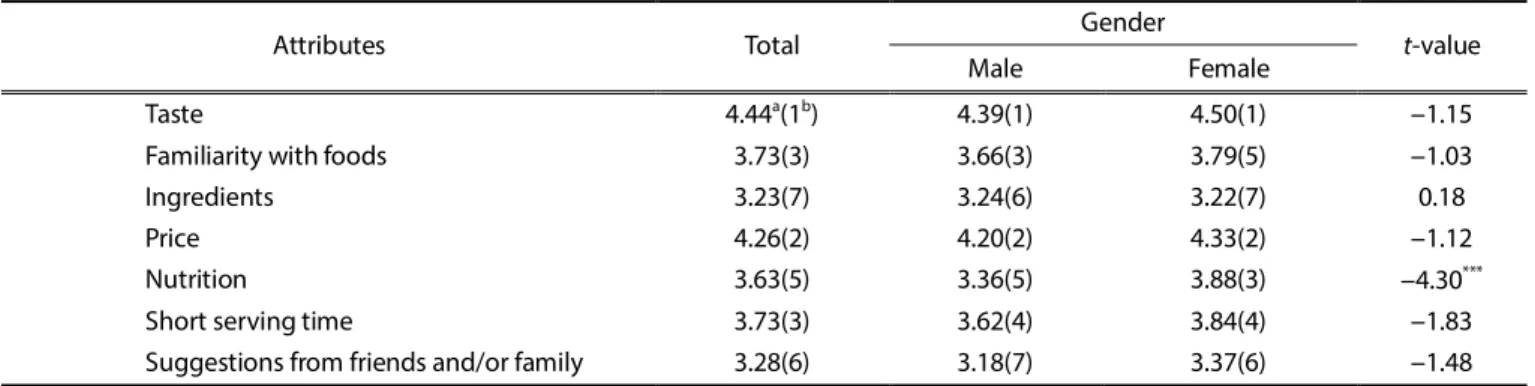
Why students choose certain foods or restaurants (i.e., attri- butes of students’ food choice) was also asked and the diffe- rences between male and female students were compared (see Table 3). Major reasons of food choice were food tastes and affordable price for both male and female students. On the other hand, some other attributes were presented differently by male and female students. One noticeable difference between male and female students is that female students are more concerned about nutritional aspects when they choose the foods compared with male students. The t-test also found that there was a sig- nificant difference on this attribute (i.e., nutrition) between male and female students (t=–4.30, p<.001).

Description of Physical Activity

Table 4 presents the level of college students’ physical activity and the difference between male and female students. The results indicate that college students exercised (e.g., sports acti- vities, stretching, weight training, or bicycle) two to three days per week. However, there were some differences between male and female students. Male students were more likely to parti- cipate in sports activities and weight training while female stu- dents were more inclined to walking or bicycling. The t-test also found that there was a significant difference on the frequencies of weight training between male and female students (t=2.45, p<.05).

Table 3. Gender comparison in attributes of food choice (N=251)

Note: * p<.05, a Number of days per week.

Perceptions about Health and Physical Activity among College Students

The survey included items asking about the changes to res- pondents’ eating habits and physical activity after they came to the university. As shown in Table 5, chi-square analysis showed that there was no difference between male and female students in terms of their diet and physical activity, and that male and female students had similar patterns of change. However, study findings indicated that about 44% of participants responded that their diets were more healthful prior to coming to college, and more than half of the participants responded that they engaged in more physical activity prior to college.

DISCUSSION AND CONCLUSION

The current descriptive study provided information about co- llege students’ eating behavior, their level of physical activity, attributes of foods and/or restaurants choice, and the perception about their health and physical activity. The current study prin- cipally compared behavioral differences between male and fe- male students. Study findings indicated that many college students do not eat fruit (20.7%), fruit juice (37.8%), and green salad (34.7%). This finding is consistent with the previous study report (Freisling et al., 2010), showing that many college students barely eat fruits and vegetables. Moreover, Cluskey and Grobe (2009) indicated in their study that college students have stru- ggled with adapting healthy eating, nutritional diet, and exercise behaviors to college life. The lack of healthy food options and few affordable fresh vegetables and fruits for students on campus is a

Attributes Total Gender

t-value

Male Female

Taste 4.44 a (1 b ) 4.39(1) 4.50(1) – 1.15

Familiarity with foods 3.73(3) 3.66(3) 3.79(5) – 1.03

Ingredients 3.23(7) 3.24(6) 3.22(7) 0.18

Price 4.26(2) 4.20(2) 4.33(2) – 1.12

Nutrition 3.63(5) 3.36(5) 3.88(3) – 4.30 ***

Short serving time 3.73(3) 3.62(4) 3.84(4) – 1.83

Suggestions from friends and/or family 3.28(6) 3.18(7) 3.37(6) – 1.48

Note: *** p<.001, a Average scores from 1 to 7, b Ranks among 7 attributes.

Table 4. Gender comparison in the level of physical activity (N=251)

Level of physical activity Total Gender

t-value

Male Female

On how many of the past 7 days did you…

Exercise or participate in sports activities that made you sweat or

breathe hard for at least 20 minutes. 2.85 a 2.93 2.78 0.65

Do stretching exercises, such as tow touching, knee bending, or leg

stretching? 2.60 2.51 2.69 –0.74

Do exercises to strengthen or tone your muscles, such as push-ups,

sit-ups, or weight lifting? 2.53 2.86 2.22 2.45 *

Walk or bicycle for at least 30 minutes at a time? 3.02 2.76 3.27 –1.76

(5)

Note: a Not significant.

likely reason for this result. Furthermore, many students are often forced to grab any convenient foods-whether they are healthy or not-in order rush to classes (Kim et al., 2012). The study also found that there were significant differences in consumption of green salad (χ 2 =11.69, p<.01), hamburger, hot dogs, or sausage 2 =35.27, p<.001), and French fries or potato chips (χ 2 =8.70, p<.05) between male and female students. Male students tend to eat significantly less salad but more hamburger, hot dogs, sau- sage, and French fries/potato chips than female students. Accor- ding to Cluskey and Grobe’s (2009) study, male students were less concerned about weight and health in their lifestyle compared with female students. Another research finding from the current study can also support the gender difference above. When co- llege students were asked about attributes of foods/restaurants choice, female students perceived the nutrition aspect more im- portantly than male students did (see Table 3). In this regard, Soriano and Cala (2014) pointed out that women are more con- cerned about their body weight and Figure in order to fulfill socially constructed ideals of beauty. Additionally, the current study found that many more female students (70.5%)-compared to 47.5% of male students-exercise to lose weight or to keep from gaining weight. One previous research study indicated that frequency of physical activity among college students declined within the typical university years (Kim et al., 2012). The current study also found that participants were engaged in physical activities (e.g., sports activities, stretching, weight training, etc.) about two to three days per week, and there were no significant differences between male and female students. Furthermore, when asked about the level of physical activity after coming to college, about 20% of total respondents (male: 18.0%; female:

22.5%) indicated that they were less involved in physical active- ties while in college.

The current study has some limitations and also directs po- ssible future research. First, the current study was conducted at one public university located in the southwestern United States, proposing a generalizability issue. Therefore, collecting nation- wide and/or even cross-cultural data can validate the study findings. Second, the current study used a descriptive approach, so it was hard to explain the relationships between variables (e.g., eating behavior, physical activity, etc.). Thus, future research can use inferential statistics to explain the relationships other than through a description of the study results. Last, a longitudinal study would be more suitable for this type of research by co- llecting and analyzing sequential data over the college years.

REFERENCES

Benton, D., & Sargent, J. (1992). Breakfast, blood glucose and me- mory. Biological Psychology, 33(2-3), 207-210.

Berkey, C. S., Rockett, H. R. H., Gillman, M. W., Field, A. E., & Colditz, G. A. (2003). Longitudinal study of skipping breakfast and weight change in adolescents. International Journal of Obesity, 27, 1258-1266.

Cluskey, M., & Grobe, D. (2009). College weight gain and behavior transitions: Male and female differences. Journal of American Dietetic Association, 109(2), 325-329.

Davy, S. R., Benes, B. A., & Driskell, J. A. (2006). Sex differences in dieting trends, eating habits, and nutrition beliefs of a group of Midwestern college students. Journal of the American Dietetic Association, 106(10), 1673-1677.

Douglas, K. A. et al. (1997). Result from the 1995 national college health risk behavior survey. Journal of American College Health, 46(2), 55-67.

Driskell, J. A., Kim, Y., & Goebel, K. J. (2005). Few differences found in the typical eating and physical activity habits of lower-level and upper-level university students. Journal of the American Dietetic, 105(5), 798-801.

Freisling, H., Haas, K., & Elmadfa, I. (2010). Mass media nutrition information sources and associations with fruit and vegetable consumption among adolescents. Public Health Nutrition, 13, 269-275.

Galore, S. R., Walker, C., & Chandler, A. (1993). Brief communica- tion: Dietary habits of first-year medical student as determi- ned by computer software analysis of three-day food records.

Journal of the American College Nutrition, 12(5), 517-520.

Grace, T. W. (1997). Health problems of college students. Journal of the American Dietetic, 45, 243-250.

Han, H., & Ryu, K. (2009). The roles of the physical environment, price perception, and customer satisfaction in determining customer loyalty in the restaurant industry. Journal of Hos- pitality & Tourism Research, 33(4), 487-510.

Hedley, A. A., Ogden, C. L., Johnson, C. L., Carroll, M. D., Curtin, L.

R., & Flegal, K. M. (2004). Prevalence of overweight and obe- sity among US children, adolescents, and adults, 1999-2002.

Journal of the American Medical Association, 291(23), 2847- 2850.

Hoffman, D. J., Policastro, P., Quick, V., & Lee, S. K. (2006). Changes in body weight and fat mass of men and women in the first year of college: A study of the “Freshman 15”. Journal of Ame- Table 5. Changes of respondents’ diet and physical activity after coming to college (N=251)

Total N(%)

Gender

χ 2

Male Female

How would you characterize the healthful- ness of your diet?

More healthful 110(43.8) 58(47.5) 52(40.3)

1.44 n.s. a

About the same 86(34.3) 40(32.8) 46(35.7)

Less healthful 55(21.9) 24(19.7) 31(24.0)

How would you characterize your level of physical activity?

More physical activity 134(53.4) 65(53.3) 69(53.5)

1.13 n.s.

About the same 66(26.3) 35(28.7) 31(24.0)

Less physical activity 51(20.3) 22(18.0) 29(22.5)

(6)

rican College Health, 55(1), 41-46.

Keating, X. D., Guan, J., Pinero, J. C., & Bridges, D. M. (2005). A me- ta-analysis of college students ‘physical activity behaviors’.

Journal of American College Health, 54(2). 116-125.

Kim, H. -S., Ahn, J., & No, J. -K. (2012). Applying the health belief model to college students’ health behavior. Nutrition Research and Practice, 6(6), 551-558.

Kwun, D. J. W. (2011). Effects of campus foodservice attributes on perceived value, satisfaction, and consumer attitude: A gen- der-difference approach. International Journal of Hospitality Management, 30, 252-261.

Neumark-Sztainer, D., Story, M., Resnick, M. D., & Blum, R. W.

(1996). Correlates of inadequate fruit and vegetable con- sumption among adolescents. Preventive Medicine, 25(5), 497- 505.

Paffenbarger, R. S., Blair, S. N., & Lee, I. (2001). A history of physical activity, cardiovascular health and longevity: The scientific contributions of Jeremy N. Morris, DSC, DPH, FRCP. Internatio- nal Journal of Epidemiology, 30(5), 1184-1192.

Page, A., & Fox, K. R. (1998). Is body composition important in young people’s weight management decision-making? Inter- national Journal of Obesity and Related Metabolic Disorders, 22(8), 786-792.

Pipher, M. (1994). Reviving Ophelia: Saving the Selves of Adolescent girls. New York, NY: Ballantine.

Pollitt, E. (1995). Does breakfast make a difference in school. Jour- nal of the American Dietetic, 95(10), 1134-1140.

Racette, S. B., Deusinger, S. S., Strube, M. J., Highstein, G. R., &

Deusinger, R. H. (2005). Weight changes, exercise, and dietary patterns during freshman and sophomore years of college.

Journal of American College Health, 53(6), 245-251.

Rodin, J., Silberstein, L., & Streigel-Moore, R. (1984). Women and

weight: A normative discontent. Nebraska Symposium on Mo- tivation, 32, 267-307.

Rozin, P., Fischler, C., Imada, S., Sarubin, A., & Wrzesniewski, A.

(1999). Attitude to food and role of food in life in the USA, Japan, Flemish Belgium and France: Possible implications for the diet-health debate. Appetite, 33(2), 163-180.

Shaffer, H. J., Donato, A. N., LaBrie, R. A., Kidman, R. C., LaPlante, D.

A. (2005). The epidemiology of college alcohol and gambling policies. Harvard Reduction Journal, 2(1), 1-20.

Soriano, E., & Cala, V. C. (2014). Comparison of dietary habits among Romanian, Moroccan and Spanish adolescents in sou- thern Spain: Cross-cultural and gender differences. Procedia- Social and Behavioral Sciences, 132, 10-18.

Striegel-Moore, R. H., Silberstein, L. R., Frensch, P., & Rodin, J.

(1988). A prospective study of disordered eating among co- llege students. International Journal of Eating Disorders, 5(5), 935-947.

Strong, K. A., Parks, S. L., Anderson, E., Winett, R., & Davy, B. M.

(2008). Weight gain prevention: Identifying theory-based tar- gets for health behavior change in young adults. Journal of the American Dietetic Association.

U.S. Census Bureau. 2010. College enrollment summary. http://

www.census.gov/2010census

U.S. Department of Education (2009). National Center for Edu- cation Statistics, 1998~99 and 2008~09 Integrated Postsecon- dary Education Data System (IPEDS), “Completions Survey”

(IPEDS-C:99) and Fall 2009.

U.S. Department of Health and Human Service. (1996). The

Surgeon General’s Call to Action to Prevent and Decrease Over-

weight and Obesity. Rockville, MD: US Department of Health

and Human Services.

수치

Table 2. Gender comparison in typical eating behavior (N=251)
Table 4 presents the level of college students’ physical activity  and  the  difference  between  male  and  female  students

참조

관련 문서

The results of analysis on the difference of psychological happiness according to frequency of participation of external physical activity of female middle school

A study on the relationship between body mass index and the food habits of college students. Keilins respiratory chain concept and its

The purpose of this study was to investigate the lower extremity muscle strength and student health of male middle school students. Twenty middle school

As for the number of participation, significant difference was found in accessibility, attractiveness and comfort of physical environment, recognition and

Third, the analysis of the body-centered vertical speed between male.. and female students showed that male students appeared faster than female students at

Physical fitness changes on college students who played ultimate frisbee showed increases in muscular strength, muscle endurance(, cardiopulmonary endurance,

First, it was identified that students who participated in Saturday sport activity showed higher emotional development that students who did not, and showed difference in

The aim of this study was not only to compare the differences of ego-resilience between students with high experience and students with low experience in