직교주파수다중화변조 기반 계층변조 릴레이 시스템의 전송방식 연구
Transmit Scheme Study for OFDM Based Fixed Relay System with Hierarchical Modulation
슈지안
*
, 강우석*
, 서종수*
Jian Xu * , Woo-Seok Kang * and Jong-Soo Seo *
요 약릴레이 시스템은 차세대 무선통신시스템에서 고속하향통신과 서비스 커버리지 확장을 실현하기 위한 주요 기술이다. 본 논문에서는 직교주파수다중화변조 기반에서 계층변조를 사용하는 릴레이 시스템을 위한 효율적인 전송방식을 제안한다. 본 전송방식은 기지국 전력의 큰 증가 없이 셀 외곽지역의 사용자들에게 셀 내에 위치한 사용자들과 같은 고속하향통신을 제공할 수 있다. 전산모의실험을 통해서 제안 전송방식의 성능을 계층변조가 적용되지 않은 기존 방식과 비교 분석하며, 그 결과 제안 전송방식이 일대일전송 및 일대다중전송의 경우 모두 기존 방식에 비해서 기지국 전력사용 측면에서 우수한 성능을 보임을 확인한다.
Abstract
Relay system is a promising technique for the high downlink throughput or coverage extension in the next generation wireless systems. In this paper, the transmit scheme for orthogonal frequency division multiplexing (OFDM) based relay system with hierarchical modulation is designed. Without using much power from the base station, the proposed scheme can guarantee the cell edge users to get high data rates as the inner cell users. In the simulation, the performance of proposed scheme was compared with the conventional one in which there is no hierarchical modulation. Numerical results show that the proposed scheme can save much power whether the unicast case or multicast case.
Key words : OFDM, Hierarchical Modulation, Relay System, Unicast, Multicast.
* 연세대학교 전기전자 공학과(Dept. of Electrical and Electronic Eng, Yonsei University) ‧ 제1저자 (First Author): 슈지안
‧ 투고일자 : 2008년 11월 29일
‧ 심사(수정)일자 : 2008년 12월 1일 (수정일자 : 2008년 12월 8일) ‧ 게재일자 : 2008년 12월 30일
I. Introduction
Simple calculations indicate that the provision of very high data rates is not feasible with the conventional wireless network architectures. Even the recent advances in multiple-input multiple-output (MIMO) technologies
and signal processing techniques (such as advanced
channel coding methods) do not seem to be sufficient to
alleviate the tremendous potential stress that will be
incurred on the link budget in future wireless networks
with the aggregate rates of 100-1000 Mbps. Towards
that end, the increase of the current networks with the
relay or multihop capability is considered to be the most feasible way to facilitate almost ubiquitous high data rate coverage in the most cost-effective manner.
In this context, there has been growing interest in the concept of multihop relaying in wireless networks such as next generation cellular (B3G, 4G), wireless LAN (WLAN) (802.11s), and broadband fixed wireless (802.16j, 802.16m) networks. Multihop relay communications can be facilitated through the use of low-power/low-cost fixed relays deployed by the service provider, or through other wireless terminals in the network.
The application of multihop relays in cellular based wireless communication systems is also in discussion to increase the spectral efficiency or improve the diversity.
In this paper, it is based on the cellular system like in Fig.1.
Hierarchical constellations consist of non-uniformly spaced signal points (see, for example, [1], [2]). Thus it allows to use a modulation scheme which can be interpreted as a scheme with higher order by the receivers close to the transmitter and as a scheme with lower order by the receivers far from the transmitter.
Due to the capability of providing different levels of protection, this type of constellations has been proposed in many applications including multimedia transmission [3], downlink multiplexing [4] and superposing bits from different users in the same sub-carrier of an OFDM system [5].
Hierarchical modulation and relay communication could be a good solution to improve the data rate of cell edge users. In Fig.1, it can be seen that the cell edge users can get the enhanced bit from the relay stations.
In this way, the base station does not need to invest much power for the cell edge users. Thus it also avoids the problem of inter-cell interference.
The application of hierarchical modulation in relay communication system was studied with distributed turbo codes in [6]. However that is only a concept and for the uplink transmission of one user case with single
carrier.
In this paper, we investigate the problem for the multiuser OFDM based relay system with hierarchical modulation. The new allocation algorithm and also the transmit scheme from relay to outer cell users is proposed.
E
E C+E
C+E C+E
E
E C+E
C+E C+E
그림 1. 계층변조를 사용하는 셀룰라 전송구조 Fig. 1. Cellular transmit structure with hierarchical
modulation.
Ⅱ. System Model and Problem Formulation
2-1. Hierarchical Constellation
A hierarchical 4/16-Quadrature Amplitude Modulation (QAM) constellation (see, for example, [5]), is shown in Fig. 2 and can be modelled as follows. We assume that there are two streams of data where one stream requires higher level of protection than the other. For every channel access two bits are chosen from each level. The two bits requiring the highest level of protection are assigned to the most significant bit (MSB) position in the inphase (I) and quadrature (Q) phase channels.
Consequently, the two bits that require the least
protection are assigned to the least significant bit (LSB)
position in the I and Q channels.
In Fig. 2, the fictitious black symbols represent a 4-QAM constellation (referred to as the first hierarchy and denoted by
). The distance between the symbols in the first hierarchy is represented by . The actual transmitted symbols are the white symbols and they represent a 16-QAM constellation. This is the second level of hierarchy (denoted by hierarchy
). One of these white symbols surrounding a selected black symbol in the first hierarchy is selected by the two bits that requires the least protection. The distance between the symbols in the second hierarchy is denoted by .
그림 2. 계층변조 4/16-QAM 성상도 Fig. 2. Hierarchical modulation of 4/16-QAM.
2-2. Proposed Transmit Scheme & System Description
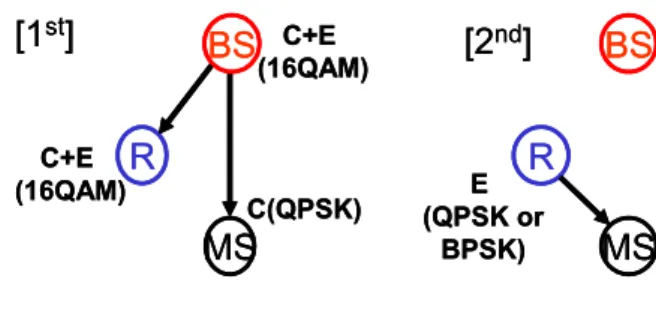
As seen in Fig. 1, the cell is divided into inner and outer cell. There exit several fixed relay stations on the boundary. Based on the resource allocation information, in the first time slot the base station selects the bits from different users and transmits them to all of the mobile users and relay station by using OFDM with hierarchical 4/16-QAM constellation. Suppose that the inner cell users and relay stations can get the 16QAM information because they are near to the base station. While the out cell users may only get the 4QAM high priority common bits. For the out cell users to get the enhanced
bits, in the second time slot the relay stations try to relay the enhanced bits to the users close to them. For a outer cell user, it can be seen in Fig.3.
The following assumptions are used in this chapter:
(i) the transmitted signals experience slowly time- varying fading channel, therefore the channel coefficients can be regarded as constants during the subcarrier allocation and power loading period; (ii) each subcarrier can be used only by one user at each time slot. Thus it is orthogonal between the users in terms of subcarriers. (iii) The number of inner cell users and outer cell users are the same.
R
[1 st ] C+E
(16QAM)
MS
[2 nd ]
R MS
BS BS
C+E (16QAM)
C(QPSK) E (QPSK or
BPSK)
R
[1 st ] C+E
(16QAM)
MS
[2 nd ]
R MS
BS BS
C+E (16QAM)
C(QPSK) E (QPSK or
BPSK)
그림 3. 셀 외곽지역 사용자의 전송방식 Fig. 3. Transmit scheme of outer cell user.
In the frequency selective fading channel, different subcarriers will experience different channel gains. We denote as the magnitude of the channel gain of the
subcarrier as seen by the user. We assume that the single-sided noise power spectral density (PSD) level
is equal to unity for all subcarriers and is the same for all users. Furthermore, we denote as the required received power in a subcarrier for reliable reception of information bits/symbol when the channel gain is equal to unity. Note that the function
depends on , and this allows different users to have different quality-of-service (QoS) requirements and different coding and modulation schemes. In order to maintain the required QoS at the receiver, the transmit power, allocated to the subcarrier by the user must equal
(1)
Throughout this chapter, denote the number of users as
and the number of subcarriers as
. The objective is to minimize the power that it needs to guarantee not only the inner cell users but also the outer cell user with high level modulation. Then the problem can be formulated as follows:
min
(2)
and the minimization is subjected to the constraints
for ∈
≤ (3)
for ∈
for ∈
(4)
for ∈
(5)
where can only be the value of 1 or 0 indicating whether subcarrier is used by user or not. Note that constraint (3) is the bit error rate requirement and constraint (4) ensures that each subcarrier can only be used by one user. Constraint (5) is to guarantee the same data rate for all of the users.
For M-QAM symbol, the required power for supporting c bits/symbol at a given BER
is
(6) where we recall that
∞
[7].
It is easy to see that is convex and increasing in
and that .
Ⅲ. Proposed Resource Allocation Scheme
Due to the complexity of optimal algorithm, the suboptimal algorithm is proposed, which includes two steps corresponding to the two time slots.
3-1. Subcarrier Allocation in Time Slot 1
In this step, the subcarriers are allocated to all of the users. The inner cell users can receive the common bits and enhanced bits together, while the outer cell users get the common bits only. The proposed algorithm can be described as follows:
1) sort the users by average channel gains (from BS to MS)
2) divide users into two groups based on average channel gain of each user:
outer cell user group:
inner cell user group:
3) get the subcarriers for the outer cell users based on the ascending order of average channel gain.
4) get the subcarriers for the inner cell users based on the ascending order of average channel gain.
5) calculate the required power for outer cell users to get common bits and for the inner cell user to get common and enhanced bits based on (6).
3-2. Transmit Scheme and Subcarrier Allocation in Time Slot 2
In this step, the relay stations transmit the enhanced
bits to the outer cell users so that they can also receive
the high data rate. The subcarriers are only allocated to
the outer cell users since there is no transmission to the
inner cell user. Thus the outer cell users can use all of
the subcarriers.
Ⅳ. Simulation Parameters and Results
In this section, simulation results are presented to demonstrate the performance of the proposed algorithm.
The simulation environment is shown in Fig.4. The wireless channel between a couple of transmit antenna and receiver antenna is modeled as a frequency selective channel consisting of eight independent Rayleigh multipaths. The pathloss is normalized to 1 and the large scale fading factor . And the required BER=
. Also the same data rates are guaranteed for inner and outer cell users. Both the unicast and multicast case are considered. In the unicast case, the users get different data service while in the multicast case a group of users may share the same data service.
To compare the performance, we also simulate the conventional scheme, in which Hierarchical Modulation is not used. In the first time slot, the signals with 16 QAM are transmitted to all the users. At this time, the inner cell users can get 4 bits while the out cell users get only 2 bits. In time slot 2, the remained 2 bits are transmitted to the outer cell users so that they can get the same service.
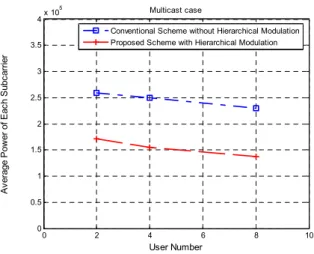
In Fig.5 and Fig.6, the power comparisons between the proposed scheme and conventional scheme for both the unicast and multicast case. In the unicast case, every user gets different data service while in the multicast case some of the user may share the same data service.
We can see that both schemes can save power compared with the scheme without Hierarchical modulation. For example, in the unicast case it could save about twenty percent and in the multicast case it is about thirty percent. Also it can be seen that the power that it needs decreases with the increase of user number. That is because the multiuser diversity.
User 1
User 2 User 3
User 4 0.3 0.6
0.8 1 User 1
User 2 User 3
User 4 0.3 0.6
0.8 1
그림 4. 시스템 전력 분석을 위해서 정규화된 셀 구조 Fig. 4. Normalized Cell structure for analyzing the
system power.
0 2 4 6 8 10
0 0.2 0.4 0.6 0.8 1 1.2 1.4 1.6 1.8
2x 10⁵
User Number
A v e ra g e P o w e r o f E a c h S u b c a rr ie r
Unicast case
Conventional Scheme without Hierarchical Modulation Proposed Scheme with Hierarchical Modulation
그림 5. 제안방식과 기존방식의 전력 비교 (일대일전송) Fig. 5. Power comparison between the proposed scheme and conventional scheme (Unicast case).
0 2 4 6 8 10
0 0.5 1 1.5 2 2.5 3 3.5
4x 10⁵
User Number
A v e ra g e P o w e r o f E a c h S u b c a rr ie r
Multicast case
Conventional Scheme without Hierarchical Modulation Proposed Scheme with Hierarchical Modulation
그림 6. 제안방식과 기존방식의 전력 비교 (일대다중전송)
Fig. 6. Power comparison between the proposed scheme and conventional scheme (Multicast case).
Ⅴ. Conclusions
In this paper, the problem for OFDM based relay system with hierarchical modulation was studied. By using the fixed relay stations and hierarchical modulation, the proposed scheme can guarantee the cell edge users to get high data rates as the inner cell users.
Numerical results show that the proposed scheme can save much power whether the unicast case or multicast case compared with the conventional scheme without hierarchical modulation.
Acknowledgements
This work was supported by the MKE (Ministry of Knowledge Economy) under the ITRC (Information Technology Research Center) program supervised by the IITA (IITA-2008-(C1090-0801-0011)), Korea.
References
[1] M. Morimoto, M. Okada and S. Komaki, "A hierarchical image transmission system in fading channel,'' Proc. of IEEE Int. Conf. Univ. Personal Commun. (ICUPC’ 95), pp. 769-772, 1995.
[2] P. Vitthaladevuni and M. Alouini, "A recursive algorithm for the exact BER computation of generalized hierarchical QAM constellations,'' IEEE Trans. Inf. Theory, vol. 49, no. 1, pp. 297-307, Jan.
2003.
[3] M. Pursley and J. Shea, "Adaptive nonuniform phase shift key modulation for multimedia traffic in wireless networks,'' IEEE J. Sel. Areas Commun., vol. 18, no.
8, pp. 1394-1407, 2000.
[4] M. Hossain, P. Vitthaladevuni, M. Alouini and V.
Bhargava, "Hierarchical modulations for multimedia and multicast transmission over fading channels,'' Proc. of IEEE VTC, pp. 2633-2637, April, 2003.
[5] S. Pietrzyk and G. Janssen, "Subcarrier and power allocation for QoS-aware OFDMA systems using
embedded modulation,'' Proc. of IEEE ICC, pp.3202-3206, 2004.
[6] C. Hausl and J. Hagenauer, ''Relay communication with hierarchical modulation'', IEEE Communication Letters, vol. 11, no. 1, pp.64-66, Jan. 2007.
[7] C. Wong, R. Cheng, K. Letaief and R. Murch,
"Multiuser OFDM with adaptive subcarrier, bit, and power allocation,'' IEEE J. Select. Areas Commun., vol. 17, no. 10, pp. 1747-1758, Oct. 1999.
슈 지 안 (徐健)
2004년 8월 : 전북대학교 전자공학과 (공학석사)
2004년 9월~현재 : 연세대학교 전기전 자공학과 박사과정
관심분야 : OFDM 시스템, MIMO 시 스템, 자원할당, Cooperative 통신 시스템
강 우 석 (姜祐碩)
1998년 2월 : 연세대학교 전파공학과 (공학사)
2000년 2월 : 연세대학교 전기전자공 학과(공학석사)
2000년 3월~2008년 2월 LG전자 선임 연구원
2008년 3월~현재 : 연세대학교 전기 전자공학과 박사과정
관심분야 : Relay 통신 시스템, Cooperative 통신 시스템, MIMO 시스템
서 종 수 (徐鍾洙)
1975년 : 연세대학교 전자공학과(공학 사)
1983년: Univ. of Ottawa, Canada, 전기 공학과(공학석사)
1988년: Univ. of Ottawa, Canada, 전기 공학과(공학박사)
1987년~1989년 : IDC, Canada책임 연구원 1990년~1992년 : 삼성종합기술원 수석 연구원
1992년~1995년 : CAL, Canada 책임 연구원 1995년~현재 : 연세대학교 전기전자공학과 교수 관심분야 : 디지털 통신, 방송시스템, OFDM, MIMO.